
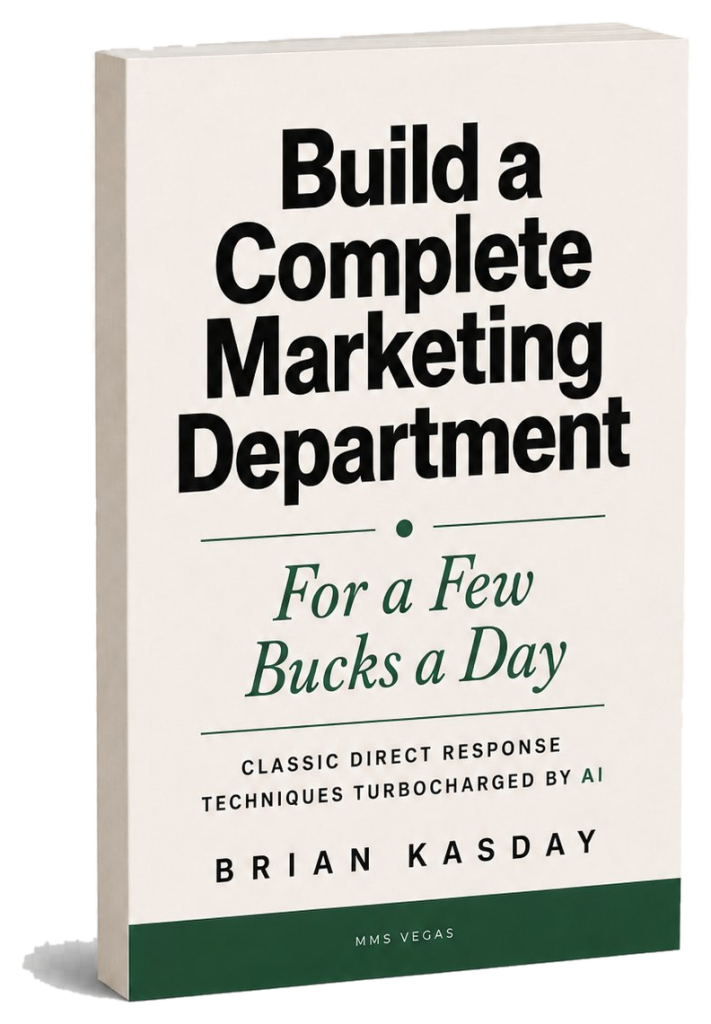
You don't have a marketing problem. You have a marketing department problem.
Every growing business needs the same handful of jobs done, over and over: someone to set the strategy, someone to write the words that sell, someone to make it look the part, someone to buy the traffic, and someone to read the numbers and say what's working.
Big companies hire five people for that. Sometimes fifty.
You've been trying to do all five yourself — between serving customers, making payroll, and everything else that hits your desk before 9am. So marketing becomes the thing you'll get to "when there's time," which is never. The stray post, the occasional email blast, the boosted ad you forgot was running — none of it compounds. You're busy. You're just not building anything.
The usual fixes don't fix it.
Hire a marketer? That's four to six thousand a month for one person who's good at one or two of those five jobs — and you still have to know enough to manage them. Hire an agency? You become one logo among forty on an account manager's spreadsheet, paying the retainer whether the work moves the needle or not. Buy more software? Now you own a tool for everything and a system for nothing — eleven subscriptions and not one more sale.
Here's what almost nobody tells you.
A marketing department was never really people. It's a set of functions — strategy, copy, design, media buying, analysis. People were just how those functions got done, back when getting them done required people.
That's the part that changed.
The grunt work inside every one of those functions — the drafting, the laying-out, the testing, the sorting of numbers — can now be done by AI, at a few dollars a day, faster than a room full of juniors. What AI can't do is decide where to point itself. It will happily write a thousand clever words that sell nothing and design something gorgeous that converts no one. The machine is the muscle. It still needs a brain that understands how selling actually works.
That brain is direct response — the marketing built by people who had to turn a profit on every mailing or go out of business. Make an offer. Talk to one person. Lead with the result. Test everything. Mail the people who already raised their hand. Those rules sold product for a hundred years before the internet, and they're exactly what AI needs to be handed so it produces money instead of noise.
Build a Complete Marketing Department is the operating manual for doing precisely that.
AI is the muscle. Direct response is the brain.
— from Build a Complete Marketing Department
What's inside.
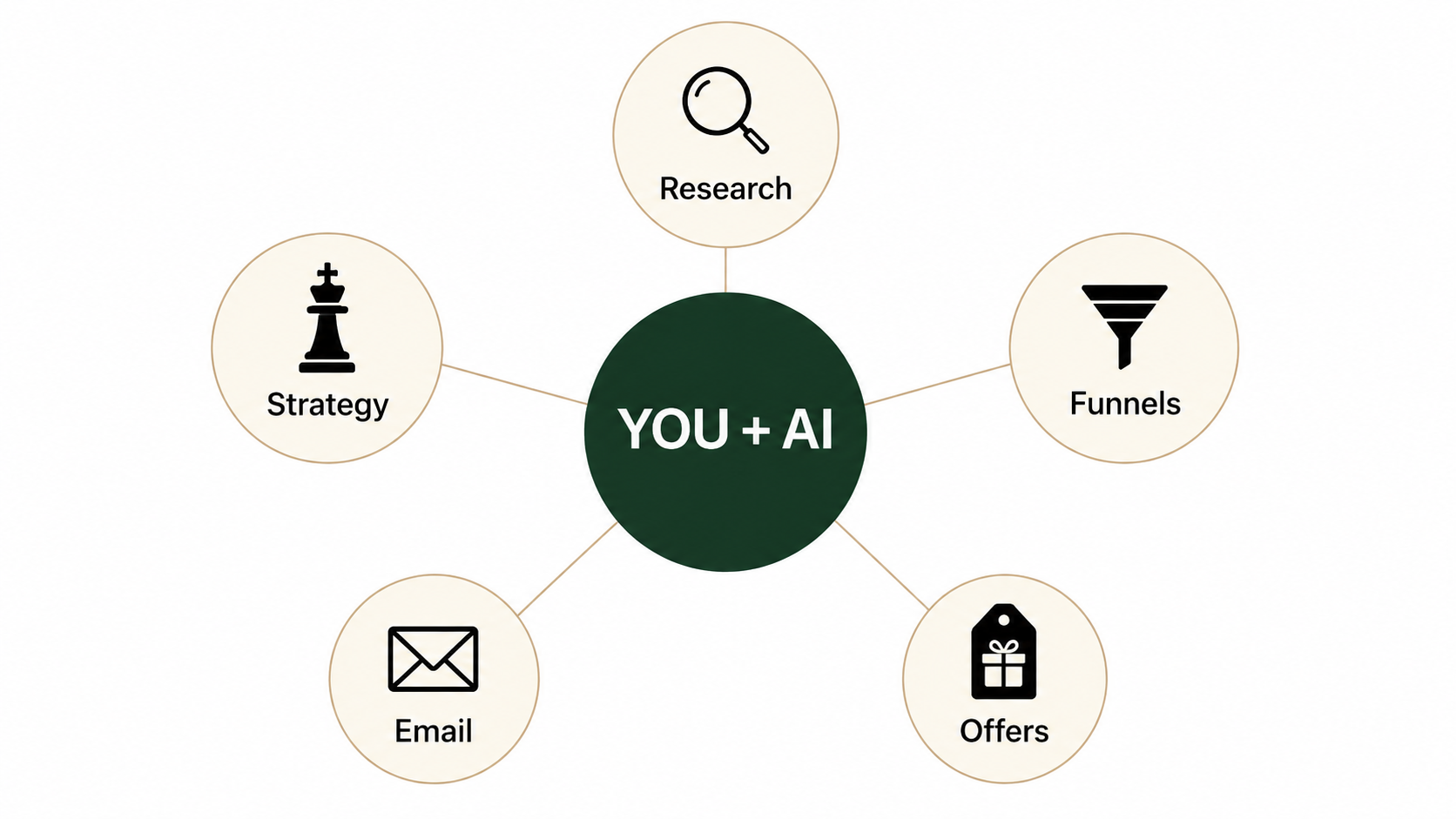
It walks you through standing up each role in your one-person department — and handing the labor to AI while you stay in the strategist's chair:
- The strategist that decides what to sell, to whom, and what to say first — so every other piece pulls in the same direction.
- The copywriter that turns out sales letters, emails, and ads built on offers and hooks that actually move people to buy.
- The designer that makes it look like you spent a fortune you didn't spend.
- The media buyer that puts your message in front of the right people without lighting cash on fire.
- The analyst that tells you, in plain numbers, what to do more of and what to kill.
Every chapter pairs a classic direct-response principle with the exact way to turbocharge it with AI — the prompts, the workflow, the order of operations. Not theory. A department you can run by Friday.
What you get
Eight parts. Twenty-five chapters. A department you can run by Friday.
Here's the whole book, in the order you'd actually build in — research first, then strategy, then the funnel, the email, the offer, and the launch.
Not theory — tools
This is one of the actual prompts inside.
The book isn't a lecture about AI. It hands you the exact prompts, in copy-and-paste form. Here's the one from Chapter 4 that turns an afternoon of customer research into a map of where the real money is:
✦ Market Discovery Prompt
I'm evaluating market opportunities in [MARKET CATEGORY — be specific: not "health" but "at-home gut health and fermentation"]. Below is raw research I've gathered from real customers in this market (forum posts, Amazon reviews, community discussions): [PASTE YOUR GATHERED RESEARCH]
Based on this research AND your broader knowledge of this market, please analyze:
- Pain Intensity Map — the 8 most significant pain points, ranked by urgency and spending willingness, each described in the customer's own language.
- Buyer Segments — 3–4 meaningfully different segments: who they are, their version of the pain, what they've tried, what they'd pay, how you'd reach them.
- Competitive Landscape — the main existing solutions, their strengths, and the gaps the pain points reveal.
- Opportunity Candidates — 3 specific underserved openings a new entrant could win.
- Reach Channels — exactly where the best-opportunity customer congregates online.
Generic market analysis is useless. I want real intelligence I can act on.
That's one of fifty. The book pairs each one with the direct-response principle behind it, so you know why it works, not just what to paste.
Who wrote it.

Brian Kasday — forty years in direct response, rebuilt as a one-person AI stack. This is the playbook he runs himself, written down.
He spent his career in classic direct response — the school where every mailing had to pay for itself or you went out of business. He got tired of being a marketing guy waiting on developers, designers, and copywriters, and rebuilt the whole capability as a one-person operation with AI and a few-dollars-a-day software stack. The Operator's Library is what he learned writing itself down.
The system, walked through
Take one small offer and run it through the system, step by step.
Say you run a small-batch hot-sauce brand. The product’s good, most of your orders are repeat buyers, and cold traffic hits the product page and leaves. The story is there — nothing is communicating it.
Run it through the system in this book. You rebuild the offer around what customers actually say: a free-plus-shipping sampler to open the door, a short digital ‘Sauce Notes’ guide as an order bump — the kind of thing you can draft with AI in an afternoon and edit down yourself — a three-bottle upsell after the sale, and a short post-purchase email sequence that handles the follow-up you’d never get to by hand.
None of that is more traffic. It’s the same visitors, asked a better question at each step — so a first order that used to stop at one bottle starts becoming three, and a one-time buyer has a reason to come back.
The growth isn’t in the ad budget. It’s in what each visitor is worth once the offer, the bump, and the follow-up are doing their jobs.
The math is almost insulting.
One marketing hire: tens of thousands a year. An agency: more. Another year of winging it: the most expensive option of all — you just never get the invoice.
The Complete Edition is $49 — the full 198-page book in a designed digital edition built for reading on screen, plus the entire 50-Prompt Library as a separate copy-and-paste PDF, delivered instantly.
If one idea in it helps you write a single email that brings back a single customer, it's paid for itself many times over. Use one chapter on one live offer, campaign, or sales page. If it doesn’t make the next decision clearer, email within 30 days for a refund.
P.S. You already own the most expensive seat in a marketing department — the strategist's. You're sitting in it. This book hands you the other five jobs, plus the AI to do them, for the price of lunch. Grab it, read it this weekend, and have your department running Monday.