
Last updated: November 2026
The double jeopardy law marketing researchers have documented over sixty years of data tells you something uncomfortable: if your brand is small, you are already losing on two fronts at once, and the standard fix most operators reach for, better retention, deeper loyalty, a points program, is the wrong tool for the problem. By the end of this page, you will understand exactly what the law says, why it cannot be wished away, and how to make concrete budget and messaging decisions that go with the grain of it rather than against it.
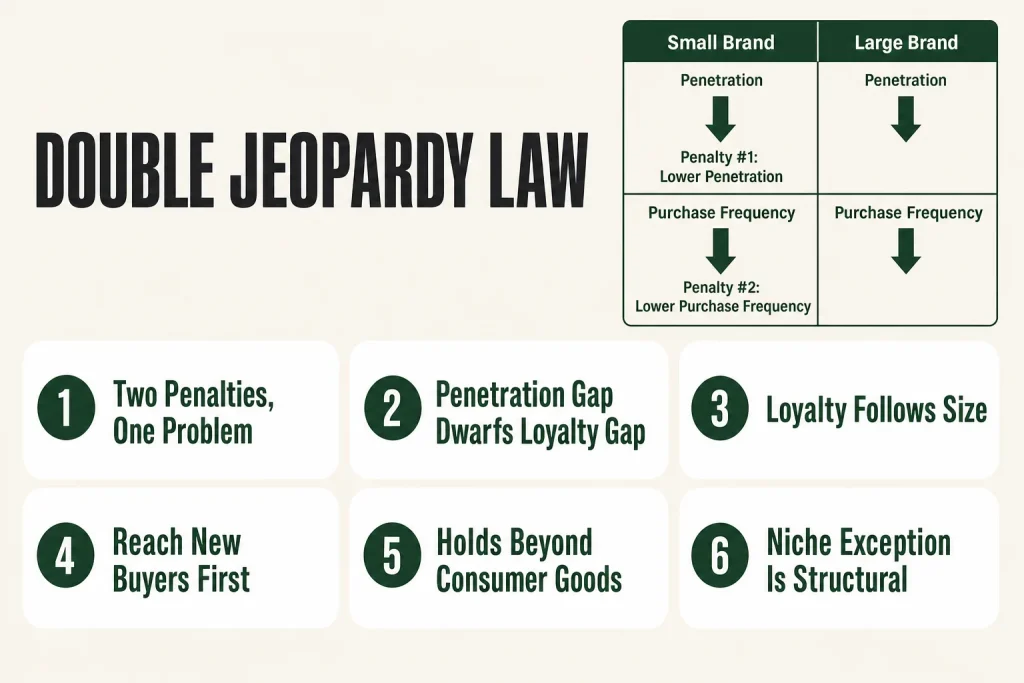
Here is what the law actually says. Double jeopardy is an empirical law in marketing stating that, with few exceptions, lower-market-share brands have both fewer buyers in a given period and lower brand loyalty than larger brands. Two penalties, stacked. Columbia University sociologist William McPhee first named the phenomenon in Formal Theories of Mass Behavior (Free Press of Glencoe, 1963), working through polling data on media audiences, he noticed that less popular comic strips and radio presenters were not just known by fewer people, but were also liked less by those fewer people than popular alternatives were liked by their audiences. He thought it unfair, and named it accordingly. His observation was about audience awareness and liking, not about purchasing.
Andrew Ehrenberg then discovered that the same double-penalty pattern applied to brand purchasing. In 1955 Ehrenberg moved into commercial marketing research, joining Attwood Statistics Ltd, which ran consumer panels recording households’ actual purchases over time. Working through panel data across product categories, he found smaller-share brands had fewer buyers, and those buyers also bought them slightly less often. He brought together his findings on repeat buying, including the double-jeopardy pattern, in Repeat Buying: Theory and Applications (North-Holland Publishing Company, 1972). The formal marketing statement of the law, with wide empirical evidence, documented exceptions, and theoretical explanations, came as Ehrenberg, Goodhardt, and Barwise, ‘Double Jeopardy Revisited,’ Journal of Marketing54 (3), 1990, pp. 82 to 91. Patrick Barwise, then Professor of Management and Marketing at London Business School, joined Ehrenberg and Gerald Goodhardt as co-author on that paper, which remains the primary source for the marketing version of the law.
The reason this matters to you as an operator is that most small-business marketing advice runs straight into the law’s teeth. ‘Build a loyal community.’ ‘Focus on your best customers.’ ‘Retention is cheaper than acquisition.’ Some of that is not wrong in isolation, but if you are using it as your primary growth lever while your penetration stays flat, you are swimming upstream against one of the most replicated findings in marketing science. Understanding exactly what the law says, and what it does not say, lets you decide where to push and where to stop wasting effort.
The idea in 30 seconds
- Smaller brands have two simultaneous disadvantages: fewer buyers and slightly lower purchase frequency among those buyers, that is the double jeopardy.
- The loyalty gap between a big brand and a small one is real but small; the penetration gap is enormous. Market share difference is overwhelmingly explained by reach, not devotion.
- Loyalty is a consequence of size, not a cause of it. You cannot loyalty-program your way to growth; you have to earn more buyers first.
- The strategic implication is blunt: if you want to grow, your budget and energy belong on acquisition and reach, especially light and occasional buyers, not on squeezing more from your existing base.
- The law holds across B2C packaged goods, B2B banking, insurance, software, and professional services. It is not an FMCG curiosity.
- There are real exceptions (niche and change-of-pace brands), but they are structural, not strategic choices you can simply elect to make.
Where the Double Jeopardy Law Came From
The story starts outside marketing entirely. William McPhee, a sociologist at Columbia University, published Formal Theories of Mass Behavior (Free Press of Glencoe, 1963) with observations drawn from polling data on media audiences. He noticed that comic strips read by fewer people were also liked less by those fewer people. Radio presenters with smaller followings were not just known by fewer listeners, the listeners they did have rated them lower than listeners of popular presenters rated theirs. Two penalties for the same underlying condition. McPhee named it ‘double jeopardy’ because he thought it unfair for the less popular item to suffer in both ways. His contribution was naming the pattern and grounding it in a theoretical explanation about asymmetric exposure: people familiar with a less popular option had, by definition, also encountered the popular alternatives and formed a basis for comparison. His work was about media audiences and liking, not about brands or purchasing.
The marketing application came from Andrew Ehrenberg. In 1955 Ehrenberg joined Attwood Statistics Ltd, a market research firm running consumer panels, panels of households completing weekly diaries recording all their purchases of consumer goods. Working through that panel data across categories, he found the same double-penalty pattern in purchasing behaviour: smaller-share brands had fewer buyers, and those buyers also bought them slightly less often. He brought together his findings on repeat buying, including the double-jeopardy pattern, in Repeat Buying: Theory and Applications (North-Holland Publishing Company, 1972; second edition published as Repeat Buying: Facts, Theory and Applications by Charles Griffin, 1988, with a US edition by Oxford University Press).
Gerald Goodhardt had also begun his career at Attwood Statistics and later joined Ehrenberg’s consultancy, Aske Research Ltd, which Ehrenberg set up in 1963. Goodhardt’s main contribution was in modelling consumer purchasing behaviour, and the 1984 paper he co-authored with Ehrenberg and Christopher Chatfield, ‘The Dirichlet: A Comprehensive Model of Buying Behaviour,’ Journal of the Royal Statistical Society, Series A147 (5), 1984, pp. 621 to 655, provided the mathematical underpinning that shows the double-jeopardy pattern as a consequence of market structure rather than an assumption. The 1990 paper credited Goodhardt and Chatfield with the w(1-b) approximation used to estimate repeat-purchase loyalty from penetration figures. Barwise joined as co-author on the formal marketing statement.
The formal marketing statement of the law appeared as Ehrenberg, Goodhardt, and Barwise, ‘Double Jeopardy Revisited,’ Journal of Marketing54 (3), 1990, pp. 82 to 91. That paper presented wide empirical evidence, the theoretical explanations, and the known exceptions. Byron Sharp’s How Brands Grow (Oxford University Press, 2010) brought the Ehrenberg-Bass body of work to a practitioner audience. Sharp did not discover the law, but he is probably the reason most marketers have heard of it at all.
What the Double Jeopardy Law Actually Says
The law has two parts, and the second one trips people up almost every time.
First jeopardy: penetration. Small brands have far fewer buyers in any given time period. This is not surprising. What surprises people is the size of the gap. The 1990 Journal of Marketing paper by Ehrenberg, Goodhardt, and Barwise describes markets where the number of buyers for the largest brands can be many times that of smaller brands in the same category, while purchase frequency differences are modest by comparison. The market share gap is overwhelmingly a penetration gap, not a loyalty gap.
Second jeopardy: loyalty. In any given time period, a small brand typically has far fewer buyers than a larger brand, and those buyers also tend to buy it less often. The loyalty difference is real, but modest. ‘Less often’ does not mean dramatically less, it means a small but consistent shortfall that compounds the penetration penalty. If you are the smaller brand, you cannot compensate for low penetration by squeezing more purchases out of existing customers, because there is not that much more to squeeze.
The mechanism is structural, not attitudinal. Most consumers are not monogamously loyal to one brand, they buy from a small set of acceptable brands. Larger brands are included in more consumer repertoires because they are more mentally and physically available. A brand that shows up for fewer people, in fewer situations, inevitably gets purchased less often. It is not that customers like it less in some deep emotional sense, they just encounter it less, so it is in fewer buying decisions.
The critical strategic implication follows directly. To grow market share, you must increase the number of buyers, not the loyalty of existing customers. Loyalty will follow as a side effect, the positive version of double jeopardy is that a bigger brand also has slightly more loyal customers. You do not manufacture loyalty and then get size; you build size and loyalty comes along for the ride, in proportion.
A small-share brand’s lower loyalty is not a failure of its CRM program, it is a mathematical consequence of being small. That reframe changes what you should actually do about it.
Why This Upends Most Small-Business Marketing Advice
The loyalty-first narrative is everywhere. Retention is cheaper than acquisition. Focus on your best customers. Build community. Some version of that advice has been the dominant frame for small-business marketing for at least two decades, and it did not come from nowhere, there is real truth in the observation that keeping a customer costs less than finding a new one.
The double jeopardy law does not say retention is worthless. It says something more specific: investing heavily in retention to leap over double jeopardy, for a small brand, is swimming against the current, because loyalty differences between brands in the same category are small and largely already set by size. You can run a perfect loyalty program and move purchase frequency by a small amount. You cannot use that small amount to compensate for a large penetration deficit.
Sharp argues in How Brands Grow that most brand plans are weighted toward loyalty metrics in ways the double jeopardy pattern predicts will not produce market share growth. If you buy that argument, and the replication record is hard to dismiss, there is a good chance the last marketing strategy you wrote, or hired someone to write, was organized around the wrong lever.
The flip side cuts just as hard. If you want to double your market share, your penetration has to near-double. Doubling your repeat purchase rate among existing customers will not double your market share. Near-doubling the number of people who buy you at all, will.
There is also a less-discussed implication for how you evaluate your marketing. Brand managers of a smaller market share brand should not be held accountable for lower customer loyalty metrics in isolation, and should not be expected to build loyalty to the brand without substantially increasing market penetration first. If you are using NPS or repurchase rate as your primary growth scorecard when you are still a small brand, you are measuring the output variable and ignoring the input that actually moves it.
Putting this to work? The ideas in the Canon are the foundation under the tactical playbook in Build a Complete Marketing Department. Grab the free companion kit at mmsvegas.com/resources.
The Double Jeopardy Law Marketing in Practice: What This Looks Like for Operators
The academic statement of the law can sound abstract until you map it onto the actual decisions a small-business operator makes. So here is what it means in concrete terms.
Budget allocation
The law implies that your budget should skew toward reaching people who do not yet buy from you. That means brand advertising, top-of-funnel content, distribution expansion, and anything that puts you in front of category buyers who have not encountered you yet. If loyalty is an effect of size, the growth strategy becomes clear: win new customers, especially occasional ones. For a small brand, the reservoir of growth is the category’s non-buyers and light buyers, not the few loyalists to squeeze.
This does not mean abandoning retention entirely. It means the ratio matters. If you are spending 70% of your marketing budget on email flows to existing customers and 30% on reaching new ones, the law suggests flipping that ratio would almost certainly produce better results, assuming your product and service experience is not actively broken.
How you think about light buyers
One of the law’s less obvious implications is that light buyers, people who buy from you once a year, or who have bought once and drifted, are not failures to be fixed. They are the normal state of a healthy market. Someone might buy a small brand once but then find it hard to repeat the purchase because they do not see any advertising to remind them that it exists. The fix there is not a nurture sequence; it is staying visible. Getting a past buyer to remember you at the next category trigger is not a CRM problem. It is a reach and salience problem.
What ‘reach’ means for a small business
Reach does not require a television budget. For a local service business, reach means consistent presence in the channels where category buyers look when the need arises, Google Business Profile, search rankings, local directories, referral networks, and any channels where you can appear to people who do not know you yet. For a B2B operator, reach might mean being present in the conversations that happen before buyers are actively in-market. The brand that wins is the one that is easy to remember when they finally are. That is a reach and visibility job, not a loyalty job.
What to do with your existing customers
None of this says ignore the people already buying from you. Retention matters for two reasons the law does not invalidate: lost customers have to be replaced by acquisition, which costs more; service failures that cause churn actively damage your penetration over time. Research into growing versus declining brands has found that growing brands achieved growth almost entirely through higher-than-expected customer acquisition rather than lower defection, while declining brands showed normal defection but poor acquisition. So the job with existing customers is not to squeeze more purchase frequency out of them (the law says that ceiling is low). It is to serve them well enough that they stay in your base and occasionally refer others, adding to penetration, which is the real lever.
Does It Hold in B2B and SaaS?
Yes, with nuances worth knowing.
The law has been replicated across categories as varied as packaged goods, retail banking, insurance, luxury products, political voting, and automobile buying, as documented in work by the Ehrenberg-Bass Institute. B2B is not exempt. A study by Ehrenberg-Bass Institute researchers Romaniuk, Dawes, and Faghidno (conducted with the LinkedIn B2B Institute) confirmed the pattern specifically in UK business banking and US business insurance: brands with fewer customers showed lower loyalty and higher defection levels than brands with more customers.
The double jeopardy pattern also applies in durable B2B categories, including concrete suppliers and airplane buying, as documented in published Ehrenberg-Bass studies. These are not impulse purchases. High-consideration, long-sales-cycle B2B markets still follow the same structural logic: bigger suppliers have more clients and slightly lower defection rates.
For SaaS, the structural translation is straightforward. Larger platforms have more customers and slightly lower churn. A small SaaS with 200 customers will likely show higher churn than a competitor with 2,000, not because the small one’s product is worse or its customer success team is lazier, but because size itself produces structural loyalty advantages. The fix is the same: grow the customer base. Churn will moderate as a consequence.
The B2B caveat worth flagging is switching costs. When a customer is locked in by contract length, integration depth, or data portability limitations, the loyalty floor rises for everyone, big and small. Ehrenberg-Bass has catalogued exceptions in subscription brands with high switching costs, such as telco contracts. Even there, the law works directionally, just with different coefficients. The underlying pattern still holds; it is just attenuated.
Where the Law Does Not Apply (and What That Actually Means)
The law has exceptions. They are real, documented, and worth knowing, but they are also frequently misread as escape hatches that most operators can step into. They cannot.
Ehrenberg, Goodhardt, and Barwise identified two deviations in their 1990 paper: a brand with unusually low penetration and consequently higher loyalty constituting its market share (a niche brand), and unusually high penetration with low repeat-purchase rates (a change-of-pace brand).
The niche brand exception. Niche brands with a narrow but very dedicated base can show loyalty higher than their share would suggest. Retailer brands (private labels) are one known example: niched because of their restricted distribution, their market share is constituted of low penetration and consequently unusually high repeat buying. A second well-documented example is a language-specific media channel, a Spanish-language television network in a predominantly English-speaking market has structurally restricted reach, so the smaller group who can and do use it are genuinely different from the broader category audience. The critical word throughout is ‘restricted.’ The niche exception is structural, not a brand identity choice. It arises when a brand’s distribution or availability is genuinely limited, not when a brand decides to call itself premium to explain away low penetration.
This matters because a lot of small-brand positioning strategy implicitly reaches for niche status as an explanation for low penetration. ‘We’re a boutique firm, not for everyone.’ Sometimes that is true and structurally grounded. More often, it is a loyalty-trap story, the idea that high devotion among a small group will substitute for broader reach, which the law says will not produce meaningful market share growth. The diagnostic question is blunt: is there a structural barrier stopping most of your potential market from buying you, or are they just unaware of you? If it is the latter, that is a penetration problem dressed up as a niche positioning.
The change-of-pace exception. Some brands have high penetration but lower loyalty than expected. Classic examples include seasonal products such as chocolate Easter eggs and brands bought situationally with no intention of regular repeat purchase. These are not models to copy.
What the exceptions tell you. If your brand’s loyalty metrics are significantly higher than your market share would predict, that is a signal worth investigating, are you structurally restricted (distribution, geography, language), genuinely premium with high switching cost, or just measuring loyalty badly? The law gives you the benchmark that makes the anomaly visible. And it is worth noting that follow-on research has found many apparent exceptions to be temporary, the result of measurement period or category definition issues, rather than persistent structural deviations.
What the law was not built to describe. Early-stage businesses in genuinely new categories, and operators making aggressive moves into new geographic markets, are operating in conditions where the market structure assumptions underlying the law may not yet hold. The law describes stable, competitive markets. It does not say growth in a nascent market is impossible without broad penetration from day one; it says that once a market matures, penetration explains most of the variance in market share. Keep that distinction in mind when applying the law to your own situation.
What People Get Wrong About the Double Jeopardy Law
Misunderstanding 1: ‘This only applies to big consumer brands, not to us.’ The law has been replicated in B2B banking, insurance, concrete suppliers, aircraft purchasing, software, and retail across dozens of countries. The claim that it is an FMCG-only artifact is not supported by the replication record. Scale matters, a solo-operator business in a local market is not operating in the same statistical universe as Unilever, but the directional logic holds even at smaller scale: more buyers, slightly more purchase frequency; fewer buyers, slightly less. The correction: before dismissing the law as irrelevant to your business, ask what your penetration rate looks like. Estimate your serviceable market and divide your active customer count by it. If that number is small and flat, the law is almost certainly working against you regardless of your category.
Misunderstanding 2: ‘If we just build a super-loyal niche, we can escape double jeopardy.’ The niche exception is structural, not positional. It arises from restricted availability, a private-label product only available in one retail chain, or a service limited to a specific language group, not from brand identity or marketing messaging. Calling yourself premium does not qualify you. The correction: map your actual distribution and availability against your serviceable market. If anyone in your target geography or vertical can in principle buy from you, and they are not, that is a penetration gap. Address it as one, not as confirmation that you are a successful niche brand.
Misunderstanding 3: ‘The law means loyalty programs are useless.’ The law says loyalty differences between brands are small and tied to size, so using retention as your primary growth lever goes against the evidence. That is not the same as saying retention has zero value. The correction: treat loyalty programs as base-protection tools. Their job is to reduce churn from the customer base you are building, not to substitute for building that base. The mistake is making retention your primary marketing investment; the right move is making it a maintenance-level spend and directing incremental budget toward acquisition and reach.
Misunderstanding 4: ‘We just need to focus on heavy buyers, our best customers drive almost all revenue.’ This is a misreading of the data. Sharp presents evidence in How Brands Grow that the heaviest fifth of buyers typically accounts for closer to three fifths of sales over a year, not the four fifths the commonly cited Pareto 80/20 implies. Even where heavy buyers are disproportionate contributors, category growth still comes largely from occasional buyers and new buyers, not from squeezing more out of your heavy segment. The correction: track revenue from first-time and light buyers as a separate line. If that number is flat or shrinking while heavy-buyer revenue holds, you have a penetration problem your heavy-buyer focus is obscuring.
Misunderstanding 5: ‘This is a reason not to invest in brand differentiation.’ The law describes what drives market share in stable markets. It does not say that product quality, messaging clarity, or positioning do not matter. The correction: distinctiveness and reach work together. The law tells you that penetration is the output variable, it does not write the message or pick the channel for you. A differentiated brand that no one has heard of still has a penetration problem. A widely known brand with nothing distinct about it has a different problem. You need both.
Common Mistakes
- Running a loyalty program as the primary growth initiative, then finding market share does not move. A loyalty program is a base-protection tool, not a growth engine. If your program is consuming more than 20% of your marketing budget and your active customer count has not grown in 12 months, that is a reallocation signal. Cap retention spend at a maintenance level, pick one specific new-reach channel, a paid search campaign targeting category search terms, a referral program with a channel partner, or a content track aimed at first-touch discoverability, and redirect the freed budget there for a quarter. Measure new customers acquired and estimated penetration change, not just NPS.
- Sending re-engagement sequences to every one-time buyer who goes quiet. One-time buyers who do not immediately return are structurally normal under the double jeopardy pattern, they are light buyers, not defectors. Before writing the sequence, audit passive visibility first: is your Google Business Profile current? Do you appear in the search terms those buyers would use at the next category trigger? Do you have any presence in the channels they use between purchase occasions? If the answer to any of those is no, fix that before spending on active re-engagement. Passive visibility investment outperforms active re-engagement for this segment in most cases, and it compounds over time where a one-off email sequence does not.
- Using ‘we’re a niche brand’ as the explanation for flat penetration. The niche exception in the double jeopardy literature is structural, it applies to brands with genuinely restricted distribution, like a private-label product sold in a single retail chain or a service restricted by language or geography. It is not a positioning story. Map your actual availability against your serviceable market: can anyone in your geography or vertical, in principle, buy from you? If yes, and a large portion of them are not, that is an acquisition gap. The diagnostic question is whether a structural barrier exists or whether the barrier is simply that potential buyers are unaware of you. Only the first is a niche exception; the second is ordinary double jeopardy and should be treated as a reach problem.
- Reporting only on retention metrics in the monthly marketing review. If your reporting dashboard shows retention rate, repeat purchase rate, and NPS but has no estimate of market penetration, you are measuring the output variable and ignoring the input. Estimate your serviceable market, total businesses or households that could plausibly buy from you, and divide your active customer count by it each quarter. Add that percentage to the dashboard alongside retention metrics. When penetration is flat and retention is strong, the law predicts stagnant market share. That trap is invisible if penetration is not tracked, and most operators only discover it after a year of solid retention numbers with no revenue growth to show for them.
- Treating a 70/30 existing-to-new customer budget split as responsible, conservative marketing. That 70% is working the low-ceiling lever; the 30% is working the high-ceiling one. Flip the ratio for one quarter and measure total new buyers acquired, estimated penetration change, and revenue from first-time customers versus repeat customers. The specific test: calculate the marginal cost of one new customer from each allocation and compare. Most small-brand operators who run this experiment find the marginal cost of retention programs has quietly risen past the marginal cost of acquisition, because the pool of existing customers to retain is small and already well-served. You do not need to abandon existing-customer programs, you need to find out what the actual ceiling on purchase frequency is for your category, and whether you have already hit it.
Operator’s Take
Here is my honest read on this after watching small operators make the same wrong bets for years.
The double jeopardy law is probably the single most useful corrective in all of marketing science, and it is underused because the alternative narrative is more emotionally satisfying. ‘We build real relationships with our customers’ feels better than ‘we need to reach more strangers.’ So does ‘we focus on quality over quantity.’ None of those things are false, but they all function as permission to avoid the uncomfortable work of reaching people who have never heard of you.
The operators I see succeed fastest accept early that loyalty is a lagging indicator, not a leading one. They keep existing customers happy through basic operational excellence, not elaborate retention infrastructure, and point their discretionary marketing energy at new reach: more distribution channels, more top-of-funnel content, more visibility at category entry points, more referral systems that expand their footprint into new networks.
The first concrete move I would make: pull your current budget split between programs aimed at existing customers versus programs aimed at new ones. If more than 60% is going to the existing base, redirect 20 points of that toward one new-reach channel for a single quarter and measure how many new customers it generates. Not NPS. Not email opens. New customers acquired. If the number surprises you upward, that is the law working in your favor.
The second move: add a penetration estimate to your monthly reporting. Take your serviceable market, total businesses or households that could plausibly buy from you, divide your active customer count into it, and start tracking that percentage every quarter. When penetration is flat and retention is strong, you are probably hitting the ceiling on purchase frequency that the law predicts is low. That signal is invisible if penetration is not on the dashboard, and most small-brand operators are flying blind on the variable that actually predicts growth.
The third move is about content. If your content calendar is mostly educational depth pieces for people who already know your brand, build a parallel track aimed purely at first-touch discoverability, the search terms people type before they know who you are, partnerships that put you in front of adjacent audiences, channels where your category buyers spend time but have not encountered you yet. The two tracks serve different functions. The existing-customer track is not wasted; it is just not growth.
A few places where I think the law gets overclaimed, too. It describes stable market patterns, an early-stage business in a genuinely new category, or an operator making an aggressive move into a new geographic market, is operating in conditions the law was not built to describe. And the ‘build reach’ argument gets used sometimes to justify unfocused, undifferentiated marketing to everyone. The law says reach more category buyers, not reach everyone indiscriminately. Targeting still matters. Distinctiveness still matters. The law tells you what the output variable is (penetration); it does not write the message or pick the channel for you.
And the law does not excuse you from product quality or service. If churn is high because the product disappoints, no amount of reach fixes that, you are filling a bucket with a hole in it. Patch the hole first, then go find more water.
Used in
- ✓ Build a Complete Marketing Department
Used to set budget allocation priorities between acquisition and retention, and to frame penetration as the primary growth metric a marketing department should track and report. - ✓ The Missing Manual for FunnelKit
Informs how top-of-funnel automation sequences are weighted toward new-contact acquisition rather than repeat-buyer nurture as the primary revenue driver. - ✓ The Missing Manual for Make
Applied when building automated workflows that segment light and occasional buyers for reach-and-visibility sequences rather than high-frequency loyalty campaigns.
FAQ
Does the double jeopardy law apply to small local businesses, not just big consumer brands?
Yes, directionally. The law has been replicated in B2B banking, insurance, software, and professional services, not just FMCG. The statistical precision is harder to establish at small scale, but the principle holds: more buyers leads to slightly more purchase frequency, and you cannot loyalty-program your way past a penetration deficit.
What is the difference between a niche brand exception and just having a small market share?
A niche brand exception is structural, it arises when availability is genuinely restricted, such as a store-brand only sold in one chain, a language-specific channel, or a service limited to a specific geography. It is not a positioning choice you make by calling yourself boutique. If your penetration is low because you have not reached enough people, that is double jeopardy operating normally, not a niche exception.
Should I abandon my loyalty program?
Not necessarily. Loyalty programs can help reduce churn and protect the customer base you need to compound growth on top of. The mistake is using them as the primary growth lever rather than a base-protection mechanism. Keep them lean and shift incremental effort toward acquisition and reach.
How do I track penetration for a small business without a consumer panel?
Estimate your serviceable market, the total number of businesses or households that could plausibly buy from you, and divide your active customer count by that number. It will be rough, but even a rough baseline lets you track direction over time. For local service businesses, geographic and demographic data can help you estimate the denominator.
Does the law change how I should think about SEO and content marketing?
Yes. The law implies that content and SEO should be evaluated primarily on reach, how many new category buyers encounter you at the moment they have the problem you solve, not on engagement metrics from people who already know you. Build for discoverability by non-buyers, not depth of engagement with current ones.
Who named and formalized the double jeopardy law for marketing?
William McPhee named and first observed the phenomenon in <em>Formal Theories of Mass Behavior</em> (Free Press of Glencoe, 1963), working with media audience data on comic strips, radio presenters, and Hollywood actors. His contribution was naming the pattern and explaining it in terms of asymmetric exposure. Andrew Ehrenberg then discovered that the same pattern applied to brand purchasing, drawing on consumer panel data he had been working with since 1955 at Attwood Statistics Ltd; he brought together his findings in <em>Repeat Buying: Theory and Applications</em> (North-Holland Publishing Company, 1972). Gerald Goodhardt, who had also worked at Attwood Statistics and later joined Ehrenberg’s consultancy, contributed the mathematical modelling work, including the w(1-b) approximation used to estimate repeat-purchase loyalty from penetration figures. The formal marketing statement, with wide empirical evidence, theoretical explanations, and documented exceptions, appeared as Ehrenberg, Goodhardt, and Barwise, ‘Double Jeopardy Revisited,’ <em>Journal of Marketing</em>54 (3), 1990, pp. 82 to 91. Patrick Barwise co-authored that paper as Professor of Management and Marketing at London Business School. Byron Sharp brought it to mainstream practitioner attention in <em>How Brands Grow</em> (Oxford University Press, 2010).
Further reading
- Ehrenberg, A.S.C. Goodhardt, G.J. and Barwise, T.P. ‘Double Jeopardy Revisited,’ Journal of Marketing54 (3), 1990, pp. 82 to 91. The formal marketing statement of the law, the primary source, not the popularization.
- Goodhardt, G.J. Ehrenberg, A.S.C. and Chatfield, C. ‘The Dirichlet: A Comprehensive Model of Buying Behaviour,’ Journal of the Royal Statistical Society, Series A147 (5), 1984, pp. 621 to 655. The mathematical foundation showing how double jeopardy is predicted from market structure alone.
- Ehrenberg, A.S.C. Repeat Buying: Theory and Applications. North-Holland Publishing Company, 1972; second edition published as Repeat Buying: Facts, Theory and Applications by Charles Griffin, 1988 (US edition: Oxford University Press). Where Ehrenberg first brought together the double jeopardy pattern in a brand-purchasing context.
- Byron Sharp, How Brands Grow (Oxford University Press, 2010). The book that brought the Ehrenberg-Bass research to practitioners; best read as a synthesis and provocation rather than a tactical manual.
- McPhee, W.N. Formal Theories of Mass Behavior (Free Press of Glencoe, 1963). The original observation, in media audiences rather than brand purchasing, worth reading to understand why the law is structural rather than industry-specific.
- Ehrenberg-Bass Institute, ‘The Double Jeopardy Law in B2B Shows the Way to Grow.’ An accessible paper applying the law to B2B categories including banking and insurance, available at the Institute’s site (marketingscience.info).
Sources: Primary sources grounding this page: McPhee, W.N. (1963), Formal Theories of Mass BehaviorFree Press of Glencoe, New York (origin of the term and phenomenon, observed in media audiences, comic strips, radio presenters, Hollywood actors, as confirmed in the 1990 Journal of Marketing paper itself, which opens by crediting ‘Columbia University sociologist William McPhee (1963)’ for noting the pattern ‘for competitive items such as different comic strips and radio presenters’; McPhee’s contribution was naming the phenomenon and explaining it through asymmetric exposure; his work was with media audience awareness and liking, not brand purchasing); Ehrenberg, A.S.C. (1972), Repeat Buying: Theory and ApplicationsNorth-Holland Publishing Company, Amsterdam (first elaboration of the double jeopardy pattern in brand purchasing, drawing on consumer panel data; Ehrenberg joined Attwood Statistics Ltd in 1955 as confirmed in the Oxford Dictionary of National Biography entry for Ehrenberg and in the Journal of the Royal Statistical Society, Series A obituary, 174 (1), 2011, pp. 227 to 228; second edition published as Repeat Buying: Facts, Theory and ApplicationsCharles Griffin & Company, London / Oxford University Press, New York, 1988, as confirmed in the JEMS internet edition preface and in the reference list of the 1990 Journal of Marketing paper); Goodhardt, G.J. Ehrenberg, A.S.C. and Chatfield, C. (1984), ‘The Dirichlet: A Comprehensive Model of Buying Behaviour,’ Journal of the Royal Statistical Society, Series A147 (5), 621 to 655 (mathematical foundation; Goodhardt’s role in the w(1-b) approximation credited in Ehrenberg et al. 1990, p. 86, as confirmed in the ResearchGate-hosted ‘Double Jeopardy, 50 Years On’ paper); Ehrenberg, A.S.C. Goodhardt, G.J. and Barwise, T.P. (1990), ‘Double Jeopardy Revisited,’ Journal of Marketing54 (3), 82 to 91 (formal marketing statement; Barwise’s affiliation as Professor of Management and Marketing at London Business School confirmed in the Studocu-hosted scan of the paper; Goodhardt’s career history confirmed in the Journal of the Royal Statistical Society, Series A obituary for Goodhardt, 183 (4), 2020, pp. 1821 to 1823); Sharp, B. (2010), How Brands GrowOxford University Press (mainstream synthesis; claims attributed to Sharp are paraphrased from that work, not quoted verbatim); Ehrenberg-Bass Institute, ‘The Double Jeopardy Law in B2B Shows the Way to Grow,’ marketingscience.info (B2B replication data for banking, insurance, concrete, airlines; a study by Romaniuk, Dawes, and Faghidno conducted with the LinkedIn B2B Institute, confirmed as covering UK business banking and US business insurance). The statement in the ‘What People Get Wrong’ section about Sharp’s finding on the heaviest fifth of buyers is drawn from How Brands Grow as paraphrase; readers should consult the book directly for Sharp’s exact figures and data. The niche exception examples (retailer private labels, language-specific networks) are drawn from the marketing wiki entry on double jeopardy (brandvisibility.wiki) and the marketinchoices.blogspot.com summary of the Wikipedia article, both of which attribute these examples to the Ehrenberg-Bass literature; readers should verify specific examples against the 1990 Journal of Marketing paper directly.
Brian Kasday spent forty years in direct-response marketing before rebuilding the whole operation as a one-person shop. He writes The Operator’s Library — including “Build a Complete Marketing Department” — for operators who’d rather build it themselves than wait on someone else.
Build the department these ideas describe. The free companion kit: mmsvegas.com/resources.
More The Operator's Canon guides
Free · Operator Toolkit
Want the tools, not just the guide?
Get the free operator toolkit — templates and checklists for the systems you actually run, plus a note when this guide changes.
Get the free toolkit →