
Last updated: September 2026
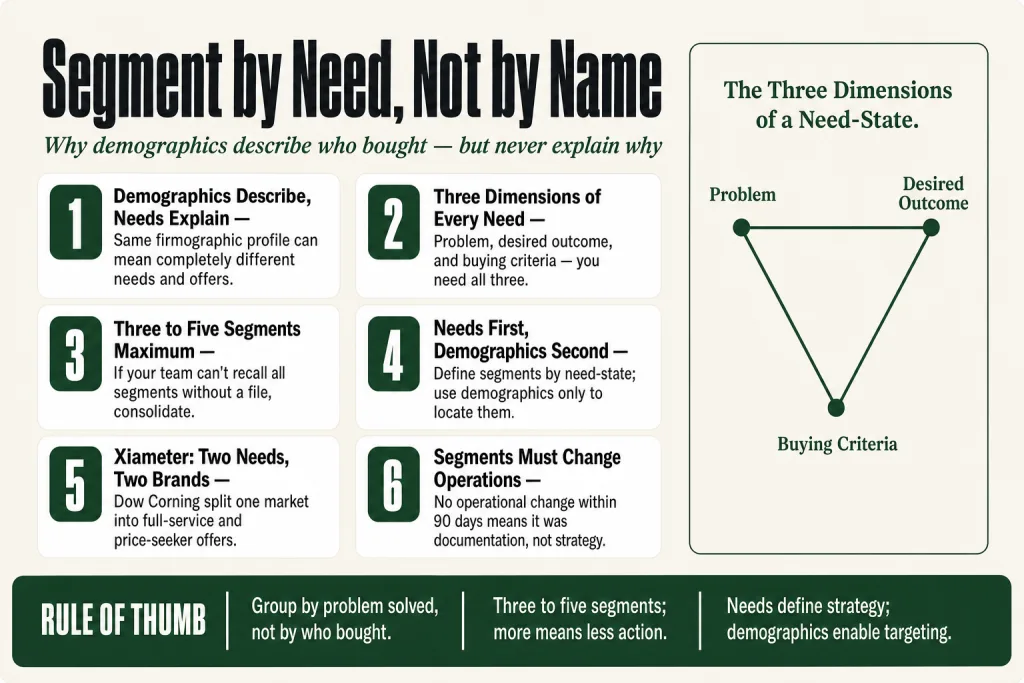
Needs-based segmentation is the practice of dividing your market into groups not by who your customers are on paper, but by what problem they’re trying to solve, what outcome they need, and what they use to decide whether your offer is worth buying. By the end of this page, you’ll be able to identify the distinct need-states inside your own customer base, and use them to make sharper decisions about your offers, your messaging, and who you should stop trying to serve.
Demographic segmentation tells you that your best customer is a 38-year-old operations manager at a 50-person B2B software company in the Mountain West. That description is precise and completely useless for writing a landing page, designing a pricing tier, or deciding what to say on a sales call. It describes who bought. It doesn’t explain why.
Two people who look identical on paper can be in completely different buying modes. One is under board pressure to cut costs, she needs proof of ROI in the first 90 days or she’s looking for the exit. The other just had a bad vendor experience and needs to know your onboarding won’t fall apart, she’ll pay a 30% premium for a dedicated implementation contact. Same firmographic profile. Completely different needs. Completely different offer.
That’s the gap needs-based segmentation closes. It’s not a replacement for knowing your customer’s industry or company size, those still matter for finding them. But the segment that drives what you say and what you sell has to be built around problems and desired outcomes. Everything else is noise.
The idea in 30 seconds
- Needs-based segmentation groups customers by the problems they need solved and the outcomes they want, not by age, location, company size, or industry label.
- Demographics and firmographics describe who your customers are; needs explain why they buy. The “why” is what drives every purchase decision.
- A single demographic profile can contain multiple need states that require completely different offers, messages, and sales motions.
- The practical output is a small set of distinct need-based segments, each with a clear problem, a desired outcome, and a buying criterion, that your team can actually use to make decisions.
- Done right, it makes your positioning sharper, your conversion higher, and your churn lower, because you stop trying to be everything to everyone.
- The research methods are within reach for any operator: customer interviews, win/loss calls, cancellation data, and close-ended surveys.
Where Needs-Based Segmentation Came From
The formal idea of market segmentation was introduced by Wendell R. Smith in a 1956 Journal of Marketing article arguing that markets were collections of distinct groups with different preferences, not a single homogeneous mass. Useful as a starting point, but Smith’s version was still mostly structural: group by observable traits, then target accordingly.
The more important shift came in 1968 when Russell I. Haley, then Vice President and Corporate Research Director at D’Arcy Advertising, published “Benefit Segmentation: A Decision-Oriented Research Tool” in the Journal of Marketing (Vol. 32, No. 3, pp. 30 to 35). His argument was pointed: most segmentation relied on descriptive factors that could tell you who bought but couldn’t predict behavior. Segment instead on the causal factors, the benefits people were actually seeking. His illustration was the toothpaste market, which he carved into four distinct groups: cavity preventers, bright-smile seekers, taste-first buyers, and price buyers. Same category. Different customers in every way that mattered, product formulation, brand voice, media strategy.
The concept got its biggest modern push from Clayton Christensen’s Jobs to Be Done framework. Christensen popularized the idea in his 2003 book The Innovator’s Solution (co-authored with Michael Raynor), building on outcome-driven thinking that Tony Ulwick had introduced to him, and developed it further in Competing Against Luck (2016, with Taddy Hall, Karen Dillon, and David S. Duncan). His core argument: demographics correlate with buying but don’t cause it. If you build segments around buyer attributes, you’ll produce groups that are statistically tidy but strategically useless.
The milkshake research made this concrete. A fast-food chain had profiled its milkshake buyers, run focus groups, and adjusted formulations. Sales didn’t move. When Bob Moesta’s team, working with Christensen, instead observed when people bought and asked what they were trying to accomplish, two separate jobs emerged. Morning commuters were hiring the milkshake to get through a long drive without eating something messy, it competed with bananas and bagels, not other milkshakes. Afternoon buyers were parents picking up a small treat for their kids. Same product, two different need-states, and a completely different strategic response for each.
Today the idea shows up under several names, needs-based segmentation, benefit segmentation, jobs-based segmentation, and the logic is consistent across all of them: group people by what they’re trying to accomplish in a specific circumstance, not by what they look like on a spreadsheet.
The Problem: Demographics Are a Map of the Wrong Territory
Demographic and firmographic segmentation feel like rigor. You have a spreadsheet. It has columns. Age, revenue band, industry code, geography, headcount. You can filter it. You can build reports from it. It looks like a strategy.
What that spreadsheet can’t tell you: why two companies of the same size, in the same industry, with the same budget, one bought and one didn’t. Or why your best customers for one product line are functionally indistinguishable from your worst customers for another. Or why a campaign that worked with a certain company profile flopped the next quarter even though you ran it to the same list.
Demographic segmentation assumes people with similar attributes have similar motivations. That assumption fails often enough to matter. Two operations managers at identical SaaS companies might be looking for completely different things, one needs speed to fix a burning problem, the other needs a defensible ROI story to justify a budget request to her CFO. Same profile. Different jobs. Different buying criteria. Different offers.
The result of ignoring this is predictable: generic messaging that speaks to no one specifically, positioning that tries to cover all the bases and resonates with none of them, and churn driven by customers who bought for the wrong reason because your sales process never established the right one. You end up with a revenue base that’s unstable because you didn’t really understand why you won it in the first place.
Needs-based segmentation forces a different question. Not “who is this customer?” but “what problem are they trying to solve, what outcome do they need, and what do they use to judge whether we can deliver it?” That question is harder to answer, it requires actual research, not just a CRM export, but the answers are what actually drive purchase decisions.
The Core Principles of Needs-Based Segmentation
There are four things you need to understand about how needs-based segmentation actually works before you can apply it.
1. Need-states, not customer types
The unit of analysis is a need-statea specific problem someone is experiencing, in a specific context, with a specific desired outcome, not a person type. The same person can occupy different need-states at different moments. A restaurant owner shopping for POS software might be in a “surviving a broken system” need-state in January, a “scaling to a second location” need-state in March, and an “integrating online ordering” need-state in June. Each is a different buying situation with different decision criteria, even though the buyer’s demographics haven’t changed at all.
2. The three dimensions of a need
A usable need-based segment has three components: the problem the customer is trying to solve (functional and/or emotional), the desired outcome they’re measuring success against, and the buying criteria they use to evaluate solutions. You need all three. Knowing the problem without the outcome means you’ll solve it in ways that don’t satisfy. Knowing the outcome without the criteria means you’ll position correctly but lose on the wrong dimension. Knowing the criteria without the problem means you’ll optimize for evaluation factors that don’t map to actual value delivery.
3. Small number of real segments
The goal is three to five distinct need-based segments that are meaningfully different from each other and large enough to be worth serving. This is not the same as finding every possible customer variation, that way lies an unmanageable matrix. The discipline is in consolidation: looking for the patterns that repeat, the clusters where the problem/outcome/criteria combination is genuinely similar, and resisting the urge to treat every anecdote as its own segment. If you can’t write a crisp one-paragraph description of what a segment needs and why, the segment isn’t real yet.
4. Segment first, then use demographics to find them
This is where operators often get confused about the sequencing. Needs-based segmentation defines your segments by need-state. Demographics and firmographics are then used to identify who in the real world is in that segment, so you can actually reach them. The strategy is built on needs. The targeting is built on observable attributes. In that order, not the reverse. A segment defined as “early-stage operators who need to move fast and can’t afford implementation risk” might overlap heavily with “Series A companies under 30 employees” in practice, but the segment came first, and the firmographic came second as a locating tool.
How to Build Your Needs-Based Segments: The Operator’s Method
You don’t need a $40,000 research firm. You need the right questions and enough discipline to follow them through. Here’s how operators actually do this.
Start with your best customers
Pull a list of your ten to fifteen highest-LTV customers from the last 18 months. These are the customers worth understanding, because they represent the value you’re actually capable of delivering. Set up 20-minute calls with as many as will talk to you. You’re not pitching anything. You’re trying to understand what was happening in their world when they decided to buy, what they were hoping would be different afterward, and what made them choose you over the alternatives.
The questions that produce useful data: What was going on that made you start looking for a solution? What would a good outcome have looked like six months after buying? What almost stopped you from buying, and what got you past that? These aren’t survey questions; they’re conversation starters. The gold is in the follow-up. When someone says “we needed to get things under control,” that’s not a segment yet. What were they trying to control? By when? Compared to what baseline? That specificity is where the segment lives.
Mine your win/loss data
If you have a sales team or a recent record of competitive deals, your win/loss patterns will show you something your customer interviews won’t: what people who didn’t buy needed instead. The deals you lost on price weren’t necessarily price-sensitive, they may have been outcome-sensitive and unconvinced your product would deliver. The deals you won on “ease of use” might cluster around a specific need-state: people who had burned out a previous vendor and needed low implementation friction above everything else. That’s a needs-based segment, and knowing it changes how you pitch.
Look at your churn data
Churned customers are often more revealing than retained ones. What do your early-churners (60 to 90 days) have in common? What outcome were they expecting that they didn’t get? Churn driven by a mismatch between what a customer needed and what you delivered is a segmentation failure, you either attracted the wrong need-state, or you failed to qualify it during the sales process. Both are fixable, but only if you know which one it is.
Survey at scale, selectively
Once your interviews have given you a working hypothesis about what your segments might be, you can validate it at scale with a short survey. The key is to ask about problems and outcomes, not preferences or satisfaction. “What is the primary problem you were trying to solve when you bought?” with a set of specific choices drawn from your interview themes will tell you whether your hypothesized segments actually hold at volume. If 60% of your customer base clusters around two need-states and the remaining 40% scatter across seven others, you now know where to concentrate.
Name your segments by their need, not their demographic
This is the discipline check. Your segment names should describe what the customer needs, not who they are. “Mid-market operations manager” is a demographic label. “Operator under implementation pressure who needs a fast, low-touch onboarding” is a need-based segment. The name you use internally will govern how your team thinks about the segment, so make it do real work.
Putting this to work? The ideas in the Canon are the foundation under the tactical playbook in Build a Complete Marketing Department — grab the free companion kit at mmsvegas.com/resources.
Needs-Based Segmentation in Practice: Named Examples
The clearest modern illustration is HubSpot. When HubSpot launched, it wasn’t targeting “small businesses” as a demographic, it was targeting a specific need-state: companies that needed to generate leads without a dedicated outbound sales team. Inbound marketing as a category was built around that problem. The segment happened to correlate with small businesses, but the strategy was built on the need, not the size. HubSpot dominated that segment, and only once it had built deep capability there did it add an enterprise tier to serve a fundamentally different need-state: large organizations needing cross-team coordination and governance tools. Same product family, different segment, different offer architecture.
Stripe made an analogous move. The incumbent payments infrastructure was built around the need-state of large, established merchants, compliance, volume pricing, account management. Stripe looked at a different need-state: developers and early-stage startups who needed to integrate payments in hours, not weeks, and whose primary criterion wasn’t pricing, it was implementation speed. That need-state was being served by nothing that existed. Stripe built entirely for it, and the firmographic that happened to cluster around that need was “startup, developer-led, pre-scale”, but the product decisions were driven by the need.
Dow Corning’s situation in the early 2000s is probably the most instructive B2B case. Competitors were undercutting their silicone materials on price, and Dow Corning kept responding with full-service offers that a significant portion of their customer base didn’t want. A strategic review led to a needs-based segmentation of their industrial customer base. That work revealed a clear split: some customers valued technical partnership and needed Dow Corning’s full-service model, while others, buyers who knew exactly what they needed, simply wanted to purchase standard product at the lowest possible price, with no added services involved. That price-seeker group was being systematically overserved: expensive account management and technical support were bundled into a price they resented paying. In 2002, Dow Corning launched Xiameter, a wholly-owned subsidiary selling standard silicone products online at prices roughly 15% lower than the core brand, with no added services and no salespeople involved. Rather than cannibalizing the core Dow Corning brand as internal skeptics feared, Xiameter captured the price-seeker segment on its own terms while the main brand was repositioned for innovation-seeking customers who valued the full-service model. Two need-states, two offers, two brands, and a business that stopped bleeding price-sensitive customers to competitors.
In B2B SaaS, the segmentation logic shows up most clearly in onboarding differentiation. A platform like Adobe, serving both independent freelancers and enterprise creative teams, faces two completely different need-states even within the same product. The freelancer needs speed-to-output and low cognitive overhead. The enterprise team needs administrative controls, shared asset libraries, and audit logs. Same product. Different needs. Different onboarding, different messaging, different success metrics. Companies that get this right build segment-specific paths; companies that don’t build one-size-fits-all onboarding that serves neither particularly well.
Where Needs-Based Segmentation Pays Off
It pays off fastest in businesses where the same product solves fundamentally different problems for different buyers, which, once you look, is most businesses. Software companies, service firms, agencies, consultants, multi-SKU product businesses, any context where you have a varied customer base and a conversion problem that isn’t purely a traffic problem is a candidate.
It’s especially valuable in three situations. First, when you’re losing deals you should win and you don’t know why. If your win rate is inconsistent across what appears to be a homogeneous target list, the likely explanation is that your list contains multiple need-states and your positioning is only resonating with one of them. Needs-based segmentation makes the invisible difference visible.
Second, when your churn is concentrated in a predictable cohort. Churn that clusters around a specific customer type, even if you can’t articulate what type, is almost always a segmentation failure. Either you’re attracting a need-state your product doesn’t actually serve, or you’re failing to qualify it during the buying process. Both problems have the same root: you don’t have a clear picture of the distinct needs in your market.
Third, when you’re building or rebuilding your positioning. You cannot write credible positioning for a vague, undifferentiated customer base. Positioning requires you to make a specific claim to a specific person about a specific problem you solve better than the alternatives. That claim can only be specific if you know which need-state you’re addressing. Needs-based segmentation is the prerequisite work for positioning that actually works.
It also matters for pricing architecture. If you have distinct need-states with different desired outcomes and different buying criteria, there’s a strong chance they also have different willingness to pay, and that a tiered pricing structure built around those differences will outperform a one-size pricing model. The customer who needs implementation speed will pay for white-glove onboarding. The customer who needs breadth will pay for an expanded feature tier. The customer who needs to prove ROI quickly will pay for a success guarantee. Build the tiers to the need-states, not to arbitrary feature counts.
Where Needs-Based Segmentation Doesn’t Help Much
It doesn’t help if you have a truly homogeneous customer base with one dominant need. If you run a niche B2B product with a tightly defined use case and all your customers have the same problem, you don’t need a segmentation exercise, you need better product and better execution. Segmentation research here is a distraction.
It also doesn’t substitute for volume. If your market is so narrow that you can count your potential customers in the hundreds, segmenting them into three or four need-states produces groups too small to build distinct strategies around. Segmentation needs a market large enough that distinct groups are worth treating differently.
And it’s not a substitute for positioning clarity at the top of your funnel. You can have a beautifully researched set of need-based segments and still fail at acquisition if you can’t communicate your point of difference in one sentence. Segmentation clarifies who to talk to and what to say. It doesn’t write the message for you, and it doesn’t make a weak offer strong.
Needs-based segmentation is also not something you do once and store in a slide deck. Markets shift. New competitors create new alternatives. Economic conditions change what buyers prioritize. A segment that was primarily driven by cost control in a recession becomes outcome-driven when the market loosens. The research has a shelf life. Operators who do the work once and treat it as permanent will find themselves with a segmentation model that’s quietly become wrong.
What Operators Get Wrong About Needs-Based Segmentation Conceptually
Misunderstanding 1: “We already know our customers, this is just academic.” The operators most likely to say this are the ones most likely to be wrong. Knowing your customers anecdotally is not the same as having a structured picture of the distinct need-states in your market. Most operators know their favorite customers well and have a blind spot for the customers who churned or didn’t buy, which means they’re working with a biased sample. Formal needs-based research corrects the sample.
Misunderstanding 2: “More segments is more sophisticated.” It isn’t. Five segments is usually better than twelve. The discipline of needs-based segmentation is in consolidation, finding the few clusters that are genuinely distinct, large enough to matter, and reachable in practice. Proliferating segments is a way to feel thorough without being actionable. If your team can’t remember all your segments without looking them up, you have too many.
Misunderstanding 3: “This is just persona work with a different name.” Personas describe fictional composite customers, often with names, stock photos, and demographic backstories. Needs-based segments describe problem-and-outcome clusters that real buying decisions organize around. The difference matters in practice: a persona is a communication tool; a need-based segment is a strategic unit. Persona work often lives in the marketing team and influences copy. Needs-based segmentation should govern product decisions, pricing architecture, sales qualification criteria, and positioning, not just the homepage hero image.
Misunderstanding 4: “Demographics are irrelevant once you have need-states.” No, demographics and firmographics are how you find the people in a given need-state. You build strategy around needs; you build targeting around observable attributes. The two work together. The error is letting the observable attributes drive the strategy rather than the need-states.
Misunderstanding 5: “Every customer has unique needs, segmentation is a false simplification.” True and irrelevant. Every customer is unique, but the goal isn’t perfect accuracy, it’s actionable groupings. If the within-segment variation on buying criteria is small relative to the between-segment variation, the segment is doing useful work. You’re not building a model of every customer; you’re building a model that helps your team make better decisions most of the time.
Common Mistakes
- Building demographic segments, labeling them needs-based, and shipping them to sales — A product marketing team at a mid-size SaaS company once handed sales a set of five supposedly needs-based segments, all named by industry and company size: ‘Enterprise FinTech,’ ‘Mid-Market Healthcare.’ Sales ignored them within a month because the descriptions didn’t match what reps heard on calls. Check your segment names. If they describe who the customer is rather than what problem they need solved, you haven’t done needs-based segmentation. Go back to the interview transcripts and look for the phrases customers use to describe their own situation. Those phrases are your segment names.
- Running the research once and assuming the segments are permanent — Dow Corning’s Xiameter story is instructive, but the lesson isn’t the launch, it’s the delay. The shift toward a price-seeker segment of industrial buyers who simply wanted standard silicone product at the lowest possible price happened gradually as the materials commoditized. By the time that shift was fully acknowledged internally, competitors had already captured a meaningful chunk of that segment. Xiameter, launched in 2002, recaptured those buyers on Dow Corning’s own terms, but the window had been open for years before the company responded. Schedule a lightweight segmentation review every 12 to 18 months using fresh win/loss data and recent churn exit interviews. Your segments will drift if you don’t actively check them against what you’re actually seeing in the market.
- Creating so many segments that the team defaults to ignoring them — A professional services firm segmented its client base into eleven needs-based categories after a thorough interview process. Nine months later, client-facing staff were routing nearly everyone into two of them, because they could only hold two in their head on a client call. The other nine existed in a document no one opened. Force yourself to three to five segments maximum. If your team can’t recall all of them without opening a file, consolidate until they can. The goal is decisions made in real time, not comprehensiveness on paper.
- Keeping the segmentation inside the marketing team’s slide deck — A B2B SaaS operator did solid segmentation research, two real need-states, well-defined, with different buying criteria. Marketing updated the website copy. Sales kept qualifying on company size. Customer success ran the same onboarding for both segments. Within six months, the segment that needed fast, low-touch implementation was churning at twice the rate of the other, not because the product failed them, but because a six-week enterprise onboarding process was being inflicted on buyers who needed to see value in two weeks. Needs-based segments should govern sales qualification criteria, onboarding design, and pricing tiers, not just homepage copy. Share the model with every team that touches the customer and build it into the actual workflows.
- Using survey data alone to discover need-states — One e-commerce SaaS company built their segmentation from a large-scale satisfaction survey that asked customers to rate feature importance on a 1 to 5 scale. The resulting segments were essentially ‘people who like the dashboard’ and ‘people who like the reporting’, artifacts of the survey instrument, not real need-states. When the team later ran ten exit interviews with churned customers, they discovered a distinct segment of users who had bought to solve an urgent compliance deadline and left as soon as the deadline passed, a need-state that never appeared in the satisfaction data because those customers were never dissatisfied, just done. Surveys validate hypotheses but rarely generate them. Start with open-ended interviews that let customers describe their situation in their own words before you design any quantitative validation.
Operator’s Take
My honest read on this: needs-based segmentation is one of the most underrated tools a small operator has, and it gets misused most badly at the enterprise level, where the budget exists to commission the research and the organizational inertia exists to ignore the results. That’s not cynicism. It’s a pattern. The framework earns its reputation in the hands of someone with thirty customers and a voice recorder, not a team with a $200,000 research contract and a deck that goes into a shared drive.
The research itself is not the hard part. Anyone who commits to fifteen customer interviews will find two or three real need-states. The hard part, the part operators quietly skip, is making actual decisions based on what they find. Not filing the findings. Not presenting them at an all-hands. Changing something: the qualification script, the onboarding flow, the pricing tier, the positioning headline. If needs-based segmentation doesn’t force at least one operational change within 90 days of completion, it was documentation, not strategy.
A few things I’ve seen trip operators up that no framework doc mentions. First, confirmation bias runs strong in this process. Most operators go in with a hypothesis about who their best customer is and find exactly what they expected. The segments that actually move the needle are usually the surprising ones, the churned customer who bought for a reason nobody tracked, the competitive loss that had nothing to do with price. If your output looks identical to what you believed before you started, you probably asked questions that confirmed rather than challenged. Push harder on the churned accounts and the deals you lost.
Second, get the segments out of the Google Doc within two weeks of finishing the research. The moment they sit longer than that, they calcify into reference material instead of decision tools. The fastest way I know to test whether your segments are real: build a two-question intake screen, one identifies the need-state a prospect is in, one flags whether that need-state is one you actually serve well, and run it on every inbound lead for 60 days. You’ll learn more from that test than from any workshop. Either the segments route real prospects cleanly to the right offer, or they don’t. If your team can’t use them without opening a file, they’re not operational yet.
Third, and this is the one most operators miss entirely, your segments should change your offer before they change your messaging. I’ve watched companies do good segmentation work and then use it exclusively to rewrite homepage copy. That’s the least valuable application. The more valuable one is using the distinct need-states to restructure your pricing tiers, your onboarding sequences, your sales qualification gates. The customer who needs implementation speed needs a different product experience than the customer who needs breadth of features. If both are getting the same onboarding, your segmentation hasn’t landed yet.
On AI in this process: use it for synthesis, not discovery. Feed your interview transcripts in, let it surface repeating phrases and group themes. That cuts analysis time meaningfully. But the call on which clusters are real segments versus noise, which ones are large enough to build around, which ones you’re willing to walk away from, stays with you. That’s the judgment the tool can’t make. And walking away from a segment is where it gets real: you actually have to stop pursuing certain prospects, stop building certain features, stop writing certain messaging. That’s not a research problem. That’s a conviction problem.
Last: if you’re under $1M in revenue, you can do this entire exercise in a week. Ten interviews, a transcript review, a one-page write-up per segment cluster. Don’t let anyone sell you a $25,000 research engagement to do what you can do yourself with a calendar and a decent set of questions.
Used in
- ✓ Build a Complete Marketing Department
Used to define which customer segments receive distinct messaging tracks, offer structures, and nurture sequences, so campaigns are built around what different buyers need rather than a single averaged profile. - ✓ The Missing Manual for FunnelKit
Applied when building segment-specific funnel paths, different landing pages, lead magnets, and email sequences for distinct need-states identified through customer research. - ✓ The Missing Manual for Make
Used to design conditional automation logic that routes contacts into different workflows based on the need-state signals they’ve expressed, turning segmentation from a static label into a live routing system.
FAQ
How is needs-based segmentation different from persona work?
Personas are fictional composite customer descriptions, useful for communication but not built to drive strategy. Needs-based segments are problem-and-outcome clusters that actual purchase decisions organize around. The difference matters: a persona lives in a slide deck; a needs-based segment should govern your pricing, your qualification criteria, and your positioning, not just your homepage copy.
How many segments should a small business have?
Three to five is the practical ceiling for most small businesses. Below three and you probably haven’t found the real differences in your market. Above five and you likely can’t operationalize the distinctions, your team will default to ignoring most of them. Force yourself to consolidate until every segment is both meaningfully distinct and large enough to make strategic decisions around.
What’s the fastest way to start without a formal research budget?
Interview your ten best customers and ten churned customers using three questions: What was happening when you started looking? What would success have looked like six months in? What almost stopped you from buying? Read the patterns. You’ll find two or three problem clusters that represent your real need-states, and that’s your starting point for building the segmentation.
Can I use firmographic data to build needs-based segments?
Firmographics are useful for locating people who are in a given need-state, but they can’t define the need-state itself. Use needs research to define your segments, then identify the firmographic characteristics that tend to correlate with each one, so your targeting and prospecting can work from observable attributes while your strategy stays grounded in the actual problem.
How often should I update my needs-based segmentation?
Revisit it seriously every 12 to 18 months, or sooner if you see a material shift in churn patterns, win rates, or the competitive landscape. Needs-based segments are not permanent, economic conditions, new alternatives, and market maturity all change what buyers prioritize and how they evaluate solutions.
Does needs-based segmentation apply to service businesses and not just SaaS?
Absolutely, arguably more so. Service businesses often have the broadest variation in why people buy: an accounting firm’s clients might include one group that needs tax compliance, another that needs financial forecasting, and another that needs to clean up a mess before a sale. Each needs a different service package, a different conversation, and different success metrics. Treating them all the same is where scope creep and client dissatisfaction originate.
Further reading
- “Benefit Segmentation: A Decision-Oriented Research Tool”Russell I. Haley, Journal of MarketingVol. 32, No. 3, July 1968, pp. 30 to 35. The original paper that named benefit segmentation and argued that benefits sought are the causal foundation of real market segments, not the descriptive attributes most segmentation relied on.
- Competing Against LuckClayton Christensen, Taddy Hall, Karen Dillon, and David S. Duncan, Harper Business, 2016. The clearest book-length argument for why demographics fail to predict purchase decisions and how Jobs to Be Done reframes the segmentation question around customer outcomes and circumstance.
- The Innovator’s SolutionClayton Christensen and Michael Raynor, Harvard Business Review Press, 2003. The book in which Christensen popularized the jobs-to-be-done framing, building on outcome-driven thinking introduced to him by Tony Ulwick, and argued that conventional demographic segmentation dooms new products to fail.
- Market Segmentation: How to Do It; How to Profit from ItMalcolm McDonald and Ian Dunbar. The most rigorous practitioner’s guide to implementing proper needs-based segmentation in a business context.
Sources: Haley, Russell I. “Benefit Segmentation: A Decision-Oriented Research Tool.” Journal of MarketingVol. 32, No. 3, July 1968, pp. 30 to 35. | Smith, Wendell R. “Product Differentiation and Market Segmentation as Alternative Marketing Strategies.” Journal of MarketingJuly 1956. | Christensen, Clayton M. and Michael E. Raynor. The Innovator’s Solution. Harvard Business Review Press, 2003. | Christensen, Clayton M. Taddy Hall, Karen Dillon, and David S. Duncan. Competing Against Luck. Harper Business, 2016. | Ulwick, Anthony W. Jobs to Be Done: Theory to Practice. Idea Bite Press, 2016. | McDonald, Malcolm. “Market Segmentation: Still the Bedrock of Commercial Success.” The Marketing Journal2017. | IMD Business School. “Xiameter: The Past and Future of a Disruptive Innovation.” | Strategy Kiln. “B2B Market Segmentation Insights & Case Studies,” August 2026. | Umbrex. “Needs-Based Segmentation Framework,” February 2026. | Blue Canyon Partners. “Needs-Based Segmentation: Unlocking Growth,” 2017.
Brian Kasday spent forty years in direct-response marketing before rebuilding the whole operation as a one-person shop. He writes The Operator’s Library — including “Build a Complete Marketing Department” — for operators who’d rather build it themselves than wait on someone else.
Build the department these ideas describe — the free companion kit: mmsvegas.com/resources.
More The Operator's Canon guides
Free · Operator Toolkit
Want the tools, not just the guide?
Get the free operator toolkit — templates and checklists for the systems you actually run, plus a note when this guide changes.
Get the free toolkit →How to cite: Needs-Based Segmentation. Associated with Russell I. Haley / Clayton Christensen, 1968. The Operator’s Canon, MMS Vegas. https://mmsvegas.com/library/needs-based-segmentation-explained/