
Last updated: July 2026
The dream 100 might be the most operationally honest customer-acquisition idea in the marketing canon. It’s also the one most small operators half-implement, get impatient with, and drop just before it would have worked.
The premise is almost irritatingly plain. Instead of trying to reach everyone who might buy from you, you make a list of the specific people or businesses who absolutely should buy from you, your best-fit clients, referral partners, or the channels where your ideal customers already spend time, and you show up for that list, repeatedly, over months, until the relationship tips.
That’s it. No ad budget required. Just a short list and what Chet Holmes called pigheaded discipline.
Most operators either don’t know the dream 100 system exists, confuse it with a one-time cold-outreach blast, or understand it intellectually but never build the actual list. Each of those is a different kind of expensive mistake. This page fixes all three.
The idea in 30 seconds
- The dream 100 is a focused list of your absolute best-fit prospects or referral partners, the ones who, if you won them, would meaningfully change your business.
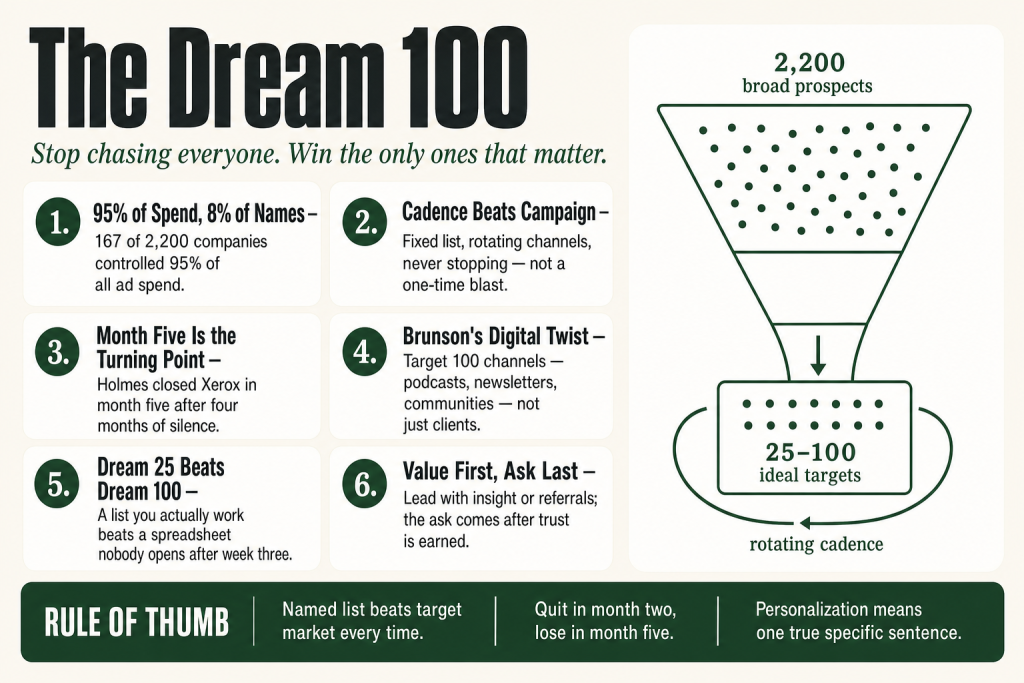
- Chet Holmes invented it while working for Charlie Munger. Holmes’ own account, told in The Ultimate Sales Machine and preserved at chetholmes.com, describes finding that 95% of his market’s ad spend came from just 167 of 2,200 possible buyers.
- The system runs on repeated, multi-channel outreach to that short list, not a single blast, but a sustained cadence over months, until you become impossible to ignore.
- Russell Brunson later adapted it for online businesses in Traffic Secrets (2020): your dream 100 can be podcasts, newsletters, influencers, and communities where your ideal customers already gather.
- For a solo or small-team operator, the number doesn’t need to be 100, a Dream 25 you actually work beats a Dream 100 spreadsheet that collects dust by week three.
- The biggest failure mode isn’t a bad list. It’s quitting after a handful of touchpoints, right before the compounding effect kicks in.
Where the Dream 100 Came From
The story starts not at a marketing agency or a business school, but at a small publication owned by Charlie Munger, yes, the same Charlie Munger who spent six decades as Warren Buffett’s partner at Berkshire Hathaway.
According to Holmes’ own account of the origin, told in The Ultimate Sales Machine and documented at chetholmes.com, he was working for Munger and had been handed a database of 2,200 advertisers. His job was to grind through hundreds of cold calls every day and win their business.
He did what most sales reps do. Results were what you’d expect from chasing a wide market. Then he stopped and looked at the numbers.
What he found: 95% of the market’s advertising spend was controlled by just 167 of those 2,200 companies, roughly 8% of the database buying nearly all the available ad spend. The rest were noise. The 167/95% figure comes directly from Holmes’ own telling of the story, as documented in The Ultimate Sales Machine and at chetholmes.com. No independent third-party audit of those original figures has been published, but the account is consistently repeated across multiple sources tracing back to Holmes himself.
So Holmes stopped chasing the 2,200. He ran a focused cadence on those 167, lumpy mail every two weeks, a phone call twice a month, rotating channels on a fixed schedule. The mediums feel dated now, but the logic is timeless: fixed list, rotating channels, never stopping.
The early results were brutal. Four months of work, nothing to show. In a normal sales org, that gets you fired. Holmes asked Munger for more time. In month five, he closed his first deal, Xerox. According to Chet Holmes International’s account at chetholmes.com, it was the biggest deal that industry had ever seen: a 15-page full-color spread. Over the next five months he closed 28 more of his dream buyers.
Holmes went on to run nine divisions for Munger. His account, repeated consistently in The Ultimate Sales Machine and on chetholmes.com, holds that he doubled the sales volume of each division, most within 12 to 15 months, and continued doubling sales in several of those divisions for years consecutively. These figures originate with Holmes himself and are reported by Chet Holmes International; they haven’t been independently verified by third parties, but the claim is corroborated by multiple sources that draw directly from Holmes’ book and interviews. Charlie Munger’s reported response, as recounted by Holmes and cited across multiple book summaries, was: “Chet, are you sure we are not lying, cheating or stealing? In all my years in business, I’ve never seen anything like this.” He formalized the approach and eventually codified it in The Ultimate Sales Machinepublished in 2007. He died at 55, but the playbook he left is dense enough that serious sales organizations are still running it today.
The name stuck even though the number is flexible. Holmes worked 167 in that original campaign. The round number is what fits in your head, small enough to feel manageable, large enough to keep you busy for months.
The Problem It Was Built to Solve
Before Holmes, the dominant sales religion was volume. More calls, more leads, more reach. The funnel was wide at the top by design, and the answer to flat numbers was always the same: pour more in.
Wide-top funnels punish small operators disproportionately. A large company can afford to spray 10,000 cold emails and wait for the 0.3% to respond. A solo operator or a two-person team cannot. You don’t have the bandwidth, the budget, or the emotional stamina to sustain a volume game, and even if you could, you’d often win the wrong clients. Volume sales attract whoever responds fastest, not whoever fits best.
Holmes’ reframe was that concentrating sales effort on a smaller number of ideal buyers is simply more effective than chasing a broad market. That sounds obvious written out. It runs against every instinct most operators have. We’re wired to want more leads, more options, more chances. The dream 100 asks you to want fewer, specifically chosen, intensively pursued.
The second problem it solved was consistency. Most outreach fails not because the prospect was never interested, but because the seller gave up. One email, no response, next name. Holmes’ system is explicitly designed to outlast the awkward early silence. When your list is short and fixed, you have to keep going back to the same names. That structure forces the follow-through that willpower alone never sustains.
And there’s a third problem it solved, one that rarely gets mentioned: it forces you to get specific about who you actually want. Most operators have a vague sense of their ideal customer. The act of building a named list, real company names, real people, real LinkedIn profiles, sharpens your thinking in a way that no persona exercise ever does. You can’t put a vague archetype on a spreadsheet.
The Core Principles of the Dream 100
Strip away the tactics and there are four ideas doing all the work here.
1. Concentration beats distribution
The whole system is an application of the Pareto principle, applied before you spend a dollar. If your top 20% of clients generate 80% of revenue, then winning ten dream clients is worth more than winning fifty mediocre ones. Target selection isn’t just a sales strategy, it’s a business-quality decision. Chet Holmes International describes the logic plainly: ideal buyers are cheaper to market to and bring far greater rewards than broad market chasing.
2. The list is finite and named
This is what separates a dream 100 from a target market. A target market is a category. A dream 100 is a roster. “Cafes in Melbourne” is not a list, that’s a category. Every entry should have a name, a contact person, and enough context to write something personal. The moment you’re sending generic outreach to your “dream 100,” you’ve turned it back into a volume play.
3. Cadence over campaign
Holmes wasn’t running a campaign. He was running a relationship program with a fixed cadence, rotating channels, fixed list, never stopping. Today the channels are different: email, LinkedIn, a handwritten note, a relevant article with a personal line, a voice message. The underlying logic hasn’t moved.
The sequence should lead with value before it asks for anything, a relevant case study, a specific insight from your work with similar businesses, a useful introduction. The ask comes after you’ve given them a reason to trust your judgment. Any single touchpoint can be ignored. Twelve over three months is much harder to ignore.
4. Pigheaded discipline, the real engine
This is the part that gets skipped in every listicle that summarizes the dream 100 in five bullet points. The system is simple. The discipline to run it for four months with zero results and keep going anyway, that’s the only thing separating operators who get results from operators who say the idea didn’t work for them.
The Ultimate Sales Machine isn’t really a book about selling techniques, it’s a book about organizational mastery. Holmes’ central argument is that most businesses suffer from a constant stream of new initiatives, none of which are executed consistently enough to compound. The dream 100 is the antidote to that pattern. Pick a thing. Do it every week. Whether or not it’s rewarding yet.
How Russell Brunson Rewired the Dream 100 for the Internet
Holmes built the dream 100 as a direct-sales tool, you’re pursuing clients directly. Russell Brunson, the ClickFunnels co-founder, picked up the concept and bent it in a direction that’s arguably more useful for most small operators today.
Brunson’s adaptation, laid out in Traffic Secrets (2020), shifts the target. Instead of 100 dream clients, your list is 100 dream channelsthe podcasts, newsletters, YouTube channels, Facebook groups, forums, and influencers where your ideal customers already spend time. In Brunson’s framing in Traffic Secretsthe dream 100 becomes a way of identifying where your ideal customers have already congregated and then working your way into those spaces, either by earning access through relationship-building, or by buying it through advertising inside those same channels.
The strategic logic is the same, concentrate effort on a short, named list instead of broadcasting content everywhere, but the execution looks different. You follow their social profiles, comment on their content, share their posts, show up as a real presence in their world before you ever make an ask. Brunson describes this as “earning your way in”, as opposed to paying your way in by advertising inside those same channels. Both paths run off the same list; you’re choosing your entry point based on budget and timeline.
Brunson has described his own use of the strategy in some detail. His relationship with Tony Robbins, documented in a December 2019 episode of the Marketing Secrets podcast titled “My 12 Year Dream 100 Campaign With Tony Robbins”, spanned more than a decade of showing up at events, contributing value, and building the relationship incrementally before Robbins promoted ClickFunnels to his audience and eventually became a business partner. In Brunson’s own telling of that story (paraphrasing his account from that episode), it was a decade of serving and building a relationship, not pitching. One relationship, worked patiently over years, producing results that no single ad campaign could have replicated.
A decade is an extreme example. But it illustrates the point cleanly: this is a relationship practice, not a campaign with an end date.
John Lee Dumas of Entrepreneurs on Fire is another figure Brunson has cited publicly as part of his dream 100 outreach during book launches. Brunson has described, across podcast episodes and in Traffic Secretsa pattern of sending pre-release copies of books and other resources before making any direct ask, letting the relationship develop naturally before a collaboration happens. The pattern is consistent across both stories: value first, patience second, ask a distant third.
As for ClickFunnels’ broader growth: the company launched in October 2014 and by 2019 had surpassed $100 million in annual revenue with roughly 99,000 customers, according to data reported by Getlatka. By 2023, revenue had reached $265.3 million with over 150,000 paying customers, figures corroborated by both Getlatka and the ClickFunnels blog. Brunson describes the dream 100 as one of his core distribution levers in Traffic Secretsthough ClickFunnels also ran free book funnels, challenge funnels, and an aggressive affiliate program in parallel. The dream 100 was a key part of the engine, not the whole thing.
For a local operator, a contractor, a boutique, a professional practice, the Brunson adaptation translates cleanly. Your dream 100 might be the local business associations, neighborhood Facebook groups, the podcasts your target clients listen to, the accountants and attorneys who serve the same demographic you do. Same principle, smaller geography.
Putting this to work? The ideas in the Canon are the foundation under the tactical playbook in Build a Complete Marketing Departmentgrab the free companion kit at mmsvegas.com/resources.
How to Build Your Dream 100 Today: An Operator’s Guide
There’s no magic to the list itself. The hard part is the honesty required to build it well and the discipline to actually work it. Here’s how to do both.
Start with the profile, not the list
Before you write a single name, get specific about who belongs on this list. Who are your best current accounts? Not your biggest, your best. The ones who pay on time, value quality, don’t grind you on price, and actually care about what you’re doing. Write down what they have in common: industry, size, location, values, how they found you. That profile is your filter.
Then ask two more questions: Who do you wish you were working with? And who is currently working with your competitors that fits this profile? That last one makes people uncomfortable. Get over it. Loyalty in business is earned, not assumed, and a prospect being someone else’s client today doesn’t mean they’re off limits.
For operators using the Brunson channel-based version: instead of profiling client characteristics, you’re profiling where your ideal client gathers. What podcasts do they subscribe to? What newsletters? What associations? What forums do they lurk in? Build from those questions.
Build the actual list
For direct client targeting: LinkedIn Sales Navigator is the most efficient research tool available at a price most small operators can justify. Supplement with Google, industry directories, your local Chamber of Commerce roster, and your own client referral history. You want a named spreadsheet, company, decision-maker name, contact info, one or two notes on what you already know about them.
For channel targeting: spend a week mapping where your audience lives. Podcast directories, Substack search, YouTube search, Facebook group directories, relevant subreddits. Aim for at least 30 entries to start; build toward 100 over time as you research more deeply.
Keep the list to a number you’ll actually work. There’s no requirement to start with 100, for most operators beginning this process, that’s too many. Twenty-five names you genuinely pursue beats a hundred-row spreadsheet nobody opens after week three. Call it a Dream 25 if that’s what fits your bandwidth. The number matters less than the quality of the list and the consistency of the cadence.
Design the cadence
You need a rotating sequence of touches, typically four to six touchpoints per quarter per target. The channels available today are richer than what Holmes had with mail and fax:
- LinkedIn connection and engagementcomment thoughtfully on their content before you ever pitch anything. A real reaction, not a “Great post!” reply.
- A personalized emailnot a template. One or two paragraphs that reference something specific about their business and offer something of real value: an insight, a resource, a referral, a piece of relevant news.
- Direct maila physical package in 2026 stands out precisely because everyone else is in the inbox. It doesn’t have to be expensive, a relevant book with a handwritten note, something that shows you did your homework.
- A referral or introductionconnecting them to someone useful to them, no strings attached. The most underused touchpoint and the highest-trust one.
- A phone call or voice messageespecially once you’ve had a few prior touchpoints. Not a cold call. A call from someone whose name they’ve seen a few times already.
Track it simply
You don’t need a fancy CRM for a 25-person list. A Google Sheet with columns for the name, last touch date, next planned touch, and channel used is sufficient. What you need is a recurring calendar block, ideally weekly, where you work the list. Without the block, the list sits.
If you want automation to help as your list grows, a lightweight CRM like HubSpot’s free tier or HighLevel can handle multi-channel follow-up reminders and log every interaction without overcomplicating the system. But for a solo operator starting out, don’t let CRM setup become the reason you never actually contact anyone. Start with the sheet.
Set a realistic timeline
Holmes’ original results started in month five, four months of work with nothing to show, then a cascade. In modern B2B, depending on deal size and sales cycle complexity, you’re typically looking at 60 to 180 days from first touch to first meaningful result. Plan for that timeline before you start. If you’re expecting results in three weeks, you’ll quit at exactly the wrong moment.
The Dream 100 in Practice: Named Examples
It’s easier to believe in a system when you can see it working in specific situations. Here are cases where the logic is clearly at work.
ClickFunnels’ launch and growth
ClickFunnels launched in October 2014. By 2019 it had crossed $100 million in annual revenue with roughly 99,000 paying customers; by 2023 it had reached $265.3 million in annual revenue and 150,000 customers, figures sourced from Getlatka (which interviewed Brunson directly) and confirmed by the ClickFunnels blog. Brunson attributes a significant part of that growth to his dream 100 approach in Traffic Secretsbuilding relationships with internet marketing influencers, affiliate partners, and list owners before asking them for anything. That said, ClickFunnels ran free book funnels, challenge funnels, and an aggressive affiliate program in parallel. The dream 100 was one of several growth levers, not the only one.
The Tony Robbins relationship is Brunson’s own account, told in his own words in the December 2019 Marketing Secrets podcast episode “My 12 Year Dream 100 Campaign With Tony Robbins.” The account as Brunson describes it: more than a decade of showing up at events, contributing value, and building the relationship incrementally, before Robbins promoted ClickFunnels to his audience and eventually became a business partner. One relationship, patiently built over years.
An optometry practice’s referral network
One specialty optometry practice built what they eventually recognized as a dream 100, directed not at end patients but at the professionals who already served those patients: local physicians, HR managers at larger employers, personal trainers, school administrators. The outreach was simple, coffee meetings, relevant referrals passed back, the occasional handwritten note. Within 18 months they had a referral pipeline that cost almost nothing to maintain and delivered a consistent stream of pre-qualified patients.
A B2B digital agency working the podcast circuit
One agency operator serving small B2B businesses built their dream 100 entirely around podcasts and newsletters their target clients consumed. Rather than running ads or cold emailing thousands of names, they identified 30 podcasts with audiences matching their ideal client profile, started commenting thoughtfully on LinkedIn posts by the hosts, sent personalized notes with relevant resources, and pitched themselves as guests. When prospects had been seeing their posts regularly before any direct outreach, they were no longer strangers. A single guest slot on a show with the right audience produced more qualified inquiries than six months of cold outreach had.
The Motilal Oswal case
On the enterprise end, Chet Holmes International landed a major Indian financial services firm, Motilal Oswal, through sustained dream 100 outreach over months, despite initial silence. The firm became so convinced of the methodology that it built the approach into their internal training program, with hundreds of staff required to read The Ultimate Sales Machine. A dream 100 target eventually became a dream 100 evangelist.
Where the Dream 100 Still Works Best
Not every business model gets equal mileage from this system, and it’s worth being specific rather than just listing categories. The question isn’t whether you’re in “B2B” or “professional services”, it’s whether the economics and the relationship dynamics actually reward the patience the dream 100 requires.
When a single client relationship justifies months of investment. If landing one dream client nets you $20,000 or more over the relationship, spending six months earning that relationship is a spectacular return on time, even if that time cost you 30 minutes a week. Run the math on your own client values before you dismiss the timeline. Most operators who balk at a 90-day cadence haven’t actually done that arithmetic.
When you operate inside a referral-driven market. Local professional services, accounting, law, dentistry, physiotherapy, financial planning, live and die by referrals. Your dream 100 in these contexts isn’t necessarily 100 clients. It’s likely 20 to 30 professionals who already serve the same people you want to serve. One strong referral partner who sends you two clients a month is worth more than any ad campaign you could run.
When you’re launching into a defined niche and distribution is the bottleneck. This is where the Brunson adaptation shines. If you can clearly name the 30 podcasts, newsletters, and communities that reach your ideal customer, and you have something genuinely useful to offer those audiences, earned distribution through dream 100 relationship-building outperforms paid acquisition at early-stage budgets. You’re not buying eyeballs; you’re borrowing trust.
When cold outreach is your current plan. That’s not a knock, cold outreach works. But if you’re already doing cold outreach to a broad list, ask yourself: what if you took the top 25 names on that list and treated them completely differently? More research, more personalization, more patience, more channels. The dream 100 isn’t a replacement for your current outreach, it’s a tiered upgrade applied to the prospects who matter most.
Where the Dream 100 Doesn’t Apply (And Where It’s Oversold)
The dream 100 gets applied promiscuously in marketing circles, and some of those applications are a stretch. Worth being honest about.
Truly mass-market consumer products. If you’re selling $12 candles on Etsy or running a food truck, you don’t have 100 dream clients, you have thousands of potential casual buyers who each represent a tiny slice of revenue. Pursuing 100 of them with a months-long relationship campaign would be wildly inefficient. You need reach, not depth.
High-velocity, low-ticket subscription businesses. SaaS tools at $29/month, consumer apps, ad-supported media, the economics don’t support the time investment per prospect that the dream 100 demands. These businesses need conversion optimization and paid acquisition, not six-month relationship programs.
When you haven’t done the basic positioning work first. The dream 100 assumes you know who your best client is and why you’re the right choice for them. If you’re still fuzzy on your positioning or your offer isn’t clearly differentiated, you’ll build a great list and then say the wrong thing to everyone on it. Fix the positioning before you build the list.
When building the list becomes an excuse to avoid sending anything. Some operators spend three weeks perfecting the spreadsheet and never send a single email. Building the list feels productive. Actually contacting people feels vulnerable. Don’t mistake the former for the latter.
There’s also a subtler version of the problem: treating the dream 100 like a broadcast campaign. Generic sequences don’t belong here, every email should feel like it was written specifically for that company, opening with something real: a recent hire in their growth team, a product launch they announced, a challenge common to their specific stage or industry. If your dream 100 outreach looks like a mass email campaign with merge fields, it has stopped being a dream 100 and started being spray-and-pray with extra steps.
Common Misunderstandings About the Dream 100
A few misconceptions that keep operators from getting real results.
‘It’s a one-time campaign.’ No. It’s an ongoing relationship program. You don’t run a dream 100 for a quarter and declare victory, you maintain an active list of top prospects and referral partners that you touch consistently, rotating people on and off as relationships develop or go cold. It’s less like a product launch and more like a garden: you’re always tending something.
‘The number has to be 100.’ Holmes’ original list was 167. There’s no requirement to start with 100, that’s too many for most operators beginning this process. The point is finite and named, not the specific integer. Twenty-five names you genuinely pursue is a real system. A hundred-row spreadsheet you look at twice is not.
‘It’s a prospecting system for direct clients only.’ The Brunson adaptation proves otherwise. Your dream 100 can be referral partners who serve the same clients you do, podcast hosts whose audiences are your target market, association leaders who sit at the center of your industry’s network, or journalists who cover your space. Anyone who, if they knew and trusted you, could meaningfully accelerate your business belongs on the list.
‘Personalization means writing a long email.’ It doesn’t. Personalization means one specific, accurate sentence that proves you actually know something about them. “I saw your post about the new location opening on Fifth” is personalization. “As a fellow entrepreneur, I know how hard it is to grow a business” is a template in a costume.
‘It replaces all other marketing.’ The dream 100 is not a full marketing strategy, it’s one high-leverage channel. You still need a compelling offer, clear positioning, and a way to convert relationships into revenue. The dream 100 gets you in the room. What happens in the room is on you.
Operator’s Take
Most of what gets written about the dream 100 treats it like a setup problem: build the list, design the cadence, send the first email. That’s the easy part. Here’s where the attention actually belongs, the moves that aren’t in the system description but that change whether it works.
Your tier-one list should make you a little nervous. Not 20 names you’re comfortable contacting. The names where landing the relationship would genuinely shift the shape of your business, the kind of client or partner where you think, “I’m not sure I’m ready for that conversation yet.” That discomfort is useful information. It usually means the prospect is high-value enough to be worth the sustained effort, and it keeps you from treating the list like a checklist you can breeze through. If your dream 100 doesn’t have at least a few names that make you think twice about reaching out, you’ve aimed too low.
The cadence problem is almost never about what to say. It’s about when. Operators who struggle with dream 100 execution usually frame it as a content problem, “I don’t know what to send them this month.” The real breakdown is structural. Without a fixed weekly block, 45 minutes, same time every week, non-negotiable, the list sits. What you send matters far less than whether you show up at all. One imperfect email sent is worth more than three perfect ones that never leave your drafts folder. Pick your day. Protect it. The content figures itself out once you’ve made showing up the default.
Use AI for research, not for writing. Before reaching out to anyone on your list, spend five minutes with an AI tool pulling together what’s publicly available about them, their recent LinkedIn posts, company announcements, the visible challenges their industry is wrestling with right now. What used to take 30 minutes of tab-switching per person takes five. The output should be three or four specific details you can reference naturally in your outreach, raw context, not a script. The judgment about what to say, the tone, the ask, that stays with you. AI does the reading faster; you do the thinking. That split matters. A dream 100 outreach written by AI and sent at scale is just cold email in a nicer jacket.
Work the list asymmetrically. Not every name deserves identical treatment. Your top ten, the relationships that would genuinely bend your trajectory, get more: a physical mailer, a more considered email, a referral made on their behalf before you ask for anything. The remaining names get a lighter, consistent touch. This isn’t about ranking people as humans. It’s about being honest with yourself about where your limited attention should go heaviest. Most operators treat the list as flat. That’s a mistake. The Pareto principle applies to your dream 100 the same way it applied to Holmes’ original 167.
Decide in advance that the first 60 days don’t count. Not slow progress, nothing. Holmes’ campaign started converting in month five. If you’ve already decided the first two months are just the price of admission, you won’t interpret silence as failure. Most people quit in month two, right when the relationship is just starting to register. The ones who make it to month four are playing a different game entirely, and they usually know it before they start.
FAQ
Does the dream 100 work for a solo operator with no team?
Yes, in fact, solo operators often run it better than teams because there’s no diffusion of responsibility. The key is scaling the list down to a number you can genuinely work: 20 to 30 names rather than 100. A Dream 25 you contact every week beats a Dream 100 spreadsheet nobody touches.
How long does it take to see results from a dream 100?
According to Holmes’ own account, his original campaign started converting in month five, with nothing in the first four months. Modern B2B outreach typically sees meaningful results between 60 and 180 days. Plan for a six-month minimum before evaluating whether the system is working, most people quit right before the compounding effect kicks in.
What’s the difference between the dream 100 and cold outreach?
Cold outreach targets a broad list with templated messages and relies on volume to generate responses. The dream 100 targets a short, named list with personalized, multi-channel, repeated contact over months. The personalization and the persistence are the entire point, automating it at scale turns it back into cold outreach.
Can I use the dream 100 for referral partners instead of direct clients?
Absolutely, this is one of the best applications for local service businesses and professional practices. Your dream 100 might be the accountants, attorneys, real estate agents, or other professionals who already serve the clients you want. Winning a relationship with one strong referral partner can deliver more value than winning ten direct clients through cold outreach.
What tools do I need to run the dream 100?
A Google Sheet and a calendar block are sufficient to start. For research, LinkedIn and a basic AI tool for synthesizing public information about prospects will cut your prep time significantly without replacing your judgment on what to actually say. If you want automated follow-up reminders and multi-channel tracking as your list grows, a lightweight CRM like HubSpot’s free tier or HighLevel handles it without overcomplicating the system.
Is the dream 100 still relevant when everyone is drowning in outreach?
It’s more relevant precisely because inboxes are flooded with generic outreach. A short, named list worked with real personalization and physical mail mixed in cuts through noise that bulk sequences never will. The saturation of volume outreach makes focused, relationship-first approaches more differentiated than they’ve ever been.
Further reading
- The Ultimate Sales Machine by Chet Holmes (2007, updated edition with Amanda Holmes 2023), the source. The dream 100 is covered in depth, but the surrounding framework on mastery and pigheaded discipline is what makes the strategy actually executable.
- Traffic Secrets by Russell Brunson (2020), Brunson’s adaptation of the dream 100 for online traffic and audience-building; valuable if your primary channel is digital and your list is platforms rather than direct clients.
- Chet Holmes International website (chetholmes.com), Amanda Holmes continues her father’s work here, including the original video account of the dream 100’s origin, case studies, and application guidance that extends the book’s frameworks into current contexts.
Sources: Chet Holmes International (chetholmes.com), primary source for the origin story, Holmes’ own account of the 167-company / 95%-of-spend figure, and the Xerox deal outcome; these figures originate with Holmes himself and are not independently verified by third parties. The Ultimate Sales MachineChet Holmes (2007), original codification of the dream 100 system. Russell Brunson, Marketing Secrets Podcast Episode 267: “My 12 Year Dream 100 Campaign With Tony Robbins” (December 16, 2019, marketingsecrets.com), Brunson’s first-person account of the Tony Robbins dream 100 relationship; all characterizations of Brunson’s statements in this article are paraphrases of that account, not direct quotations. Traffic SecretsRussell Brunson (2020), Brunson’s framing of the online dream 100 as a system for identifying where ideal customers congregate and working or buying your way into those spaces; characterizations throughout this article are paraphrases, not direct quotations. ClickFunnels Blog (clickfunnels.com/blog/), ClickFunnels revenue and customer milestones; Brunson’s description of the online dream 100 process. Getlatka.com, ClickFunnels revenue figures by year ($100M by 2019, $265.3M by 2023), sourced from Nathan Latka’s direct interview with Brunson and Dickerson. Verne Harnish, Agile Scaleup blog (verneharnish.typepad.com, February 2009), independent corroboration of Holmes’ nine-division sales-doubling account, citing Holmes directly. Predictable Profits (predictableprofits.com), synthesis of dream 100 history. Resources.Rework.com, analysis of Holmes’ organizational mastery framework.
Brian Kasday spent forty years in direct-response marketing before rebuilding the whole operation as a one-person shop. He writes The Operator’s Library, including “Build a Complete Marketing Department”, for operators who’d rather build it themselves than wait on someone else.
Build the department these ideas describethe free companion kit: mmsvegas.com/resources.
More The Operator's Canon guides
Free · Operator Toolkit
Want the tools, not just the guide?
Get the free operator toolkit — templates and checklists for the systems you actually run, plus a note when this guide changes.
Get the free toolkit →