
Last updated: September 2026
The freemium business model is one of those ideas that sounds self-evidently brilliant until you run the math on your own business and realize you’ve been subsidizing thousands of people who were never going to pay you. By the end of this page, you’ll be able to identify which of three roles your free tier is actually playing, acquisition engine, awareness play, or permanent product tier, and you’ll have the questions you need to decide whether freemium is the right move at all.
The premise is simple enough: offer a real, usable version of your product at no cost, then charge for the features, capacity, or experience that power users actually need. Done right, it can be the lowest-CAC distribution channel you’ll ever find. Done wrong, it’s a cost center wearing a growth strategy’s clothes. The difference is almost never the idea itself, it’s whether your underlying economics actually support it.
Most of what gets written about freemium is written by people celebrating Spotify and Dropbox. This page isn’t that. This is for the operator trying to figure out whether free belongs in their offer stack at all, and if it does, exactly where to put the gate.
The idea in 30 seconds
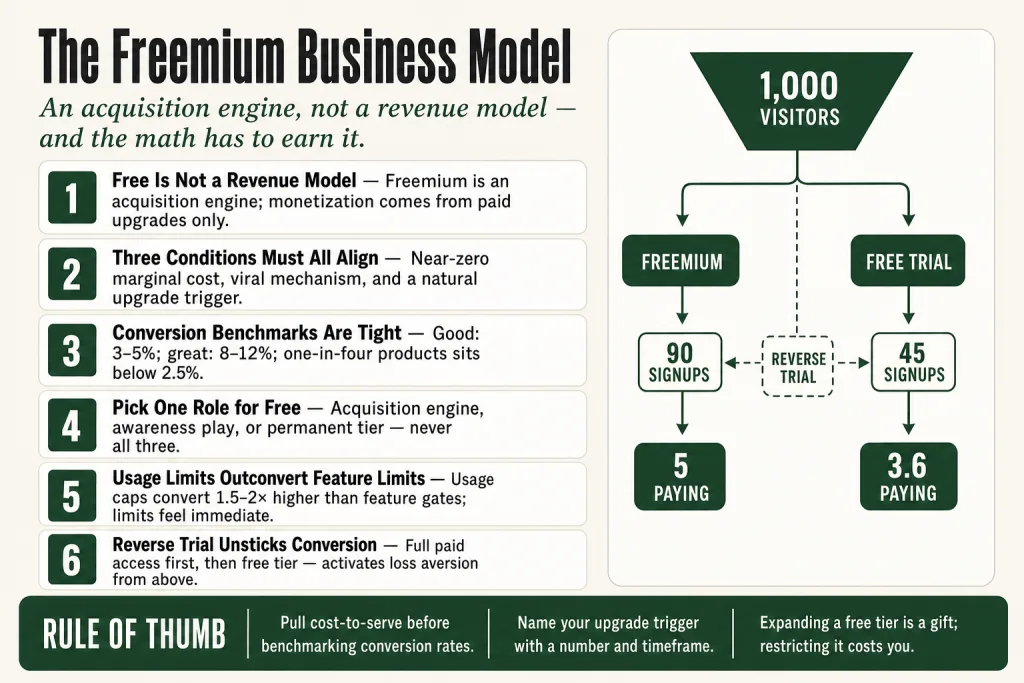
- The freemium business model offers a permanent free tier to attract users, then monetizes a subset through paid upgrades, it is an acquisition engine, not a revenue model in itself.
- Free-to-paid conversion for self-serve freemium averages 3 to 5% for a ‘good’ result and 8 to 12% for a ‘great’ one, per the ChartMogul / Growth Unhinged / ProductLed SaaS Conversion Report (200 B2B products, January 2026). One-in-four freemium products sits below 2.5%, a warning sign worth diagnosing.
- The model only works when three conditions align: near-zero marginal cost to serve free users, a viral or network-effect mechanism, and a clear natural upgrade trigger that fires as usage grows.
- Free tiers can be acquisition engines, brand-awareness plays, or permanent product tiers, pick one and design for it; trying to be all three produces a tier that’s none of them.
- The biggest operator mistake is treating freemium as a default pricing strategy rather than a product-economics decision that has to be earned by the numbers.
- If the free tier is too generous, you train users to expect everything for nothing; if it’s too thin, nobody stays long enough to want more.
Where the Freemium Business Model Came From
The term has an exact birth date. On March 23, 2006, venture capitalist Fred Wilson published a post on his AVC blog titled ‘My Favorite Business Model,’ describing a strategy of giving a service away free, acquiring customers efficiently through word-of-mouth and referrals, then charging for premium upgrades. He asked readers to name it. Jarid Lukin, then working at Alacra, a company in Wilson’s portfolio, suggested ‘freemium,’ and Wilson adopted it on the spot. Wilson later confirmed explicitly that he did not coin the word.
The practice predates the label by roughly two decades. Software shareware in the 1980s worked on the same basic logic: distribute a limited version freely, charge for the full one. The conversion psychology was identical, the economics were just noisier because distribution was physical and marginal costs were real.
Chris Anderson’s 2009 book Free gave the idea mainstream vocabulary, influential, and not entirely wrong, but it blurred a line that’s gotten sharper since: zero marginal cost of distribution is not the same as zero marginal cost of serving a user. That distinction barely mattered for mp3s. It matters a great deal for products that run on compute, storage, and support at scale.
The 2020s have made the original assumptions harder to hold. AI-native products carry real per-query costs. Evernote’s slow unraveling showed what happens when a free tier trained on millions of users gets pulled back years later. The economics that made freemium look frictionless in 2012 are not the economics operators are working with now.
The Problem Freemium Actually Solved
Before freemium became a deliberate strategy, digital products faced a straightforward but brutal problem: credence goods are hard to sell cold. A credence good is something whose value you can only assess after using it, software, professional services, most SaaS tools. You’re asking a stranger to pay before they know whether what you’re selling is any good. That’s a friction point that kills conversion at the top of the funnel regardless of how good the product actually is.
Free trials addressed this, but imperfectly. A 14-day window creates artificial urgency. If your product’s value takes three weeks of real use to become obvious, which is true of most workflow tools, the trial ends before the user has experienced the thing they were supposed to want to pay for. Low conversion, not because the product is bad, but because the evaluation window was wrong.
Freemium solved this by removing the time constraint entirely. The user can evaluate the product on their own schedule, build genuine habits, accumulate data or history in the tool, and eventually hit a natural ceiling that makes the upgrade decision obvious. The key word there is natural. The best freemium conversions don’t feel like sales pressure, they feel like the user reaching a point where paying is the logical next step.
There’s a second problem freemium solved, arguably more important for operators thinking about distribution: it turned users into a marketing channel. If the free tier is useful enough that people share it, invite colleagues, or link to it publicly, you’ve turned your product into its own acquisition machine. That’s the real economic logic behind why Dropbox gave away storage, not generosity, but distribution efficiency. Google AdWords was costing Dropbox $233, $388 per customer for a $99/year product. The referral program replaced that at a fraction of the cost, drove 35% of all daily signups at peak, and permanently increased signups by 60%. The math made the decision obvious.
The Core Principles of the Freemium Business Model
There are three structural requirements for freemium to work. Miss any one of them and you’re not running a growth strategy, you’re running a subsidy program.
1. Near-Zero Marginal Cost to Serve a Free User
This is the foundational condition. If one more free account costs you almost nothing in infrastructure, compute, or support, you can afford a large free base and treat it as a distribution channel. If every free user consumes expensive resources, GPU compute for AI inference, human support hours, physical inventory, freemium turns your growth into a cost line that scales faster than your revenue. Digital products with near-zero marginal costs are natural candidates. Service-adjacent products where free users require real human attention are not.
2. A Viral or Network-Effect Mechanism
Freemium is far more powerful when free users do marketing work just by using the product. Dropbox grew because every shared folder exposed the product to a non-user. Slack grew because one free team invited colleagues from other companies. Figma grew because a designer sharing a file link forced the recipient to open Figma. The free tier wasn’t just a product, it was a distribution channel operating outside the paid media ecosystem. Without this property, you still have a top-of-funnel play, but you’re missing the compounding effect that makes the math look good at scale.
3. A Natural Upgrade Trigger
This is the condition most operators underestimate. There has to be a moment, ideally a predictable, recurring moment, where a free user hits a real limitation and the upgrade decision becomes obvious without feeling forced. Dropbox’s storage limit was elegant precisely because it was tied to the user’s own success: the more they used the product, the sooner they hit the ceiling. Spotify’s ad interruptions are deliberate friction that the upgrade removes. LinkedIn’s InMail limits matter more as your career advances. The trigger should fire as a consequence of engagement, not arbitrarily. If you’re nagging free users to upgrade, the trigger is probably wrong.
Products that limit usage, seats, API calls, storage, tend to convert 1.5 to 2x higher than products that limit features, because usage limits create an immediate, tangible trigger rather than a vague capability gap. The goal is a free tier that fully solves one narrow use case, and a paid tier that’s obviously necessary for the next use case up. That gap is where conversion happens, and it’s a design decision, not a happy accident.
The Free/Paid Split in Practice
The cleanest way to think about the split: the free tier should make a specific person’s specific job noticeably easier. Not a neutered version of everything, a complete solution to one well-defined problem. The paid tier then solves the next problem up, the one that shows up naturally as the user gets better at the first one.
The Three Roles a Free Tier Can Play, and Why You Need to Pick One
Here’s where most operators get into trouble: they launch a free tier without deciding which of three fundamentally different jobs they want it to do. Each role has different design requirements, different success metrics, and different risks. Running all three at once usually means you’re running none of them well.
Role 1: Acquisition Engine
The free tier exists to bring in qualified leads who will eventually convert to paid. This is the Dropbox model, the Slack model, the Figma model. Success is measured by free-to-paid conversion rate and the CAC efficiency of the free channel compared to paid acquisition. The free tier has to be useful enough to create real habit, but constrained enough that growth naturally generates upgrade pressure.
Kyle Poyar’s 2026 free-to-paid conversion report, produced in partnership with ChartMogul and ProductLed, analyzing 200 B2B software products, puts the benchmarks like this: for self-serve freemium, 3 to 5% is a good result and 8 to 12% is great. One-in-four freemium products converts below 2.5%, which is a warning sign that needs diagnosis. The spread between top and bottom quartile is nearly 10x, so the median tells you almost nothing useful about where your product should land.
Role 2: Demand Creation and Brand Awareness
The free tier exists to expose the market to the product, build familiarity, and eventually drive enterprise or upmarket sales, but most free users were never going to convert directly. HubSpot’s free CRM is closer to this model. The free user may never pay, but they become a reference, an internal advocate, or a hiring manager who specifies the tool to a team. Conversion from free to paid isn’t the primary metric here, the metric is the rate at which free usage generates enterprise pipeline. This is expensive to run if you’re not at scale, and it only makes sense if the enterprise contract value is large enough to justify the marketing cost of the free tier.
Role 3: Permanent Product Tier
Some free users will never pay, and that’s the design. Spotify’s free tier is genuinely monetized through advertising, the free user is a product sold to advertisers, not just a potential subscriber. Legitimate model, but it requires a different business entirely: ad sales infrastructure, audience scale, and a willingness to treat non-payers as a revenue source rather than a conversion funnel. Most operators reading this page don’t have that business and shouldn’t try to build it.
The dangerous situation is when you haven’t decided which role you’re playing. Your free tier ends up too generous to drive upgrade urgency, not large enough to sell advertising, and not enterprise-directed enough to generate pipeline. It just costs money.
Putting this to work? The ideas in the Canon are the foundation under the tactical playbook in Build a Complete Marketing Department — grab the free companion kit at mmsvegas.com/resources.
Freemium in Practice: What the Best Examples Actually Teach
Dropbox is the canonical success story, and it’s worth understanding precisely why it worked, because the lesson is narrower than most people extract from it. The company grew from 100,000 users to 4 million in 15 months through a referral program that rewarded both referrer and new user with 500MB of additional storage. At peak, 35% of all daily signups came from referrals, and the program permanently lifted signup volume by 60%. Before the referral program, Google AdWords had been costing the company $233, $388 to acquire each customer for a $99/year product. The genius wasn’t just the referral mechanic, it was that the reward was denominated in the product’s own value: more storage, which is exactly what a growing Dropbox user wanted. Every part of the system pointed the same direction.
Spotify runs freemium at a scale that makes most comparisons irrelevant, but the structure is still instructive. As of Q4 2024, Spotify had 675 million monthly active users and 263 million paid subscribers, roughly 39% of active users paying. That’s an exceptional free-to-paid rate by any industry standard, held up because the free tier has genuine value while the paid tier removes frictions, ads, download limits, that matter more as usage deepens. Spotify’s full-year 2024 operating income reached €1.4 billion, marking its first full year of operating profitability, a signal that the model is generating sustainable unit economics after years of royalty pressure.
Evernote is the cautionary tale. For years it was cited as a freemium success. Then the economics became unsustainable under owner Bending Spoons, and the solution, restricting the free plan, exposed exactly how much brand equity a generous free tier can build up and then spend down. On December 4, 2023, Evernote capped free accounts at 50 notes and one notebook; existing users were not grandfathered. Users who had accumulated years of notes in the product experienced the change as a betrayal rather than a reasonable business adjustment. The lesson isn’t that Evernote was wrong to have a free tier, it’s that a free tier training users to expect a specific capability, then removing it, generates backlash that a more modest free tier from the start would have avoided. You can tighten a free tier. Just not easily, and never without losing some users.
LinkedIn is a useful case for B2B operators because its freemium works through a mechanism different from storage or ads. The free tier is sufficient for casual networking. The paid tiers, Recruiter, Sales Navigator, Premium Career, address specific high-value use cases where the ROI of the upgrade is calculable. A recruiter who closes one hire using LinkedIn Recruiter has paid for the subscription many times over. The upgrade trigger isn’t a friction point; it’s a capability gap that becomes obvious when the use case intensifies.
Where the Freemium Business Model Still Works
Freemium remains well-suited to a specific set of conditions, and being honest about that is more useful than either cheerleading or dismissing it.
Products with near-zero marginal cost per free user. Pure software, content platforms, and most SaaS tools still meet this condition. If adding one more free user costs you a few cents in storage and compute, a large free base is affordable. If it costs meaningful compute per query, as generative AI products often do, the math changes fast. Kyle Poyar’s 2026 report noted that supporting free users has gotten materially more expensive as AI token costs remain high, which is reshaping which products can responsibly offer perpetual free access.
Products where free usage generates virality. Collaboration tools are the strongest candidates. When a Figma file gets shared with someone outside the organization, that person has to touch Figma. When a Notion workspace goes public, it’s an advertisement. When a Calendly link goes out, the recipient encounters the product. The free user’s normal behavior exposes the product to non-users without additional acquisition spend.
Products with a large enough total addressable market to support the funnel math. If you need 50,000 free users to find 2,500 paid ones at a 5% conversion rate, you need a market big enough to supply those free users affordably. Niche B2B products with small, identifiable buyer lists often don’t have that luxury, every potential customer is too valuable to park in a free tier that might not convert.
Products where the upgrade trigger fires naturally at the exact moment value is highest. Storage limits, seat limits, usage caps, feature unlocks tied to workflow progression, the best upgrade triggers feel inevitable rather than arbitrary. When a user hits a storage wall while actively trying to do something, upgrading is the obvious path. When an upgrade prompt fires at a random 30-day mark with no connection to what the user is doing right now, it feels like a sales pitch.
One more context where freemium earns its place: markets where trust is the main acquisition barrier. Free usage lets a skeptical buyer prove the product to themselves before committing. Especially true in markets where switching costs are high and buyers are risk-averse. A free tier is a risk reversal built into the product itself.
Where the Freemium Business Model Breaks Down
The conditions where freemium fails are just as specific as the conditions where it works, and they’re more common than the success stories suggest.
High marginal cost per free user. If serving a free user requires meaningful compute, human support, or physical resources, you’re subsidizing non-payers at scale. AI-heavy products are the current example, and not a hypothetical one. If every conversation costs $0.05 in inference, a free tier with active users is a meaningful cost line before you’ve converted anyone. Service-adjacent businesses, where free users still require account management or onboarding support, face the same problem.
No viral or network mechanism. If your free users don’t naturally expose the product to non-users, you’re relying on organic search and brand advertising to fill the free tier. That’s not impossible, but it eliminates the main economic advantage of freemium over a free trial. You’re paying to acquire free users who convert at a modest rate, instead of paying to acquire trial users who convert at a higher one. The math usually favors the trial.
A free tier that’s a permanent substitute for the paid product. This is the trap. If the free tier satisfies the primary use case for most of your target market, you’ve created a product that competes with itself. The people who most need to pay are the people most satisfied by what they’re getting for free. Conversion stalls. You’ve built a charity.
Enterprise-first markets. When your target buyer is a large organization with a procurement process, individual bottom-up adoption through a free tier may never reach the decision-maker. You might accumulate thousands of free individual users inside a company without ever generating a contract, because the person with budget authority never touched the free product. In enterprise-primary markets, a free tier can actually slow sales by training individuals to expect free access, making the enterprise conversation harder.
When you can’t afford the time horizon. Freemium is a slow-burn model. It often takes months or years for a free user base to generate meaningful paid revenue. If you need predictable cash flow in the near term, the lower conversion rate and longer sales cycle of freemium can put real pressure on the business. Free trials convert faster. Direct sales convert faster still. Freemium is the right choice only when you have the runway to wait for the flywheel to spin up.
Freemium vs. Free Trial: The Decision Most Operators Get Wrong
The freemium-versus-free-trial question gets treated as a branding or philosophy decision when it’s actually an economics and product decision. The two models aren’t competing worldviews, they’re different machines for converting attention into revenue, and each one works under specific conditions.
A free trial gives temporary full access; the user experiences everything, then decides. A freemium tier gives permanent limited access; the user stays on free indefinitely unless they choose to upgrade. Kyle Poyar’s 2026 ‘‘1,000 visitors’ analysis makes the comparison concrete: for every 1,000 website visitors, freemium products generate roughly 90 free signups and about 5 paying customers. Standard free trials produce 45 signups and 3.6 paying customers, worse overall despite a higher per-signup conversion rate. Freemium generates roughly twice the signup volume, so the net paying customers per visitor can end up comparable.
The practical decision rule: choose freemium when your product has strong network effects or viral mechanics, when your cost to serve a free user is low, and when your product’s value takes weeks or months of real use to become obvious. Choose a free trial when your product shows its value quickly, when network effects are weak, and when your target market is small enough that you can’t afford to subsidize non-converters at scale.
There’s a third option worth knowing: the reverse trial. The user gets full paid access for a limited period, then drops to a permanent free tier rather than churning entirely. This combines freemium’s retention advantage with the trial’s urgency, and for products with a stuck free-to-paid conversion rate, it’s one of the more reliable ways to unstick it. The user experiences the ceiling from above rather than below, which activates loss aversion in a way that freemium’s gradual pressure often doesn’t. Poyar’s 2026 report puts reverse trial conversion in the 4 to 6% ‘good’ and 8 to 12% ‘great’ range, roughly between standard trials and freemium, and names Calendly and Slack as products that use this motion.
The Unit Economics Every Freemium Operator Needs to Run
Before committing to a freemium model, you need three numbers. If you can’t get clean answers to all three, you’re not ready to launch a free tier, you’re guessing.
Cost to Serve a Free User (Monthly)
Add up infrastructure, storage, compute, and the allocated support cost for your free tier. Divide by free active users. If this number is more than a few dollars per user per month, your free tier needs to convert fast or generate ad revenue, or it will bleed you. Many operators skip this calculation because the individual cost feels trivial, it’s not trivial when you have 50,000 free users. AI products compound this problem: Poyar’s 2026 research found that supporting free users has gotten significantly more expensive as AI token costs remain high, which is part of why the freemium calculus for AI-native products is different from classic SaaS.
Free-to-Paid Conversion Rate (Cohort-Based)
Don’t measure this as a snapshot, measure it as a cohort. Take all users who signed up in a given month and track what percentage convert to paid within 30, 60, 90, and 180 days. The ChartMogul / Growth Unhinged / ProductLed SaaS Conversion Report (January 2026, 200 B2B products) puts good self-serve freemium conversion at 3 to 5%, with 8 to 12% considered great. Below 2.5% is a warning sign that needs diagnosis: is the free tier too generous? Is the upgrade trigger unclear? Is the product attracting the wrong users in the first place?
Context matters. A 5% conversion rate for a $500/month tool generates a very different revenue outcome than 5% for a $9/month consumer app. Benchmark against your specific category and price point, not just a headline industry average.
LTV of a Converted User vs. Blended CAC
What’s a converted user worth over their lifetime? What did it cost to acquire the free user who became them, including the cost of serving all the free users who didn’t convert? If your average converted customer is worth $1,200 in lifetime value and your blended cost to acquire (including free-tier subsidies) is $200, the model works. If your LTV is $200 and your blended acquisition cost is $180, you’re running on fumes.
This is where freemium connects directly to your CAC-to-LTV ratio. The free tier changes the numerator in ways that aren’t always visible in standard reporting, because the cost of non-converting free users often gets buried in infrastructure spend rather than attributed to customer acquisition. Pull it out and look at it directly.
Common Mistakes
- Skipping the cost-to-serve calculation and setting price anchors instead — Most operators jump straight to ‘what’s the right conversion rate?’ without first pulling the fully-loaded monthly cost per active free user. The cost-to-serve number is upstream of everything else. A freemium model that looks fine at 5% conversion can still lose money if the per-user infrastructure cost is $4/month and you have 50,000 active free users burning $200K before a single upgrade happens. Pull the number from your actual infrastructure bill, compute, storage, prorated support, before you benchmark anything else.
- Treating the free tier as a product decision rather than a distribution decision — The free tier isn’t just ‘a cheaper version of the paid product.’ It’s a distribution mechanism with specific jobs: generate qualified leads, create virality, or build enterprise pipeline. Most operators who end up with a bloated, non-converting free tier built it as a product feature instead of asking ‘what acquisition work does this tier need to do?’ Define the job first. The feature set follows from that, not the other way around.
- Measuring total free signups instead of cohort conversion — Total free user counts tell you whether people are signing up, not whether the model is working. Track cohort-based free-to-paid conversion over 30, 60, 90, and 180 days for every monthly signup cohort. A conversion curve that flattens early and never lifts past 1% is diagnostic data; ‘we have 80,000 free users’ is not. If you don’t have cohort data, you can’t diagnose whether the problem is the free tier design, the upgrade trigger, or the user profile you’re attracting.
- Setting the free tier too generously at launch, then trying to claw it back — Set limits conservatively from day one. Expanding a free tier later is a gift, users love it. Restricting one is a broken promise. Evernote’s December 2023 cap at 50 notes and one notebook, applied to existing users without grandfathering, is the case study in how this goes wrong. Users who had built workflows around the product experienced the change as a betrayal. If you’re not sure where the line should be, err toward less generous and expand as you learn. You cannot run this experiment in reverse without paying for it in churn and reputation.
- Adopting freemium because a competitor uses it, without checking your own structure — Competitor pricing is not evidence that freemium works for your economics. Run the three structural checks first, near-zero marginal cost per free user, a viral or network-effect mechanism, and a clear natural upgrade trigger. If your product doesn’t meet all three, a free trial or direct paid model will almost always outperform freemium for your specific situation. The only question that matters is whether your unit economics support it, not whether someone else in your category is doing it.
Operator’s Take
Most writing about freemium tells you how the model works in theory. What it skips is the order of operations, the sequence in which the decision should actually happen. Here’s my honest read on it.
Start with the cost-to-serve number, not the conversion benchmark. Pull your fully-loaded monthly cost to serve one active free user directly from your infrastructure bill: compute, storage, prorated support for non-payers. Run it at 50,000 users before you dismiss it as trivial. If the number makes you wince, that’s not a sign to optimize the free tier, that’s a sign to question whether perpetual free access is the right model at all. A credit-based access model or a reverse trial often makes more sense when per-user costs are real. Operators who skip this step and go straight to ‘what’s a good conversion rate?’ are asking the second question before they’ve answered the first.
Name your upgrade trigger with a number and a timeframe, or admit you don’t have one. Not ‘users will want more features eventually.’ Something like: ‘Active users hit our 2GB storage limit around week six, based on current upload-rate data.’ If you can’t say it with that kind of precision, the trigger isn’t designed, it’s a hope. Open your analytics, find what ceiling your best free users actually hit, and when. If there isn’t one, that’s the real problem, and no email sequence will fix it. Consider limiting by usage, seats, API calls, storage, rather than features. Usage limits create an immediate, tangible moment. Feature gaps are easy to rationalize around.
Check whether a free user’s normal workflow does distribution work for you. Does it involve sharing a file, sending a link, inviting a collaborator? If yes, you have a distribution multiplier working quietly in the background. If the product is entirely self-contained, the user gets value but nobody else ever touches it, you’re filling your free tier through organic search and paid media alone. That’s a slower, lower-converting free trial without the urgency. If this check fails, a standard free trial almost certainly outperforms freemium for your situation: higher per-signup conversion, no indefinite subsidy, faster revenue signal.
If all three pass, freemium is almost certainly the right model. If one or two fail, a free trial usually beats it. If all three fail, charge from day one and put the energy you’d have spent on free-tier design into making your paid onboarding excellent. Paid onboarding that works is underrated; a free tier that doesn’t is overbuilt.
One thing I’d push back on directly: the idea that freemium is primarily a volume play. Volume matters, but qualified volume is the point. A free tier that attracts the wrong user profile produces conversion numbers that look broken when the real problem is audience fit. If your ICP work isn’t done before you design the free tier, you’ll end up with 80,000 free users and a 0.8% conversion rate and blame the model. The model isn’t wrong, the targeting is.
On AI products specifically: the economics are materially different right now. Poyar’s 2026 data flags explicitly that supporting free users has gotten significantly more expensive as AI token costs remain high. If your product has meaningful inference costs per query, a generous perpetual free tier isn’t freemium, it’s a subsidy program. Usage-capped free access or a reverse trial are worth testing before you commit to something your margin can’t support. The 2015 freemium playbook doesn’t port cleanly to a world where every user interaction has a real compute cost attached.
Used in
- ✓ Build a Complete Marketing Department
Used to evaluate whether a free offer belongs in the acquisition stack, specifically how to design the free-tier gate so it drives pipeline rather than permanent non-paying usage. - ✓ The Missing Manual for FunnelKit
Applied when building free-tier onboarding sequences and upgrade nudge automations, the trigger events that move free users toward conversion are mapped and automated inside the funnel architecture. - ✓ The Missing Manual for Make
Used to automate free-user monitoring, tracking usage signals, firing upgrade prompts at the right moment, and routing high-engagement free users to a sales-assist workflow.
FAQ
What is a realistic free-to-paid conversion rate for a freemium product?
Kyle Poyar’s 2026 free-to-paid conversion report, produced with ChartMogul and ProductLed, analyzing 200 B2B software products, puts good self-serve freemium conversion at 3 to 5%, with 8 to 12% considered great. One-in-four freemium products sits below 2.5%, which is a warning sign worth diagnosing: either the free tier is too generous, the upgrade trigger is unclear, or the product is attracting the wrong users. Context matters too, a 5% rate for a $500/month tool is a very different business than 5% for a $9/month consumer app. Benchmark against your specific category and price point, not just a headline average.
What’s the difference between freemium and a free trial?
A free trial gives full product access for a limited time, then forces a decision. Freemium gives limited access permanently, letting users stay on free indefinitely. Kyle Poyar’s 2026 ‘‘1,000 visitors’ analysis found that freemium generates roughly 90 free signups and about 5 paying customers per 1,000 visitors, while standard free trials produce 45 signups and 3.6 paying customers, worse overall despite a higher per-signup conversion rate. Free trials convert a higher share of signups but pull a narrower funnel. Free trials work best when your product’s value is obvious quickly. Freemium works best when value takes weeks or months of real use to become clear.
Does the freemium business model work for non-SaaS businesses?
Rarely, and only when marginal cost is near zero. Physical products, professional services, and most B2B services don’t meet the structural requirement because serving each free customer costs real money. The model was built around digital goods where adding one more user costs almost nothing, that’s what makes the math work at scale.
What should the free tier include versus the paid tier?
The free tier should fully solve one narrow, specific workflow, not a watered-down version of the whole product, but a complete solution to a well-defined problem. The paid tier should solve the next workflow up: the one power users inevitably need after mastering the first. Products that gate usage (storage, seats, API calls) rather than features tend to convert 1.5 to 2x higher, because the limit is concrete and immediately felt.
How do I know if my free tier is too generous?
The clearest signal is a flat conversion curve, users who are very active in the free tier for months but never convert. If your most engaged free users have no natural reason to upgrade, the free tier is satisfying the use case that was supposed to require payment. The fix is either adding a meaningful gate to the free tier or redefining which capabilities sit behind the paywall. A 0.5% conversion rate on highly active users is not a growth problem; it’s a tier design problem.
What is a ‘reverse trial’ and when should I use it?
A reverse trial gives new users full paid-tier access for a limited period, then drops them to a permanent free tier rather than canceling them. It activates loss aversion, users experience the ceiling from above rather than growing into it from below, which can unstick a freemium conversion rate that’s plateaued. Poyar’s 2026 report puts reverse trial ‘good’ conversion at 4 to 6% and ‘great’ at 8 to 12%, and names Calendly and Slack as examples of products using this motion. It works best for products with a feature-rich paid tier where the value difference is obvious after real use.
Further reading
- Free: The Future of a Radical Price by Chris Anderson (2009), the book that gave freemium its economic vocabulary; useful context for why near-zero marginal cost changes the pricing calculus for digital goods.
- Monetizing Innovation by Madhavan Ramanujam and Georg Tacke, a rigorous framework for deciding what to charge for and what to give away; directly applicable to free-tier gate design.
- ChartMogul / Growth Unhinged / ProductLed SaaS Conversion Report (January 2026)the most current large-sample data on freemium conversion rates across 200 B2B products; the primary benchmark source used throughout this page.
Sources: Fred Wilson, AVC Blog (March 23, 2006), ‘My Favorite Business Model’, original freemium model articulation; Fred Wilson, AVC Blog (July 2009), ‘Freemium and Freeconomics’, Wilson confirms Jarid Lukin coined the term while at Alacra; ChartMogul / Growth Unhinged / Kyle Poyar / ProductLed SaaS Conversion Report (January 2026, 200 B2B products surveyed); Spotify Newsroom, ‘Spotify Reports Fourth Quarter 2024 Earnings’ (February 4, 2025), 675M MAUs, 263M paid subscribers, €477M Q4 operating income; Music Business Worldwide, ‘Spotify posts $1.5bn annual operating profit for 2024’ (February 2025), €1.4B full-year operating income confirmed; Variety, ‘Spotify Q4 2024 Earnings: Streamer Posts First Full-Year Profit’ (February 2025), €1.138B net income, first annual profit; ReferralRock / LaunchList / SaaSMarketingInsider Dropbox referral program case study data, AdWords CAC ($233, $388), 35% of daily signups from referrals at peak, 60% permanent signup lift, 100K to 4M users in 15 months; TechCrunch, ‘Evernote pushes users to upgrade with test of a free plan limited to only 50 notes’ (November 27, 2023); Engadget via Yahoo Tech, ‘Evernote officially limits free users to 50 notes and one measly notebook’ (November 30, 2023); usecarly.com, ‘Evernote Pricing in 2026’ (July 2026), December 4, 2023 cap confirmed, existing users not grandfathered; Kyle Poyar, Growth Unhinged, ‘The 2026 free-to-paid conversion report’ and ‘‘1,000 visitors’ analysis; EBSCO Research Starters: Freemium; Wikipedia: Freemium.
Brian Kasday spent forty years in direct-response marketing before rebuilding the whole operation as a one-person shop. He writes The Operator’s Library — including “Build a Complete Marketing Department” — for operators who’d rather build it themselves than wait on someone else.
Build the department these ideas describe — the free companion kit: mmsvegas.com/resources.
More The Operator's Canon guides
Free · Operator Toolkit
Want the tools, not just the guide?
Get the free operator toolkit — templates and checklists for the systems you actually run, plus a note when this guide changes.
Get the free toolkit →How to cite: Freemium Business Model. Associated with Fred Wilson & Jarid Lukin, 2006. The Operator’s Canon, MMS Vegas. https://mmsvegas.com/library/freemium-economics-explained/