
Last updated: September 2026
Your biggest competitor just dropped a new feature set. A VC-backed startup is undercutting your prices. You’re three weeks from a product launch and someone on your team just called it “disruptive.” Sound familiar? That moment, when the label gets slapped on before anyone’s done the diagnosis, is where most operators start making expensive mistakes.
Disruptive innovation has a precise definition, and almost nobody uses it correctly. Everyone from solo consultants to Fortune 500 CMOs claims to be disrupting something. Pitch decks wouldn’t exist without it. And almost none of them are actually describing what Clayton Christensen meant when he introduced the concept in 1995.
That sloppiness costs operators real money. When you misread your own position, thinking you’re disrupting a market when you’re actually competing on features against well-resourced incumbents, you make the wrong calls on pricing, customer targeting, and where to put your growth energy. This page gives you the real framework so you can tell the difference, and a practical lens for deciding whether the disruptive frame fits your business or not.
When it applies, this is one of the sharpest strategic insights available to a resource-constrained operator, because it tells you precisely which customers to go after first and why your bigger competitor won’t bother fighting you there. That’s an edge worth having. But you have to use the concept honestly to get it.
The idea in 30 seconds
- Disruptive innovation is a specific process, not a synonym for “impressive” or “fast-growing.” It describes how a smaller player enters at the low end or in a new market segment, then moves upmarket to unseat established competitors.
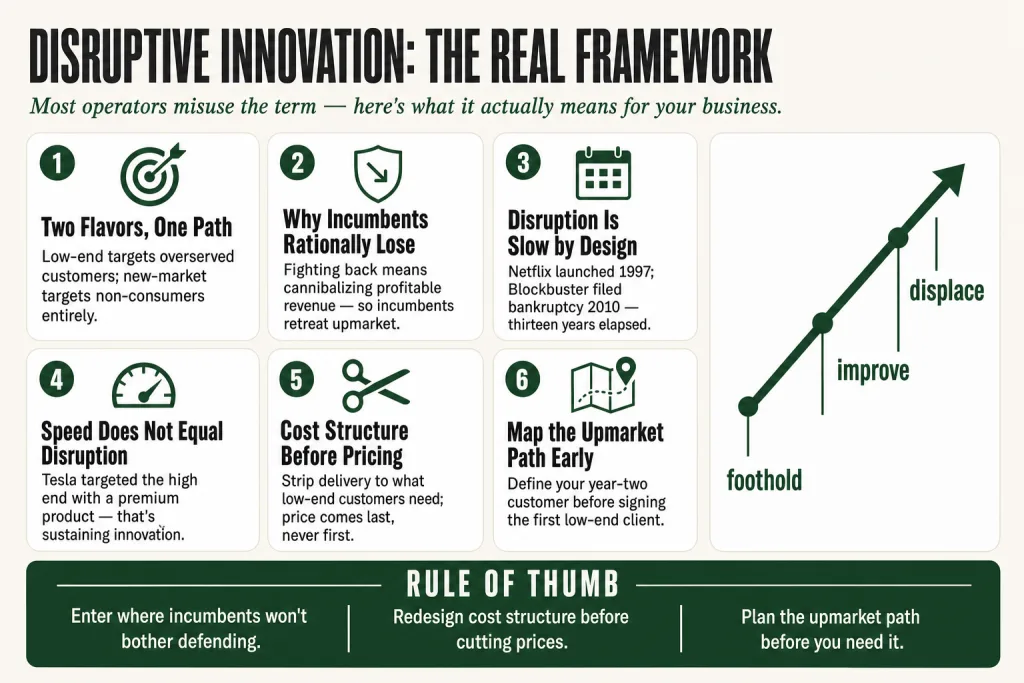
- There are exactly two flavors: low-end disruption (targets overserved customers with a cheaper, good-enough product) and new-market disruption (targets non-consumers who couldn’t access the category before).
- The mechanism depends on incumbents being rationally unwilling to fight back, because the entrant’s early segment is too unprofitable for them to bother with.
- Most operators calling themselves “disruptors” are actually building sustaining innovations, better products for existing customers. That’s fine; it’s just a different game with different rules.
- By the end of this page you’ll be able to diagnose whether your market position is disruptive, a sustaining play, or just good marketing, and position accordingly.
Where the Idea Came From
Clayton Christensen, a Harvard Business School professor, introduced the concept in a 1995 Harvard Business Review article co-written with Joseph Bower, “Disruptive Technologies: Catching the Wave.” That label shifted to “disruptive innovation” in the 2003 follow-up book The Innovator’s Solutionco-written with Michael Raynor, once it became clear the phenomenon was less about the technology and more about the business model and market path it enabled.
The 1997 book The Innovator’s Dilemma is where the idea became famous. Intel’s Andy Grove called it the most important book he’d read in a decade. The core paradox landed hard: the better an incumbent listens to its best customers and invests in what they value, the more vulnerable it becomes to a new entrant targeting customers the incumbent has quietly stopped caring about. Doing good business sows the seeds of displacement. Counterintuitive enough to stick, useful enough to last thirty years.
Christensen spent much of his later career correcting misapplications of the idea. In a 2015 Harvard Business Review piece co-written with Michael Raynor and Rory McDonald, he pushed back on the term’s drift, how it had become shorthand for any fast-growing startup or bold product move. That correction matters for operators, because a misapplied framework gives you the wrong strategic moves.
What Disruptive Innovation Actually Means
Here’s the definition, read it slowly: disruptive innovation describes a process by which a product or service takes root in simple applications at the bottom of a market, typically by being less expensive and more accessible, and then moves upmarket, eventually displacing established competitors. Not “any startup that shakes things up.” Not “a technology that spreads really fast.” A specific path, starting below the radar of the incumbent, into segments the incumbent doesn’t find worth defending.
Two distinct versions of this path exist:
Low-End Disruption
A low-cost entrant enters the bottom of an existing market with a product that’s inferior on the dimensions mainstream customers care about, but good enough for customers who are currently overserved and paying for features they don’t need. The incumbent, chasing higher profit margins from its best customers, doesn’t find it worth fighting for the low end. So it retreats upmarket. The entrant improves, follows, and eventually the incumbent runs out of upmarket runway. Southwest Airlines did it to major carriers. Walmart did it to department stores. Canon did it to Xerox’s copier business.
New-Market Disruption
Instead of targeting the bottom of an existing market, new-market disruption targets people who weren’t in the market at all, non-consumers who lacked the money, skill, or access to participate. The disruptor competes against non-consumption, which means even an inferior product wins, because the alternative was nothing. Personal computers did this to mainframes. The transistor radio did it to the console stereo. The product doesn’t need to beat the incumbent head-to-head; it just needs to be good enough for people who previously had no option.
The shared ingredient in both cases is the incumbent’s rational inaction. Incumbents don’t miss disruptors because they’re asleep. They ignore them because fighting back would require cannibalizing profitable revenue for unprofitable revenue, and no publicly accountable business willingly does that. The math works against them. That’s the part that makes disruption strategically interesting, and different from ordinary competition.
What It Is Not
A sustaining innovation is an improvement along dimensions that existing mainstream customers already value, better performance, more features, higher quality. Incumbents are actually good at sustaining innovation. They have the resources, the customer relationships, and the incentive structures to keep improving for their best customers. Build a faster, prettier, more feature-rich version of something and go directly after the mainstream market, and that’s a sustaining attack. It might work. But the rules are different, incumbents will fight back hard, because your segment is exactly the profitable one they’re trying to protect.
This distinction matters operationally. If you misidentify your position as “disruptive” when you’re actually in a sustaining fight, you’ll underprice yourself into unsustainability, target the wrong customers, and misread why you’re winning or losing deals. If you want to think more carefully about how these positioning choices stack up, the Porter’s Generic Strategies page works as a useful companion, it maps the cost-leadership path that most low-end disruptors rely on.
The Mechanism: Why Good Companies Get Beaten
The most useful thing about Christensen’s framework isn’t the vocabulary, it’s the mechanism. Understanding why incumbents lose tells you exactly where to position to make their rational behavior work against them.
Established businesses are built around their best, most profitable customers. Their pricing, product roadmap, sales process, and cost structure are all tuned to serve that segment well. When a low-end or new-market entrant shows up with a cheaper, simpler product aimed at customers the incumbent barely notices, the incumbent runs a rational calculation: the margin on that segment is thin, those customers are less attractive, and fighting back means cannibalizing their own higher-margin business. So they don’t fight. They retreat further upmarket toward more profitable customers, which is exactly the right move by their existing metrics.
That retreat is the window. The disruptor isn’t fighting the incumbent; it’s occupying the territory the incumbent just vacated. Then it improves, incrementally, until it can serve customers closer to the mainstream. By the time the incumbent recognizes the threat as real, the disruptor has a cost structure, brand, and customer base that the incumbent can’t replicate without rebuilding from scratch.
The steel mini-mill story from The Innovator’s Dilemma is the cleanest illustration. Mini-mills produced lower-quality steel, fine for rebar, unacceptable for sheet steel. Integrated mills were happy to cede the rebar market because margins were thin anyway. Mini-mills took rebar, improved their processes, moved into structural steel, then sheet steel, until they had displaced integrated mills across most of the market. Each retreat felt rational. Collectively, it was fatal.
And if you want a modern version playing out in real time: BYD entered with affordable EVs aimed at buyers incumbents weren’t fighting for, and by the close of 2025 had surpassed Tesla as the global sales leader in pure electric vehicles, selling approximately 2.26 million battery-electric vehicles against Tesla’s 1.64 million (per Electrek and CNBC, January 2026). In a Bloomberg TV interview in October 2011, when host Betty Liu raised BYD as a potential Tesla rival, Musk burst out laughing and said, “Have you seen their car?”, adding that he didn’t see BYD as a competitor at all. That’s not a punchline; it’s the mechanism working exactly as described.
Modern Examples, and What Operators Should Take From Them
The clearest modern examples hold up under scrutiny, meaning they actually fit the definition, not just the label. But more than the history, what matters is what each one tells you about your own positioning.
Canva vs. Adobe. Adobe’s Creative Suite was, and still is, best-in-class for professional designers. But it’s expensive, complex, and aimed squarely at creative professionals. Canva targeted people who would never have bought Adobe anyway: small business owners, solopreneurs, social media managers who needed decent-looking graphics without a design degree. That’s new-market disruption, targeting non-consumers. By the end of 2025, Canva had surpassed 265 million monthly active users (per TechCrunch, February 2026, citing figures disclosed by Canva COO Cliff Obrecht), and 95% of Fortune 500 companies were using it (per Canva’s own newsroom, December 2025), not because IT procurement approved an enterprise contract, but because employees inside those organizations had already adopted it individually and refused to give it up. The operator lesson: you don’t have to beat the category leader on their terms. You just have to be good enough for people the category leader never cared about, and let the upmarket march take care of itself.
CVS MinuteClinic vs. hospital systems. Retail medical clinics entered at the absolute low end of healthcare, strep tests, flu shots, minor infections. Major medical centers didn’t fight back because treating sinus infections doesn’t register as a strategic threat for a hospital system built around complex, high-margin procedures. MinuteClinic took the bottom of the market, built operational competence, and has steadily expanded its service range. The operator parallel: if the large regional firm in your category would genuinely not notice losing the clients you’re targeting, you have a window. Use it before you grow big enough to appear on their radar.
Online legal services vs. law firms. LegalZoom and Rocket Lawyer targeted people who needed simple legal documents, LLC formation, basic wills, standardized contracts, but would never have paid a traditional law firm’s hourly rate. Non-consumers became consumers. Law firms couldn’t profitably serve that segment even if they wanted to, given their billing structures and overhead. The low end has since expanded: these platforms now handle increasingly complex work, pressuring mid-market legal practices. The operator lesson: “they’ll never touch our core clients” is not reassurance, it’s exactly what disruption theory predicts you’ll say, right before they do.
Notice what all of these have in common: they started somewhere incumbents didn’t find worth defending. That’s the tell. And in every case, the incumbent’s dismissal was rational, by their own numbers, right up until it wasn’t. For a framework that works alongside this one when mapping where to compete, see the Blue Ocean Strategy page, it handles the complementary question of how to create new value dimensions rather than just finding undefended segments.
Putting this to work? The ideas in the Canon are the foundation under the tactical playbook in Build a Complete Marketing Department — grab the free companion kit at mmsvegas.com/resources.
Where This Framework Still Applies, and for Whom
Disruptive innovation as a strategic lens is most useful in two situations: when you’re choosing where to enter a market, and when you’re trying to understand whether a new competitor is actually threatening you or just making noise.
For an operator entering a market. If you’re a smaller, resource-constrained business going up against established players, the disruptive frame gives you a disciplined answer to “who should my first customers be?” The answer, if disruption is your path, is: customers the incumbent is actively ignoring or barely tolerating, the ones in the low-margin tier, or the ones who aren’t yet in the market at all. You don’t try to win the incumbent’s best customers in round one. You take the territory they’ll happily give up, build competence there, and move upmarket as your capabilities improve. The Needs-Based Segmentation page covers the practical mechanics of identifying which tier that actually is in your specific market.
For a local or regional service business. This plays out in service industries constantly. A new bookkeeper offers simplified monthly accounting packages at a fixed low price to micro-businesses, the segment that a regional CPA firm considers too small to be worth the client management overhead. The CPA firm doesn’t fight back because those clients don’t register as worth protecting. The bookkeeper builds a client base, adds advisory services, raises prices as their reputation grows, and starts nibbling at mid-market clients. Classic low-end disruption, no Silicon Valley required.
For a B2B SaaS operator. The pattern is common in software. Enterprise project management tools like Microsoft Project were expensive, complex, and aimed at professional project managers. Trello targeted small teams and individuals who weren’t buying enterprise tools anyway. The enterprise vendors didn’t bother competing at Trello’s price point. Eventually Trello and tools like it started appearing in enterprise environments, not because they beat Microsoft Project on its own terms, but because teams were already using them and couldn’t be pried away. If you’re thinking about using a freemium or free-tier entry to replicate this, the Freemium Business Model page maps out where that mechanic works and where it bleeds you dry.
As a threat-assessment tool. If a new competitor shows up targeting your lowest-margin customers with a cheaper, simpler product, Christensen’s framework says: don’t dismiss them. The rational response, let them have that unprofitable segment, is exactly the behavior that sets up displacement. You need to either aggressively defend the low end (accepting margin compression) or consciously cede it and move upmarket with full awareness that you’re shrinking your addressable market over time. Neither is comfortable. But at least you’re making the choice with clear eyes.
Where Disruptive Innovation Doesn’t Apply
The framework has real limits, and Christensen’s critics, particularly Harvard historian Jill Lepore in her 2014 New Yorker essay, and Dartmouth’s Andrew King in subsequent academic work, pointed to some of them honestly.
Lepore argued that Christensen made circular arguments, disregarded cases that didn’t fit his theory, and failed to prove it was predictive. King and his collaborators, writing in MIT Sloan Management Review in 2015, found the theory’s predictive power limited when applied systematically to Christensen’s own case studies. Fair criticisms of the theory as a forecasting model. What survives the critique, for operators, is the diagnostic value, the framework still tells you something real about where incumbents are structurally vulnerable, even if it can’t tell you which disruptors will win.
The practical limits are more immediate:
Disruption isn’t a strategy by itself. Saying “we’re going to disrupt the industry” doesn’t tell you how to win. The framework identifies a structural pattern; it doesn’t generate a business model. You still need to figure out your actual offer, your unit economics, and your path upmarket. Many operators who try to position as disruptors skip this entirely and end up with a cheap product and no plan to ever be profitable.
Not every market has a viable disruptive entry point. Disruption requires that incumbents have overserved customers or untouched non-consumers, and that those segments can sustain a business long enough for you to improve. In highly commoditized markets where incumbents have already competed to thin margins, there’s no profitable position to cede. You can’t disrupt a market that’s already been disrupted.
Disruption is a slow process. Netflix launched in 1997. Blockbuster filed for bankruptcy in 2010. Thirteen years. Mini-mill steel disruption took decades. If you’re trying to build a business that pays you this year, “we’ll start at the low end and move upmarket over a decade” is not a cash-flow strategy. The disruption framework is long-horizon thinking, useful for strategic positioning, not for Q4 planning.
High-quality beats disruption when switching costs are high. In markets where customers face significant cost or risk in switching, professional services with deep institutional knowledge, specialized B2B software with years of data inside it, a low-end entrant often can’t gain the foothold needed to move upmarket. The overserved customers stay because leaving is more painful than overpaying.
Calling yourself a disruptor doesn’t make incumbents ignore you. If your product is immediately visible to the incumbent’s core customers and represents a credible threat to their margins, they’ll respond, regardless of where you positioned your entry. The rational-inaction mechanic only works if your initial foothold doesn’t register on the incumbent’s profit radar.
What People Get Wrong About Disruptive Innovation
A few misunderstandings come up so consistently they’re worth naming directly.
“Disruption means fast, impressive growth.” No. A company can grow explosively while doing pure sustaining innovation, building a better product for existing customers. Tesla is frequently called a disruptor; by Christensen’s definition, it’s actually a sustaining innovator. Tesla went straight after the high end of the automotive market with a premium product. Remarkable company, excellent sustaining strategy. Meanwhile, something genuinely disruptive might grow slowly for years before the upmarket march becomes visible. Speed and disruption are unrelated.
“If it uses new technology, it’s disruptive.” Technology is often involved, but it’s not the point. The disruptive quality is the market path, not the tech stack. A new SaaS tool that replaces an older SaaS tool for the same customers at a higher price is sustaining innovation with modern technology. A simple SMS-based scheduling tool targeting small service businesses that never had scheduling software before, that’s potentially new-market disruption. The question is always: who were the first customers, and why were incumbents willing to leave them alone?
“Disruption always defeats the incumbent.” Sometimes incumbents respond effectively. Sometimes they acquire the disruptor. Sometimes the disruptor’s low-end foothold never becomes good enough to move upmarket. The theory describes a structural vulnerability, not a guaranteed outcome. Christensen’s critics were right to challenge some of the original case studies on exactly this point.
“A small business can’t be a disruptor.” The opposite is closer to true. Disruption is a strategy for resource-constrained operators who can’t win a head-to-head fight with a larger incumbent on the incumbent’s terms. The disruptive path is specifically designed for smaller players. You don’t have to win the mainstream market on day one, you just need a foothold the incumbent won’t fight for.
“Disruption is inherently good.” Depends entirely on your position. If you’re the incumbent being disrupted, it’s threatening. If you’re a customer being served by a new low-cost entrant, it might be better, or it might just be cheaper and worse. The framework is descriptive, not normative.
Applying Disruptive Innovation as an Operator Today
You don’t need to label your strategy “disruptive” to use the framework. What you need is the diagnostic, a clear-eyed answer to four questions before you decide where to position.
1. Are there overserved customers in your target market? Look at the incumbent’s product or service. Who’s paying for features or complexity they don’t actually use? Who would defect to a simpler, cheaper option if one existed and were credible? That’s your low-end foothold. The test isn’t whether you can build a cheaper product, it’s whether the incumbent will leave that segment alone while you establish yourself there. If the incumbent will fight aggressively for those customers, you’re not in disruptive territory; you’re in a price war.
2. Are there non-consumers you could serve? This one is underused. Who isn’t in your market right now, not by preference, but because access, price, or complexity excludes them? If you can build something simple enough and affordable enough that those people can participate for the first time, you’re not competing against the incumbent at all. You’re creating demand. The incumbent has no incentive to stop you because you’re not touching their customers. The Product Led Growth page covers one of the most effective modern delivery models for this kind of entry, low or no cost access that removes the barrier for non-consumers.
3. Can you build a business model that works at the low end? This is the practical constraint most operators miss. Low-end disruption requires a cost structure that generates acceptable margins at a low price point. That almost always means simplification, stripping the offer down to the components that actually matter to the early customer, removing the overhead that the incumbent needs to serve its high-end clients. If your cost structure mirrors the incumbent’s, you can’t profitably undercut them for long.
4. Do you have a sequenced upmarket path? Starting at the low end is not the destination, it’s the entry point. At some point you need to improve your product and serve progressively more valuable customers. What does that path look like? What capabilities do you build in the low-end phase that translate upmarket? Without an answer, you risk building a low-margin business that stays low-margin forever rather than a foothold that becomes a platform.
The disruptive innovation lens is equally valuable as a defensive tool. If you’re already established and a new entrant shows up targeting your low-margin customers with something cheaper and simpler, you’re looking at the early stages of potential disruption. The instinct is to ignore them, because fighting back means diluting your margins. That instinct is exactly what Christensen documented. You can choose to defend, choose to acquire, or choose to consciously exit and move upmarket, but you have to choose deliberately, not drift into it.
Common Mistakes
- Pricing low without first stripping the cost structure — Operators launching a low-end entry often cut prices while keeping their full delivery overhead intact, the same account managers, the same onboarding process, the same tool stack as the premium offer. The result is thin or negative margins from month one. Fix: before setting the price, redesign the delivery model. Identify which components of your current service the low-end customer actually needs, remove the rest, and build a cost structure around that stripped version. Price comes last, not first.
- Targeting the incumbent’s core customers from day one — A regional marketing agency tries to position itself as the “affordable” alternative to a larger competitor, but goes straight after mid-market clients the larger firm actively sells to and would fight to keep. The result is a direct competitive response: the incumbent drops price on selected accounts, and the smaller firm can’t win on margin. Fix: identify which customer tier the incumbent has mentally deprioritized, the ones they’d lose without a sales call, and start there. Build track record and case studies in that tier before moving up.
- Building the upmarket path reactively, after the low-end fills up — A SaaS founder nails a low-price tier and fills the funnel with entry-level customers. Eighteen months later, the business is capped, the entry clients can’t grow into higher-value accounts because the product and support model were never designed to serve them. By the time the team tries to build upmarket features, they’re doing it under cash pressure with a product architecture optimized for the wrong customer. Fix: define the year-two and year-three customer profile before signing the first low-end client. What will they need? What do you need to build in phase one to make phase two possible?
- Dismissing a new low-end competitor because their product is obviously weaker — An established bookkeeping firm notices a new AI-assisted service charging $99/month for what the firm charges $600/month for. The work is narrower, the output less nuanced, so the firm ignores it. Two years later, three clients have left citing price, and the competitor is now offering payroll integration. The product improved while the firm wasn’t watching. Fix: set a concrete monitoring trigger now. Track which clients the cheaper competitor is winning, watch their product changelog, and decide in advance at what point you respond, whether that’s a counter-offer, a separate low-end brand, or a deliberate upmarket move.
- Claiming the disruptive frame when the product targets the incumbent’s best customers — A startup pitches itself as “disrupting enterprise HR software”, but its first target accounts are 500-person companies that Workday and ADP actively sell to and would fight for. This isn’t disruption; it’s a direct sustaining attack. The consequence: the founder prices too low for a segment the incumbent will defend, gets into a feature war they can’t win, and burns runway trying to out-resource a company with 50x their budget. Fix: before claiming the disruptive label, ask honestly whether the incumbent would fight to keep your target customer. If yes, plan for a direct competitive response and price accordingly.
Operator’s Take
Pull up your current client list and sort by margin, not revenue, margin. The bottom tier is either dead weight or your most important strategic intelligence, depending on how a cheaper competitor would see it. If someone could build a stripped-down version of your offer and happily serve those clients at 40% of your price, you have a flank that’s already exposed. Most operators don’t discover this until someone is already eating there.
Here’s the first move: before you set a single price on a low-end offer, redesign the delivery model. Identify which parts of your current service the low-end customer actually needs, cut the rest, and build your cost structure around that stripped version. Pricing comes last. Operators who cut price first and figure out costs second are just subsidizing their own displacement, they create a margin hole they never climb out of.
On the non-consumer angle: write down the person who would genuinely benefit from what you sell but isn’t buying today, not by preference, but because the price is out of reach or the product requires skills they don’t have. That’s your new-market entry point. AI tools make building a simplified version of your offer more tractable than it was five years ago, faster prototyping, lighter delivery infrastructure, lower overhead on a thin-margin early offer. The judgment calls stay with you: which segment to enter, whether the upmarket path is real, what “stripped down” actually means in your specific category. But the execution barrier is meaningfully lower.
If you’re entering a market, don’t show up trying to win the premium accounts in month three. Take the clients the established player has mentally already fired. Build your processes around serving them efficiently. That’s how you get a cost structure the incumbent literally cannot match without dismantling what makes them profitable. There’s a reason the large firm isn’t fighting for those clients, use that window before you grow large enough to register on their radar.
On the upmarket path: map the year-two and year-three client profile now, before you take the first low-end engagement. What will those clients need? What do you have to build in phase one to make phase two possible? If you can’t answer that, you’re not building a platform, you’re building a permanent discount operation. Filling your calendar with entry-level clients is easy; building a bridge from there to something more valuable requires that you designed the bridge before you needed it.
Last, and this one’s purely defensive: decide right now what signal would make you take a cheaper competitor seriously. Not a feeling, a specific number. “When I lose three clients to this competitor in a single quarter” forces a response. “When it starts to feel like a real threat” is drift that turns into a crisis. The framework gives you the warning signs in advance. The only question is whether you’re willing to act on them before they’re urgent.
Used in
- ✓ Build a Complete Marketing Department
Used to choose which customer segment to target first in a market-entry strategy, specifically to identify whether a low-end or new-market foothold is available before committing to a positioning and messaging approach. - ✓ The Missing Manual for FunnelKit
Informs funnel architecture decisions for operators entering a crowded market at a lower price point, ensuring the offer, opt-in, and conversion sequence are built around the foothold segment rather than the incumbent’s mainstream customer. - ✓ The Missing Manual for Make
Applied when automating a simplified service offering aimed at a low-end or non-consumer segment, helping operators build cost-efficient delivery systems that make thin-margin entry positions operationally viable.
FAQ
Is Uber a disruptive innovation?
Contested, and that’s actually the point. Christensen himself argued Uber is not a classic disruptor because it entered directly against taxi services’ mainstream customers with a superior product on the dimensions those customers valued, that’s a sustaining attack, not a disruptive foothold. Whether the label fits depends on which market you define as the starting point, but the question itself illustrates why the definition matters.
Can a small local service business use disruptive innovation?
Yes, and it fits small operators better than large ones in many cases. A local bookkeeper, landscaper, or marketing agency targeting a customer tier that the established regional firm considers too small to be worth managing is doing exactly what the framework prescribes. You take the territory the incumbent doesn’t want, build competence and reputation, and move upmarket as you grow.
What is the difference between disruptive innovation and sustaining innovation?
Sustaining innovation improves an existing product for existing customers along dimensions they already value, it’s what incumbents are naturally good at. Disruptive innovation enters at the low end or in a new market segment with an offer that’s initially inferior by mainstream standards but good enough for customers the incumbent ignores. The business model, target customer, and competitive dynamics are fundamentally different.
How do I know if my market is vulnerable to disruption?
Look for overserved customers, people paying for features they don’t use and would gladly drop for a lower price, and non-consumers who are priced out or excluded by complexity. If both groups exist and are large enough to build a business on, the structural conditions for disruption are in place. Also ask whether incumbents in the market systematically retreat upmarket to protect margins; that pattern is a strong signal.
Does disruptive innovation always win in the end?
No. Incumbents sometimes respond effectively by acquiring the disruptor, launching a separate low-end brand, or building switching costs that prevent the disruptor from moving upmarket. The theory describes a structural vulnerability, not a guaranteed outcome. When it does play out fully it tends to be dramatic, but plenty of attempted disruptions stall at the foothold stage.
How long does disruptive innovation typically take?
Years to decades, in most well-documented cases. This is why the framework is better suited to strategic positioning decisions than to short-term planning. Operators should use it to decide where to build initial credibility and what capabilities to develop, while maintaining a separate view of how to stay financially viable during the long upmarket march.
Further reading
- The Innovator’s Dilemma by Clayton Christensen (1997), the original source; read it for the disk-drive and steel mill case studies, which are still the clearest illustrations of the mechanism even if some of the predictions haven’t aged perfectly.
- The Innovator’s Solution by Clayton Christensen and Michael Raynor (2003), where “disruptive technologies” became “disruptive innovation” and the framework was extended to include practical guidance for how entrants should sequence their upmarket move.
- “The Disruption Machine” by Jill Lepore, The New Yorker (June 2014), the most prominent critique; read it alongside the original to understand where the theory’s predictive limits actually sit.
- “How Useful Is the Theory of Disruptive Innovation?” by Andrew King and Baljir Baatartogtokh, MIT Sloan Management Review (Fall 2015), the academic stress-test of Christensen’s case studies; useful for calibrating how much weight to put on the theory as a predictive tool versus a diagnostic lens.
Sources: Clayton Christensen and Joseph Bower, “Disruptive Technologies: Catching the Wave,” Harvard Business Review (January, February 1995); Clayton Christensen, The Innovator’s Dilemma (Harvard Business Review Press, 1997); Clayton Christensen, Michael Raynor, and Rory McDonald, “What Is Disruptive Innovation?” Harvard Business Review (December 2015); Christensen Institute, christenseninstitute.org/theory/disruptive-innovation/; Jill Lepore, “The Disruption Machine,” The New Yorker (June 2014); Andrew King and Baljir Baatartogtokh, “How Useful Is the Theory of Disruptive Innovation?” MIT Sloan Management Review (Fall 2015); Canva 265 million monthly active users and $4 billion ARR: TechCrunch (February 2026), citing disclosure by Canva COO Cliff Obrecht; 95% Fortune 500 figure: Canva Newsroom, canva.com/newsroom/news/canva-2025-wrap/ (December 2025); BYD 2025 full-year battery-electric vehicle sales: 2,254,714 units per Electrek (January 2, 2026) and CnEVPost (January 2, 2026); Tesla 2025 full-year deliveries: 1,636,129 units per Tesla/Electrek (January 2, 2026); Elon Musk Bloomberg TV interview dismissing BYD: October 2011, interviewer Betty Liu, documented by Bloomberg, InsideEVs, NPR, and Fortune.
Brian Kasday spent forty years in direct-response marketing before rebuilding the whole operation as a one-person shop. He writes The Operator’s Library — including “Build a Complete Marketing Department” — for operators who’d rather build it themselves than wait on someone else.
Build the department these ideas describe — the free companion kit: mmsvegas.com/resources.
More The Operator's Canon guides
Free · Operator Toolkit
Want the tools, not just the guide?
Get the free operator toolkit — templates and checklists for the systems you actually run, plus a note when this guide changes.
Get the free toolkit →How to cite: Disruptive Innovation. Associated with Clayton Christensen, 1995. The Operator’s Canon, MMS Vegas. https://mmsvegas.com/library/disruptive-innovation-explained/