
Last updated: August 2026
The 7 Powers business strategy framework, developed by Hamilton Helmer and published in his 2016 book of the same name, is a tool for answering one ruthlessly practical question: if your business is working, what’s going to stop a well-funded competitor from copying it next year? By the end of this page, you’ll be able to identify which of the seven Power types your business can realistically build, which ones are out of reach at your stage, and what moves to make today that compound into a structural position, not just a temporary lead.
Most small operators don’t think about strategy this way. They think about tactics: better ads, a new offer, a tighter sales script. Those things matter for getting customers, but they answer the wrong question. Getting customers is a marketing problem. Keeping your position after your market gets crowded is a strategy problem. Helmer’s framework is built for the second one.
Here’s the uncomfortable thing about a business that’s ‘working’: if it’s working for you, it’s visible to everyone else. Without some structural reason for competitors to leave you alone, or find themselves unable to imitate you without self-harm, your margins are a loan, not an asset.
The idea in 30 seconds
- Power is Helmer’s word for a structural advantage that both improves your economics and creates a barrier competitors cannot easily overcome.
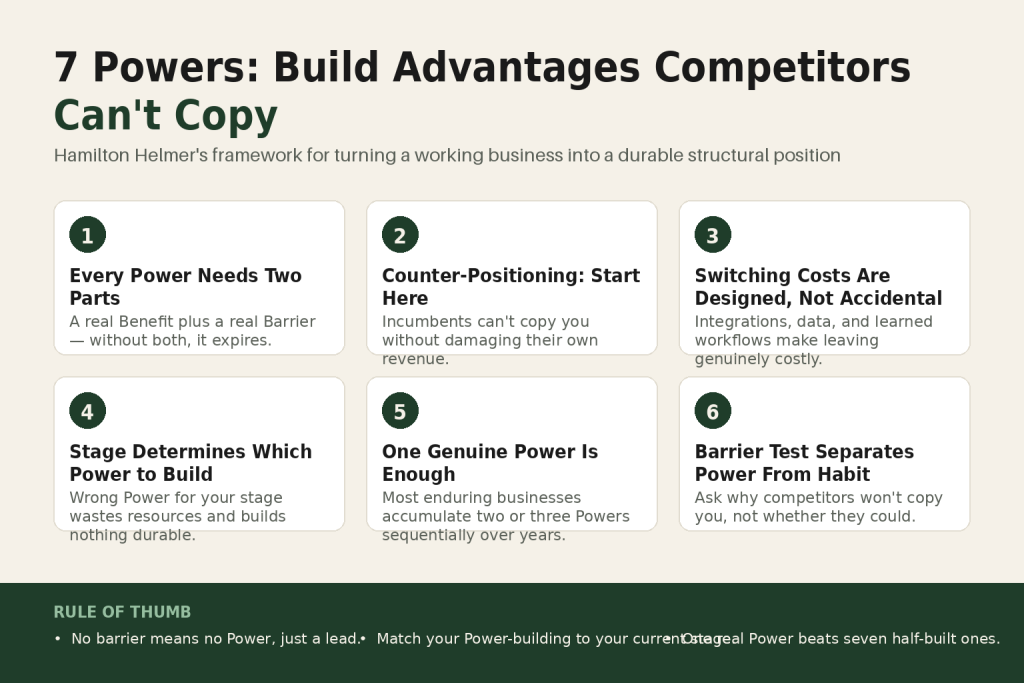
- Every Power has two parts: a Benefit (better margins, lower costs, or higher prices) and a Barrier (why competitors can’t copy it without hurting themselves).
- The seven Powers are: Scale Economies, Network Economies, Counter-Positioning, Switching Costs, Branding, Cornered Resource, and Process Power.
- Different Powers become available at different stages, origination, takeoff, and stability, so the question isn’t just ‘which Power?’ but ‘which Power, right now?’
- Most small operators have realistic access to Counter-Positioning, Switching Costs, Cornered Resource, and Process Power, the other three demand scale you probably don’t have yet.
- The framework won’t tell you what to build. It tells you whether what you’re building will hold once competitors notice it.
Where the 7 Powers Framework Came From
Hamilton Helmer is the co-founder and co-chief investment officer of Strategy Capital. He spent his career as a practicing business strategist: at Helmer & Associates (later Deep Strategy), the firm he founded, he led over 200 strategy projects with major clients including Adobe Systems, Coursera, Hewlett-Packard, Netflix, and Spotify. Before founding his own firm, he was employed at Bain & Company, and holds a Ph.D. in Economics from Yale University. For a decade, he taught Business Strategy in the Economics Department at Stanford University. The book was selected by Bloomberg for its Best Books of 2017.
What actually matters about that background: Helmer wasn’t writing as an academic. He was writing as an investor trying to figure out which companies would still be worth owning years from now. That lens shapes everything. He wasn’t asking what makes a company profitable right now, he was asking what makes a company’s profitability durable. Those are very different questions, and it’s why this framework has aged better than most strategy writing from the same era.
The book landed when Silicon Valley had gotten drunk on growth metrics and ‘network effects’ had become a hand-wavy excuse for anything defensible. Helmer’s contribution was precision: here are exactly seven types of structural advantage, here is what each one requires, and here is the order in which they tend to become available. That rigor is what makes it useful for operators, not just investors.
The Benefit-and-Barrier Test: The Core Logic Behind 7 Powers Business Strategy
Before getting into the seven individual Powers, the underlying logic is worth sitting with, because it’s the thing most people skip, and it’s what makes the framework actually useful.
Helmer’s central idea is that every genuine competitive advantage must do two things simultaneously. First, it has to provide a real Benefitsomething that materially improves your business economics: lower costs, higher prices you can sustainably charge, or reduced capital requirements. Second, it must create a genuine Barriersomething that prevents competitors from arbitraging your advantage away. The barrier is what transforms a temporary lead into a structural position.
The test for a barrier isn’t ‘can competitors copy this?’ The test is ‘why won’t they copy it?’ Sometimes it’s because they can’t, the resource is locked up, the process took twenty years to build. Sometimes it’s because copying would hurt them more than it would help. Without a real barrier, you have a benefit with an expiration date.
Helmer’s value equation is sometimes expressed as: Value = Market Size × Power. Without Power, a big market produces commodity-level returns in the long run. You’re just running faster on a treadmill. Market size determines the ceiling; Power determines how much of that ceiling you keep after competition shows up.
This is also why ‘we have great customer service’ isn’t a Power. It might be a real benefit. But what’s the barrier? Any competitor can hire better service staff next quarter. Without the barrier, it’s not a Power, it’s a habit that can be matched.
The 7 Powers Business Strategy Framework: Each Power, Explained for Operators
1. Scale Economies
As production volume increases, per-unit costs fall. A smaller competitor literally cannot match your cost structure without first achieving the same volume, which requires winning customers you already have. Classic examples: Amazon’s logistics network, or any SaaS business spreading mostly fixed development costs across a growing user base.
For most small operators, Scale Economies is the Power furthest out of reach. It requires meaningful volume before it kicks in. Chasing scale for its own sake, before you’ve proven the model, is how operators burn capital pursuing a moat they’re not yet positioned to build.
2. Network Economies
The product becomes more valuable as more people use it. Every new user makes the network more attractive to the next. The barrier is prohibitive: to displace the incumbent, a competitor would have to compensate users for moving to a less-valuable, less-populated alternative.
A small operator building a local or vertical-specific community might have bounded network effects that are defensible within a geography or niche. The question is whether your network creates genuine value-per-user gains as it grows, not just more users.
3. Counter-Positioning
Counter-Positioning happens when you adopt a business model that incumbents can’t replicate without damaging their existing business. The barrier isn’t capability, it’s conflict of interest. The incumbent sees what you’re doing, understands it, and still can’t follow you without gutting something they depend on.
In 2000, late fees brought in $800 million for Blockbusteraccounting for 16% of Blockbuster’s total revenue. Netflix’s flat monthly subscription with no late fees was a direct attack on that income stream. On December 14, 2004, Blockbuster issued a press release announcing that, effective January 1, 2005, it would no longer charge customers late fees at its more than 4,500 company-owned U.S. storesbut the timing mattered. For the full year 2005, Blockbuster projected that late fees would have contributed approximately $250 to $300 million to operating income had they been kept. By the time Blockbuster moved, Netflix had already built the subscriber base to fund its streaming transition.
For operators: if you can design a model where your best customers get something the market leader structurally can’t offer without cannibalizing themselves, you have Counter-Positioning. A fixed-fee service in a market dominated by hourly billing is a simple version of this. The existing firms aren’t stupid, they just can’t match you without gutting their current revenue.
4. Switching Costs
Customers who have invested time, data, integrations, or learned behaviors in your product face real loss from switching to a competitor. To win them away, a rival must offer enough value to overcome not just their own pricing, but also the cost and pain of the switch itself.
Switching Costs are one of the most actionable Powers for small operators. Every decision to deepen a customer’s dependency, integrations, proprietary formats, accumulated data, learned workflows, builds this Power. It rewards depth over novelty. The operator whose product customers have to un-learn to leave is in a structurally different position than one whose customers can export a CSV and walk.
5. Branding
Branding as a Power is more specific than most people mean when they say the word. It’s not awareness or likability. It means a customer pays a persistent price premium based on accumulated trust and associations, associations that took years to build and can’t be quickly replicated by a newcomer with a bigger ad budget.
Two conditions are usually required for Branding Power to hold: the product must be one where buyers genuinely worry about quality or reliability (so the brand reduces anxiety), and the associations must be ones competitors genuinely cannot claim. Most small operators are building toward this, not sitting inside it. The trap is declaring victory on branding before you’ve built the trust that justifies a premium.
6. Cornered Resource
You have preferential access to a valuable input that competitors cannot acquire on equivalent terms. A patent is the obvious version. So is an exclusive licensing deal or a key hire with rare expertise who chose your company over the open market.
For operators: think exclusive channel relationships, proprietary data sets that took years to accumulate, a key technical hire who would cost a competitor three years to develop internally, or an exclusive vendor relationship in your geography. The barrier is the non-replicability of the resource itself, whether protected by contract, rarity, or personal loyalty.
7. Process Power
A set of embedded practices and institutional knowledge that produces better outcomes at lower cost, and that would require years of organizational effort for a competitor to replicate. Toyota’s Production System is the canonical example. The barrier is time and depth: you can’t buy Process Power; you build it, iterate it, and let it compound.
Process Power is available to small operators, but it takes patience. A team that has genuinely optimized every step of delivering a specific outcome for a specific customer type, documented those practices, and iterated on them over years, that’s a real moat. A specialist firm handling one type of complex transaction for one vertical, say commercial real estate lease negotiation for medical tenants, can build Process Power that a generalist can’t match without years of focused repetition.
The Power Progression: Timing Matters as Much as Choice
One of Helmer’s sharpest contributions isn’t the list of seven, it’s the idea that different Powers become available at different stages of a business’s development. Not every Power is achievable at every stage, and chasing the wrong one wastes resources.
Three phases matter:
- Originationbefore you’ve achieved compelling value for customers. At this stage, the available Powers are Counter-Positioning and Cornered Resource. You can design a model incumbents can’t copy, or secure a unique resource before anyone else recognizes its value. Everything else requires scale or time you don’t have.
- Takeoffthe rapid growth phase once you’ve proven compelling value. Now Scale EconomiesNetwork Economiesand Switching Costs become available. This is the window to invest in depth, customer integrations, platform expansion, volume-driven cost advantages. Missing this window while fixating on short-term profitability is a common error.
- Stabilitywhen growth slows, the remaining Powers are Branding and Process Power. These compound slowly but durably. Not flashy, just hard to replicate.
The practical implication: at any given moment, there are at most two or three Powers worth building toward. Pursuing all seven simultaneously is incoherent. And pursuing a Stability-phase Power when you’re in Origination is just distraction, you’re polishing a brand no one’s heard of instead of designing a model the incumbent can’t copy.
This sequencing also explains why companies that look dominant for a few years often collapse. They enjoyed a real advantage, but it was a first-mover benefit without the structural barrier to back it up. Competition showed up, matched the benefit, and erased the lead. The stage framework is a forcing function: it demands you ask whether you’ve built the barrier, or just the benefit.
Putting this to work? The ideas in the Canon are the foundation under the tactical playbook in Build a Complete Marketing Department — grab the free companion kit at mmsvegas.com/resources.
The 7 Powers in Practice: Named Examples
The framework’s value shows up most clearly in specific cases.
Netflix vs. Blockbuster (Counter-Positioning + Scale Economies): Blockbuster’s business model was built on a foundation customers despised: late fees, which generated roughly $800 million per year, nearly 16% of total revenue. Netflix offered a radically different model, DVD-by-mail with no late fees, flat monthly pricing, and eventually streaming, that directly attacked Blockbuster’s most profitable and most hated revenue stream. If Blockbuster eliminated late fees to compete, they’d lose $800 million in revenue immediately. Wall Street would panic. Stock price would crater. On December 14, 2004, Blockbuster issued a press release announcing that, effective January 1, 2005, it would no longer charge customers late fees at its more than 4,500 company-owned U.S. storesbut for the full year 2005, Blockbuster projected that late fees would have contributed approximately $250 to $300 million to operating income. By then, Netflix had already built the subscriber base to fund streaming. Then Scale Economies kicked in, amortizing expensive original content across a massive subscriber base gave Netflix a cost-per-viewer advantage no new entrant could match without years of growth.
Salesforce (Switching Costs + Scale Economies): Once a company’s entire sales pipeline, customer data, custom fields, integrations with billing and marketing, and years of contact history live in Salesforce, the actual cost of migrating away is substantial. Industry sources estimate a full CRM migration for a mid-sized sales team runs anywhere from $25,000 to well over $150,000 when data cleanup, integration rebuilds, and retraining are included, and that doesn’t count the productivity disruption during the transition. That Switching Cost moat grows with every year a customer is on the platform, compounding without additional investment from Salesforce.
Toyota Production System (Process Power): Toyota spent decades developing and iterating its manufacturing practices. Competitors can study the system in books and hire consultants to implement versions of it. But the institutional memory, the cultural reflexes, the thousand small adjustments embedded in how Toyota’s workers actually behave on the floor, those cannot be copied in a quarter or purchased from an integrator. The barrier is time and organizational depth, which is exactly what makes it a Power rather than a method.
A regional specialty firm (Counter-Positioning + Cornered Resource): A smaller firm specializing exclusively in one industry, say, franchise operators or a highly regulated vertical, can develop expertise that large generalist firms structurally won’t develop: too niche, too compliance-heavy, too reputationally complex for a big-brand practice. That’s Counter-Positioning paired with a developing Cornered Resource, the accumulated compliance knowledge and regulatory relationships that make the firm the only credible choice for its vertical. This pattern shows up repeatedly in fields like healthcare real estate, export compliance, and specialized lending.
How a Small Operator Applies the 7 Powers Business Strategy Framework
The honest version: most small operators will realistically access three or four of the seven Powers, not all of them. That’s fine. One genuine Power is enough to build a durable position. The goal isn’t to collect all seven, it’s to identify the one or two that fit your stage and your market, then make deliberate moves to build them.
Start with a Power audit, not a strategy retreat. Take each of the seven and ask two questions: Does my business currently have a benefit in this category? And is there a real barrier preventing competitors from matching it? Write down your honest answer. If you can’t articulate the barrier, you don’t have the Power, you have a temporary advantage with an expiration date.
Counter-Positioning is the most accessible for operators at the Origination phase. The question to ask: is there something structurally broken or compromised about how the market leader makes money, such that if you offered a genuinely better model, they couldn’t copy it without hurting themselves? Fixed-fee legal services in an hourly-billing market. Per-seat software pricing in a market where the incumbent charges per-module. A specialty contractor who only takes jobs in one building type while generalists won’t say no to anything. Real, buildable Counter-Positions, and you can price them into your next proposal template or service page today.
Switching Costs should be a design criterion, not an afterthought. Every product decision is a chance to ask: does this increase or decrease the customer’s cost of leaving? Proprietary integrations, accumulated data, learned workflows, custom configurations, these are deliberate choices, not accidental features. A service business builds switching costs through institutional knowledge of a client’s specific context that would take a competitor months to develop. Don’t give that away casually.
Cornered Resource is underused by small operators. Most don’t realize they’re sitting on one. An exclusive referral relationship with a complementary provider, a proprietary data set, a key team member with rare expertise, a certification that takes three years to obtain, all are Cornered Resources. The discipline is identifying them, protecting them, and investing in deepening them rather than treating them as background conditions.
Process Power compounds slowly, but it’s available to any operator willing to focus. A team that delivers a specific outcome for a specific customer type, refines the process over years, and documents what works builds something competitors can’t shortcut. The barrier isn’t the documentation, a competitor can read your playbook. The barrier is the organizational muscle memory and iteration cycles required to actually embed the process. That takes time, and time is a moat.
AI tools shift the build timeline, but not the underlying logic. AI can help a small operator analyze competitive positioning, draft diagnostic questions for a Power audit, or stress-test a proposed strategy against the Benefit-and-Barrier test. What it can’t do is build the barrier for you. The barrier is a structural condition of your market and your relationships, AI cuts your dependence on outside help for the thinking work, but the judgment and the moves belong to you.
Where the 7 Powers Framework Works, and Where It Doesn’t
The 7 Powers framework is excellent for a specific job: evaluating whether your business has the structural conditions to defend its position against a well-resourced competitor over a multi-year timeframe. For that job, it’s probably the most rigorous tool available to a non-economist.
It’s less useful as a day-to-day operating tool. It doesn’t tell you what to build, who to hire, or how to run this quarter’s marketing. It tells you whether the thing you’re building will hold. Those are different problems, and conflating them is a mistake.
The framework also has real limits for very small or very early businesses. If your annual revenue is under $500K and you’re still proving the model, obsessing over Power can distract from the more urgent problem: finding enough customers to test whether the business actually works. Get to compelling value first. Then run the Power audit.
One more honest caveat: some industries have structural features that make certain Powers nearly impossible. Highly commoditized service markets with low customer switching costs and no economies of scale are brutal environments for building Power. The framework will tell you that clearly, which is useful. The answer might be that you need to reposition into a narrower niche where Power becomes achievable.
The framework was built primarily on examples from technology companies and large incumbents. The principles hold for small businesses, but the translation takes some work. A local HVAC company building Process Power looks nothing like a semiconductor manufacturer building Process Power. The underlying logic is the same; the execution is completely different.
Common Misunderstandings About the 7 Powers
‘First-mover advantage is a Power.’ It’s not. First-mover advantage is a window. What you build inside that window, Scale Economies, Switching Costs, Network Effects, might become a Power. Being first gives you a lead; it doesn’t give you a barrier. Yahoo was the dominant search engine before Google. MySpace was the dominant social network before Facebook. Being first gave them a head start; it didn’t protect them when a better model showed up.
‘Operational excellence is a competitive advantage.’ Only if it’s embedded so deeply in your organization that a competitor would need years of effort to replicate, that’s Process Power, a specific and hard-won condition. ‘We execute well’ is not a barrier. A competitor with more capital and a better hiring budget can match your execution within 18 months. Running better systems is necessary but not sufficient.
‘Branding is one of the most achievable Powers.’ Operators routinely overrate their brand as a strategic moat. Branding Power requires a demonstrated ability to charge a persistent price premium in a category where buyers genuinely worry about quality risk. A well-known local business name is not Branding Power. Brand awareness is a marketing outcome. Branding Power is the customer who pays 30% more because the alternative feels risky.
‘Data is automatically a moat.’ Having a lot of data isn’t a Power. The question is whether the data improves your product in ways competitors can’t replicate, and whether that improvement creates a genuine barrier. Some data loops are real network-effect moats, a healthcare AI that gets materially smarter with every new hospital client has a real data advantage. A marketing agency with a large email list does not.
‘You need all seven to have a strong position.’ You need one genuine Power with a real barrier. One is enough to make a business durably valuable. Most enduring businesses are built on two or three, and those usually accumulate sequentially over years. Trying to build all seven simultaneously is a recipe for building none of them properly.
Common Mistakes
- Confusing a temporary advantage with a Power — Apply the Barrier test every time. Ask not whether competitors could copy your advantage, but why they won’t, or what it would cost them in time, capital, or self-damage to do so. If the answer is vague, you have a benefit, not a Power.
- Pursuing the wrong Power for your stage — Match Power-building effort to your phase. In Origination, Counter-Positioning and Cornered Resource are the only viable targets, everything else requires scale or time you don’t have. Polishing a brand no one has heard of is a stage mismatch, not a strategy.
- Treating ‘great service’ or ‘operational excellence’ as a moat without the Process Power bar — Ask whether your execution advantage is embedded deeply enough that a well-funded competitor would need years of organizational effort to replicate it. If the honest answer is no, it’s business hygiene, valuable, but not a structural barrier.
- Declaring Branding Power before customers are actually paying a premium for it — Branding Power is demonstrated, not claimed. The test: are customers consistently paying meaningfully more than they’d pay a credible alternative, not because of features, but because of the name alone? If not, you have brand awareness, not a Power.
- Skipping the Power audit entirely and jumping to tactics — Run a written Benefit-and-Barrier check for your top two or three competitive claims before the next planning cycle. It takes one afternoon and reframes every major decision that follows, because it forces you to separate ‘this generates revenue’ from ‘this builds position.’
Operator’s Take
Run the Benefit-and-Barrier test on your own business right now, in your head. Not on paper, just off the top of your head, because the honest answers are faster that way. How many of your supposed advantages have a barrier that would still hold if a well-capitalized competitor showed up tomorrow, hired away your two best people, and matched your price? If the answer is ‘most of them,’ you’re probably confusing a strong operation with a structural position. They’re not the same thing, and the gap between them is where most businesses get eroded.
The stage-matching problem is where I see operators lose the most money. Early-stage founders pour budget into brand, photography, PR, thought leadership, a rebrand, when what the stage actually calls for is Counter-Positioning work: designing a model so the incumbent can’t follow without gutting their margins. Branding Power takes a decade to build from nothing. A Counter-Position can be embedded in how you price, what you refuse to do, or which customers you publicly turn away. Those are not equivalent investments. Spending money on brand when you haven’t built the position yet is like renovating a house you don’t own yet.
Here’s the judgment call that actually separates operators who get value from this framework from ones who just pick up the vocabulary: the framework is most useful before a decision, not as a post-hoc label. You’re thinking about adding a new service line, does it build a barrier, or does it just add revenue? You’re thinking about dropping your pricing to win a big account, does that accelerate a Power you’re building, or does it undermine the Counter-Position you’ve already created? Those questions sound simple. They’re not easy to answer honestly when you’re looking at a $200K contract on the table.
The other thing I’d tell any operator: your Cornered Resource is almost certainly underprotected. Most operators treat an exclusive referral relationship, a proprietary process, or a rare-expertise team member as background furniture, it’s just there. Then a competitor shows up and pays to disrupt it, or the team member leaves, or the referral partner gets acquired. The resource was real. It just wasn’t treated like a strategic asset. Map your Cornered Resources explicitly. Figure out what would happen if each one disappeared tomorrow. That exercise alone tends to change how you invest.
On AI: the tools available now genuinely compress the diagnostic work. You can feed a competitive analysis into a language model, apply the Barrier test to each claimed advantage, and get a useful first pass in an hour instead of a day. That’s real. What AI won’t do is tell you whether your specific referral relationship with a particular channel partner is actually defensible, or whether your process documentation is embedded deeply enough to constitute real Process Power versus a well-organized wiki anyone could replicate over a long weekend. That judgment is yours. The tools cut the cost of thinking, they don’t replace the thinking.
One last thing: treat the Power audit as a recurring check, not a one-time exercise. Run it before every major strategic decision, new service line, new market, new pricing model. The question isn’t ‘do we have Power?’ It’s ‘does this move build a barrier, or just a benefit?’ Write that down. Every time.
Used in
- ✓ Build a Complete Marketing Department
Used to stress-test whether a positioning claim represents genuine structural advantage or a temporary feature that competitors will match within a year. - ✓ The Missing Manual for FunnelKit
Applied when designing funnel architecture to ask whether the channel and offer combination builds Switching Costs or Counter-Positioning over time, not just immediate conversion. - ✓ The Missing Manual for Make
Referenced when automating operational processes, the question is whether the automation deepens Process Power or simply replicates what any competitor can buy off-the-shelf.
FAQ
Do I need all 7 Powers to have a defensible business?
No. One genuine Power with a real barrier is enough to build a durable position. Most enduring businesses accumulate two or three over time, usually sequentially as the company moves through stages of growth.
Which of the 7 Powers are most realistic for a small operator?
Counter-Positioning, Switching Costs, Cornered Resource, and Process Power are the most accessible at small scale. Scale Economies and Network Economies require meaningful volume first, and Branding Power as Helmer defines it typically takes a decade to establish.
Is the 7 Powers business strategy framework only for tech companies?
No, though most of Helmer’s examples come from tech. The underlying logic, every advantage needs both a Benefit and a Barrier, applies across industries. A specialist professional services firm or a regional contractor can build Process Power or Counter-Positioning just as genuinely as a SaaS company can.
How does 7 Powers differ from Porter’s Five Forces?
Porter’s Five Forces evaluates how attractive an industry is overall, it’s a market-level tool. Helmer’s 7 Powers evaluates whether a specific firm within that industry has a structural advantage that will persist against competitors. They answer different questions and work best together.
What is the Power Progression?
It’s the observation that different Powers become available at different stages of a business: Counter-Positioning and Cornered Resource in early stages, Scale and Network Economies and Switching Costs during rapid growth, and Branding and Process Power in the stability phase. Pursuing a late-stage Power too early wastes resources.
How do I know if I actually have a Power or just a temporary advantage?
Apply the Barrier test: ask not whether competitors can copy your advantage, but why they won’t, or what it would cost them in time, capital, or self-damage to do so. If you can’t articulate a genuine barrier, you have a benefit with an expiration date, not a Power.
Further reading
- 7 Powers: The Foundations of Business StrategyHamilton Helmer (Deep Strategy, 2016). The source. Short, dense, and worth rereading before any major strategic planning cycle.
- Good Strategy / Bad StrategyRichard Rumelt. Helmer’s framework is a natural complement to Rumelt’s diagnostic for what makes a strategy coherent versus merely aspirational.
- Acquired Podcast, ‘7 Powers with Hamilton Helmer’ episode. Helmer walks through the framework applied to real companies; useful for operators who want to hear the reasoning in conversational form rather than reading the book.
Sources: Hamilton Helmer, 7 Powers: The Foundations of Business Strategy (Deep Strategy, 2016); 7powers.com/author (Helmer biography, client list, background, Yale Ph.D. Stanford decade); strategycapital.com/team (Helmer career background and co-CIO role); strategycapital.com/about (Bloomberg Best Books of 2017 reference); Chartwell Speakers, Hamilton Helmer speaker biography (Stanford decade confirmed); Cato Institute, ‘Lessons from the Rise of Netflix and the Fall of Blockbuster,’ October 2024 (Blockbuster late fee revenue, $800 million in 2000); Money Digest, ‘What Even Happened to Blockbuster Video?’ October 2024 (16% of total revenue figure); Stratrix, ‘Blockbuster’s Failure to Adapt,’ March 2025 (late fee revenue as share of total sales); Blockbuster Inc. SEC Form 8-K, December 14, 2004 (official press release announcing end of late fees effective January 1, 2005, sec.gov); Blockbuster Inc. SEC Form 8-K Exhibit 99.1, December 14, 2004 (full press release text, sec.gov); NBC News, ‘Blockbuster to end late fees in 2005,’ December 14, 2004 (projected $250, $300 million operating income contribution from late fees in 2005); Seattle Times / Associated Press, ‘Blockbuster to end late fees,’ December 15, 2004 (same operating income projection, competitive context); Blockbuster Inc. SEC Form 10-K, FY2004 (confirmation of December 2004 announcement and January 1, 2005 effective date); Portmux, ‘How Much Does a CRM Migration Cost in 2026?’ (CRM migration cost ranges); Acquired Podcast episode with Hamilton Helmer; Commoncog, ‘7 Powers in Practice’ (updated May 2026).
Brian Kasday spent forty years in direct-response marketing before rebuilding the whole operation as a one-person shop. He writes The Operator’s Library — including “Build a Complete Marketing Department” — for operators who’d rather build it themselves than wait on someone else.
Build the department these ideas describe — the free companion kit: mmsvegas.com/resources.
More The Operator's Canon guides
Free · Operator Toolkit
Want the tools, not just the guide?
Get the free operator toolkit — templates and checklists for the systems you actually run, plus a note when this guide changes.
Get the free toolkit →How to cite: 7 Powers. Associated with Hamilton Helmer, 2016. The Operator’s Canon, MMS Vegas. https://mmsvegas.com/library/7-powers-explained/