
Last updated: July 2026
Switching costs are the total burden a customer would absorb to stop working with you and start working with someone else. That burden might be a termination fee. It might be the twenty hours required to migrate data out of your system. It might be the relationship with your team that has developed over three years and simply doesn’t exist anywhere else.
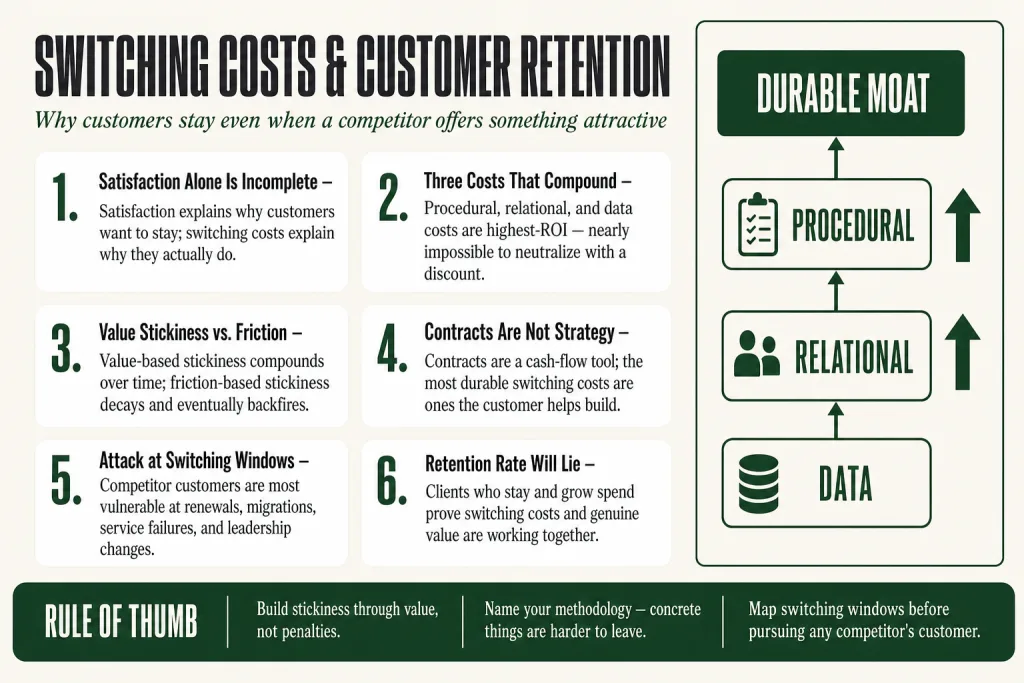
Most operators think about retention in terms of satisfaction, keep customers happy and they’ll stay. That’s true, but incomplete. Satisfaction explains why customers want to stay. Switching costs explain why they stay even when a competitor offers something attractive. The two work together, and the interaction between them is where your margin actually lives.
Here’s the uncomfortable thing this concept forces you to confront: some of the retention you’re crediting to your great service is actually accidental stickiness, customers staying because leaving is a hassle, not because you’ve earned it. That’s fragile. The moment a competitor makes switching easy enough, that inertia evaporates. The operator who understands switching costs can tell the difference between those two situations, and that distinction is worth real money.
The idea in 30 seconds
- Switching costs are everything a customer must sacrifice, money, time, relationships, learned habits, to leave you for a competitor.
- Retention built on value (data accumulation, workflow ownership, trusted relationships) compounds over time. Retention built on friction (penalty clauses, hostage data, artificial hurdles) breeds resentment and eventually blows up.
- The goal isn’t to trap customers, it’s to make staying the obvious rational choice, while also making staying emotionally comfortable.
- For most small operators, the highest-ROI switching costs are procedural and relational, not financial. They cost almost nothing to build and are nearly impossible for a competitor to neutralize with a discount.
- Coercive barriers deter new prospects before the relationship even starts, so the same walls that retain existing clients can quietly kill acquisition.
- By the end of this page, you’ll be able to map your own switching cost inventory, identify which costs are durable and which are accidental, and deliberately build the ones that serve both you and your customer.
Where Switching Costs Come From
Michael Porter gave switching costs their formal strategic footing in Competitive Strategy (1980), where he identified them as one of six primary barriers to entry. His five forces framework treated switching costs as a determinant of buyer power: when they’re high, buyers have less leverage, because the cost of exercising that leverage, leaving, works against them. That framing was about reading industries, not running businesses.
The operator angle came later. In 1999, economists Carl Shapiro and Hal Varian published Information Rulesbringing the concept directly to technology companies. Their core argument: in competitive markets where rivals offer comparable products at comparable prices, the profit you can earn from a customer is roughly equal to the total switching costs that customer faces. Zero switching costs, margins compress toward zero. Real switching costs, real pricing power, not because you’re exploiting anyone, but because you’ve made yourself genuinely harder to replicate.
What’s changed since 1999 is access. Software has made procedural and data-based switching costs available to small operators, not just enterprise giants. A local accountant whose client’s books live inside a customized platform faces the same structural dynamic as a Fortune 500 company migrating off SAP, just at a different scale. And the economists’ warning about coercive barriers has only gotten louder: data portability rules have expanded across the EU and increasingly the U.S. The right kind of switching costs, the ones customers build through their own engagement, have gotten more durable. The wrong kind, contractual traps, locked data, have gotten more legally and reputationally expensive.
The Core Problem: Why Retention Without Switching Costs Is a Leaky Bucket
Consider what happens to a business with zero switching costs. Every customer relationship starts fresh at every renewal decision. A competitor can walk in with a slightly lower price, a slightly better feature, or simply a nice lunch, and your entire relationship history counts for nothing, because leaving you costs the customer nothing. You’re forced to re-win the customer every single period. Margins get competed away. CAC never gets amortized across a long enough customer life. Your business is basically a spot market, and spot markets are exhausting to run.
Now flip the math. A customer who would cost a competitor $5,000 to acquire and $2,000 in migration friction to win from you is effectively worth $7,000 more to you than to that competitor on day one. They have to offer $7,001 in value advantage before switching even makes rational sense. That’s a moat, and you didn’t build it with advertising spend, you built it through the natural accumulation of integration, relationship, and invested time.
This is why switching costs punch so far above their weight. Satisfaction keeps customers who are happy. Switching costs keep customers who are busy, who have invested in your system, whose team has learned your processes, even on the days when they’re mildly frustrated. That’s not cynical. Businesses don’t lose customers only when they fail catastrophically. They lose customers when switching becomes easy enough that a small disappointment tips the scale. Your job is to make sure the scale starts tilted toward staying.
There’s a related insight on the acquisition side that operators miss entirely: understanding competitor switching costs tells you exactly when to attack. Customers don’t evaluate alternatives uniformly over time, they do it at natural switching windows: contract renewals, technology migrations, major internal changes, team turnover. A prospect whose data is deeply embedded in a competitor’s platform is a poor target on a random Tuesday. That same prospect, three months before their annual renewal, after a rough service experience? Completely different conversation. Mapping switching costs, yours and your competitors’, is as much an acquisition tool as a retention one.
The Six Kinds of Switching Costs (and Which Ones Actually Work for Small Operators)
Not all switching costs are equally useful or equally durable. Here’s the practical taxonomy, ordered from most to least reliable for a small-business operator.
1. Procedural Costs, Learned Workflows
These are the costs of learning a new system, reconfiguring a process, retraining staff. They’re often invisible until someone actually tries to switch, at which point they become very visible. A client whose team has spent eighteen months learning your project management templates and reporting formats faces real retraining costs to move. You didn’t have to engineer this deliberately; it emerged from doing good work consistently. That said, you can design for it: building proprietary reporting formats, custom dashboards, or named methodologies that become part of how the client thinks about their own business all raise procedural switching costs organically.
2. Data and Integration Costs
The customer’s own history, transaction records, behavioral data, documented preferences, past project files, lives in your system. Migrating it is time-consuming, lossy, or both. This is the dominant mechanism in software, but it applies in service businesses too. A bookkeeper whose client’s chart of accounts, tax elections, and multi-year records all live in a specific format has created real migration friction. A marketing agency that stores years of customer journey data, A/B test results, and audience segments has too. The practical implication: build systems where customer data accumulates in ways that are useful to the customernot just useful to you. That data becomes a shared asset they’d hate to lose.
3. Relational Costs
This is the one most small operators already build without thinking about it, and the one that’s hardest for a competitor to replicate on any timeline. The relationships your customers have with specific members of your team, the institutional knowledge your team has about the customer’s quirks and history, the informal trust that means a client calls you before a problem becomes a crisis, none of that transfers. A new vendor starts at zero. Relational switching costs are particularly powerful in B2B and professional services, where the bond between buyer and specific practitioner carries real economic value.
4. Financial Costs
Termination fees, prepaid commitments, lost loyalty rewards, the sunk cost of custom equipment. These are the bluntest instrument, effective at creating short-term stickiness, but the ones most likely to generate resentment. Telecom companies built empires on early termination fees and also became synonymous with the phrase “customer hell.” Financial switching costs work best when they’re structured as commitments that also deliver genuine value, multi-year pricing that’s meaningfully cheaper, for instance, rather than as pure penalties for leaving.
5. Compatibility and Ecosystem Costs
When your product or service is wired into a broader ecosystem the customer depends on, replacing one piece means disrupting the whole. Apple is the canonical example, moving away from iOS means losing purchased apps, established iMessage threads, device handoff workflows, and hardware investment. At a small-business scale, this looks like being the IT vendor who also manages the phone system and the backup solution: replacing one piece disturbs the others. Strategic bundling that creates genuine operational interdependence raises switching costs without any penalty clauses required.
6. Psychological and Uncertainty Costs
The devil you know. Switching to an unfamiliar vendor introduces risk: Will the new service be as good? Will the transition go smoothly? Even when a competitor offers a marginally better deal, the risk premium of the unknown can outweigh the expected benefit. This is particularly strong in categories where failures are painful, accounting, legal, healthcare, IT. Customers don’t switch because the cost of being wrong is high, even when they’re not entirely satisfied with the status quo.
For most small operators, the highest-ROI combination is procedural + relational + data. These three compound naturally over the course of a well-managed engagement. You don’t have to impose them, you have to design your delivery model to generate them. Financial switching costs (termination fees, contracts) are a distant fourth. They substitute for the other three when you haven’t built them, which is almost always the wrong reason to reach for them.
Building Switching Costs Deliberately: The Operator’s Playbook
The distinction that matters most in practice: are you building switching costs as a byproduct of delivering genuine value, or are you engineering friction as a substitute for value? That’s not just an ethical question, it’s a strategic one. Value-based stickiness compounds. Friction-based stickiness decays and eventually backfires.
Design your delivery to accumulate customer-side assets
Every engagement decision that deposits something of value into the customer’s account, documented processes, custom templates, historical data, trained preferences, raises switching costs as a natural side effect. The accounting firm that builds and maintains a client’s chart of accounts in its proprietary format isn’t trying to trap anyone; it’s creating a record that genuinely belongs to the client and that genuinely costs something to replicate. Design your service delivery to leave meaningful artifacts: proprietary reports, named processes, custom configurations, accumulated history. These are assets your customer would lose by leaving, which makes leaving more costly, and staying more rational.
Name your methodology
This one is underused by small operators. When you have a distinctive way of doing something, an approach to onboarding, a diagnostic framework, a specific sequence you use for client projects, give it a name. A unique mechanism that becomes part of how the client describes their own business creates a real switching cost. They’d have to explain to any new vendor why they care about the specific diagnostic you developed for them, and then find someone who can actually deliver against it. That’s friction, but friction born from value, not from obstruction.
Build across the relationship, not just at the product level
Relational switching costs come from depth of engagement with specific people on your team, not just from your product’s capabilities. Staffing decisions matter for retention: consistency of account management, senior practitioners who know the client, team members who remember context without being asked. Every handoff between team members is a small erosion of relational stickiness. And client-facing staff turnover is a genuine retention risk, when the person the client trusted leaves, they start re-evaluating the relationship from scratch.
Use integrations to raise ecosystem costs
Connect your service or product to other systems the client already depends on. Not as a technical gimmick, but because genuine integration makes your solution more valuable. A CRM that feeds your invoicing that feeds your reporting dashboard has created an ecosystem where replacing the CRM means disrupting invoicing and reporting too. The integration was justified on its merits. The switching cost is a natural consequence.
Target competitor customers at natural switching windows
Understanding when competitor customers face lower switching costs, renewal moments, technology migrations, team changes, a service failure at the existing vendor, is how switching costs become an acquisition tool. You don’t attack a deeply embedded competitor at a random moment. You map when the switching cost temporarily drops, and you’re ready with a compelling offer precisely at that window. This requires patience and pipeline discipline, but it pays off in acquisition efficiency.
What AI can (and can’t) do here
AI tools can help identify which customers are most at risk of leaving, analyzing engagement patterns, transaction frequency, recency, and support ticket sentiment, and flag the right moments for proactive retention outreach. They can also surface which customers are underintegrated (using only one service when they could use three), and identify opportunities to deepen the relationship through value. What AI won’t do is make the call on which switching costs to build. That’s a strategic decision about your business model, your customer relationships, and the kind of company you want to run. The analysis assists; the operator decides.
Putting this to work? The ideas in the Canon are the foundation under the tactical playbook in Build a Complete Marketing Department — grab the free companion kit at mmsvegas.com/resources.
Switching Costs in Practice: What Real Businesses Actually Did
The conceptual taxonomy above is useful. But it’s easier to see what you’re actually building, or missing, when you look at businesses that got it right, got it wrong, or stumbled into something more complicated than they expected.
Apple: Stickiness that doesn’t feel like a cage
Everyone knows Apple ties you in through iMessage, the App Store, and continuity features that make iPhone, iPad, and Mac work together. The less obvious lesson is why it generates so little backlash compared to, say, carrier termination fees: the ecosystem genuinely becomes more useful the more of it you own. Users aren’t angry about the switching cost, most barely think of it as a switching cost at all. They think of it as a reason they like Apple. That’s the target state. Stickiness that doesn’t feel like a cage.
Adobe Creative Cloud: When switching costs carried a forced migration
In 2013, Adobe killed perpetual licenses for Photoshop, Illustrator, and the entire Creative Suite, moving to subscription-only. The backlash was immediate, a Change.org petition hit over 50,000 signatures, and industry media called the move anti-consumer. Adobe went ahead anyway. Industry estimates place Creative Cloud’s paid subscriber base at approximately 41 million at year-end 2025, and Adobe reported $23.8 billion in total revenue for fiscal 2025, with subscriptions making up over 90% of the total.
What kept customers wasn’t the subscription model itself. It was the procedural investment already baked in: years of mastered workflows, industry-standard file formats that collaborators expected, certification programs that professionals had staked careers on. The subscription made the cost of leaving visible. It didn’t create it.
The story has a cautionary postscript. The FTC originally brought a complaint in June 2024 accusing Adobe of burying early termination fees, sometimes reaching hundreds of dollars, in fine print and behind textboxes. The case was referred to the DOJ, and a proposed settlement filed in March 2026 would require Adobe to pay $75 million in civil penalties and provide an additional $75 million in free services to customers. Even with genuine procedural stickiness already in place, the company layered on coercive financial penalties, and ended up in federal court for it.
Salesforce: The integration is the product
Salesforce’s enterprise dominance isn’t primarily about CRM features, it’s about what happens after eighteen months of use: custom objects, third-party integrations, data history, workflow automations, and a team of people who’ve been certified in the platform. The CRM features are the on-ramp. The integration depth is the actual moat. AppExchange now lists more than 5,600 apps, and every added connection raises the cost of a full migration that much further. Replacing one piece eventually means reconsidering everything.
The small-operator parallel
For operators who don’t run software companies, the parallel is service delivery design. The bookkeeper who has built a client’s entire chart of accounts, multi-year tax history, and payroll structure inside a specific workflow has created the same dynamic at a different scale. The marketing consultant who runs a client’s email automation, manages audience segments, and tracks multi-year campaign performance has created real migration cost. The IT firm that manages phones, backups, security, and networking for a small business has built an ecosystem where replacing one element disturbs the others. None of these required a contract to build. They emerged from doing good work consistently in an integrated way.
Blockbuster: When customer stickiness doesn’t stop a category disruption
Blockbuster had sticky customers, rental history, pre-registered accounts, nearby stores, familiarity with the browsing experience. None of it survived Netflix. Not because customer stickiness isn’t real, but because Netflix didn’t offer a slightly better version of the same thing. It restructured the category around a fundamentally different model. The lesson isn’t that switching costs are invincible, it’s that they buy you time and margin, but they don’t substitute for relevance. If a competitor rewrites the rules of the game, stickiness built on the old paradigm can collapse fast. Build switching costs inside a model that’s structurally sound. Don’t use them to prop up a model that’s becoming obsolete.
Where Switching Costs Work, and Where They Quietly Fail
Switching costs work best in relationships that are inherently longitudinal, where the value of staying increases over time as knowledge, data, and integration accumulate. Professional services, B2B software, managed services, recurring maintenance relationships, and specialty B2B suppliers all fit this pattern. The longer the relationship, the greater the value of continuity, and the greater the cost of starting over. In these categories, switching cost strategy isn’t optional, it’s the primary retention mechanism, because the customer is always doing a periodic calculation about whether the incumbent’s accumulated value exceeds the switching cost plus the competitor’s offer.
Switching costs also work well in categories with high stakes for error. Medical practices, legal advisors, financial managers, IT support, the switching cost here is partly psychological, partly practical. The fear of getting a new provider wrong, the cost of a botched transition, the time required to rebuild institutional knowledge, these are real and significant. You don’t have to engineer them; you have to maintain the quality that makes them feel legitimate.
Where switching costs don’t work, and where over-relying on them is a mistake:
- Commodity-adjacent categories. If your service is genuinely interchangeable with competitors’, same output, same process, same pricing, switching costs create temporary protection at best. The customer knows the switching cost is the only reason they’re staying, and they resent it. Any competitor willing to absorb the switching cost on their behalf can break through.
- Consumer categories with strong social proof alternatives. When switching costs are real but reviews, recommendations, and trial offers make evaluation nearly costless, your stickiness only has to lose to word-of-mouth and curiosity. A dissatisfied customer in a high-review-visibility category is motivated to leave and to tell others about it.
- Categories facing structural disruption. Switching costs are backward-looking, they’re built on investments the customer has already made in the current paradigm. When a new entrant restructures the category, existing switching costs can become irrelevant because the customer isn’t switching from your product to a competitor’s product. They’re switching from one model to an entirely different one.
- One-time or very low-frequency transactions. If a customer only buys from you once every five years, there’s no relationship investment to accumulate. Price, reputation, and fit dominate.
One more honest caveat: high switching costs can deter new customers from ever starting with you. A prospect who perceives your system as a trap they can’t exit is a prospect who never enters. This is the acquisition tax on coercive barriers. The better your switching cost strategy, the more it should feel like deepening commitment to a customer who’s getting more value over time, not like a roach motel. If you’re building switching costs you’d be embarrassed to describe to a prospect, you’re building the wrong kind.
Switching Costs vs. Permission Marketing: The Tension That Sharpens Both
Seth Godin’s permission marketing framework sits in productive tension with switching cost strategy, and understanding that tension is useful. Permission marketing argues that retention should be based on consent, the customer stays because they chose to opt in, continue to consent to the relationship, and derive enough value that they keep saying yes. It’s about earning attention freely given.
Switching cost strategy, taken to its extreme, argues the opposite: build deep enough stickiness that the customer stays even when they’d prefer not to. That’s the coercive end of the spectrum, and it’s where the model breaks down both ethically and practically.
The synthesis isn’t complicated: permission marketing describes the experience you want the customer to have. Switching cost strategy describes the structure you build around the relationship. The best businesses use both, they earn genuine consent through consistent value delivery, and they build structural integration that makes the relationship sticky enough to survive the inevitable rough patches. Neither alone is sufficient. Permission without switching costs produces high churn the moment a well-funded competitor shows up. Switching costs without permission produces a trapped, resentful customer base that leaves en masse at the first available opportunity and tells everyone why they left.
In practice, this means your switching costs should be transparent enough that a prospect would consider them features, not traps. ‘We build all your workflows into our system and store four years of your history’ is a feature if the customer understands it builds over time. ‘You’ll pay $3,000 to leave’ is a trap. The same underlying dynamic, migration friction, reads completely differently depending on whether the customer perceives it as accumulated value or imposed penalty.
What Operators Get Wrong About Switching Costs
Misunderstanding 1: Switching costs are the same as contracts. A multi-year contract is one specific mechanism that raises financial switching costs. It’s not switching costs, it’s one of the bluntest and most resentment-generating forms of them. Most durable switching costs don’t require a contract at all. They emerge from the natural accumulation of value, workflow, and relationship. Operators who think ‘switching costs’ and immediately think ‘cancellation fee’ are solving the wrong problem with the wrong tool.
Misunderstanding 2: High switching costs always benefit the incumbent. They do in the short run. In the long run, high coercive switching costs attract competitors specifically designed to absorb them, T-Mobile’s ‘Contract Freedom’ offer, announced at CES in January 2014, is the textbook case. ETFs at the major carriers could reach up to $350 per line. T-Mobile offered to reimburse the full amount for customers switching from AT&T, Sprint, and Verizon. Any time your switching cost is primarily financial, a funded competitor can neutralize it by simply paying it on your customer’s behalf. The only switching costs that can’t be bought away are procedural, relational, and data-based, the ones that require time, not just money, to rebuild.
Misunderstanding 3: High retention is the same as a healthy retention strategy. High stickiness suppresses the signal of a retention problem. Customers who can’t leave don’t churn, but they also stop providing useful feedback, stop expanding their engagement, and eventually leave the moment the friction weakens. If you’re using switching costs as a substitute for figuring out why customers would want to leave in the first place, you’re building a pressure vessel, not a retention strategy. The metric you want is retained customers who are also expandingthat’s the sign that switching costs and genuine value are working together.
Misunderstanding 4: Switching costs are always rational. A significant portion of the switching cost effect is psychological, habit, familiarity, the discomfort of the unknown. The endowment effect means customers overvalue what they already have relative to what a competitor could offer. Incumbent advantage includes this psychological premium, and it’s real. But it’s also fragile, a single service failure, a particularly compelling competitor narrative, or a change in the customer’s leadership team can reset the psychological calculus. Don’t mistake psychological inertia for structural stickiness. Map what’s actually durable.
Misunderstanding 5: Switching costs are symmetric. Your switching costs and your competitor’s switching costs are completely different assets, and which competitor you’re facing matters enormously. A customer deeply embedded in a competitor’s ecosystem is a much harder acquisition target than one running on a loose month-to-month arrangement. Treating all prospects as equally switchable leads to wasted acquisition spend. Your first question about any prospect should be: what are the switching costs they’re currently facing, and what will it take to make the switch worthwhile?
Common Mistakes
- Delivering switching costs at onboarding, then forgetting to protect them — Here’s a specific thing that happens: you spend the first ninety days of an engagement building out a client’s custom reporting dashboard, documented workflow, and onboarding playbook. Then a team member leaves and takes institutional knowledge with them. Then you migrate to a new platform and lose the historical data configuration. Two years later, the client has less friction holding them than they did in month three, and neither of you noticed. Run a deliberate switching cost audit once a year for your top ten accounts. For each one, list the artifacts your team has built that live in your system (not in a shared Google Drive the client could grab on the way out), estimate the hours it would take a competitor to reconstruct them, and flag anything that’s eroded. That list is a retention asset. Treat it like one.
- Signing multi-year contracts before you’ve built anything worth staying for — A three-year contract signed in month one, before your team has built any real workflow depth, is a cash flow decision dressed up as a retention strategy. When renewal comes, the client evaluates from scratch, because nothing structural changed since they signed. The fix isn’t a shorter contract; it’s tying contract terms to value milestones. Year one at standard rates, year two unlocks a custom reporting suite built specifically for their business, year three includes quarterly strategy sessions where your team presents data no competitor could have without starting over. Now the contract length and the stickiness are growing together. Renewal stops being a negotiation and starts being a recognition of what they’d lose.
- Treating a prospect’s embedded competitor relationship as a wall instead of a clock — A prospect who signed with their current vendor eighteen months ago, CRM customized, staff trained, renewal fourteen months out, is a fundamentally different target than one who’s month-to-month, recently frustrated, and actively comparing options. Chasing the embedded prospect at the wrong moment burns pipeline budget and produces frustration on both sides. Instead, map the switching cost profile before investing in pursuit: integration age, contract timing, any recent service complaints visible on review sites or LinkedIn. Then set a calendar trigger for ninety days before their likely renewal window. That’s when the switching cost math shifts. Patience here isn’t passivity, it’s timing.
- Running exit interviews like a formality — When clients leave, most operators conduct a polite wrap-up call, file the notes somewhere they’re never read, and move on. That exit conversation is one of the most useful data points in your business, and you’re treating it like a thank-you card. Structure it around one specific question: ‘What made the hassle of switching feel worth it?’ The answer tells you exactly which switching costs held and which ones failed. If three clients in a row mention the same thing, say, that your reporting was hard to hand off to their internal team, or that the transition to a new account manager felt chaotic, that’s not a client problem. That’s a repeating process failure with a fixable cause. Run those findings against your onboarding and delivery model quarterly.
- Framing switching costs as a retention story only, not a sales story — Here’s what an IT services firm’s proposal often looks like: paragraph one is credentials, paragraph two is pricing, paragraph three is a contract term with a termination clause buried in the appendix. That’s the wrong order. The switching cost framing that terrifies prospects (‘you’ll be locked in’) is the exact same dynamic that attracts the right ones, when described as accumulated value. Rewrite the sales narrative: ‘In month one we document every system and credential. By month six, we’ll have built a runbook specific to your environment that no other firm will have. By year two, we know your infrastructure the way your own IT director would.’ That’s not a trap. That’s a value promise. Prospects who self-select into that story are the ones worth having.
Operator’s Take
Start with an inventory, and make it specific enough to be uncomfortable. Pick your three best clients and ask: if each of them decided to leave next month, what would it actually cost them? Not in vague terms. In hours. Who on their team would need retraining, and on what specifically? How many of their internal processes have your fingerprints on them? Where does their data actually live, and how painful is extraction? Write it down. Most operators finish this exercise faster than they expect, because the honest answer for at least one of those clients is ‘not much.’ That’s your gap.
Now put a rough number on it. A client who’d need forty hours of staff retraining at a blended rate of $75/hour is sitting on $3,000 of procedural switching cost, before anyone even touches data migration. A client whose engagement history, campaign files, and audience segments live in your platform is looking at a different conversation than one where you’ve been emailing deliverables as PDFs. Get specific. ‘Our switching costs are strong’ is an opinion. ‘Client A faces approximately $8,000 in migration friction and two months of retraining’ is a business asset you can protect, describe to prospects as a benefit, and notice when it starts to erode.
Once you’ve done the inventory, sort what you find into deliberate vs. accidental. Accidental stickiness is fine until something disrupts it, a platform migration, a staff departure, a client reorganization, and then it quietly drains without anyone noticing. Because you never built it consciously, you can’t protect it or rebuild it when it erodes.
The highest-leverage thing most small B2B operators can do this week costs nothing and takes one afternoon: name what you already do. If you have a diagnostic process, an onboarding sequence, a reporting format that clients rely on, give it a name, write it down, and make it part of how you describe your service. The bookkeeper who calls her month-end close process something proprietary isn’t being precious; she’s making it concrete in the client’s mind. Concrete things are harder to walk away from than unnamed habits. Once it has a name, you can train your team to protect it, describe it to prospects as a feature, and notice when it starts to slip.
Now the piece that gets missed most often: staff transitions are retention events. Every time a senior person leaves a client-facing account, you’ve temporarily reduced that client’s cost to leave. They’re re-evaluating from scratch. That’s precisely when a competitor’s outreach lands hardest. Fix this with process, not just goodwill, documented client histories that belong to the account, not the individual; warm handoffs with senior leadership present; a structured first call where the incoming person demonstrates they already know the client’s context. This isn’t about being nice. It’s about not handing a competitor an opening every time HR happens.
Use what you know about switching costs offensively, not just defensively. T-Mobile went to CES in January 2014 and announced it would reimburse up to $350 per line in early termination fees for customers switching from AT&T, Sprint, and Verizon, because they correctly diagnosed that financial switching costs are the one kind money can dissolve. You probably can’t match that budget. But you can match their timing. Map when a target prospect’s stickiness with their current vendor dips: three months before contract renewal, after a service failure shows up on review sites, when a new executive joins who wasn’t part of the original vendor decision. That’s your window. Showing up after they’ve already committed to evaluating three vendors isn’t a pipeline strategy; it’s hope.
Finally: your retention rate will lie to you. A 90% retention figure looks healthy. It might be. Or it might be a room full of clients who stay because leaving is inconvenient, and who are quietly telling their networks about it. The number that tells the real story is expansion revenue alongside retention. Clients who stay and grow their spend are proof that switching costs and value are working together. Clients who are flat year over year at high retention are a yellow flag, stuck, not loyal. Set a target: if fewer than half of your retained clients expanded their engagement in the past twelve months, you have a stickiness problem masquerading as a retention win. Build for the former. The referral business that comes from it is worth more than any contract clause you’ll ever write.
Used in
- ✓ Build a Complete Marketing Department
Used to design the retention layer of the marketing system, specifically, how service delivery decisions, data architecture, and client communication protocols can deliberately raise switching costs as a byproduct of good work. - ✓ The Missing Manual for FunnelKit
Applied when structuring post-purchase automation sequences and customer data accumulation workflows that increase integration depth, and therefore switching cost, with each additional purchase or interaction. - ✓ The Missing Manual for Make
Used when designing automated workflows that embed client data and operational history into interconnected systems, creating procedural and technical switching costs as a natural byproduct of operational integration.
FAQ
What are switching costs in simple terms?
Switching costs are everything a customer would have to give up, spend, or redo to stop working with you and start working with someone else. They can be financial (termination fees), procedural (relearning a new system), relational (losing your team’s institutional knowledge), or data-based (migrating years of history out of your platform).
Can a small business realistically build meaningful switching costs?
Yes, and most already have more than they realize. Procedural and relational switching costs emerge naturally from long-term service delivery: custom workflows, institutional knowledge about a client, accumulated data history, and deep team relationships all raise the cost of switching. The question isn’t whether you can build them; it’s whether you’re building them deliberately or by accident.
When do switching costs backfire?
When they’re coercive, imposed through penalties, contractual traps, or artificially restricted data, rather than earned through value accumulation. Customers who feel trapped are resentful customers. They leave the moment the friction weakens, and they tell others on the way out. High coercive switching costs also deter new prospects who fear entering a relationship they can’t exit on fair terms.
How is stickiness different from loyalty?
Loyalty is a customer staying because they genuinely prefer you. Stickiness is a customer staying because leaving is costly or painful. The best retention strategies produce both, customers who prefer you AND face real costs to leave. Stickiness without loyalty is fragile; loyalty without stickiness is vulnerable to well-funded competition.
How do switching costs relate to customer lifetime value?
Directly. The higher your switching costs, the longer customers stay, the more revenue you earn per customer, and the lower your effective CAC per dollar of lifetime revenue. Economists Shapiro and Varian argued that in competitive markets, a firm’s profit from a given customer is roughly bounded by the total switching costs facing that customer, which means building switching costs and building LTV are essentially the same strategic project.
Should I use contracts to create switching costs?
Contracts are a cash flow tool, not a retention strategy. An annual contract reduces churn on paper but does nothing to make the customer want to stay, and a customer serving out a contract they resent is actively damaging your referral network. Use contracts where they make operational sense, but don’t mistake them for genuine switching costs. The most durable switching costs are ones the customer helps build.
Further reading
- Competitive Strategy by Michael Porter (1980), the original framework that identified switching costs as a barrier to entry and a driver of buyer power; Chapter 1 on structural analysis is the relevant section.
- Information Rules by Carl Shapiro and Hal Varian (1999), the most rigorous operator-level treatment of switching cost types, the economics of retention, and how to both build and attack them; written before the smartphone era but the core taxonomy holds up; treat any post-1999 applications as inference, not cited fact.
- Never Lose a Customer Again by Joey Coleman, practical framework for the post-acquisition phase where switching cost depth is actually built, focused on the first 100 days of a new client relationship.
Sources: Michael Porter, Competitive Strategy (Free Press, 1980); Carl Shapiro and Hal Varian, Information Rules (Harvard Business School Press, 1999); Joseph Farrell and Paul Klemperer, ‘Coordination and Lock-In: Competition with Switching Costs and Network Effects,’ Handbook of Industrial Organization (Elsevier, 2007); Harvard Business School Working Knowledge, ‘Information Rules: Avoiding Lock-In in the Information Economy’ (1999); sqmagazine.co.uk, ‘Adobe Creative Cloud Statistics 2026: Subscribers, Revenue and Market Share’ (June 2026), industry estimates place the Creative Cloud paid subscriber base near 41 million at year-end 2025, per ProDesignTools reconstruction; Adobe fiscal year 2025 Form 10-K via sqmagazine.co.uk, total revenue $23.77 billion; U.S. Department of Justice, proposed stipulated order filed March 13, 2026, resolving allegations under the Restore Online Shoppers’ Confidence Act, Adobe agreed to pay $75 million in civil penalties and provide $75 million in free services to customers; settlement pending court approval as of publication; newsshooter.com, ‘Adobe has agreed to a $150M Settlement to Resolve Allegations of Hiding Fees’ (March 2026); T-Mobile Newsroom, ‘T-Mobile Delivers Contract Freedom for Families By Paying Off Early Termination Fees’ (January 8, 2014), ETFs capped at $350 per line; Forcetalks / SFApps.info, ‘State of AppExchange Salesforce Apps Market 2025’, AppExchange lists more than 5,600 apps as of 2025; Wall Street Prep, ‘Switching Costs: Definition and Examples’ (2024); FasterCapital, ‘Switching Costs: How to Create and Leverage Switching Costs’ (2024).
Brian Kasday spent forty years in direct-response marketing before rebuilding the whole operation as a one-person shop. He writes The Operator’s Library — including “Build a Complete Marketing Department” — for operators who’d rather build it themselves than wait on someone else.
Build the department these ideas describe — the free companion kit: mmsvegas.com/resources.
More The Operator's Canon guides
Free · Operator Toolkit
Want the tools, not just the guide?
Get the free operator toolkit — templates and checklists for the systems you actually run, plus a note when this guide changes.
Get the free toolkit →How to cite: Switching Costs & Customer Retention. Associated with Michael Porter, 1980. The Operator’s Canon, MMS Vegas. https://mmsvegas.com/library/switching-costs-lock-in-explained/