
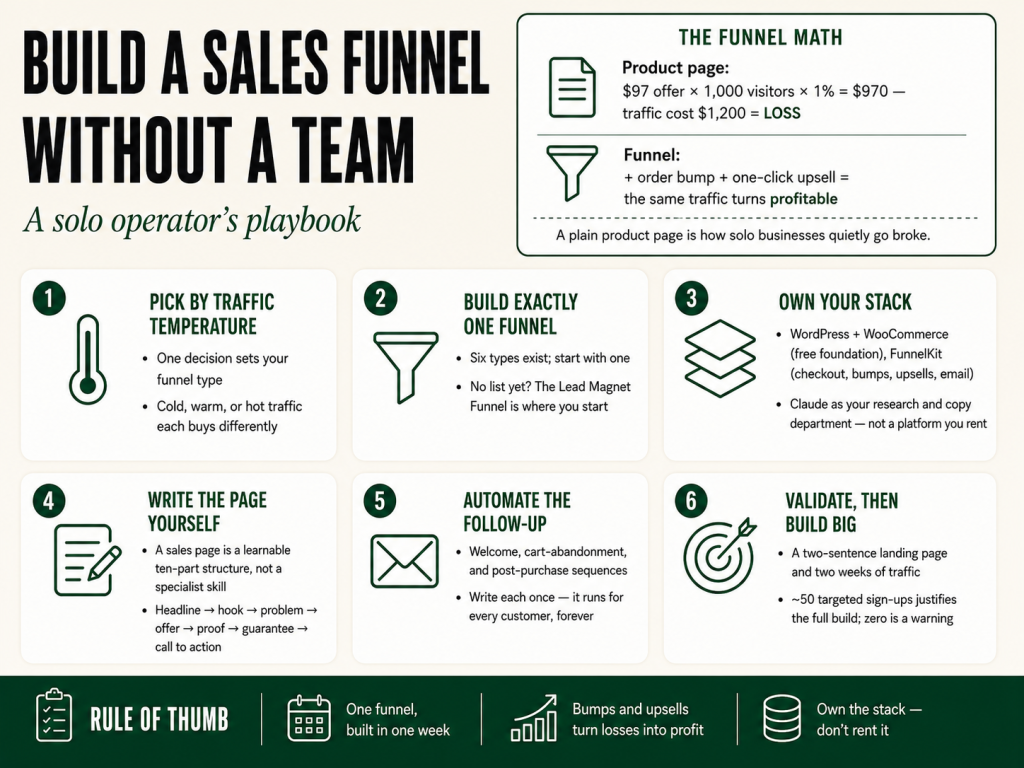
You have a product. You do not have a team. Somewhere between those two facts sits the thing everyone tells you that you need next, a sales funnel, and the quiet assumption that building one requires a developer, a designer, a copywriter, and a few thousand dollars you would rather keep. It does not. You can build a sales funnel without a teamby yourself, on software you own, and have it running this week. This is the solo operator’s playbook for doing exactly that.
The premise of Build a Complete Marketing Department for a Few Bucks a Day is that some work an agency charges thousands to set up can now be handled by one operator with the right stack and a disciplined build process. The author opens that book with a $14,400 invoice from an agency that, after six weeks, delivered a landing page converting at 1.2 percent, ninety-nine of every hundred visitors looked and left. You are not trying to clear a high bar. You are trying to not waste your traffic. A funnel you build yourself, with intent, can beat that.
What a sales funnel actually is (skip the jargon)
Strip away the diagrams and a funnel is just a sequence that moves a stranger from first encountering you to becoming a paying customer. Every funnel, in every industry, runs through the same five stages: Awareness, Interest, Consideration, Decision, and Retention and Expansion.
Here is the part that saves you money. The first two stages, Awareness and Interest, happen outside your funnel software. They are your ads, your SEO, your social posts, the podcast you guested on. Your funnel tool picks the visitor up at the Consideration stage, when someone is on your page deciding. So you are not building a machine that does everything. You are building the part that converts attention you already earned. That is a much smaller job, and it is one person’s job.
The one decision that sets your funnel type: traffic temperature
Before you choose a funnel, answer one question: is your traffic cold or warm?
Cold traffic has never heard of you. It needs a soft entry, a free guide, a free-plus-shipping product, a piece of value before you ask for anything. Warm trafficyour email list, repeat visitors, an audience that already follows you, can go straight to the offer. As the book puts it, making a warm buyer opt in again before you will sell them anything is its own kind of friction. Most solo operators get this backwards and send cold strangers straight to a buy button. Match the entry to the temperature and your conversion problem is half-solved before you write a word.
The six funnel types, and which one to build first
There are six funnel types worth knowing, and as a one-person operation you should build exactly one of them to start.
- Lead Magnet Funnelyou give something valuable away free in exchange for an email. The email list is the main event. This is where you start if you have nothing yet, no audience, no list, no proof of concept.
- Free-Plus-Shipping Funnela physical product is free; the customer pays only shipping (typically $5.95 to $9.95). The right move if you have a physical product and want low-cost customer acquisition.
- Tripwire Funnela low-priced offer, typically $7 to $37, made immediately after an opt-in to convert a subscriber into a buyer.
- Webinar Funnelfor products priced above $500, delivered through a 60-to-90-minute presentation that is roughly seventy percent value and thirty percent offer.
- Challenge Funnela five-day challenge that converts twenty to thirty percent of active participants. Good for an existing audience and a higher-ticket offer.
- Application Funnelfor coaching or services at $3,000 and above, where you are not selling, you are qualifying.
The decision rule is blunt: if you have nothing, start with the lead magnet funnel. If you have a physical product and want cheap acquisition, run free-plus-shipping. High-ticket offer with an audience? Webinar or challenge. Selling services? Application funnel. And the rule that matters most for a team of one: start with one funnel, build it properly, and optimize it before adding complexity. A single well-executed funnel usually beats three half-built ones.
Build it on tools you own, not a platform you rent
The reason a solo operator can do this for a few dollars a day is the stack. The book’s three-tool stack is WordPress plus WooCommerce (the free foundation), FunnelKit (the marketing layer that builds your checkout pages, order bumps, one-click upsells, and email automations), and Claude (your research department, strategist, and copywriter, around $20 a month). In the book’s lean-stack model, the core setup lands around $55, $75 a month, depending on hosting, plugin tier, and usage.
The durable difference is the shape of the pricing, not any single number. Hosted funnel platforms, ClickFunnels, Kartra, Kajabi, bill monthlyand the funnel lives on infrastructure you rent. FunnelKit runs as an annual WordPress/WooCommerce plugin on a site you own outright, so the funnel, the customer list, and the data are yours. The exact plan prices move constantly and these tools show annual, introductory, and renewal pricing differently, so compare any stack on annual cost, renewal cost, and data ownership rather than the lowest advertised monthly number. If you want the chapter-and-verse on building the checkout, the order bumps, and the upsell pages, that is the entire subject of The Missing Manual for FunnelKitand our FunnelKit library guides cover the execution step by step.
Write the page yourself, in your own voice
Copy is where most solo operators freeze, because they think writing a sales page is a specialist skill. It is a learnable structure. The book gives a ten-part architecture for a converting sales page, in this order, because the order mirrors how a person actually decides to buy: headline, opening hook, problem statement, agitation, solution introduction, offer presentation, social proof, value stack, guarantee, call to action.
Each element has one job. The headline’s job is to get the subheadline read. The subheadline’s job is to get the body copy read. The body’s job is to build desire and answer objections. The CTA’s job is to turn that desire into a click. You do not need to invent this from scratch, you feed that structure to Claude as a framework, paste in the real language your customers use, and direct it sentence by sentence. Then run the draft through a devil’s advocate pass: ask the AI to read your page as your most skeptical potential customer and list the ten reasons they would not buy. Fix those ten things. That single step will do more for your conversion rate than any headline trick.
The math that makes a one-person funnel profitable
Here is why the funnel, not just a product page, is worth building. Take a $97 core offer, 1,000 visitors, and a 1 percent conversion. That is 10 sales, $970. If you paid for that traffic at $1.20 a click, you spent $1,200 to make $970. You just lost $230. A plain product page is how solo businesses quietly go broke.
Now add the two pieces a funnel gives you. An order bump is a single checkbox offer on the checkout page, no re-entering payment. Twenty to thirty percent of buyers take one. A one-click upsell fires after the purchase is complete and is accepted with a single click; fifteen to twenty-five percent take it. The book’s worked example: ten sales at $97 is $970; a $27 bump at 25 percent adds about $67; a $67 upsell at 20 percent adds about $134; a second upsell nudges the total to roughly $1,200. That is a twenty-four percent revenue increase from the same trafficand your average order value climbs from $97 to about $120. The traffic that lost $230 now breaks even, and every optimization after that is profit. Running a funnel without a bump and at least one upsell leaves roughly thirty to sixty percent of your potential revenue on the table.
The discipline here: the upsell is not a second attempt to sell something they refused. It is an upgrade or expansion of the decision they just made. The fitness program buyer gets offered the $27 meal plan. The coffee sampler buyer gets the fourth bag. Make the bump and upsell feel like the obvious next step, not a new pitch. (These take-rate ranges are directional industry figures, not guarantees, but the structure is what matters.) For the deeper build on bump and upsell sequencing, see the FunnelKit manual.
Automate the follow-up so you can sleep
A funnel that only sells at the moment of purchase is leaving the relationship, and most of the lifetime value, unbuilt. The same FunnelKit layer that runs your checkout also runs your email: welcome sequences, cart-abandonment sequences, post-purchase sequences. As a one-person shop, this is your leverage. You write the sequence once and it runs for every customer, forever, while you do something else.
When your follow-up grows past what a single tool handles cleanly, syncing customers to other systems, triggering fulfillment, multi-step logic across apps, that is where a dedicated automation platform earns its place. Our Operator’s Library covers that layer in the Make guides, and The Missing Manual for Make is the full reference. Start with FunnelKit Automations; reach for more only when you have outgrown it.
Validate before you build the big version
Do not spend a month perfecting a funnel for a market that will not buy. The cheapest test in business is a minimal lead-magnet landing page: a two-sentence description and an opt-in form, a little traffic, two weeks. As a rule of thumb in the book, fifty targeted sign-ups is enough to justify building the full funnel; zero sign-ups from two weeks of consistent effort is a warning that the offer, audience, or promise is wrong. Build the full funnel after the market has raised its hand, not before. If you are still choosing what to sell, start one step earlier with market research with AI.
Your one-week build plan
Day one: pick your single funnel type from traffic temperature. Day two: install WordPress, WooCommerce, and FunnelKit on owned hosting. Day three: design the offer and the one order bump and one upsell. Day four: write the page against the ten-part structure with Claude, then run the devil’s advocate pass. Day five: build the checkout, bump, and upsell in FunnelKit. Day six: write the welcome and abandonment sequences. Day seven: turn on a trickle of traffic and watch the numbers. One funnel, built properly, usually beats three half-built ones.
Frequently asked questions
Can I really build a sales funnel without a team or a developer?
Yes. To build a sales funnel without a team you need WordPress, WooCommerce, and FunnelKit on hosting you own, plus an AI like Claude to help you write the copy. The funnel software handles the checkout, order bumps, one-click upsells, and email automations that used to require specialists. In the book’s lean-stack model the whole setup runs around $55 to $75 a month, and a focused operator can have a working funnel live in a week.
Which sales funnel should a beginner build first?
If you have no audience, list, or proof of concept yet, build a lead magnet funnel, give away something valuable in exchange for an email and build your list first. If you sell a physical product and want low-cost customer acquisition, build a free-plus-shipping funnel. Build only one funnel to start and optimize it before adding another.
How much extra revenue do order bumps and upsells actually add?
In the book’s worked example, adding one order bump and two one-click upsells to a $97 offer raised total revenue about twenty-four percent and lifted average order value from $97 to roughly $120, from the same traffic. Skipping them leaves an estimated thirty to sixty percent of potential revenue unclaimed. Actual take rates vary; treat the ranges as directional.
Do I need an expensive platform like ClickFunnels?
No. Hosted platforms like ClickFunnels bill monthly and the funnel lives on infrastructure you rent. FunnelKit runs as an annual WordPress/WooCommerce plugin on a site you own outright, so you keep the funnel and the customer data. Plan prices change often, so compare on annual cost, renewal cost, and data ownership, but for a solo operator watching costs, owning your funnel on FunnelKit is the durable advantage.
How do I know my funnel will convert before I invest in it?
Validate first. Put up a minimal landing page with a two-sentence description and an opt-in form, drive a little targeted traffic, and give it two weeks. As a rule of thumb, around fifty targeted sign-ups means a real market worth building the full funnel for. Zero sign-ups after two weeks of effort means the offer or the audience is wrong, fix that before you build.
Build your funnel the way an operator would
The full system, choosing your funnel, designing the offer, writing the copy with AI, and wiring the upsell math, is laid out in Build a Complete Marketing Department for a Few Bucks a Day. Start with the free companion guide, From WooCommerce Cart to a Funnel That Converts in a Weekendand build the version that pays for itself. Get the book and the guide here.
Building your marketing without a team? The playbooks, prompts, and templates behind the one-person marketing department live in one place. Get the full toolkit at mmsvegas.com/resources.
Sources
Brian Kasday, Build a Complete Marketing Department for a Few Bucks a DayChapter 3 (the three-tool stack and platform pricing), Chapter 12 (funnel stages, funnel types, and which to build), Chapter 13 (the ten-part sales page architecture), Chapter 14 (the upsell math), Chapter 18 (offer design). Conversion and take-rate ranges are directional figures drawn in the manuscript from industry data published by FunnelKit, ClickFunnels, and direct response practitioners; actual results vary. Platform pricing changes frequently; verify current vendor pricing directly before relying on any figure.
Brian Kasday writes The Operator’s Library for MMS Vegas — production-grade reference manuals for the tools small operators actually run.
More Marketing guides
Free · Marketing Operator Toolkit
Running marketing on your own?
Get the free toolkit — the templates and the expensive mistakes behind a one-person marketing department, plus a note when this guide changes.
Get the free toolkit →