
Table of contents
- The 30-second answer
- Why your AI copy sounds like AI
- How to write marketing copy with AI: start with specific context
- The five-element prompt that writes usable copy
- The iteration protocol: the first draft is never the point
- Train the model on your voice so it stops sounding generic
- The devil’s-advocate pass before you publish
- A worked example: one email, weak prompt vs. strong
- Frequently asked questions
You typed “write a marketing email for my business,” got back something bland and vaguely robotic, and concluded that AI can’t really write copy. That conclusion is wrong, but the experience was real. The gap wasn’t the model’s ability, it was the prompt. Learning how to write marketing copy with AI is a skill, and like any skill the distance between a beginner and someone who’s learned it properly is enormous. The good news for a solo operator is that it’s a small skill to learn, and it cuts your dependence on outside copy help for the day-to-day copy a small business constantly needs. This is the method, not a pile of copy-paste prompts, but the way of prompting that lets you write your own for most of the marketing copy your business needs.
A copywriter is expensive because good copy takes judgment. AI can draft, pressure-test, and revise fast, but the judgment still has to come from you, and the skill is directing the model well enough that its drafts are worth your judgment. Directing it well comes down to five elements, one non-negotiable habit, and a review pass that catches what you’re too close to see.
The 30-second answer
To write marketing copy with AI that you’d actually use:
- Give it specific context, not generic contextwho the audience is, what your voice sounds like, what the copy is for, and the objection it has to overcome. Everything you don’t specify, the model fills in with a bland default.
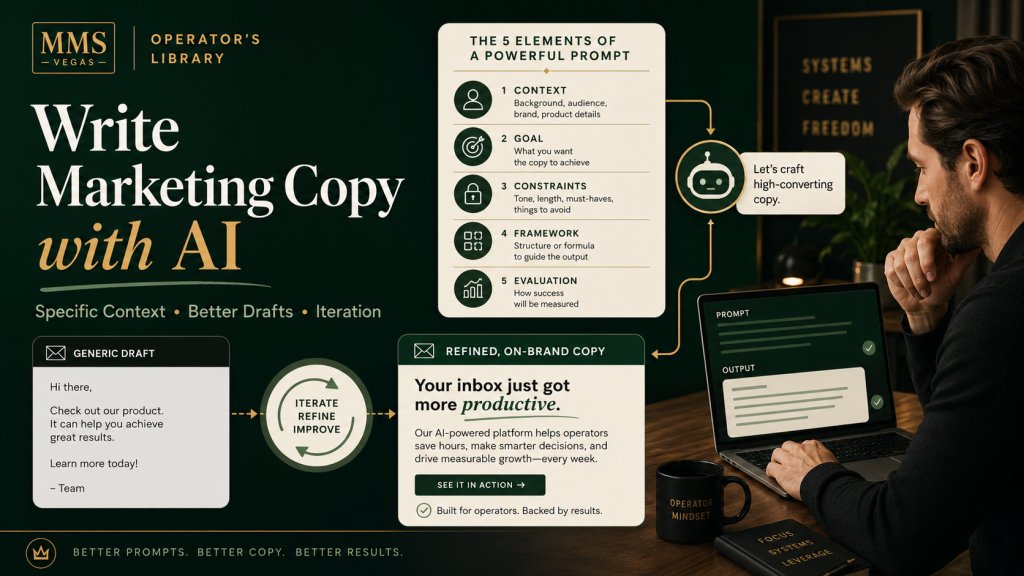
- Use the five-element promptContext, Goal, Constraints, Framework, and Evaluation Criteria. Missing elements are why most prompts come back useless.
- Treat the first output as a draftread it fully, name the three to five specific things to change, and iterate two or three rounds. Don’t give up after one.
- Train it on your voicepaste real examples of your writing so its drafts start close to how you actually sound.
- Run a devil’s-advocate passhave the model read your copy as a skeptical buyer and list what would stop them from buying, before you publish.
Why your AI copy sounds like AI
The pattern is consistent, and it’s the same one that makes people give up: they ask a vague question, get a vague answer, decide the tool isn’t useful for real work, and go back to doing everything the slow way. The problem is almost never the model’s capability. The problem is the gap between what they asked for and what they needed to ask for.
Here’s the mechanism. The model doesn’t know your business, your voice, your audience, or the specific thing you’re trying to accomplish, unless you tell it. Everything you leave unspecified, it fills in with a default. Those defaults are usually fine. But “fine” is exactly the problem: fine copy is generic copy, and generic copy is what sounds like AI. It reads like a wellness brand on Instagram or a corporate marketing department because, absent instruction, that’s the average of everything the model has seen. Your job isn’t to get the model to be more creative. It’s to remove the ambiguity that’s forcing it to be average.
How to write marketing copy with AI: start with specific context
The single most impactful change you can make to any copy prompt is to add specific context, and the emphasis is on specificnot just more words. Consider the difference. “Write an email for my health business” is generic context. Now the specific version:
“Write a broadcast email for my list of 3,200 health-conscious women aged 35 to 50 who subscribed through my gut-reset lead magnet. My voice is conversational and honest, I write like I’m talking to a friend who trusts my health knowledge, not like a wellness brand on Instagram. This email announces a 3-day flash sale on my fermentation kit. The main objection to handle is that people think fermentation is complicated. The subject line should create curiosity.”
Same task. Wildly different output, because the second version hands the model the whole picture before asking it to write a word, the audience, the voice, the goal, and the exact objection to overcome. Before any important copy prompt, ask yourself one question: what does the model need to know to give me something I’d actually use? Write that down and put it in the prompt. And if you have past copy you’re proud of, paste it in as an example, showing the model good work does more than describing it. The research that produces this kind of specific context, who the customer really is and what they actually want, is its own task, covered in market research with AI.
The five-element prompt that writes usable copy
Specific context is the foundation. The full structure is five elements, and once you know them you start noticing when one is missing, which is exactly when output comes back useless. They don’t have to appear in order or carry equal weight, but the best copy prompts contain all five.
Context. The world the copy lives in: your business, your customer, your brand, the relevant history. “I run an online business” is weak. “I run a direct-to-consumer specialty coffee subscription, three-bag sampler boxes at $49/month, roughly 60% gift buyers and 40% personal subscribers, average subscriber stays four months, and we pride ourselves on origin storytelling” is strong. The strong version hands over the picture; every line the model writes afterward sits inside it.
Goal. What you want produced, stated explicitly. “Help me think through pricing” gets a meandering essay. “Generate three pricing options for a $297, $997 B2C course aimed at busy professionals, each with the core price, the upsell price, and the rationale” gets something you can decide on.
Constraints. The limits that focus the output, voice rules, format, things to include or avoid. Constraints aren’t restrictions on the model; they’re guidance that makes the copy sharper. Useful ones: “Write in plain English, if you’d say it differently to a friend at dinner, say it that way here.” “Don’t use ‘leverage’ as a verb, and don’t use ‘unlock,’ ‘empower,’ or ‘transform.’” “Output five labeled variations, no preamble, no summary.” “This is for small-business owners with no marketing background, don’t assume they know what a CTA or a tripwire is.” A prompt without constraints asks for whatever the model thinks you want; a prompt with good ones produces what you actually need.
Framework. The methodology or lens to apply, this is where strategic sophistication enters the copy before a word is written. Ask for a sales page and you get a sales page; ask for a sales page built on PAS (problem, agitation, solution) with the agitation getting twice the space of the problem, and you get copy on a proven structure. Frameworks worth naming: AIDA (attention, interest, desire, action), risk reversal for an offer, the three growth levers for an idea list. The model can follow named marketing structures, name the framework and it knows the shape you’re asking for. The copywriting frameworks themselves are the subject of how to write a sales page yourself.
Evaluation criteria. How you’ll judge the result, effectively a scoring rubric the model writes against. “Write some subject lines” is weak. “Write ten subject lines for a Black Friday promotion; each under 50 characters, each creating curiosity without clickbait, at least three not mentioning Black Friday, and the whole set sounding like a real person rather than a corporate marketing department” is a rubric. State the criteria and the output comes back dramatically closer to usable.
You don’t need all five every time, a simple task can skip Framework and Evaluation. The real skill isn’t memorizing the list; it’s noticing, when a draft comes back wrong, which element was missing or weak, and fixing that one specifically before you run it again.
Want the prompts already built? The free prompt library that ships with Build a Complete Marketing Department includes the Voice Training prompt and the Devil’s Advocate copy-review prompt referenced in this article, ready to paste your own material into. Grab the prompt library →
The iteration protocol: the first draft is never the point
The most common mistake after learning to write a good prompt is expecting the first output to be finished. It’s a draft. Excellence comes from a specific feedback-and-revision loop, and it’s a short one:
- Read the whole output before reacting. Don’t start editing in your head halfway through, understand what the model did before you decide what to change.
- Name the three to five most specific things to fix. Not “make it better.” Instead: “the second paragraph is too formal, the transition after paragraph four doesn’t work, the CTA is weak, and the opening hook is generic.”
- Give that feedback back, including what you liked. Telling the model what worked isn’t politeness; it tells it which elements to preserve while it fixes the rest.
- Repeat. Two or three rounds of specific feedback usually gets you to something genuinely good. If you’re still unhappy after three, the problem is probably in the original prompt, not the execution, rewrite the prompt more specifically.
The trap is quitting after one round because the draft wasn’t perfect. First drafts almost never are. The second and third, shaped by specific feedback, are where usable copy comes from, and this loop is the entire reason one person can do a copywriter’s job.
Train the model on your voice so it stops sounding generic
Even a well-structured prompt will default to a generic register unless you teach the model how you actually sound. This is one of the highest-return things you can set up once and reuse forever. The method is simple: give the model real examples of your writing, actual emails, posts, or copy you’ve written, ideally a few hundred words each, and ask it to describe your voice back to you along specific dimensions: sentence length and structure, formality, phrases you reach for, things you’d never say, how you open and close, your use of humor, and how you talk to the reader. Then have it write a short test piece in that voice.
The magic is in the feedback that follows. When the test piece comes back, tell it precisely what’s right and what’s off: “you got the sentence length, but the opening is too formal, I never start with a statement, I start with a question or an observation.” That level of specific voice feedback sharpens every draft afterward. The more real writing you feed it, the smaller the gap between its draft and your published voice, and the smaller that gap, the less editing you do on everything else you write together, from your welcome email sequence to the page behind your next offer. If email copy is a priority, the same voice discipline applies to your abandoned cart emails, where generic tone is especially costly.
The devil’s-advocate pass before you publish
Here’s the part solo operators skip and shouldn’t. Before you publish any important piece of copy, run it through a devil’s-advocate prompt. Paste in the sales page, email, or offer and tell the model to read it as your most skeptical potential customer, someone who’s been disappointed by products like yours before, reads everything critically, defaults to “no,” and isn’t impressed by marketing language. Ask, in that role, for the ten things that would make them not buy, the claims that read as too vague to believe, the trust gaps, the questions the copy leaves unanswered, and the single most important change.
It’s a humbling prompt, and that’s the value. When you write copy alone, you have no skeptical colleague to catch the buried guarantee, the overreaching claim, or the obvious question you forgot to answer, you’re too close to the work. The model plays that role on demand. Run it on every major piece before it goes live, and you fix the objections in private instead of watching them cost you sales in public. This is the same critical-eyes move that protects a solo product launchand it pairs naturally with getting your positioning sharp enough that the copy has something real to say. Where the finished copy actually goes, the checkout, the order bump, the funnel pages, is wired up in the FunnelKit guides.
A worked example: one email, weak prompt vs. strong
Say you sell a $39 meal-prep planner and you want a re-engagement email to subscribers who’ve gone quiet.
The weak prompt: “Write a re-engagement email for my meal-prep business.” What comes back is competent and lifeless, “We miss you! Here’s what’s new…”, because you gave the model nothing to work with, so it wrote the average of every re-engagement email ever sent.
The strong prompt uses the five elements. Context: a $39 printable meal-prep planner sold to busy working parents who bought once and haven’t opened an email in 60 days. Goal: one email that gets a click back to a free “5-dinner reset” resource, not a hard sale. Constraints: plain English, under 150 words, warm and a little self-aware, no “we miss you,” subject line under 40 characters. Framework: lead with the reader’s real problem (weeknight dinner chaos), not with the product. Evaluation: it should feel like a text from a friend who happens to run a business, and a stranger should understand the offer in one read.
Then you iterate. The first draft nails the tone but opens too slowly, so you tell it exactly that, and that you liked the subject line, and ask it to cut the first two sentences and open on the problem. Round two lands. Total time: a few minutes. That’s the difference between “AI can’t write copy” and a re-engagement email you’d actually send, and the only thing that changed was how you asked.
Frequently asked questions
How do I write marketing copy with AI that doesn’t sound like AI?
Remove the ambiguity that forces the model to write a generic average. Give it specific context, the exact audience, your voice, the goal, and the objection to overcome, and train it on real samples of your own writing. Then use the five-element prompt (Context, Goal, Constraints, Framework, Evaluation), iterate two or three rounds with specific feedback, and run a devil’s-advocate pass before publishing. Copy sounds like AI when the prompt left too much unspecified; specificity is the fix.
What are the five elements of a good copy prompt?
Context (your business, customer, and brand), Goal (exactly what you want produced), Constraints (voice rules, length, format, things to avoid), Framework (a named methodology like PAS or AIDA), and Evaluation Criteria (the rubric you’ll judge the output against). You don’t need all five for every task, but knowing them lets you diagnose a bad draft, when output comes back wrong, it’s usually because one element was missing or weak.
Can AI replace a copywriter for a small business?
Often, yes. For day-to-day marketing copy, emails, landing pages, product descriptions, ads, a solo operator who prompts well can produce usable copy without hiring one. The catch is “prompts well”: the output is only as good as the context, constraints, and iteration you put in, and it still needs your editing pass and judgment. Think of it as replacing the expensive drafting labor while you keep the strategic and editorial control, not as removing the human entirely.
Why does the AI keep giving me generic marketing copy?
Because you’re leaving too much unspecified, and the model fills every gap with a bland default. “Write an email for my business” tells it almost nothing, so it writes the statistical average of all business emails. Add the specific audience, your voice with real examples, the single objection to overcome, and a clear goal, and the output stops being generic. Generic copy is almost always a symptom of a generic prompt.
How many rounds of feedback does good AI copy take?
Usually two or three. Treat the first output as a draft: read it completely, identify the three to five most specific things to change (including what you liked so the model keeps it), and give that feedback back. Most copy reaches “genuinely good” by the second or third round. If it’s still off after three, the problem is likely the original prompt rather than the execution, rewrite the prompt more specifically and start again.
Does AI work for short-form copy like email subject lines and ad headlines?
Yes, and it’s one of the highest-return uses. Generate ten or twenty variations fast, apply your Evaluation Criteria to filter them, and you avoid the blank-page problem entirely. The key is the same as long-form: specify the audience, the goal, the constraints (character limit, tone, what to avoid), and give it a rubric. “Write subject lines for a re-engagement email” returns guesses. “Write ten subject lines under 45 characters for a re-engagement email to lapsed buyers, curious tone, no discount mention, no ‘we miss you’” returns a set you can actually choose from.
Sources
Grounded in Build a Complete Marketing Department for a Few Bucks a Day by Brian Kasday, Chapter 20 (The Most Effective Way to Prompt AI: the Principle of Specific Context, the Five Elements of a Great Business Prompt, the Iteration Protocol, and Voice Training) and Chapter 21 (Advanced AI Techniques: the Devil’s Advocate copy-review technique). Chapter 13 (Writing Copy That Sells Without Sounding Like Copy) provides the copywriting frameworks referenced.
Brian Kasday spent 40 years in direct-response marketing before rebuilding the entire capability as a one-person operation, strategy, funnels, copy, and automation, using classic discipline and a few-dollars-a-day AI stack. He writes The Operator’s Library for MMS Vegas.
Write the whole department’s copy yourself. Build a Complete Marketing Department for a Few Bucks a Day is the full system, positioning, offers, funnels, and the prompt library that produces the copy. Get the book → | Download the free prompt library →
More Marketing guides
Free · Marketing Operator Toolkit
Running marketing on your own?
Get the free toolkit — the templates and the expensive mistakes behind a one-person marketing department, plus a note when this guide changes.
Get the free toolkit →