
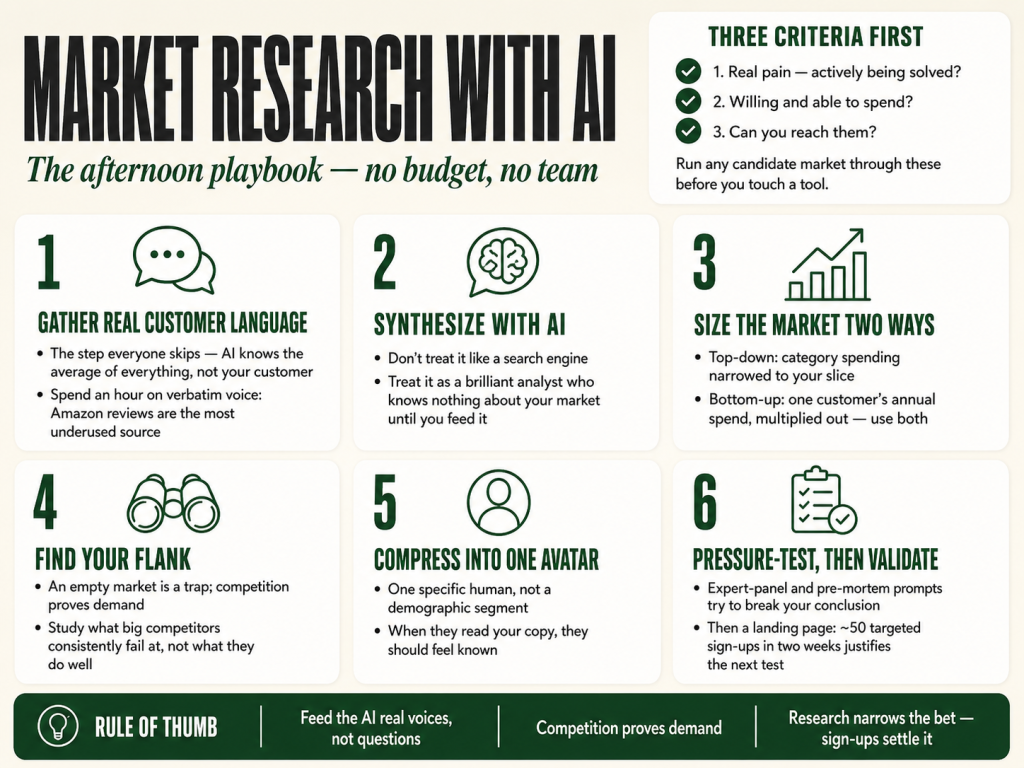
You are about to build something, a product, an offer, a whole business, and the honest question underneath the excitement is: will anyone actually pay for this? A traditional agency-style research project can cost thousands and take weeks. For an early-stage decision, you can do a useful first pass yourself in an afternoon, for the price of an AI subscription. This is how to do market research with AI as a solo operator with no research budget and no team, and come out with a decision you can actually build on.
Here is the uncomfortable truth that makes this the highest-leverage hour you will spend: most businesses do not fail in execution. They fail in market selection. They build something competent for a market that was never going to buy. The research below is how you avoid being that statistic, not by guessing more confidently, but by listening to what your market is already saying out loud. (“No research budget” here means no agency, panels, or paid survey tools, not zero software cost; you will want an AI subscription, around $20 a month.)
Start with the three criteria that matter
Before any tool, run a candidate market through three questions, from Build a Complete Marketing Department:
- Are there people in this market who are in real pain? Not mild annoyance. Pain people are actively trying to solve.
- Are those people willing and able to spend money? If people are already spending, say, $200 a year in a category, that proves the market.
- Can you reach the people who have this pain? A real market you cannot reach efficiently is not a market you can serve.
All three have to be yes. A market with intense pain and no money is a charity. A market with money you cannot reach is a daydream. Hold every idea against these three before you invest a single hour building.
Step 1, Gather real customer language (before you touch AI)
This is the step everyone skips, and skipping it is why most AI research comes back generic. The AI does not know your customer. It knows the average of everything. Your job is to feed it the specific, unaveraged voice of real people. So before you open a single prompt, spend at least an hour gathering verbatim customer language from where it already lives:
- Amazon reviewsone of the highest-value, most underused sources of free market intelligence. Read every one-, two-, and three-star review of the products near your idea. The gap between what the top products promise and what the negative reviews complain about is your opportunity.
- Redditthe subreddit structure is essentially an organized directory of human problems. Find the relevant subreddit and look for the recurring thread, the complaint that resurfaces every few weeks.
- Facebook groups and YouTube commentsespecially comments on how-to videos, where “this didn’t work for me because…” tells you exactly where existing solutions break.
- Niche forumsthe older and more specific, the better the language.
Copy the actual sentences. Not summaries, the real words, typos and all. This raw language is the single biggest determinant of whether the next step produces gold or mush.
Step 2, Synthesize with AI (the prompt that does the work)
Now you bring it to the AI. The mistake to avoid is treating it like a search engine and typing “what are the problems in the fitness market.” Treat it instead as a brilliant analyst who has read everything but knows nothing about your specific market until you tell it.
The book’s Market Discovery Prompt takes the customer language you gathered and returns five things: a pain intensity map (the most significant pain points ranked by urgency and willingness to spend), buyer segments (three to four meaningfully different groups), a competitive landscape overviewopportunity candidates (specific gaps to enter), and reach channels. The author is blunt about the dependency: the quality of this output is almost entirely determined by the quality of the raw research you paste in.
What makes a prompt like this work is specificity. The most impactful change you can make to any business prompt is adding specific context, not generic context, specific context, because everything you do not specify, the AI fills with defaults, and “fine” is not what you are optimizing for. The book frames a strong prompt as five elements: context, goal, constraints, framework, and evaluation criteria. Name the framework you want it to use. Give it a scoring rubric, not a wishlist. Then read the whole output before reacting, identify the three to five things to change, and give specific feedback, usually two or three rounds gets you to something genuinely useful. You are directing an analyst, not pressing a button.
When you read the synthesis back, look for three signals: pain points described with emotional specificityclear evidence of existing spending, and gaps that line up with something you are actually good at.
Step 3, Size the market before you commit
A pain that is real but tiny is still tiny. Size it two ways, used together. Top-down starts broad and narrows toward your slice, total category spending down to your specific addressable piece, and tells you whether you are in a large or a small pond. Bottom-up starts from one customer: who they are, how many exist, what one engaged customer spends a year, multiplied out. Neither is precise. Together they give you a decision-useful range. The book’s Market Sizing Prompt runs both and forces an honest verdict: is this a real business, or a small lifestyle business at best?
Then cross-check the AI against the real world. How many reviews do the top Amazon products have? (Review volume tracks sales volume.) How active is the forum? How many monthly Google searches? The AI estimates; observable signals confirm or deflate. And remember the operator’s rule: all market sizing is hypothesis until someone gives you money.
Step 4, Find your flank
New operators look for an empty market. That is a trap. An empty field usually means either no one wants what is being offered or someone already tried and failed. Competition proves demand. Your job is not to find an empty market, it is to find the angle that lets you win a crowded one.
So do not study what big competitors do well. Look for what they consistently fail at, the recurring complaints in their reviews, the questions their support ignores, the customer segment they have abandoned because it does not fit their core business. Large, successful companies are optimized around their core customer, which means they are systematically under-optimized for everyone else. That is your opening. The book calls it flanking: instead of attacking the strongest position head-on, you move to the flank they have not defended. Southwest did it with low-cost reliability the legacy carriers could not match without dismantling their model. FedEx did it with “absolutely, positively overnight.” Run the Competitive Analysis Prompt to map the table stakes, the systematic gaps, and the one entry point where the market leader would have to break their own business to fight you.
Step 5, Compress it into one avatar
All of this research collapses into one deliverable: a single customer avatar. Not a demographic segment, not a persona in a deck, a specific human being you understand so well that when they read your copy, they feel known. That feeling of being understood converts better than any headline formula or urgency tactic.
This is why demographics are nearly useless on their own. Age, income, and location explain almost nothing about why someone buys. Psychology does, values, identity, fear, aspiration. The book’s Customer Avatar Prompt takes your gathered verbatim language and produces a brief demographic sketch, a deep psychographic profile, the pain, the desire, the buying psychology, the exact phrases your customer uses, and a 300-word “day in the life” narrative. Read that narrative to find the specific moment your product would appear in their day. And build only one avatar to start, the single most valuable customer. Writing to one specific person is how you reach many people effectively.
Pressure-test before you bet on it
Before you build on your conclusion, try to break it. Two AI techniques from the book do this well. The expert panel asks the AI to simulate a debate among advisors who genuinely disagree, a skeptical CFO, an aggressive growth marketer, a seasoned operator, because the disagreements between them are where the real insight lives. The pre-mortem assumes it is twelve months later and your plan has failed badly, then lists the ten most plausible reasons why. It beats a normal risk assessment because it forces specificity: instead of “what could go wrong,” it asks “what went wrong.” Fix the top risks now, while fixing them is free.
Then validate with real money (or at least real emails)
Research narrows the bet. It does not settle it. The only proof is a market raising its hand. Put up a minimal landing page, a two-sentence description and an opt-in form, drive a little targeted traffic, and give it two weeks. As a rule of thumb in the book, around fifty email sign-ups from targeted traffic is enough to justify the next test; zero after two weeks of consistent effort tells you something is wrong. When the market does raise its hand, you are ready to build a sales funnel without a team and turn that interest into sales. For the tools that capture and automate those sign-ups, our FunnelKit guides and The Missing Manual for FunnelKit cover the build, and The Missing Manual for Make covers automating the research-gathering itself once you want it running on a schedule.
Frequently asked questions
How do I do market research with AI if I have no budget?
Do market research with AI in two moves. First, spend an hour gathering real customer language for free from Amazon reviews, Reddit, Facebook groups, and YouTube comments. Second, paste that language into an AI like Claude and ask it to map the pain points, buyer segments, competitors, and opportunities. The free customer language is what makes the AI output specific instead of generic. “No budget” here means no agency or paid panels, you will still want an AI subscription, around $20 a month.
Can AI replace a market research agency for a small business?
For early-stage solo operators, AI can replace the first-pass research brief you might otherwise hire out, especially the synthesis, pattern-finding, and avatar building. What used to take a research analyst a week can take an afternoon. It does not replace real customer interviews, paid panels, or statistical validation when those are genuinely needed, and it will not do the gathering or the judgment for you. Think of it as replacing the expensive synthesis-and-reporting layer, not the entire discipline.
Why do I have to gather customer language myself instead of just asking the AI?
Because the AI does not know your specific customer, it knows the average of everything, which produces generic answers. Real one-, two-, and three-star reviews and forum complaints carry the emotional specificity and exact wording that turn a vague summary into a usable insight. The quality of your research output is almost entirely determined by the quality of the raw language you paste in.
How do I know if a market is big enough to be worth it?
Size it two ways. Top-down starts from the broad category and narrows to your slice; bottom-up starts from one customer’s annual spend and multiplies by how many exist. Use both for a realistic range, then cross-check against real signals, Amazon review counts, forum activity, monthly search volume. Ultimately all sizing is a hypothesis until someone actually pays you, so validate with a landing page next.
What’s the difference between demographics and psychographics in a customer avatar?
Demographics are age, gender, income, and location, they get you in the room but explain almost nothing about why someone buys. Psychographics are values, identity, fear, and aspiration, the psychology that actually drives buying. A useful customer avatar leans heavily on psychographics, built from the real language customers use, not from a demographic report.
Do the research before you spend a dollar building
The full method, every prompt, the sizing models, the flanking playbook, and the avatar build, is in Build a Complete Marketing Department for a Few Bucks a Day. Start with the free companion guide, The 12 Questions Every Bootstrapped Founder Should Answer Before Spending Another Dollar on Marketingand make your next move from evidence instead of a hunch. Get the book and the guide here.
Building your marketing without a team? The playbooks, prompts, and templates behind the one-person marketing department live in one place. Get the full toolkit at mmsvegas.com/resources.
Sources
Brian Kasday, Build a Complete Marketing Department for a Few Bucks a DayChapter 2 (working with AI as a collaborator), Chapter 4 (the three criteria, sources of customer language, and the Market Discovery Prompt), Chapter 5 (top-down and bottom-up market sizing and the validation shortcut), Chapter 6 (flanking and the Competitive Analysis Prompt), Chapter 7 (the customer avatar and psychographics), Chapters 20 to 21 (the five elements of a prompt, the iteration protocol, expert panels, and pre-mortems).
Brian Kasday writes The Operator’s Library for MMS Vegas — production-grade reference manuals for the tools small operators actually run.
More Marketing guides
Free · Marketing Operator Toolkit
Running marketing on your own?
Get the free toolkit — the templates and the expensive mistakes behind a one-person marketing department, plus a note when this guide changes.
Get the free toolkit →