
Last updated: July 2026
The hook model is the most useful framework for explaining something operators observe but rarely name: some businesses just keep customers without working very hard at it, while others run expensive re-engagement campaigns every quarter and still watch people drift. By the end of this page, you’ll be able to map your own customer experience against the four-stage loop, find the one phase where your engagement is leaking, and make a specific, low-cost change that compounds over time.
Habit beats intention. A customer who returns because they’re in the habit of returning is cheaper to keep, harder to lose, and worth far more over their lifetime than a customer you have to convince anew each time. The hook model is a blueprint for engineering that habit, deliberately, without tricks, and in a way that actually serves the customer.
Most operators encounter the framework through the Silicon Valley product world, where it’s used to explain why people check Instagram involuntarily 47 times a day. Fair enough, that’s where the clearest examples live. But the loop itself applies anywhere a business wants customers to return regularly. The work for a small operator is translating it out of the app-design context and into the real world of service businesses, local retail, professional practices, and subscription products where the stakes and the mechanics are meaningfully different.
The idea in 30 seconds
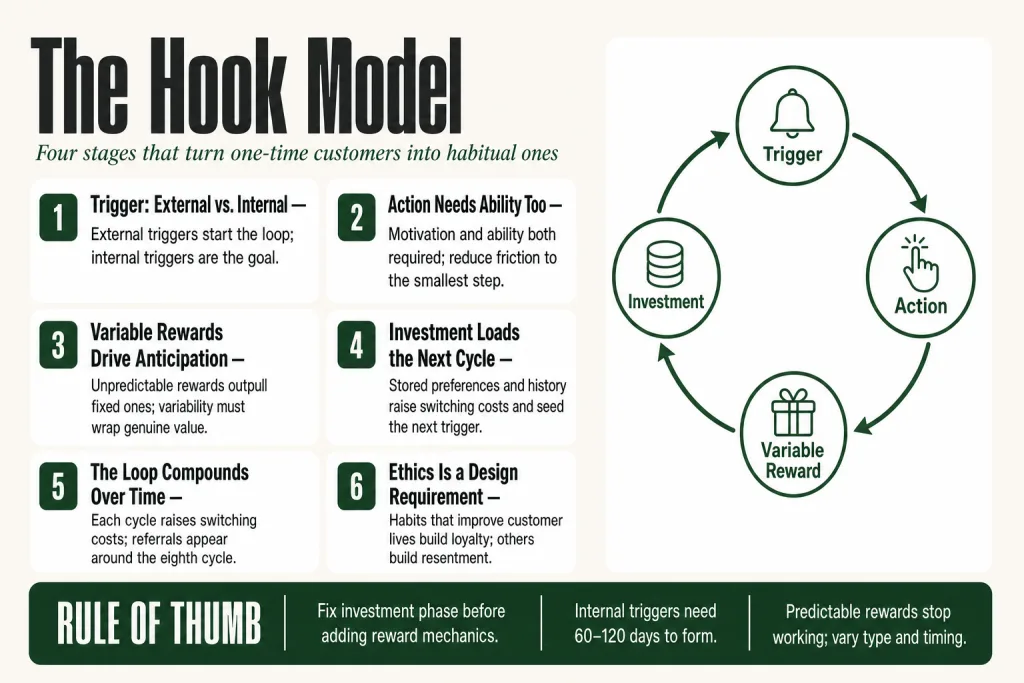
- The hook model is a four-step behavioral loop, Trigger → Action → Variable Reward → Investment, that turns one-time customers into habitual ones.
- External triggers (emails, notifications, reminders) kick off the cycle early; internal triggers (emotions, routines) are the goal, the point where the customer returns without being prompted.
- Variable rewards must stay genuinely unpredictable to keep working; the moment the reward is perfectly predictable, the pull evaporates.
- Investment is the most underused phase for small operators: small deposits of data, preference, or effort by the customer raise their switching costs and seed the next trigger automatically.
- The model works best for products and services used frequently, it struggles where purchase cycles are measured in years, not days or weeks.
- Used ethically, the loop builds real loyalty; used manipulatively, it builds resentment. The operator’s job is to design hooks around genuine value, not manufactured compulsion.
Where the Hook Model Came From
Nir Eyal synthesized years of work in the video gaming and advertising industries into a teaching curriculum at Stanford’s Graduate School of Business. Those lectures became Hooked: How to Build Habit-Forming Productspublished in 2014 with Ryan Hoover. Silicon Valley product teams adopted it almost immediately as required reading.
Eyal wasn’t inventing new psychology, variable reinforcement schedules trace back to B.F. Skinner’s operant-conditioning experiments, and BJ Fogg’s Behavior Model directly informed the Action phase. What Eyal did was synthesize those threads into a single loop with a name on each step. Knowing the ingredients separately doesn’t tell you how to cook. That synthesis is the contribution.
The ethics question has been part of the conversation since day one. The original book included a ‘Manipulation Matrix’ to help designers assess whether they were creating genuine value or exploiting vulnerabilities, and Eyal’s 2019 follow-up, Indistractableaddressed the tension directly by teaching readers how to defend against the same mechanics the first book described. That both books needed to exist tells you something about the loop’s power.
The Problem the Hook Model Actually Solves
Before Eyal named the loop, most businesses thought about retention in one of two ways: offer better product quality and hope customers noticed, or run promotions and hope customers came back to redeem them. Both strategies treat returning behavior as a rational decision, the customer weighs the options, decides you’re the best choice, comes back.
The problem is that most customer decisions aren’t rational in that sense. They’re habitual. People use Spotify not because they comparison-shopped streaming services this week, but because opening Spotify when they want music is simply what they do. They buy the same brand of coffee not because it won a blind taste test, but because it’s been on the same shelf in their kitchen for two years. Habit drives repeat behavior far more than analysis does.
This matters for operators because the competition for a returning customer isn’t happening at the moment of decision, it happened weeks or months ago, when the habit formed. The business that got into the customer’s routine first has a structural advantage that’s very hard to dislodge. The hook model is a map of how that routine forms, which means it’s also a map of where you can intervene to become part of it, and where a competitor might intervene to replace you.
There was a sequencing problem, too. Operators knew they needed good triggers, good experiences, and good loyalty mechanics, but they were deploying them in the wrong order, or treating them as independent programs rather than a loop. The hook model shows why investment must come after the customer has already received variable rewards several times. Ask for investment too early and you’re asking a stranger to move in before they’ve been on a date.
The Hook Model’s Four Phases, What They Actually Mean
Phase 1: Trigger
A trigger is whatever initiates the behavior. Eyal divides triggers into two types, and the distinction matters more than most operators realize.
External triggers are the prompts you design and send: the email reminder, the push notification, the ‘we miss you’ postcard, the social media post, the loyalty program nudge. They’re how you reach a customer when they’re not already thinking about you. For a new customer, someone who hasn’t yet built a habit around your business, external triggers are everything. They’re how the loop starts.
Internal triggers are the goal. An internal trigger is an emotion, a routine, or a context that automatically connects to your business in the customer’s mind. They wake up Sunday morning thinking about brunch, and your restaurant is the one they picture. They feel overwhelmed at work, and they reach for the workflow tool you sell. The internal trigger doesn’t require any action from you. It fires inside the customer’s head, and you’re the answer.
Most small operators build systems to fire external triggers and stop there. Fine as far as it goes, but external triggers are expensive to maintain and fragile. The whole point of running the loop is to eventually make external triggers less necessary because internal triggers have taken their place. Operators who understand this invest differently: instead of asking ‘how do we get customers’ attention,’ they ask ‘what emotion or routine should our business become the answer to?’
Phase 2: Action
The Action is the simplest behavior the customer performs in anticipation of a reward. Eyal’s key insight here, borrowed directly from BJ Fogg’s Behavior Model, is that action requires both motivation and ability. Most operators focus on motivation, better copy, better offers, while ignoring the ability side: how easy it actually is for the customer to take the next step.
Duolingo built one of the most habit-forming products of the last decade partly by making the first action almost frictionless: a lesson takes five minutes, on your phone, no setup. Compare that to a competitor requiring 20-minute desktop sessions and a fresh login every time. Same product category, dramatically different action friction.
For a service business, the Action equivalent might be booking a return appointment, completing an intake form, or simply opening an email. The operator’s job at this phase is to audit every step between trigger and action and ask: what’s the smallest, least effortful version of this that still counts as engagement? Then remove every obstacle between the customer and that version.
Phase 3: Variable Reward
This is where the behavioral science gets interesting, and where most operators either miss the point or bolt on mechanics that don’t fit.
Skinner established that variable reinforcement schedules are more powerful than fixed ones. A slot machine pays out unpredictably, and people pull the lever far more obsessively than they would if it paid out on every third pull. The unpredictability itself creates anticipation. Dopamine fires harder in anticipation of a reward than in receiving one, and it fires hardest when the reward is uncertain.
Eyal identifies three categories of variable reward, and the strongest habit-forming products typically engage more than one:
- Rewards of the Tribesocial rewards: feeling accepted, appreciated, recognized, or included. The coffee shop where the barista knows your name. The membership where long-tenured customers get visible recognition. The online community where engagement earns you a role or a badge.
- Rewards of the Huntthe search for material resources or new information. Flash sales, editorial newsletters with genuinely useful tips, a discovery-oriented experience where customers find something unexpected. The key word is ‘find’, the customer does some seeking, and the reward isn’t perfectly predictable.
- Rewards of the Selfintrinsic rewards of mastery, completion, or progress. Streak mechanics. Progress bars. The satisfaction of reaching a milestone. Duolingo’s streak counter is the most studied example: the pull to protect a long streak reliably outweighs the five minutes of effort required to maintain it.
Variable rewards only work if the underlying product delivers genuine value. Variability for its own sake, fake urgency, manufactured scarcity, manipulative randomness, produces short-term behavior change and long-term distrust. The reward needs to be real; the variability just makes the anticipation more compelling.
Phase 4: Investment
Investment is the most neglected phase for small-business operators, and it’s also the one that does the most structural work.
Investment is any action by the customer that loads the next cycle. They store something in your system, preferences, data, saved settings, relationship history, social connections, earned status, content they’ve created. The product gets more valuable to them personally because of what they’ve put in. And the investment generates the next trigger: the stored data prompts a personalized email; the built relationship makes them think of you the next time they need you; the accumulated loyalty points remind them to come back.
LinkedIn is the textbook example. Every connection you add, every skill you endorse, every recommendation you write makes the platform more valuable to you specifically, and more painful to leave. The more you put in, the higher the switching cost, and the more likely you are to cycle through the loop again.
For a small operator, investment looks different but works the same way. A client who’s filled out a detailed intake form and had three appointments where you’ve built on that history is not the same as a client who just booked their first session. The first client has invested, and they’re far less likely to switch. A customer who’s set preferences in your app, built a saved-order list, or earned a meaningful loyalty tier has invested. The operator’s job is to design small, easy investments that happen naturally in the course of a great customer experience, not to ask for burdensome data entry up front.
Why the Hook Model Loop Is Self-Reinforcing
The reason the four-step loop compounds over time is that the investment phase feeds directly back into the trigger phase. The customer puts something into the system; that stored value generates the next prompt; the prompt initiates the next action; the action delivers another reward; the customer invests again, loading a richer trigger for next time. Each cycle makes the next cycle more likely.
This is the structural difference between the hook model and a traditional marketing funnel. A funnel has an end point, conversion. The hook model has no end point; it’s a closed loop that gets stronger with repetition. Businesses that successfully run the loop don’t need to re-acquire the same customers repeatedly. The habit does the re-engagement work.
There’s also a compounding effect on switching costs. Early in the relationship, a customer can walk away with no real loss, they haven’t invested anything. After twenty loops, they’ve stored preferences, built history, accumulated loyalty benefits, and integrated your product into their routine. The cost of switching is now real, even if it’s never explicitly calculated. Spotify users rarely cancel despite equally good competitors, the investment phase has raised the exit cost high enough that the motivation to switch rarely overcomes it.
The implication for operators is that patience is the strategy. The first two or three cycles of the loop feel unremarkable, you’re just doing good work and maintaining contact. It’s the eighth and twelfth cycle where the compounding becomes visible: customers start referring without being asked and returning without being reminded.
Putting this to work? The ideas in the Canon are the foundation under the tactical playbook in Build a Complete Marketing Department — grab the free companion kit at mmsvegas.com/resources.
Hook Model in Practice: Examples Worth Studying
Duolingo is probably the cleanest living demonstration of all four phases working together. External triggers are push notifications timed to streak risk. Internal triggers are the user’s desire to improve a skill combined with social comparison. The action is frictionless, a five-minute lesson on mobile with immediate feedback. Variable rewards come from streaks, XP points, league rankings, and unlocks. Investment accumulates as the user builds a streak, earns badges, and personalizes their learning path; losing a 90-day streak feels like losing something real, because it is. The results back it up: Duolingo reduced monthly churn from 47% in 2020 to around 28% in major markets, not from any single mechanic, but from all four phases of the loop running in concert. (Source: StriveCloud, ‘Duolingo Gamification: 5 Tactics for User Retention,’ February 2026.)
Spotify runs a similar playbook. Push notifications about new releases from followed artists serve as external triggers; boredom or the desire for music is the internal trigger. The action is a single tap. Variable rewards come from algorithmically generated playlists like Discover Weekly, the content genuinely surprises, and the quality varies, which keeps anticipation high. Investment happens every time a user creates a playlist, saves a track, or follows an artist. Those preferences power the next recommendation. The stored playlists alone constitute a meaningful switching cost.
Fitness apps like Strava use the Tribe reward aggressively, social feeds, kudos from followers, leaderboards among friends, combined with Self rewards from progress metrics and streak mechanics. Investment is months of biometric data and personal records that exist only inside the platform. The exit cost isn’t a monthly fee; it’s your entire training history.
The non-digital examples are less studied but equally instructive. Starbucks’ rewards program runs the loop: the app notification about bonus star days is the external trigger; the purchase is the action; the variable reward is the uncertain timing of when you’ll hit a free drink, you’re never quite sure when the stars will add up, and that’s the hunt. Investment is the accumulated star balance and personalized order history. The same structure, not the technology, but the loop, could be adapted by any local café with a punch card and a mailing list, as long as the reward genuinely varies and the investment accumulates.
Where the Hook Model Works for Small Operators
The hook model earns its ROI when your product or service has three characteristics: high frequency (the customer could reasonably engage weekly or more), genuine variable value (there’s something authentic to discover or receive each time), and a natural place for investment to accumulate. When those three conditions exist, running the loop is one of the highest-leverage things you can do for retention.
Service businesses with recurring appointmentsgyms, salons, dental practices, coaches, accountants, have the frequency. Their gap is usually in trigger design and investment architecture. Operators in these categories rarely think about what’s accumulating on their side of the relationship for the customer’s benefit. A client history that gets richer over time, personalized notes that a service provider actually references, progress tracking that makes the client’s investment visible, all of these are low-tech investment mechanics that raise switching costs and deepen the internal trigger.
Subscription products and memberships are essentially hook model businesses by design. The trigger is the renewal date and the regular touchpoint; the action is usage; the variable reward needs to be built deliberately into the content or service delivery; and investment shows up as customization, community involvement, and accumulated history. The operators who fail at subscription retention are almost always the ones who signed people up but never closed the loop, never built the investment phase.
Content and email-driven businessesnewsletters, courses, local media, expert services, can run the loop through communication design. Email combines all three reward types: social obligation (Tribe), potentially valuable information (Hunt), and the satisfaction of clearing the inbox (Self). An operator who sends genuinely variable, high-value emails, not every message perfectly predictable, can build a strong internal trigger around their communication alone.
Local retail with a loyalty program: the hook model clarifies why most points programs underperform. They deliver fixed rewards (spend $100, earn $5) rather than variable ones. The compulsion of a well-run program comes from genuine variability, surprise upgrades, unexpected bonus days, personalized offers that feel like the business actually knows you. Most local retailers don’t get this right. Starbucks does.
Where the Hook Model Struggles
The loop depends on frequency. If your typical customer buys once every three years, a kitchen renovation, an estate plan, a vehicle purchase, the hook model cannot do what it does best. By the time you’d run the customer through enough cycles to build an internal trigger, the purchase is already over. This doesn’t mean the framework is useless for low-frequency categories; it means the trigger and investment phases need to work through adjacent high-frequency behaviors, content consumption, community participation, referral activity, rather than the core transaction itself.
The model also assumes the customer experiences genuine reward. If your product is mediocre, no amount of loop engineering fixes the underlying problem. Variable rewards only maintain engagement when the floor quality is already good. The hook model is a retention amplifier, not a rescue operation.
There’s a category of service business where high investment raises switching costs but the variable reward is weak: think of a B2B software platform with lots of stored data but a tedious user experience. Customers stay because leaving is painful, not because returning is pleasurable. That’s lock-in, not loyalty, and the two behave very differently when a competitor offers a compelling migration path. Real loyalty built through genuine reward and investment is far more durable than lock-in built through data hostage-taking.
The model was designed primarily around consumer digital products with very high interaction frequency. The mechanics translate to other contexts, but they require real adaptation. Trying to apply the loop mechanically, ‘step one: send notification, step two: make them click something’, without thinking about what genuinely rewards your specific customer produces a parody of engagement rather than the real thing.
What People Get Wrong About the Hook Model
‘Variable rewards means gamification.’ Gamification, points, badges, leaderboards, is one implementation of variable rewards, in the Tribe and Self categories specifically. But variable reward is a broader concept. A genuinely editorial newsletter where you never know which issue will contain the one insight that changes your business is a variable reward. A service provider who occasionally surfaces an unexpected connection is delivering a variable reward. The mechanic doesn’t require game mechanics; it requires genuine unpredictability around something the customer actually values.
‘The hook model is a conversion tool.’ It isn’t. The loop is a retention tool, and applying it too early, before a customer has experienced enough of your product to be worth retaining, just burns trust. Operators who try to run the investment phase on a first-time visitor are asking a stranger for a favor before they’ve done anything to earn it. Let the first few cycles be entirely about delivery. Ask for investment later.
‘The goal is to make customers addicted.’ This is how the model gets misapplied. Eyal drew a clear line between habits that serve the user and compulsions that serve the business at the user’s expense. The test is two questions: does the product materially improve the user’s life? And would you be comfortable if the user fully understood how the engagement was designed? An operator who can answer yes to both is building loyalty. One who can’t is building something more fragile, and more corrosive long-term.
‘Internal triggers are something you can engineer quickly.’ They’re not. Internal triggers form after repeated cycles of the loop, they’re the result of successful habit formation, not the input. Operators who expect to shortcut to internal triggers by running clever campaigns will be disappointed. External triggering is the work you do until the internal trigger exists. That takes months, not weeks.
‘The hook model is only for apps and digital products.’ The behavioral loop predates smartphones entirely. The mechanisms, environmental cues triggering behavior, unpredictable reinforcement sustaining it, investment raising switching costs, apply wherever human habits form. Any business with recurring customer contact can run the loop. The digital examples are just the most observable ones.
Common Mistakes
- Bolting on variable reward mechanics before the core experience earns a second visit — Run a quick exit survey or review audit first. If customers aren’t enthusiastic after the first or second interaction, a points program won’t rescue that, it will make the gap more visible. Specifically: read your last 20 reviews and count how many mention the experience itself versus the reward. If the experience gets no mention, fix it before layering on incentive mechanics.
- Treating the investment phase as something that accumulates passively — Investment doesn’t build unless you design a container for it. Identify one specific thing that should be captured after every customer interaction, a stated preference, a service note, an earned status marker, and confirm your system records it. Then make sure your team or tool actually surfaces it at the next interaction. If nothing carries forward, the customer is functionally new every time, and your retention curve will show it.
- Firing external triggers on a calendar cadence with no behavioral logic — A weekly email sent regardless of what the customer just did is noise. Tie your external triggers to behavior: the day after a purchase, the week before an expected repurchase window, the moment a streak or progress milestone is at risk. If your platform allows behavioral automation, map out three trigger rules tied to customer actions and replace your next calendar blast with one of them.
- Expecting internal triggers to form within a few weeks of starting campaigns — Internal triggers are the output of six to twelve successful loop cycles, not a campaign result. Budget for 60 to 90 days of consistent, rewarding external triggering before you expect unprompted return behavior. If you pull back before the habit has had time to form, because you didn’t see immediate results, it won’t form. Track unprompted return rate as a separate metric from campaign-driven return rate so you can see when the shift is actually happening.
- Running variable rewards that are variable in name only — If every customer gets the same offer on the same day each week, there’s no variability, there’s a predictable schedule the brain stops registering. Rotate across reward types (Hunt, Tribe, Self), vary timing, and occasionally surprise loyal customers with something they didn’t see coming. A simple test: ask a loyal customer what reward they expect from you next week. If they can name it exactly, your rewards aren’t variable, they’re a fixed schedule with a loyalty veneer.
Operator’s Take
A few hard opinions after watching operators try to use this framework, and getting it wrong in predictable ways.
Start with the investment phase. I know that sounds backwards, most operators want to talk about rewards and campaigns, but when I look at where retention actually leaks, it’s almost never ‘our rewards aren’t exciting enough.’ It’s that nothing is accumulating. The customer finishes an appointment or a purchase and walks away having left zero trace. No preferences stored, no history noted, no status earned. You reset to zero every time. Then you wonder why re-engagement campaigns don’t hold.
The one-thing rule: pick a single piece of information that should be captured after every customer interaction and make sure your system actually captures it. Not ten things, one. For a salon, it’s the products they liked and the stylist notes from last visit. For an accountant, it’s the client’s recurring anxiety about a specific expense category. For a retailer, it’s the saved cart or wishlist. That captured detail seeds the next internal trigger. Without it, you’re starting from scratch every time, and you’ll be running external trigger campaigns forever just to stay even. If you use a CRM or email platform, set up a post-interaction field or tag today, not next quarter.
On triggers: the question most operators ask is ‘how often should we email?’ Wrong question. The right question is: what specific moment of discomfort or desire do we want to own in our customer’s week? A bookkeeper who sends a monthly newsletter is forgettable. A bookkeeper who becomes the answer to a client’s low-level ongoing anxiety about whether the numbers are right, that’s an internal trigger worth owning. One positioning gets you a tax season. The other gets you a five-year retainer. Audit your last five external triggers and ask honestly: did each one reinforce a specific emotional association, or did it just announce something? Rewrite the next one around the emotion you want to own.
On variable rewards: this phase gets the most attention and the most abuse. The abuse is easy to spot, fake urgency, manufactured scarcity, spin-the-wheel popups on businesses where the underlying experience barely justifies a second visit. Stop. Variable reward isn’t the engine; it’s the fuel additive. Build something worth returning to first. Then ask: is there any genuine variability in what customers receive each time? If every visit is identical, the anticipation collapses. A practical fix: rotate which reward type you engage. Sometimes the Tribe reward (public acknowledgment, belonging). Sometimes the Hunt (a genuinely unexpected offer or piece of information). Sometimes the Self (a milestone hit, a streak maintained). You don’t need a loyalty platform to vary reward types. You need to plan it intentionally, one interaction at a time.
The ethics question is simpler than people make it. If the habit you’re building genuinely improves your customer’s life, they exercise more, manage money better, eat well, stay connected, the loop serves them. If it primarily serves your revenue at their expense, that eventually shows up in churn and reputation. Most legitimate small businesses don’t need a philosophy seminar to find the line. The instinct that tells you not to pressure-sell someone into something they don’t need works here too.
The diagnostic you should run this week: map your customer journey against all four phases and mark the one that’s visibly broken. Trigger is usually fine, most operators at least send emails. Action is usually fine, the purchase or booking works. Variable reward is often weak or nonexistent. Investment is almost always missing entirely. Fix the investment phase first. It’s quieter than running a promotion, but it’s what separates customers who stay three visits from customers who stay three years. Specifically: choose your one captured data point, wire it into your CRM or booking system, and make sure your team or automation surfaces it at the next interaction. That’s the first move.
Used in
- ✓ Build a Complete Marketing Department
Used to design the retention layer of a marketing system, specifically to identify which trigger, reward, and investment mechanics belong at each stage of the customer lifecycle. - ✓ The Missing Manual for FunnelKit
Used to structure post-purchase automation sequences: trigger design for re-engagement flows, variable reward mechanics in upsell offers, and investment capture through preference and behavior tracking. - ✓ The Missing Manual for Make
Used to automate the investment phase, capturing customer preferences, building personalization data, and routing returning customers through progressively richer trigger sequences without manual intervention.
FAQ
Does the hook model only work for digital products?
No, the behavioral loop applies anywhere habits form. Service businesses, local retail, memberships, and professional practices can all run the loop. The digital examples are just the most studied because engagement is measurable. The mechanics are the same offline; the implementation is different.
How long does it take to build an internal trigger in a customer?
Realistically, 60 to 120 days of consistent, rewarding interactions. Internal triggers are the product of repeated successful loop cycles, you can’t shortcut them with a single great experience. Plan your external trigger calendar around sustaining enough touchpoints to let the habit form.
Is the hook model manipulative?
The mechanics can be used manipulatively, but the same is true of any persuasion tool. Eyal’s own test is useful: does the product materially improve the customer’s life, and would you be comfortable if they understood exactly how the engagement was designed? If yes to both, you’re building loyalty, not manufacturing compulsion.
What’s the most common phase small operators miss?
Investment, almost universally. Most operators deliver a good experience and then start from scratch at the next interaction. Building even simple investment mechanics, saved preferences, personalized history, earned status, changes the economics of retention dramatically.
How is the hook model different from a loyalty program?
A loyalty program is one implementation of the investment and variable reward phases, it’s not the whole loop. The hook model also requires a trigger strategy (how customers are reminded to return) and an action design (how frictionless the return experience is). A loyalty program without those phases produces points balances that customers forget exist.
Can the hook model work for low-frequency purchases?
It works poorly on the core transaction when purchases happen every few years. The workaround is to run the loop on adjacent high-frequency behaviors, content consumption, community participation, referral activity, so the relationship stays warm until the next purchase occasion arrives.
Further reading
- Hooked: How to Build Habit-Forming ProductsNir Eyal with Ryan Hoover (Portfolio, 2014). The source material; worth reading once for the full framework and examples, with the ethics chapter treated as seriously as the mechanics chapters.
- IndistractableNir Eyal (BenBella Books, 2019). The other side of the coin: understanding how the loop can work against users helps operators design loops that genuinely serve customers.
- Thinking, Fast and SlowDaniel Kahneman (Farrar, Straus and Giroux, 2011). The deeper behavioral economics context for why habit (System 1) dominates deliberate decision-making (System 2), useful for understanding why the loop works at all.
Sources:
- Nir Eyal with Ryan Hoover, Hooked: How to Build Habit-Forming Products (Portfolio, 2014).
- Nir Eyal, Indistractable: How to Control Your Attention and Choose Your Life (BenBella Books, 2019).
- StriveCloud, ‘Duolingo Gamification: 5 Tactics for User Retention,’ updated February 2026, source for Duolingo churn figures (47% in 2020 to 28% in major markets).
- Sensor Tower, ‘Duolingo: Monetizing Through Product Stickiness’, source for power-user and churn trend data cited in the Duolingo example.
- ProductPlan Glossary, ‘Hook Model,’ updated April 2026.
- NirAndFar.com, ‘Variable Rewards: Want to Hook Users? Drive Them Crazy’, Eyal’s own explanation of the variable reward mechanism.
- BJ Fogg, Tiny Habits: The Small Changes That Change Everything (Houghton Mifflin Harcourt, 2019), background on the Fogg Behavior Model referenced in the Action phase.
Brian Kasday spent forty years in direct-response marketing before rebuilding the whole operation as a one-person shop. He writes The Operator’s Library — including “Build a Complete Marketing Department” — for operators who’d rather build it themselves than wait on someone else.
Build the department these ideas describe — the free companion kit: mmsvegas.com/resources.
More The Operator's Canon guides
Free · Operator Toolkit
Want the tools, not just the guide?
Get the free operator toolkit — templates and checklists for the systems you actually run, plus a note when this guide changes.
Get the free toolkit →How to cite: Hook Model. Associated with Nir Eyal, 2014. The Operator’s Canon, MMS Vegas. https://mmsvegas.com/library/hook-model/