
Last updated: September 2026
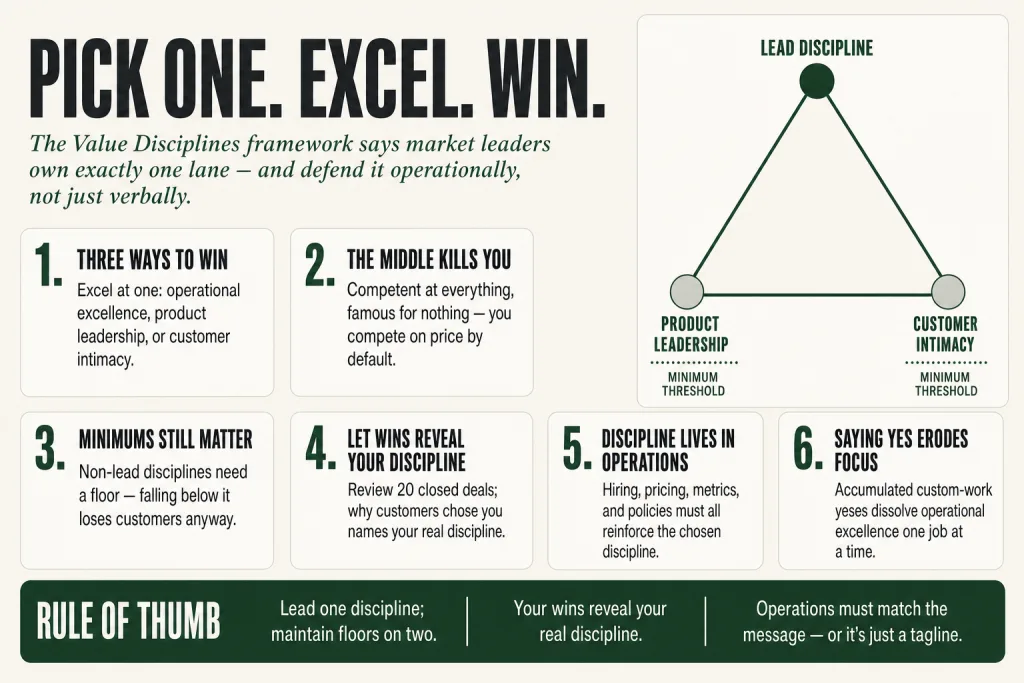
Value disciplines is one of the most useful strategic lenses a small-business operator can pick up, and one of the most frequently misapplied. The premise is deceptively simple: there are only three ways to deliver superior value to customers. You can be the most reliable and affordable option. You can be the most innovative. Or you can know your customers better than anyone else and tailor everything around them. Pick one. Excel at it. Meet a baseline on the other two. That’s the whole thing.
What makes it powerful isn’t the taxonomy, it’s the forcing function. Most operators are running a business that is sort of operationally decent, sort of relationship-driven, and sort of trying to add new services every year. Not terrible at anything. Not memorable at anything either. Treacy and Wiersema had a name for that: stuck in the middle. And stuck in the middle is not a safe harbor. It’s where businesses slowly lose ground without ever understanding why.
This page walks you through all three disciplines, what each actually demands of your operations, not just your messaging, and how to make an honest call about which one you’re built to lead. You’ll be able to name the discipline your business should own, check whether your current systems actually support it, and stop making trade-off decisions by accident.
The idea in 30 seconds
- Value disciplines is a strategic framework by Michael Treacy and Fred Wiersema that says market leaders win by excelling in exactly one of three areas: operational excellence, product leadership, or customer intimacy.
- You must choose one as your dominant discipline, it shapes your hiring, your processes, your metrics, and what you say no to.
- The other two disciplines don’t get ignored; they get maintained at a minimum acceptable standard so you don’t actively repel customers.
- The worst place to be is the middle, competent at everything, famous for nothing.
- Your choice of discipline isn’t just a marketing message; it’s an operating system that either reinforces itself or tears itself apart.
- By the end of this page, you’ll know which discipline fits your business today, whether your current operations actually support it, and how to make the trade-offs explicit instead of accidental.
Where Value Disciplines Came From
Michael Treacy and Fred Wiersema introduced the framework in the Harvard Business Review in January 1993, then expanded it into a book, The Discipline of Market Leaderspublished in 1995. The book made the New York Times bestseller list, though the authors and publisher were later accused of orchestrating bulk purchases of tens of thousands of copies to accelerate its chart position. The content outlasted the controversy.
The pattern at the center of their research was focus. Companies that had taken leadership positions in their industries had typically done so by narrowing, not broadening, their business focus. They’d picked one way to deliver superior value and organized everything around it, while keeping the other two dimensions at a floor level, not an excellence level.
The intellectual predecessor is Porter’s Generic Strategies from 1980: cost leadership, differentiation, or focus. Treacy and Wiersema sharpen it in one meaningful way, they’re explicit that the disciplines you don’t lead still require a minimum threshold performance. Falling below that threshold costs you customers regardless of how exceptional you are at the one you lead. That’s the part most operators miss, and the part Porter’s model leaves underspecified.
The Three Disciplines, Plainly Stated
Each discipline is worth understanding on its own terms, because operators often apply the wrong label to themselves. ‘We’re customer-focused’ is the most common mislabel in business. Everyone thinks they’re customer-intimate. Most aren’t.
Operational Excellence
Operational excellence means delivering reliable products or services at competitive prices with minimum friction for the customer. The emphasis is on efficiency, standardization, and consistency, not customization. Think about how a quick-service restaurant chain runs its kitchen, or how a regional plumbing company with flat-rate pricing and GPS-tracked vans wins repeat business. These businesses win by removing cost and friction from the transaction, then passing enough of those savings to the customer to make switching feel pointless.
What this actually demands: standardized service packages, tight cost controls, and a culture that treats variation as waste. That last part is critical. If your people are empowered to improvise for individual customers, you’re not operationally excellent, you’re just inconsistent with good intentions. Operational excellence requires the discipline to say, ‘we don’t customize that.’
For a small operator, this might look like a cleaning company with locked-in service tiers, automated scheduling, and a booking system that never requires a human to answer the phone. The pitch is: we show up on time, every time, for a price that doesn’t change. That’s a real promise. It attracts a real customer who is tired of unreliable service and surprise invoices. And it only works if the operator actually resists the urge to take on bespoke jobs that break the model.
Product Leadership
Product leadership is about offering the most innovative, highest-performing, or most forward-thinking option in your category. The operating model is nearly the mirror image of operational excellence. Where operational excellence craves predictability, product leadership requires tolerance for experimentation and a willingness to make your own current offerings obsolete before a competitor does. Apple releasing the iPhone knowing it would cannibalize iPod sales is the textbook example of this logic.
What this actually demands: investment in development and creative work, a culture that rewards new ideas without punishing the failures that come with them, and a sales approach that centers on your capability rather than your relationships. A product-led business is constantly shipping, iterating, and positioning its newest capability as the reason to buy. The product is the argument.
For a smaller operator, product leadership tends to show up in professional or technical services: a software consultancy that stays genuinely ahead of the tooling curve, a CPA firm that builds proprietary modeling tools for a specific niche, a commercial photographer who invests in techniques nobody else in the market is using yet. The signal that you’re actually leading here is that competitors copy you, not the other way around.
Customer Intimacy
Customer intimacy is the most misunderstood of the three, because every business claims it. What it actually means: you segment your market precisely, tailor your offering to match the specific demands of those clients, and measure success by customer lifetime value rather than transaction size. You know your best customers better than they know themselves. You anticipate needs. You customize solutions. You probably provide supplemental services, training, implementation, ongoing consulting, that competitors view as unprofitable overhead and you view as the glue.
What this demands: operational flexibility, deep customer knowledge, and a willingness to sometimes do things that don’t scale, because the long-term relationship justifies the short-term cost. It also demands that you don’t try to serve everyone. Customer-intimate businesses are selective about which customers they take on, because the model only pays off with customers who stay, expand, and refer.
The test: if a key customer called with an unusual request today, would your team find a way to accommodate it, or route it through a standard intake form? Customer-intimate businesses bend. Operationally excellent businesses hold the line. Neither is wrong; they’re just different disciplines serving different customers.
The Rule Nobody Talks About: Minimum Standards
The part of the value disciplines framework that gets the least attention is the part that fails the most businesses: you cannot neglect the disciplines you don’t lead. You just don’t have to lead them.
Think of it as table stakes. If you’re pursuing customer intimacy, your product still has to be good enough that it doesn’t embarrass the relationship. If you’re pursuing operational excellence, your service still has to be responsive enough that customers don’t feel trapped. Falling below the minimum acceptable threshold on any dimension will cost you customers, even if your lead discipline is genuinely excellent.
This plays out constantly in small businesses. The boutique agency that does exceptional strategic work but sends invoices that are consistently wrong, late, or confusing. The operationally excellent service business that has the smoothest delivery in town but whose owner never returns calls. The customer-intimate firm that knows its clients deeply but whose technology stack is so outdated that routine tasks take three times as long as they should. In each case, a genuine strength is being undermined by a threshold failure, not by competition.
Your lead discipline is why customers choose you. Your threshold performance on the other two is why they don’t fire you. Both matter. They just don’t require equal investment.
Once you’ve chosen your lead discipline, audit the other two briefly. You’re not trying to excel at them. You’re asking whether you’re actively failing at them, whether there’s something in your operation that a reasonable customer would call unacceptable. Fix those things first. Then put your resources into the discipline you’re leading.
What This Looks Like Right Now
The framework is 30 years old, which makes it fair to ask whether the logic still holds in a market where software can automate both efficiency and personalization. Short answer: yes, and a few recent examples make it concrete.
Figma is probably the clearest product leadership story of the last five years in software. The company built a browser-based design tool that non-users could view and comment on without signing up, and the viral sharing loop did the selling. By the time Adobe announced its acquisition attempt in 2022, Figma had effectively become the default tool for product design teams, not because it was the cheapest or because the sales team built deep relationships, but because the product kept moving faster than competitors could follow. That is product leadership operating as an actual discipline, the capability was the argument, and the capability kept changing.
On the operational excellence side, Toast POS is a useful small-business-adjacent example. Toast built an all-in-one restaurant platform aimed specifically at independent operators, a segment most enterprise software companies avoid because the sales cost is high and the operators are volatile. The pitch was consistent and simple: one system for orders, payments, payroll, and reporting, priced predictably, set up fast. By the end of 2024, Toast had added a record 28,000 net new locations in a single year and crossed its first full year of GAAP profitability. They didn’t win on relationship depth or product innovation in the research-lab sense, they won by making complexity disappear reliably at a price small operators could budget for. That’s operational excellence working as a discipline, not a tagline.
For customer intimacy at a smaller scale, look at the wave of fractional executive firms, fractional CFOs, CMOs, and COOs, that emerged post-2020. The model only works if the practitioner goes deep on a short client list. A fractional CFO serving 12 founder-led businesses has to know each client’s personal financial goals, succession plans, and risk tolerance, not just their P&L. Firms that kept rosters deliberately small and built client knowledge into their operating rhythm, structured check-ins, documented context, proactive conversations before crises, retained clients and generated referrals. Firms that tried to serve 25 clients with the same model ended up delivering neither the efficiency of a standard bookkeeper nor the depth of a true advisor. The discipline, or the lack of it, showed up in retention numbers within 18 months.
None of these examples are abstract. The discipline showed up in how the business was structured, pricing, client load, investment priorities, long before it showed up in any marketing message.
Where Operators Get This Wrong
The framework is easy to understand and hard to apply honestly. Here are the misapplications that show up most often, not as abstractions, but as real patterns.
The Agency That Claims Product Leadership But Ships Nothing New
A digital marketing agency positions itself as ‘innovative’ and ‘ahead of the curve.’ Its pitch deck has a section on proprietary methodology. In practice, the methodology hasn’t changed in three years, the team is running the same playbooks as every other mid-market agency, and the only thing being updated is the slide design. This is aspirational mislabeling, and customers figure it out, usually right around month four. Product leadership requires active investment in staying ahead: protected time for methodology development, a process for testing new approaches, and a willingness to publish results so the market can actually see the gap. If your competitors aren’t copying you, you’re not leading.
The Professional Services Firm That Calls Itself Customer-Intimate But Bills Like a Factory
A regional accounting firm leads every sales conversation with ‘we treat you like a partner, not a number.’ Then the client gets a 14-page engagement letter, a billing system that sends auto-generated invoices with no explanatory notes, and a different staff accountant every time they call. Customer intimacy as a lead discipline requires that the client experience actually reflects deep knowledge and flexibility, not just warm language in the proposal. The firms that do this well, a boutique wealth management shop that calls clients before a tax-law change rather than after, have built operational flexibility into their model. The ones that claim it without building it are setting themselves up for churn they’ll blame on price sensitivity.
The Contractor Who Drifts Out of Operational Excellence by Saying Yes to Everything
An HVAC company builds a solid reputation on exactly one thing: flat-rate pricing, same-day service, no surprises. Business is good. A commercial property manager asks them to bid a full ductwork redesign, custom, multi-phase, complex. They say yes because the number looks good. Then another client wants a maintenance contract with detailed custom reporting. They say yes to that too. Within 18 months, 30% of their jobs are custom projects that run over schedule, the dispatch system is a mess, and the on-time rate that made them famous has slipped from 94% to 78%. They didn’t make a bad decision any single time. They made the same mistake 40 times: letting revenue opportunity override discipline. This is how operationally excellent small businesses dissolve into generalists, not through one dramatic pivot, but through accumulated yeses.
The SaaS Founder Who Thinks Cheap Pricing Is Operational Excellence
There’s a persistent confusion between ‘operationally excellent’ and ‘cheapest in the market.’ A SaaS founder prices their product at the bottom of the category, assumes that’s a defensible strategy, and then discovers that the customers it attracts are the most demanding and least loyal, because they’ll leave the moment a cheaper option appears. Operational excellence isn’t a race to the lowest price. It’s a promise of reliable value delivered with minimum friction at a competitive, not necessarily minimum, price. A flat-rate mid-market product with a clean onboarding flow is more operationally excellent than a cheap product with a confusing setup and inconsistent support.
The Consultant Who Mistakes a Full Calendar for Customer Intimacy
A management consultant tells every prospect that she ‘really gets to know her clients’ and ‘builds long-term relationships.’ She has 22 active clients. She sees each of them quarterly at best. She knows their names and their industries, but not their succession plans, their internal politics, or what keeps them up at night. That’s not customer intimacy, that’s a full calendar. True customer intimacy requires a deliberately limited client load, a system for capturing and using what you know about each client, and a track record of anticipating needs rather than reacting to them. You cannot be deeply intimate with 22 clients if each engagement is 90 minutes a quarter.
Putting this to work? The ideas in the Canon are the foundation under the tactical playbook in Build a Complete Marketing Department — grab the free companion kit at mmsvegas.com/resources.
Why Being Average at Everything Is a Slow Death
The worst strategic position is the middle. Not bad, not great, no distinct claim. Competent at everything. Famous for nothing.
The middle feels safe because you never have to make hard calls. You add services because a customer asks. You cut prices when a competitor undercuts you. You hire a designer because someone said you needed better branding. You add a custom option because it felt like a missed sale. None of these decisions are wrong in isolation. Together they create a business that has quietly abandoned the discipline it used to lead, and now has no discipline at all.
This drift is particularly common in small and mid-sized businesses because the operator is close enough to every customer to feel the pull of customization, close enough to the books to feel the pull of every additional revenue opportunity, and usually too busy to notice that the aggregate of all those individual decisions has blurred the company’s identity. The business becomes a generalist by accident rather than by choice.
The problem with generalism isn’t that it produces bad work. It’s that it produces undifferentiated work. Customers in every category are increasingly able to find options, compare them online, and read reviews before they contact you. A business that can’t be easily categorized as ‘the reliable one,’ ‘the innovative one,’ or ‘the one that really gets our situation’ has no anchor in the customer’s memory. You compete on price almost by default, because price is the only obvious differentiator left.
There’s also an operational argument. Each discipline requires a different culture, a different organizational structure, and different metrics. Operational excellence wants standardization; customer intimacy wants flexibility; product leadership wants experimentation. You can’t run all three cultures in the same organization without one eventually crowding out the others, and usually the one that wins is whichever the founder happens to prefer, not whichever the business is actually best positioned to lead. Making the choice explicitly removes that ambiguity before it becomes expensive.
How to Actually Choose Your Discipline
Most treatments of the framework explain the three disciplines clearly, then leave you to figure out the choice on your own. Here’s how to actually approach it.
Start with evidence, not aspiration
The question isn’t ‘which discipline do we want to lead?’ It’s ‘which discipline are we already closest to leading, and is there a real market for that?’ Run a win/loss analysis on your last 20 deals or customer conversations. Why did people buy from you? Why did the ones who didn’t buy go elsewhere? Look for a pattern in the wins, not what you told them in the pitch, but what they said when they explained why they chose you.
If most of your wins come from people who say something like ‘you were reliable and easy to work with’, that’s an operational excellence signal. If they say ‘you really understood our situation’ or ‘you built something specifically for us’, that’s customer intimacy. If they say ‘your approach was more advanced than anyone else we talked to’, that’s product leadership. Let the customers tell you what discipline you’re already practicing.
Check your operating model for coherence
Once you have a candidate discipline, test it against your actual operations. Ask: does the way we hire, the way we price, the way we measure performance, and the way we build our service delivery actually support this discipline? Or are we claiming to lead in customer intimacy while staffing to a ratio that allows 15 minutes per client interaction?
The discipline you choose has to be one you can actually deliver, not one that sounds good in a positioning statement. A small landscaping company claiming product leadership when it runs no budget for development and copies competitors’ service lists six months after they launch isn’t a product leader. It’s an aspirational mislabeler. The choice needs to match what your business can actually resource and sustain.
Consider your target customer
Different customer types weight the three disciplines differently. Price-sensitive buyers who make frequent, low-risk purchases tend to value operational excellence. High-stakes buyers with complex problems who need a trusted partner tend to value customer intimacy. Buyers who need the latest capability to stay competitive tend to value product leadership. Your ideal customer profile and your chosen discipline need to be a matched set, the discipline that your best customers most reward you for is the one worth leading.
Make the trade-offs explicit
Choosing a discipline means actively deciding not to lead at the others. That’s uncomfortable. It means telling some prospective customers that you’re not the right fit. It means saying no to service expansions that would dilute your focus. It means building policies and processes that enforce consistency even when individual situations tempt you to deviate. Write it down. Tell your team. ‘We compete on X. We maintain acceptable standards at Y and Z. When a decision conflicts with that, here’s how we resolve it.’ That sentence, internalized, is worth more than any mission statement.
What Each Discipline Actually Looks Like in a Small Business
Theory travels well. Operations don’t. Here’s what each discipline looks like when a small operator is actually running it, as opposed to just claiming it.
Operational Excellence
A residential HVAC company in a mid-sized market decides to compete on operational excellence. The pitch is not ‘we care the most’, it’s ‘we show up in the window we give you, we finish the same day in 95% of cases, and our pricing is flat-rate with no surprises.’ That promise requires: standardized service packages, flat-rate pricing published in advance, GPS tracking so dispatch knows where every tech is, and a booking system that doesn’t require a human to answer the phone. The moment they start offering custom ductwork redesigns or taking on jobs that run four hours over, the model breaks, not because those jobs are bad, but because they introduce variability that destroys the consistency the brand is built on.
The metrics that matter here: on-time arrival rate, first-call resolution rate, cost-per-job against budget. Not NPS. Not relationship scores. Operational excellence businesses win on execution numbers.
Product Leadership
A digital marketing agency specializing in e-commerce brands decides to lead on product leadership. Their differentiator is a proprietary analytics layer that connects ad spend to margin contribution, not just revenue, which most agencies don’t track. They’re constantly updating it, running internal experiments, and publishing the results. Their pitch is essentially: our method is more advanced than what you’re getting now. That requires investment in development time, even if it’s just one person spending 20% of their hours on methodology work, a willingness to walk away from clients who want standard work, and a sales process that leads with capability rather than relationship-building.
The metrics that matter: how often clients encounter something they hadn’t seen before, the gap between their outcomes and market benchmarks, and whether competitors are copying their methodology. Client churn due to ‘relationship’ reasons should be low; churn because a client went in-house and replicated the model is, oddly, a good sign, it means the model was real enough to steal.
Customer Intimacy
A fractional CFO firm serving founder-led companies under $10M in revenue decides to compete on customer intimacy. They limit their client roster to 12 companies at a time. Every client gets a quarterly strategy session that goes beyond the numbers, connecting financial performance to the founder’s personal goals, succession planning, and risk tolerance. They know which clients are going through a difficult transition, which are thinking about selling, which are about to hit a hiring wall. They don’t just report on the past; they anticipate the next six months and surface the conversation before the client knows to ask for it.
The metrics that matter: net revenue retention (are clients expanding their engagement?), referral rate, and average client tenure. A customer-intimate business that is losing clients after 18 months has a problem, either it’s not delivering the depth of relationship it promises, or it’s attracting the wrong clients who never intended to stay. Net revenue retention is the financial fingerprint of a customer-intimate model working correctly.
Where the Framework Gets Overrated (Or Just Misapplied)
Value disciplines is a positioning tool, not an execution system. It tells you which lane to run in. It doesn’t tell you how to run fast. That distinction matters because operators sometimes make the choice, name their discipline, and then expect the choice itself to do work, without actually restructuring their operations to support it.
The framework is also less useful in very early-stage businesses where the operator hasn’t accumulated enough customer feedback to know what customers actually value them for. If you’ve been in business 18 months and served 30 clients, you may not have enough signal yet. Customer discovery, talking directly to your best clients about why they stay, is more valuable at that stage than picking a discipline from theory.
There’s a fair critique around certain digital-native businesses, too. Some platforms have combined operational excellence (clean UX, fast delivery) with customer intimacy (personalization at scale) in ways that would have been impossible without modern data infrastructure. Amazon is the most cited example. The argument is that technology now makes it possible to lead at more than one discipline simultaneously, at least in certain configurations. That’s probably true for large, well-funded platforms. For a small operator, the resource constraints make that combination much harder to sustain, and the attempt usually produces a diluted version of both rather than leadership in either.
The framework also has nothing to say about timing. It doesn’t help you decide when to shift disciplines as your market evolves. A business that was well-served by product leadership in a young, fast-moving market may find that market maturing around it, with more competitors copying innovations and customers becoming more price-sensitive. At that point, a shift toward operational excellence might be the right move. The framework can tell you what the options are; it can’t tell you when the window opens or closes. That judgment stays with the operator.
What People Commonly Get Wrong About Value Disciplines
‘Customer intimacy just means good customer service.’ No. Every business is supposed to have acceptable customer service, that’s a threshold standard, not a discipline. Customer intimacy as a lead discipline means your business model is built around knowing specific customer segments so deeply that you can deliver solutions those customers couldn’t have specified themselves. It requires investment in customer knowledge, operational flexibility, and the willingness to turn down customers who don’t fit the profile. A friendly team and a clean office is not a strategy.
‘We can do all three.’ You can meet minimum thresholds on all three. You cannot lead at all three. The internal conflicts are structural, not motivational. A culture that rewards standardization and punishes deviation (operational excellence) will grind against a culture that rewards improvisation and custom solutions (customer intimacy). You can hire smart people who understand both, but the operating system, the incentives, the processes, the metrics, will eventually resolve the conflict in one direction. Better to choose that direction consciously.
‘This is just a marketing framework.’ It’s a strategy framework that has marketing implications. Your choice of discipline shapes your positioning, your messaging, and your offer design, but it should also shape your org chart, your hiring criteria, your pricing model, and your KPIs. If the discipline only shows up in how you describe yourself externally but not in how you operate internally, you haven’t chosen a discipline. You’ve written a tagline.
‘Operational excellence means being cheap.’ Operational excellence means delivering reliable value at a competitive price with minimal friction, it doesn’t require you to be the lowest-price option. Pricing that is predictable and transparent is part of the discipline. Being cheapest is a race to the bottom the framework explicitly doesn’t endorse. A flat-rate service business at mid-market pricing with zero billing surprises is more operationally excellent than a low-price competitor who invoices inconsistently.
‘Our discipline is just what we’re good at.’ What you’re good at and what customers value you for are not always the same thing. A firm might have genuinely excellent analytical capabilities but win deals primarily because the founding partner builds deep personal trust with every client. That’s customer intimacy driving the business, regardless of how good the analysis is. The discipline is defined by what customers are buying, not by what you’re proudest of internally.
Common Mistakes
- Taking on custom work that breaks your operational model, once, then again, then habitually — Before saying yes to any job or engagement outside your standard service menu, ask one question: does this reinforce the discipline we’re leading, or does it pull against it? The HVAC company that slipped from a 94% on-time rate to 78% didn’t make one bad call. They said yes to 40 custom jobs, each of which looked fine in isolation. Track the ratio of standard to non-standard work quarterly. If more than 15 to 20 percent of your revenue is coming from custom work you don’t usually do, your operational excellence model is already eroding, you just haven’t felt it yet in the numbers.
- Claiming customer intimacy while running a client load that makes depth impossible — Pick a single client account and walk through their last 90 days with you. Count the touchpoints that required someone to actually know that client’s specific context, not just their name. If the answer is fewer than two or three substantive interactions, the intimacy is in the pitch deck, not the operation. The practical fix: set a hard cap on how many active accounts one person can carry. A fractional CFO who’s intimate with 12 clients is credible. One carrying 25 is a scheduler, not an advisor. Either redesign delivery around dedicated account ownership with a structured client-knowledge system, or choose a discipline your current model already supports.
- Investing in branding and messaging before fixing the operational gaps your discipline requires — A new website, a refined pitch deck, or a rebrand won’t compensate for a threshold failure in delivery. If you’re pursuing operational excellence but your scheduling system still requires a human to manually confirm every appointment, fix the scheduling system first. If you’re pursuing product leadership but no one on the team has protected hours for methodology development, carve those hours out before touching the marketing. The sequence matters: operations first, then message. A well-described discipline that the business can’t actually deliver just accelerates churn.
- Labeling yourself ‘product leader’ because you had one novel idea two years ago — Open your last six client proposals or sales conversations. Count the number of times you described a capability or approach that didn’t exist in your business 18 months ago, something you built, tested, or published. If the answer is zero, you’re selling a legacy methodology with a premium wrapper. Carve out protected time for genuine development, even 20% of one person’s week, or reposition around what your operation actually delivers consistently rather than what it aspired to when you wrote the original pitch.
- Treating every client who churns as a pricing problem rather than a threshold failure — Before assuming a departed client left because of cost, ask them one direct question: ‘Was there anything about the experience that felt inconsistent or frustrating?’ A pattern of threshold failures, slow response times, invoice errors, outdated tools, hand-off gaps, shows up in those answers faster than any survey. If two or three departing clients say a version of the same thing, that’s a floor issue, not a fee issue. Fix the floor. Price complaints from clients who were already unhappy are almost always a proxy for something else.
- Choosing your discipline based on what sounds best in a pitch rather than what the evidence supports — What you want to be known for and what clients are actually paying you for are often different. A founder who believes the business wins on innovative methodology may discover, on reviewing 20 win conversations, that clients consistently cite reliability and ease of working together. That’s an operational excellence signal. The evidence should drive the label, not the other way around. Sit down with your last 20 closed deals and write two words next to each one describing why they actually chose you. The pattern that emerges is your real discipline.
- Treating a discipline shift as a messaging update rather than a business model change — If you decide to move from operational excellence to customer intimacy, because the market has matured and you’re now competing on price you can’t sustain, expect 6 to 12 months of structural transition: a smaller, more selective client roster, different hiring criteria, new success metrics, and some existing clients who won’t make the move with you. A shift in discipline touches pricing, staffing ratios, delivery design, and how you define a good month. Plan it that way, or the new messaging and the old operations will fight each other until one wins, and it won’t be the messaging.
Operator’s Take
Most operators who work through this framework pick a label, feel a small rush of clarity, and then go back to running the business exactly as before. The label doesn’t change anything if you never made the trade-offs operational. So here’s what actually makes the difference, not a framing exercise, but four things you can do this month that most operators skip entirely.
Run a 20-client win/loss review before you do anything else. Pull your last 20 new clients or closed deals. For each one, write down the real reason they chose you, not the pitch you gave, but what they said when they explained their decision. Three or four words per client is enough. Then look for clusters. ‘Easy process.’ ‘You really got us.’ ‘Nobody else was doing what you showed us.’ That cluster is your discipline. If you have CRM notes or call transcripts, run them through a language model and ask it to find the dominant decision pattern. You still make the call, the AI spots the pattern, you decide what it means. But the sorting takes 20 minutes instead of two hours.
Translate the discipline into three operational policies, not a positioning statement. Actual policies. If you’re operationally excellent: what is the standard service menu, what do you explicitly not customize, and what’s the on-time metric you hold yourself to? If you’re customer-intimate: what’s the maximum client load per account manager, what happens when a client asks for something outside scope, and how do you capture client knowledge so it doesn’t live only in one person’s head? If you’re product-leading: what percentage of billable time goes to methodology development, what’s your process for publishing that work externally, and who has authority to kill a stale approach? Write the policies down. Send them to your team. The discipline has to live in the operations, not the deck.
Do the threshold audit on your other two disciplines, one conversation is enough. Talk to a client who left in the last 12 months if you can reach one. Or talk to a client who stayed but has mentioned a friction point. Ask directly: ‘Is there anything about working with us that feels clunky or behind the times?’ One conversation per non-lead area. The answers cluster fast if there’s a threshold problem. A customer-intimate firm with a billing system that’s a mess, an operationally excellent firm whose owner goes dark for days, these are threshold failures that no amount of excellence at your lead discipline will offset indefinitely. Fix the floor before you raise the ceiling.
Put the discipline on the agenda for your next real decision, not the next annual retreat. New service? New hire? New pricing structure? One question: does this reinforce the discipline we’re leading, or does it pull against it? That question, asked consistently before decisions instead of after them, does more work than any planning offsite. The HVAC company in the earlier example didn’t need a consultant, they needed someone to ask that question 40 times before they said yes to 40 custom jobs. The habit is the intervention.
One thing worth pushing back on in the standard framing: the idea that you pick a discipline once and hold it forever. Markets shift. Teams change. Client bases evolve. What matters is that at any given moment you have a dominant discipline, one that is clearly leading, clearly resourced, and clearly communicated. Set a calendar reminder every six months to pull your last 10 wins and check whether the pattern still matches the discipline you said you were leading. If they’ve drifted apart, you either need to realign your operations or honestly reconsider the discipline. Either answer is fine. The mistake is letting the drift go unexamined for two years and then blaming the market for a problem you chose, slowly, one decision at a time.
Used in
- ✓ Build a Complete Marketing Department
Used to establish the single positioning promise that governs which audiences to pursue, which offers to build, and which channels to invest in, before any campaign work begins. - ✓ The Missing Manual for FunnelKit
Used to determine which funnel architecture fits the chosen discipline, operational excellence funnels prioritize low-friction self-service conversion, while customer intimacy funnels build in qualification and consultation steps. - ✓ The Missing Manual for Make
Used to identify which automations reinforce the lead discipline, operationally excellent businesses automate broadly and standardize; customer-intimate businesses automate the routine so human attention can focus on the relationship.
FAQ
Can a small business realistically compete on product leadership?
Yes, but the bar is relative to your market, not to Apple or Tesla. A small technical services firm leading on methodology, a local retailer who curates a genuinely differentiated selection, a software shop that builds proprietary tools, all of these can lead on product within their competitive set. The question is whether you’re investing in staying ahead, or just calling yourself innovative while running a standard playbook.
What happens if our market is price-sensitive, does that force us into operational excellence?
Price sensitivity in a market is a signal, not a mandate. It often means competitors have commoditized on operational excellence and the market has responded by negotiating on price. Customer intimacy and product leadership can both command premiums in price-sensitive markets if the right customer segment exists, but you have to be willing to walk away from buyers who are purely price-driven and find the ones who aren’t.
How do we know if we’ve fallen below the minimum threshold on a non-lead discipline?
Look for churn reasons, lost deals, and complaints that cluster around a specific operational area, billing, response time, product reliability, whatever it is. If a meaningful percentage of lost clients or negative feedback points to the same non-lead discipline, you’ve fallen below threshold. One or two complaints is noise; a pattern is a signal.
Is it possible to shift disciplines as your business matures?
Yes, and sometimes it’s necessary, particularly as markets mature and early product-leadership advantages get copied by competitors. The transition is hard because it usually requires restructuring the operating model and the team. It should be a deliberate decision with a clear timeline, not a drift that happens because you started saying yes to different kinds of customers.
How does value disciplines relate to my positioning statement or USP?
Your chosen discipline is the strategic foundation that your positioning statement and USP should reflect. Discipline first, then message. If you’ve chosen customer intimacy as your lead discipline but your USP talks about price or product features, there’s a misalignment between strategy and communication. The discipline tells you what to be famous for; the positioning statement is how you say it.
Does customer intimacy only work in B2B, or can it work in consumer businesses too?
It works in both, but it’s harder to scale in consumer markets because the unit economics of individualized attention get expensive quickly. In B2B or high-ticket consumer contexts, wealth management, custom home building, specialty retail, the lifetime value of the customer justifies the investment. In high-volume, low-ticket consumer markets, operational excellence is usually the more viable lead discipline.
Further reading
- ‘Customer Intimacy and Other Value Disciplines’Michael Treacy and Fred Wiersema, Harvard Business ReviewJanuary, February 1993. The original HBR article that introduced the framework; shorter and more direct than the book.
- The Discipline of Market LeadersMichael Treacy and Fred Wiersema (Addison-Wesley, 1995). The full book-length treatment with company case studies; best read selectively for the case examples rather than cover to cover.
- Competitive StrategyMichael Porter (Free Press, 1980). The intellectual predecessor; valuable for understanding cost leadership and differentiation before reading Treacy and Wiersema’s refinements.
Sources: Treacy, M. & Wiersema, F. (1993). ‘Customer Intimacy and Other Value Disciplines.’ Harvard Business Review71(1), 84 to 93. | Treacy, M. & Wiersema, F. (1995). The Discipline of Market Leaders. Addison-Wesley. | Wikipedia: ‘The Discipline of Market Leaders’, documents the book’s New York Times bestseller run and the bulk-purchase controversy reported by Bloomberg Businessweek in August 1995. | Umbrex Strategy Frameworks Library (2025). ‘Treacy & Wiersema Value Disciplines Explained.’ | de Kluyver, C. (2010). Fundamentals of Global StrategySection 4.6: ‘Market Leadership and Value Disciplines.’ Business LibreTexts. | Christian Science Monitor (September 6, 1995). ‘Bestseller Lists Bind Industry In Controversy’, reports on bulk purchases of The Discipline of Market Leaders by the authors and publisher. | Kiosk Industry (2025). ‘Toast POS 2025: Critical Review, Pricing & Market Dominance’, cites Toast’s record 28,000 net new locations added in 2024 and first full year of GAAP profitability. | Mixpanel (2026). ‘Product-Led Growth: A Complete Guide’, cites Figma’s viral sharing mechanism and Adobe acquisition attempt in 2022 as a product leadership case.
Brian Kasday spent forty years in direct-response marketing before rebuilding the whole operation as a one-person shop. He writes The Operator’s Library — including “Build a Complete Marketing Department” — for operators who’d rather build it themselves than wait on someone else.
Build the department these ideas describe — the free companion kit: mmsvegas.com/resources.
More The Operator's Canon guides
Free · Operator Toolkit
Want the tools, not just the guide?
Get the free operator toolkit — templates and checklists for the systems you actually run, plus a note when this guide changes.
Get the free toolkit →How to cite: Value Disciplines. Associated with Michael Treacy & Fred Wiersema, 1993. The Operator’s Canon, MMS Vegas. https://mmsvegas.com/library/value-disciplines-explained/