
Last updated: September 2026
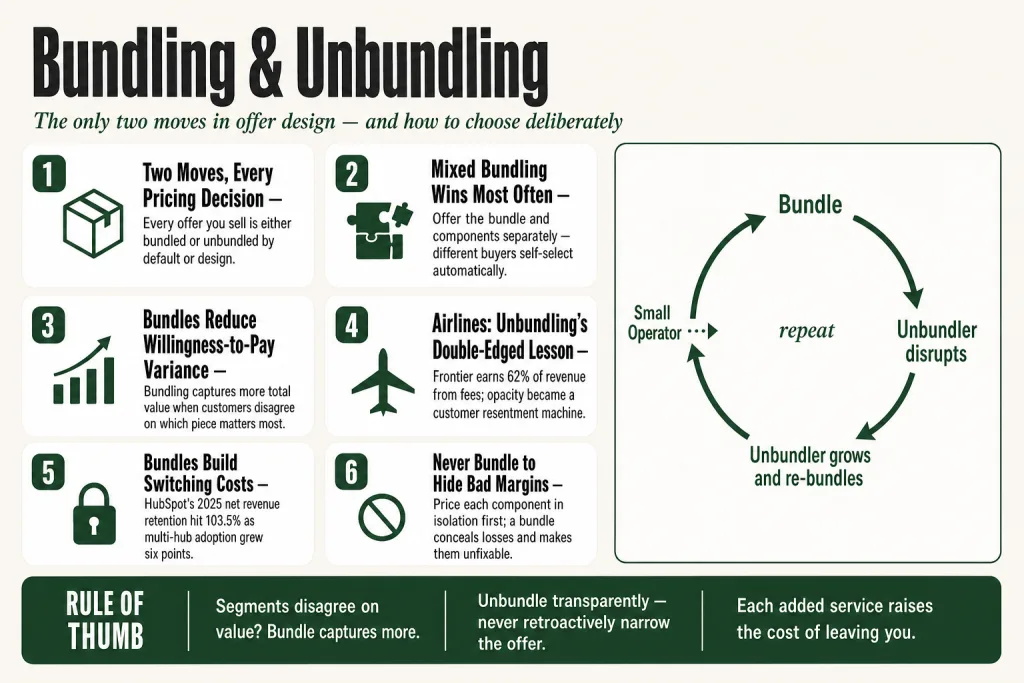
Bundling and unbundling are the two fundamental moves in offer design, nearly every pricing decision you’ll ever make is a version of one or the other. You can look at any offer you sell, figure out whether you’re currently bundling or unbundling by accident rather than by choice, and make a deliberate call about which structure serves your customers and your margin better. That’s what this page is for.
In August 1995, on the final leg of the Netscape IPO roadshow, Jim Barksdale, Netscape’s CEO, fielded a question from investment bankers worried Microsoft would simply copy Netscape’s browser by folding it into Windows. His answer became one of the most quoted lines in business strategy: there are only two ways to make money, bundling and unbundling. He wasn’t describing a trick. He was describing the shape of competitive pressure itself.
Microsoft did bundle a browser into Windows. Then the internet unbundled the desktop. Google and Facebook re-bundled attention. Craigslist unbundled newspaper classifieds. Spotify re-bundled music after iTunes unbundled the album. The pattern doesn’t stop, and every small operator is inside it whether they’re paying attention or not.
The idea in 30 seconds
- Bundling means combining multiple offers into one package, often at a single price that feels like a deal, even if your margin improves.
- Unbundling means splitting a packaged offer into à-la-carte components so customers pay only for what they want, and you can price each piece on its own terms.
- Neither is inherently better. The right move depends on who your customers are, what they value most, and where willingness-to-pay is concentrated in your market right now.
- Business markets shift between the two, bundlers get disrupted by unbundlers; unbundlers grow, add products, and become bundlers again. Small operators who see this coming can use it as a competitive move.
- Every offer you sell is either bundled or unbundled by default or by design. The difference between the two is whether you made a deliberate call about what belongs together, what should be optional, and where you’re hiding value customers would pay more for if they could see it clearly.
The Economics Behind It, and Why They Matter for Your Prices
The formal economics of bundling predate Barksdale by three decades. In 1963, economist George Stigler published a paper examining how Hollywood studios priced film packages to cinema chains, block booking, and showed mathematically that bundling can dominate separate component pricing in profitability. William Adams and Janet Yellen formalized the three bundling structures in their 1976 paper in the Quarterly Journal of Economicsand Richard Schmalensee extended that framework in 1984. The finding that held across all of it: bundling works because it reduces the variance in how much different customers value each piece. When your customers disagree about which part of your offer matters most, a bundle captures more of the total value in the room than selling each piece separately.
Here’s what that looks like for a service business. Say you offer social media management and email marketing. Your restaurant clients care a lot about social and very little about email. Your e-commerce clients are the reverse. If you price each at $800/month, some customers buy only one. Bundle both for $1,200/month, noticeably less than $1,600, and a meaningful share of both groups buys the package, you capture more revenue per customer, and neither segment feels like they’re overpaying for the piece they actually wanted. The bundle smooths out the disagreement.
The same logic cuts the other way. When customers are very heterogeneous, when what one person values, another actively doesn’t want, a bundle starts to feel like waste. Charging a solo freelancer for a 25-seat collaboration platform because it’s “included” doesn’t feel like a deal. It feels like subsidizing other people’s features. That’s when unbundling wins: let people pay for exactly what they need, remove the friction of perceived waste, and you can often charge more for the thing they actually wanted.
Pure Bundling, Pure Components, and Mixed Bundling
Three structures, and they behave very differently in the market.
Pure bundling means customers can only buy the package, no à-la-carte option exists. Think cable television circa 2010: you want ESPN, you’re taking the History Channel and twelve home shopping networks too. Pure bundles maximize revenue capture when your customer base has widely varying preferences across components, the bundle averages out what each person values, and no one can cherry-pick just the cheap piece.
Pure components (full unbundling) is the opposite: everything priced and sold individually. Spirit Airlines at its most aggressive, where a seat, a carry-on bag, a printed boarding pass, and a bottle of water each had their own fee, is the extreme version. This structure works when customers have narrow, specific needs and when your cost structure lets you deliver individual items profitably on their own.
Mixed bundling is what most operators should actually be running: offer both the bundle at a discount and the individual components at their own prices. Adams and Yellen identified all three structures in their 1976 Quarterly Journal of Economics paper and found mixed bundling is usually the most profitable when your customer base is genuinely segmented, because different groups self-select into the version that fits their situation. The high-volume buyer takes the bundle. The one-time buyer takes the component. You capture both.
For a local marketing agency, mixed bundling might look like this: a “Growth Package” with SEO, paid ads, and monthly reporting at $3,500/month, or each service individually at $1,500, $1,800, and $400. Some clients buy the package because reporting feels like it comes along for the ride. Others buy just paid ads because that’s all they want right now. The bundle anchors the perceived value of the individual services, and the individual services make the bundle’s discount visible and concrete. Both effects work at the same time, that’s the engine inside mixed bundling.
How the Pattern Plays Out, and Where You Sit in It
Bundling and unbundling aren’t a one-time decision. They follow a cycle driven by technology and distribution. In a 2014 HBR IdeaCast conversation, Marc Andreessen put it plainly: “bundles emerge as a consequence of the current technology.” The newspaper bundle, news, sports scores, classifieds, stock quotes, all arriving together once a day, was a consequence of the printing plant and the delivery route. When the internet arrived, that bundle fell apart because the distribution constraint disappeared.
The music industry ran this cycle visibly enough that anyone who lived through it watched it happen in real time. The CD was a bundle, you bought twelve songs to get the two you wanted. Apple launched iTunes in 2003 and made $0.99 singles the default. Then Spotify re-bundled: not twelve songs for $10, but thirty million songs for $10/month. New bundle, larger than anything that came before it.
Bundlers get disrupted by unbundlers. Unbundlers grow into large companies and become bundlers themselves. Startups use unbundling as a wedge, they take one piece of an incumbent’s bundle, do it dramatically better, and win a segment. Zoom did this to Cisco’s collaboration suite. Then Zoom added products back and became a bundler. The direction always reverses eventually.
What does this mean for a small operator? Your competitive position is never static. If you run a full-service marketing agency and a nimble freelancer is now offering just Instagram Reels production at half what you charge for that piece, that’s unbundling pressure, and the right response isn’t to compete on price for that component. It’s to reinforce the value of what integration actually delivers. Conversely, if a competitor just launched a stripped-down version of your core service for 40% less, consider whether any piece of your current offer is serving customers poorly, and whether a clearly priced, lighter option might win back the segment you’re losing.
Putting this to work? The ideas in the Canon are the foundation under the tactical playbook in Build a Complete Marketing Department — grab the free companion kit at mmsvegas.com/resources.
Named Examples, What These Moves Look Like in Practice
The airline industry is the canonical modern case for unbundling, and it deserves a hard look because the lesson cuts both ways. Starting in the mid-2000s, low-cost carriers began stripping services out of the base fare, checked bags, seat selection, printed boarding passes, meals, that had always been included. According to an October 2024 projection by IdeaWorksCompany and CarTrawler, global airline ancillary revenue reached $148.4 billion for 2024, up from $109.5 billion in the pre-pandemic year of 2019. The 2025 IdeaWorksCompany Yearbook of Ancillary Revenue, covering 2024 financial data for 61 airlines, shows Frontier at 62%, meaning ancillary fees now account for 62% of Frontier’s total revenue, with five carriers overall generating more than half their revenue from fees rather than ticket prices.
The strategy worked financially, until it worked against the airlines reputationally. A 2024 U.S. Senate Permanent Subcommittee on Investigations report found that separating bag and seat fees from advertised airfare makes it hard for customers to know the true total cost before they’re deep into the purchase flow. That opacity turned a pricing strategy into a customer resentment machine. Southwest’s “Bags Fly Free” policy was the most famous counter-move in the industry, and even that ended in May 2025 under financial pressure, when Southwest began charging $35 for the first checked bag.
The lesson for small operators isn’t “don’t unbundle.” It’s: unbundle transparently, and don’t unbundle things people reasonably assumed were included. Charging separately for something a customer thought they already paid for isn’t a pricing strategy. It’s a trust problem.
On the bundling side, HubSpot’s trajectory is instructive. The company launched in 2006 as a single inbound marketing tool. Today it runs Marketing, Sales, Service, Content, and Operations hubs, with bundle pricing woven through the whole platform. Per HubSpot’s Q4 2025 earnings release (February 2026), 40% of the Pro+ installed base by ARR owned four or more hubs, up six points year-over-year, with full-year 2025 net revenue retention at 103.5%, up from 101.8% in 2024. Existing customers spend more each year without HubSpot needing a new acquisition to grow that revenue. That’s the bundling retention flywheel in operation.
For a small professional services firm, the principle translates directly: build service lines that complement each other, offer them together at a package price that’s compelling enough to pull clients in early, and the switching cost of leaving compounds with every additional service they adopt.
When to Bundle, the Conditions That Make It the Right Call
Bundling works best when several conditions line up. The more of these are true for your business, the stronger the case for moving toward a bundled offer structure.
Your customers have different high-value pieces
If Segment A values service A and Segment B values service B, a bundle captures revenue from both groups that separate pricing would leave on the table. The bundle averages the variance out, each segment gets the thing they care most about, plus something they care about less, for a price that still feels like it fits. That math only works when segments are genuinely different. If all your customers want the same one thing, a bundle won’t help.
Friction is costing you sales
If your sales conversation turns into a menu negotiation, “do you want this piece, what about that piece, should we add X?”, a well-constructed bundle collapses that down to a single yes/no decision. Less cognitive load for the buyer means faster closes. Buyers who get confused or overwhelmed don’t usually ask for clarification. They delay or go elsewhere.
Your marginal cost is low
Bundles work best when the cost of adding one more component is small relative to the perceived value it adds. Software has near-zero marginal cost, which is why SaaS bundling can be so profitable. For service businesses the math isn’t quite as clean, but it’s often much better for incremental additions than for standalone delivery. If you can add a quarterly strategy review to a retainer for two hours of prep time, bundling it in raises perceived value more than your cost increases.
You want to increase switching costs
The deeper a client is inside your bundle, the harder it is to leave. Not because you’ve trapped them, because the integrated experience is genuinely superior to a set of separate point solutions. When clients use multiple services from you and those services feed into each other, the effort required to replace you is significant. That stickiness is one of the most durable competitive advantages a small operator can build.
You’re trying to introduce something new
Bundling is one of the most effective ways to get a new service in front of existing clients. Add a content audit to your existing SEO retainer and clients who would never have bought it separately will use it because it’s “included”, and once they see the value, they’ll ask for more. Bundling is a distribution mechanism, not just a pricing one.
When to Unbundle, and How to Do It Without Burning Goodwill
Unbundling is underrated as a proactive strategy for small operators. Most people treat it as something that happens to them, a competitor strips away a piece of your offer and undercuts you, rather than something they choose. Done deliberately, unbundling can open new customer segments, improve margin transparency, and give price-sensitive buyers a way in that doesn’t require swallowing a full package they don’t need yet.
Your customers are telling you they don’t want the full package
When prospects consistently say “I only need X,” that’s a signal worth taking seriously. You can interpret it as a price objection. Or you can interpret it as market research telling you that your bundle contains items some buyers don’t value. If that’s happening often enough, offer a stripped-down version at a lower price, get those customers in the door, and earn the upsell over time. Lower-priced unbundled entry points reduce purchasing friction, which means more people start the relationship.
You have high-value components that are invisible inside the bundle
Sometimes a bundle accidentally hides your best work. If you do exceptional video production and bury it inside a “social media package” without calling it out separately, some customers will never understand what they’re paying for or how good it is. Unbundling that component, even just for positioning purposes, can let it command attention and price on its own terms. You don’t have to stop offering the bundle. You can do both.
You need to recapture margin on specific services
When a cost that used to be easily absorbed becomes material, separating it out lets you recover it without raising your headline price. A florist who offered free delivery bundled that cost into the flower price, it worked fine when delivery was cheap. As delivery costs rose, unbundling it into a separate line item became the honest fix. That same logic applies to any service business where one input cost has moved significantly.
When NOT to unbundle
Don’t unbundle things that feel foundational to the service. If a customer reasonably expected something to be included and you charge for it separately, you haven’t created a new revenue line, you’ve created a complaint and probably a lost renewal. The airline industry ran this experiment at scale and found there’s a floor below which unbundling stops being clever pricing and starts being a customer service crisis. Don’t find that floor the hard way.
How Small Operators Apply This Today
Not theory. Just the decisions you actually need to make and the order to make them in.
Step 1: Audit what you’re currently doing
Write down every service or product you deliver. For each one, ask: is the customer aware they’re getting this, or is it buried in the price? Does it add perceived value, or is it something you do operationally that they neither notice nor care about? Items in the second category are either bundling overhead you should price separately (if they’re costly) or silent value you should start naming (if they’re not).
Most service businesses have significant invisible value, things they do that clients don’t notice because they happen behind the scenes. A bookkeeper who catches a payroll tax error before it becomes a penalty is delivering enormous value. If that’s never surfaced, it’s hidden inside the monthly retainer and the client thinks they’re buying “bookkeeping,” not “financial protection.” Naming it, even inside a bundle, changes perceived value without changing the price.
Step 2: Map your customer segments to your components
List your five best clients and rank which services they use most and value most. If there are clear clusters, some care deeply about deliverable A, others about deliverable B, you have a bundling opportunity. A package that combines both captures more from each group than selling à-la-carte to each. If your segments all want the same one or two things, you may be over-bundling. Strip it back to what they actually use, price that sharply, and let the optional pieces be clearly priced add-ons.
Step 3: Choose your structure deliberately
For most small service businesses, mixed bundling is the right default. Offer a flagship package at a compelling price, and offer the individual services at prices that make the package look smart. The individual prices serve a dual purpose: they give you customers who just need one thing, and they make the bundle’s effective discount visible and concrete. “$3,500/month for all three, or $1,500 + $1,800 + $400 individually”, the pricing structure does the work without a line of sales copy.
Step 4: Use your bundle as a retention engine
Every additional service a client takes from you increases their switching cost and decreases their likelihood of leaving. This only works long-term if the services are actually good. But build your offer roadmap with this in mind: what’s the natural second service a client buys after the first? Price it so saying yes is easy. Then what’s the third? If you can architect a path where clients naturally adopt more services over 12 to 18 months, you’ve built a bundling growth engine that compounds without requiring new customer acquisition for every revenue dollar.
Step 5: Let AI handle the analysis, not the judgment
An AI assistant can help you run a quick pricing audit, give it your services, your client segments, and usage patterns, and ask it to flag where you might be under-pricing standalone components or over-bundling into packages with low perceived value. That’s legitimate and genuinely useful. The judgment call, which services belong together, what price signals trust to this specific client, when to hold firm on bundle pricing, stays with you. AI can surface the analysis. The operator makes the call.
Common Mistakes
- Building a bundle before calculating component margins — Price and cost each service in isolation first. If one piece loses money on its own, a bundle conceals that loss and makes it harder to fix, you’ll eventually feel it in margin without being able to trace it. Settle the economics of each component before combining anything.
- Setting the bundle discount arbitrarily rather than structurally — Start with individual component prices set at their true market value. Then work backward: what discount makes the bundle an obvious choice for your target buyer without gutting margin? If you’re discounting 30% and the bundle still rarely converts, the problem is usually component fit, not price level, the items don’t feel like natural companions.
- Applying a new bundle structure to existing clients without warning — Existing clients priced under your old structure should stay there unless they choose to migrate. Introduce new packaging only to new clients, and offer current clients a voluntary path to the new structure with a clear value case. Forced changes to established pricing relationships damage trust in ways that take months to repair.
- Unbundling items clients assumed were always included — Before separating any line item, ask honestly: did clients know this was optional when they signed up? If the answer is no, you’re not clarifying your offer, you’re retroactively narrowing it. Only charge separately for things disclosed as optional before the relationship started. Surprises on invoices rarely end well.
- Locking in a bundle structure and never revisiting it — Offer design is not set-and-forget. Run an annual audit: what are competitors now offering that you used to be the only one doing? Which components do clients actually use versus which sit idle? A bundle that was the right call 18 months ago may now be over-serving low-value clients or under-pricing a component your best clients value most. The structure should follow the market, not the other way around.
Operator’s Take
Most operators I talk to have never made a deliberate offer design decision. They priced their first service, got some clients, and the structure calcified. What they’re running now is whatever they accidentally arrived at, not a choice they made.
Start by naming what’s inside your current offer. Go line by line through what you actually deliver. A bookkeeper who catches a payroll tax error before it becomes a penalty, a designer who flags a brand inconsistency before it reaches print, that work gets done and disappears into the retainer. Name it. Surface it. Even if you don’t change the price, clients who can see what they’re getting perceive it differently than clients staring at a single monthly number. That’s the cheapest move available to almost any operator, and most skip it entirely.
The two failure modes I see most often. First: rolling everything into a retainer without naming the components, so clients have no idea what they’re getting, and you have no footing when someone pushes back on price. Second: selling everything à-la-carte while prospects stall indefinitely at the “which services do I actually need?” stage, because you’ve handed them a configuration problem instead of a decision. Mixed bundling addresses both. A flagship package gives the buyer a clean yes or no. Individually priced components anchor each piece’s value and make the bundle discount concrete and visible. Run the numbers on paper before you pitch it. If the individual prices don’t make the package look obviously smart, adjust them until they do.
On retention: this is the angle most operators underweight. Every additional service a client takes from you is a switching cost that protects your revenue, not because you’re trapping them, but because integrated services are harder to replace than standalone ones. If you’re handling someone’s email marketing, paid ads, and monthly analytics reporting, replacing you means coordinating three new vendors or finding one who does all three as well as you do. That’s a high bar. HubSpot’s Q4 2025 earnings show this at scale: 40% of the Pro+ installed base by ARR owned four or more hubs, up six points year-over-year, with full-year 2025 net revenue retention at 103.5% (HubSpot Q4 2025 Earnings, February 2026). Existing customers spent more, without a new acquisition. The dynamic scales down to any size business.
On margin: don’t bundle to hide bad economics. If a service inside your package is unprofitable on its own, bundling it doesn’t fix that, it just makes the problem harder to see. Know the contribution margin of every component before you decide what goes in the package. This isn’t optional. It’s the foundation the whole structure sits on.
On competitive positioning: a large bundled competitor isn’t automatically a reason to bundle too. Often it’s the opposite signal. If there’s a dominant full-service player in your market, the fastest way to win a beachhead is to take one component that bundle handles poorly, do it dramatically better, and own that segment. Zoom didn’t beat Cisco by building a bigger collaboration suite. It beat them by making video calls so much better and cheaper that the rest of the suite stopped mattering for a huge slice of buyers. A sharp local agency can run the same play against a national firm selling a 40-item retainer when three things done well would have been enough.
On when to consider unbundling proactively: if you keep losing the first conversation because prospects balk at your package price, don’t automatically discount it. Ask what they actually want. If the answer is consistently one or two components, you may be forcing a bundle on a market that wants an entry point. A smaller, clearly scoped offer at a lower price can bring clients in, and earn the expanded relationship over time. That’s a deliberate unbundling play, not a concession.
A practical first move. Give an AI assistant your current service list, your client segments, and your rough pricing. Ask it to identify where you might be hiding value or where a bundle might be creating confusion. It won’t tell you what to charge, it doesn’t know your relationships or your competitive context. But it can help you see the structure of the problem before you touch anything. Use that. Then make the call yourself.
Used in
- ✓ Build a Complete Marketing Department
Used to design offer tiers and package structures that move prospects from entry-level to high-value engagements without requiring separate sales campaigns for each service. - ✓ The Missing Manual for FunnelKit
Applied when configuring order bumps, upsell sequences, and product packages, FunnelKit’s order flow mechanics are a direct implementation of mixed bundling logic at the checkout level. - ✓ The Missing Manual for Make
Used when automating service delivery workflows that vary by package tier, the automation logic branches based on which bundle a client purchased, triggering different onboarding and fulfillment sequences accordingly.
FAQ
What’s the simplest way to test whether I should bundle or unbundle?
Talk to your last ten customers and ask which parts of your service they find most valuable. If they all say the same one or two things, you’re probably over-bundling. If they each value something different, a bundle will likely capture more revenue than selling à-la-carte.
Can a one-person service business really use bundling strategy?
Absolutely. If you offer more than one service, you have a bundling decision. A freelance designer who offers logo design, brand guidelines, and social media templates can structure those as a standalone menu or as a ‘Brand Launch Package’, the bundle almost always wins on average deal size.
How do I know if my bundle discount is set at the right level?
A practical test: do most clients who see the bundle choose it? If almost nobody takes the bundle, the discount isn’t compelling enough or the components don’t feel like natural companions. If almost everybody takes the bundle, you may have priced the individual components too high relative to the package.
Is unbundling just a way to raise prices without looking like you’re raising prices?
It can be used that way, and customers know it, which is why transparency matters. Done honestly, unbundling reveals the true cost of specific services that were previously hidden in a package price. Done cynically, it obscures the real total cost. The difference is disclosure: customers should know exactly what’s included and what costs extra before they commit.
What’s the connection between bundling and customer retention?
Every additional service a client uses from you increases the effort required to replace you, they’d need to find multiple new vendors or one vendor who does everything as well as you do. Multi-service clients churn at materially lower rates than single-service clients, which means bundling is as much a retention strategy as a revenue strategy.
Should my bundle always be cheaper than buying everything separately?
The bundle should feel like better value, but that doesn’t always mean a lower number. Convenience, simplicity, and integrated delivery are valuable in themselves. That said, for most markets, a visible mathematical discount makes the bundle’s appeal concrete and easy to act on, so in practice, yes, most effective bundles carry a real price advantage over the sum of components.
Further reading
- ‘Commodity Bundling and the Burden of Monopoly’Adams & Yellen (1976, Quarterly Journal of Economics). The foundational academic paper that formalized the three bundling structures and their welfare implications. Dense but worth the effort if you want the theoretical grounding.
- Personal MBA by Josh Kaufman, covers bundling and unbundling as core value-creation mechanisms in accessible language, framed around how any business can reconfigure its offers to serve more customers without building something new.
- Stratechery by Ben Thompson (stratechery.com), Thompson has written extensively on the bundling and unbundling pattern in media and technology, with clear frameworks that translate directly to how smaller operators should think about their own competitive position.
- ‘How to Succeed in Business by Bundling, and Unbundling’Justin Fox, Harvard Business Review (June 2014). The HBR IdeaCast interview with Marc Andreessen and Jim Barksdale that brought their framework to a wide business audience. The source for Andreessen’s quote on distribution technology and bundle structure.
Sources: Jim Barksdale, Netscape IPO roadshow (August 1995), as documented in multiple secondary sources including Satyajit Rout (Medium, 2021) and Fintech Takes (Alex Johnson, June 2023). Marc Andreessen on bundle economics: HBR IdeaCast, ‘Marc Andreessen and Jim Barksdale on How to Make Money,’ July 2014 (hbr.org/podcast/2014/07); Andreessen’s quote, ‘bundles emerge as a consequence of the current technology’, cited in Deloitte Insights (2016), Fintech Takes (2023), and Swell & Cut (2021). George Stigler, ‘United States v. Loew’s Inc.: A Note on Block Booking,’ Supreme Court Review (1963). William J. Adams and Janet L. Yellen, ‘Commodity Bundling and the Burden of Monopoly,’ Quarterly Journal of Economics, Vol. 90, No. 3 (August 1976), pp. 475 to 498. Richard Schmalensee, ‘Gaussian Demand and Commodity Bundling,’ Journal of Business (1984). IdeaWorksCompany and CarTrawler, ‘Airline Ancillary Revenue Skyrockets to $148.4 Billion Worldwide for 2024,’ press release, October 2024 (ideaworkscompany.com); IdeaWorksCompany 2025 Yearbook of Ancillary Revenue (covering 2024 financial data for 61 airlines): Frontier at 62% ancillary revenue share, highest in the Yearbook, with five airlines above 50%; confirmed by PhocusWire (September 2025) and TheWiseMarketer (September 2025). U.S. Senate Permanent Subcommittee on Investigations, ‘The Sky’s the Limit: The Rise of Junk Fees in American Travel,’ November 2024. Southwest Airlines ended ‘Bags Fly Free’ policy effective May 28, 2025 (announced March 11, 2025; confirmed by Airways Magazine, NerdWallet, Bloomberg, May 2025). HubSpot Q4 2025 Earnings Release, February 11, 2026: 40% of Pro+ installed base by ARR own four or more hubs, up six points year-over-year; 62% of new Pro+ customers landed with multiple hubs in 2025; full-year 2025 net revenue retention at 103.5%, up from 101.8% in 2024 (sources: ir.hubspot.com official earnings release; The Motley Fool earnings transcript, February 11, 2026; Globe and Mail transcript; Yahoo Finance earnings call highlights, February 12, 2026).
Brian Kasday spent forty years in direct-response marketing before rebuilding the whole operation as a one-person shop. He writes The Operator’s Library — including “Build a Complete Marketing Department” — for operators who’d rather build it themselves than wait on someone else.
Build the department these ideas describe — the free companion kit: mmsvegas.com/resources.
More The Operator's Canon guides
Free · Operator Toolkit
Want the tools, not just the guide?
Get the free operator toolkit — templates and checklists for the systems you actually run, plus a note when this guide changes.
Get the free toolkit →How to cite: Bundling and Unbundling. Associated with Jim Barksdale / George Stigler (academic foundation), 1963. The Operator’s Canon, MMS Vegas. https://mmsvegas.com/library/bundling-unbundling-explained/