
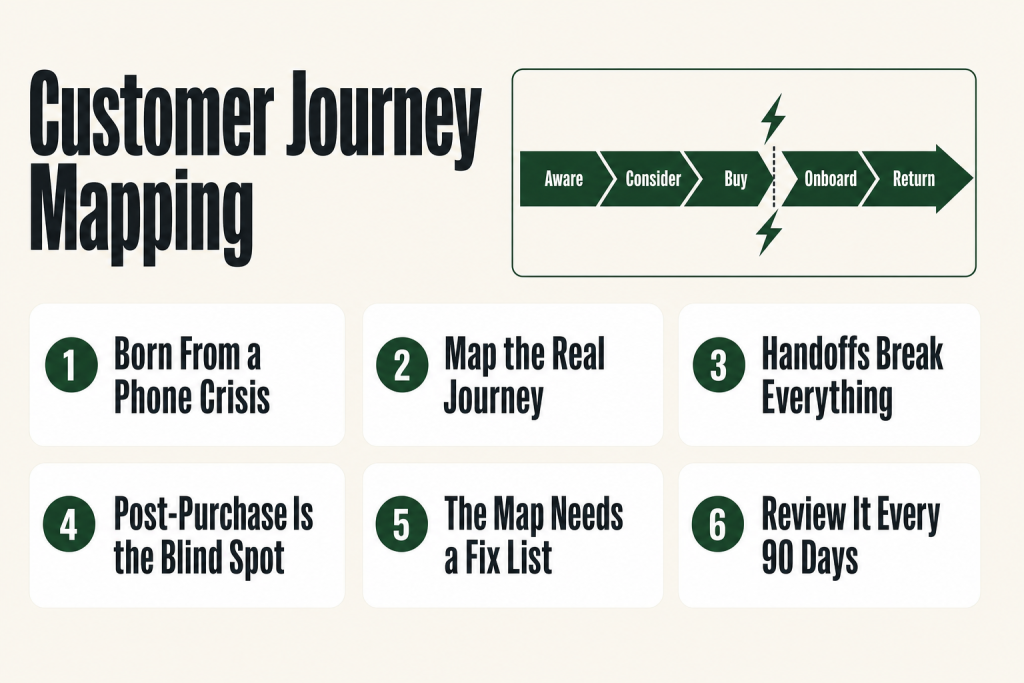
Last updated: July 2026
Customer journey mapping is the practice of charting the real, unvarnished sequence of steps, goals, questions, and emotional states your customer moves through, before, during, and after they buy from you. By the end of this page, you’ll be able to build a working map of any customer segment, identify the specific moments where you’re losing people, and prioritize fixes by business impact rather than gut feeling.
You already have a customer journey. You just haven’t drawn it out. And right now it probably has at least three points where a customer hits friction, goes quiet, and either waits for you to follow up (which may never happen) or quietly moves on to someone else. Journey mapping makes the invisible visible.
Done at operator scale, this is the discipline of walking your customer’s path yourself, logging every touchpoint, every question they’d have, every handoff between your team members or systems, and asking honestly: where does this fall apart? Where do we think it’s smooth but the customer is actually grinding?
The most useful maps aren’t the most beautiful. They’re the ones that produce a short punch list of fixes the operator actually implements. A map that lives in a Google Slide and gets reviewed once a year is decoration. A map that generates three process changes this quarter is a business tool.
The idea in 30 seconds
- Customer journey mapping charts every step, question, and emotion a customer moves through, from first awareness to loyal repeat buyer, so you can see your business through their eyes, not yours.
- The goal isn’t a pretty poster. It’s a decision tool: which friction points do you fix first, and where are handoffs between your team losing customers you already earned?
- Most small-business maps fail because they document the intended journey (how you designed it), not the actual journey (what customers actually do). The gap between those two things is where revenue disappears.
- Start with one customer type and one journey segment, awareness to first purchase, or purchase to second purchase. A tight, accurate small map beats a sprawling aspirational one.
- The map is only valuable if it produces a fix list. If you finish mapping and nothing changes in your business, you wasted the afternoon.
- AI tools (Claude, ChatGPT) can accelerate interview synthesis, spot patterns across support tickets, and draft hypothetical journey stages, but the judgment about what to fix and in what order stays with you.
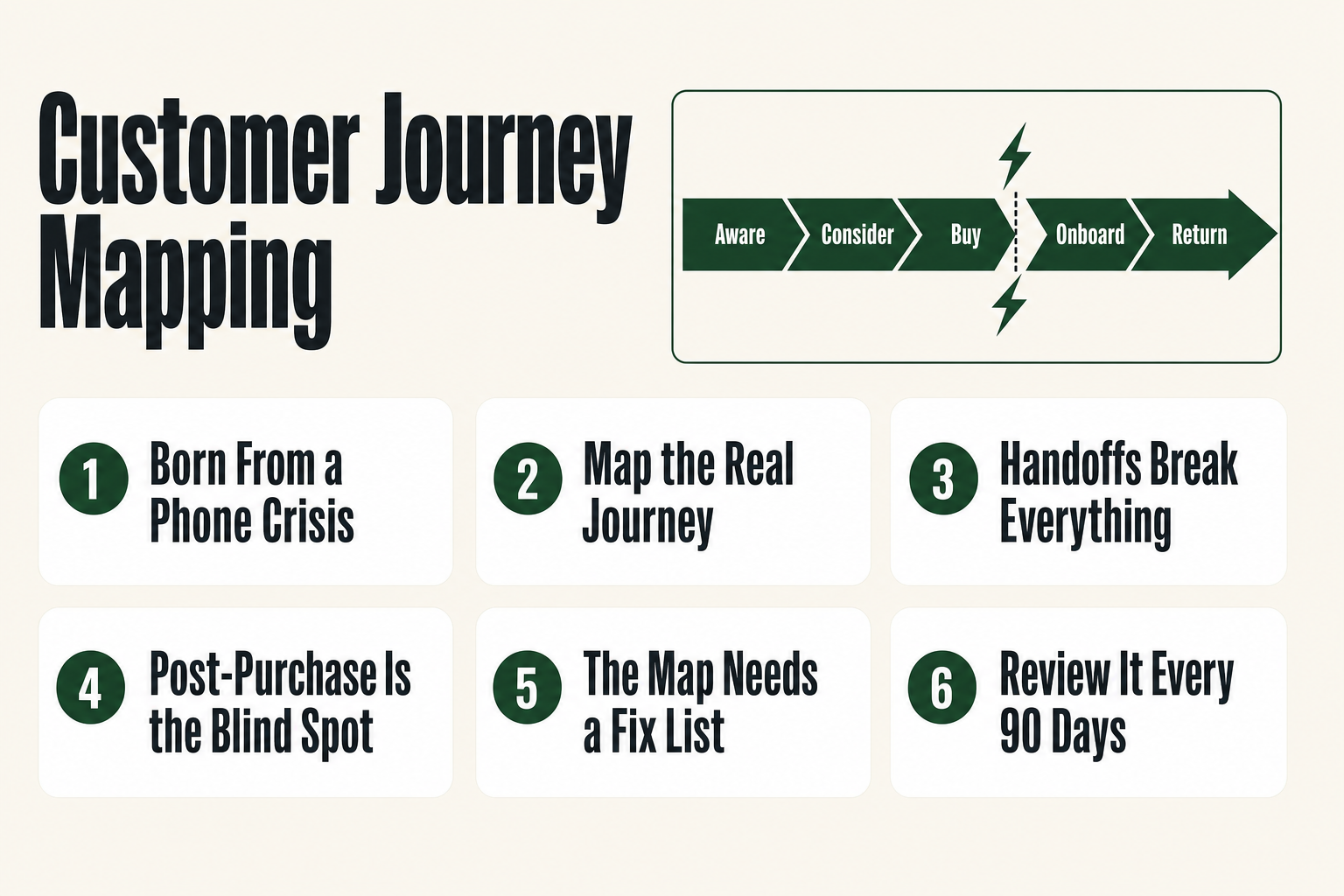
Where Customer Journey Mapping Came From
The idea didn’t come from a design agency or a Silicon Valley product team. It started with a phone company drowning in hostile customer calls.
In 1985, consultants Chip Bell and the late Ron Zemke were hired to help a large telephone company whose contact center was overwhelmed following residential service outages. They interviewed customers in focus groups, walking them step by step through the experience from the moment the dial tone went dead. When the sequence landed on paper in front of leadership, it was hard to argue with. Bell and Zemke called the practice ‘cycle of service mapping.’ Their 2003 book Service Magic (Dearborn Trade Publishing) put the methodology into formal written record, and Bell later described the original engagement in a June 2023 piece for Martechvibe.
Running independently, and at roughly the same time, was Jan Carlzon’s work at Scandinavian Airlines. Carlzon became CEO in 1981 and returned a loss-making airline to profitability within a year by identifying every point where a customer touched the airline and calling those moments ‘moments of truth.’ His book was first published in Swedish in 1985 as Riv pyramiderna!then translated into English in 1987 by Ballinger Publishing as Moments of Truth. It gave customer experience thinking a vocabulary it still uses today.
Bell and Zemke were building a diagnostic sequence from customer interviews; Carlzon was focused on empowering frontline employees to handle individual interactions better. Same era, different industries, neither influencing the other. Both shaped what the field became.
UX designers in the late 1990s expanded the practice into digital products. By the 2010s, journey mapping had landed firmly in mainstream consulting, which is both a sign of its usefulness and the reason so many maps are mediocre. When something becomes fashionable, execution gets sloppy.
For an operator, the relevant takeaway is simple: this tool was invented to solve an actual operational problem, not to generate a deliverable. It started as a diagnostic. Use it that way.
The Problem Customer Journey Mapping Actually Solves
Every operator builds their business from the inside. You know where the front door is, how the phone gets answered, who handles fulfillment, what the invoice looks like. You’ve seen every piece of the machine hundreds of times, so you tend to assume it works, or at least, that the parts are connected in a way that makes sense to a customer.
Your customer enters from the outside and experiences something completely different. They don’t see your departments, your intentions, or your internal logic. They see a Google result, a review, a website, a conversation, a wait, a form, a follow-up (or the absence of one), an invoice, a support interaction, a renewal reminder. Each of those is a moment of truth. Each one either builds confidence or erodes it.
The gap between how operators think their business works and how customers actually experience it is where most preventable churn hides. Friction rarely announces itself as one dramatic failure. It tends to be a chain of small, seemingly normal issues: a call that rings out, a web chat that’s only staffed occasionally, a handoff between sales and delivery that adds two days, an inbox treated as someone else’s problem, a booking process that requires three follow-up emails. No single one of those is fatal. Together, they’re exhausting, and the customer who experiences all of them won’t write a complaint. They’ll just stop.
Journey mapping solves that by forcing you to look at the sequence as the customer experiences it, not as you designed it. Once you’ve drawn the real path, with every step, every question the customer would have, every place the baton gets passed, the gaps reveal themselves. The map becomes a diagnostic: here’s where you’re losing people you already had.
Often, operators who complete their first real journey map discover that the problem isn’t top-of-funnel at all. Awareness is fine. The conversion rate isn’t the culprit. What’s broken is the follow-up sequence between inquiry and proposal, or the onboarding experience between purchase and first result. Spending more money on ads into a leaky system is the wrong move, and the map shows you that before you cut the check.
Customer Journey Mapping: Core Principles Every Operator Should Know
The mechanics of a journey map are not complicated. What’s hard is being honest enough to draw the real one instead of the ideal one. These are the principles that separate maps that produce change from maps that produce slide decks.
It’s the customer’s journey, not yours
This sounds obvious. It isn’t. Your expertise, your assumptions, your knowledge of how the system is supposed to work, all of it becomes a liability when you’re trying to see what the customer actually encounters. The map should be written in the customer’s language, describing what they experience at each step, what question they’re asking themselves, and what they’re feeling. Not what you intended them to feel. What they actually feel, based on the evidence: support transcripts, reviews, lost-deal interviews, churn conversations.
Stages represent customer goals, not your internal departments
Most bad journey maps are organized around the company’s org chart: Marketing, Sales, Delivery, Support. That’s an internal view. A customer-oriented map organizes around what the customer is trying to accomplish at each stage, figuring out if this is even worth my timecomparing my optionsmaking the purchase feel low-riskgetting my first resultdeciding whether to come back. Those stages don’t respect your department boundaries, which is exactly the point.
Most customer journeys are not linear
Buyers loop back. They research, then go quiet, then return after seeing a competitor’s ad, then Google you again, then ask a colleague, then reach out. A map that assumes a clean left-to-right progression from awareness to purchase is a fiction. Build in the possibility of re-entry, of customers who stall at consideration for weeks, of people who buy and then go cold. The nonlinear reality matters because it tells you where to put nurture content, where to install reminder triggers, and where to make re-engagement easy rather than friction-filled.
Emotions and questions matter as much as actions
At each stage, a well-built map captures three things: what the customer is doingwhat they’re thinking or asking themselvesand what they’re feeling. That last row is where operators learn the most. A customer in the early-consideration stage might be taking the action of reading your About page, but the underlying question is can I trust these people? and the emotion might be skepticism. If you know that, you know what job your About page actually has to do. It’s not there to impress; it’s there to reduce suspicion.
Handoffs are the highest-risk moments
Any point where responsibility transfers between people, teams, or systems is where the experience most often breaks. Sales hands to delivery. Your CRM fires an automated email but the account manager doesn’t know. The customer pays, then hears nothing for four days. Handoffs are the moments of truth that operators most consistently underestimate because each person on their side of the handoff thinks someone else owns the follow-through. Mapping surfaces the handoff gaps explicitly.
The map is a starting point, not an artifact
A journey map has a short shelf life. Customer behavior changes, channels shift, you change your offers or onboarding process. Build the habit of reviewing it quarterly, not annually. The map isn’t the work, the fixes are the work. Once a map is finished and prioritized, its value decays quickly if you’re not implementing changes and watching whether the friction metrics improve.
How to Actually Build a Map You’ll Use
Skip the template for now. The most common mistake operators make is opening a journey mapping template, filling in the labeled boxes, and calling it done. You end up with a map that reflects the template’s structure rather than your customer’s reality. Start with the data and build the structure from what you find.
Step 1: Pick one persona and one journey segment
Don’t try to map every customer type and the full lifecycle at once. Pick your most important customer segment, the one that drives the most revenue or that you’re losing at the highest rate, and pick one journey segment to start: awareness to first purchase, or first purchase to second. A sharp, accurate narrow map beats a sprawling one with twenty assumptions baked in.
Step 2: Gather real evidence before you draw anything
Pull your support tickets, review your CRM notes, look at where drop-offs happen in your analytics, read your Google reviews, the 3-star ones especially. Run five to ten short customer interviews, not surveys, actual conversations, and ask people to walk you through their experience chronologically. Ask what they were thinking at each step, what almost stopped them, what surprised them. Your frontline staff (whoever handles sales calls and customer service) are also a primary source. They hear the real questions every day; you may not.
Step 3: Map the stages in customer language
Write each stage as the customer’s goal or question, not your process step. ‘Awareness’ is fine as a label, but the customer’s version might be: I Googled my problem and landed on your site, now I’m deciding in 20 seconds whether to stay or leave. That specificity changes what you do about it. Under each stage, document: what the customer is doing, what they’re asking themselves, how they’re feeling, what touchpoints they encounter (website, email, phone, in-person), and what could go wrong here.
Step 4: Mark the friction and the handoffs
Go back through the map and flag every place where a customer would hit delay, confusion, inconsistency, or extra effort. Flag every place where the baton passes between people or systems. These are your candidates for the fix list. Not all friction is equally costly, prioritize based on volume (how many customers hit this point?) and impact (how much does it hurt conversion or retention?).
Step 5: Build the fix list and assign owners
For each friction point you’re going to address: what’s the specific change, who owns it, by when, and how will you measure whether it worked? The map without this step is decorative. Three implemented fixes based on a rough map are worth more than a pixel-perfect map with zero follow-through.
A note on AI assistance
AI tools can genuinely accelerate the synthesis phase. Feed Claude or ChatGPT a batch of support ticket summaries or interview notes and it can surface recurring patterns and suggest stage groupings faster than you’d do it manually. It can also draft hypothetical journey stages for a persona you haven’t fully interviewed yet, which you then validate against real data. What it can’t do is decide which friction points matter most to your specific business, or make the judgment calls about what to fix first. That analysis stays with you.
Putting this to work? The ideas in the Canon are the foundation under the tactical playbook in Build a Complete Marketing Department — grab the free companion kit at mmsvegas.com/resources.
Where Journey Mapping Works, and Where It Really Earns Its Keep
Journey mapping is especially powerful in a few specific situations. Know which ones apply to you before you invest the time.
When you’re losing customers at a specific stage and you don’t know why. If your close rate is fine but churn is high in the first 90 days, a post-purchase journey map will almost certainly show you the problem, and it’s usually a handoff gap or an onboarding experience that leaves new customers feeling abandoned. This is the single most valuable use of the tool for service businesses.
When you’re adding a new channel or offer. If you’re launching a new service, opening a second location, or starting to sell through a new platform, mapping the intended customer journey before you go live reveals the failure points you haven’t built solutions for yet. This is the closest journey mapping gets to a pre-mortem, you’re imagining the customer’s path before the problems occur rather than reverse-engineering them after.
When you have multiple people or teams touching the customer. The more handoffs in your business, the more valuable the map. Solo operators with a simple product have fewer gaps to find. A 12-person business where leads come in through three channels, get handled by two salespeople, then pass to an operations team, then go to a support function, that business has four or five places where the experience can silently break. The map finds them.
When you’re competing on experience, not price. If you’re in a category where you can’t realistically win on price, the customer experience is the product. Journey mapping becomes a strategic exercise, not just an operational one, it tells you which moments to invest in differentiating and which ones to make as frictionless (and forgettable, in a good way) as possible.
Journey mapping also connects naturally to other tools in the operator’s toolkit. It extends and operationalizes the Marketing Hourglassthe Hourglass gives you the lifecycle phases, and the journey map fills in the specific touchpoints, questions, and friction points within each phase. It supports your Customer Effort Score work by showing you where the effort lives, not just how much of it there is. And it informs your Voice of Customer research, knowing which journey stages to investigate helps you ask better questions in the right places.
Where Journey Mapping Struggles (and Isn’t Worth Your Time)
The tool has real limits. Knowing them saves you from building an impressive-looking thing that doesn’t actually help.
Very early-stage businesses with no real customers yet. If you’re pre-revenue or just launched, you don’t have the behavioral data to build an accurate map. You have hypotheses about a journey, which is closer to a user-story exercise than a journey map. That’s still useful, but call it what it is. Once you have 20-30 real customers, you can rebuild it from evidence and it’ll look very different.
Businesses with a transaction so simple it barely has a journey. A food truck, a vending machine business, a simple e-commerce shop with a fast impulse buy, the customer’s path from discovery to purchase may be two or three steps. There’s still friction to find (the Instagram post to the link in bio to the checkout is a classic gap), but a formal multi-stage map is probably overkill. Fix the three obvious friction points directly.
When the map becomes the goal. This is the most common failure mode in larger organizations, and it seeps into small businesses too. The team spends three weeks producing a visually stunning journey map that gets presented, admired, and filed. The map was the deliverable. Nothing changes. This isn’t a failure of the tool; it’s a failure of intent. The map is infrastructure for a fix list, not a product in itself.
When you use it to confirm existing beliefs. Mapping that starts with conclusions and works backward to justifications is worse than no map at all, it gives you false confidence in a picture of the customer that you’ve essentially invented. If your finished map looks exactly like how you’d hoped your business works, that’s a signal to be suspicious, not satisfied.
Common Misunderstandings About Customer Journey Mapping
A few conceptual confusions show up repeatedly, worth clearing them out before they cost you time or misdirected effort.
‘Journey mapping is the same as a sales funnel.’ No. A funnel is your view of the customer, organized around your sales stages and conversion rates. A journey map is the customer’s view of the experience, organized around their goals and feelings at each step. They can and should inform each other, but they’re different lenses. A funnel tells you how many people drop off at each stage; a journey map tells you why and what they were experiencing when they did.
‘One map covers all your customers.’ A single map captures one persona’s experience through one journey path. If you have two meaningfully different customer types, say, a small-business buyer and an individual consumer, they have different questions, different timelines, different trust requirements, and different friction points. One map for both is a compromise that serves neither. Keep them separate.
‘The map should reflect how the journey is supposed to work.’ The most dangerous version of this mistake is when operators map the journey they designed rather than the one customers actually take. The designed journey is a policy document. The actual journey is a diagnostic. You need the second one.
‘Journey mapping and the AIDA model are the same thing.’ AIDA (Attention, Interest, Desire, Action) is a model of the psychological progression toward a purchase decision. It’s a useful framework for messaging, what a piece of content or an ad needs to accomplish. Journey mapping is about the full operational experience across all touchpoints, including everything that happens after the purchase. AIDA ends where the customer journey keeps going. The AIDA model is a subset tool; the journey map is the broader context it lives inside.
‘Journey mapping is a one-time project.’ Customer behavior changes. Your business changes. A map that was accurate 18 months ago may now have three stages that no longer exist and two new ones that aren’t documented at all. Schedule a full review twice a year, with lightweight updates any time a significant process or channel changes.
How Real Companies Have Used Journey Mapping to Fix What Mattered
The examples worth studying aren’t the famous brand case studies with six-figure research budgets. The useful ones are closer to the scale where the insight is actually transferable.
A retirement home referral business mapped the decision journey and discovered something counterintuitive: the person making the choice wasn’t the elderly resident, it was their adult children, often navigating the decision under stress, guilt, and time pressure. Every piece of marketing had been written to reassure the prospective resident. None of it spoke to the adult child who was actually driving the decision. Once they understood whose journey to map, the messaging, channel strategy, and follow-up sequence changed completely.
Capital One used a service blueprint, a close cousin of the journey map, to chart how small-business owners apply for a business credit card, use it, and seek a higher credit limit. The exercise was designed not to fix what was broken but to identify where new features could slot into the existing journey without disrupting it. The map flagged workflow mismatches that aggregate satisfaction scores had obscured, because customers who’d adapted around gaps weren’t complaining; they’d just quietly changed how they used the product.
At the small-business level, the pattern is consistent: the most actionable insights tend to come not from the awareness or purchase stages (which operators usually have the clearest view of) but from the post-purchase experience. What happens after the customer pays is often the least intentional, least documented part of the operation. The customer gets a receipt. Maybe an automated email. Then silence. For a service business, the critical window for building loyalty, or losing it, is the first 30 days after purchase, and most operators have almost nothing mapped for that period.
A local landscaping company mapped why referrals had declined. The map revealed that the handoff between the sales call and the first service appointment was a 12-day gap with zero proactive communication. Customers who’d agreed to a proposal were left wondering whether the company had forgotten them. Three automated touchpoints inserted into that gap, a confirmation, a prep-day reminder, and a ‘we’re on our way’ message the morning of service, changed the experience without changing the service itself.
Common Mistakes
- Building the fix list in your head instead of on paper — Before the mapping session ends, write down each friction point you identified, who specifically owns resolving it, and a deadline. Vague intentions don’t survive contact with a busy week. A written list with names attached does.
- Skipping the post-purchase half of the map entirely — The stages operators understand least, and where the most preventable churn hides, are everything after the customer pays. If your map ends at ‘sale closed,’ you’ve documented the half your customer cares about least. Build the post-purchase sequence first.
- Using the map as a performance review instead of a diagnostic — When journey maps get presented to teams, they can quickly turn into a blame session, this department dropped the ball here, that team owns this gap. That dynamic kills the honesty you need. Frame every session as ‘where does the system fail the customer,’ not ‘who failed.’ The map is a process tool, not a scorecard.
- Mapping only the happy path — Most maps document the experience of a customer who does everything right and encounters no friction. Real customers miss emails, misread instructions, get busy, and return weeks later. Your map needs at least one ‘what if they go sideways here?’ branch per stage, otherwise you’re designing for an ideal customer who doesn’t exist.
- Treating ‘we talked to five customers’ as sufficient research for all future maps — Customer behavior shifts. The questions people ask in the consideration stage today may be completely different from the ones they asked 18 months ago, especially if you’ve changed your offer, your pricing, or your primary channel. Don’t let one round of interviews carry more than one map revision. Refresh the data regularly.
Operator’s Take
Journey mapping is one of the most underused diagnostic tools in small business. The version worth your time takes about a day, roughly half of it in real conversation with customers and staff, the other half drawing out what you heard and flagging where the experience falls apart. No software required. No consultant on retainer.
Here’s the honest opinion: most operators who do this once, act on it, and revisit it six months later get more out of it than teams who run expensive facilitated workshops and produce beautiful deliverables that nobody touches again. The format doesn’t matter. The follow-through does.
So, practically, here’s what that looks like for an operator who’s ready to move this week, not next quarter.
Start with the 48 hours after the customer pays. Awareness is the part you probably understand reasonably well already. Flip it. Map what happens the moment a customer hands over money or signs the agreement. Write down every touchpoint in sequence: who contacts them, when, through what channel, and what the message actually says. Then ask whether a customer who went through that sequence would feel confident they made the right call, or would feel ignored. In most service businesses, the answer lands somewhere between ‘mildly uncertain’ and ‘already regretting it.’ That’s your starting problem.
Circle every handoff, and assume each one is broken until you verify otherwise. Go through that post-purchase sequence and mark every place where responsibility moves from one person, system, or team to another. Two or three of those handoffs are probably leaking customers on a weekly basis, quietly, with no one owning the gap because each side thinks the other does. Pick the worst one. Fix it before the end of the month. That’s not a 90-day initiative, it’s a Tuesday afternoon and a new process document.
Run three 3-star review conversations. Pull your three most recent reviews in the 2.5-to-3.5-star range and email those customers asking for 15 minutes. Don’t lead with what went wrong; ask them to walk you through their experience from the beginning. They’ll tell you exactly which moment almost cost you their business. That’s your friction map, handed to you for free. Most operators avoid that conversation. It’s uncomfortable. Do it anyway.
Use AI to speed up synthesis, not to do your thinking. Once you’ve gathered your interview notes and support ticket patterns, feed them to Claude or ChatGPT and ask it to group recurring themes by journey stage. It’s faster than doing it manually and it surfaces patterns you might miss when you’re too close to the material. What it won’t do is tell you which of those friction points to fix first given your team’s current capacity, your margins, or what you’ve already tried. That call stays with you.
Then broaden the map. Once you’ve addressed the most obvious post-purchase gaps, work backward to awareness and consideration. Same discipline: draw the actual path, not the intended one. Run five more interviews. Read CRM notes from your last ten lost deals. Look at where your website analytics drop off. Build the full sequence and mark the friction.
Set a 90-day check-in, not an annual review. The map degrades faster than you think. A new hire, a changed onboarding flow, a platform switch, any of these can open gaps that didn’t exist when you first drew the map. Block 90 minutes every quarter to walk back through it with whoever owns the customer experience on your team. It’s not a big ceremony. It’s a standing appointment with your own operation.
Keep it embarrassingly simple. If the map requires a 20-minute tour to interpret, it’s too complex for operational use. A new employee should be able to look at it and understand how the customer experience works. That’s the right level of detail, not a research artifact, a working reference.
One more thing: don’t confuse a completed map with a finished project. The map is the start. The fix list is the work. The metric you’re watching, whether that’s churn rate in the first 90 days, repeat purchase rate, or referral volume, is how you know whether the work landed.
Used in
- ✓ Build a Complete Marketing Department
Used to diagnose which stage of the customer lifecycle is underserved or leaking, so messaging, follow-up sequences, and resource allocation can be directed at the highest-value fix. - ✓ The Missing Manual for FunnelKit
Journey mapping informs funnel architecture decisions, which pages, automations, and sequences to build, and in what order, based on where the real customer experience breaks down. - ✓ The Missing Manual for Make
Used to identify the handoff gaps and repetitive manual steps that automation should target first, ensuring that Make scenarios are built around real friction points rather than arbitrary efficiency wins.
FAQ
How long does it take to build a useful customer journey map?
A working first map for one persona and one journey segment can be built in a day, roughly half that time gathering real evidence (interviews, support data, analytics) and the other half drawing it out and marking friction points. A more rigorous, data-backed map across multiple personas realistically takes two to four weeks. Start narrow and build from there.
What’s the difference between a customer journey map and a sales funnel?
A funnel is your internal view, organized around your sales stages and conversion metrics. A journey map is the customer’s view, organized around their goals, questions, and feelings at each step. Funnels tell you how many people drop off; journey maps tell you why and what the experience felt like when they did.
Do I need special software to create a journey map?
No. A whiteboard, a Google Doc with a table, or a simple spreadsheet is sufficient for an operator-level map. Software tools like Miro, FigJam, or Smaply are useful if you have a team that needs to collaborate on or update the map regularly, but they’re not required to get value from the exercise.
How many personas should I map?
Start with one, your highest-revenue or highest-churn customer segment. Build one accurate map before expanding. Trying to map multiple personas simultaneously usually produces a lowest-common-denominator map that’s accurate for nobody.
How often should I update a journey map?
A lightweight review every six months and a full rebuild whenever something significant changes, a new channel, a new offer, a change in your onboarding or fulfillment process. Customer behavior also shifts over time, so a map that was accurate two years ago should be treated with skepticism.
Who actually invented customer journey mapping?
Chip Bell and the late Ron Zemke are credited with originating the practice, then called ‘cycle of service mapping’, through their 1985 consulting work with a large telephone company. Jan Carlzon’s ‘moments of truth’ philosophy, developed through his SAS turnaround in the early 1980s and published in Swedish in 1985, developed independently and from a different angle: Carlzon focused on empowering frontline employees at individual interaction points rather than charting end-to-end customer sequences. Both contributions shaped the field, but they came from separate contexts and weren’t derived from each other.
Can AI help with customer journey mapping?
Yes, for specific tasks. AI tools like Claude or ChatGPT can synthesize interview notes, surface patterns across support tickets, and draft hypothetical journey stages for validation. What they can’t do is make the judgment calls about which friction points matter most to your specific business, that analysis stays with you.
Further reading
- Moments of Truth by Jan Carlzon (Ballinger Publishing, 1987; originally published in Swedish as Riv pyramiderna!1985), The source text for the ‘moments of truth’ framework. Carlzon’s account of the SAS turnaround makes the case that every customer interaction is a trust event, and that frontline employees need the authority to handle those moments well. Short, readable, still relevant.
- Service Magic by Ron Zemke and Chip R. Bell (Dearborn Trade Publishing, 2003), The book in which Bell and Zemke formally described their ‘cycle of service mapping’ practice. Useful if you want to understand the original diagnostic intent behind the tool, rather than the more visual, workshop-oriented versions that consultants popularized later.
- This Is Service Design Doing by Marc Stickdorn, Markus Hormess, Adam Lawrence, and Jakob Schneider (O’Reilly, 2018), A practitioner’s reference for service design methods, including journey mapping and service blueprinting. Better used as a methods library than read cover to cover; go to it when you need to go deeper on facilitation or research technique.
- The Effortless Experience by Matthew Dixon, Nick Toman, and Rick DeLisi (Portfolio/Penguin, 2013), Makes the research-backed case that reducing customer effort drives loyalty more reliably than adding delight. Read alongside your journey map work: where you find friction in your map, this book will remind you why eliminating it matters more than layering on extras.
Sources: Chip R. Bell, ‘The Origin of Customer Journey Mapping,’ Martechvibe (June 13, 2023), Bell’s first-person account of the 1985 telephone company engagement with Ron Zemke; also syndicated to CXM Today and LinkedIn Pulse same date; Lead Change Group, Chip Bell author bio (leadchangegroup.com), confirms ‘Cycle of Service Mapping’ terminology and the 2003 book Service Magic as the formal written record of the practice; Ron Zemke and Chip R. Bell, Service Magic: The Art of Amazing Your Customers (Dearborn Trade Publishing, a Kaplan Professional Company, 2003); Jan Carlzon, Riv pyramiderna! (1985), Swedish first edition confirmed via Open Library and Goodreads editions records; English translation published 1987 by Ballinger Publishing (Cambridge, MA) under the title Moments of Truth; Perennial Library reprint edition 1989 confirmed via Internet Archive; Grokipedia, ‘Jan Carlzon’ entry, SAS financial turnaround figures cited as MSEK 109 loss (approximately $20 million) in 1980/81 fiscal year, returning to profit of MSEK 336 in 1981/82; Segment/Twilio Growth Center, ‘Customer Journey Mapping Examples’, Capital One service blueprint for small-business cardholders, citing product designer Kai Wang’s work mapping the credit card application and approval journey; HubSpot Service Blog, customer journey mapping overview (2025); Salesforce Small Business Blog, journey mapping for small businesses (2026); Aberdeen Group research on journey management programs, cited via Sogolytics (2026); McKinsey service-cost reduction data, cited via Pravaah Consulting (2026).
Brian Kasday spent forty years in direct-response marketing before rebuilding the whole operation as a one-person shop. He writes The Operator’s Library — including “Build a Complete Marketing Department” — for operators who’d rather build it themselves than wait on someone else.
Build the department these ideas describe — the free companion kit: mmsvegas.com/resources.
More The Operator's Canon guides
Free · Operator Toolkit
Want the tools, not just the guide?
Get the free operator toolkit — templates and checklists for the systems you actually run, plus a note when this guide changes.
Get the free toolkit →