
Table of contents
- What a sales page actually has to do
- The 10-part structure of a page that converts
- The five-element offer underneath the page
- Write the first draft with AI, then direct it
- Don’t leave money on the checkout page
- Ship it, then test the headline
- Frequently asked questions
You need a sales page. The quote you got from a copywriter may run into the low-to-mid four figures, and a good one is worth it, but you’re a one-person operation, the budget isn’t there, and the page needs to exist this week, not next quarter. So you’re going to write it yourself.
Here’s the thing nobody tells the solo operator: a sales page that converts isn’t a feat of creative writing. It’s a structure. Direct-response marketers refined that structure over decades of measuring which version pulled more orders, and it works because it mirrors the exact sequence a person moves through when deciding to buy something. Learn the structure, fill it with the truth about your offer, and lean on AI to beat the blank page, and you can write a sales page yourself that sells as hard as one you’d have paid for. This is how.
What a sales page actually has to do
A sales page has a harder job than most people appreciate, because it usually has to do all of its persuasion in a single encounter with a stranger, someone who found you through a search or an ad and has no relationship with you yet. You have a few seconds to establish relevance, a few more to establish credibility, a few more to describe the problem so accurately the reader feels understood, and then you have to present an offer that makes saying yes feel obvious.
That’s why every element on the page has a job, and nothing is decoration. The headline’s job is to get the subheadline read. The subheadline’s job is to get the first line of body copy read. The body’s job is to build desire and answer objections. The call to action’s job is to turn that desire into a click. When you understand that each piece exists to earn the reader’s attention for the next piece, you stop writing “copy” and start building a sequence.
The headline is not decoration, the headline is the ad. A headline change has doubled response on campaigns that ran for years. Everything beneath it either capitalizes on the attention the headline captured or it wastes it. Spend a disproportionate amount of your effort here.
The 10-part structure of a page that converts
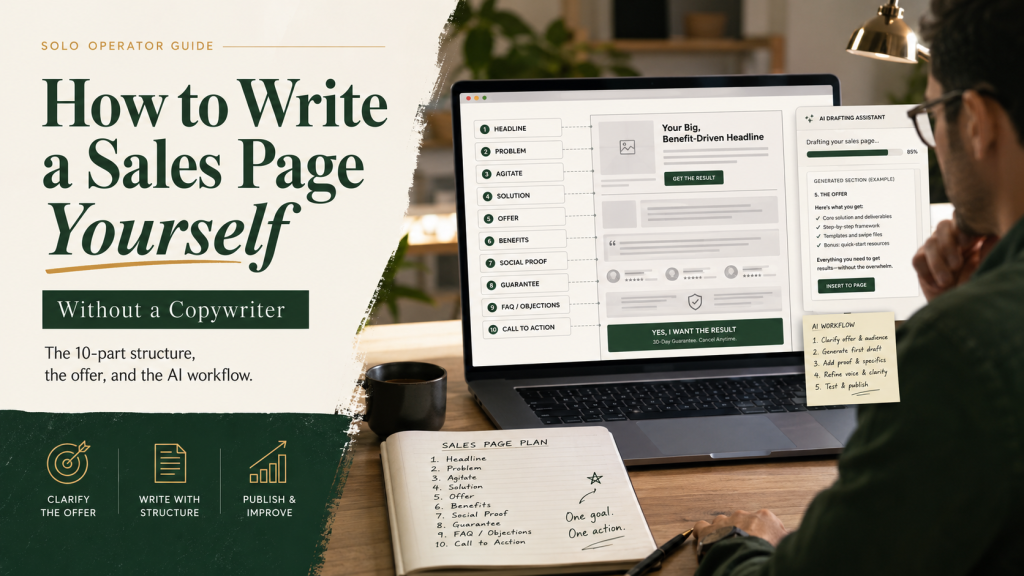
A long-form sales page follows an order that’s been refined over decades, and the order matters because it walks the reader through the psychological steps of a considered decision. Write your page in these ten beats, in this sequence:
- Headline. The single most important element. Capture the big promise in a way that instantly signals relevance to the right reader. Write several; pick the strongest.
- Opening hook or story. Establish emotional connection. Make the reader feel understood rather than sold to, implicitly, “I know exactly what you’re dealing with, because I’ve been there.”
- Problem statement. Name the problem in the reader’s own language, with enough specificity that they nod along. This is where customer research pays off directly.
- Agitation. Deepen the pain before you offer relief. What does it cost them, in money, time, frustration, to leave this unsolved? Not manipulation; helping them see why acting matters.
- Solution introduction. The bridge from problem to offer. Why does a solution exist, and why is this the right one? Introduce yourself and how you came to it.
- Offer presentation. Exactly what’s included, why it’s valuable, how it works, told as a narrative, not a bare list.
- Social proof. Evidence the promise is real: testimonials, results, case studies. (Use honest placeholders if you don’t have them yet, and replace them fast.)
- Value stack. The full offer presented as a package, each piece with a value, so the asking price feels like a fraction of what’s on the table.
- Guarantee. Risk reversal. The stronger and more specific, the better, more on this below.
- Call to action. Clear, specific, action-oriented. One more picture of the transformation, then the exact next step.
Long-form pages feel excessive until you understand their purpose: they answer every question a serious buyer might have, so that by the end, the only reason left not to buy is that they don’t want the thing. Short pages can leave serious-buyer objections unanswered, and unanswered objections are where conversions go to die. You’re not padding, you’re closing doors one at a time.
The five-element offer underneath the page
Here’s a trap worth naming early. Most people who can’t convert think they have a copy problem. Often they have an offer problem, and no amount of clever writing rescues a weak offer. A product is a thing: a course, a kit, a service. An offer is how you present that thing, the framing, the value stack, the guarantee, the bonuses, the reason to act now. You can wrap a great product in a mediocre offer and struggle. So before you polish a single sentence, make sure the offer underneath the page has all five of these:
- A specific, compelling core promise. Not “you’ll learn about email marketing.” Something vivid and verifiable: “by day thirty you’ll have a complete welcome sequence set up, running, and converting, or your money back.”
- A value stack that makes the price feel small. The total perceived value of everything included should be several times the asking price, not ten percent more, multiples more. When the math is obviously in the customer’s favor, the decision gets easy.
- Targeted bonuses that neutralize objections. Every buyer has specific fears. If the objection is “this seems complicated,” the bonus is a quick-start guide. If it’s “I’ve tried this before,” the bonus is a diagnostic or a call that keeps them from repeating the failure.
- Risk reversal that makes saying no feel riskier than saying yes. A strong guarantee removes the financial risk. What’s left to say no to?
- Honest urgency or scarcity. A real reason to act now, a genuine deadline, real limited availability, or a real consequence of waiting. Manufactured urgency the customer sees through destroys trust permanently.
Spend extra effort on the guarantee, because it’s the element most businesses underinvest in. The counterintuitive truth from direct response: the businesses that offer the strongest guarantees tend to report the lowest refund rates. A bold guarantee signals genuine confidence in the product, which attracts motivated buyers who actually use the thing and get the result. The guarantee that makes you a little uncomfortable to offer is usually the one that would move your conversion rate the most. If you’re still figuring out what price to put on the offer itself, how to price your product or service without guessing works through that decision before the page goes live.
Write the first draft with AI, then direct it
This is where writing your own page stops being intimidating. An AI assistant like Claude is genuinely good at producing a first draft of a sales page, the part that’s slow and painful when you’re staring at a blank screen. It is not good at handing you a finished page. Treat it as a fast writer in the chair and treat yourself as the director, and the workflow clicks into place.
Give it everything before you ask for a word: the offer and price, the single core promise, a real description of your customer, their pain, their failed attempts, the exact language they use, their objections, your value stack with a value on each piece, your guarantee, any social proof, and a note on how you talk. Then ask it to write the page in the ten-beat structure above: three headline options, an opening that meets the reader where they are, agitation that uses their words, the solution story, the offer as narrative, social proof, the value stack building to a price reveal, the guarantee, and a final close. The more context you load in, the less generic the draft.
The output is a starting point, never the final page. The voice will usually need editing, AI drifts toward a register more formal than you want, and it has never met your customers, so its take on their fears is a smart guess you confirm against what you actually know. Direct it at the sentence level: not “make this better,” but “cut paragraph two to two sentences; the word ‘optimize’ sounds corporate, replace it; the CTA is weak, make it specific.” That kind of note produces a dramatically better next pass.
One more safeguard worth running before you publish: have it read the finished offer back as if it were the most skeptical member of your audience and tell you what’s still not enough. Then ask for the single change that would turn it from compelling into an obvious yes, and make that change. (If you haven’t nailed the customer language yet, that gap is upstream of the page, research the market with AI first so the page has real words to use. And for a broader look at how to fold AI into your copy process, how to write marketing copy with AI covers the full method.)
Don’t leave money on the checkout page
A sales page’s job is the first sale. But the page hands off to a checkout, and the checkout is where a one-person operation quietly leaves thirty to sixty percent of its potential revenue behind, every day, on traffic it already paid for. Two mechanics fix that, and they belong in your plan the moment the page exists.
An order bump is a checkbox on the checkout page offering a small, relevant add-on, the customer is already in a yes-state, payment details already entered, so a modestly priced companion to what they just chose is an easy yes. Bumps commonly convert at twenty to thirty percent of buyers. A one-click upsell fires right after payment: because their card is already on file, they accept with a single click, and it should feel like the natural next step on the same journey, not a separate pitch. Upsells commonly land at fifteen to twenty-five percent. Together they can lift a funnel from losing money on cold traffic to breaking even on it, and breakeven on the first sale means everything after it is margin.
You don’t hand-code any of this. On a WordPress and WooCommerce site, FunnelKit handles the sales page, checkout, order bump, and one-click upsell as an annual plugin stack on a site you own. Hosted funnel platforms typically bill monthly. Compare annual cost, renewal cost, feature gates, and data ownership before choosing. Here’s the practical path from page to working checkout: how to set up a FunnelKit order bump and the broader build a sales funnel without a team walkthrough.
Ship it, then test the headline
Your first version will not be your best version, and that’s fine, no page is. The discipline that improves it isn’t rewriting on a hunch; it’s testing one element at a time and keeping what wins. And the element to test first is the headline, because it’s the highest-leverage thing on the page: it decides whether anyone reads the rest. One winning headline test is worth twenty button-color tests.
The workflow is simple. Ask your AI assistant for ten headline alternatives worth testing, pick the two strongest challengers, and run them against your current headline, one variable, enough traffic to mean something, the winner kept. From there the priority order runs to the offer, then price, then the guarantee. If you want the full diagnostic discipline, how much data you need before you trust a result, and how to read what the numbers are telling you, that’s its own skill: how to read your marketing data without an analyst.
Want the prompts that build the page? The free 50-prompt marketing library includes the full sales-page prompt and the irresistible-offer design prompt referenced here, grab it at Get the free prompt library →. And if you want the whole operator’s playbook, research, positioning, funnels, offers, and the AI workflow behind all of it, Build a Complete Marketing Department is at mmsvegas.com/marketing-department.
Frequently asked questions
Can I write a sales page myself without a copywriter? Yes, you can write a sales page yourself. A converting sales page is a structure, not a creative gift, ten beats, in order, filled with the truth about your offer. Use the structure below, draft it with an AI assistant to beat the blank page, and edit it in your own voice. The structure is learnable in an afternoon.
What is the structure of a high-converting sales page? Headline, opening hook, problem statement, agitation, solution introduction, offer presentation, social proof, value stack, guarantee, and call to action, in that order, because it mirrors how a person actually decides to buy.
How long should a sales page be? As long as it takes to answer every objection a serious buyer has. Long-form pages often work better for considered purchases because they answer more objections. The right length is the length required to make the decision feel clear.
Can AI write my sales page? It can write a strong first draft if you give it your offer, price, core promise, customer details, value stack, and guarantee. Treat the output as a starting point: edit the voice, confirm its read on your customer against what you actually know, and direct it at the sentence level. It beats the blank page; it doesn’t replace your judgment.
Why does my sales page get traffic but not sales? Most often it’s an offer problem wearing a copy costume. Check the five elements, a specific core promise, a value stack several times the price, objection-killing bonuses, a strong guarantee, and honest urgency. A weak offer can’t be rescued by better sentences.
What tool do I use to build and publish the page? On WordPress and WooCommerce, FunnelKit can handle the sales page, checkout, order bump, and one-click upsell. Hosted funnel platforms bill monthly; FunnelKit runs as an annual WordPress plugin stack on a site you own. Compare annual cost, renewal cost, features, and data ownership before choosing. It also has A/B testing built in, so you can test the headline without a separate tool.
How do I get customer testimonials for my sales page? Ask for them immediately after a customer gets a result, not weeks later when the moment has passed. A simple one or two question email right after delivery gets the most specific, useful quotes. For a repeatable system that removes the awkwardness, how to get customer testimonials without making the ask awkward covers the full process.
More Marketing guides
Free · Marketing Operator Toolkit
Running marketing on your own?
Get the free toolkit — the templates and the expensive mistakes behind a one-person marketing department, plus a note when this guide changes.
Get the free toolkit →