
Last updated: October 2026
Your best ad stopped working and nobody touched it. Same headline, same offer, same list, and the response
quietly fell off. Before you rewrite the copy, consider that the copy may not be the problem. The
market sophistication levels are Eugene Schwartz’s answer to this situation: a map of how a
market gets tired of hearing a promise, and what you have to say once it has.
Most operators meet this as the forgotten half of a framework they half-remember. It deserves better.
Awareness tells you what your buyer knows. Sophistication tells you what your market will still believe, and
that is often the constraint on whether a true claim still gets believed.
The 30-second answer
- Sophistication measures the market, not the buyer. It asks how many times your
audience has already heard a promise like yours, and how much of their belief is left. - Schwartz described five stages. In our shorthand: plain claim, enlarged claim,
mechanism, enlarged mechanism, identification. Each answers the one before it losing force. - The same words can stop pulling because the category around them changed, not because
anyone edited the sentence. - Diagnosis starts with what competitors actually say, in their own words, not with your
opinion of your own product. - Writing below your stage is the miss we see most often. A plain claim in a market full
of mechanisms can sound generic. - It is a lens, not an instrument. There are no validated thresholds, and anyone selling
you a precise score has invented a precision the idea does not contain.
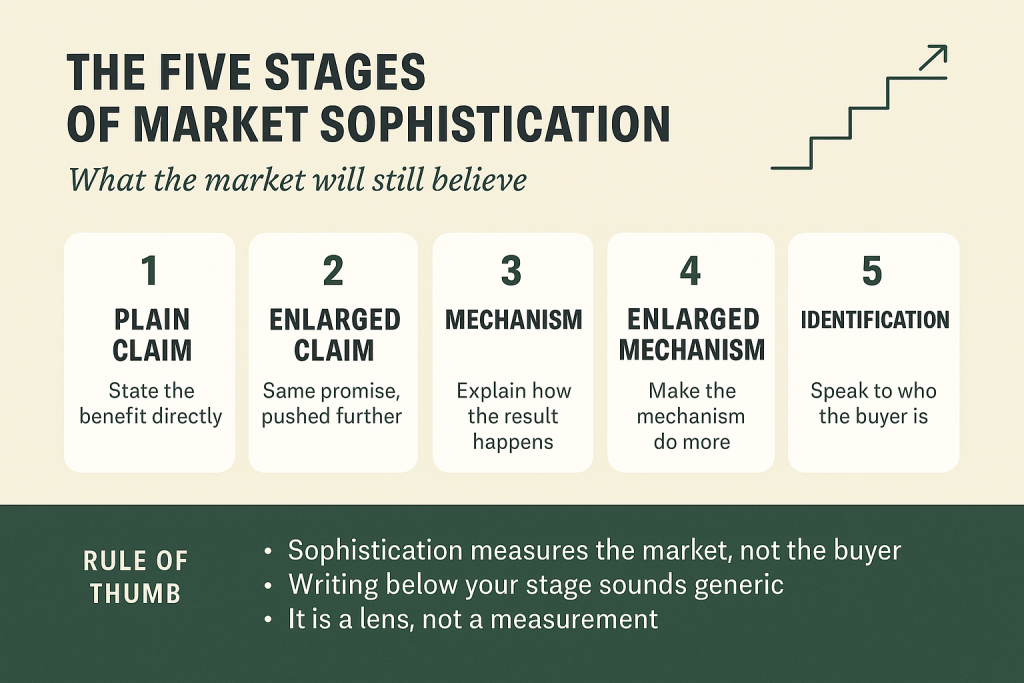
The five stages at a glance
Schwartz describes five stages of market sophistication in Breakthrough Advertising. He writes
about them as stages; most modern writing, including this guide’s title, calls them levels. The table below is
a brief paraphrase of the model.
| Stage | Market condition | Schwartz’s move |
|---|---|---|
| 1 | You are first with this claim or product | State the claim directly |
| 2 | The claim now has competitors | Enlarge the claim, drive it to its limit |
| 3 | Claims are exhausted and disbelieved | Introduce a new mechanism |
| 4 | Mechanisms are being copied | Elaborate and enlarge the mechanism |
| 5 | Neither claims nor mechanisms engage | Shift toward identification with the prospect |
Three labels run through the rest of this guide, and keeping them apart is the point. Schwartz
means what is documented in Breakthrough Advertising. Our shorthand means the plain
names we use for the stages. Our working method means the competitive review we built on top,
which is ours and not his.
Where the idea came from
Eugene M. Schwartz set out the stages of sophistication in Breakthrough Advertising, published by
Prentice-Hall in 1966. Schwartz came out of measurable mail-order advertising, where the consequences of
getting this wrong showed up in the returns, and the book addresses problems beyond mail order.
That background is what makes the model worth your attention sixty years later. Schwartz developed it from
practical advertising experience and examples across multiple markets, not from a controlled study. It is a
practitioner framework, and reading it as anything more exact than that is where people go wrong with it.
One way to think about the underlying idea: a market wears out a claim the way a joke wears out from
retelling. The first person to say it gets the laugh. The fifth person saying it is the reason people leave
the room. That analogy is ours, not Schwartz’s, but it is what the stages describe.
Sophistication is about the market, not the buyer
This is the distinction that makes the model usable, and it is the one that gets lost. Market awareness
asks a question about a person: what does this buyer already understand about their problem, about the
solutions that exist, and about you? Sophistication asks a question about a crowd: how much advertising has
this market already absorbed on this subject, and how much credibility does any claim have left?
You often have to hold both at once. A buyer who has never once thought about their bookkeeping is
completely unaware as a person. The bookkeeping software market they are about to walk into has been
promising to save them time for twenty years. Unaware buyer, sophisticated market. Write to the buyer’s
innocence while ignoring the market’s exhaustion and you will produce copy that sounds, to anyone who has
shopped before, exactly like everyone else.
Awareness tells you where to start the conversation. Sophistication tells you what you are
allowed to say once it starts. Our companion piece on
the five market awareness levels covers the buyer half in
detail.
Worth separating from both: creative fatigue is exhaustion with one particular execution.
Sophistication is accumulated exposure to a class of promises and mechanisms across the whole market.
An audience can be sick of your ad while the market sits exactly where it was.
The five stages, one at a time
Advertisers escalate for plenty of reasons. The progression Schwartz describes is the earlier message
losing force.
Stage 1: the plain claim
You are first in your market with this product, so prospects have had no previous information about
anything like it.
Schwartz’s move: be simple and direct. Name the claim, dramatize it, introduce the
product, and prove it works.
Our read: there is no accumulated disappointment to overcome yet, so any cleverness you
add is a tax on comprehension. If you cannot name three competitors making your promise, you may be here.
Check before you decide that.
Stage 2: the enlarged claim
Your success has attracted copies. The plain version no longer distinguishes you.
Schwartz’s move, paraphrased: if the direct claim still works, take the successful claim
and enlarge it, pushing it to its limit against the competition.
In practice that means more specific and more dramatic. Not “cuts invoicing time” but “cuts invoicing
time by seventy percent.” Competitors can keep pushing the claim until the market stops treating any of the
numbers as real, which is what moves it to the next stage.
Stage 3: the mechanism
The market has heard every size of claim and stopped believing them. Asserting you are better no longer
works, because assertion itself has been devalued.
Schwartz’s move: shift from what the product does to how it works. A new
mechanism makes an old promise fresh and believable again.
Schwartz’s examples came largely from weight-reduction advertising. The stage-3
illustration most often reported from that chapter, per the standard secondary summaries, is a mechanism
headline often paraphrased as floating the fat right out of your body, which sells the mechanism rather than
the result. A modern equivalent might be the metabolic angle, the hormonal angle, or
the eating-window angle. Each shifts attention from the promised result to an explanation for it.
For an ordinary business this means you do not say your bookkeeping is faster. You name the thing that
makes it faster and let the buyer point at it. Our test: a mechanism the buyer can repeat to someone else is
doing its job. We go deeper in
the unique mechanism guide.
Stage 4: the enlarged mechanism
This is the stage many modern summaries get wrong, including, until recently, ours. Stage 4 is not about
proof or head-to-head comparison. It is the same escalation that happened at Stage 2, applied one level
down: what gets enlarged now is the mechanism rather than the promise.
Schwartz’s move, paraphrased: make the mechanism easier, quicker, or surer. Have it solve
more of the problem, overcome a limitation competitors cannot, or carry additional benefits.
Our read: once every rival has a named process, having one stops distinguishing you. The
question quietly changes from “how does yours work” to “what does yours do that theirs cannot.” Proof and
comparison are useful advertising at this point, and we would still reach for them, but that is our tactical
advice and not Schwartz’s definition of the stage.
Stage 5: identification
The market has absorbed every claim and every mechanism and become genuinely cynical. Claim-based
messaging stops registering, not because your claim is weak but because the category of claim is exhausted.
Schwartz’s move: the emphasis shifts away from promise and mechanism toward
identification with the prospect. The illustrations most consistently reported from that chapter, again per
the standard secondary summaries, are the Postum advertisement usually referred to as Why Men Crack, and
visual identification in cigarette advertising, where masculine imagery did the selling.
Our read: modern examples often used to illustrate this include a computer company
selling a creative self-image and a motorcycle company selling membership. Those are later analogies, not
Schwartz’s. The useful part for a small operator is that you can hit Stage 5 dynamics in a small market: when
nothing anybody says in your town moves anyone, more claims will not fix it. For our fictional bookkeeper,
identification sounds less like “the fastest reconciliation available” and more like “for owners who would
rather know where they stand on the fifteenth than find out in April.” That is ours, not Schwartz’s, and it
is the kind of line you can actually put on a homepage.
One product through all five stages
Five separate descriptions are harder to hold than one category moving through the sequence. Here is a
fictional bookkeeping product, invented to illustrate the progression. It is our example, not Schwartz’s.
- Stage 1: “Do your books automatically.” Nobody has offered this before, so the plain
statement is enough. - Stage 2: “Cut bookkeeping time by seventy percent.” Three competitors now say the first
thing, so the claim gets enlarged. - Stage 3: “Automatic transaction reconciliation matches every bank entry.” Nobody
believes the percentages any more, so you explain the engine. - Stage 4: “Dual-source reconciliation catches the matches ordinary auto-categorization
misses.” Everyone has a reconciliation story, so yours gets elaborated into something that does more. - Stage 5: the messaging stops arguing capability at all and speaks to who the buyer is:
the sort of operator who would rather know where they stand on the fifteenth than find out in April.
Notice that the product barely changes. What changes is how much the market has already heard.
Our working method: a practical competitive review
Schwartz gave no numerical cutoffs. He framed the question as how many similar products
the market has already been told about, which is a research question by its nature. What follows is an
Operator’s Library heuristic for turning that into something you can run on a Tuesday afternoon. The procedure
is ours, not his.
- Write down your primary claim in the plainest form you can manage. One sentence. The
actual promise, not the tagline. - List your direct competitors, meaning the ones your buyer would genuinely consider
instead of you. That usually rules out the famous names you like to compare yourself against. - Copy each one’s main promise verbatim from their homepage or their ads. Their words, not
your summary of their words. Summarizing is where people flatter themselves. - Sort what you gathered into claims and mechanisms. How many assert a result? How many
name a method that explains the result? - Read the pattern. Most still asserting results puts you early in the sequence. Most
naming mechanisms puts you late in it. A roughly even split is the common result, and it usually means the
market is mid-shift: lead with the mechanism, because the half still asserting results is the half you will
sound like otherwise. If the claims and mechanisms no longer register even to you, treat Stage 5 as a
hypothesis rather than a finding.
This gives you evidence for a judgment call. It does not return a number, and counting
alone can mislead you. Before you decide, also look at how similar the promises actually are, which
mechanisms competitors lead with, how long your buyers have been exposed to them, whether buyers repeat those
claims back to you in reviews and sales calls, and whether the picture changes by segment, geography, or
channel. A market can be two different stages in two different towns.
Working through your own positioning? The Operator’s Letter goes out with the
plain-English breakdowns behind guides like this one, plus the prompt library we use to pressure-test
messaging before it ships. Get the free prompt library and the
Letter here.
What people get wrong about this
Writing below your stage. The miss we see most often. A plain claim in a market full of
elaborated mechanisms can sound generic, and the buyer moves on without being able to tell you why.
Writing above it. An elaborate mechanism pitched to a market that has not yet heard the
basic promise makes the buyer work for no reason. Say the simple thing while the simple thing still lands.
Treating a mechanism as a naming exercise. Inventing a capitalized name for something you
already did is a costume, not a stage-3 message. A mechanism has to explain why the result happens, or the
market sorts it back into the noise.
Confusing sophistication with quality. A sophisticated market is not a discerning one. It
is an exhausted one. Those behave very differently.
Assuming Stage 5 is the destination. Stage 5 is what is left when claims and mechanisms
have stopped registering. It is not a prize, and it is not where most of these markets are.
Where the model has limits
The stages are a lens, not a measurement. There are no validated thresholds in
Schwartz’s framework, and no instrument returns “your market is a 3.4.” A precise score is added precision, not
something present in the original idea.
Schwartz presented a practitioner framework built from advertising experience and examples, not an
experimentally validated scale with objective thresholds.
Markets and segments do not all advance together. We read the model as a progression
within a defined market rather than something you simply reverse, since buyers do not unhear claims. But a new
product can open a less exhausted market inside an old category, and a genuinely new segment, geography, or
buyer type may start the sequence again. This is one of the honest arguments for narrowing who you sell to,
which we cover in
the ideal customer profile guide.
Your own history counts separately. If you have been making escalating claims to the same
list for three years, that list is sophisticated about you specifically, whatever the wider market is
doing.
The model says nothing about whether your product is good. It describes what the market
will hear, not what you can honestly promise. A mechanism that explains a result you do not reliably
produce may produce short-term response at the cost of refunds, complaints, and trust. Diagnosing the stage
tells you which true thing to lead with. It is not permission to claim more.
Frequently asked questions
What is market sophistication?
Market sophistication is how much advertising a market has already absorbed on a given subject, and how much belief any claim about it has left. Eugene Schwartz set it out as five stages in Breakthrough Advertising (1966). It is a property of the market rather than of your product, which is why a message that works in one market falls flat in another with the same offer behind it.
What are the five market sophistication levels?
State the claim plainly when you are first, enlarge the claim once competitors copy it, introduce a mechanism when claims stop being believed, elaborate that mechanism once rivals have their own, then shift toward identification with the prospect. Schwartz calls these Stages of Sophistication; they are commonly called levels today.
What is the difference between market awareness and market sophistication?
Awareness is about one buyer and what they already know. Sophistication is about the whole market and how much it has already heard. An unaware buyer can walk into a highly sophisticated market, which is why the two are diagnosed separately.
What are some examples of market sophistication?
Weight loss is the category Schwartz used and the one that still shows the whole arc: plain claims, then bigger numbers, then mechanism headlines of the floats-fat-right-out-of-your-body kind, then competing mechanisms, and finally identity-led brands that barely argue results at all. In our reading, mattresses, meal kits, and project-management software have each run a similar sequence recently.
How do I know what sophistication level my market is at?
This is our method rather than Schwartz’s, who gave no numerical cutoffs. Gather what your direct competitors actually say, in their own words, and read it for two things: how many are making your core promise, and how many have moved past promises to naming a mechanism. If most still assert a result, you are early in the sequence. If most name a method, you are late in it. It is a judgment informed by evidence, not a measurement.
Can a market go back down a sophistication level?
Not by itself, since buyers do not unhear claims. But a new product can open a less exhausted market inside an old category, and a genuinely new segment, geography, or buyer type can start the sequence again while the parent market stays exactly where it is.
Why did my ad stop working when nothing about it changed?
One possible reason is that the market moved and the ad did not: a claim that was novel when you wrote it becomes background noise once enough competitors repeat it. Several other causes look identical from the outside, including creative fatigue, ad auction costs, seasonality, landing-page changes, and competitor pricing. One way to tell sophistication from fatigue is to run the same claim in a fresh segment or geography. If it pulls there and not at home, sophistication can be the better hypothesis. If it pulls nowhere, look elsewhere.
Sources
Eugene M. Schwartz, Breakthrough Advertising (Prentice-Hall, 1966), where Schwartz codified the
five stages of market sophistication used in this guide, alongside the five market awareness levels covered
in our companion piece.
On the evidentiary basis. The stage definitions and the advertising illustrations described
here follow the account of that chapter as it is consistently reported across the standard secondary
literature. We have not quoted the 1966 printing directly and we do not present any wording here as a verbatim
quotation from it. Anyone citing Schwartz in academic work should go to the book itself.
The plain stage names used as headings, the bookkeeping worked example, the competitive-review procedure,
and the small-market applications are Operator’s Library working practice built on that foundation, not claims
from the book.
Related guides:
Market awareness levels ·
The unique mechanism ·
The value equation
Brian Kasday writes The Operator’s Library for MMS Vegas. He spent four decades in direct-response
marketing before rebuilding the whole capability as a one-person operation, and writes about what actually
works when you are the one who has to build it, fix it, and answer for it.
Next step: Get the free prompt library and
The Operator’s Letter, or see
Build a Complete Marketing Department, the book this
guide draws on.
More The Operator's Canon guides
Free · Operator Toolkit
Want the tools, not just the guide?
Get the free operator toolkit — templates and checklists for the systems you actually run, plus a note when this guide changes.
Get the free toolkit →How to cite: Market Sophistication. Associated with Eugene Schwartz, 1966. The Operator’s Canon, MMS Vegas. https://mmsvegas.com/library/market-sophistication-levels-explained/