
Last updated: July 2026
Market awareness levels are the lens that determines whether your marketing lands or gets ignored, and most small-business operators skip the diagnosis entirely. By the end of this page, you’ll be able to read your own market, identify where your typical buyer is in their awareness journey, gauge how skeptical and jaded they’ve become, and use that to write the right opening line before you touch a single ad or email.
The problem Eugene Schwartz was solving back in 1966 hasn’t changed one bit: most marketing fails not because the product is bad, but because the message assumes the wrong starting point. The operator writes copy as if the reader already knows they have a problem, already believes a solution exists, and is simply comparison-shopping. Meanwhile, most of the market is somewhere completely different, unaware a problem even exists, or deeply skeptical after hearing the same promises twenty times from twenty competitors.
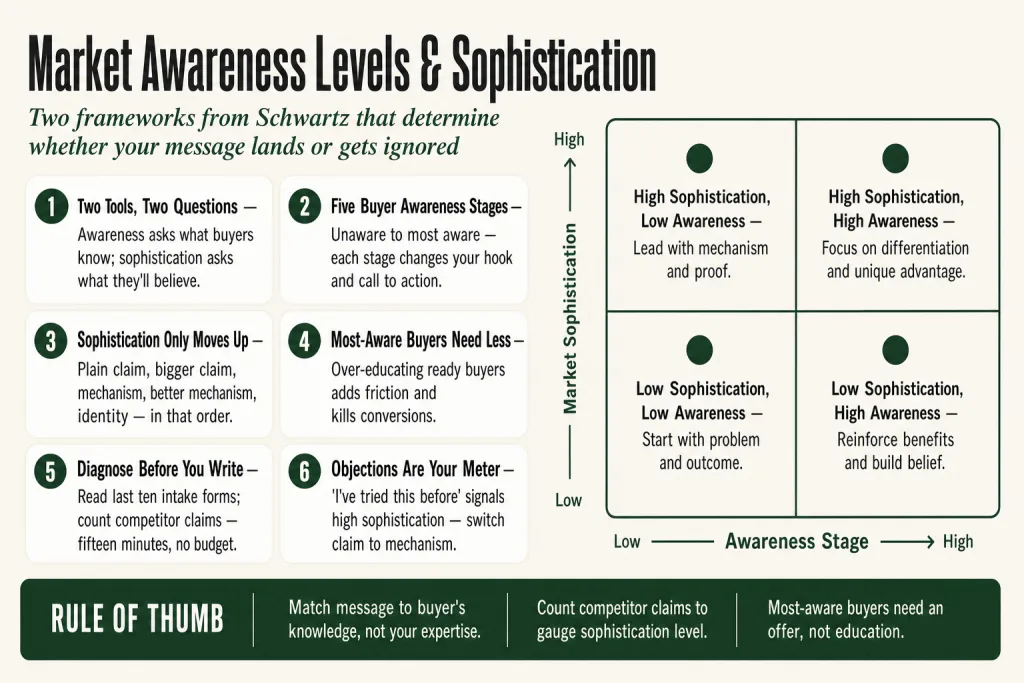
Schwartz gave us two tools to fix that. They’re related, but they answer different questions. Customer awareness stages ask: what does this individual buyer already know? Market sophistication asks: how worn out is the whole market from hearing claims like mine? Get either one wrong and you’re shouting into a room where nobody’s listening, or worse, boring the people who were ready to buy.
The idea in 30 seconds
- Eugene Schwartz identified two separate but linked frameworks in Breakthrough Advertising (1966): five stages of customer awareness and five levels of market sophistication.
- Awareness describes how much an individual buyer knows, about their problem, solutions that exist, and your product specifically.
- Sophistication describes how tired the overall market is of hearing the same claims, and how hard you have to work to be believed.
- Mismatching message to awareness stage is one of the most common and expensive mistakes in small-business marketing: pitching a discount to someone who doesn’t know they have a problem, or educating someone who’s already ready to buy.
- Diagnosing both dimensions before you write a single headline determines everything, your hook, your proof, your offer, your channel.
- The operator’s job is to run a quick audit of their market, pick the dominant awareness stage, match sophistication level, then write accordingly, not guess.
Where the Idea Came From
Eugene Schwartz was a direct-response copywriter, the kind who got paid when the mail-order coupon came back, not when the ad looked pretty. He joined Huber Hoge & Sons as a messenger in 1949, worked his way up to copy chief, then went independent in 1954. He worked primarily in the 1950s through the 1980s, generating hundreds of millions of dollars in revenue for publishers, supplement companies, and information product marketers.
What he noticed across those decades wasn’t a creative pattern. It was a psychological one: the same product, the same benefit, the same price, radically different results depending on what the reader already believed when they opened the envelope. That observation became the spine of Breakthrough Advertising (1966). He firmly believed that the key to effective marketing was not to ‘create’ desire, but to channel existing desires already present in consumers’ minds.
From that starting point he built two complementary frameworks: five stages of customer awareness describing the individual buyer’s knowledge spectrum, and five levels of market sophistication describing the collective fatigue of an entire market after years of competing claims. Both live in the same book, answer different questions, and conflating them sends operators in the wrong direction.
The Five Stages of Customer Awareness
This is the framework that gets all the attention, and it deserves it. Schwartz mapped five distinct stages a buyer passes through on the way from total ignorance to a purchase decision. Each one changes what you say and how you open.
Stage 1, Unaware
The prospect doesn’t know they have a problem. They may be feeling symptoms, stress, slow sales, physical discomfort, but they haven’t named it yet. You cannot lead with your product here, or even with the category of solution. You have to make an invisible problem visible, usually through a story, a provocative fact, or a pattern interrupt that makes them think: wait, that’s me.
Most small-business operators rarely advertise here, and that’s usually the right call, it’s expensive, slow, and hard to measure. But it’s worth knowing the stage exists, because content marketing often functions at this level, building a pipeline of people who didn’t know they needed you until they read something you wrote.
Stage 2, Problem Aware
The prospect knows they have a problem. They can name it. They feel it. But they don’t yet know solutions exist, or haven’t seriously explored them. Your job here is to deepen their understanding of the problem, meet them in the language they use to describe it, and start creating the belief that relief is possible. You’re not selling yet, you’re connecting. The message that resonates here starts with their words, not yours.
This is where a lot of valuable SEO content lives. If someone’s searching for “why do my Facebook ads keep losing money,” they’re problem aware. They’re not yet searching for your specific service or even the solution category. You earn trust by proving you understand the problem better than they do.
Stage 3, Solution Aware
The prospect knows solutions exist but hasn’t committed to one. They’re doing research, reading comparisons, asking peers. They don’t yet know your product. Lead with the solution category, and position your approach as the logical one to choose. Case studies, comparison content, and clear explanations of your method all belong here.
Stage 4, Product Aware
The prospect knows your product exists. They’re comparing you to alternatives. Skepticism is the dominant emotion, they’ve done enough research to know that claims are cheap. Proof does the heaviest lifting at this stage: testimonials, case studies, specific numbers, guarantees, demonstrations. Don’t rehash what you offer, prove you deliver what you claim.
Stage 5, Most Aware
The prospect already knows you, likes what they see, and is basically ready to buy. They just need a clear invitation. Short and transactional: here’s the offer, here’s how to get it, here’s why right now makes sense. Overloading a most-aware buyer with education or backstory is a conversion killer. They didn’t come to be convinced, they came to be asked.
The practical implication cuts in both directions. First, most businesses write most of their copy for stage 4 and 5 buyers, the people already searching for them, while ignoring the much larger pool at stages 2 and 3. Second, the businesses that write problem-aware content often forget to bridge it toward their product. You build audience but not pipeline.
Before you write anything, answer one question honestly: which stage is my typical new customer in when they first hear from me? That answer governs the hook, the structure, and the call to action of everything you produce.
The Five Levels of Market Sophistication
This is the less-celebrated half of Schwartz’s contribution, and for operators competing in crowded markets, it’s arguably more useful. Awareness is about the buyer; sophistication is about the market. The same claim that crushes in a fresh market is invisible in a tired one, because the audience has heard it a hundred times. And sophistication only moves in one direction: up.
Think of it as measuring how many times your market has heard something like your promise, and how much they believe it now. A market that’s heard “lose weight fast” a thousand times from a thousand sellers is far harder to crack than a market seeing that claim for the first time. The same words that work beautifully early become invisible, or actively off-putting, once they’re everywhere.
Level 1, Plain Claim
You’re among the first to market with this type of solution. The prospect hasn’t heard the claim before. State your core benefit simply and directly and win on novelty alone. “This software will cut your invoicing time in half”, that’s enough when the concept is new. There’s no skepticism to overcome because there’s no prior history of disappointment. Lead with the plain benefit, and don’t complicate it.
Level 2, Bigger Claim
Competitors have appeared, making similar promises. To stand out, you escalate: your claim becomes bolder, more specific, or more dramatic. “Cut invoicing time by 70 percent” or “the fastest invoicing tool on the market.” This works for a while, but it’s an arms race, and an arms race always ends at the next level.
Level 3, Unique Mechanism
The market has heard every version of the big claim and stopped believing it. You can no longer win by saying you’re better or faster, everyone says that. What works now is introducing how you do it: the process, system, ingredient, or method that explains why your approach is different, not just that it is different. Schwartz introduced the idea that markets evolve over time and become more sophisticated as competitors saturate the market with similar products or messages, and that marketers need to adapt their advertising strategies to match.
The weight-loss market is the textbook example. Once “lose weight fast” became noise, marketers shifted to mechanisms: the metabolic reset, the hormone pathway, the specific eating window. Each mechanism bought a window of credibility before that too became saturated. At Level 3, you don’t just say your accounting software is faster, you explain the engine behind it. Your proprietary reconciliation algorithm. Your one-step bank sync. Something the buyer can point to as an explanation.
Level 4, Better Mechanism
Your competitors have also introduced mechanisms. Now you need to prove yours works better. Specificity and proof carry the weight, not just “our system,” but why our system beats the others, with evidence. Third-party validation, head-to-head comparisons, specific results data. Novelty of mechanism isn’t enough anymore. Demonstrate superiority.
Level 5, Identity
The market has heard every claim, every mechanism, every proof point, and has grown genuinely cynical. Claims are irrelevant because nobody believes them. When everything has been said, compete on identity, brand, and belonging. Apple at Level 5 wasn’t selling computers, it was selling the identity of being creative, different, not-corporate. Harley-Davidson isn’t selling motorcycles; it’s selling membership in a tribe.
Most small businesses never face a Level 5 market. But the insight matters: when your market stops responding to any claim-based message, you’ve hit Level 5 dynamics, even in a local market. The answer isn’t louder claims or a flashier mechanism. It’s community, belonging, and what your brand represents beyond the transaction.
A shortcut for diagnosing sophistication level: count how many direct competitors are making your primary claim. One or two? You’re at Level 1 or 2, lead with the claim. A dozen? You need a mechanism. Everyone has a mechanism? You need proof that yours is better. And if the whole market sounds like white noise? Time to build something that people belong to, not just something they buy.
Awareness and Sophistication Are Not the Same Thing, and Confusing Them Costs Money
Most explanations of Schwartz’s work go sideways right here. People treat awareness and sophistication as two names for the same idea. They’re not.
Awareness is about the individual buyer’s knowledge: what do they know about their problem, their options, and you specifically? Sophistication is about the whole market’s collective experience: how many times has this audience been promised something like this, and how jaded are they?
You can have a most-aware buyer in a Level 1 market, someone who’s already found you, is ready to purchase, and you’re among the first to offer this type of solution. The message is short and direct: here’s the offer. Conversely, you can have a problem-aware buyer in a Level 4 market, they know they have a headache but haven’t researched solutions, yet the market they’ll enter when they start comparing is already exhausted with claims. You have to meet them at their problem stage while preparing a mechanism-level position for when they start looking around.
The two frameworks run in parallel. Awareness tells you where in the buying journey to enter the conversation. Sophistication tells you what kind of claim or hook will still be believed at that entry point. You need both answers before you write anything.
A practical way to hold this: awareness asks “what does this person already know?” and sophistication asks “what will this person actually believe?” They’re related, a more aware buyer has usually encountered more competing claims, so sophistication tends to rise as awareness rises, but they’re not identical, and treating them as interchangeable produces muddy, mismatched copy.
Putting this to work? The ideas in the Canon are the foundation under the tactical playbook in Build a Complete Marketing Departmentgrab the free companion kit at mmsvegas.com/resources.
How to Diagnose Your Market Before You Write a Word
The frameworks are only as useful as your ability to run the diagnosis quickly and honestly. No research budget required.
Diagnosing Awareness Stage
The fastest proxy is the language your best customers used before they found you. Not the words they use after they bought, the words they used when they were searching. Pull your last ten sales conversations or intake forms and look for the first question each customer asked. “How do I get more leads?” is problem aware. “What’s the difference between your service and [competitor]?” is product aware. “I’d like to get started” is most aware.
If you don’t have that data yet, look at the search terms people use to find your website in Google Search Console. Broad symptom-based queries (“why is my restaurant slow on Tuesdays”) signal problem awareness. Category queries (“restaurant marketing service”) signal solution awareness. Branded queries signal product awareness. The distribution tells you where most of your incoming audience sits.
Customer reviews, yours and your competitors’, are another gold mine. The language people use in a Google or Yelp review to describe the problem they had before they hired you is almost always pure, unfiltered problem-aware language. It’s the vocabulary of someone who didn’t know the solution category existed yet. That language belongs in your top-of-funnel content almost verbatim.
Diagnosing Sophistication Level
Do a quick competitive audit. Look at the ads and homepage headlines of your five closest competitors. Write down the core claim each one makes. Now count: how many are making essentially the same promise? If you’re all saying “fast, reliable, affordable,” you’re at Level 2 or 3 and you need a mechanism. If you’re all explaining your unique process or system, you’re at Level 3 to 4 and you need comparative proof. If everyone sounds the same regardless of angle, you may be looking at a Level 5 market where the only differentiator is brand and belonging.
Also ask: what are your customers’ most common objections? “I’ve tried this before and it didn’t work” is a pure sophistication signal, it tells you the market has been burned by similar promises. The stronger that objection, the higher the sophistication level, and the more your copy needs to explain why this time is different via a credible mechanism, not just a bolder claim.
Running Both Together
Map it like a two-by-two in your head. Where is the typical incoming buyer on awareness? Where is the market on sophistication? Then pick the message that matches both. A problem-aware buyer in a Level 3 market probably needs a piece of educational content that introduces the problem (matching their awareness stage) but frames your solution via a unique mechanism (matching the market’s sophistication). A product-aware buyer in the same market needs a differentiation message, why your mechanism beats the alternatives, with supporting proof.
This takes ten or fifteen minutes the first time you do it properly, and it changes the entire direction of what you write.
Where Market Awareness Levels Apply, and Where They Don’t
The frameworks apply anywhere you’re writing a message for a specific audience: ads, landing pages, email sequences, sales scripts, social posts, even the language you use in a proposal. Any time there’s a gap between what you know and what your audience knows, these frameworks help you close it gracefully instead of talking past each other.
Three situations where they earn their keep most clearly. First, when you’re entering a new channel where your audience is colder than what you’re used to. A business running warm referral-based sales that decides to try Facebook ads is about to encounter an almost entirely unaware audience. The message that works in a referral conversation is wrong for a cold ad, and awareness stages tell you exactly why and what to do instead.
Second, when a campaign stops working and you can’t figure out why. If your message has been running for a year and response has dried up, you may not have a creative problem, you may have a sophistication problem. The moment numbers stop being believed, switch from claim to mechanism. The fix isn’t a shinier ad; it’s a new mechanism or a shift in positioning.
Third, when you’re launching something genuinely new, a service category your area doesn’t have yet, or an approach nobody in your market is currently offering. That’s Level 1 sophistication, and operators routinely over-engineer their messaging for it. You don’t need a mechanism when a plain, clear claim has never been made before. Save the complexity for when you actually need it.
Where the frameworks are less useful: when your market is relationship-driven to the point where no amount of positioning changes the buying decision, think professional referral networks where the deal happens because of who you know, not what you say. Or when you’re operating in a category so local and small that there’s genuinely no meaningful competition to calibrate against. Even then, the awareness stages still help you understand what a first-time customer needs to hear versus a returning one, they just can’t tell you much about sophistication level when the competitive landscape is essentially blank.
Common Misunderstandings About Market Awareness Levels
Misunderstanding 1: Awareness stages are a funnel you build separately for each stage. They’re not a content calendar or a funnel architecture, they’re a diagnostic lens. The point isn’t to build five separate campaigns, one per stage. It’s to identify where your primary audience sits and write your main message to match. The other stages can inform supporting content, but you can’t write equally for all five at once without creating a confusing mess.
Misunderstanding 2: Buyers move linearly through stages on a predictable timeline. Some buyers jump from unaware to most aware in a single search session. A dental emergency does that, someone goes from “my tooth hurts” to “I need to book right now” in twenty minutes. Others sit in problem-aware for months, following your content until they’re ready. The framework describes the state of knowledge at any given moment, not a rigid sequence with a clock on it.
Misunderstanding 3: Most-aware audiences need the most copy. The opposite is true. Most-aware buyers are already sold on the idea, they just need a clear offer and a simple path to say yes. Long copy at the most-aware stage introduces friction and doubt where neither belongs. Save the education and the mechanism for the earlier stages. The closer to the sale, the simpler the message.
Misunderstanding 4: Sophistication level is a one-time diagnosis. Markets mature faster than most operators notice. A local market that had two competitors making Level 1 claims can shift to Level 3 dynamics in a couple of years if the space becomes crowded, especially online, where national players collapse geographic boundaries overnight. Revisit the sophistication diagnosis before every major campaign, not once at the start of your marketing career.
Misunderstanding 5: The frameworks are about what you want to say. They’re entirely about what the buyer is ready to hear. That’s the complete inversion of how most operators approach copy, they start with their product’s features and write outward. Schwartz’s frameworks start with the buyer’s mind and write inward. That shift in starting point is what makes the difference.
Market Awareness Levels in a Modern Operator’s Work
The frameworks were built for direct-mail copy, but they map almost perfectly to digital marketing, with one important difference. In Schwartz’s era, you chose one audience and one message. Today, an operator running a Facebook or Google campaign is almost certainly reaching people at multiple awareness stages simultaneously in the same ad set. Someone searching a broad symptom keyword and someone searching your brand name are both in your campaign, at completely different points on the awareness map.
The practical response isn’t to build a separate micro-campaign per stage, most small operators don’t have the budget or bandwidth for that. Identify the dominant awareness stage of the largest segment of your incoming audience and write your primary message for them, while making sure the path from earlier stages is accessible (usually through content, SEO, or a longer email sequence) and the path for most-aware buyers is simple and frictionless, a clear offer with a direct call to action.
For email specifically, the awareness framework becomes a sequencing tool. New subscribers who found you through problem-aware search content should enter a sequence that acknowledges their problem, validates it, introduces the solution category, and only then presents your specific offer, mirroring the awareness journey in the email flow. Subscribers who signed up after a product-aware comparison search can enter a shorter, proof-heavy sequence. Two different paths for two different starting points, built into the automation once and running forever.
On landing pages, the awareness diagnosis governs the opening line. A cold paid traffic page landing problem-aware visitors should open in the language of the problem, not the product. A remarketing page hitting product-aware visitors who’ve already seen your homepage can open with proof and an offer. Same product, two pages, two completely different openers, determined by awareness stage, not by creative preference.
AI writing tools can accelerate the drafting process once you’ve done the diagnostic work yourself. When you give an AI assistant a well-structured briefing, “write this for a problem-aware buyer who doesn’t yet know this solution category exists, in a market at Level 3 sophistication where competitors are all claiming the same mechanism”, you get dramatically better draft output than “write me an ad for my accounting software.” The awareness and sophistication frameworks become the prompt architecture, and that’s a real time-saver. The diagnostic judgment, which stage, which level, which channel, stays with you. That part doesn’t get handed off.
Common Mistakes
- Writing for your own expertise level, not your buyer’s starting pointBefore writing anything, go back to your last ten new-client enquiries and look at the very first sentence each person wrote. That’s the awareness stage you’re actually dealing with. Most operators write copy for someone who already understands the category, because that’s the buyer they can picture, but it’s almost never the buyer they’re reaching with cold or lukewarm traffic. A useful test: read your homepage opening line to someone who’s never heard of your business. If they look confused, you’re writing for a stage your audience hasn’t reached yet.
- Counting local storefronts to gauge sophistication levelYour local competitor count is a misleading number. What matters is the competitive noise your prospect has already been exposed to, often from national brands, aggregator sites, or retargeting ads from out-of-area players. A homeowner who’s been retargeted by three different HVAC companies this week arrives at your ad carrying their skepticism, regardless of how many local HVAC companies you have. Pull your most common first-call objection instead. That’s the real reading.
- Over-educating most-aware buyersWhen someone already knows you and is ready to move, give them a clear offer and a short path to yes. Every extra paragraph of problem backstory you add at this stage is friction, a reason to pause, second-guess, or navigate away. Most-aware pages and emails should be the shortest thing you produce, not the longest. If your confirmation or follow-up sequence runs longer than your initial pitch, something is backwards.
- Abandoning the awareness match mid-executionCorrect diagnosis matters less than execution discipline. Once you’ve identified the dominant stage, cut everything on the page or email that belongs to a different stage. A most-aware buyer wading through problem education before reaching the offer, or a cold reader hitting a pricing table on the third scroll, both are the same failure mode: accurate diagnosis, incomplete commitment. The uncomfortable part is cutting content you spent real time writing. Do it anyway.
- Re-using last year’s sophistication read for this year’s campaignMarkets mature faster than operators notice, especially in digital channels where national competitors can dissolve your local market’s innocence over a single busy quarter. Build the sophistication audit into your pre-campaign checklist, not just your initial marketing setup. If the objections in your first sales call are shifting, more ‘I’ve seen this before,’ more price resistance, more requests for proof, that’s the signal to move from claim to mechanism, or from mechanism to comparative proof.
Operator’s Take
The awareness diagnosis is non-negotiable. Not once at the start of your marketing career, before every major campaign. It takes fifteen minutes and no budget. Pull your last ten intake forms or new-client emails and read what people said before they understood your category. That language tells you everything about the stage you’re actually writing for.
Here’s a concrete example of what skipping it costs. A pest control company I came across recently was spending over $4,000 a month on Google ads. Every ad opened with “our proprietary treatment protocol”, copy written for someone who’s already evaluated competitors and just needs a differentiator. But the people clicking those keywords were searching “bugs in my kitchen.” Problem aware. They didn’t know what a treatment protocol was, let alone why this one should impress them. That mismatch, message designed for Stage 4, audience sitting at Stage 2, is a four-thousand-dollar-a-month tax on skipping a fifteen-minute diagnostic. And it’s the most common mistake I see, by a wide margin.
On sophistication: I have a strong opinion here that goes against a lot of what circulates in copywriting communities. Most local and regional operators are sitting in Level 2 or early Level 3 markets. But the copywriting content they consume, the courses, the forums, the YouTube teardowns, is almost entirely written for people fighting over nationally saturated direct-response buyers: supplements, online courses, financial offers. The mechanism obsession that makes perfect sense for those markets is actively wrong for an operator who’s the only physical therapist in a mid-sized suburb offering dry needling. You’re at Level 2. Say so plainly. Don’t bury the claim under mechanism language engineered for a level of competition you don’t actually face yet.
That said, sophistication creep online moves faster than most operators expect, and local competitor count is the wrong thing to watch. A prospect retargeted by four different roofing contractors in the same week arrives at your landing page carrying Level 3 skepticism, even if you’re technically the only roofer in your county running digital ads. The right signal is the objection you hear in the first sixty seconds of your first sales call. “I’ve already tried that” or “everyone says that” tells you exactly where the market’s head is. Those two phrases are your real sophistication meter, and they’re free data you’re already collecting.
The mistake I see most often isn’t a wrong diagnosis. It’s a correct diagnosis that gets abandoned mid-execution. An operator nails the awareness stage, writes the right hook, then clutters the page trying to serve a second audience, a most-aware buyer wading through three paragraphs of problem education before reaching the offer, or a problem-aware reader hitting a comparison pricing table on the third scroll. Matching the stage is step one. Committing to it, cutting everything that belongs to a different stage, is where most people balk. That cut is often the most valuable thing you can do to a piece of copy, and it costs nothing except the willingness to remove content you worked hard to write.
One habit worth building into your calendar: once a quarter, pull your ten most recent intake forms and read the first sentence each person wrote to describe why they reached out. Read it as if you’d never heard of your category. That sentence, or something close to it, belongs in the opening line of your best-performing ad. Most operators have their best problem-aware copy buried in a blog post nobody reads, or have never extracted it at all.
Used in
- ✓ Build a Complete Marketing Department
Used to diagnose the starting awareness stage of each audience segment before assigning channel, message, or content type, the diagnostic step that governs the entire department’s output. - ✓ The Missing Manual for FunnelKit
Applied to sequence logic, awareness stage determines which email flow a new subscriber enters and what that flow’s opening message says, so the automation matches where the subscriber actually is. - ✓ The Missing Manual for Make
Used to brief AI-assisted copy workflows: awareness stage and sophistication level become the core parameters in any prompt template that generates draft ads, landing page copy, or email subject lines, with the operator making all final calls on stage, level, and message direction.
FAQ
What’s the difference between customer awareness and market sophistication?
Customer awareness describes what an individual buyer knows, about their problem, available solutions, and your product. Market sophistication describes how tired the whole market is of hearing similar claims. Awareness tells you where to enter the conversation; sophistication tells you what kind of claim will still be believed when you do.
How do I know which awareness stage my customers are in?
Look at the language your last ten customers used before they found you, in intake forms, sales conversations, or first-contact emails. Also review the search terms bringing people to your site via Google Search Console. Broad symptom searches signal problem awareness; branded and comparison searches signal product awareness.
Do I need to write separate content for all five awareness stages?
Not at the start. Diagnose which stage the majority of your incoming audience is in and write your primary message for that stage first. Build out supporting content for adjacent stages over time. Trying to address all five at once typically produces copy that’s muddled and connects with nobody.
How do I know what sophistication level my market is at?
Look at the headlines and core claims of your five closest competitors. Count how many make essentially the same promise. One or two using similar language puts you at Level 1 to 2; many competitors with similar claims means Level 3 or higher. Customer objections like ‘I’ve tried this before’ are also a direct signal of elevated sophistication.
Does this framework apply to B2B as well as consumer marketing?
Yes, with slight adjustments. B2B buyers tend to enter at a higher baseline awareness stage because they’ve often done more research before any conversation, and B2B markets in mature categories often exhibit Level 3 or 4 sophistication. The diagnostic process is the same; the dominant starting stage and sophistication level may differ from a typical consumer market.
What happens if I get the awareness diagnosis wrong?
You get mismatch, copy that either confuses a cold buyer by pitching before they understand the problem, or bores a hot buyer by educating them when they just want to be asked to buy. Both are expensive. Mismatch typically shows up as low conversion rates that don’t improve no matter how much you tweak the creative.
Further reading
- Breakthrough Advertising by Eugene M. Schwartz (1966, republished by Brian Kurtz), the source document; read the sections on awareness and sophistication in their original form, without relying on secondary summaries.
- Scientific Advertising by Claude Hopkins (1923), the predecessor that established the principle of meeting the customer where they are; a short, direct read that pairs well with Schwartz.
- Cashvertising by Drew Eric Whitman, a practical companion that extends awareness-stage thinking into specific headline and copy formulas for direct response.
Sources: Eugene Schwartz, Breakthrough Advertising (1966, Boardroom Books edition); leadgen-economy.com, “Eugene Schwartz’s 5 Stages of Awareness” (January 2026); selfstorming.com, “Market Sophistication: Schwartz’s 5 Levels” and “Customer Awareness Stages: Schwartz’s 5 Stages for Ads”; optimum7.com, “5 Levels of Customer Awareness” (April 2026); cardenalgroup.com, “The 5 Levels of Market Sophistication”; nordiccopy.com, “What is Market Sophistication?”; betweenthelinescopy.com, “The 5 Stages of Awareness In Marketing.”
Brian Kasday spent forty years in direct-response marketing before rebuilding the whole operation as a one-person shop. He writes The Operator’s Library, including “Build a Complete Marketing Department”, for operators who’d rather build it themselves than wait on someone else.
Build the department these ideas describethe free companion kit: mmsvegas.com/resources.
More The Operator's Canon guides
Free · Operator Toolkit
Want the tools, not just the guide?
Get the free operator toolkit — templates and checklists for the systems you actually run, plus a note when this guide changes.
Get the free toolkit →How to cite: Market Awareness Levels & Market Sophistication. Associated with Eugene Schwartz / Breakthrough Advertising, 1966. The Operator’s Canon, MMS Vegas. https://mmsvegas.com/library/market-awareness-levels-explained/