
Last updated: July 2026
An ideal customer profile is the deliberate decision about which customers your business should pursue and which it should decline, and by the end of this page, you’ll be able to build one specific enough to use as an actual filter, not a decorative slide in a pitch deck.
Most operators skip this. Not because they don’t believe in targeting, most would nod enthusiastically at the concept, but because defining a profile feels like closing doors. You spend years trying to get more customers, and now someone’s telling you to say no to some of them? The logic feels backward.
It isn’t. The operators who’ve actually done this consistently report the same thing: the moment they got specific about who they were for, everything got easier. Ads cost less. Proposals converted more often. Customers stayed longer. Referrals got better. The work itself got better, because they were doing it for people it actually helped.
The ICP isn’t a constraint. It’s an efficiency engine. And for a small business, where every hour of sales effort, every ad dollar, and every onboarding session has a real cost, it might be the highest-leverage decision you make all year.
The idea in 30 seconds
- An ideal customer profile defines the type of customer who gets the most value from what you sell, and delivers the most value back to your business.
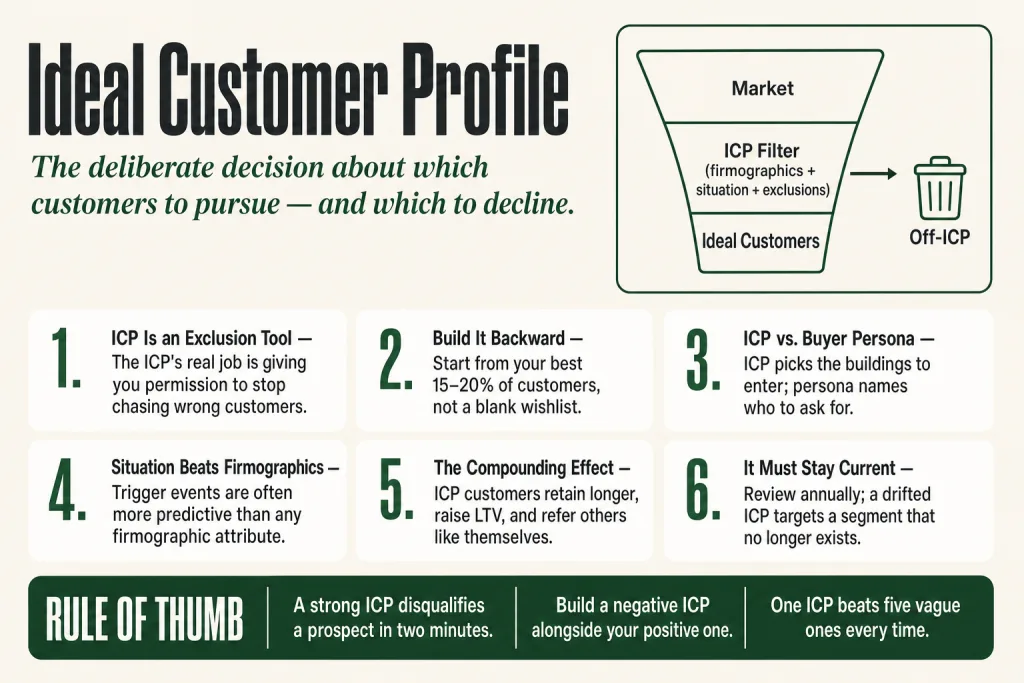
- The ICP’s real job is exclusion: giving you permission to stop chasing customers who drain your resources, churn early, and refer nobody.
- It’s built backward, from your best current customers, not from a wishlist, and covers firmographics, situation, and behavioral signals, not just demographics.
- ICP is distinct from a buyer persona: the ICP tells you which accounts are worth entering; the persona tells you who to talk to once you’re inside.
- A weak ICP is vague and aspirational. A strong ICP is specific enough to disqualify a prospect in under two minutes.
- Treated as a living document, an ICP compounds over time, sharpening messaging, shortening sales cycles, and pointing you toward customers who refer others like themselves.
Where the Idea Came From
The phrase “ideal customer profile” doesn’t have a single clean origin story. It grew out of B2B sales and marketing practice, sharpened by the hard realities of selling technology products to businesses with wildly different abilities to adopt and benefit from them.
Geoffrey Moore’s Crossing the Chasm (HarperBusiness, 1991) is the intellectual ancestor, though Moore never used the term ICP. His argument was about technology adoption gaps: a chasm exists between early adopters and the pragmatic mainstream, and the only way across it is to pick one specific beachhead segment, win it completely, then expand. That operating instinct, one segment, total focus, then move, is the same logic the ICP later put into sales-ops language.
The explicit ICP term gained traction in the mid-2000s alongside SaaS. When software companies started tracking churn and LTV with real precision, the cost of acquiring the wrong customer became impossible to ignore. Aaron Ross and Marylou Tyler’s Predictable Revenue (Pebblestorm Publishing, 2011) then put ICP into standard B2B vocabulary, treating it as the mandatory first step before building any outbound prospecting system. Ross had built the outbound process at Salesforce that generated over $100M in recurring revenue; defining the ICP before you build your list was Step 1 of that playbook.
The ICP’s consumer-marketing ancestor is the target market and customer avatar, tools that have existed since the mid-20th century. What makes the modern ICP different is its emphasis on situation-level fit, explicit disqualifying criteria, and a direct connection to revenue outcomes like LTV and referral rate. It became an operational filter, not just a marketing description.
What an Ideal Customer Profile Actually Is
There’s real confusion here that costs operators time and money, so let’s be precise.
An ideal customer profile is a description of the type of customer, whether that’s a company, a household, or an individual in a defined situation, who gets maximum value from what you sell, and who in return provides maximum value to your business. That second half matters as much as the first. You’re not just asking who needs your product most. You’re asking who benefits most from it, is ready to buy it, can afford it, and will stick around long enough for the relationship to be worth having.
What makes a customer “ideal” usually includes some combination of:
- Situation fit: They have the specific problem your offer solves, at the severity level where it actually matters to them.
- Readiness: They’re in a position to act, budget exists, decision authority exists, timing is right.
- Behavioral signals: They show the patterns that historically predict fast closes, smooth onboarding, high retention, and referrals.
- Economics: Their lifetime value justifies the cost of acquiring them, and they don’t consume a disproportionate share of your support capacity.
What it is not is a buyer persona. A buyer persona describes an individual, their motivations, objections, job title, daily frustrations. An ICP describes a customer type or account, the conditions and characteristics that make them a good fit in the first place. Your ICP tells you which accounts are worth entering; the persona tells you who to talk to once you’re inside. Think of it this way: the ICP tells you which buildings to walk into, the persona tells you who to ask for when you get there.
For a B2C or local service business, the ICP logic works just as well, even though the vocabulary is often more B2B-flavored. A residential contractor’s ICP might be: homeowners who’ve lived in the house more than five years, have a defined project (not a vague “thinking about it”), own outright or have significant equity, and have already gotten one quote. That’s not a demographic. It’s a situation. And it’s specific enough to actually use.
Building Your Ideal Customer Profile from Existing Customers
The single most common mistake in ICP development is starting with a blank page and imagining the customer you wish you had. That produces an aspirational description, not a useful filter. The right starting point is your current customer base, specifically, the best 15 to 20% of it.
“Best” doesn’t mean biggest. It means customers who generate strong revenue relative to the effort they require, stay the longest, refer others, and leave you feeling like the work was worth doing. Start there.
Pull them out and look for patterns across these dimensions:
Firmographic or Situational Signals
In B2B, this is industry, company size, revenue range, location, organizational structure, and technology stack. In B2C or local services, it’s geography, household situation, life stage, and context. The question isn’t “what do they look like demographically”, it’s “what conditions were present when they became a great customer?”
Behavioral Signals Before the Sale
How did they find you? How long was their sales cycle? Did they ask the right questions or the wrong ones? Did they push back on price, or did they understand value quickly? Customers who took three months to close and haggled at every step are telling you something, even if they turned out fine in the end. The ones who moved quickly and asked operational questions, “when can you start?” instead of “can you go lower?”, are also telling you something.
Trigger Events
What was happening in their world right before they bought? A company that just added a second location. A homeowner who just finished a renovation and wants to tackle the next one. A business owner who just lost a key employee. Trigger events are often more predictive than any firmographic. If three of your best five customers came to you within six months of a specific kind of change in their situation, that’s a signal worth tracking.
Your Negative ICP
Build a disqualification list in parallel. Who were the customers who were a poor fit? What did they have in common? The exclusion criteria in an ICP are often more practically useful than the qualification criteria, because they’re what you need when a prospect is in front of you and you’re feeling the pull of a potential sale. A prospect who looks great on paper but has three flags from your negative ICP is a trap. Name the traps explicitly.
Once you have patterns across your best and worst customers, synthesize them into a profile tight enough to actually use. The test: can a team member read it and disqualify a prospect in under two minutes? If not, it’s not operational yet.
The Dimensions of a Strong Ideal Customer Profile
Most ICP templates stop at firmographics, industry, company size, location, revenue. Those are necessary, but they’re only the baseline. The profiles that actually improve marketing performance go further.
Firmographics (or Their B2C Equivalent)
Industry and vertical. Company size by employee count or revenue. Geographic range you can realistically serve. For B2C or local business: geography, household type, life stage, income bracket where relevant. This layer filters the universe down to a manageable pool. On its own, it’s not enough.
Technographics
In B2B, what tools does the company already use? This matters more than it sounds. A company running Salesforce Enterprise has a fundamentally different buying process, internal sophistication, and integration expectation than one managing their pipeline in a spreadsheet. If you sell a Shopify plugin, your ICP must include companies already on Shopify. The tech stack tells you a lot about operational maturity and decision-making speed before you ever speak to anyone.
Psychographic and Cultural Signals
Is the company data-driven or relationship-driven? Does it move quickly or require lengthy committee approval? Does the buyer actually value expertise, or are they primarily shopping on price? Culture shapes how long deals take, how smooth onboarding runs, and whether the customer refers others. A price-shopper who found you through a race-to-the-bottom comparison site is rarely your ICP, regardless of firmographic match.
Pain Severity and Urgency
Your ICP isn’t just a type of customer, it’s a type of customer in a specific situation. The same company that’s a great customer this year might have been a poor fit last year if the problem wasn’t acute enough to prioritize. ICP customers have the problem at a level where solving it is a real priority, not a someday project. Urgency and severity are qualifiers that firmographics can’t capture.
Economic Reality
Can they afford you without it being a stretch that creates anxiety throughout the relationship? Do the unit economics work, is the likely LTV worth the CAC? A small customer who is low-effort, high-retention, and high-referral can be ICP. A large customer who consumes outsized resources, requires custom work at every turn, and churns unpredictably probably isn’t, even if the top-line revenue looks attractive.
Exclusion Criteria
Name them explicitly. A prospect too early-stage to have budget. A company whose industry you can’t serve well. A situation where you know from experience the customer will over-consume support. A buyer who signals during the sales process that they don’t value expertise. These aren’t just “bad leads”, they’re a defined category you can train yourself and your team to recognize and exit cleanly.
Putting this to work? The ideas in the Canon are the foundation under the tactical playbook in Build a Complete Marketing Department — grab the free companion kit at mmsvegas.com/resources.
Why the Ideal Customer Profile Matters More Than You Think
Here’s a way to think about what your ICP actually does to your business: every decision downstream of it gets easier or harder depending on how clearly it’s defined.
Your messaging gets tighter because you’re writing to a specific situation, not a vague demographic. Your rule-of-one copywriting has an actual “one person” to aim at. Your 40-40-20 rule allocates more weight to the list than the creative, and the list only gets good when you know who belongs on it. Your value proposition canvas has a real customer job to match against your offer.
Without a clear ICP, you’re doing all of these things in the dark. You write copy that’s vague enough to appeal to everyone and compelling to no one. You run ads to broad audiences and wonder why the click-to-close ratio is dismal. You build a referral program and get referrals that don’t look like your best customers because your best customers don’t know who you’re for either.
The ICP also has a compounding effect that’s easy to underestimate. When you consistently acquire ICP customers, retention improves. When retention improves, LTV climbs. When LTV climbs, you can afford to pay more to acquire the right customer, which means you outbid competitors for the audience you actually want. And ICP customers tend to refer others like themselves. Your referral engine starts producing a self-selecting feed of prospects who already fit.
The inverse is equally true, and more painful. When you acquire off-ICP customers because the sales felt easy or the revenue looked good, you take on customers who churn faster, complain more, require more support, and refer others who are also poor fits. The short-term revenue gain from a bad-fit customer often gets eaten entirely by the downstream costs of serving them and eventually losing them.
One more thing: the ICP disciplines your product and service development. When you know who you’re for, you know what to build. Feature requests from off-ICP customers become easy to decline, not dismissively, but clearly. “That’s not a problem our core customer faces” is a complete sentence. Without an ICP, every loud customer request looks equally valid, and you end up with a product or service that’s been stretched in seventeen directions and doesn’t serve anyone particularly well.
Ideal Customer Profile in Practice: Real Examples
Abstract ICP advice is common. Concrete examples are rarer. Here’s how the thinking actually played out at real companies, and how it translates to smaller operators.
Gusto (Payroll SaaS)
When Gusto launched, they didn’t target “small businesses.” Their initial ICP was practically surgical: five or fewer employees, California-based, no existing benefits provider, salaried workers only, no contractors or unusual deductions, paying within eight days of payroll. Six hard filters on a single type of customer. Absurdly narrow, and it worked. They used that tight profile to nail onboarding, build word-of-mouth, and expand stepwise to eventually serve 300,000+ businesses. The narrowness wasn’t a liability. It was the strategy.
HubSpot’s ICP Decision
In 2012, HubSpot faced a genuine fork in the road. They were serving two meaningfully different customer types: “Mary Marketer” (marketers inside companies with 10 to 1,000 employees) and “Owner Ollie” (small business owners with fewer than ten employees and no dedicated marketing person). Both bought. Both churned at different rates. HubSpot’s CEO Brian Halligan later described the cost of indecision directly, product requirements, support requirements, and pricing were all different for each type, and by not choosing, the company “made one uninspired compromise after another.” In 2012, they picked Mary. Every team, content, product, sales, could stop building for two different people and start building for one. That’s not a marketing decision. That’s an operating decision with marketing consequences.
B2B SaaS (Conversation Intelligence)
A company selling conversation intelligence software might define its ICP as: B2B SaaS companies with 50 to 500 employees, between $5M and $50M ARR, selling complex solutions with multi-stakeholder sales cycles, already using Salesforce or HubSpot, experiencing challenges with CRM data quality, and growing 25%+ annually. Notice there’s no demographic information about individual buyers, it’s entirely company-level and situation-level. A three-person startup on a spreadsheet might technically benefit from the product, but they’re not the ICP.
Professional Services
A management consultant whose ICP is “mid-sized manufacturing companies” is starting, not done. Add the situation: companies that have hit $20 to 50M in revenue and are experiencing operational friction from processes that worked at $5M. The trigger event might be a leadership transition, a second location, or a specific type of customer complaint that keeps surfacing. Narrowing to that situation means the consultant can write outreach, content, and case studies that speak directly to that inflection point, which is where the prospect is when they’re actually open to help.
Local Services (HVAC)
A residential HVAC company might discover that their best customers, highest ticket, easiest to work with, most likely to sign maintenance agreements, most likely to refer, are homeowners of houses built between 1990 and 2010, owned at least five years, in specific zip codes, who had a previous equipment failure (the trigger) rather than shopping preventively. That profile is operational: a direct mail list can be built against it, a Google Ads geotargeting strategy can be built against it, and the sales conversation can be designed around the person who’s already experienced the pain.
E-Commerce
For an e-commerce brand, the ICP logic often gets translated into customer segmentation and cohort behavior. The question becomes: which customer type, by acquisition channel and first-purchase behavior, produces the highest 90-day LTV and the highest referral rate? A RFM segmentation analysis on your existing base will often surface your ICP more clearly than any survey. The customers with high recency, frequency, and monetary value, who are costing you relatively little in returns and support, that’s your ICP showing up in the data.
In every case, the pattern is the same: identify the situation and conditions that predict a great customer, then work backward to find where more of those situations exist and how to reach them before competitors do.
Where the Ideal Customer Profile Applies
The ICP is close to universally applicable, with some nuances on where it matters most.
It has the highest leverage in businesses with significant customer acquisition costs, where bad-fit customers produce measurable downstream damage, and where the range of possible customers is wide enough that targeting actually changes outcomes. That covers a lot of ground: professional services, B2B of any kind, local services with repeat-purchase economics, SaaS, agencies, consultants, coaches.
It also matters enormously at the beginning of a business. When you’re deciding where to focus your first hundred customers, the ICP question is the same as the positioning question: who are you for, and what are you promising them? Getting this right early means you accumulate the right evidence, case studies, testimonials, referral patterns, that compounds into a durable positioning advantage. Getting it wrong means you spend two years serving a mix of customers and struggling to describe who you help.
The ICP is also a live input for your customer journey mapping work. You can’t map a journey without knowing whose journey you’re mapping. The friction points, the decision triggers, the moments of hesitation, they’re all specific to a customer type. Trying to map for everyone produces a journey that’s accurate for no one.
And it feeds directly into customer discovery. When you define an ICP hypothesis and then go talk to the customers who fit it, you’re testing whether the profile is real. Customer discovery conversations are most productive when they’re structured conversations with people who might actually fit, not a general survey of everyone who’s ever bought from you.
It also connects tightly to your market segmentation work and your jobs-to-be-done thinking. Segmentation tells you how the market is divided; the ICP tells you which segment to bet on. Jobs-to-be-done tells you what problem the segment is trying to solve; the ICP tells you which version of that problem, at what severity, in which type of account, is worth pursuing.
Where the ICP Gets Complicated
The ICP has limits, and pretending otherwise sets operators up for frustration.
First: early-stage businesses don’t have enough customer history to build a data-grounded ICP. When you’ve had twenty customers, patterns are suggestion, not signal. That doesn’t mean you skip the exercise, it means you treat your initial ICP as a hypothesis, not a verdict. Form the best-informed view you can based on interviews, competitive research, and your own domain experience, then test it with real acquisition and adjust as the data comes in. The error isn’t building an ICP early. The error is treating an early ICP as final.
Second: there’s real tension between the ICP and the reality of building early revenue. Focusing exclusively on ICP accounts can slow short-term growth if your historical wins came from a mix of good and poor-fit customers. Saying no to off-ICP revenue when you need cash flow is genuinely hard. There’s no magic answer here, it’s a real tradeoff. The operator who understands it can make it deliberately, rather than letting it happen by accident.
Third: the ICP can become a form of comfortable self-deception if you build it to validate existing decisions rather than challenge them. “Our ICP is customers who love us” is not an ICP. A real ICP includes disqualification criteria sharp enough to actually lose some sales. If your ICP has never caused you to walk away from a deal, it isn’t doing its job.
Fourth: markets shift. The ICP that worked perfectly in 2021 may describe a segment that’s contracted, changed buying behavior, or been commoditized by new competitors. An ICP isn’t a set-once artifact, it needs review when you see meaningful changes in retention patterns, sales cycle length, or the quality of referrals coming in.
Common Mistakes
- Treating the ICP as a sales filter only, not a product filter — When feature requests keep coming from customers outside your stated ICP, that’s a targeting failure showing up in your roadmap. Before scoping anything, ask: does our ICP customer actually have this problem? A management consulting firm whose best clients are $20M, 50M manufacturers should decline feature-equivalent requests from sub-$5M clients without a second meeting about it. One question, applied before every roadmap conversation, saves weeks of misallocated build time.
- Skipping the disqualification check when a deal feels close — Write your three fastest negative ICP signals somewhere visible before you open a proposal doc, not in a CRM note, somewhere you actually see. Two hits out of three means you price at a significant premium or pass. A marketing agency that adds ‘how did your last agency relationship end?’ to its intake form and scores the answer will catch more bad-fit clients before the contract than any firmographic checklist. Pull your closed-lost data and verify: those engagements almost always lose money on a fully-loaded basis.
- Building the ICP once and never reviewing it — Set a calendar reminder, quarterly for fast-growth businesses, annually at minimum, to pull your most recent high-LTV cohort and compare it to the current profile. A SaaS company that locked its ICP around Series A startups in 2021 and never updated it might miss that its best retention cohort quietly shifted to bootstrapped operators by 2023, a meaningful difference in churn, messaging, and channel. If the customers you’re acquiring look different from the ones you wrote the profile around, the targeting is off.
- Firmographic match without a situation check — A prospect can match your industry, company size, and geography and still be completely wrong. If they’ve cycled through two providers in the past eighteen months or can’t articulate what success looks like in concrete terms, those are situation flags that override the firmographic match. Add at least one situation-level question to your qualification step, something that can’t be answered by looking at a LinkedIn profile.
- Keeping the ICP in marketing’s hands only — When customer success keeps getting surprised by month-four churn and product keeps building for the loudest customers rather than the most profitable ones, the common cause is usually that the ICP lives in a slide deck that sales and CS have never actually used. Condense it to three sentences, put it in the shared wiki, and reference it in sprint planning and onboarding reviews, not just pipeline calls. A short ICP that’s used beats a detailed one that nobody looks at.
Operator’s Take
Most operators have built an ICP at some point. The gap, and it’s wide, is between having the document and actually using it to change decisions. These are the moves that close that gap.
Tie the ICP check to a specific intake moment before the excitement kicks in. The classic failure mode: a prospect looks pretty close, money’s on the table, and the ICP check quietly gets skipped. You tell yourself you’ll be flexible just this once. Eight months later you’re managing a customer who complains constantly, demands scope you didn’t price, and leaves without referring anyone. That one “flexible” call costs more than the contract was worth. The fix isn’t willpower, it’s structure. Add one disqualifying question to your inquiry form. Build a five-minute qualification call into your intake flow. Open every first consultation with a standard opener designed to surface fit signals. Make it a step with a specific trigger, not a judgment call in the heat of the moment.
Cut your disqualifiers to three, and write them somewhere you see them before opening a proposal. Not a 20-row spreadsheet. Three signals that have historically predicted a bad outcome. For most service businesses, they look something like: they contacted you primarily on price, they’ve cycled through two or more providers in the past year, and they can’t say what success looks like in concrete terms. Any two of three and you’re looking at a difficult engagement. Your response is either a significant price premium that prices the friction in, or a clean pass. “We’re not the right fit” is a complete sentence. Pull your closed-lost data from the past two years and run it against those three flags, the pattern will confirm or sharpen the signals fast.
Before you approve any roadmap item, run it through the ICP filter. Ask one question: does our ICP customer actually have this problem? If the loudest voice requesting a feature belongs to a customer segment outside your ICP, that’s a targeting problem dressed up as a product question. Every feature you build for an off-ICP customer is a feature your actual ICP customer didn’t get. Put this question on your sprint planning template. The ICP belongs in product conversations, not just pipeline reviews.
Use AI to compress the research, not to make the calls. Tools that scan your CRM, cluster customers by attribute, and surface which cohorts produce the highest LTV with the lowest support load used to take a data analyst and a few days. Now it’s an afternoon. Feed your customer data in, get the cohort analysis out, then layer your own judgment on top, which signals actually matter for your business, what to do with borderline cases, when to override the data because you know something the model can’t see. The analysis cuts your research time significantly. The decisions stay yours.
Put a calendar review on the books, quarterly if you’re growing fast, annually at minimum. Pull your most recent high-LTV cohort and compare it against the current profile. If the customers you’re acquiring look meaningfully different from the ones you wrote the ICP around, the profile has drifted and your targeting is off. A SaaS company that locked its ICP around a specific buyer type and never revisited it will eventually find its targeting perfectly calibrated for a segment that no longer exists. The operators who keep the ICP current end up with an increasingly precise targeting advantage over the ones who filed it away.
Used in
- ✓ Build a Complete Marketing Department
Used as the foundational decision that governs which audiences to build, which channels to prioritize, and how to write copy that converts, everything downstream of it assumes a defined ICP. - ✓ The Missing Manual for FunnelKit
Used to configure segmentation logic and qualification rules in funnel flows, ensuring that automation targets and advances only the customer types the ICP identifies as worth pursuing. - ✓ The Missing Manual for Make
Used to automate lead scoring and account filtering in multi-step workflows, so that ICP criteria get applied programmatically rather than relying on manual judgment at every touchpoint.
FAQ
What’s the difference between an ideal customer profile and a buyer persona?
The ICP describes the type of account or situation worth pursuing, it’s your entry filter. The buyer persona describes the individual inside that account you need to reach and persuade. Your ICP tells you which buildings to walk into; the persona tells you who to ask for once you’re there. Both matter, but confusing them leads to profiles that are too individual to use for targeting and too vague to guide messaging.
How many ideal customer profiles should I have?
Most small businesses have one, sometimes two, rarely three. If you think you have five or six, you probably have one broad description that isn’t filtering anything. The test is whether each profile is specific enough to disqualify a prospect, if all of your ‘profiles’ would accept the same prospects, collapse them.
What if I’m early-stage and don’t have enough customers to analyze?
Build a hypothesis based on deep interviews with a handful of customers or target prospects, competitive research, and your own domain expertise. Treat it explicitly as a hypothesis, use it to guide your first acquisition efforts, then revise it as real data comes in. A hypothesis-level ICP is better than none at all.
Should I turn away customers who don’t fit my ICP?
Not necessarily, especially early on when cash flow matters. But enter off-ICP engagements with eyes open about the likely economics. Charge more for the extra friction, scope the work tightly, and don’t let off-ICP volume crowd out investment in attracting the right customers.
How often should I update my ICP?
Review it whenever you see meaningful changes in retention patterns, sales cycle length, customer complaint themes, or the quality of referrals. For most operators, an annual review with a mid-year check is sufficient, unless something in the business or market changes that would shift who your best-fit customers are.
Can I use AI to build my ideal customer profile?
AI tools are genuinely useful for the analytical work, clustering customer attributes, scanning CRM patterns for commonalities, identifying high-LTV cohort characteristics. Where AI can’t substitute for you is the judgment call: deciding which criteria actually matter for your business, what your negative ICP looks like, and whether a borderline prospect is worth pursuing. The analysis cuts your research time. The calls stay yours.
Further reading
- Crossing the Chasm: Marketing and Selling High-Tech Products to Mainstream Customers by Geoffrey A. Moore (HarperBusiness, 1991), the conceptual ancestor of the ICP’s core logic. Moore’s argument is about technology adoption gaps, not customer targeting per se, but the insistence on picking one beachhead segment and winning it completely is the same instinct the ICP later formalized. Not an ICP manual, but the reasoning that makes the ICP make sense.
- Predictable Revenue by Aaron Ross & Marylou Tyler (Pebblestorm Publishing, 2011), the book that operationalized ICP thinking in outbound B2B sales, specifically as Step 1 of the Cold Calling 2.0 framework Ross built at Salesforce. Brought the concept into standard go-to-market vocabulary for SaaS and beyond.
- Obviously Awesome by April Dunford, the best modern treatment of positioning, which is tightly linked to ICP: you can’t position without first deciding who you’re positioning for.
Sources: Geoffrey A. Moore, Crossing the Chasm: Marketing and Selling High-Tech Products to Mainstream Customers (HarperBusiness, 1991), the conceptual anchor for targeting a specific beachhead segment rather than an average buyer; Aaron Ross and Marylou Tyler, Predictable Revenue (Pebblestorm, 2011). The ideal customer profile has no single originator: it grew out of B2B sales and SaaS go-to-market practice rather than from a published framework, which is why no name or year appears on the card above. The sales-tooling vendors who publish ICP guides were read for implementation detail only, and roughly a dozen of them were removed from this list in an October 2026 review because none adds evidence to a claim. The scoring model, the segment thresholds and the worked examples in this article are ours.
Brian Kasday spent forty years in direct-response marketing before rebuilding the whole operation as a one-person shop. He writes The Operator’s Library — including “Build a Complete Marketing Department” — for operators who’d rather build it themselves than wait on someone else.
Build the department these ideas describe — the free companion kit: mmsvegas.com/resources.
More The Operator's Canon guides
Free · Operator Toolkit
Want the tools, not just the guide?
Get the free operator toolkit — templates and checklists for the systems you actually run, plus a note when this guide changes.
Get the free toolkit →How to cite: Ideal Customer Profile (ICP). The Operator’s Canon, MMS Vegas. https://mmsvegas.com/library/ideal-customer-profile-explained/