
Last updated: November 2026
STP marketing, segmentation, targeting, positioning, is the sequence that decides who you’re for and what you stand for. By the end of this page you’ll be able to run the process yourself, pick the target segment worth your time, and write a positioning statement your whole business can operate from. That’s the actual payoff. Not a framework to hang on the wall.
Most small-business owners skip this. They start with the ad, or the website redesign, or the email campaign, without ever deciding who the message is actually for. The result is content written for everyone, which means it resonates with no one. The homepage talks about being “dedicated to quality and customer service”, which is what every competitor says too. The ads show a little bit of everything because someone, somewhere, might want it.
That’s not a messaging problem. It’s an upstream strategy problem. STP is how you fix it. The sequence is: map who’s in your market, pick the segment worth serving, then build a position that makes you the obvious choice for that specific group. Every other marketing decision, your offer structure, your channel mix, your pricing, your landing page headline, becomes dramatically easier once those three questions are answered honestly.
The idea in 30 seconds
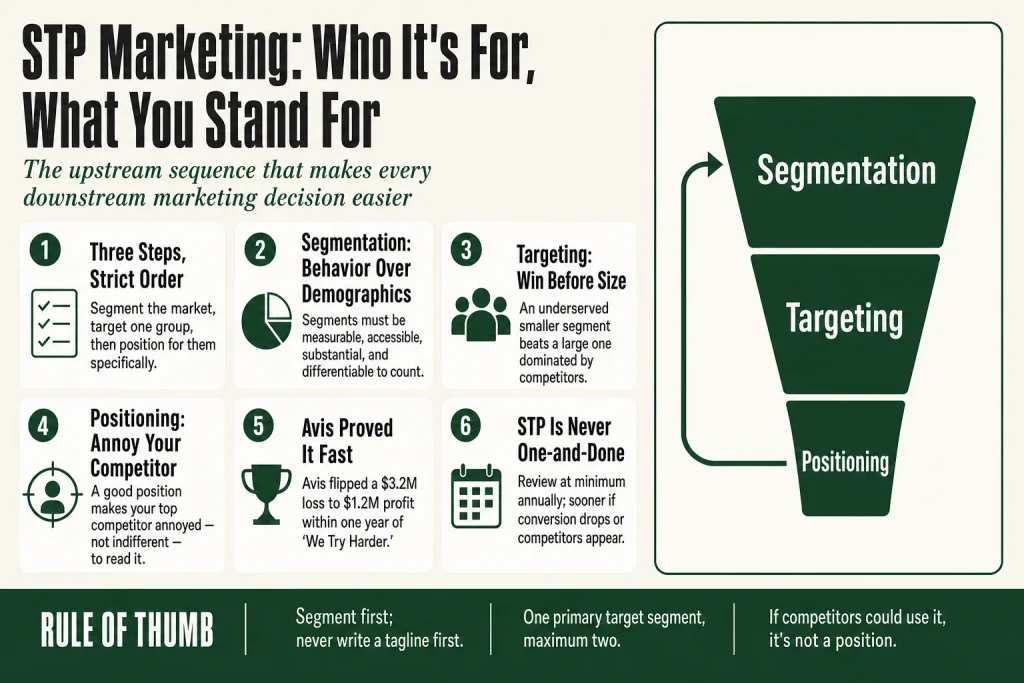
- STP marketing is a three-step sequence: divide the market into segments, choose the one worth pursuing, then craft a position that makes you the obvious answer for that group.
- The order is strict. Skipping segmentation and jumping to positioning is why most small-business messaging sounds generic, you can’t have a sharp position without a sharp target.
- Segmentation describes who’s out there. Targeting decides who you’re for. Positioning decides what those people should think of you compared with their current alternative.
- For a small operator, the most common failure is trying to target everyone, which produces positioning no one believes and ad spend that disappears into noise.
- STP is upstream of everything: your offer structure, your pricing tiers, your channel choices, and every word on your homepage all flow from the choices made here.
- Running STP once is not the same as owning it. Markets shift, new competitors appear, and the segment that was underserved three years ago is crowded today.
Where STP Came From (and Why Kotler Didn’t Invent It)
Philip Kotler is the name most associated with STP as a named sequence, primarily through successive editions of Marketing Managementfirst published in 1967. That association is fair, but it needs a qualifier: Kotler popularized the sequence; he didn’t originate its parts. In an interview published at marketinghistory.org, Kotler said, with notable tentativeness, “I think I developed it myself, STP”the hedging is his, not an editorial gloss. The historical record comes down on the assembly side.
Segmentation was named and formalized by Wendell R. Smith. His article “Product Differentiation and Market Segmentation as Alternative Marketing Strategies” appeared in the Journal of Marketingvolume 21, issue 1, pages 3 to 8, in July 1956. Smith’s argument was conceptually simple but strategically disruptive: demand is not homogeneous, and a business should adapt its offer to that variation rather than try to bend buyers toward a single standardized product.
Positioning came from a different world entirely, the advertising industry, not academia. Al Ries and Jack Trout popularized positioning with a three-part series in Advertising Age in 1972, and later in their book Positioning: The Battle for Your Mind (1981). Their central thesis: positioning is not something you do to a product, it’s something you do to the mind of a prospect. Sixteen years separate Smith’s segmentation article from the Ries and Trout series. The two ideas developed in different fields, with no visible connection between them until someone decided they belonged together.
Kotler’s contribution was the integration, drawing on Smith’s earlier work and assembling the pieces into a cohesive sequence. Segmentation only has value if it leads to deliberate targeting, and targeting only has value if it drives a clear positioning strategy. That’s a real insight. Editorial rather than originating, but no less useful for it.
The origin year for STP as a named, integrated sequence is genuinely contested, which is why this page sets that field to zero rather than pick a convenient date. If you want a fixed point, use 1956 for the segmentation idea and 1972 for the positioning vocabulary.
The Problem STP Actually Solves
Before STP became standard thinking, the default was mass marketing. One product, one message, the whole market. It worked when manufacturing was the scarce resource and consumer choice was limited. When the product was available on the shelf, that was often enough.
That world is gone. Smith drew the distinction that still anchors the field: you can try to bend demand toward a single offering, or you can accept that demand is genuinely varied and build offerings that fit the variation. The second path is harder to execute but far more durable, because you’re not fighting human nature, you’re aligning with it.
For a small-business operator, the problem STP solves is more immediate. When you can’t outspend competitors on reach, you have to outmaneuver them on fit. A large competitor can blanket a market; you need to pick a corner of it and be undeniably the right answer there. That’s what targeting does. And once you’ve picked that corner, positioning tells you what claim to make, and what you’re implicitly promising to prove.
Without this sequence, most operators default to describing their business rather than positioning it. “We offer high-quality HVAC service with experienced technicians and fair pricing.” Fine. So does every other HVAC company. The description doesn’t make a buyer choose you; it just confirms you exist. STP forces you to ask the uncomfortable question: compared to what, and for whom?
The three parts work in sequence, you can’t do targeting without segmentation, and you can’t do positioning without a clear target. Break the sequence, and the wheels come off. This is precisely what most operators do when they try to write a tagline before they’ve chosen a segment.
The STP Marketing Sequence: What Each Step Actually Requires
Step One: Segmentation
Segmentation is the act of mapping who’s in your market and sorting them into groups that behave differently. The important word is behave. A segment is only useful if people in it buy differently, need differently, or respond to messages differently than people outside it. Demographics, age, income, job title, are a starting point, not an end point.
The four main lenses are demographic (who they are), geographic (where they are), psychographic (how they think and what they value), and behavioral (what they do, usage rate, purchase triggers, loyalty). Most useful segmentation combines more than one lens. A behavioral slice, say, customers who switch providers every 18 months versus customers who stay for a decade, often tells you more about purchase motivation than age and zip code combined.
For a small operator with limited data, start with what you have: your best ten customers and your worst ten. What do the best ones have in common beyond surface demographics? What problem did they come in with? What was happening in their life or business that made them look for you? That pattern is a segment.
A segment needs to pass a basic sanity check before you move on. It should be measurable (you can roughly estimate how many people fit), accessible (you can reach them through channels you can afford), substantial (there are enough of them to build a real business), and differentiable (they respond differently than other segments). If a segment fails those tests, it’s an observation, not a strategy.
Step Two: Targeting
Targeting evaluates each segment’s attractiveness, size, growth, profitability, accessibility, and selects those that align with your organizational strengths. For a small operator, the key addition is: which segment can you actually win?
That question matters more than size. A large segment dominated by well-resourced competitors who’ve been serving it for years is a trap. A smaller segment that’s underserved, or that your specific background and delivery model is uniquely suited to, is an opportunity. Attractiveness without winnability is wishful thinking.
The targeting decision also includes how many segments you’re going to serve. For most small businesses, the answer is one, maybe two. More than that fragments resources and muddles positioning unless you are a scaled portfolio player. Every time you say yes to a second segment, you’re splitting your positioning budget and your operational focus. That’s a tradeoff worth making consciously, not accidentally.
One useful tool here, this is a diagnostic we use at the Operator’s Canon, not something sourced from Smith or Kotler, is a simple two-axis grid: segment attractiveness on one axis, your competitive strength on the other. The upper-right quadrant is where you should be pointing. The lower-left is where most businesses are spending their time, serving segments they’re not well-suited to because those customers happened to show up first.
Step Three: Positioning
Positioning is the choice of what your target segment should think of you compared to the alternative they’re currently using. That last clause, compared to the alternative, is what separates real positioning from a list of features you happen to offer.
A working positioning statement template: “For [target segment], [brand/offer] is the [frame of reference] that [point of difference] because [reasons to believe/proof].” The frame of reference tells the buyer what category you’re in. The point of difference tells them why you’re the best choice within that category. The proof makes the claim believable.
Three things kill positioning statements before they ever reach a customer: they’re too broad (“the best choice for businesses that want to grow”), they’re unverifiable (“we genuinely care about your success”), or they claim parity instead of difference (“we match the quality of the market leaders at a lower price”). A positioning statement only works if a competitor would be embarrassed to say the same thing. If your whole industry could use it, it’s not a position, it’s a description.
Positioning also has to be supported by the actual product and delivery. When Avis adopted “We Try Harder” in 1963, management adopted it as an operational standard, not just a communications one. Employees wore the slogan on buttons. The claim was about behavior, not just advertising. That internal coherence is why it held for decades. A position you can’t operationally back up is a liability, not an asset, buyers will notice the gap, and they’ll talk.
Why the Sequence Works: The Avis Case
No example in marketing history illustrates STP as cleanly as the Avis “We Try Harder” campaign, launched in 1963 by agency Doyle Dane Bernbach. It’s instructive to look at through the STP lens because it shows all three steps doing real work, not as a theory exercise, but as a business that was losing money and needed to turn around fast.
Segmentation. The car rental market wasn’t uniform. There were customers who always booked Hertz because Hertz was #1, the low-risk default. And there were customers who were weary of complacent dominant brands, who suspected that the company fighting for the business would actually try harder. That second group was a real segment with a real psychological profile.
Targeting. In 1963, Avis had only an 11% market share and had not turned a profit in 13 years, according to campaign histories reported consistently by Campaign magazine and others in secondary accounts. Rather than chase Hertz’s customers directly on Hertz’s terms, DDB helped Avis target the segment predisposed to root for the underdog, business travelers who valued service over status.
Positioning. Avis saying “we’re number two” was so obviously true, and so obviously a thing a company wouldn’t normally say about itself, that it made “we try harder” feel true by association. The claim was differentiated, specific, and impossible for Hertz to co-opt. Hertz couldn’t say it. Hertz was #1. The asymmetry made the position unassailable.
The business result is consistently reported across campaign histories: within a year of the campaign’s launch, Avis turned a $3.2 million loss into a $1.2 million profit, its first profitable year in over a decade. The market-share movement is similarly documented in secondary accounts: from 1963 to the mid-1960s, the gap between Hertz and Avis narrowed from roughly 61 to 29 to 49 to 36 in market-share percentage points. No primary Avis financial filing has been independently located for this page, so treat the figures as consistently reported secondary history rather than audited financials.
That’s what a clean STP execution produces: a position so logically consistent with who you’re targeting and why that the message essentially writes itself. The operators who struggle with messaging usually have a targeting problem underneath, not a copywriting problem. Fix the targeting and the words get a lot easier.
Putting this to work? The ideas in the Canon are the foundation under the tactical playbook in Build a Complete Marketing Department. Grab the free companion kit at mmsvegas.com/resources.
STP Marketing in Practice Today
Large companies do STP at a portfolio level, different brands, different segments, deliberate positioning for each. Marriott International splits its hotel portfolio into distinct groups, each designed to target a different subset of consumer. Luxury targets the high-end traveler through brands like The Ritz-Carlton and JW Marriott. Premium targets younger couples and business consumers through Marriott Hotels, Sheraton, and others. Every brand in the family is a targeting decision made explicit. This isn’t accidental, it’s the same STP logic running at corporate scale.
HubSpot is a useful B2B case. HubSpot segmented by business size and marketing maturity, then targeted small businesses without a dedicated marketing team, which explains why their early positioning emphasized ease of use and all-in-one functionality rather than power features. That’s not a product decision in isolation. It follows directly from the targeting choice. As one secondary analysis of the case notes, the result was a large SMB customer base built on educational content that spoke directly to one segment’s core pain: lack of marketing resources. That’s behavioral targeting expressed through content, not a campaign strategy dreamed up in isolation.
Brooklyn-based superfood company Golde offers a smaller-scale example with a verifiable sourcing trail. According to Shopify’s published case study on the brand, Golde’s founders used customer data to identify what their audience cared about, finding that buyers were drawn to the ritual of making its matcha and turmeric beverages, and built their messaging around that behavioral insight. Golde cofounder Trinity Mouzon Wofford noted that the brand was “seeing in our data that our customer was very concerned with gut health,” which informed both product development (the Pineapple Debloat Ade) and positioning. That’s behavioral segmentation translated directly into a product and a claim. No research department required.
For a small operator, the same logic applies at a smaller scale. A bookkeeping firm that segments by business type, targets e-commerce businesses under $5M in revenue, and positions itself as the firm that understands inventory accounting and cost-of-goods complexity, that’s STP. It doesn’t require a research department. It requires honesty about who your best customers are and what makes you different for them.
Where STP Marketing Works Best
STP earns its place in a few situations where the choice of who to serve actually changes what you build and how you sell it.
When the market is fragmented by need. If different buyers want fundamentally different things, not just different flavors of the same thing, segmentation finds the gap. A law firm serving both individuals and corporations is usually serving neither as well as a specialist could. STP forces the choice.
When you’re entering a market with an established dominant player. Tesla entered the auto market targeting affluent early adopters with a luxury electric sports car, then expanded to the mass market over time. That’s a classic STP entry sequence: find the segment the incumbent is ignoring or underserving, build a credible position there, and use that beachhead to grow. The alternative, trying to compete directly with the incumbent on their strongest ground, rarely ends well for a resource-constrained entrant.
When your conversion rate is low but traffic is decent. This is a diagnostic signal. If people are finding you but not buying, you probably have a positioning problem, which almost always traces back to a targeting problem. The message isn’t landing because it’s written for everyone, so it’s optimized for no one.
In B2B, where buying committees vary by segment. A buying committee for a mid-market company looks nothing like one for an enterprise. The stakeholders, the concerns, the objections, the proof they need, all different. STP at the account level tells you which stakeholders to reach and what to say to each of them.
When you have more than one product or service line. If you’re selling to two meaningfully different customer types, you may need two positioning statements, and possibly two separate sales paths. STP helps you recognize that early instead of trying to create one message that satisfies both and ends up satisfying neither.
Where STP Has Real Limits
STP is not a universal answer. There are situations where following the framework too rigidly is its own kind of mistake.
Very early-stage businesses with no customer data. You can’t segment a market you don’t understand yet. If you’ve made fewer than fifty sales, running a formal STP exercise produces confident-looking fiction. At that stage, the right move is to get customers any way you can, talk to all of them intensively, and let the segmentation emerge from what you learn. Run STP after you have real signal, not before.
Commodity markets with low differentiation. If buyers are genuinely choosing on price alone and every provider’s offer is functionally identical, positioning claims don’t change the outcome. The right strategy in that situation is usually operational, cost structure, margins, volume, not marketing. STP can’t paper over a structurally undifferentiated product.
When the segments you identify aren’t actually reachable. Segmenting by psychographic profile is intellectually satisfying but operationally useless if you have no channel into that group. A position aimed at a segment you can’t reach efficiently is a strategy that exists only on paper. The targeting step has to include an honest assessment of channel fit, which is a different analysis from segment attractiveness alone.
When the market is too small for segment-level economics. Some local businesses serve everyone in a ten-mile radius because there simply aren’t enough people to specialize. In that case, the right application of STP is lighter: understand the main need patterns in your market, make sure your positioning is at least not off-putting to any major group, and focus operational energy on delivery rather than segmentation precision.
None of this means STP is wrong in those situations. It means the tool needs to be sized to the job. A scalpel is not better than a steak knife for every task.
What People Get Wrong About STP Marketing
“Positioning is about brand image.” Positioning is about the specific choice a specific buyer makes when they’re comparing you to the alternative. It’s a competitive claim, not an aesthetic one. Brand image is downstream of positioning, not the same thing. You can have beautiful visual identity and terrible positioning, most small businesses do.
“Segmentation means picking a demographic.” Demographics describe a segment; they don’t define it. Two 45-year-old male homeowners in the same zip code with the same income might have completely different needs, motivations, and switching triggers. Demographic segmentation is a starting hypothesis, not a finished answer. Needs-based segmentation usually reveals more commercially useful distinctions.
“You run STP once.” The market shifts. New competitors enter, technologies change buyer behavior, and what made a segment attractive three years ago may now be crowded. STP is not a strategy session you hold once during your launch phase. It’s a question you should revisit whenever your conversion rate drops, a new competitor appears, or your best customers start to look different from who you built for.
“Narrow targeting means you’re leaving money on the table.” This is the fear that kills most STP exercises before they get anywhere useful. Operators resist choosing a specific segment because they’re afraid of excluding someone who might pay them. The reality is the opposite: a sharp position for a specific segment is what makes buyers in that segment feel like you’re the obvious choice. Vague positioning aimed at everyone produces the feeling of being aimed at no one. You don’t lose revenue by choosing. You lose revenue by not choosing.
“STP and the 4Ps are the same kind of thing.” They’re not. The 4Ps (product, price, place, promotion) describe the marketing mix, the operational execution. STP is upstream of that. You run STP to decide who you’re serving and what you’re claiming, then you configure the 4Ps to deliver on those decisions. Strategy first, tactics second. Most small businesses do it backwards. Kotler himself, in an interview transcript, stated that “the four Ps should come after STP”a point he made explicitly about sequencing.
“A positioning statement is marketing copy.” A positioning statement is an internal strategic document. It’s the sentence your whole team can test decisions against: does this product feature support our position? Does this campaign speak to our target segment? The customer may never read it in that form. The positioning statement is for your team, not your ads, though it should inform every word of your ads.
Common Mistakes
- Running STP in a workshop, then launching campaigns that target two or three segments at once. Before the campaign brief goes out, write a single-line targeting statement that names exactly one primary segment. Treat any brief that includes ‘and also’ as a signal the targeting call wasn’t made yet. Launch to the primary segment, measure, then decide on a second segment with real data in hand, not optimism.
- Spending months on segmentation research but never updating the positioning statement, so the homepage headline still reflects who you thought you were serving two years ago. Tie a positioning statement review to your annual planning cycle. Pull up the current statement alongside your last 90 days of closed-won and closed-lost data. If the wins don’t match who the statement says you’re for, the statement is fiction. Rewrite it to reflect who is buying and why, then cascade it through the homepage, sales deck, and onboarding scripts.
- Choosing a target segment based on who you want to serve, then finding no reachable channel to get in front of them affordably. Add a channel-fit check before finalizing any targeting decision. For each candidate segment, name the specific channel (publication, community, search intent, event, referral source) where you can reach them at a cost-per-lead your margins can support. If the channel doesn’t exist or is prohibitively expensive, the segment is not actionable yet, regardless of how attractive it looks on paper.
- Writing a positioning statement that describes what you do rather than what your target segment gets, so the same line could appear on any competitor’s website. After drafting the statement, read it aloud and ask: could the second-place player in my market use this word-for-word? If yes, it’s a category description, not a position. Rewrite it around the specific problem your target segment has that your model is unusually good at solving, the thing a larger or less specialized competitor structurally can’t deliver.
- Treating a drop in ad conversion rate as a creative problem and cycling through new copy and visuals for months without improvement. Before touching the creative, check whether the ad is reaching the segment named in your targeting statement. Pull the audience data and ask whether the people clicking look like your defined segment. If not, the problem is upstream in the targeting parameters, not in the ad itself. Tighten the audience first, hold the creative constant, and measure the change. Only after the audience is right does creative optimization move the needle.
Operator’s Take
The framework almost never fails in the segmentation step. It fails in the gap between targeting and doing something about it. Operators do the exercise, build the grid, pick the segment on paper, and then immediately water it down with language like “our primary focus is X, though we also serve Y and Z.” That sentence is a retreat. The targeting decision wasn’t made, it was deferred with prettier words.
I’ve watched this play out enough times that I’d almost rather skip the two-by-two grid entirely and just ask a single question: who is the last customer you turned down, or should have turned down, because they weren’t a fit? If the answer is nobody, the targeting decision still hasn’t been made. Turning someone away, or at minimum, not pursuing them, is what a targeting decision looks like in the real world.
The practical upside nobody talks about: picking a tight segment and holding to it changes the quality of your customer base, not just your messaging efficiency. The right customers refer other right customers. They don’t grind you on price because they’re not shopping on price, they’re buying because your position matches their actual problem. The wrong customers do the opposite on both counts. Narrow targeting is an operational decision as much as a marketing one.
On positioning specifically: the test before showing a positioning statement to anyone is this, would your top competitor be annoyed to read it? Not indifferent. Annoyed. Because it names something true about your segment that they can’t credibly claim. If they could just swap their name in and run it themselves, you haven’t positioned anything. You’ve described a category. Go back and find the specific thing only your model, your background, or your client base lets you say honestly for this segment.
Once you have a draft positioning statement you believe, run it through these three checks before it touches any external-facing asset.
- Does it name a specific target? Not “growing businesses”, a specific type of buyer with a specific problem. If you read it aloud and a stranger couldn’t picture the customer, it’s too vague.
- Does it name a specific alternative? Not “competitors” in the abstract, the actual thing the buyer is using or considering right now. No named alternative means no real position.
- Does the proof exist today? Not in a future state, but in something a buyer could verify right now. If you fail this one, you’re making a promise you can’t keep yet. Fix the proof before you cascade the statement through your homepage, sales deck, or onboarding scripts. A bad positioning statement that runs through your whole funnel causes more damage than no statement at all.
When ad performance is bad, the instinct is to fix the ad, the creative, the copy, the audience targeting in the platform. Sometimes that’s right. But if you’ve been cycling through ad variations for three months and nothing has moved, the problem probably isn’t in the ad. The ad is downstream. No version of that creative can land cleanly because the target and position choices upstream are still soft. A sharper creative won’t fix a fuzzy segment.
What to steal from the academic version of this framework: the discipline of treating segmentation, targeting, and positioning as genuinely separate decisions with a strict sequence between them. What to skip: the elaborate matrices with seventeen rows and six scoring dimensions. That’s consulting theater that produces the feeling of rigor without the substance. You need one clear answer to “who is this for” and one clear answer to “why us and not them, for them specifically.” Two sentences. Start there. The sophistication, if you ever need it, comes later.
Used in
- ✓ Build a Complete Marketing Department
Used as the foundational sequence before any channel or campaign decision is made, segment and target first, then configure every downstream tactic to serve that choice. - ✓ The Missing Manual for FunnelKit
Applied when configuring funnel flows and landing pages, the positioning statement derived from STP governs the headline, offer framing, and objection handling throughout the funnel. - ✓ The Missing Manual for Make
Used to define audience data inputs for automated segmentation workflows, the segment definitions from STP determine which contacts receive which automated sequences.
FAQ
What does STP stand for in marketing?
STP stands for Segmentation, Targeting, and Positioning. It’s a three-step strategic sequence: divide the market into distinct groups, choose the group worth serving, and define what your offer means to that group relative to the competition.
Who created the STP marketing framework?
STP is a sequence assembled from parts developed by different people. Wendell R. Smith named and formalized market segmentation in a 1956 article in the Journal of Marketing. Al Ries and Jack Trout popularized positioning through a 1972 series in Advertising Age and later in their 1981 book. Philip Kotler integrated the parts into a named sequence and taught it through successive editions of Marketing Management, which is why his name is most associated with STP. In an interview at marketinghistory.org, Kotler said, with notable uncertainty, ‘I think I developed it myself, STP’, the hedging is his own. The historical record suggests he assembled and popularized an integrated sequence more than he originated the underlying ideas.
Can a small business actually use STP, or is it just for big companies?
STP is arguably more important for small businesses than large ones, because a small operator can’t afford to waste budget on unfocused messaging. The process doesn’t require a research department, your best existing customers are your starting point. Interview five of them and the segmentation patterns will emerge.
How is STP different from just doing a marketing plan?
A marketing plan describes what you’re going to do, channels, budget, tactics, timeline. STP is the upstream strategy that determines who you’re doing it for and what claim you’re making. STP should precede the marketing plan, not be written as part of it.
How specific does a positioning statement need to be?
Specific enough that your top competitor would be annoyed to read it. If the same statement could come from any company in your category, it’s not a position, it’s a description. The claim needs a named target, a named frame of reference, a specific point of difference, and proof that makes it credible.
How often should I revisit my STP decisions?
At minimum, annually. Trigger an earlier review if your conversion rate drops without an obvious cause, a well-funded competitor enters your space, or your best customers start to look meaningfully different from the people you originally built for.
Further reading
- Wendell R. Smith, ‘Product Differentiation and Market Segmentation as Alternative Marketing Strategies,’ Journal of Marketing 21(1), 1956, pp. 3 to 8The original article that named market segmentation as a deliberate strategy. Worth reading in full; it’s six pages and still sharp.
- Al Ries and Jack Trout, Positioning: The Battle for Your Mind (1981)The book that made positioning a usable idea for practitioners. The core argument, that position lives in the mind of the buyer, not on your product sheet, has aged extremely well.
- Philip Kotler and Kevin Lane Keller, Marketing Management (Pearson, multiple editions)The textbook that embedded STP into professional marketing education. Useful as a reference; not meant to be read cover to cover.
Sources:
Wendell R. Smith, ‘Product Differentiation and Market Segmentation as Alternative Marketing Strategies,’ Journal of Marketing 21(1), pp. 3 to 8, July 1956. Confirmed via SAGE Journals (DOI: 10.1177/002224295602100102).
Philip Kotler, Marketing Management: Analysis, Planning, and Controlfirst edition, Prentice Hall, 1967. Publication date confirmed via EBSCO Research Starters.
Al Ries and Jack Trout, three-part ‘Positioning’ series, Advertising Age1972. Confirmed via multiple secondary sources. Book form: Positioning: The Battle for Your MindMcGraw-Hill, 1981.
Philip Kotler and Kevin Lane Keller, Marketing Management14th edition, the preface notes that the first 1967 edition contained little mention of segmentation, targeting, and positioning as named topics. Confirmed via the 14th edition text (Pearson).
Philip Kotler interview, ‘Dr. Philip Kotler: The Father of Modern Marketing,’ marketinghistory.org podcast (A History of Marketing, hosted by Andrew Mitrak). Kotler’s statement, ‘I think I developed it myself, STP’, appears in the published transcript at marketinghistory.org and in the Spotify episode of the same name. The hedged phrasing is Kotler’s own.
Philip Kotler interview transcript, ‘The Future of Marketing: An Interview with Philip Kotler,’ kenna.ca/test/wp-content/uploads/2019/05/PhilipKotler-Transscript.pdf. Kotler states: ‘What is important is that the four Ps should come after STP.’ Cited for the sequencing point in the common misunderstandings section.
Avis ‘We Try Harder’ campaign history, financial figures ($3.2 million loss to $1.2 million profit) and market-share data (61 to 29 to 49 to 36): Figures appear consistently across secondary campaign histories including Campaign magazine historical accounts. The figure of 11% market share and 13 consecutive years of losses before the campaign is consistent across these secondary accounts. No primary Avis financial filing or audited annual report has been independently located for this page. The figures should be treated as consistently reported secondary history, not verified corporate financials. The 1963 campaign launch date, DDB authorship, and copywriter Paula Green’s role are not in dispute across sources.
JCPenney fiscal 2012 performance data, J.C. Penney Company, Inc. SEC Form 8-K filings: Q2 2012 (filed August 10, 2012, comparable-store sales down 21.7%); Q3 2012 (filed November 9, 2012, comparable-store sales down 26.1%). Full-year net loss of $985 million reported consistently across SEC filings and secondary accounts including CNN and Retail Dive.
Tropicana 2009 packaging redesign, unit sales decline of 20% and estimated dollar-sales loss of approximately $33 million between January 1 and February 22, 2009, as reported by Information Resources data cited in Ad Age and confirmed across secondary accounts including The Branding Journal. PepsiCo announced reversal on February 23, 2009. These are secondary-source figures; no PepsiCo primary financial filing has been independently located confirming the precise dollar figure.
Golde STP case, Trinity Mouzon Wofford quote (‘seeing in our data that our customer was very concerned with gut health’) sourced from Shopify’s published case study on the brand, cited at shopify.com/blog/stp-marketing-strategy. HubSpot B2B STP characterization sourced from dashly.io secondary analysis of HubSpot’s segment strategy.
Brian Kasday spent forty years in direct-response marketing before rebuilding the whole operation as a one-person shop. He writes The Operator’s Library — including “Build a Complete Marketing Department” — for operators who’d rather build it themselves than wait on someone else.
Build the department these ideas describe. The free companion kit: mmsvegas.com/resources.
More The Operator's Canon guides
Free · Operator Toolkit
Want the tools, not just the guide?
Get the free operator toolkit — templates and checklists for the systems you actually run, plus a note when this guide changes.
Get the free toolkit →