
Last updated: July 2026
A unique selling proposition is the single sharpest claim your business can own, and most small-business operators either don’t have one or have confused it with something else entirely. Not a mission statement. Not a tagline. Not the word “quality” used confidently. A USP is one specific promise only your business makes, stated clearly enough that a prospect can repeat it back to a friend over text. If your competitor could put their logo on your homepage and nothing would feel wrong, you don’t have a USP yet, you have a description.
That gap costs money. Without a sharp USP, every marketing dollar works harder than it should: ads fight for attention on price or volume alone, salespeople improvise different stories to different prospects, and word-of-mouth stalls because satisfied customers don’t know quite what to say. The unique selling proposition solves a deceptively simple problem, why you, specifically?and everything else in your marketing gets easier the moment you can answer it honestly.
The idea in 30 seconds
- A unique selling proposition is one specific, ownable promise, not a description of your business, not a tagline, not a vibe.
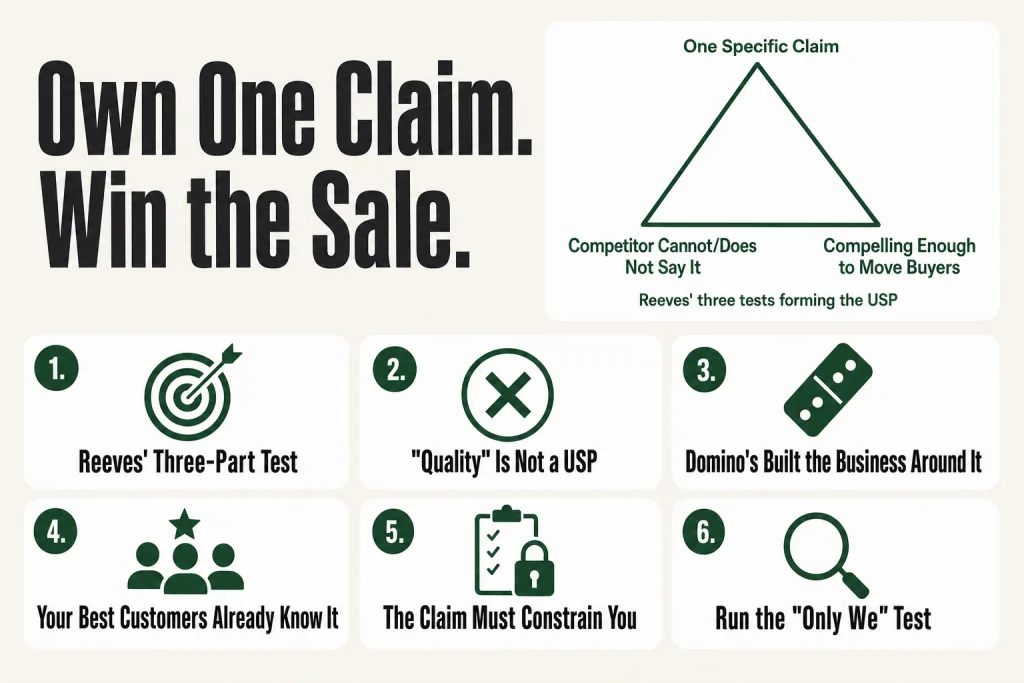
- Rosser Reeves codified three tests in Reality in Advertising (1961): the proposition must be a real offer with a specific benefit, it must be one the competition cannot or does not make, and it must be compelling enough to actually move buyers.
- “Best quality” and “great service” are not USPs, every competitor says the same words, so they differentiate nobody.
- Most small businesses already have a real USP hiding somewhere, in their process, their guarantee, their specialization, or their speed, but have never named it out loud.
- A USP is not a tagline you write; it’s a position you operate from. Every business decision either reinforces it or undermines it.
- Once you own a specific claim, your marketing gets dramatically easier, because you finally know what to say and what to ignore.
Where the Unique Selling Proposition Came From, and Why It Still Holds
Rosser Reeves coined the term and gave it a formal framework in his 1961 book Reality in Advertising. He rose to chairman at Ted Bates & Company, ran what was effectively one of the first in-house A/B testing operations in advertising, the Bates Copy Laboratory, and measured every campaign by one criterion: did it move product? Creative awards were, to him, vanity metrics. Sales were the only scoreboard.
His intellectual predecessor was Claude Hopkins, whose Scientific Advertising argued that copy should function like a salesman, not a showman. Reeves inherited that conviction wholesale. His contemporaries, Ogilvy, Bernbach, believed in persuasion as art. Reeves believed in persuasion as science, and was openly contemptuous of what he called “show-window advertising”: visually clever, commercially inert.
What Reality in Advertising formalized was a three-part test. Each advertisement must make a specific proposition, an actual offer: buy this, get this specific benefit. The proposition must be one the competition either cannot or does not offer. And it must be strong enough to actually change a buying decision, not merely interest someone. By the time the book was published, the term had already diluted enough that a copywriter reading the draft reportedly told Reeves, “My God, every campaign has a USP.” His whole point was that most of them didn’t, they just thought they did.
The Anacin campaign is the cleanest early example. The ad was famously grating, a hammer pounding inside an animated skull, the word “fast” repeated in rapid succession, a voiceover that would clear a living room at full volume. Viewers hated it. It tripled Anacin’s sales. Speed of relief said something precise when every other pain reliever was claiming gentle, effective, or trusted. Fast was verifiable. Fast was what a person with a headache actually wanted. That’s the USP doing its job.
The pressure Reeves identified, differentiate clearly or be ignored, only got worse as markets expanded. Television let a brand reach millions of households with one message. So could every competitor. Products that had been differentiated by geography or familiarity suddenly had to compete on something real. The internet did exactly the same thing to small businesses sixty years later, only faster. The HVAC company that used to win because it was the only one anyone had heard of now competes with twelve other Google results and a Yelp page. Reeves’ problem is still your problem.
What a Unique Selling Proposition Actually Is (and What It Isn’t)
Let’s get specific, because this is where most operators go sideways.
A USP is one claim. Not five. Not a paragraph of bullet points. The discipline of forcing yourself down to one claim is itself the exercise, it requires you to decide what your business actually bets on, which most operators have been avoiding for years because it feels like leaving something out.
A USP must be specific enough to be falsifiable. “We deliver better service” cannot be falsified. “We answer every support call live, Monday through Saturday, 7am to 7pm” can be. The first is a sentiment. The second is a promise with edges.
A USP must be something a competitor cannot immediately copyor chooses not to claim, even if they could. This is Reeves’ second test, and it’s worth sitting with. Many small operators have advantages their competitors don’t claim: they’ve been at it for 22 years in one specific industry, they’ve built a proprietary process, they specialize in one customer type to the exclusion of everyone else. Those are real USPs. The reason no one knows is the operator has been too modest, or too worried about narrowing the audience, to say them out loud.
A USP must matter to the buyer. Reeves’ third test, and it cuts the other direction. You might be the only HVAC company in your market that uses a specific brand of refrigerant, but if that distinction is invisible to a homeowner choosing between three quotes, it’s not a USP. It’s a specification. The test is whether the specific claim actually changes a buyer’s decision.
The things that are definitely not USPs
- “We provide exceptional quality.” Every competitor says this. It’s not a differentiator; it’s a baseline expectation.
- “We have great customer service.” Same problem. It’s the thing every business claims and customers assume every business believes about itself.
- “We’re a family-owned business.” True for millions of businesses. Irrelevant as a differentiator unless you can attach a specific, meaningful consequence to it that competitors can’t.
- “We’ve been in business for X years.” Longevity by itself isn’t a promise of any outcome. Translated into something specific, “we’ve installed over 3,000 roofs in Henderson, Nevada, which means we’ve seen every local permit issue before it becomes yours”, it can become part of a USP. As a number standing alone, it doesn’t work.
- A tagline or slogan. Nike’s “Just Do It” is not a USP. It’s a brand emotion. USPs and slogans occasionally overlap, M&M’s “melts in your mouth, not in your hand,” which Reeves helped develop at Ted Bates, is both, but your USP is the underlying strategic position. A slogan might be how you advertise it. Build the USP first; the slogan is optional.
Two Examples That Show the Idea Working at Different Scales
The Domino’s story is the cleanest large-scale demonstration of a USP built from operational reality. Tom Monaghan’s 30-minute delivery guarantee, formalized by at least the mid-1980s as a hard promise, any pizza late arriving free, staked a specific, testable claim on top of a category no dominant competitor had yet claimed. Pizza Hut didn’t even offer delivery until 1986, pressured by Domino’s growing market share.
Notice what the Domino’s USP did not say: no claim about taste, quality, ingredients, or value. That was intentional. Competing on taste against better pizza would have been a losing bet. Competing on the certainty of delivery, a guarantee-backed promise no competitor was making, was one they could win operationally. The guarantee drove growth that took the company from around 200 stores in 1978 to 5,000 by the end of the 1980s. The USP forced the entire business to reorganize around one promise: specialized boxes that folded faster than competitors’, in-car ovens, store placement decisions calibrated for delivery radius. The claim came first; the operations followed to support it.
It eventually became a legal liability. Drivers racing to meet the guarantee caused accidents; by 1989, collisions involving Domino’s drivers had accounted for more than 20 fatalities. After a St. Louis jury awarded a woman $78 million following a crash involving a Domino’s driver, Monaghan retired the guarantee in 1993. The dark irony is that the guarantee was so real, so embedded in how the business actually ran, that it created fatal pressure when the system was pushed. That’s what a genuine USP does, it reorganizes the whole operation. Marketing language with nothing behind it never generates that kind of internal force.
Death Wish Coffee is the small-business counterpart. Mike Brown started out of a coffee shop in Saratoga Springs, New York in 2012, having noticed that customers kept asking for the strongest cup he could make while every competitor was racing toward lighter roasts and sweeter flavors. Brown went the other direction: “the world’s strongest coffee,” built from robusta and arabica beans, sold with skull-and-crossbones branding and a full-refund guarantee for anyone who disagreed. Polarizing by design. It doesn’t try to appeal to the person who wants a delicate pour-over. It ignores that person completely and speaks directly to the one who wants something strong enough to feel like a dare. That specificity built a following that eventually landed the brand a Super Bowl commercial slot, Death Wish beat more than 15,000 other small businesses in Intuit’s competition to win the spot. The underlying logic works at any size: own a specific claim, and the right customers find you instead of you chasing everyone.
Putting this to work? The ideas in the Canon are the foundation under the tactical playbook in Build a Complete Marketing Departmentgrab the free companion kit at mmsvegas.com/resources.
How to Find Your Unique Selling Proposition When You Think You Don’t Have One
Here’s the version of this conversation I have most often: an operator tells me they can’t identify a USP because their business is similar to competitors. Same services, similar pricing, same geographic market. “We just do good work.” That’s not the absence of a USP, it’s the absence of having looked for one seriously. Every business has positions it could own; most haven’t done the work of naming them.
Start with your best customers. Not average customers, your ten or fifteen best. The ones who refer often, complain rarely, and pay without friction. What do they say when they explain why they chose you? Not what you told them, but what they tell other people. The language they use is often a better USP than anything you could write in a strategy session. If three different customers independently say some version of “I can always get someone on the phone,” that’s a candidate. If they say “you’re the only one who actually showed up the same week,” that’s a candidate. They’re telling you what differentiated you in their experience.
Then look at what you do that competitors could do but haven’t claimed. Reeves was clear on this: a USP doesn’t have to be something no one else is capable of, it just has to be something the competition isn’t saying. If every plumber in your market is advertising “reliable, licensed, and insured” and you’re the only one willing to put a specific guarantee in writing, same-day service or the call is free, you’ve created a USP from something competitors technically could match but haven’t.
Look at your process, your specialization, and your constraints. Counterintuitively, the things that narrow your business are often the best raw material for a USP. If you only serve restaurants, not general commercial, not residential, that constraint becomes a claim: nobody in your market understands restaurant HVAC the way you do, which means you catch problems a generalist would miss. If you’ve built a specific intake process that reduces project surprises, name it, describe it, make it visible. A named process signals discipline in ways that generic claims never do.
The “only we” test is worth running on every candidate: finish the sentence “Only we ___” and see whether a competitor could say the exact same thing without lying. If they could, keep looking. When you hit something where the answer is no, or at minimum, “nobody else in our market is saying this”, you’ve found territory worth claiming.
AI is genuinely useful here. Feed a language model your customer reviews, your intake conversations, your competitor’s homepage copy, and ask it to surface what your customers consistently value that your competitors are silent on. The output won’t be your USP, you’ll need to pressure-test it against your actual operations and the competitive reality you know better than any AI does, but it can identify patterns in customer language faster than you’d find them manually. The judgment about what to claim and what you can actually deliver stays with you.
The six lanes where small-business USPs actually live
These aren’t the only possibilities, but they’re the ones that show up most reliably for operators who don’t sell a product with a patented ingredient:
- Speed with a specific number. “48-hour turnaround” beats “fast” every time. Specificity is what makes the promise credible.
- Specialization by customer type or problem. “We only serve dental practices” is a USP. “We serve healthcare” is not.
- A named process or methodology. If you can give your way of working a name and explain why it reduces a specific pain, you’ve created intellectual property from something you were already doing.
- A guarantee with real teeth. “On-time or we refund the project management fee” is a USP. “We stand behind our work” is not.
- Access to people, not systems. In markets where every competitor routes customers through portals and tickets, “you’ll reach the same person every time, not a call center” can be a genuine differentiator.
- A specific, documented outcome. “Our clients reduce their accounts-receivable days by an average of 11 days in the first 90 days” is a USP. “We improve your cash flow” is not.
The Part Nobody Talks About: A USP Is an Operational Commitment, Not a Marketing Decision
This is where the idea gets real, and where most implementations fail quietly. A USP isn’t a line you write on a website and then work backward from. It’s a claim you build forward from, meaning every operational decision either supports it or undermines it.
Domino’s didn’t just advertise 30-minute delivery. They restructured the business to deliver it, specialized packaging, in-car ovens, routing systems, store placement decisions calibrated for delivery radius. The USP became the organizing principle for resource allocation. When the guarantee eventually created safety problems, that was evidence the USP was real: the business was so genuinely organized around the promise that it created dangerous pressure when the system was pushed past its limits. A fake USP, one that’s only marketing language, would never generate that kind of internal tension.
If your USP is “you’ll always reach a live person,” you need to staff for it. If it’s “48-hour turnaround,” your scheduling and capacity planning needs to make that true even when things get busy. If it’s “we only serve restaurants,” you need to actually turn down non-restaurant work, which feels painful the first time and liberating the tenth.
The test is simple: does your USP constrain what you do? If saying yes to your USP also means saying no to something else, it’s real. If you can claim it while continuing to operate exactly as you did before, it’s still a slogan.
Where This Idea Works Best, and Where It Gets Complicated
The unique selling proposition is most powerful in markets with low visible differentiation, commodity-adjacent services where buyers have a hard time comparing quality until after the purchase. Trades, professional services, SaaS, agency work, logistics, financial services, anywhere the buyer is choosing mostly on trust and whatever surface signals they can find. In those markets, a specific, believable promise cuts through in a way that no amount of “we’re passionate about what we do” ever will.
It works particularly well for B2B and professional services because the stakes of a wrong vendor choice are high and buyers are actively trying to reduce risk. A sharp USP that names the risk and addresses it directly, “every engagement includes a written scope of work with a fixed price, guaranteed”, lands harder with a CFO approving a vendor than any branding exercise would.
It’s more complicated in markets where the purchase is primarily emotional, luxury, fashion, certain consumer categories, where brand identity and feeling carry more weight than a rational proposition. That’s not a reason to abandon differentiation; it’s a reason to acknowledge that the differentiation might need to operate differently. Reeves was criticized for being too rational, for treating every purchase as a logical decision, which is a fair critique for some categories. For most small businesses, though, the problem runs the other direction, they’ve been too vague and too emotional, not too rational.
It also gets complicated when the thing that makes you genuinely different is hard to communicate quickly. If your USP lives entirely in your execution quality, you really are just better at the work than everyone around you, you need to find a way to make that visible and specific before you can claim it. Certifications, named methodologies, documented case studies, specific outcome metrics: these are the mechanisms that translate execution quality into something a prospect can evaluate before they hire you.
Common Misunderstandings About the Unique Selling Proposition
“We can’t narrow down to one thing, we do so much.” This is the most common objection, and it misunderstands what a USP is. You’re not describing everything your business does. You’re naming the one thing that makes a prospect choose you over the alternative. A law firm doesn’t have to limit its practice areas to have a USP, it just needs one claim that differentiates it when someone is comparing options. Everything else you do still exists; you’re just leading with the claim most likely to win the right prospect.
“Our differentiator is our people / culture / passion.” Internal virtues aren’t USPs. They may be real and genuinely admirable, but a prospect can’t evaluate them before the relationship starts. A USP has to be something a buyer can reasonably expect to experience. “Our team genuinely cares” is invisible to a prospect. “Our account manager responds to every message within four business hours, and you’ll have their direct number from day one”, that’s the translation of care into something verifiable.
“Our USP is our price.” Price can be a USP, but it’s the most fragile version. Anyone can undercut you. Price-based differentiation also trains your customers to expect low prices and attracts buyers who will leave the moment someone offers a lower number. Compete on price only if you have a structural cost advantage that’s genuinely durable, and even then, pair it with a specific claim about what the price guarantees, not just the number itself.
“A USP is a permanent thing.” It isn’t. Markets shift, competitors evolve, customer expectations change. A USP that was genuinely differentiating five years ago may be table stakes today. The operators who stay sharp review their claimed position against their competitive reality every year or so and ask honestly: is this still the claim that wins us the right customers, or has the world caught up?
“We need a USP for our ads.” You need a USP for your business. The ads are downstream of that. If you only think about your unique selling proposition when you’re writing ad copy, it tends to become aspirational rather than operational, a better version of the business rather than an honest description of the one you actually run. The claim has to be true before it can be effective.
Common Mistakes
- Treating the USP as ad copy rather than an operational commitmentBefore publishing any claim, map out which specific staffing, scheduling, or process decisions have to change to make it true. If nothing has to change, it’s not a USP, it’s a slogan. Audit the last 30 jobs against the claim before you put it on the homepage. If you’re promising 48-hour turnaround and 40% of those jobs ran to day four, you know exactly what to fix first.
- Choosing a claim your prospect can’t verify before they hire youInternal virtues, passion, culture, craftsmanship, are invisible to someone who hasn’t worked with you yet. Translate them into something observable before the sale: a specific response-time commitment, a named deliverable, a money-back term. ‘We care deeply’ is not a differentiator. ‘You’ll have a dedicated point of contact who responds within four business hours, in writing, guaranteed’ is one.
- Writing a claim that requires an asterisk to be trueEvery escape hatch you build into a promise, ‘subject to availability,’ ‘during normal business hours,’ ‘for standard orders only’, erodes the differentiation. If the claim can’t survive without a footnote, either fix the operation or narrow the claim until it’s unconditionally true. A tighter, honest promise outperforms a broader, qualified one every time.
- Switching positioning every six to eight months out of boredom or competitive anxietyMarket penetration takes time, your ideal customer needs repeated exposure to the same claim before it sticks. If a competitor starts using similar language, don’t abandon the position; go one level deeper on specificity. ‘Fast turnaround’ becomes ’48-hour turnaround, or we discount the invoice 20%.’ Resetting your positioning from scratch every season resets your penetration to zero.
- Trying to maintain five different USPs for five different audiencesPick one primary USP for your core buyer and make it the headline of everything. Secondary messages can speak to different segments, but they should all be consistent with the same underlying position. Five different claims don’t add up to five times the clarity, they add up to none.
Operator’s Take
I’ll tell you exactly where I see operators get this wrong, and I’ll try not to be diplomatic about it.
The USP conversation almost always gets stuck in the writing phase. Someone spends an afternoon workshopping tagline variations, maybe runs it by a copywriter, and posts it on the website, and then treats the work as done. Zero hours were spent asking whether the claim they want to make is actually true on a random Tuesday in October when the team is stretched thin. That’s the trap, and it’s a common one.
So before you write a single word of positioning, do this first: pull up three competitors’ websites right now. Read them. If they all say “quality work, exceptional service, family-owned”, and most of them will, the bar in your market is so low you can clear it with one specific sentence. The opportunity is real. The question is whether you’re willing to commit to something specific enough to matter.
My strong opinion on where to start: don’t brainstorm. Interview your three best customers this week, the ones who refer you, who never nickel-and-dime you, who call you first. Ask them why they stayed. Ask what they tell friends when they recommend you. Their language will almost always be more specific, more credible, and more differentiating than anything you’d invent in a conference room. Your USP is probably already sitting in those conversations, unnamed and unclaimed.
Once you’ve got a candidate, stress-test it against your worst week. If your claim is “same-day response,” go look at your last 90 days of support tickets and count the misses. If you can’t deliver the clean version of the claim on a bad November week when two people are out sick, you have two choices: fix the operation, or narrow the claim until it’s true without the asterisk. “Same-day response for existing clients, Monday through Friday” is smaller, and it’s real. A smaller, truer promise wins every time over a bigger, softer one.
Then write it as a sentence a stranger could understand in ten seconds. Not a tagline, a plain declarative sentence. “We’re the only bookkeeper in Austin who works exclusively with food-and-beverage businesses, and every client gets a monthly P&L call with a CPA, not an associate.” If you need more than two clauses, keep cutting. The more words it takes to explain your differentiator, the less of a differentiator it is.
Give it at least six months before you change anything. The biggest mistake I watch operators make is switching positioning every eight months because they got bored or a competitor started using similar language. If a competitor copies your positioning, you haven’t lost it, they’ve validated it. Go one level deeper on specificity. “Fast turnaround” becomes “48-hour turnaround, or we discount the invoice 20%.” Starting over from scratch resets your market penetration to zero, and you’ll be tired of saying the claim long before your market is done hearing it for the first time.
One last thing: AI can accelerate the discovery phase, pull your reviews, your competitor’s homepage, your intake notes into a language model and ask it to surface what customers consistently value that nobody around you is saying. That’s a real head start. But the call about what you’re willing to commit to operationally, what your team can actually sustain week after week, that’s yours. AI cuts the research time; it doesn’t make the decision.
Used in
- ✓ Build a Complete Marketing Department
- ✓ The Missing Manual for FunnelKit
FAQ
What’s the simplest definition of a unique selling proposition?
It’s the one specific promise only your business makes, stated clearly enough that a prospect can repeat it to a friend. If a competitor could say the exact same thing without lying, you haven’t found your USP yet.
Is a unique selling proposition the same as a tagline or a slogan?
No. A tagline is the public expression of a brand feeling; a USP is the underlying strategic claim that a business bets on. They occasionally overlap, M&M’s ‘melts in your mouth, not in your hand,’ which Reeves helped develop at Ted Bates, is both, but most taglines are emotional and most USPs are propositional. Build the USP first; the tagline is optional.
Can a small business with no patent or proprietary product have a real USP?
Yes, and most small businesses’ best USPs come from exactly this situation. Specialization, a specific guarantee, a named process, a documented outcome, speed with a number attached, these are all legitimate USPs and none of them require a patent. The question is whether you’re willing to claim it clearly and build your operations around it.
How is a USP different from a value proposition?
A value proposition covers the full range of benefits a customer gets from choosing you. A USP is the single sharpest differentiator, the one thing that answers ‘why you instead of them?’ Think of the value proposition as the full case and the USP as the decisive argument within it.
How often should I revisit or update my unique selling proposition?
At minimum, once a year, and immediately after a meaningful shift in your competitive landscape. The claim has to remain something competitors aren’t already saying loudly. If three competitors have copied your positioning in the past 18 months, it’s time to find the next level of specificity.
Can price be a USP?
It can, but it’s the most fragile version because anyone can undercut you. A price-based USP is most defensible when it’s attached to a structural cost advantage, a proprietary process, a volume relationship, an efficiency others can’t replicate, rather than just a willingness to charge less.
Further reading
- Reality in Advertising by Rosser Reeves (1961), the source document; short, blunt, and still more useful than most modern marketing books on differentiation.
- Obviously Awesome by April Dunford, a practical modern framework for positioning, which is the strategic context your USP lives inside; particularly useful for service businesses and SaaS operators.
- Scientific Advertising by Claude Hopkins (1923), Reeves’ intellectual predecessor; the argument that copy should function as a salesperson, not a decorator, which underpins much of what the USP idea rests on.
Sources: Rosser Reeves, Reality in Advertising (1961); Branding Strategy Insider, “The Advertising Wisdom of Rosser Reeves” (2022); Campaign Live, “History of Advertising No. 120: Rosser Reeves’ Reality in Advertising” (2015); FRMWRKS, “Book: Reality in Advertising” (2024); Ranker, “How Domino’s ’30 Minutes Or Less’ Guarantee Resulted In A $78 Million Lawsuit”; The Hustle, “The Failure of the Domino’s 30-Minute Delivery Guarantee” (2024); Tasting Table, “Why Domino’s Was Forced To Abandon Its Famous 30-Minute Delivery Promise” (2025); Forbes, “Meet The Entrepreneur Behind The Death Wish Coffee Super Bowl Ad” (2016); NBC News, “Contest-Winning Coffee Maker Readies for Jolt From Super Bowl Ad” (2016); Fortune, “This Entrepreneur’s (Death) Wish Has Come True” (2016); Death Wish Coffee official About page; The Alternative Board, “How to Develop a Unique Selling Proposition for Small Businesses” (2026); Wikipedia, “Unique Selling Proposition.”
Brian Kasday spent forty years in direct-response marketing before rebuilding the whole operation as a one-person shop. He writes The Operator’s Library, including “Build a Complete Marketing Department”, for operators who’d rather build it themselves than wait on someone else.
Build the department these ideas describethe free companion kit: mmsvegas.com/resources.
More The Operator's Canon guides
Free · Operator Toolkit
Want the tools, not just the guide?
Get the free operator toolkit — templates and checklists for the systems you actually run, plus a note when this guide changes.
Get the free toolkit →How to cite: Unique Selling Proposition (USP). Associated with Rosser Reeves / Reality in Advertising, 1961. The Operator’s Canon, MMS Vegas. https://mmsvegas.com/library/unique-selling-proposition-explained/