
Last updated: July 2026
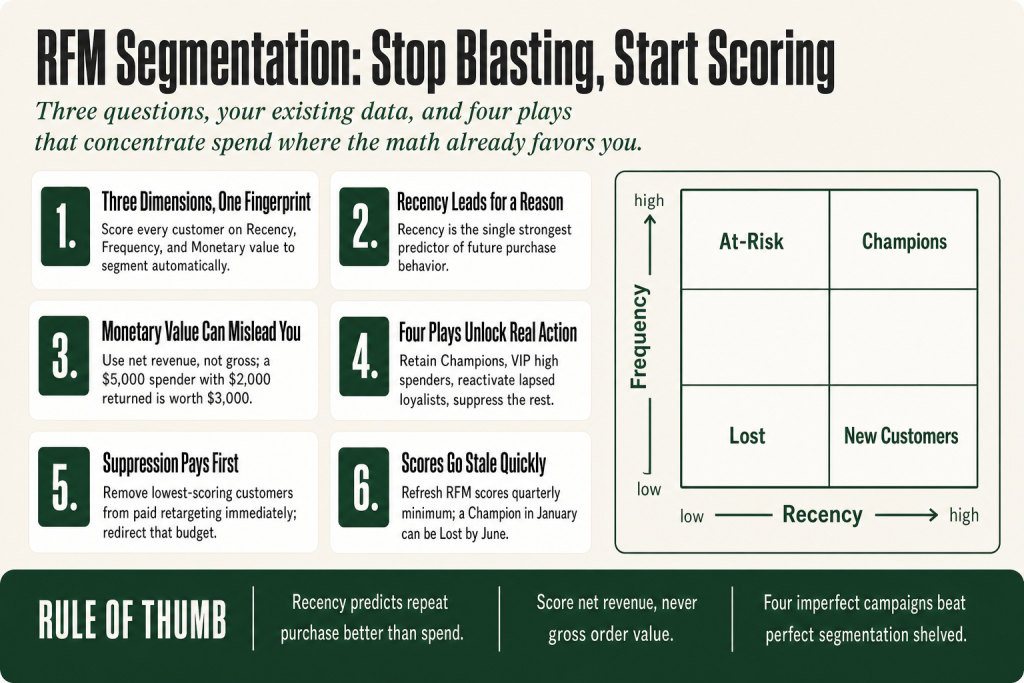
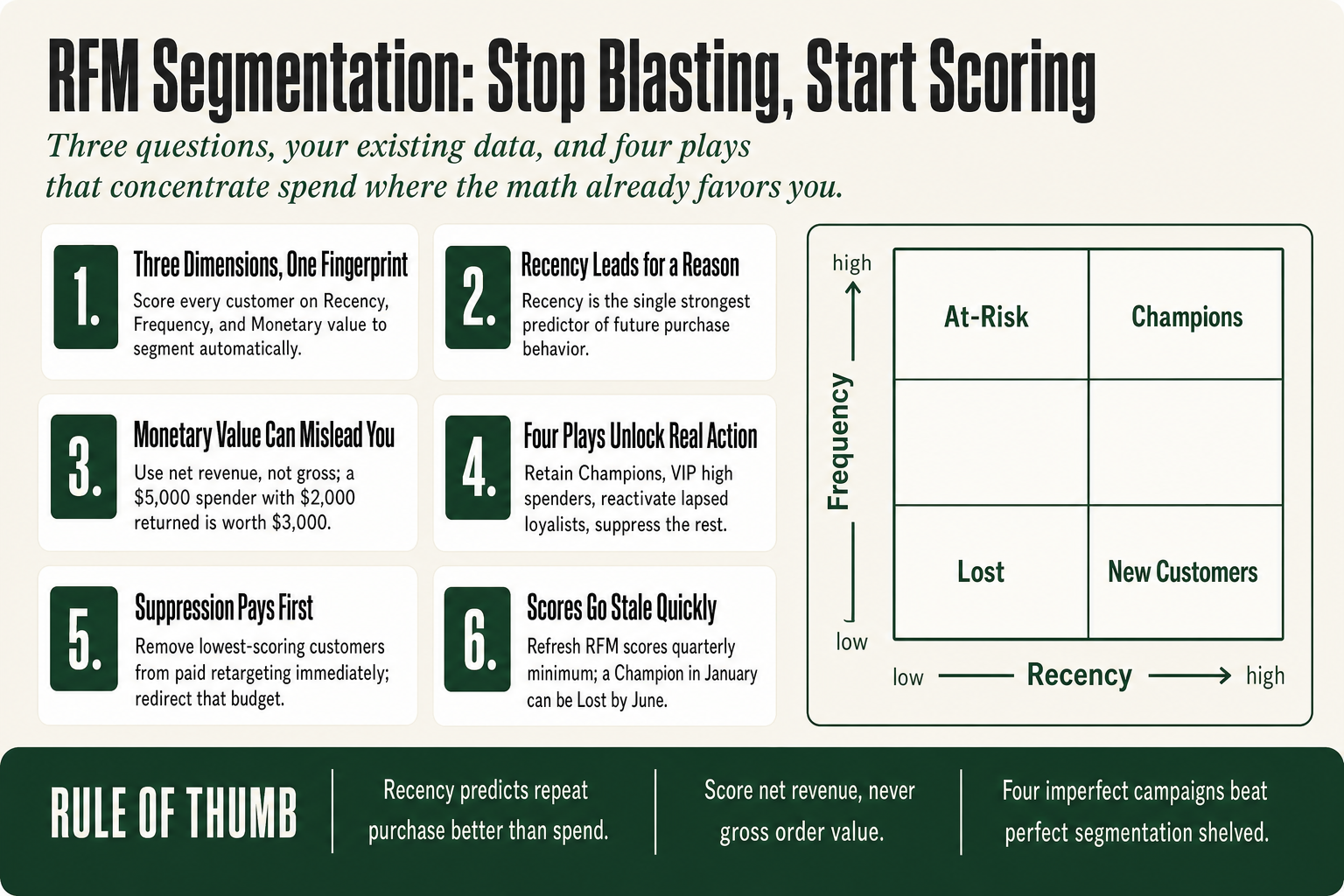
RFM segmentation is the cleanest answer to a question every operator eventually faces: now that I have customers, which ones do I actually invest in? By the end of this page, you’ll be able to score your own list, name your segments, and assign a specific marketing action to each one, so you stop blasting everyone with the same message and start spending where the math already favors you.
Most small-business operators have a list, but they treat it like one undifferentiated blob. The champion who bought three times last month gets the same email as the person who bought once eighteen months ago and never came back. Same offer, same timing, same discount. It’s not that operators don’t care, it’s that they haven’t had a structured way to tell customers apart. RFM segmentation fixes that, and it does it with data you already own.
The framework is deliberately simple. Score every customer on three questions: How recently did they buy? How often do they buy? How much have they spent? Combine those scores, and your customer list sorts itself into segments with clear behavioral fingerprints, and clear implications for what you do next. No data science team required. No $50,000 CRM. Transaction records and an afternoon of honest thinking about what the numbers are telling you.
The idea in 30 seconds
- RFM segmentation scores every customer on three dimensions: how recently they bought, how often they buy, and how much they spend.
- The output is a handful of named segments, Champions, At Risk, Hibernating, Lost, each calling for a different marketing response.
- Recency is the single strongest predictor of future purchase behavior; it leads the model for a reason.
- Operators use RFM to stop wasting budget on low-probability customers and concentrate spend where the math already favors them.
- Works best for businesses with repeat-purchase potential and at least six months of clean transaction history.
- By the end of this page you’ll be able to score your own customer list, identify the four plays, retain, VIP, reactivate, reduce, and wire each one to a specific campaign.
Where RFM Segmentation Came From
The catalog industry figured this out before anyone thought to give it a name. Direct-mail marketers were tracking customer purchase patterns on index cards long before anyone called it a model, because physical catalogs cost real money per piece, and mailing everyone went broke fast. That constraint forced discipline that digital marketers had to relearn the hard way decades later.
The framework was codified for the database marketing era when Arthur Middleton Hughes published Strategic Database Marketing in 1994. Hughes’ method scores each of the three RFM attributes independently into five equal-frequency bins, producing 125 possible cells. In practice, most operators collapse those into eight to eleven named segments, which is plenty. The move to digital didn’t change the underlying logic. The jargon updated; the math didn’t.
Today RFM segmentation is built into Klaviyo, referenced in every retention-focused ESP, and the conceptual backbone of loyalty programs from Starbucks to Sephora. Thirty years and a lot of software later, it’s still the same three questions.
The Three Dimensions of RFM Segmentation, and What Each One Actually Tells You
Operators routinely underestimate one of these variables and overestimate another. Worth slowing down on each.
Recency, the Strongest Signal in RFM Segmentation
Recency measures the time elapsed since a customer’s last purchase. Think of it as a proxy for attention. The person who bought last Tuesday is still thinking about you. The person who bought two years ago has moved on, in their head if not on your list.
Direct-mail marketers observed for decades that recency of purchase was the single strongest predictor of repeat response, which is why recency still carries outsized weight in many weighted-score variants, and why it leads the acronym. Win-back campaigns that filter first by recency consistently outperform ones that cast a wide net over anyone who’s ever bought.
Frequency
Frequency reflects how often a customer has transacted during a given period. Where recency tells you how warm a customer is right now, frequency tells you about the underlying habit. A customer who’s bought six times in a year is behaviorally different from one who’s bought once, even if their last purchase was the same week. Frequency is where you find your loyalists, and the customers worth treating differently from the rest of the list.
Monetary Value
Monetary is the dimension operators get most excited about and the one most likely to mislead them. High spenders aren’t automatically your best customers, they might carry a high return rate, a one-time large purchase that won’t repeat, or margins that don’t justify the investment. The fix is to use net revenue or gross profit in the monetary calculation rather than raw order value. A customer who’s spent $5,000 gross but returned $2,000 of it has a monetary value of $3,000, not $5,000. Treating them as a top-tier customer based on gross is expensive.
Together, the three variables produce a behavioral fingerprint. Score every customer on all three, combine the scores, and each customer falls into a named segment with a clear marketing objective.
The Four Operator Plays That RFM Segmentation Unlocks
The practical output of RFM segmentation isn’t 125 cells, it’s four decisions about what to do with different customers. Every named segment maps back to one of them.
Play 1: Retention (High Recency + High Frequency)
These customers are buying, they’re buying regularly, and they bought recently. Your job here isn’t conversion, they’re already converted. Your job is to maintain the relationship, make them feel recognized, and give them a reason to keep coming back. The worst thing you can do with Champions is treat them the same as everyone else. They notice.
Retention plays look like: early access to new products, priority service, acknowledgment of their loyalty status, referral invitations (they’re your most credible advocates), and communication that assumes the relationship rather than pitching at them. Don’t sell Champions, you’ve already won them. Invest in them.
Play 2: VIP Programs (High Recency + High Frequency + High Monetary)
This is a subset of retention, but it deserves its own play because the economics justify a meaningfully higher investment per customer. If someone is spending $1,000 a year with you, a $40 perk is a rounding error in the relationship cost, and it dramatically increases the odds of year three and year four.
VIP plays look like: concierge-level service, exclusive offers not available to the general list, direct access (a phone number, a named rep, a Slack channel), and personalization that signals you actually know who they are. The investment scales with what the segment’s lifetime value justifies.
Play 3: Reactivation (Low Recency + High Historical Frequency or Monetary)
This is the segment most operators either ignore or overwork. Customers who used to buy regularly and haven’t lately are not the same as customers who only bought once. They already know you, they’ve already crossed the trust gap, and something, a life change, a price point, a bad experience, or simple distraction, interrupted the habit. That’s a different conversation than converting a cold prospect.
A targeted win-back sequence with a meaningful offer, not a generic “we miss you” with 10% off, can recover a real percentage of this group. The key is acknowledging the gap without being weird about it, and making the return feel easy.
One note on win-back: set a realistic cutoff. If someone bought once four years ago and has never returned, pouring reactivation spend into them is usually a losing proposition. The cutoff depends on your product’s natural repurchase cycle, most operators draw the line somewhere between 12 and 24 months of inactivity.
Play 4: Reduced Spend (Low Recency + Low Frequency + Low Monetary)
This is the play nobody wants to talk about, but it’s arguably the most valuable. Some customers in your database are not worth marketing to at the same level, or at all. They cost you acquisition dollars, they have low lifetime value, and they’re unlikely to reactivate. Continuing to spend on them depresses your overall marketing ROI and skews your metrics.
Reducing spend doesn’t mean deleting them forever. It means moving them to a lower-cost nurture track, cutting email frequency (which also protects your sender reputation), and stopping paid retargeting against them. The budget you free up goes to the segments where it actually works. This is the unsexy half of RFM segmentation, and it often pays as much as the VIP work.
How to Actually Score Your List Using RFM Segmentation
You don’t need a PhD in data science or a six-figure analytics platform. You need clean transaction records, a spreadsheet or a CRM that can filter purchase dates, and about four hours the first time through.
The Simple Three-Step Method
Step 1: Pull your transaction data. You need three fields per customer: customer identifier, transaction date, and transaction value. That’s it. If your POS or e-commerce platform can’t export this in under twenty minutes, that’s a different problem to solve.
Step 2: Score each dimension on a 1 to 5 scale, with 5 being best. For recency: sort all customers by days-since-last-purchase and divide into five equal groups, the most recent 20% get a 5, the next 20% get a 4, and so on. Do the same for frequency (number of purchases in your chosen window) and for monetary value (total net spend). You end up with a three-digit score for every customer, something like 5-4-3 or 2-1-1.
Step 3: Name your segments. You don’t need to act on all 125 combinations. Collapse them into six to ten groups based on score patterns:
- Champions: 4 to 5 on all three, recent, frequent, high-value. Protect and invest.
- Loyal Customers: High frequency and monetary, moderate recency, they buy a lot but haven’t been in recently. Prioritize re-engagement.
- At-Risk: Previously high-scoring customers whose recency has dropped. Trigger a win-back before they go cold.
- New Customers: High recency, low frequency. The onboarding window is now, get them to a second purchase.
- Big Spenders (Low Frequency): High monetary, low frequency. They came once, spent a lot, haven’t returned. A targeted offer referencing their specific purchase can reactivate these.
- Hibernating: Mid-range across the board, haven’t bought recently, didn’t buy that often. Worth a light-touch reactivation sequence but not heavy spend.
- Lost: Low across all three. Move to suppression or a minimal automated track. Stop paying for ads against them.
Setting the Right Time Window for Your RFM Segmentation
The window you choose for recency and frequency scoring should reflect your product’s natural purchase cycle, not a generic default. A coffee shop and a mattress store have completely different definitions of what “inactive” means. If you run a seasonal business, a landscaping company, a tax prep firm, a holiday-heavy retailer, be careful about measuring during off-peak windows. Use a rolling 12-month window or measure performance against the equivalent period last year instead of a snapshot 90-day look.
The Tools That Actually Help
For WooCommerce operators, Metorik calculates RFM scores natively and lets you push segments directly to your email platform. FunnelKit Automations can then trigger the right sequence the moment a customer’s score changes, a customer moving from Champion to At-Risk gets a win-back flow automatically, without you pulling a report. Klaviyo uses a 1 to 3 scale with composite groups; Shopify and most academic implementations use 1 to 5. ActiveCampaign can replicate the logic with more setup work but costs less per contact, making it a reasonable option for operators comfortable with custom fields and conditional automations.
AI can accelerate the setup, having an AI assistant help you build the scoring logic in a spreadsheet or configure the automation rules in your CRM cuts first-time setup from a full day to a few hours. The judgment calls, where to draw the segment lines, which offer to put in front of each group, how aggressively to pursue reactivation, those stay with you.
Putting this to work? The ideas in the Canon are the foundation under the tactical playbook in Build a Complete Marketing Department — grab the free companion kit at mmsvegas.com/resources.
Who Uses RFM Segmentation Today, and What You Can Steal From Them
The enterprise examples are useful not because you can copy them wholesale, but because they reveal the mechanics at a scale where the ROI is undeniable.
Starbucks. The clearest recent case study in what happens when a major brand stops differentiating by frequency. After running a flat, tier-free structure since 2019, the company reintroduced status tiers in 2026, explicitly because it had stopped distinguishing its best customers from casual ones. Chief Brand Officer Tressie Lieberman put it plainly to CNBC: “Our very best customers are coming 200 times a year, and we were treating them the same as someone who comes once a year.” The redesigned Starbucks Rewards program now sorts members into three tiers, Green, Gold, and Reserve, based on how many Stars they accumulated in 2025. That’s frequency doing the sorting. Classic RFM logic, wrapped in a points system.
Sephora. The Beauty Insider program applies RFM segmentation without calling it that. There are three tiers of membership: Insider, VIB, and Rouge, and achieving VIB or Rouge status requires a minimum annual spend. VIB status kicks in at $350 annual spend, and Rouge, the top tier, requires $1,000. That’s monetary value doing the sorting. Then the first Rouge Celebration, a four-day in-store and online event held in August 2024 exclusively for top-tier members, put experiential investment where the revenue concentration actually is. Sephora offsets a lower cashback rate with richer experiential benefits at Rouge, a deliberate trade-off that reduces liability accrual while concentrating value where it drives the highest-AOV cohort. The principle scales down. If a client spends $1,000 a year on your services, a dinner invitation or early scheduling access costs you almost nothing and signals everything.
The small-business translation. A landscaping company with 400 clients can sort them into segments in an afternoon: clients who’ve had work done in the last 60 days, clients who’ve had multiple projects across two or more seasons, clients who’ve spent over $5,000, first-timers from the last 90 days, and everyone who hasn’t called in over 18 months. The multi-season regulars get early-season scheduling priority and a referral ask. First-timers get a follow-up call and a second-service offer. The 18-month-lapsed get a reactivation postcard with a specific seasonal hook. That’s RFM segmentation. It just doesn’t look like a software dashboard, it looks like a clipboard and a phone.
Subscription and SaaS. Extended RFM frameworks for subscription businesses integrate additional dimensions, such as basket depth and inter-order intervals, alongside recency, frequency, and monetary values to sharpen segmentation. For a SaaS product, recency becomes last login date, frequency becomes usage sessions per week, and monetary becomes MRR or expansion revenue. The three questions are the same; the data sources shift. Platforms like Bloomreach and Braze now implement automated RFM dashboards that flag segment changes in real time, so an At-Risk flag triggers a win-back flow before you’ve even noticed the customer went quiet.
Where RFM Segmentation Earns Its Keep
RFM segmentation delivers the clearest returns in specific conditions. The ideal scenario includes repeat-purchase potential, sufficient transaction history, and relatively consistent pricing, e-commerce retailers, subscription services, B2B distributors, and membership organizations all fit this profile.
The framework earns its keep when your business has:
- Repeat-purchase dynamics. Customers who could plausibly come back multiple times per year. Cafes, salons, gyms, online stores, software subscriptions, professional services with ongoing engagements, home services businesses, all of these work.
- At least six months of transaction history. You need enough data to see behavioral patterns. A business open for two months doesn’t have a recency problem yet, it has a history problem.
- Clean customer identification. Every transaction needs to be tied to a known customer. Cash-only businesses without any loyalty or membership system struggle here because you can’t score what you can’t identify. Guest checkouts with no customer ID mean you simply can’t track frequency.
- Meaningful variance in customer behavior. If 90% of your customers bought exactly once and nobody repeats, you don’t have a segmentation problem, you have a product or onboarding problem. RFM will show you that, but it can’t fix it.
For subscription businessesRFM adapts cleanly: renewal dates replace purchase recency, login frequency or usage depth replaces transaction frequency, and MRR or expansion revenue replaces raw monetary value. The three questions are the same; the data sources shift.
Where RFM Segmentation Falls Short
RFM segmentation is honest about its own limits if you’re willing to look. The places it fails aren’t obscure edge cases, they’re common small-business situations.
Long sales cycles and one-time purchases. A real estate agent, a wedding photographer, a car dealership, customers who buy once and are done by design don’t produce the transaction history RFM needs. In those businesses, the more useful segmentation is by referral potential, lead source quality, and relationship depth. Don’t force RFM onto a business model it wasn’t designed for.
Small or highly concentrated B2B customer bases. When you have twenty major clients, scoring them 1-through-5 in equal quintiles produces nonsense, you already know who your top five accounts are, and the RFM grid doesn’t tell you anything your account manager doesn’t already know. A simple account-level priority list plus relationship-quality tracking serves you better in that scenario.
The backward-looking problem. RFM is a static snapshot. A customer who bought frequently for three years and then stopped due to a competitor’s launch looks identical in an RFM model to a customer who just hit a seasonal lull. The score tells you what happened; it doesn’t tell you why. That’s where operator judgment, and actual conversations with at-risk customers, fills the gap.
Revenue without margin. Using gross revenue instead of margin in the monetary dimension means you overinvest in low-margin categories or high-return shoppers. Use contribution margin, or at minimum net revenue adjusted for returns and discounts. A customer who buys $3,000 worth of goods and returns $1,500 of them has a monetary value of $1,500, not $3,000.
New customers getting penalized. A customer who bought four times in their first three months is a different animal from a four-year customer who’s bought four times total. Consider running a separate scoring track for customers under 90 days old rather than mixing them into the main RFM pool, where their short tenure will drag their scores down artificially.
What Operators Get Wrong About RFM Segmentation Before They Even Start
A handful of misunderstandings cause operators to either dismiss RFM segmentation before trying it or implement it in ways that guarantee disappointment.
“I need enterprise software to do this.” No. The original Hughes method was designed for catalog companies working from printed spreadsheets. You can implement a workable version of RFM segmentation in any spreadsheet application if you have clean transaction exports from your POS or e-commerce platform. The fancy tools speed up the refresh cycle and add automation; they don’t change the underlying logic.
“High monetary score equals best customer.” Not automatically. A one-time big spender with low recency and zero repeat purchases is not your best customer, they’re a former customer. The composite score is what matters. A 5-5-3 (very recent, very frequent, moderate spend) is typically more valuable to retain than a 1-1-5 (bought once a long time ago, spent a lot). Monetary is one leg of a three-legged stool.
“RFM is just email segmentation.” RFM segmentation governs far more than email. Scores should influence your retargeting audiences (suppress low-scoring segments from paid social rather than paying to re-show ads to people who’ve repeatedly ignored you), your direct mail decisions, your sales rep prioritization in B2B contexts, and the level of customer service investment any given customer receives.
“This is a one-time project.” RFM scores go stale fast. A customer who was a Champion in January can be At-Risk by April if your refresh cycle is annual. The operators who treat RFM as a living system, refreshing scores quarterly at minimum, and triggering automations the moment a customer crosses a segment boundary, get materially better results than those who pull a report once and file it.
“RFM replaces relationship intuition.” It doesn’t. RFM segmentation tells you what behavior looks like from the outside. It doesn’t tell you why a loyal customer went quiet, whether they moved, had a bad experience, found a competitor, or just got busy. The score tells you who to call; the call tells you what happened. The two work together.
RFM Segmentation vs. the Rule of Seven: Why They Serve Different Purposes
The Rule of Seven idea, that a prospect needs multiple meaningful touchpoints before they’re ready to buy, is about building familiarity with cold audiences. RFM segmentation is about something entirely different: allocating your relationship investment across people who already know you.
The contrast matters because operators sometimes use them interchangeably, and they shouldn’t. The Rule of Seven logic says: keep showing up, keep being visible, eventually the prospect will be ready. Right for acquisition. RFM segmentation says: your existing customers are not equivalent, some deserve more of your attention, some deserve less, and treating them all the same is a misallocation that costs you on both ends.
A Champion customer who’s bought six times this year doesn’t need seven more brand touchpoints before they trust you. They already trust you. What they need is recognition that they’re a Champion, and a reason to stay one. A dormant customer who bought once two years ago might benefit from a re-exposure sequence more like the acquisition model. RFM segmentation helps you know which customer you’re talking to before you decide which playbook to run.
The integration point: use the Rule of Seven (and Buying Temperature thinking) for prospects and first-time buyers. Use RFM segmentation for everyone who’s crossed the purchase line. The moment someone buys, they move from an awareness/consideration model to a retention/relationship model, and RFM is the map for that territory.
Common Mistakes
- Scoring gross revenue instead of net in the monetary dimension — Subtract returns and discounts from each customer’s transaction total before you score, not as a note you’ll remember later. A customer showing $4,000 gross with $1,800 in returns has a true monetary value of $2,200. Score them on gross and you’re sending VIP perks to a middling customer.
- Using a 90-day recency window for businesses with long purchase cycles — Set your window to match your median repurchase interval before you run a single score. A home renovation contractor or B2B distributor with quarterly orders will show artificially low recency scores on a 90-day window. Check your output: if your Champions don’t actually look like Champions, lengthen the window.
- Running a win-back campaign against the entire low-recency segment — Filter first. Low-recency customers who were also low-frequency and low-monetary the first time have shown you twice who they are, they’re suppression candidates, not a win-back opportunity. Restrict your win-back sequence to customers who scored 4 or 5 on frequency or monetary before they went quiet. That’s the recoverable population.
- Refreshing RFM scores annually and treating the output as current — Set a quarterly refresh cadence at minimum, and configure your CRM or automation platform to recalculate segment tags automatically. A Champion in January can be Lost by June in a business with a monthly purchase cycle, annual scores guarantee you’re marketing to ghosts.
Operator’s Take
Here’s my actual opinion on where operators go wrong with RFM, and it’s not the scoring math.
The biggest mistake I see is treating RFM as a planning exercise rather than a spending decision. Operators spend two weeks naming all eleven segments perfectly and then run the same promotional email to eight of them. That’s not segmentation. That’s a spreadsheet hobby. The only question that matters is: where does this budget go instead of where it was going before?
On that question, I have a pretty clear view. Suppress before you invest. Pull your current Facebook or Google retargeting audiences and remove every customer scoring 1-1 on recency and frequency right now, before you’ve built a single new campaign. Those people bought once, probably on promotion, probably a long time ago, and they’ve already voted with their silence. Stop paying to re-show ads to people who’ve already demonstrated they’re not interested. Redirect that spend to your At-Risk Champions, customers scoring 4 or 5 on frequency who’ve gone quiet on recency in the last 60 days. You’ll see ROAS lift before you’ve changed a single creative. That one reallocation often pays for the entire segmentation effort.
Win-back messaging deserves a harder opinion too. “We miss you” with 10% off is noise, it’s what every brand sends, and it signals that you have no idea who the person is. The operators who actually recover lapsed customers lead with specific acknowledgment: “It’s been about six months since your last lawn service, spring availability is opening up and I wanted to give you first access before the calendar fills.” That message is only possible if you’ve formatted your transaction data into recency windows. It’s not clever copywriting. It’s just using the data you already have.
On VIP perks: stop defaulting to discounts for your best customers. A gift card to someone spending $2,000 a year trains them to expect discounts. Early access to new inventory, a direct line to a named rep, a preview event before the general list, those feel like recognition. Recognition retains. Discounts train customers to wait for the next one.
Where I’d push back on the conventional RFM advice: most of it tells you to build the full eleven-segment model before you do anything. I’d invert that. Run four campaigns first, retain, VIP, reactivate, suppress, with whatever rough scoring you can do in a day. See what actually moves. The nuance of whether your segment six is “Promising” or “Needs Attention” does not matter until you’ve learned what your customers actually respond to. Perfect segmentation on a shelf beats nothing. Four imperfect campaigns in market beat perfect segmentation on a shelf every time.
AI is useful here for the mechanical work, building scoring formulas, configuring automation logic, drafting copy variations for each segment. What it can’t do is decide where your thresholds sit, whether a three-year-lapsed customer is worth a win-back attempt, or what offer will actually resonate with your specific At-Risk cohort. Those calls require knowing your margins, your customers, and your history. AI handles the plumbing; you make the calls.
Used in
- ✓ Build a Complete Marketing Department
Used to structure the retention and loyalty tier of the marketing system, assigning specific campaigns, budgets, and communication cadences to each RFM segment rather than treating the customer list as a single audience. - ✓ The Missing Manual for FunnelKit
Used to configure segment-triggered automations in FunnelKit, so that a customer crossing from Champion to At-Risk automatically enters a win-back sequence without manual intervention. - ✓ The Missing Manual for Make
Used to build automated data pipelines that pull transaction records, calculate RFM scores on a scheduled basis, and push updated segment tags into your CRM or email platform.
FAQ
How many customers do I need before RFM segmentation is worth doing?
There’s no hard floor, but the model starts producing useful signal once you have at least 100 to 150 customers with two or more purchases each. Below that, you likely know your best customers by name anyway. The value compounds as the list grows, at 500+ customers, RFM segmentation pays for the setup time many times over.
Do I need special software to run RFM scoring?
No. A spreadsheet with DAYS, COUNTIF, and SUMIF formulas handles the calculation for lists up to a few thousand customers. Dedicated tools like Klaviyo, Metorik, or Drip automate the refresh and push segments directly into your email platform, which matters as your list scales.
How often should I refresh my RFM scores?
Quarterly is the minimum for most businesses. For fast-moving e-commerce stores with weekly purchase cycles, monthly or even real-time scoring (via automation) catches segment changes while they’re still actionable. Scores go stale, a quarterly refresh catches most drift before it becomes churn.
Does RFM segmentation work for service businesses, not just product sellers?
Yes, with adaptation. A service business defines ‘transaction’ as a completed engagement or appointment. Recency becomes days since last appointment, frequency becomes number of engagements per year, and monetary becomes total billed. The logic is identical; the data source is your service records rather than your e-commerce dashboard.
What’s the single highest-ROI use of RFM segmentation for a small operator who can only do one thing?
Suppression. Identify your lowest-scoring customers and remove them from paid retargeting audiences immediately. The budget you stop wasting on people who are statistically unlikely to buy again pays for the rest of the segmentation work, and then some.
Can I use RFM segmentation for B2B businesses?
With caveats. For B2B businesses with many small accounts that buy repeatedly, RFM segmentation works well. For B2B with a small number of large strategic accounts, the quintile-scoring approach breaks down because you already know who your top five clients are. Use RFM directionally, as a flag for account health, rather than as a rigid scoring system.
Further reading
- Strategic Database Marketing by Arthur Middleton Hughes (1994), the book that codified the method. Worth reading directly rather than through summaries.
- Peter Fader & Bruce Hardie’s academic work on CLV and RFM (Wharton), their 2005 paper ‘RFM and CLV: Using Iso-Value Curves for Customer Base Analysis’ is the best bridge between the Hughes scoring method and modern lifetime value thinking.
Sources: Arthur Middleton Hughes, Strategic Database Marketing (1994); Visualizing RFM Segmentation, SIAM International Conference on Data Mining (2004), Kohavi et al.; Braze RFM Segmentation Guide (2025); Barilliance RFM Analysis Guide (2025); MCP Analytics RFM Practical Guide (2025); Umbrex RFM Segmentation Framework Reference (2026); Datadrew RFM Segmentation for Klaviyo (2026); Digital Applied RFM Segmentation 2026 Framework Review; Starbucks Investor Relations, Reimagined Loyalty Program Announcement (January 2026); CNBC, Starbucks Reintroduces Loyalty Tiers (January 2026); Loyalty Reward Co, Sephora Beauty Insider Master Guide (2026); Joy.so, Sephora Loyalty Program Analysis (2026); Open Loyalty, Sephora Beauty Insider Deep Analysis (2026); Sephora Beauty Insider Terms & Conditions (2025).
Brian Kasday spent forty years in direct-response marketing before rebuilding the whole operation as a one-person shop. He writes The Operator’s Library — including “Build a Complete Marketing Department” — for operators who’d rather build it themselves than wait on someone else.
Build the department these ideas describe — the free companion kit: mmsvegas.com/resources.
More The Operator's Canon guides
Free · Operator Toolkit
Want the tools, not just the guide?
Get the free operator toolkit — templates and checklists for the systems you actually run, plus a note when this guide changes.
Get the free toolkit →