
Last updated: July 2026
Loss aversion is the psychological tendency to weigh a potential loss more heavily than an equivalent gain, and it’s the single most documented finding in all of behavioral economics. The pain of losing twenty dollars feels roughly twice as sharp as the pleasure of finding twenty dollars. That asymmetry shapes almost every buying decision your customers make, usually without them noticing.
The idea sounds simple enough that operators often assume they already understand it. Most don’t, not really. They’ve heard “people hate losing more than they love winning” and translated that into countdown timers and ALL CAPS LAST CHANCE subject lines. That’s not loss aversion in action; that’s anxiety-farming. It works exactly once before the customer tunes it out or resents you for it.
What loss aversion actually gives you, when you apply it carefully, is a principled way to frame real stakes. Your prospect’s roof is leaking right now while they’re waiting to decide. Their competitor is taking market share while they delay. Their current provider is costing them three hours a week in workarounds. Those are losses happening in real time. Naming them honestly isn’t manipulation; it’s information. By the end of this page, you’ll be able to identify which of your current claims already use loss framing, which ones could be reframed more effectively, and, just as importantly, where to leave the tactic alone entirely.
The idea in 30 seconds
- The core finding: people feel the pain of a loss roughly twice as intensely as the pleasure of an equivalent gain, a bedrock finding from Kahneman and Tversky’s 1979 prospect theory research.
- The operator implication: framing an offer around what a buyer stands to lose by not acting is more persuasive than framing it around what they’ll gainbut only when the loss is real.
- Three honest applications: guarantees that remove purchase risk, framing that names the cost of inaction, and free trials or demos that create felt ownership before a buying decision.
- The ethics bright line: fake scarcity, invented deadlines, and manufactured urgency borrow against trust, and the FTC notices. Loss aversion only stays a durable asset when the threatened loss is genuine.
- Where it works least: high-involvement repeat buyers who already know you, and price-sensitive segments where fear messaging reinforces doubt rather than resolution.
- By the end of this page, you’ll know which claims in your marketing already use loss aversion, which could be reframed to use it better, and where to leave it alone.
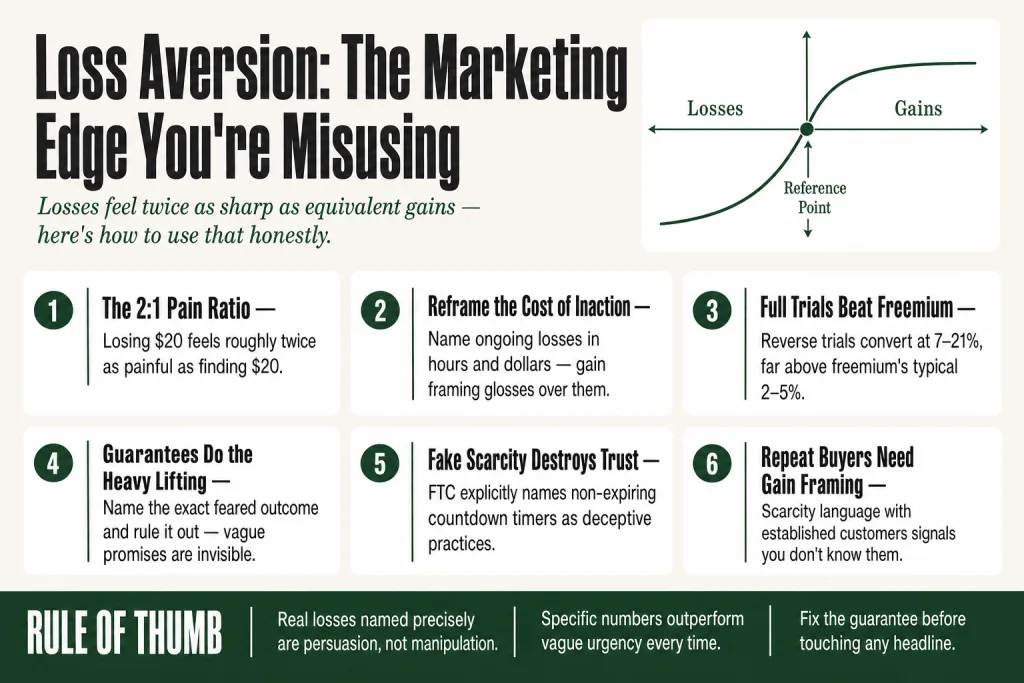
Where Loss Aversion Comes From
In 1979, Daniel Kahneman and Amos Tversky published Prospect Theory: An Analysis of Decision under Risk in Econometrica. Their argument was blunt: the standard economic model of rational choice was wrong. Real humans evaluate outcomes as gains or losses relative to a reference point, and they weigh the two sides very differently.
The 2:1 ratio most operators have heard, losses felt roughly twice as intensely as gains, comes from follow-up work Kahneman and Tversky published in 1992. It’s an approximation, not a law of physics. A 2020 global study across 19 countries and 13 languages replicated the core prospect theory findings with a 90 percent replication rate on the theory’s central contrasts. The direction has held. The specific ratio varies by individual, by domain, and by the size of the stakes involved.
Kahneman received the Nobel Memorial Prize in Economics in 2002, with prospect theory explicitly cited. Tversky had died in 1996, Nobel prizes aren’t awarded posthumously. For an operator, the relevant point is this: loss aversion isn’t a copywriting trick someone invented in the 1990s. It’s one of the most replicated behavioral findings in the social sciences, which means it comes with real responsibilities and real limits.
The Mechanics Behind Loss Aversion
Kahneman and Tversky’s prospect theory stacks several interlocking ideas. Loss aversion is the most operator-relevant one, but the others explain a lot of buyer behavior you’ve probably noticed and couldn’t quite name.
Reference Points
People don’t evaluate outcomes in a vacuum. They evaluate them relative to a reference point, typically their current situation, a price they’ve seen before, or an expectation they’ve built up. Move the reference point and you change what counts as a loss. This is why anchoring a higher price before revealing your actual price makes the actual price feel less painful: the high anchor becomes the reference, and paying less than the anchor registers as a partial gain rather than a full loss. That mechanic is explored further in the Positioning in Marketing and pricing sections of the Canon, but its root is prospect theory.
The Asymmetric Value Curve
If you graphed how people feel about gains and losses, you’d get an S-shaped curve, steep on the loss side, flatter on the gain side. A $500 loss produces a stronger emotional response than a $500 gain, and the loss side of the curve is steeper. This is the engine. It’s why “save $500” can outperform “get $500 back” even when the financial outcome is identical.
The Endowment Effect
A close cousin of loss aversion: people assign more value to things they already own than to identical things they don’t yet own. Once something is “mine,” giving it up registers as a loss rather than a neutral transaction. This is why free trials that give users full feature access convert better than freemium models that show users what they could have. With a full trial, the user has the premium features. Losing them at day 30 is a felt loss. With freemium, they only have aspiration, which is a weaker motivator.
Status Quo Bias
Change feels risky because any new action could result in a worse outcome than the current one. Staying put never feels like a choice, it feels like the baseline. But it is a choice, and it has costs. Honest loss framing makes those costs visible. The prospect who doesn’t switch service providers isn’t breaking even; they’re losing the three hours a week their current setup wastes. Saying that clearly, with real numbers, corrects a real cognitive blind spot.
These mechanics work together. Understanding them keeps you from treating “loss aversion” as a single dial you just turn up. It’s a family of related tendencies, and the application differs depending on which one you’re working with.
How Loss Aversion Shows Up in Your Marketing Right Now
Before you add anything new, take stock of where loss aversion is already operating, because it is, whether you named it or not. Every money-back guarantee is a loss-aversion tool. Every “only 4 spots left this quarter” note on a service page is a loss-aversion tool. Every abandoned-cart email that says “your items are still waiting” is a loss-aversion tool. The question isn’t whether you’re using it, it’s whether you’re using it intentionally, honestly, and well.
Framing: Gains vs. Losses
The most accessible application is also the most under-used by small operators: reframe your core benefit as the avoidance of a loss rather than the achievement of a gain. “Our bookkeeping service saves you 6 hours a week” is gain framing. “Without systematic bookkeeping, you’re spending 6 hours a week on work that produces no revenue” is loss framing, same math, different emotional weight. Research consistently shows that loss-framed messages generate higher response rates than gain-framed ones for equivalent offers. The difference shows up clearly in headline split tests.
This isn’t about being negative or scary. It’s about making the cost of inaction legible. Most prospects don’t calculate the ongoing cost of their current problem; they’ve normalized it. Naming it specifically, in hours, in dollars, in stress, in missed opportunities, is useful information that loss framing delivers and gain framing glosses over.
Guarantees
A well-constructed guarantee works because it shifts the perceived risk of purchase. The prospect’s fear isn’t “I won’t gain value”, it’s “I’ll pay and get nothing, and that money will be gone.” A money-back guarantee addresses that specific loss fear directly. It doesn’t just signal confidence; it changes the prospect’s internal math. The worst-case scenario goes from “I’m out $2,000” to “I’m out the time I spent trying this.” For many buyers, that’s enough to move.
The guarantee doesn’t have to be a blanket refund to do this work. A performance guarantee (“if you don’t see X result in 90 days, we work for free until you do”) addresses risk without creating a cash outflow. A service guarantee (“if we miss a deadline, you don’t pay for that deliverable”) addresses the fear of being burned on execution. The structure matters less than the fact that a specific bad outcome has been ruled out for the buyer.
Free Trials and Demos
The reason full-access free trials convert better than freemium isn’t just feature exposure, it’s the endowment effect at work. When a user configures a tool, imports their data, and builds a workflow around the premium features, they’re not just evaluating it anymore. They’ve mentally taken ownership of it. When the trial ends, losing those capabilities is a concrete, felt loss, not an abstract missed opportunity. The “reverse trial” model, where users start on full premium access and are downgraded rather than upgraded at the end, has picked up real traction in product-led SaaS; OpenView’s research puts reverse trial conversion at 7 to 21%, meaningfully above the 2 to 5% typical of standard freemium. The endowment effect does the conversion work before the ask ever arrives.
The same logic applies to service businesses. A complimentary strategy session that produces a real, specific deliverable, a plan, an audit, a roadmap, creates felt ownership of a future outcome. Walking away from that feels like losing something tangible, not just declining an offer.
Deadlines and Scarcity
Real scarcity, a service business that can genuinely onboard only three new clients this quarter, a product run with a fixed production ceiling, an early-bird rate with a hard close date, is one of the most honest applications of loss aversion in marketing. It names a real constraint, and buyers who miss that window actually do lose the opportunity.
If you run a service firm, look hard at your actual capacity ceiling before deciding you have no scarcity to point to. Most operators do: there are only so many client calls that fit in a week, only so many projects that can be in flight at once, only so many months left before the next price review. Stating that ceiling honestly creates legitimate urgency without manufacturing anything.
Loss Aversion in the Wild: Named Examples
Abstract principles land harder with specifics. Here are actual examples worth studying, not as templates to copy but as illustrations of the mechanic at different scales.
The Reverse Trial (Notion, Miro, Loom)
Several well-known SaaS products have moved toward the reverse trial model: start users on full premium access, then downgrade after the trial period rather than requiring an upgrade. Users build real workflows around premium features, integrate the product into daily work, and then face a specific, concrete loss when the trial ends. Pure freemium, where users only ever see what they could have, doesn’t create that same psychological weight.
NordVPN’s 30-Day Guarantee
NordVPN offers a 30-day money-back guarantee with essentially no friction on the refund. The guarantee language addresses a specific fear, paying for a subscription and finding it doesn’t work in a particular country or on a particular device, rather than making a vague “satisfaction” promise. That specificity matters. It converts because it names the exact loss the buyer fears (wasted recurring cost) and neutralizes it before the purchase is made.
Google Drive Storage Expansion
When Google bundles expanded storage with device purchases, 100GB free for a limited window, the conversion mechanic is almost purely loss aversion. Users exceed the 15GB free limit during the promotional window, making all their files dependent on the paid tier. Choosing not to subscribe at the end of the promotion means losing access to things they already treat as theirs. A clean illustration of how a company can structure a trial to put the endowment effect to work before the conversion ask arrives.
Abandoned-Cart Emails
“Your items are still waiting”, the standard abandoned-cart sequence, frames inaction as the loss of something the buyer mentally claimed. The framing matters: “Your cart is expiring” hits harder than “Come back and check out” because one names a loss while the other makes a request. Same intervention, different psychological mechanism.
The Endowed Progress Study (Nunes & Drèze, 2006)
Researchers Joseph Nunes and Xavier Drèze ran a real-world test using loyalty cards at a car wash. Cards requiring eight stamps to earn a free wash were distributed in two versions: one with eight blank spaces, one with ten spaces and two already stamped. Both required eight more stamps to redeem. After nine months, 34% of people with the pre-stamped cards had redeemed them, versus 19% with the blank cards. The illusion of already-acquired progress, something to lose, nearly doubled completion. Any loyalty or referral mechanic you run can use this: start people with credit already in the account, not at zero.
Putting this to work? The ideas in the Canon are the foundation under the tactical playbook in Build a Complete Marketing Departmentgrab the free companion kit at mmsvegas.com/resources.
Where Loss Aversion Works Best for Small Operators
Loss aversion isn’t a universal conversion accelerant. It’s most powerful in specific situations, and knowing which those are keeps you from overusing a tool that wears out fast.
High purchase risk, first-time buyers. When someone is evaluating your business for the first time and the dollar amount is meaningful, purchase fear is real. The prospect isn’t just thinking about what they’ll gain, they’re thinking about whether they’ll regret this. Guarantees, testimonials that specifically address “I was worried about X,” and framing that names what they’re risking by staying with their current provider all do useful work here.
Service businesses with genuine capacity constraints. If you can only serve 15 clients at a time and 12 are currently full, the three remaining spots are legitimately scarce. Say so. An accountant who closes out new engagements every March has a real deadline to offer. A consultant who limits their practice to eight active clients has a real ceiling. The constraint is your urgency, and it requires no embellishment.
Complex or high-consideration decisions. The more a buyer has to think about a purchase, the longer the status quo persists, and the longer it persists, the more its ongoing cost accumulates. Naming that cost precisely (“companies in your position typically lose 12 to 15% of billable hours to this problem each year”) gives the buyer a reason to act that has nothing to do with your offer’s appeal. You’re making the inaction option look worse, not just making your offer look better.
Subscription and recurring revenue businesses. Loss aversion is baked into the economics of subscription models. Cancellation always feels like giving something up, which is why even mediocre subscription products have lower churn than comparable one-time-purchase products. If you’re designing a subscription or retainer, structure the onboarding so the client integrates your work into their operations quickly, the more embedded you are, the higher the switching cost, which is the endowment effect working in your favor honestly.
Referral and loyalty programs. Pre-loading credit into an account (“you have $25 waiting”) outperforms offering to give someone $25 when they complete a referral. Same money; different felt relationship to it. One is a potential gain; the other is a current asset at risk of going unused. Design your referral and loyalty programs so participants feel they already have something to protect.
Where Loss Aversion Doesn’t Work, and Can Backfire
Find a tactic that works in one context and apply it everywhere, that’s how operators turn a precision instrument into a blunt object. Loss aversion deployed indiscriminately stops being persuasion and starts being pressure, and buyers feel the difference.
Repeat buyers and established customers. A customer who has bought from you three times doesn’t need loss framing to make the next purchase. They trust you. Leading with “don’t miss out” when someone already has a relationship with you can feel vaguely insulting, like a restaurant warning regulars that their usual table might get taken. With established customers, emphasize the gain, the upgrade, the new thing they’ll have access to. Save the scarcity language for acquiring new buyers who haven’t yet made the leap.
Price-sensitive buyers already in doubt. Fear messaging applied to someone who is already anxious about cost can amplify doubt rather than resolve it. If a prospect is on the fence because they’re not sure they can afford you, “you’re losing $X every month you wait” can easily be heard as “this will be an ongoing pressure on your finances.” Know your audience segment. Loss framing works when the buyer’s primary hesitation is risk, not budget.
When the loss is implausible. If you tell a prospect they’re “losing thousands of dollars every month” to a problem they’ve been living with comfortably for five years, you’ve just told them you don’t understand their situation. The loss needs to be credible, grounded in their reality, not inflated to make your offer look more necessary. Exaggeration doesn’t amplify loss aversion; it triggers skepticism, which shuts down the conversation.
Commoditized markets where everyone uses the same tactics. If every competitor in your space runs countdown timers, “limited spots” notes, and “last chance” emails, yours will disappear into the noise. In a commoditized market, loss aversion is table stakes, it doesn’t differentiate you. The operators who stand out here are the ones who’ve done the work on unique positioning and lead with something that actually distinguishes them.
Any time the scarcity or deadline is fabricated. Fake countdown timers that reset when you refresh the page, “only 2 left in stock” on an item with 500 units, “price goes up Friday” when Friday comes and the price doesn’t change, all of these burn trust when caught, and they get caught more easily than you think. The FTC’s Bringing Dark Patterns to Light report explicitly names false countdown timers and scarcity claims among the design elements that induce false beliefs, an enforcement priority under the FTC Act. State regulators have followed suit: California’s privacy regulator issued guidance in September 2024 specifically cautioning businesses to audit user interfaces for these same patterns. Even when fake scarcity works in the short run, it attracts buyers motivated by panic, and panic-buyers have the highest remorse rates and the lowest lifetime value.
What People Get Wrong About Loss Aversion
The idea has been in pop-science circulation long enough that a few persistent misreadings have become common, and they lead operators in wrong directions.
“Loss aversion means fear-based marketing always wins”
The finding is that losses loom larger than equivalent gains in the same decision context. It doesn’t mean fear messaging is universally superior to positive messaging. Gain framing works extremely well for aspirational purchases, for established customers, and for contexts where the buyer’s reference point has already been set by the problem you solve. Prospect theory describes an asymmetry in how losses and gains are weighted, not a rule that one always beats the other regardless of context.
“It’s the same as FOMO”
Fear of missing out and loss aversion overlap but aren’t the same thing. FOMO is primarily social, it’s driven by seeing others have an experience you’re not having. Loss aversion is a more fundamental tendency that operates even in completely private decisions with no social component. You can feel loss aversion about canceling a gym membership even when no one else knows. Treat them as related but distinct levers.
“Scarcity and loss aversion are synonyms”
Scarcity is one mechanism that activates loss aversion, the sense that something is running out triggers the fear of not being able to have it later. But loss aversion shows up in guarantees (removing the fear of wasted spend), in framing (naming the cost of inaction), in free trials (creating felt ownership before the buying decision), and in loyalty programs (pre-loading credit). Scarcity is a tactic; loss aversion is the psychological principle underneath several different tactics.
“The 2:1 ratio is a precise rule”
Kahneman and Tversky’s research suggested losses are felt roughly twice as intensely as equivalent gains. That ratio is a useful approximation, not a conversion constant. It varies by individual, by domain familiarity, and by the size of the stakes. Someone who understands accounting deeply will be less loss-averse about a new accounting tool than a first-time buyer with no frame of reference. Older buyers tend to be more loss-averse than younger ones. The direction of the asymmetry is reliable; the magnitude isn’t fixed.
“Using loss aversion is inherently manipulative”
Naming a real cost is information, not manipulation. If a buyer doesn’t realize their current approach costs them six hours a week, telling them so helps them make a better decision. The ethical line isn’t gain-framing versus loss-framing, it’s accuracy. A loss that’s real, specific, and grounded in the buyer’s actual situation is persuasion. A loss that’s invented, exaggerated, or designed to produce panic is manipulation. The distinction is factual, not aesthetic.
Loss Aversion vs. the Godfather Offer: Understanding the Contrast
Worth pausing on a distinction the Canon flags elsewhere: loss aversion contrasts with the Godfather Offer. The contrast is instructive.
The Godfather Offer is engineered to make saying yes the only rational response, it stacks value so high that a buyer would feel foolish turning it down. Its primary mechanism is perceived gain: the offer is so loaded in the buyer’s favor that the opportunity cost of refusing it is obvious.
Loss aversion works from the other direction: it makes the downside of inaction visible. The cost of staying put, of not buying, of waiting, those become tangible rather than abstract.
They’re not competing frameworks. A strong offer often uses both: the Godfather structure makes the deal attractive on its own terms, and loss framing makes the cost of delay legible. A Godfather Offer paired with honest urgency (“we’re onboarding two new clients this quarter and both spots are spoken for after those two commit”) is more persuasive than either element alone.
Where they diverge is in the primary mechanism. If your offer isn’t that strong yet, leaning on loss aversion is a patch. The real problem, a weak offer, stays unfixed. Get the offer right first. Loss aversion is a framing tool, not a substitute for a compelling proposition. The Value Equation is the right place to start before you add any psychological framing layer.
Using AI Tools to Apply Loss Aversion in Your Messaging
AI writing tools are genuinely useful for one specific loss-aversion task: generating and testing alternative framings of the same message. You have a benefit, say, “our service saves clients an average of eight hours a month on compliance work.” An AI assistant can quickly produce a dozen variations approaching that same fact from different angles: gain frames, loss frames, social proof frames, before/after frames. You read them, cut the ones that feel wrong for your audience, and A/B test the shortlist. The judgment about which one matches your customer’s actual fears is yours, informed by real voice-of-customer research. The AI speeds up generation. It doesn’t replace the insight step.
AI is also useful for auditing your existing copy for loss framing that’s vague or fear-driven without being specific enough to be useful. Paste a landing page or email sequence into a good AI assistant and ask it to flag every place a loss is implied or named, then rate whether each one is specific and credible or vague and hyperbolic. That audit takes ten minutes and often surfaces framing you didn’t consciously put there.
What AI won’t do: tell you what your customers actually fear losing. That knowledge comes from customer conversations, reviews, sales calls, and support tickets, the raw material of Voice of Customer work. Feed that insight to the AI; don’t expect it to supply the insight itself.
Common Mistakes
- Rewriting the guarantee last, or not at allMost operators spend hours on headline variants and ignore the guarantee entirely. That’s backward. The guarantee is doing the heaviest lifting for first-time buyers, who aren’t asking themselves ‘will I gain value?’, they’re asking ‘what happens if this goes wrong?’ If your current guarantee doesn’t answer that question with a specific named outcome and a specific remedy, it’s invisible. Audit it before you touch anything else. Write out the single worst outcome a new buyer fears, then write a guarantee that rules it out by name. One sentence change here will outperform weeks of headline testing.
- Writing loss claims from assumption rather than customer researchGeneric loss framing, ‘you’re leaving revenue on the table,’ ‘don’t let competitors pass you by’, is what happens when you write about what you think buyers fear rather than what they’ve actually said. Pull your last 20 sales call notes or support tickets. Find the moments where someone said ‘I was worried about…’ or ‘the thing that almost stopped me was…’ That language, quoted near-verbatim, is your loss framing. It’s specific, it’s credible, and it sounds nothing like what everyone else in your category is writing. The research step takes a few hours; skipping it costs you in every campaign you run after.
- Running the same loss-framed creative to your entire listFirst-time prospects and repeat buyers need completely different messaging, and if you’re not segmenting before you write, you’re either leaving conversion on the table with new buyers or creating quiet resentment with existing ones. Customers who’ve purchased twice already know you deliver. Hitting them with scarcity and urgency language tells them you either don’t know who they are or you’ve stopped caring. Segment the list. For acquisition, use loss framing. For retention and upsell, flip to gain framing: what they’re getting next, what they’re graduating into, what they’d be the first to access. The copy cost is the same; the impact isn’t.
- Building a trial or intro offer that produces aspiration instead of ownershipA demo that shows features creates interest. A trial that ends with the prospect having configured their own data, built a real workflow, or received a concrete deliverable creates loss aversion, because now walking away means giving something up. These are not equivalent conversion mechanics. If your trial, free session, or intro offer ends and the prospect can exit cleanly without anything tangible, the trial is the conversion problem, not your pricing. Ask: ‘What would they miss?’ If the answer is ‘the experience of evaluating us,’ redesign it until the answer is something specific they built or received.
- Using vague urgency language instead of a specific number“Limited availability” and “filling up fast” are phrases that have appeared on every service business website since 2008. They register as decoration. If you have three open client slots in the next quarter, say three. If your next price review is October 1st, say October 1st. The specific number is more persuasive than the hedge, not because it sounds better, but because it’s verifiable. Buyers have learned to treat vague urgency as theater. A concrete constraint reads as the truth because it usually is.
- Running a countdown timer on an offer that doesn’t actually expireBuyers test these. They come back the next day. They reload the page. When the timer resets, the relationship doesn’t just weaken, it’s over, and the review is specific and public. Beyond the trust damage, the FTC’s <em>Bringing Dark Patterns to Light</em> report names non-expiring countdown timers as deceptive practices under Section 5 of the FTC Act, and California’s privacy regulator extended similar scrutiny at the state level in 2024. If your offer has a real deadline, show the deadline. If it doesn’t, remove the timer entirely and find a constraint that’s actually true.
Operator’s Take
The single highest-leverage place to start is almost never where operators think it is. It’s not the headline. It’s the guarantee.
Here’s why: your headline might get tested and improved over weeks. Your guarantee is either killing first-purchase conversion right now, or it isn’t, and most operators won’t know until they look at it squarely. “Satisfaction guaranteed” is not a guarantee. It addresses no specific fear, names no specific outcome, and gives a first-time buyer nothing to hold you to. When someone who’s never worked with you is deciding whether to hand over $1,500 or $5,000, “satisfaction guaranteed” reads as a sentence that was written because someone said there should be a guarantee. Rewrite it first. Name the exact bad outcome your first-time buyers most dread, a missed deadline, a deliverable that never arrives, results that don’t materialize, and rule that outcome out by name. “If we haven’t delivered a draft by day 14, that week’s retainer is on us” is a guarantee. It’s concrete, checkable, and directly addresses the fear that kills first-purchase decisions for service businesses: paying and waiting and having nothing to show for it. One sentence change; measurable conversion effect.
Second, before you touch your ad copy or subject lines: do you actually know what your buyers fear losing? Not what you assume they fear, what they’ve said, in their own words, in reviews, on sales calls, in support tickets. This matters because loss framing built on your assumptions tends to sound generic. Loss framing built on a customer’s actual words tends to stop them mid-scroll. The difference between “protect your revenue” and “stop losing billable hours to manual reconciliation every month-end” is the difference between copy an AI wrote and copy someone pulled from a real conversation. Go get the real conversation first.
Third, something counterintuitive that most loss-aversion articles skip: the segment that doesn’t respond to loss framing is often your most valuable one. Repeat buyers, customers who’ve purchased two or three times, are past the fear stage. They trust you. Running scarcity and urgency language at them signals that you don’t know who they are, which is its own kind of trust erosion. Pull your customer list and physically separate first-time prospects from repeat buyers before you write a single word. The creative should be different. The mechanism should be different. This is table-stakes segmentation that most small operators skip entirely, and it’s free to fix.
On trials and demos: the specific question worth asking is whether your trial produces something the prospect would actually miss. A tour of features produces aspiration. A configured dashboard with their own data in it, a completed workflow, a deliverable they’ve already referenced in a meeting, those produce loss aversion. If your trial or intro offer ends and the prospect can walk away without feeling like they’re giving something up, the trial design is the conversion problem, not the pricing.
Last, a practical note on capacity constraints: most service operators have real scarcity they never mention. Look at your calendar for the next 90 days. How many new client slots do you actually have? If the honest answer is three, say three, not “limited availability” or “filling up fast.” The specific number is more credible than the vague hedge, and it does the same job. Vague urgency reads as theater. A specific number reads as the truth, because it usually is.
Used in
- ✓ Build a Complete Marketing Department
Used to shape offer framing and guarantee design, specifically, how to write the risk-reversal language that makes a first-time buyer’s fear of loss smaller than their perceived gain. - ✓ The Missing Manual for FunnelKit
Applied in checkout page and abandoned-cart sequence design, where loss-framed copy and visible guarantee badges address the specific purchase fears that kill conversion at the final step. - ✓ The Missing Manual for Make
Used to automate the delivery of time-sensitive, loss-framed follow-up sequences, including trial expiration notices and deadline-based campaign automations, so honest urgency runs without manual intervention.
FAQ
Is loss aversion the same as scarcity marketing?
No, scarcity is one tactic that activates loss aversion, but loss aversion also shows up in guarantees, free trials, inaction-cost framing, and loyalty program design. Scarcity creates the fear of missing out on something limited; loss aversion is the underlying psychological tendency those tactics all rely on.
How do I use loss aversion in email subject lines without it feeling manipulative?
Keep the loss specific and real, “Your Q3 filing window closes Friday” lands as information; “LAST CHANCE, Don’t miss out!!!” lands as pressure. Name an actual consequence the reader will recognize from their own situation, and make sure the deadline or constraint you’re referencing genuinely exists.
Does loss aversion work in B2B sales, or is it mainly a B2C tool?
It works in B2B, often more powerfully, because the stakes are higher and the cost of inaction is easier to quantify in dollars. Framing a proposal around what a prospect’s business is losing per month due to an unresolved problem is standard consultative sales, loss aversion is just the psychological principle that explains why it works.
What’s the difference between loss aversion and fear-based marketing?
Fear-based marketing tries to produce anxiety, often exaggerated or disconnected from the buyer’s real situation, to drive action. Loss aversion framing makes a real, existing cost visible so the buyer can make a better-informed decision. The distinction is accuracy: a real loss named precisely is persuasion; an invented or inflated loss is manipulation.
Can I use loss aversion honestly if my business has no genuine scarcity?
Yes, scarcity is only one application. Focus instead on the cost of inaction: the ongoing hours, dollars, or opportunities a prospect loses by not solving their problem now. Almost every service business also has a real capacity ceiling (only so many client slots, only so many hours in the week), state it honestly rather than ignoring it.
Does loss aversion work equally well on all customers?
No. Older buyers tend to be more loss-averse than younger ones, and buyers with less domain knowledge tend to be more loss-averse than experts in the subject. Both are tendencies reported in the literature rather than rules you can count on for any individual buyer. Loss framing also works harder on first-time buyers than on established customers who already trust you, where gain framing typically performs better.
Further reading
- Thinking, Fast and SlowDaniel Kahneman (2011). The most accessible account of prospect theory and loss aversion from the researcher who developed it; the first half is particularly relevant for operators.
- MisbehavingRichard Thaler (2015). Thaler’s account of how behavioral economics moved from lab curiosity to real-world policy and business application; stronger on practical implications than Kahneman’s book.
- Influence: The Psychology of PersuasionRobert Cialdini. The canonical treatment of ethical influence principles, several of which, especially scarcity and commitment, are direct applications of loss aversion in marketing contexts.
Sources: Kahneman, D. & Tversky, A. (1979). Prospect Theory: An Analysis of Decision under Risk. Econometrica47(2), 263 to 291. | Tversky, A. & Kahneman, D. (1992). Advances in Prospect Theory: Cumulative Representation of Uncertainty. Journal of Risk and Uncertainty. | Ruggeri, K. et al. (2020). Replicating patterns of prospect theory for decision under risk. Nature Human Behaviour. 19 countries, 13 languages, n=4,098; 90% replication rate on core theoretical contrasts. | Nunes, J.C. & Drèze, X. (2006). The Endowed Progress Effect: How Artificial Advancement Increases Effort. Journal of Consumer Research32(4), 504 to 512. | FTC, Bringing Dark Patterns to Light (September 2022), countdown timers on offers that are not actually time-limited are explicitly named as deceptive practices under Section 5 of the FTC Act; enforcement scrutiny has intensified at both federal and state levels since. | California Privacy Protection Agency (September 2024), guidance cautioning businesses to audit user interfaces for dark patterns including false scarcity and non-expiring countdown timers. | OpenView Partners / ProductLed / ChartMogul SaaS Conversion Benchmark Report (January 2026), reverse trial free-to-paid conversion benchmarks of 7 to 21%, analyzed across 200 B2B software products.
Brian Kasday spent forty years in direct-response marketing before rebuilding the whole operation as a one-person shop. He writes The Operator’s Library, including “Build a Complete Marketing Department”, for operators who’d rather build it themselves than wait on someone else.
Build the department these ideas describethe free companion kit: mmsvegas.com/resources.
More The Operator's Canon guides
Free · Operator Toolkit
Want the tools, not just the guide?
Get the free operator toolkit — templates and checklists for the systems you actually run, plus a note when this guide changes.
Get the free toolkit →How to cite: Loss Aversion. Associated with Daniel Kahneman & Amos Tversky, 1979. The Operator’s Canon, MMS Vegas. https://mmsvegas.com/library/loss-aversion/