
Last updated: July 2026
The zero moment of truth is the research phase where your buyer makes up their mind about you, and you’re almost certainly not in the room when it happens. By the end of this page, you’ll know how to audit every touchpoint a prospect touches before contacting you, and how to shape those touchpoints so the decision goes your way before you’ve said a single word.
Here’s the uncomfortable reality for most operators: the moment you think of as “the sales process” starts far later than you imagine. A prospect gets a referral from a friend, sees your van on the road, catches a Facebook ad, and then, before they ever call or click, they go looking. They search your name. They read your reviews. They watch a competitor’s explainer video. They find a Reddit thread. They check your Instagram and judge whether it looks current or abandoned. All of that happens in a window you don’t control, on platforms you may not even know they’re using, and it results in a mental verdict about whether you’re worth contacting.
That verdict is the zero moment of truth. And if you haven’t built anything to influence it, you’re depending entirely on luck, or on a competitor’s failure to show up.
The idea in 30 seconds
- The zero moment of truth is the research phase a buyer goes through, searches, reviews, comparisons, videos, before they ever reach your website, call you, or walk in your door.
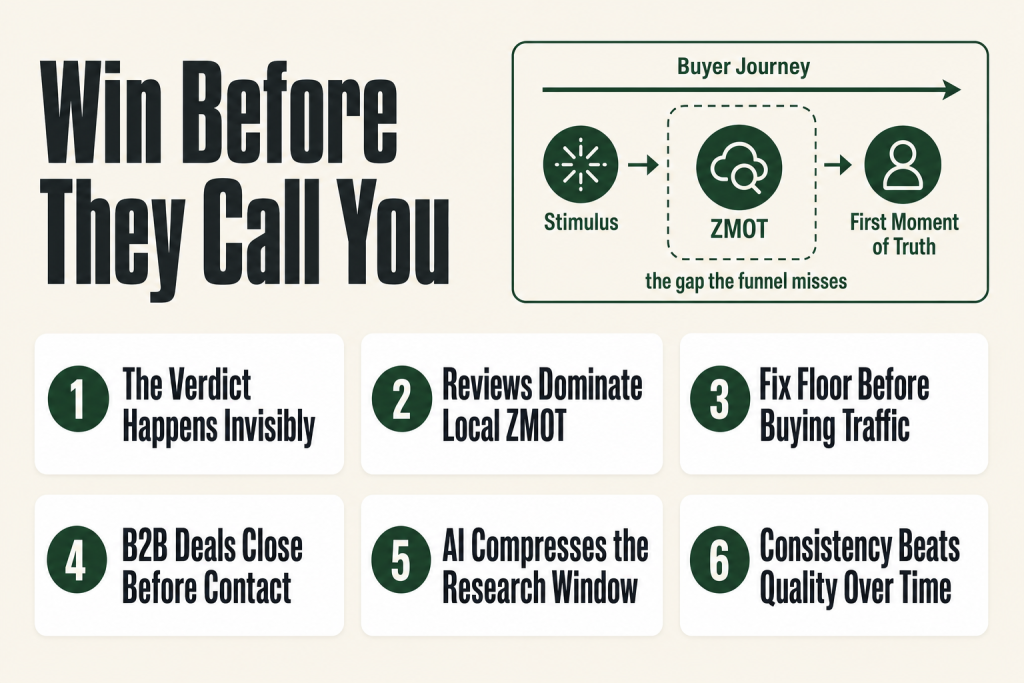
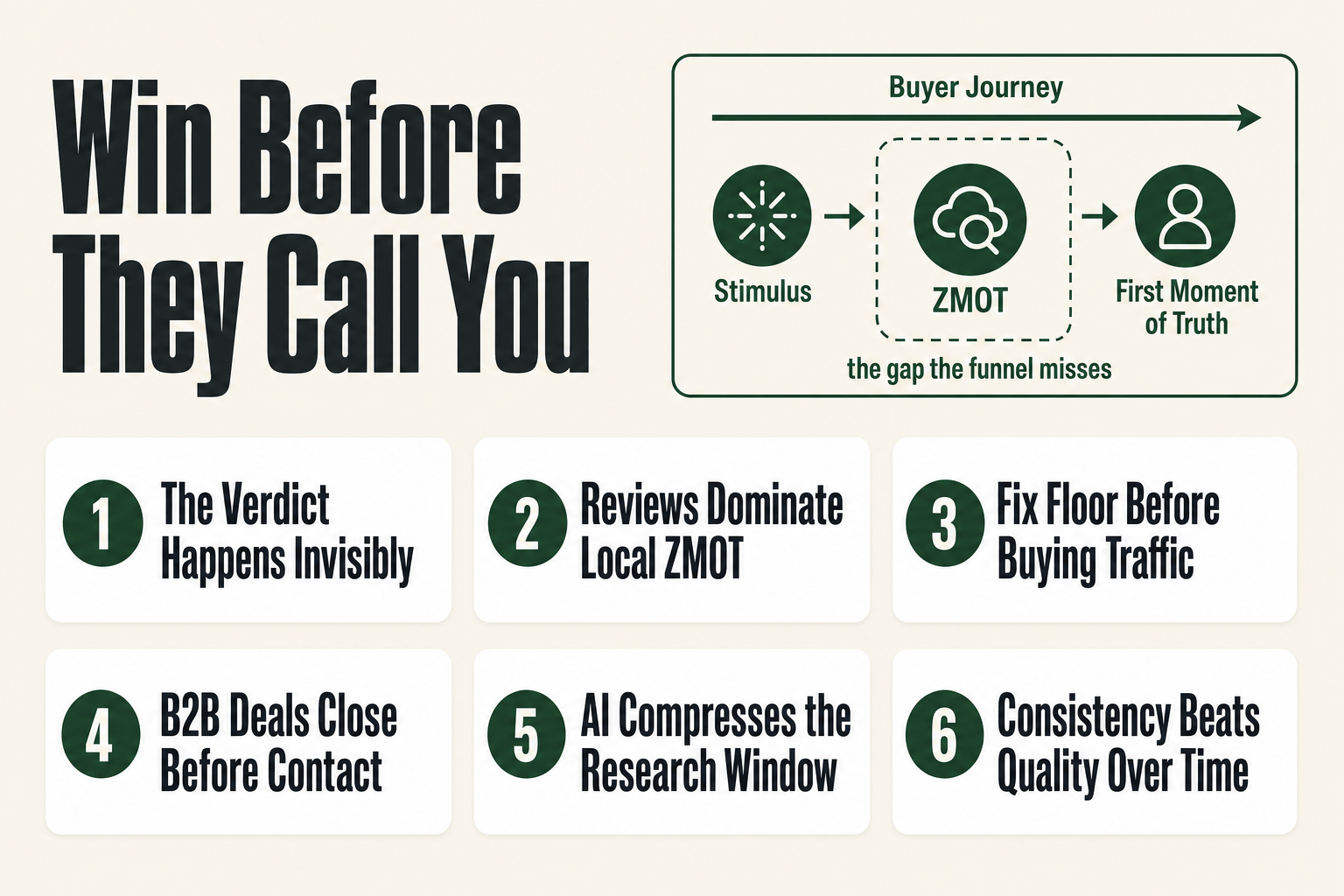
- Coined by Google’s Jim Lecinski in 2011, it sits between the stimulus (an ad, a referral, a need) and the traditional first moment of truth (encountering your brand directly).
- Most buyers consult multiple sources before deciding, your job is to show up favorably across those sources, not just on your own properties.
- For small businesses, the ZMOT battleground is Google reviews, search results, YouTube, and comparison content, the places prospects go when you’re not in the room.
- Winning the ZMOT means running a reviews program, publishing answers to real buyer questions, and staying present on the channels your buyers actually use to research.
- AI search is changing how ZMOT plays out, the implications for operators are real and covered at the end of this page.
What the Zero Moment of Truth Actually Is, And What It Isn’t
The zero moment of truth is not a funnel stage. It’s not a click or a page view or a conversion event you can track in Google Analytics. It’s a window of autonomous research that happens in your prospect’s head before they decide to engage with you. The window may last eight seconds, a quick name search that confirms you’re still in business, or eight weeks of comparison shopping. Both are ZMOT.
What happens inside that window varies by category and purchase size, but typically includes some mix of:
- Search engine queries, both your business name and category-level searches (“best HVAC company in Henderson,” “accounting software for restaurants”)
- Review site checks, Google reviews, Yelp, G2, Houzz, Avvo, industry-specific platforms
- Social proof scanning, Instagram, Facebook, LinkedIn, to see whether you look current and credible
- Video research, YouTube tutorials, demos, or walkthroughs that explain how a solution like yours works
- Comparison content, blog posts, “X vs Y” pages, Reddit threads that stack you against alternatives
- Peer referrals cross-checked online, someone recommended you, and the prospect is verifying that recommendation
The word “truth” in the name matters. The buyer isn’t just gathering information, they’re forming a verdict. Jim Lecinski described this not as casual browsing but as a high-stakes interrogation of the brand. Most of the time, the purchase decision is functionally made before the prospect ever speaks to you. The sales conversation that follows is often just confirmation, not persuasion.
A quick note on where ZMOT fits relative to buying temperature. Buying temperature describes how warm or ready a prospect is, a spectrum you can influence through your marketing sequencing. ZMOT describes the mechanism by which a prospect gets warm or cold before they ever enter your funnel. If you understand buying temperature, you want to know where that temperature gets set. Answer: mostly at the zero moment of truth.
ZMOT also isn’t the same as awareness. A prospect can be completely aware of you, seen your ads, heard your name, received a referral, and still go through a ZMOT that ends badly if what they find when they look you up is thin, outdated, or actively negative. Awareness gets them to look. ZMOT determines what they find.
And a word on origins, briefly: the term was named by Google’s Jim Lecinski in a 2011 ebook. It built on P&G CEO A.G. Lafley’s earlier “moments of truth” framework, the First Moment of Truth (encountering a product on a shelf) and the Second Moment of Truth (using it at home). Lecinski’s core observation was that a new step had inserted itself between the stimulus and that first real encounter: buyers were going online first, arriving with their minds largely made up. Google had a financial incentive to publish this argument, more importance attached to search equals more ad spend, but the underlying behavior is clearly real. Worth keeping the source in mind when someone cites the data as gospel in a conference room.
The Traditional Funnel’s Blind Spot
The classic marketing funnel, Awareness, Interest, Desire, Action, was designed around controlled touchpoints. You run an ad. The ad sends them to a landing page. The landing page makes the case. A button closes the deal. The assumption baked in is that the brand controls the narrative at every step.
ZMOT exposes the flaw: between Awareness and Interest, there’s an entire research episode that happens off your propertyand the funnel model gives you no handle on it. You spend money driving awareness, but if the prospect’s ZMOT experience turns them cold, they never reach your landing page. You’ve paid for a lead that someone else’s three-star review killed before it converted.
For small businesses, this blind spot is particularly expensive. You’re often selling in categories with low switching costs, low brand differentiation, and high buyer anxiety, exactly the conditions that make the ZMOT most decisive. If someone needs a plumber, an accountant, a web designer, or a catering company, the moment they receive a recommendation, they will immediately go verify it online. If they can’t, if your Google profile is sparse, your reviews are old, your website looks like it was built in 2014, the recommendation dies in their browser.
The good news is that the ZMOT is learnable terrain. You can audit it. You can map what a first-time researcher actually finds when they look for you, and you can build content and social proof to shape that experience. The bad news is that most operators have never run this audit. They’ve built a website, maybe run some ads, and assumed the research phase takes care of itself.
It doesn’t.
Winning the Zero Moment of Truth: What Operators Actually Need to Build
Winning your ZMOT comes down to four things: presence, proof, content, and consistency. Not four campaigns, four categories of work that compound over months.
Presence: Show Up Where They’re Actually Looking
Start with an honest ZMOT audit. Pull up an incognito browser, search your business name, and spend ten minutes clicking everything a real prospect would click. What’s your first Google result? Is your Google Business Profile complete, current, and photo-rich? Does your social media look active or abandoned? Are you on the review platforms that matter in your category? Are there any negative results, a Yelp complaint, a forum thread, an old news story, that a prospect would find on page one?
Then do the same for category searches. Search the way your prospect searches when they don’t already know your name: “[your service] [your city],” “best [your type of business] near me,” “[your service] reviews.” Where do you rank? Who’s ranking above you, and why? What does the content they’ve built look like against yours?
This audit is not a one-time exercise. Do it quarterly, the ZMOT landscape shifts. New reviews get posted. Competitors build new content. Your own profiles go stale.
Proof: Reviews Are Not a Nice-to-Have
If there’s one lever that dominates the ZMOT for local and service businesses, it’s Google reviews. BrightLocal’s 2026 Local Consumer Review Survey, 1,002 U.S. adults, found that 97% read reviews before choosing a local business, and 41% now do so every single time they browse for a business, up from 29% the year before. That jump happened in twelve months. A business with 4.8 stars and 200 reviews will almost always beat a competitor with 4.6 stars and 11 reviews, even if the underlying quality is identical. Buyers use review volume as a proxy for risk.
Most operators leave reviews almost entirely to chance, they hope satisfied customers will post without being asked, and ignore negative reviews or respond defensively when they do. Neither behavior serves you at the ZMOT.
Build a review-request process. Identify the right moment to ask, not during the transaction, not weeks after, but at the specific point when a customer is most satisfied: the moment a project completes, the day after a successful service call, the end of a first successful engagement. Make the request easy: a direct link to your Google review page, a two-sentence ask that tells them exactly what to do. Handle negative reviews as public customer service, every future prospect reading that thread sees your response too, not just the original reviewer.
Content: Answer the Questions They’re Already Asking
Buyers in the ZMOT phase are asking specific questions. Not “who is the best HVAC company”, they’re asking “how much does AC replacement cost in Las Vegas,” “how long does a roof repair take,” “what’s the difference between term and whole life insurance.” Every one of those questions is a content opportunity that compounds through search over time.
You don’t need to blog five times a week. You need to identify the ten or fifteen questions your best prospects ask most often before they hire someone like you, the questions that signal genuine purchase intent, and build one piece of quality content that answers each one better than anyone else in your market has. A FAQ page with real answers. A comparison guide that explains your category honestly. A short explainer video that demystifies the process. One 1,200-word piece that explains your pricing factors and sets realistic expectations.
This is where voice of customer research pays off directly. The questions your prospects are asking in the ZMOT are almost word-for-word the questions your past customers asked before they hired you. Mine your intake calls, your email threads, your sales conversations for those phrases, and build content that uses that language, answers those questions, and shows up in the searches that phrase triggers.
Consistency: The ZMOT Is a Moving Target
The ZMOT isn’t a project you finish. Competitors build new content. Platforms shift their algorithms. Your review count from two years ago looks thin against a competitor who started asking last year. Your explainer video from 2021 may now rank below a sharper one your competitor posted six months ago.
The Rule of Seven applies here more broadly than most operators realize. That principle talks about frequency of exposure, but in a ZMOT context, it’s not just about how many times they see your ads. It’s about how many of the sources they consult are saying favorable things about you. If eight of their ten research stops reinforce your credibility, you win. If only one does, your own website, you’re hoping they don’t look too hard at the other nine.
How ZMOT Plays Out Differently by Business Type
Not all ZMOTs are created equal. The length, intensity, and channel mix of the research phase varies a lot by category.
Local Service Businesses (HVAC, Plumbing, Landscaping, Home Services)
The ZMOT here is fast, often under ten minutes, and dominated almost entirely by Google reviews and Google Business Profile. The prospect gets a referral or finds you in a near-me search, clicks your profile, reads four or five reviews, and either calls or moves on. The content bar is low but the proof bar is high. Three-star averages kill you here. The investment is almost entirely in a well-run reviews program and a well-maintained Google Business Profile with current photos.
Professional Services (Legal, Financial, Healthcare, Consulting)
The ZMOT here is longer, days or weeks, and involves considerably more content consumption. Prospects are higher-anxiety, higher-stakes buyers. They read bio pages carefully. They look for articles you’ve written, cases you’ve cited, talks you’ve given. They search your name plus terms like “reviews,” “complaints,” and “disciplinary.” They check LinkedIn. They look for third-party validation, board memberships, media mentions, association affiliations. The investment here is in demonstrating expertise through content and maintaining a clean, thorough professional footprint.
B2B
B2B ZMOTs involve multiple researchers across different roles, the champion who found you, the skeptic who’s going to poke holes, the finance lead who’s going to check whether you’re financially stable. According to 6sense’s 2025 Buyer Experience Report, 95% of the time the winning vendor was already on the buyer’s shortlist on Day One, and buyers now contact sellers around 61% of the way through their journey. That means the deal is largely over before your sales team picks up the phone. You can’t win on reviews alone, or content alone, or LinkedIn presence alone. Case studies, third-party reviews on G2 or Capterra, LinkedIn credibility, comparison pages, and clear ROI documentation all need to be working simultaneously.
There’s also a shift worth tracking: a growing share of B2B ZMOT now happens in what researchers call “dark social”, private Slack channels, LinkedIn DMs, email threads where a procurement team is forwarding your case study around without ever leaving a trackable footprint. You can’t measure this directly. You can influence it by being the vendor whose credibility shows up consistently across every public channel, so that when someone does share your name internally, the research that follows confirms rather than undermines.
E-commerce and Consumer Products
Here the ZMOT is often fragmented and platform-specific, a TikTok review, a YouTube unboxing, a comparison blog post, an Amazon review section. You don’t own most of these channels, but you can influence them through sampling and seeding programs, affiliate partnerships with honest reviewers, and by making it easy for buyers to post their experience. For many categories, the average rating on a product detail page is the single highest-leverage ZMOT variable in your control.
Putting this to work? The ideas in the Canon are the foundation under the tactical playbook in Build a Complete Marketing Department — grab the free companion kit at mmsvegas.com/resources.
What Smart ZMOT Strategy Looks Like in Practice
Abstract frameworks are fine. Seeing what the work actually looks like is better.
A regional solar installation company mapped the questions their prospects searched before requesting a quote, questions like “how long do solar panels last,” “solar vs. battery backup,” and “solar installation timeline”, and built state-specific landing pages, ROI calculators using local utility rates, and comparison guides for each question cluster. They optimized their Google Business Profiles for each branch location, launched a review-request program timed to post-inspection completion, and ran explainer videos on YouTube targeting high-intent queries. Within four months, their average search ranking for target queries moved from the third page to the top five, and their presence in the Google local map pack reached 72% of their target zip codes. That’s the compounding effect of ZMOT infrastructure built deliberately, not by accident.
On the B2B side, think about how any serious software evaluation happens. A procurement manager hears about a tool, from a peer, a conference, a newsletter. Before scheduling a demo, they search the product name, read three pages of G2 reviews, find a “[Product] vs. [Competitor]” post, and watch a five-minute YouTube demo. The vendors who built that content infrastructure win the demo request. The vendors who didn’t may never understand why their inbound pipeline is thin, they’re getting beaten at the ZMOT before they ever get a chance to sell.
Local service businesses with strong ZMOT infrastructure share a common pattern: they treat Google reviews as a pipeline metric, not a PR afterthought. Operators in the HVAC and plumbing space who average 4.8+ stars with 300+ reviews have typically built review requests into their job-completion workflow, not left it to technician discretion. The volume creates a flywheel: more reviews mean higher placement in local search, which means more leads, which means more opportunities to collect reviews.
Where the Zero Moment of Truth Matters Less
ZMOT is not a universal framework. It’s most powerful for considered purchases, where the buyer has time to research, the stakes feel meaningful, and multiple options exist. There are legitimate categories where it barely applies.
True impulse purchases: Gum, a bottle of water at the airport, a last-minute magazine. The research window effectively doesn’t exist. ZMOT strategy is wasted effort here; your money goes to point-of-display instead.
Captive or monopoly situations: If you’re the only plumber in a rural county, or the only approved vendor for a specific compliance requirement, the ZMOT matters much less. Buyers still go through the motions, but there’s no real competition to lose to.
Pure relationship businesses: Situations where the buyer’s decision is 95% driven by a personal relationship, a longtime accountant, a family attorney, a vendor who’s been doing business with you for fifteen years, the ZMOT is confirmatory at best. They’re not researching alternatives. They’re checking that nothing has obviously gone wrong with your reputation. Trying to win here by building content is mostly wasted energy.
Extremely low-stakes, high-frequency transactions: Weekly grocery items, routine supplies, commodity repurchases. The research phase exists at the beginning, when a buyer is new to a category, but once they’ve settled on a preference, the ZMOT largely switches off. Your energy is better spent on the post-purchase experience that builds that preference.
Even in categories where ZMOT applies, there’s a ceiling to its influence. If your product or service genuinely underperforms, no amount of ZMOT optimization fixes the problem, it just brings you more customers you eventually disappoint. ZMOT is an amplifier. It amplifies a good offer and a solid reputation. It also accelerates the damage when the underlying experience doesn’t hold up.
Where Operators Actually Go Wrong With ZMOT
These aren’t abstract conceptual errors. They’re implementation failures, the specific places where operators misread what ZMOT requires and build the wrong things as a result.
Treating it as a one-time build. The operators who get the most out of ZMOT strategy run it as a standing operation, not a project. Reviews are collected weekly. Profiles are updated when anything changes. Content is audited when a competitor publishes something new. The operators who stall built something solid in year one and then let it sit, and two years later, a competitor who started later now outranks them simply by showing up consistently. Consistency beats quality over time at the ZMOT.
Buying traffic before the floor is solid. This one costs real money. A Google Ads campaign sending traffic to a profile with a 3.9-star average and twelve reviews from 2022 converts at a fraction of what it should. The ZMOT experience kills the lead before the landing page gets a chance. Fix the review profile and the Google Business Profile first. Then buy traffic. The sequencing matters enormously, and most operators get it exactly backwards because ads feel like doing something, while fixing a review profile feels like maintenance.
Conflating ZMOT with SEO. SEO is one lever, not the whole toolkit. A prospect researching you might never touch a search engine, they might go directly to your Yelp page, ask in a Facebook group, watch a YouTube comparison video, or check your LinkedIn. Operators who treat ZMOT as a synonym for organic rankings end up with strong Google positions and terrible Yelp profiles. Which is still a losing ZMOT.
Building content based on what you find interesting rather than what buyers are actually searching. Company origin stories, thought leadership on industry trends, general category education, almost none of this is what a buyer at the research stage types into a search bar. The content gap to close is transactional-intent queries: “[your service] cost [your city],” “how long does [your process] take,” “[your category] vs [alternative].” Use Google’s autocomplete and People Also Ask to confirm real search volume before writing anything. If nobody’s searching the phrase, it doesn’t matter how good the piece is.
Thinking a single strong channel is enough. A general contractor who builds 200 Google reviews but has a 2.9-star profile on Houzz, which ranks on the first page for contractor searches in many cities, is losing leads from a platform they never check. After your ZMOT audit, map every third-party platform that appears in the first page of results for your category and city. Each one needs to be claimed, current, and reviewed. The weakest result on page one sets the ceiling for your overall ZMOT. One bad profile undoes a lot of good work elsewhere.
The Zero Moment of Truth in 2026: What AI Changes
There’s a real shift happening in how the ZMOT plays out, and it’s worth being direct about what it means rather than vague about it.
The classic ZMOT was a human-led research process. The buyer typed queries, opened multiple tabs, and synthesized ten sources into a personal verdict. Your job was to show up favorably across enough of those tabs. The more sources that said good things about you, the better your odds.
AI-powered search is changing that dynamic in two ways simultaneously. First, the research is increasingly being done by the AI rather than just assisted by it. A Pew Research Center study covering 68,879 Google searches from 900 U.S. adults found that when an AI Overview appeared, users clicked a traditional search result in only 8% of visits, versus 15% when no AI Overview appeared. Even the sources cited inside the AI summary were clicked just 1% of the time. The research window isn’t spreading across ten tabs anymore; it’s concentrating in whatever the AI decided to surface.
Second, AI has become a discovery channel in its own right. BrightLocal’s 2026 Local Consumer Review Survey found that 45% of consumers now use AI tools like ChatGPT for local business recommendations, up from just 6% the year before. Google’s share of local-business discovery dropped from 83% to 71% over the same period. A meaningful share of your potential customers are typing “who’s the best HVAC company in Phoenix” into ChatGPT and getting back an answer that looks nothing like a Google results page. If you’re not in that answer, you’re invisible to those buyers, and they’ll never know they missed you.
What this means practically: the inputs to the AI’s selection, your reviews, your content quality, your E-E-A-T signals (Google’s framework of Experience, Expertise, Authoritativeness, and Trustworthiness), your presence on authoritative third-party sites, matter even morenot less. AI systems don’t invent credibility; they synthesize it from the signals that already exist across the web. If your ZMOT infrastructure is thin, an AI assistant won’t surface you. If it’s strong, you have a shot at being the short answer instead of one option among ten.
The implication for operators: everything that made ZMOT strategy worth doing before is still worth doing, and it’s now more defensible as a moat. Businesses with strong review profiles, quality content, and consistent third-party presence are the ones AI systems surface with confidence. Businesses without that foundation disappear from the consideration set without the buyer, or the business, ever knowing why.
Common Mistakes
- Treating ZMOT as a one-time build rather than a standing operation — The operators who fall behind on ZMOT almost always made one solid push, got the reviews up, updated the profiles, wrote a few pieces, and then treated it as done. Two years later, a competitor who started later now outranks them purely through consistent upkeep. Set a quarterly calendar reminder to run the incognito audit. Respond to every new review within 48 hours. Add one new content piece per month answering a question your intake team hears regularly. The compounding is in the consistency, not in the initial sprint.
- Buying traffic before the review floor is solid — Paid traffic sent to a 3.9-star profile with twelve reviews from 2022 converts at a fraction of what it should. The problem isn’t the ad, it’s the ZMOT experience that kills the lead before the landing page gets a chance. The sequencing matters: reviews and Google Business Profile first, then content, then paid amplification. Ads accelerate whatever the research phase already communicates. If that communication is weak, you’re accelerating a rejection.
- Running the review-request workflow manually instead of building it into the job-completion process — When review collection depends on a technician remembering to ask, or a manager sending a follow-up email by hand, it happens inconsistently, which means your review velocity is tied to whoever is least busy that week. The fix is a single automated trigger in your CRM or field service software: job marked complete → SMS or email with a direct Google review link fires within two hours. Set it up once. It runs every time without anyone making a judgment call.
- Responding to negative reviews defensively or not at all, then moving on — A negative review with no response, or a defensive one, does double damage: it signals to every future reader that the problem wasn’t addressed. Build a response template for one-star reviews that acknowledges the experience, explains what you’ll do differently, and invites an offline conversation. Keep it under five sentences. Never argue, never offer a discount publicly, and never paste the same generic apology across multiple reviews. Future prospects read the pattern, not just the individual reply.
- Concentrating ZMOT investment on one platform while ignoring the others that appear on page one — A general contractor who builds 200 Google reviews but has a 2.9-star profile on Houzz, which ranks on the first page for contractor searches in many cities, is losing leads from a platform they never check. After your ZMOT audit, map every third-party platform appearing in the first page of results for your category and city. Make sure each profile is claimed, current, and has at least a handful of recent reviews. The weakest result on page one sets the ceiling for your overall ZMOT.
Operator’s Take
Here’s where I’ll stop describing the framework and tell you what I actually think, the calls that matter in practice, where the framework itself won’t help you.
Your ZMOT audit tells you something more useful than gaps: it tells you your competitor’s ceiling. When you search your category and city in incognito and pull up the top three local pack results, you’re reading the upper bound of what a buyer in your market currently expects to find. If the top-ranked competitor has 140 reviews and a mediocre profile description, that’s not a high bar. You don’t need to build the world’s best ZMOT presence, you need to be noticeably better than whoever’s sitting above you on three specific dimensions. That reframe changes the project from “build a complete marketing machine” to “beat this specific profile right here.” Much more manageable. And it tells you exactly where to spend the next 90 days.
Sequence matters more than most operators realize, and most get it exactly backwards. They write content before they’ve fixed their review count. They post on Instagram before they’ve answered the unanswered Q&A questions sitting on their Google Business Profile. They hire someone to run ads before they’ve checked whether those ads are sending people to a 3.9-star average with fourteen reviews from 2022. Fix the floor before you buy traffic to walk across it. Reviews and Google Business Profile first. Content second. Paid amplification third, and only once the research phase is strong enough to convert the curiosity you’re buying. Ads accelerate whatever the ZMOT experience already is. If that experience is weak, you’re accelerating disappointment.
The fastest visible return available to most operators right now costs nothing: respond to every unanswered review you currently have, positive and negative, in the next 48 hours. BrightLocal’s 2026 research found that 97% of people who read reviews also read business responses. Every cold review sitting unanswered is a missed conversation with every future prospect who reads that thread. It takes an hour. Your competitors almost certainly haven’t done it either.
On the AI question specifically: the operators I’d worry about most are those who built their ZMOT entirely around one channel, usually Google search rankings, and are watching traffic quietly decline without understanding the mechanism. The answer isn’t to abandon SEO. It’s to build a wider footprint: third-party review profiles on platforms your category uses, mentions on industry association sites, podcast appearances, guest pieces in trade publications. Those are precisely the corroborating signals that AI systems draw on when deciding whether to recommend a brand. One strong website is not enough. What the AI is looking for is consistency of signal across sources it trusts independently of you.
Where AI tools are actually useful in this context: not for writing your content. That’s how you end up with the same generic FAQ page as your three nearest competitors. Use AI to map the question landscape instead, feed your service type and geography into a model and ask for the questions buyers search before hiring someone like you. Use that list as your content backlog. The judgment about which questions genuinely match your buyers, and what the honest answer looks like, still belongs to you. That’s the part that differentiates the content. It’s also the part that can’t be outsourced to a model.
One thing the framework undersells: ZMOT investment pays back in sales velocity, not just lead volume. A prospect who goes through your research phase and comes out impressed arrives at the first real conversation already half-sold, fewer basic questions, less price resistance, faster close. The best operators I’ve worked with don’t think of ZMOT work as lead generation. They think of it as shortening the sales cycle, and they can see it in their numbers within a quarter of getting the foundation right.
Used in
- ✓ Build a Complete Marketing Department
Used to structure the pre-contact layer of your marketing system, specifically, the review program, content infrastructure, and third-party presence that shape what prospects find before they ever reach your funnel. - ✓ The Missing Manual for FunnelKit
Informs how landing pages and optin flows are positioned to convert traffic arriving from ZMOT research channels, people who already know what they’re looking for and need confirmation, not education. - ✓ The Missing Manual for Make
Used to automate the review-request workflow, triggering personalized review asks at the right moment in the customer lifecycle so proof-building runs without manual follow-up.
FAQ
What is the zero moment of truth in simple terms?
It’s the research phase a buyer goes through, searches, review checks, video watching, comparison reading, before they ever contact a business. The decision to reach out (or not) is largely made during this window.
How is ZMOT different from the First Moment of Truth?
The First Moment of Truth (coined by P&G’s A.G. Lafley in 2005) is when a buyer encounters your product or brand directly, on a shelf, on your website, in a sales conversation. ZMOT happens before that, during the independent research phase the buyer conducts on their own terms.
Does ZMOT apply to B2B as well as B2C?
Yes, and the stakes are arguably higher. B2B buyers conduct longer, more thorough research before making contact, often involving multiple stakeholders. According to 6sense’s 2025 Buyer Experience Report, 95% of the time the winning vendor was already on the buyer’s Day One shortlist, and buyers now contact sellers around 61% of the way through their journey. By the time your sales team hears from them, most of the ZMOT work is done, for better or worse.
What’s the single most important thing a small business can do to improve its ZMOT?
For most local or service businesses, building a consistent Google review program is the highest-leverage ZMOT investment, it’s the first thing buyers see and the most powerful trust signal at this stage. Start there before investing in content or other channels.
How does AI search change the zero moment of truth?
In two concrete ways. First, AI Overviews are compressing the research window: Pew Research Center’s study of 68,879 Google searches found users clicked a traditional result only 8% of the time when an AI Overview appeared, versus 15% without one. Second, AI tools have become a discovery channel themselves, BrightLocal’s 2026 survey found 45% of consumers now use AI tools for local business recommendations, up from 6% the prior year. Both shifts reward operators who have built broad, consistent ZMOT infrastructure across multiple platforms, those are the signals AI systems draw on when deciding who to surface.
How do I audit my own zero moment of truth?
Open an incognito browser and search your business name, your competitors’ names, and category searches the way a prospect would. Click everything. Note what your profile looks like, how your reviews read, whether your content appears, and what a neutral observer would conclude. Do the same for the platforms specific to your category, Yelp, G2, Houzz, Avvo, or others. Then do it again in three months, because the landscape shifts.
Further reading
- Winning the Zero Moment of TruthJim Lecinski (Google, 2011). The original free ebook that named the concept; short, data-driven, and still worth the hour for the research context alone.
- This Is MarketingSeth Godin. Godin’s work on permission and trust-building connects directly to what you’re trying to achieve during the ZMOT research phase, being the brand that earns the next step.
- InfluenceRobert Cialdini. The social proof chapter is the most directly applicable to ZMOT mechanics: understanding why reviews, testimonials, and third-party credibility function as decision shortcuts during independent research.
Sources: Jim Lecinski, Winning the Zero Moment of Truth, Google/Think with Google, 2011. Google/Shopper Sciences ZMOT Macro Study, April 2011 (5,000 respondents, 12 categories). BrightLocal Local Consumer Review Survey 2026 (1,002 U.S. adults via SurveyMonkey, published February 11, 2026). Pew Research Center, “Google users are less likely to click on links when an AI summary appears in the results,” July 22, 2025 (data from March 2025, n=900 U.S. adults, 68,879 searches). 6sense 2025 Buyer Experience Report. Whitespark Local Search Ranking Factors Survey, 2026. Dreamdata B2B Benchmarks Report, 2026. Gartner B2B Buying Research, 2024.
Brian Kasday spent forty years in direct-response marketing before rebuilding the whole operation as a one-person shop. He writes The Operator’s Library — including “Build a Complete Marketing Department” — for operators who’d rather build it themselves than wait on someone else.
Build the department these ideas describe — the free companion kit: mmsvegas.com/resources.
More The Operator's Canon guides
Free · Operator Toolkit
Want the tools, not just the guide?
Get the free operator toolkit — templates and checklists for the systems you actually run, plus a note when this guide changes.
Get the free toolkit →