
Last updated: July 2026
Cialdini’s principles of persuasion are the most research-backed framework for understanding why people say yes. By the end of this page you’ll be able to identify which ones you’re already using, which you’re leaving on the table, and exactly where the line between persuasion and manipulation falls, so you never accidentally cross it.
Here’s what’s strange about this framework: almost every operator who’s been in business more than a few years is already using some version of these principles. They just don’t have names for what they’re doing. The contractor who sends a job estimate with three client testimonials on the cover sheet is using social proof. The spa that hands new clients a complimentary product sample at checkout is running reciprocity. The boutique fitness studio that posts “only 4 spots left this month” on its scheduling page, well, that one depends entirely on whether it’s true.
Naming the principles matters because it moves your use of them from instinct to intention. You stop accidentally leaving authority on the floor. You stop running fake scarcity because that’s what you saw some internet marketer do. You start building a coherent persuasion architecture across every touchpoint, one that works with your customers’ psychology instead of fighting it, and one that holds up when a prospect looks you up before they call.
The idea in 30 seconds
- Robert Cialdini identified seven psychological principles, reciprocity, commitment/consistency, social proof, authority, liking, scarcity, and unity, that reliably move people toward yes.
- The principles work because they tap into mental shortcuts humans use to make decisions quickly in a complex world.
- Every principle can be used ethically (helping people make decisions that serve them) or manipulatively (exploiting psychology for one-sided gain). The operator’s job is to stay on the right side of that line.
- Fake scarcity, bought reviews, and fabricated social proof aren’t just ethically wrong, the FTC, the UK’s CMA, and EU regulators have all moved hard against them, and the enforcement wave isn’t slowing down.
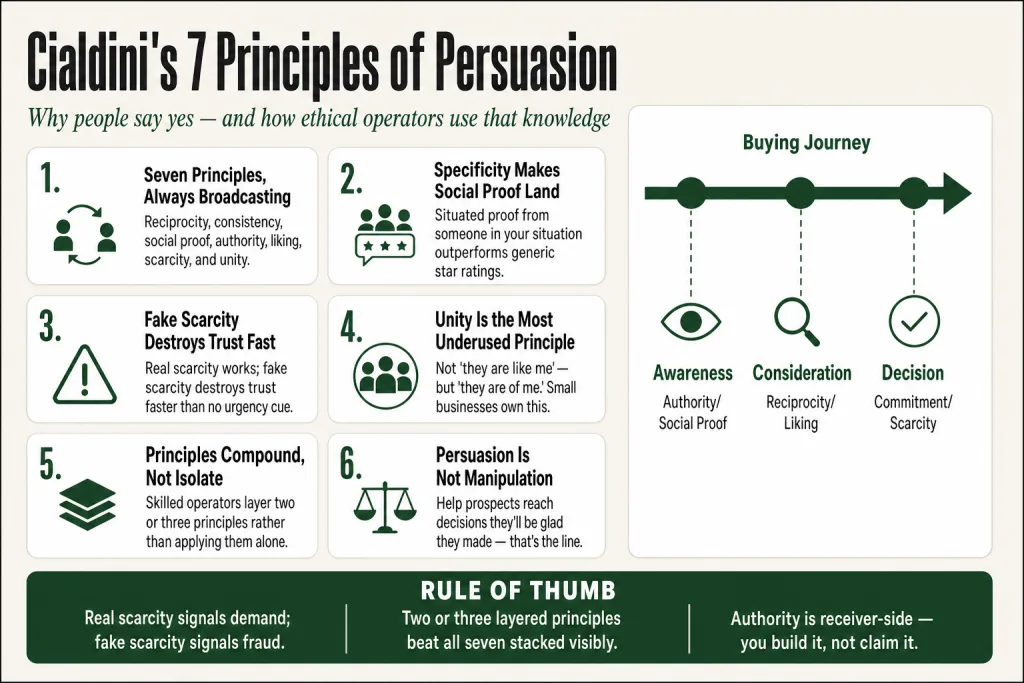
- The principles compound: skilled operators layer two or three at a time rather than applying them in isolation.
- Unity, the seventh principle, added in Pre-Suasion (2016), is the most underused by small businesses and the one with the longest-lasting effect on loyalty.
Where the Principles of Persuasion Came From
Robert Cialdini spent years embedded among what he called the world of “compliance professionals”, salespeople, fundraisers, recruiters, advertisers, observing in the field rather than theorizing from a lab. He is Regents’ Professor Emeritus of Psychology and Marketing at Arizona State University. Influence: The Psychology of Persuasionpublished in 1984, went on to sell more than seven million copies in 44 languages.
The core claim: humans rely on mental shortcuts when deciding whether to say yes, because we’re busy and the world is complicated. These shortcuts evolved because they’re usually correct. Cialdini’s contribution was identifying and naming them, and drawing the line between using them to help someone reach a good decision and using them to exploit the same shortcut for one-sided gain.
In Pre-Suasion (2016) he introduced a seventh principle, unity, writing that it had been hiding beneath the surface of his data all along. Which says something about how easy it is to miss the most powerful thing in your own research.
One honest caveat: the replication crisis in social psychology has touched some of the smaller supporting studies in older editions of Influence. The broad directional claims, reciprocity, social proof, authority, and scarcity reliably move people toward yes, have held up across decades of commercial application. The specific effect sizes from 1984 are where you’d be right to apply more skepticism.
The Seven Principles of Persuasion, Defined for Operators
These aren’t seven independent levers you pull one at a time. Think of them as seven frequencies that are always broadcasting. Your marketing is already tuned to some of them, the question is whether you’re doing it consciously, and whether the signal is clean.
1. Reciprocity
People feel a strong psychological pull to return favors and repay debts. When you give something first, without strings attached, you create an obligation the recipient will almost always want to settle. This isn’t cynical; it’s one of the social mechanisms that makes human cooperation possible. For a small business, it means a useful piece of content, a free consultation, a sample, or a handwritten thank-you note does real work. The critical word is “without strings.” Reciprocity built on a gift the other person didn’t want tends to backfire, it reads as obligation-manufacturing, and people know the difference.
2. Commitment and Consistency
Once someone has taken a public position or made a small commitment, they want their subsequent behavior consistent with it. That’s why a low-friction first step, a free trial, an email opt-in, a micro-purchase, is so valuable. It’s not the revenue from the first transaction that matters; it’s that the customer now thinks of themselves as the kind of person who does business with you. The commitment needs to be real, not manufactured. A pre-checked box that signs someone up for a newsletter isn’t commitment, it’s friction removal, and the resulting “subscriber” has zero psychological investment in the relationship.
3. Social Proof
When people are uncertain, they look at what other people are doing. The more uncertain the decision, the more powerful social proof becomes. Reviews, testimonials, case studies, client counts, press mentions, before/after results, all of it. Specificity matters enormously here. “Customers love us” is near-worthless. “312 families in Henderson have replaced their HVAC with us in the past three years” is credible and vivid. Social proof is also contextual: a prospect in a specific situation is far more persuaded by proof from someone in the same situation than by aggregate star ratings.
4. Authority
People defer to expertise, not because they’re gullible, but because they don’t have time to evaluate every claim from scratch. Credentials, certifications, press coverage, published content, industry affiliations, speaking engagements: all authority signals. For a small business, the most underused lever is just being visibly expert, writing useful content on your specific topic, getting quoted by local media, displaying your actual training prominently. You don’t need to be nationally famous. You need to be the most credibly expert person the prospect has encountered on this problem.
5. Liking
People say yes to people they like. Liking follows from similarity, familiarity, and warmth, not from being charming in a salesperson way. It’s about letting your actual personality, values, and point of view show through your marketing so the people who’d like you in person find reasons to like you before they ever call. For local businesses, community involvement, consistent personal communication, and showing the humans behind the operation all work. Liking is also why cold outreach from someone who’s done zero research on the recipient fails, it reads as forced familiarity with nothing underneath.
6. Scarcity
People place more value on things that are or seem harder to get. Limited availability, whether of time, quantity, or access, increases perceived value and purchase urgency. This is one of the most powerful principles and, by a wide margin, the most abused one. Real scarcity works. Fake scarcity destroys trust faster than no urgency cue at all. A 2022 meta-analysis by Barton, Zlatevska, and Oppewal published in the Journal of Retailing analyzed 416 effect sizes across 131 studies and found that scarcity cues consistently lift purchase intention, but that the effect varies significantly by scarcity type and product category. The practical test stays simple: if a customer paused and verified your scarcity claim, would they find it accurate? If not, pull it.
7. Unity
Introduced in Pre-Suasionunity goes deeper than surface similarity. Cialdini’s distinction: it’s not “they are like me”, it’s “they are of me.” Shared identity. Family, community, shared mission, shared struggle. This is why a fitness brand built around a specific lifestyle attracts fiercely loyal members while a generic gym competes purely on price. When a customer feels your business belongs to the same world they belong to, the relationship becomes something closer to an alliance than a transaction. For small businesses, this is the most durable competitive advantage available, and the one big platforms genuinely can’t replicate by throwing money at it.
How Modern Businesses Apply the Principles of Persuasion
The most instructive large-scale example is Booking.com, not as a model to copy, but as a stress test that shows where even sophisticated operators drift when there’s no ethical discipline on the persuasion stack.
Their platform runs what amounts to a real-time Cialdini laboratory at millions of impressions per day: social proof (“87 people looked at this hotel today”), scarcity (“Only 2 rooms left!”), authority (property ratings, verified review counts), and commitment (the account login that ties your stated preferences to future searches). For years this worked commercially. It also pushed some of those signals past the ethical threshold. The UK’s Competition and Markets Authority took enforcement action against Booking.com and five other booking platforms in 2019 over pressure selling and false scarcity claims. Then, in June 2025, the Dutch Consumers’ Association (Consumentenbond) and the Consumer Competition Claims Foundation formally announced a collective action against Booking.com, alleging fake discounts, fabricated scarcity, and anticompetitive pricing practices going back to January 2013. After out-of-court talks failed, the case was formally brought before a Dutch court on November 13, 2025. It is pending.
Amazon layers the principles differently. Its customer review system is the most powerful social proof engine ever built at retail scale. “Frequently bought together” borrows social proof and consistency simultaneously. Prime’s free trial is a commitment device, once you’ve saved on shipping twice, you think of yourself as a Prime member. But the enrollment and cancellation flows crossed from persuasion into dark-pattern territory: the FTC filed suit in 2023, and three days into trial, Amazon settled for $2.5 billion in September 2025, $1 billion in civil penalties and $1.5 billion in consumer redress. The “Only 3 left in stock” label exists in legitimate form, when it’s true, and in dark-pattern form. Regulators have now made that distinction legal, not just philosophical.
For small businesses, the applications are less dramatic but just as real. A local accounting firm that publishes a plain-language guide to small-business taxes every January is running reciprocity and authority in parallel, the guide is useful, it demonstrates expertise, and it creates goodwill before any conversation about fees. A landscaping company that sends new-inquiry emails with three case studies from neighborhoods near the prospect’s home is running social proof with exactly the right contextual specificity. A membership fitness studio that closes its waitlist at a real capacity limit, and tells you exactly what that limit is, runs honest scarcity that also signals demand. None of these require ad budgets or expensive platforms. They require clear thinking about what each touchpoint is actually doing.
Sephora’s Beauty Insider program is a clean example of loyalty built on reciprocity at scale, members receive birthday gift sets and bonus points, establishing a give-first posture that builds goodwill without feeling transactional. It works because the gifts are real and the recognition feels personal. That’s the mechanism: the recipient feels seen, not marketed to.
The principles compound. A fundraising email might tell a story about someone the reader finds relatable (liking), include a running donor tally (social proof), mention a matching grant expiring at midnight (scarcity), and close with a sign-off from a recognized expert (authority). Skilled operators rarely use one principle in isolation, the scarcity claim rides on an authority signal; the authority is built through social proof; the whole stack is primed by prior reciprocation.
Putting this to work? The ideas in the Canon are the foundation under the tactical playbook in Build a Complete Marketing Departmentgrab the free companion kit at mmsvegas.com/resources.
Where the Principles of Persuasion Still Apply (Everywhere, Honestly)
These principles are not trends. They’re not platform-dependent. They’re not going to be disrupted by the next algorithm update. They describe how human psychology works, and that hasn’t changed materially in forty years of commercial application. Technology changes the medium. The mental shortcuts stay fixed.
Social proof has moved from word-of-mouth to Google reviews to TikTok comments to AI-generated summaries of your review corpus, but the underlying mechanism is identical. Authority has moved from framed diplomas on an office wall to LinkedIn credentials to YouTube subscriber counts. Scarcity has moved from “the last one on the shelf” to countdown timers in email footers. Same effects, same trust destruction when faked.
For local and service-based small businesses, these principles may actually be more available than they are to large brands. You can build genuine unity, the deep shared-identity principle, in a way a national brand simply can’t. You’re from here. You know the neighborhoods. You went to the same high school as half your clients. That’s not marketing copy; it’s actual shared identity, which is the raw material unity is built from. A plumber who’s worked the same zip code for twenty years has a unity advantage over a franchise that arrived three years ago with a national ad budget. The franchise can buy media. It can’t buy that.
Email marketing is still one of the highest-ROI channels for applying the principles because you control the sequence. A well-built onboarding series walks new subscribers through reciprocity (delivering immediate value), commitment (getting a micro-yes early), social proof (showing who else is in this community), and authority (demonstrating depth of expertise), all before you ask for anything significant. That architecture doesn’t require expensive software. It requires clear thinking about what you’re actually doing at each step.
Where the Principles Have Real Limits
The principles are persuasion accelerants, not a substitute for a decent offer. Scarcity can’t make a mediocre product worth buying. Authority can’t paper over a legitimately bad customer experience. Social proof built on five reviews left by the owner’s family will be sniffed out by any prospect paying attention. The principles amplify what’s already there, they don’t manufacture it from nothing.
They also have limits by industry and audience. High-stakes, high-deliberation decisions, commercial real estate, specialized professional services, complex B2B procurement, involve buying committees, lengthy evaluation periods, and buyers who are specifically trained to notice influence attempts. The principles still operate in these environments, but they work more slowly, at the trust-building layer rather than the conversion layer. You’re not closing a seven-figure contract because you ran a clever reciprocity play in an email. You’re closing it because you built genuine authority and accumulated real social proof over 18 months of visibility.
There’s also a fatigue effect when every business in a category uses the same playbook. When every course creator has a countdown timer, the countdown timer stops working. When every consultant lists “As seen in Forbes” regardless of what the Forbes mention actually said, the badge loses its signal. The operator who says “27 of our 30 clients last year renewed without being asked” is running more effective social proof than the one who plasters generic five-star badges across a homepage.
And unity can’t be manufactured. It’s the one principle that falls apart entirely when it’s performed rather than real. A brand that wraps itself in community language while treating customers as interchangeable transactions will be found out, usually publicly, and usually in a review thread.
Common Misunderstandings About the Principles of Persuasion
“Persuasion is manipulation.” This keeps otherwise ethical operators from using the framework at all. Persuasion is influencing beliefs or behavior through communication rather than coercion. Every advertisement, every sales conversation, every well-written proposal is persuasion. The question isn’t whether to persuade, it’s whether you’re helping someone reach a decision they’ll be glad they made. Manipulation exploits psychological vulnerabilities to serve the persuader’s interests at the other person’s expense. Not the same thing.
“More principles applied simultaneously means more conversions.” Not really. Stacking all seven principles on the same landing page in visible, overt ways tends to read as pressure rather than persuasion. Sophisticated buyers will name what you’re doing and resist it. Two or three principles, applied naturally and specifically to the right stage of the buying journey, outperform a checklist every time. The principles should feel like honest communication, not a compliance-engineering exercise.
“Social proof means more reviews.” Quantity matters less than specificity and credibility. A local HVAC company with 47 detailed, varied, name-attributed Google reviews from recognizable neighborhood addresses will outperform one with 312 generic five-star ratings with no text. Specificity tells the prospect: someone in my situation, with my problem, got a good result. That’s the job the review is doing.
“Scarcity means adding a countdown timer.” A countdown timer is a delivery mechanism for a scarcity claim. The claim has to be true. The FTC’s 2022 dark-patterns report specifically named countdown timers on non-time-limited offers as a deceptive design element. A countdown that resets on page reload isn’t a persuasion tool, it’s a dark pattern, and increasingly illegal in multiple jurisdictions. Many operators who’ve been burned by this weren’t cynical; they copied a tactic from a course without thinking through what happens when a customer notices it’s fake.
“Authority means credentialing yourself.” Authority is a receiver-side perception, you don’t grant it to yourself. You build it through visible evidence that others find credible: publications, certifications, documented years of work, client outcomes, press coverage. An operator who writes “industry expert” in their own bio is claiming authority. An operator quoted by three industry publications with 200 verified client outcomes has authority. Anyone who looks can see the difference.
Common Mistakes
- Running evergreen countdown timersIf the deadline isn’t real, remove the timer, full stop. For genuine deadlines (a closing enrollment, a sale with a hard end date), tie the timer to that specific date programmatically so it can’t loop. Before you publish any scarcity claim, run this test: could you explain the expiration logic to a customer and have it check out? If not, you’re in dark-pattern territory. The FTC’s 2022 dark-patterns report named non-expiring countdown timers as a deceptive practice by name.
- Wishing for testimonials instead of building a collection systemBuild a one-question post-project email into your workflow, “What would you tell a friend deciding whether to hire us?”, and send it automatically within 48 hours of project close. Tag each response by service type and client situation. When you write a proposal, pull the two testimonials that most closely match that prospect’s context. The system takes about an hour to set up. Without it, you’ll always be thin on proof at the exact moments you need it most.
- Replacing third-party authority signals with self-declared onesAudit your website copy and bio for every phrase you control entirely, “industry expert,” “leading provider,” “top specialist.” Replace each one with a third-party-verifiable signal: a certification number with a link to verify it, a press mention with the actual URL, a named client outcome with a specific, checkable result. If you can’t link to it or point someone to it independently, it isn’t doing authority work.
- Framing reciprocity gifts as funnel entry pointsYour free resource should deliver complete, standalone value, the reader can use it fully without ever buying from you or even hearing from you again. The follow-up sequence is separate and opt-in. A quick test: remove every CTA from your lead magnet. If what remains is still genuinely useful, you’ve run reciprocity correctly. If what remains is an incomplete teaser, you’ve run a funnel disguised as a gift, and experienced prospects will clock it immediately.
- Manufacturing commitment through pre-checked opt-insPre-checked boxes and auto-enrollment after a download don’t create psychological investment, they create a list of people who didn’t notice they joined. Replace forced opt-ins with an active micro-question at sign-up: something like “What’s your biggest challenge right now with [your topic]?” that requires the person to type a real answer. That answer creates genuine investment because they just told you something about themselves. It also gives you information you can actually use.
Operator’s Take
Most operators I work with are leaving authority completely on the floor, and I find that genuinely baffling, because it’s the one principle where small businesses have a structural advantage over big brands. A national chain can’t be your local expert on this specific problem in this specific market. You can.
Here’s a pattern worth examining in your own business before you do anything else: think about the single question your ten best clients Googled before they hired you. Not a topic, the actual question, the one that kept them up a little. Write a 600-word answer to that question. No hedge, no funnel, no upsell lurking at the bottom. Put your name on it. Publish it once a month for twelve months. That’s it. After a year you’ll have a body of search-visible, owned authority that compounds on itself, each piece reinforces the others, and it costs exactly zero dollars beyond your time. Your competitors who didn’t do it won’t be able to catch up quickly, because authority built this way has age and backlinks behind it.
That’s distinct from what I see most operators do instead, which is publish content that proves they understand their own topic. That earns you credibility among peers. It does almost nothing for buyers. The content that builds buyer trust is written for the prospect’s problem, not the operator’s expertise. A roofing company that publishes “What Henderson homeowners actually get wrong about hail damage claims” is doing real authority work. One that publishes “Our 15 years of roofing experience” is writing for its own ego.
On social proof: the collection problem isn’t about motivation, it’s about not having a system. After every completed project, one email, one question, “What would you tell a friend who was deciding whether to hire us?” Paste the verbatim answer into a tagged library sorted by service type and client situation. Pull the two closest matches every time you write a proposal. Do that for ninety days and you’ll have fifteen pieces of situated, specific social proof that do more persuasive work than a hundred anonymous star ratings. Specificity is what makes social proof land, a Henderson homeowner reads a review from another Henderson homeowner, not a generic national testimonial, and the recognition is immediate.
On scarcity: the question to ask isn’t “will this create urgency?” Ask instead whether you’d be comfortable if a prospect screenshotted the claim and sent it to a journalist. A service business that genuinely caps at four new clients a month because of real capacity constraints should say so, close the month when they mean it, and explain exactly why. That’s honest scarcity that doubles as a demand signal. A digital-product seller running a countdown timer on an unlimited-supply offer? That timer is a liability now. The FTC named non-expiring countdown timers as a deceptive practice in its 2022 dark-patterns report, and the Amazon settlement, $2.5 billion, final order entered September 25, 2025, made clear the enforcement has teeth.
On unity, one diagnostic worth running right now: ask yourself whether your ten best clients would describe you as one of them, or as a vendor they happen to like. There’s usually a gap there, and closing it doesn’t happen through marketing language, it happens through showing up consistently in the specific places your specific people are. A Las Vegas, based HR consultant who only works with restaurant groups, who attends the Nevada Restaurant Association every year, who knows the seasonal staffing calendar better than her clients do, that’s unity. Her competitors can copy her pricing. They can’t copy being her.
One more thing, and it’s where AI actually earns its keep in this framework: you can use it to audit your existing messaging for persuasion gaps, draft authority content faster, or flag scarcity claims that might not hold regulatory scrutiny. That’s genuinely useful. The judgment about what’s true in your specific market, where your ethical line sits, and which clients represent the shared identity you actually want to build, that stays with you. It doesn’t get outsourced.
Used in
- ✓ Build a Complete Marketing Department
Used to audit every customer touchpoint for persuasion gaps, where the business is thin on social proof, missing authority signals, or failing to give value before asking. - ✓ The Missing Manual for FunnelKit
Applied at the page and sequence level: which principle governs each funnel stage, how commitment devices are built into opt-in and checkout flows, and how scarcity is implemented honestly. - ✓ The Missing Manual for Make
Used to automate ethical reciprocity and social proof collection, triggering post-purchase review requests, delivering lead-magnet value sequences, and surfacing authority content at the right moment in automated customer journeys.
FAQ
Are Cialdini’s principles of persuasion still valid, or has the research been discredited?
The broad directional principles, that reciprocity, social proof, authority, and scarcity reliably move people toward yes, have held up well across decades of commercial application and subsequent research. Some of the smaller supporting studies cited in the original 1984 edition have been touched by the replication crisis in social psychology, but the core framework remains the most empirically grounded model available for everyday marketing decisions. A 2022 meta-analysis by Barton, Zlatevska, and Oppewal in the <em>Journal of Retailing</em>, drawing on 416 effect sizes across 131 studies, confirmed that scarcity cues consistently lift purchase intention, though effectiveness varies by scarcity type and product category.
What is the difference between persuasion and manipulation in this framework?
Cialdini drew the line at alignment with the other person’s genuine interests. Ethical persuasion uses psychological shortcuts to help people reach decisions they’ll be glad they made. Manipulation uses the same shortcuts to push people toward decisions that serve the persuader at the other person’s expense. In business terms: showing real case studies matched to a prospect’s situation is persuasion. Displaying a fabricated ‘only 2 left’ inventory warning is manipulation, and, increasingly, a regulatory violation. The FTC, the UK’s CMA, and EU regulators have all brought enforcement actions that make this distinction legal, not just philosophical.
What is the seventh principle of persuasion and why does it matter for small businesses?
Unity, introduced in Cialdini’s 2016 book <em>Pre-Suasion</em>, is the principle of shared identity, the sense that two people belong to the same meaningful ‘we.’ Cialdini distinguished it from liking: it’s not ‘they are like me’ but ‘they are of me.’ For small businesses, especially locally rooted ones, this is a structural advantage over national competitors, genuine community belonging can’t be purchased or replicated, which makes it one of the most durable forms of competitive positioning available.
Can I use all seven principles on the same page or in the same campaign?
You can, but it’s usually counterproductive. Layering every principle visibly into a single page reads as pressure rather than persuasion, and sophisticated buyers will notice and resist. Two or three principles applied naturally and specifically to the right stage of the buying journey will outperform a full-checklist approach.
Is using a countdown timer on my sales page ethical?
Only if the timer corresponds to a real deadline. A countdown on a genuinely closing enrollment or a sale with a real end date is ethical scarcity. A countdown that resets when the page reloads is a dark pattern, the FTC’s 2022 ‘Bringing Dark Patterns to Light’ report explicitly named non-expiring countdown timers as a deceptive practice, and the $2.5 billion Amazon settlement (final order September 25, 2025) underscored that enforcement in this space is serious. The ethical test: if a customer verified your claim, would they find it accurate?
How do I build authority if I’m a small or unknown business?
Authority is built through visible evidence others can verify, certifications, documented client outcomes, published writing on your specific topic, press mentions, and industry affiliations. The most accessible move for most small-business operators is to publish useful content consistently on their specific subject, answering the real questions prospects Google before they hire someone like you. Done over 12 to 18 months, this builds more credible authority than any self-declared title.
Further reading
- Influence: The Psychology of Persuasion by Robert B. Cialdini (1984, updated editions through 2021), the primary source; read the most recent edition for updated examples and the unity principle.
- Pre-Suasion: A Revolutionary Way to Influence and Persuade by Robert B. Cialdini (2016), introduces unity and the concept of priming the persuasion context before the actual influence attempt; essential companion volume.
- Thinking, Fast and Slow by Daniel Kahneman (2011), provides the broader cognitive science scaffolding (System 1 vs. System 2 thinking) that explains why the persuasion shortcuts work at a neurological level.
Sources: Research and claims in this page were grounded using: Barton, B. L., Zlatevska, N., and Oppewal, H., ‘Scarcity tactics in marketing: A meta-analysis of product scarcity effects on consumer purchase intentions,’ Journal of Retailing98(4), 741 to 758 (2022); FTC, ‘Bringing Dark Patterns to Light’ staff report (September 2022); FTC v. Amazon.com, Inc., $2.5 billion settlement ($1 billion civil penalty + $1.5 billion consumer redress), final order entered September 25, 2025; UK Competition and Markets Authority enforcement action against Booking.com and five other hotel booking platforms (2019), including undertakings filed February 2019; Dutch Consumers’ Association (Consumentenbond) and Consumer Competition Claims Foundation (CCC) collective action against Booking.com, announced June 26, 2025; case formally brought before Dutch court November 13, 2025, alleging fake discounts, fabricated scarcity, price inflation, and anticompetitive practices since January 2013 (sources: Consumer Competition Claims Foundation official statement; Consumentenbond; MLex, November 18, 2025; LoyaltyLobby, July 8, 2025); Cialdini, R. B., Pre-Suasion: A Revolutionary Way to Influence and PersuadeSimon and Schuster (2016), unity principle confirmed via multiple published summaries of the primary text; CXL Institute applied articles on Cialdini’s principles (updated 2026); MarTech editorial on ethical persuasion vs. dark patterns (2025).
Brian Kasday spent forty years in direct-response marketing before rebuilding the whole operation as a one-person shop. He writes The Operator’s Library, including “Build a Complete Marketing Department”, for operators who’d rather build it themselves than wait on someone else.
Build the department these ideas describethe free companion kit: mmsvegas.com/resources.
More The Operator's Canon guides
Free · Operator Toolkit
Want the tools, not just the guide?
Get the free operator toolkit — templates and checklists for the systems you actually run, plus a note when this guide changes.
Get the free toolkit →How to cite: Principles of Persuasion (Cialdini). Associated with Robert B. Cialdini, 1984. The Operator’s Canon, MMS Vegas. https://mmsvegas.com/library/principles-of-persuasion-explained/