
Last updated: July 2026
Porter’s five forces is the most useful pre-commitment tool in strategy, and also one of the most misapplied. By the end of this page, you’ll be able to look at any market you’re considering, score each of the five forces honestly, and decide whether to enter, avoid, or find a structural angle that makes the odds more favorable. That’s the job. Not a slide deck. Not an academic exercise. A decision.
Here’s the real problem it solves: most operators evaluate a market by asking “how many competitors do I have?” Porter argued that question is far too narrow. Your competitors are only one of five forces draining profitability out of your business. A market can have almost no direct rivals and still be a terrible place to operate, because one giant supplier controls your input costs, or because switching to a free substitute costs your customer nothing, or because a thousand new entrants can walk in the door tomorrow with a Shopify store and a TikTok account. The framework forces you to look at all five simultaneously before you commit.
This matters twice as much for small-business operators as it does for corporations. A big company can absorb a few bad market years with a restructuring. You can’t. Choosing the wrong structural position isn’t bad luck or a messaging problem, it’s often the slow bleed that kills the business while the operator blames their ads, their pricing, or their team. Before you fix the funnel, make sure the pond you’re fishing in actually has fish in it.
The idea in 30 seconds
- Porter’s five forces is a structural analysis of any market, it tells you whether the industry itself is set up for profit, before you factor in your own execution.
- The five forces are: competitive rivalry, threat of new entrants, threat of substitutes, bargaining power of buyers, and bargaining power of suppliers.
- When forces are collectively strong, profits get squeezed toward zero regardless of how well you operate, that’s the core insight.
- For an operator, the framework’s primary value is the entry/exit decision and the repositioning question: can I find a position in this market where I face weaker versions of these forces than the average competitor?
- It is not a marketing plan, a pricing tool, or a substitute for knowing your customer, it’s the terrain assessment you run before committing resources.
- Use it once before entering a market, revisit it whenever a force shifts visibly (a new platform player, a major supplier consolidation, a regulatory change).
Where Porter’s Five Forces Came From
Michael E. Porter, then a young associate professor at Harvard Business School, published “How Competitive Forces Shape Strategy” in the Harvard Business Review in 1979, then expanded the ideas into his 1980 book Competitive Strategy. A major update came in January 2008, adding practical application guidance and addressing critics directly. The work remains among the most cited in management literature.
The framework drew on industrial organization economics, the field that examines how market structure shapes firm behavior and profitability. The dominant strategic tools before Porter were largely internally focused: SWOT analyses, portfolio matrices, growth projections. They asked what are we good at? Porter redirected the question: what does the structure of this industry do to profit? Even a well-run company with great products could be trapped in a market where all the value leaked away through supplier power, buyer pressure, or relentless new entry. That reframe was the contribution.
One honest caveat: the framework was designed to analyze industries, not individual firms. When you apply it as a solo consultant or a single-location service business, you’re stretching it slightly beyond its original scope. That extension is well-established and worth doing. Just know that force-scoring at small scale involves interpretation, and that’s fine.
The Five Forces: What They Actually Measure
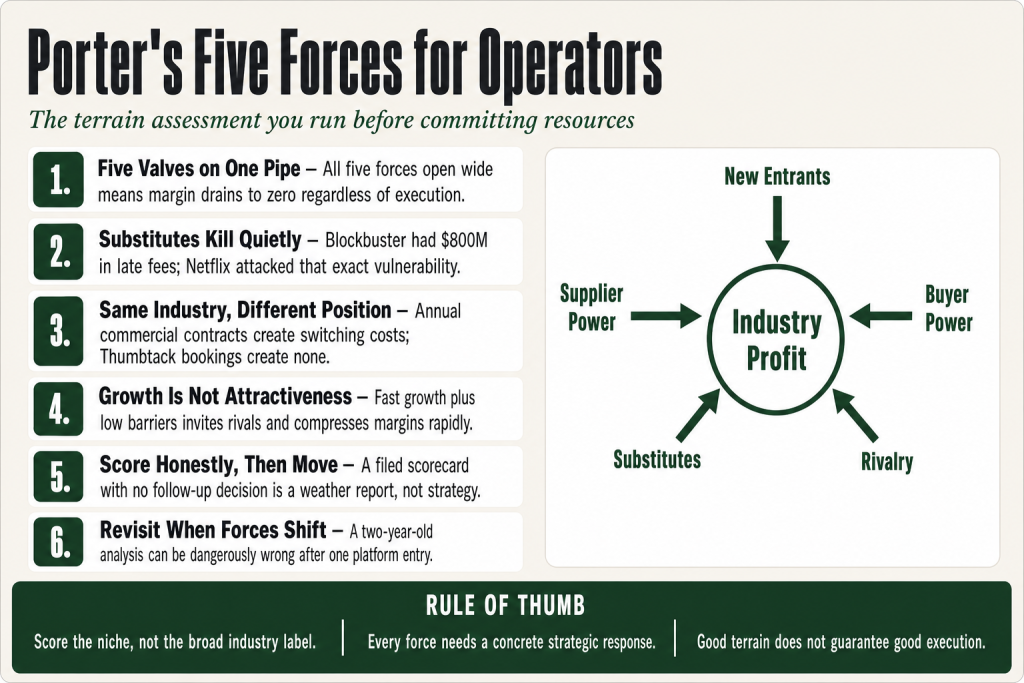
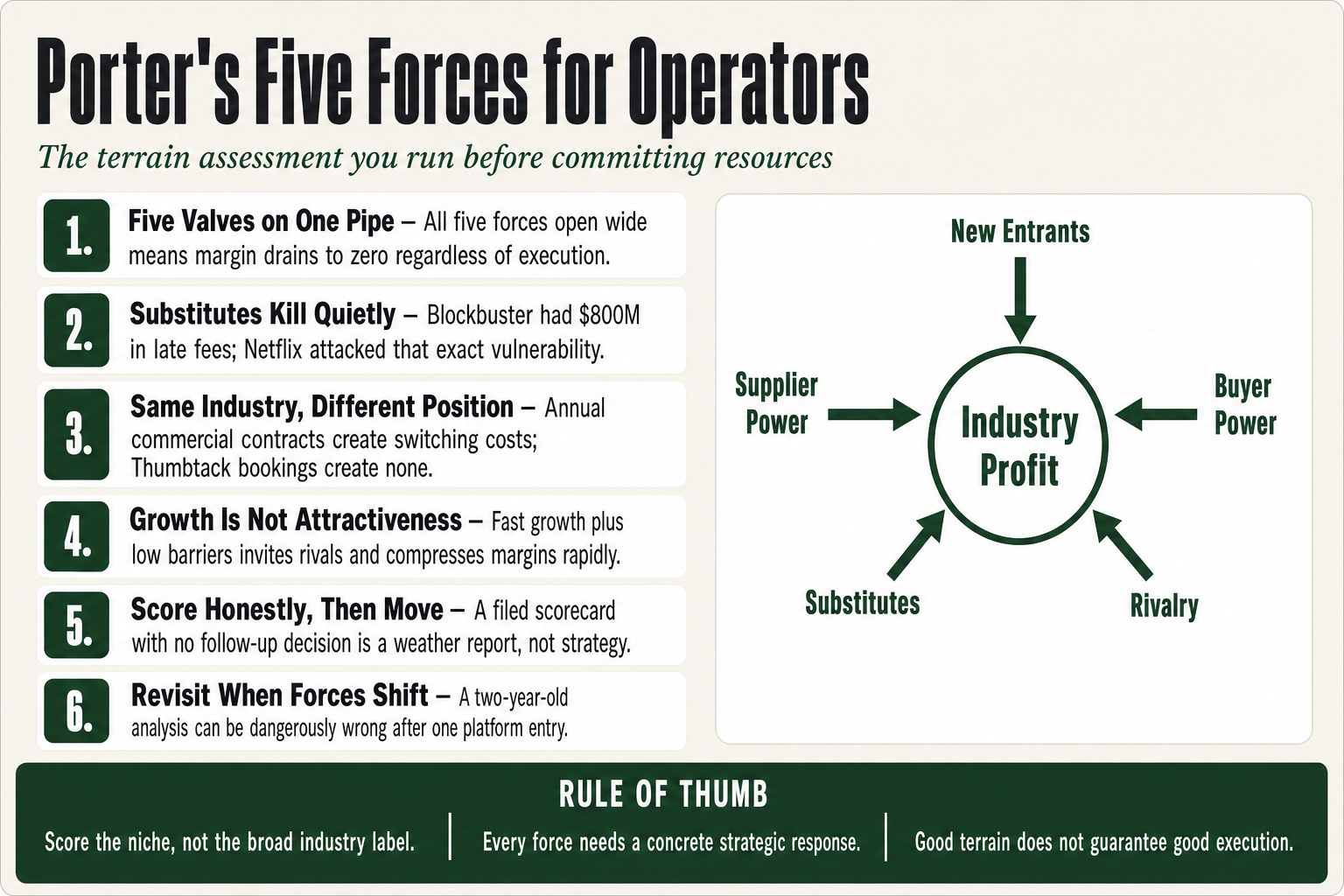
Each force represents a distinct pressure on your ability to earn a profit. Think of them as five different valves on the same pipe, the more open the valves, the faster your margin drains out.
1. Competitive Rivalry
This is the force everyone spots first. It measures how intensely the businesses already in your market are fighting each other, price wars, feature races, advertising battles, capacity dumping. The key drivers are competitor count, how undifferentiated the offering is, how high exit barriers are (a competitor who can’t afford to leave keeps fighting even when losing money), and how slowly the market is growing. Slow growth amplifies rivalry because every gain comes directly at a rival’s expense.
The mistake operators make here is counting only direct competitors, businesses that describe themselves the same way. Rivalry is shaped by how all five forces interact. A market with three competitors but near-zero entry barriers, no switching costs, and a credible substitute is far more dangerous than a raw competitor count suggests.
2. Threat of New Entrants
How easy is it for a new player to show up and take your customers? The answer depends on barriers to entry: capital requirements, regulatory licenses, brand recognition, proprietary technology, scale advantages, and network effects. High barriers protect existing players. Low barriers mean any growth you demonstrate is an open invitation to new competition.
For most small operators, in local services, retail, professional services, barriers are distressingly low. Starting a competing yoga studio, landscaping company, or accounting firm requires modest capital and no proprietary technology. The operators who survive this force long-term have either built real switching costs (relationships, proprietary systems, institutional knowledge) or positioned into a niche narrow enough that new entrants don’t bother.
3. Threat of Substitutes
Substitutes aren’t direct competitors. They’re different products or services that solve the same underlying problem. This is the force most operators underestimate, and the one that has historically killed the most businesses that thought they were fine.
Blockbuster is the case study that holds up. At its 2004 peak, the company had over 9,000 stores and roughly $6 billion in annual revenue. Late fees had hit $800 million in 2000, about 16% of total revenue at the time, and represented its most hated revenue stream. Netflix launched its website in April 1998 with per-rental pricing, then shifted to flat monthly subscription pricing with no late fees in 1999, attacking that exact vulnerability. Blockbuster had the chance to buy Netflix for $50 million in 2000 and passed. When Blockbuster filed for Chapter 11 in September 2010, it carried over $900 million in debt; DISH Network won the bankruptcy auction with a bid valued at approximately $320 million. The substitute didn’t arrive wearing a competitor’s jersey, it came through the mail.
The framework, applied honestly and early, would have flagged that substitution risk. The threat wasn’t “another video rental chain”, it was any delivery model that let a customer watch a movie at home without leaving the couch and paying a late fee. When you score substitution risk, ask: what are customers actually hiring my product to do? Then ask what else could do that job cheaper, faster, or with less friction.
4. Bargaining Power of Buyers
When customers have strong bargaining power, they extract value through price pressure, demands for higher quality at the same cost, or credible threats to switch. Buyer power rises when there are few buyers purchasing in volume, the product is undifferentiated, switching costs are low, buyers have full price transparency, and the purchase represents a small fraction of the buyer’s total spend, so they push hard without much pain to themselves.
In B2B markets, a small operator with two or three large clients is structurally exposed, each client knows they represent a meaningful share of your revenue and can extract concessions accordingly. In consumer markets, digital platforms have dramatically increased buyer power by making price comparison instant and switching costs near-zero. The response to high buyer power is almost always the same: build switching costs, deepen relationships, or serve a segment that values differentiation over price.
5. Bargaining Power of Suppliers
Suppliers gain power when there are few of them, when their input is critical and hard to replace, or when they could credibly move into your market directly. A single-source supplier relationship is a structural vulnerability. A staffing business that depends entirely on one platform for candidate sourcing, a restaurant whose signature dish relies on one specialty distributor, a tech company whose product runs on one cloud provider, all exposed.
The 2024 Federal Reserve Small Business Credit Survey found that small businesses dependent on single suppliers faced the most severe supply chain disruptions. Supplier diversification isn’t just operational good practice, it’s a hedge against one of the five forces.
How to Read the Collective Score, and Why It’s Not Just Addition
Each individual force tells you something. But the strategic insight comes from the combination, from asking: given all five forces together, where does the economic value in this market actually end up?
The five forces determine how the value an industry creates gets distributed. That value can drain away through rivalry among existing competitors, get bargained away through supplier or buyer power, or get constrained by the threat of new entrants or substitutes. If all five of those channels are wide open, the industry is a hard place to build lasting margin regardless of execution quality.
The practical scoring method most operators use is a simple high/medium/low rating for each force, then reading the overall pattern. No single force is automatically disqualifying. What matters is whether you can identify a structural position, a specific niche, a specific customer segment, a specific delivery model, where the forces you face are weaker than the industry average.
Consider two operators in the same broad category, say, residential cleaning services:
- Operator A competes on price in a market flooded with low-barrier entrants, serves customers who comparison-shop on Thumbtack and switch quarterly, and buys supplies from commodity distributors. High rivalry, high new entrant threat, high buyer power, moderate substitution risk. Structurally brutal.
- Operator B serves high-end commercial clients on annual contracts, has built proprietary cleaning protocols with documented outcomes, and has invested in relationships with property managers who face real switching costs, new vendor vetting, insurance verification, building access logistics. Lower rivalry due to service complexity, lower buyer power due to switching costs, higher barriers for new entrants to replicate the commercial credentials. Same industry. Very different structural position.
Same cleaning supplies. Same labor market. Completely different force exposure. The framework doesn’t tell Operator B what to clean, it tells them where to stand in the market to keep more of what they earn.
Running a Porter’s Five Forces Analysis as an Operator
There are two modes in which operators use this framework: the entry decision and the structural audit. Both are worth running differently.
The Entry Decision
Before you enter a new market, launch a new service line, or expand into a new geography, run a five-forces assessment. This doesn’t need to be a formal 20-page document. It needs to be an honest conversation with yourself, ideally a two-hour working session with a whiteboard, a legal pad, or a simple spreadsheet. Score each force, explain the evidence for your rating, and then ask the single most important question the framework poses: is there a structural position in this market where I can face weaker versions of these forces than the average competitor?
If the answer is yes, your next question is: can I credibly occupy that position with my current resources? If the answer is no, if all five forces are strong and you see no structural relief, take that seriously. Many operators look at a market that seems attractive because it’s growing and they can see potential customers. Growth is not the same as structural attractiveness. A rapidly growing market with low barriers and strong buyer power is an invitation to watch your margins compress as a dozen competitors pile in to chase the same growth you spotted.
The Structural Audit
For operators already in a market, run the five forces as an audit every one to two years, or whenever a significant force shifts. Trigger events that should prompt an immediate audit include: a new platform player entering your market (affects new entrant threat and buyer power simultaneously), a supplier consolidation or acquisition (directly shifts supplier power), a new technology that could serve as a substitute, or a major regulatory change that raises or lowers entry barriers.
The audit question is slightly different from the entry question: given how the forces have shifted, does my current positioning still face a favorable version of each force? If not, what structural move would improve my position?
Where to Get the Information
This is where operators get paralyzed. They think a five-forces analysis requires industry reports and consultant databases. It doesn’t. For most small operators, the information lives in their own experience and accessible sources:
- Competitive rivalry: How many local competitors are actively marketing? How often are you losing quotes to price? How frequently do clients mention they comparison-shopped?
- Threat of new entrants: What did it take for you to start? Would it take more or less today? Are platform aggregators (Yelp, Angi, Thumbtack, Amazon Local) reducing barriers by commoditizing discovery?
- Threat of substitutes: What do customers do when they decide not to buy from anyone in your category? What technology or behavioral shift could eliminate their need for your service?
- Buyer power: How often are you getting price-shopped? What’s your close rate, and is it trending? Are any customers large enough that losing them would materially hurt your business?
- Supplier power: How many sources do you have for your critical inputs (labor, materials, platforms, referrals)? What would it cost you if your primary supplier doubled their rates or disappeared?
None of this requires a consultant. It requires honesty.
Putting this to work? The ideas in the Canon are the foundation under the tactical playbook in Build a Complete Marketing Department — grab the free companion kit at mmsvegas.com/resources.
Porter’s Five Forces in Action: Three Market Reads Worth Studying
Frameworks need traction in reality. Here are three market situations that show the five forces operating as a system, not as a checklist.
Streaming Video: A High-Rivalry Market With a Structural Moat at the Top
The streaming video market looks, at first pass, like a structurally terrible place to operate. Rivalry is fierce, Disney+, Max, Amazon Prime Video, Apple TV+, Peacock, and Paramount+ are all competing for the same screen time. Buyer power is high: switching costs are minimal (a subscriber can cancel in two clicks and sign up elsewhere before the end of the month). The threat of substitution is real and varied, live events, free ad-supported TV, YouTube, social video, and gaming all compete for the same hours. New entrants have materialized at scale, with every major studio now running its own platform.
And yet Netflix has maintained a durable position despite all of it. The structural move was specific: Netflix committed a reported $100 million for two seasons of House of Cards when it launched in February 2013, roughly $50 million per 13-episode season, and used original content to reduce its dependence on licensed libraries it didn’t control. By 2025, originals account for roughly 46.5% of Netflix’s approximately $18 billion content budget, and you can’t watch a Netflix Original anywhere else. That creates a substitution barrier rivals have to spend their way around. The structural move here was to reshape two of the five forces, supplier power over licensed content, and substitution risk, by becoming its own content supplier. That’s the advanced application: not just diagnosing your position, but engineering a better one.
Local Professional Services: Where the Forces Are Sneaky
Take a local accounting firm serving small businesses. On the surface, it looks fine: competitive rivalry is moderate (limited local competitors), supplier power is low (the main input is professional labor, which the firm employs), and buyer power seems manageable.
But look harder. The threat of new entrants has risen sharply, not from new accounting firms, but from software platforms like QuickBooks Live and Bench that offer bookkeeping and tax prep at a fraction of traditional rates, staffed by remote accountants. That’s both a new entrant threat and a substitution threat operating at the same time. Buyer power has also increased: platforms like Yelp and Google make price comparison trivial, and any business owner can read detailed reviews before shortlisting. The local firm that assumed it had a protected competitive position because it had few direct local rivals was looking at only one force. The real pressure was coming from two others.
Specialty Coffee: Low Barriers, High Rivalry, Strategic Salvation in Brand
Opening a coffee shop is the canonical example of a structurally hostile market for small operators. Entry barriers are low (equipment, lease, barista training, manageable). Rivalry is intense, especially in urban markets. Buyer power is high, customers will walk two blocks to save a dollar. Substitution threats are permanent: home espresso machines, office coffee pods, and drive-through chains all compete for the same morning ritual.
The operators who survive long-term do so by finding structural refuges within the category. A roastery with proprietary sourcing relationships that supplies wholesale to restaurants and offices has shifted the model: now there’s a supplier relationship that creates stickiness on the buyer side (restaurants don’t want to switch their house coffee mid-season), and the roastery’s direct-to-consumer bag sales carry higher margin than espresso drinks. Different position, different force profile, same basic industry.
Where Porter’s Five Forces Still Does Its Best Work
The framework performs best in markets with relatively stable industry structures, where the five forces shift slowly enough that a two-year-old analysis is still largely valid. Industries like professional services, healthcare, construction, manufacturing, specialty retail, and local services all qualify. In these markets, structural position is durable, and the work of choosing where to stand pays off over years rather than months.
It also works exceptionally well at the entry/exit decision point, arguably the highest-stakes decision any operator makes. The opportunity cost of entering the wrong market is enormous. Operators spend years building a position in a structurally unattractive market that would have been obvious with thirty minutes of honest five-forces thinking. That’s the use case where the ROI on this framework is highest.
Finally, it’s a powerful frame for reshaping decisions. Once you’ve run the analysis and identified which force is squeezing you hardest, you have a target. If buyer power is your problem, the response is to build switching costs and deepen relationships. If new entrant threat is high, the response is to invest in the things new entrants can’t quickly replicate, proprietary process, reputation, relationships, certifications. If substitution risk is real, the response is to reposition your offer around needs that the substitute doesn’t meet. The diagnosis and the strategic response travel together.
Where Porter’s Five Forces Doesn’t Work Well, Be Honest About This
The framework has real limitations, and pretending otherwise is how operators misuse it.
The most significant limitation is that it’s a static snapshot. It models an industry’s structure at a point in time, not its trajectory. The framework applies cleanly under stable conditions, but markets don’t stay stable, especially in the digital economy. Technology, regulation, and customer behavior can shift multiple forces simultaneously and rapidly. The five-forces analysis you ran in 2022 may be significantly wrong by 2025 if a new platform entered your category, a supply chain disrupted a key input, or a substitute became dramatically cheaper. The tool requires periodic recalibration, not a one-time filing.
Platform-based business models are a particular challenge. In a two-sided marketplace, Airbnb, Uber, or any app-store ecosystem, the traditional supplier/buyer distinction collapses, network effects create structural dynamics the framework wasn’t designed to model, and the competitor you most need to watch may be a platform that doesn’t look like a competitor at all. Digital platform strategy genuinely operates on different economic principles than those the five forces assumes.
The framework also doesn’t tell you what to do. It identifies structural attractiveness or hostility, but it offers no prescription for execution. You can run a perfect five-forces analysis and still build the wrong product, price it wrong, or market it ineffectively. The tool is a terrain map, not a battle plan.
There’s also a subtle risk of false precision. Operators sometimes rate each force high/medium/low and then treat the output as a definitive verdict when the underlying ratings were themselves guesswork. The framework is only as good as the honesty and market knowledge you bring to the scoring. A poorly informed five-forces analysis is worse than no analysis, because it gives you false confidence in a flawed picture.
One more: it works poorly as a marketing tool. Plenty of consultants and agency owners will suggest to clients that they need a five-forces analysis when what they actually need is a clearer value proposition and a better lead funnel. The Five Forces tells you about industry structure. It doesn’t directly tell you how to acquire customers, build a brand, or price an offer. Those are different problems that other frameworks handle better.
Common Misunderstandings About Porter’s Five Forces
“It’s a competitive analysis tool.” Partially, yes, but that framing undersells it and causes misuse. Competitive analysis typically focuses on who your rivals are and what they do. Five Forces is an industry structure analysis. The question isn’t “what is my competitor doing?” but “what structural forces are shaping profit distribution in this market?” Your direct competitors are only one of five factors. Treating this as a competitive benchmarking exercise misses most of the insight.
“High scores on all five forces means I should leave the market.” Not necessarily. It means you should find a structural position that faces weaker versions of those forces, or decide the forces are temporary and worth enduring. The framework was designed not just to evaluate markets but to prompt strategic repositioning within them. The insight isn’t always “get out.” Sometimes it’s “stop competing on price in the commodity segment and move upmarket where buyer power drops.”
“It only applies to big companies.” The framework originated in corporate strategy research, but it scales down naturally. A single-location service business faces all five forces. The analysis is quicker and requires less data at small scale, not more. If anything, small operators benefit more from this framework because they have fewer resources to absorb the cost of a structurally bad market choice.
“You only need to run it once.” Forces shift. A market that was attractive in 2019 may look very different today, particularly any market touched by AI tools, platform aggregators, or significant supply chain restructuring. The analysis should be a periodic revisit, not a one-time filing in a drawer.
“A growing market is an attractive market.” One of Porter’s most important contributions is the correction of this assumption. Rapid growth attracts new entrants, especially when entry barriers are low. Fast growth combined with weak barriers and undifferentiated offerings is a formula for rapid margin compression, regardless of how large the total market becomes. Many operators entered cannabis, e-commerce, and meal-kit delivery on this logic and found themselves in races to the bottom.
Common Mistakes
- Scoring all five forces and stopping there — The scorecard is the input, not the output. A regional HR consulting firm ran a thorough five-forces analysis before expanding into a new metro market, rated rivalry as medium, buyer power as high, new entrant threat as medium-high. Then filed it. Six months in, margins were already compressing. The analysis had correctly identified buyer power as the dominant force, but no one asked the follow-up: what’s the one structural move that changes our exposure to it? Schedule a working session within the same week as the scoring. One question only: which force is highest, and what’s the concrete move that shifts our relationship to it?
- Scoring the industry category instead of the specific niche you’re actually entering — A solo management consultant scored ‘professional services’ as moderately attractive and entered without realizing she was specifically competing in the ‘sub-$5,000 project, no retainer, no referral network’ segment, the most structurally punishing corner of that market. Brutal buyer power, near-zero switching costs, new entrants every quarter. The fix: score the specific delivery model and customer segment you’re actually entering, not the broad industry label. ‘Local commercial cleaning on annual contracts’ has a completely different force profile than ‘residential cleaning booked through Thumbtack.’ The industry category is just a starting point, the niche is where the real scoring happens.
- Treating new entrant threat as a capital-and-licensing question only — A regional staffing firm correctly identified that capital requirements were high in their space and rated new entrant threat as low. They missed that three SaaS platforms had entered the market with a technology-first model letting clients self-serve the entire candidate funnel, no capital required, no office, no license. New entrant threat isn’t only about who can afford to start a traditional version of your business; it’s about who can serve the same customer job through a completely different model at a fraction of the cost. Before finalizing your rating, list the non-traditional entrants separately, platforms, software tools, adjacent-industry players, alongside traditional ones. They’re usually more dangerous.
- Locking in force ratings without a single customer conversation — A B2B training operator spent an afternoon scoring substitution risk as low, he saw no direct competitors entering his niche and assumed customers were satisfied. He hadn’t spoken to a client in three months. When he finally did, two clients mentioned they’d started routing similar training through an internal LMS they’d just licensed. The substitute was already inside the building. Before finalizing any force rating, run at least three conversations with active customers and two with churned ones. What they tell you will correct at least one of your scores, almost always the substitution or buyer power rating.
- Letting a good structural score paper over real execution problems — An operator in a structurally attractive market, few rivals, high entry barriers, weak buyer power, ran the analysis, felt reassured, and stopped asking hard questions about how the business actually ran. Eighteen months later, margins were still eroding. The culprit was internal: pricing drift, scope creep, and underinvestment in delivery quality. Five Forces grades the terrain, not the operator. After the structural analysis, run a separate and equally honest audit of your operations. The framework tells you the pond is worth fishing in. It has nothing to say about your casting.
Operator’s Take
The most common five-forces output I see from operators is a completed scorecard that gets saved to a folder and never opened again. They rated each force, felt informed, and moved on. That’s not strategy. That’s a weather report with no decision attached to it.
So let’s make this concrete. Here’s how to actually use the output, force by force, in the order I’d prioritize for most small operators.
If buyer power is your highest-scoring forceyou’re getting price-shopped constantly, close rates are sliding, clients feel interchangeable, the lever is switching costs. Not loyalty programs. Actual operational friction: proprietary systems they’d have to retrain around, documented outcomes tied to your specific process, relationships built with multiple stakeholders inside the client organization rather than just one contact point. Take your top ten accounts and ask honestly: what would it cost them, operationally, to replace us? If the answer is “a couple of phone calls,” you don’t have a pricing problem. You have a switching cost problem.
If new entrant threat is what’s eating youcheaper, faster competitors keep showing up and commoditizing what you built, the only durable response is to invest in exactly what takes years to replicate. Not features or service line expansions. Reputation depth, proprietary certifications, documented case outcomes, referral networks that took half a decade to build. A new entrant can match your service list in six months. They can’t match your track record or your referral web. That’s where the next dollar goes.
If substitution risk is the issuecustomer need is slowly migrating toward something that doesn’t look like a competitor yet, the move is to shift your positioning around the job the substitute handles poorly. This is the hardest one to act on, because it usually means changing something before the revenue pressure is obvious. Waiting until the substitute has taken 30% of your volume is waiting too long. Figure out what part of the customer’s problem your substitute addresses badly. Start building toward that before you have to.
If supplier power is squeezing youone platform, one distributor, one referral source holding most of the cards, the only real fix is diversification, and it compounds slowly. The operators who get crushed by supplier power are almost always the ones who knew they were single-threaded and kept deferring the fix. Add a second sourcing channel before you need it. Do it now.
One thing that’s genuinely overrated about how this framework gets taught: the idea that a favorable structural position is a safe bet. It isn’t. I’ve watched operators in structurally attractive markets, few rivals, high entry barriers, weak buyer power, still bleed out from pricing drift, scope creep, and underinvestment in delivery quality. A good structural position tells you the terrain works in your favor. It doesn’t tell you that you’ll execute well. Use the framework to pick the right pond. Then fish well.
And if you’re already in trouble, losing on price, watching a substitute erode your volume quarter by quarter, fending off new competitors who keep undercutting you, the instinct is to fix the funnel, sharpen the messaging, run a promotion. Sometimes that’s right. But if the forces have moved against you structurally, better ads won’t save you. You need to move.
Used in
- ✓ Build a Complete Marketing Department
Used in the market-selection and positioning phase to evaluate whether a target segment is structurally worth pursuing before allocating marketing budget and resources. - ✓ The Missing Manual for FunnelKit
Informs funnel architecture decisions by clarifying buyer power and switching costs, markets with high buyer power require more trust-building stages and stronger proof elements before conversion. - ✓ The Missing Manual for Make
Supports automation decisions about supplier and platform dependencies, understanding which force a critical integration represents helps operators prioritize redundancy and contingency workflows.
FAQ
Do I need industry data or research reports to run a five-forces analysis?
Not for most small-business applications. The information lives in your own operating experience, your close rates, your supplier contracts, how often customers mention they price-shopped you, and what alternatives they’ve considered. Industry reports help if you’re entering a market you don’t yet operate in, but direct knowledge is often more accurate and always faster.
How often should I revisit my five-forces analysis?
Annually at minimum, and immediately whenever a significant structural shift occurs, a major platform enters your market, a supplier consolidates, a new technology emerges that could substitute for what you offer, or a regulatory change raises or lowers entry barriers. Forces are not static, and a two-year-old analysis can be dangerously wrong.
Is Porter’s Five Forces still relevant in digital and platform-based markets?
The framework requires interpretation in platform markets because traditional supplier/buyer distinctions blur and network effects create dynamics Porter didn’t model in 1979. That said, the five forces still operate, they just manifest differently. Buyer power in digital markets is often extreme due to zero switching costs and full price transparency; new entrant threat is shaped by platform access rather than capital requirements. Use the framework as a lens, not a rigid checklist, and it still illuminates the right questions.
How is Porter’s Five Forces different from a SWOT analysis?
SWOT analyzes your company, its internal strengths and weaknesses, external opportunities and threats. Five Forces analyzes your industry’s structure, the external forces that shape profitability for every firm competing in the market. They’re complementary: Five Forces tells you what game you’re playing; SWOT tells you how you’re equipped to play it.
What’s the most important of the five forces for a small local business?
It depends on the specific market, but buyer power and threat of new entrants are the forces that most commonly squeeze small operators. Buyer power has increased dramatically with digital price comparison and platform aggregators; new entrant threat is persistently high in any market where capital and regulatory barriers are low. These two deserve the most honest scoring for most small businesses.
Can Porter’s Five Forces help me set my pricing?
Indirectly, yes. Understanding buyer power tells you how much pricing latitude you have, high buyer power means customers will resist price increases and shop aggressively on price. Understanding competitive rivalry tells you whether price competition is the dominant game in your market. But for direct pricing tools, frameworks like the Van Westendorp Price Sensitivity Meter give you more tactical guidance on where your price should land.
Further reading
- “How Competitive Forces Shape Strategy”Michael E. Porter, Harvard Business ReviewMarch, April 1979. The original article; shorter and more readable than the book, and a good first read before committing to the full framework.
- Competitive StrategyMichael E. Porter (1980, Free Press). The source text. Worth reading for the depth on each force and the introduction of generic strategies; skim the industry-specific chapters and focus on the framework chapters.
- “The Five Competitive Forces That Shape Strategy”Michael E. Porter, Harvard Business ReviewJanuary 2008. The 30-year update and reaffirmation; adds practical guidance on applying the framework and addresses critics directly.
- Playing to WinA.G. Lafley and Roger L. Martin (2013, Harvard Business Review Press). Takes Porter’s structural thinking and translates it into the operational choices an organization actually makes, the best bridge between Five Forces diagnosis and actionable strategy.
Sources: Michael E. Porter, “How Competitive Forces Shape Strategy,” Harvard Business ReviewMarch, April 1979; Porter, “The Five Competitive Forces That Shape Strategy,” HBRJanuary 2008: 78 to 93; Competitive Strategy (Free Press, 1980); Harvard Business School Institute for Strategy and Competitiveness, “The Five Forces” (isc.hbs.edu); Blockbuster Inc. Form 10-K (SEC EDGAR, FY2004); Blockbuster Inc. Chapter 11 Bankruptcy Petition (SEC EDGAR, September 2010); Blockbuster Inc. Form 8-K (SEC EDGAR, FY2004); TechCrunch, “DISH Wins Bankruptcy Auction, Buys Blockbuster Assets For $228M In Cash” (April 2011); DISH Network press release, “DISH Network Agrees to Acquire Blockbuster Assets” (April 6, 2011); CNN Money, “House of Cards: Netflix’s $100 million bet on must-see TV” (February 2013); BusinessStats, “Netflix Content Budget 2012 to 2026” (2026); Variety, “Netflix Tops 325 Million Subscribers, Plans to Boost Content Spending 10% to $20 Billion in 2026” (January 2026); 2024 Federal Reserve Small Business Credit Survey.
Brian Kasday spent forty years in direct-response marketing before rebuilding the whole operation as a one-person shop. He writes The Operator’s Library — including “Build a Complete Marketing Department” — for operators who’d rather build it themselves than wait on someone else.
Build the department these ideas describe — the free companion kit: mmsvegas.com/resources.
More The Operator's Canon guides
Free · Operator Toolkit
Want the tools, not just the guide?
Get the free operator toolkit — templates and checklists for the systems you actually run, plus a note when this guide changes.
Get the free toolkit →