
Last updated: July 2026
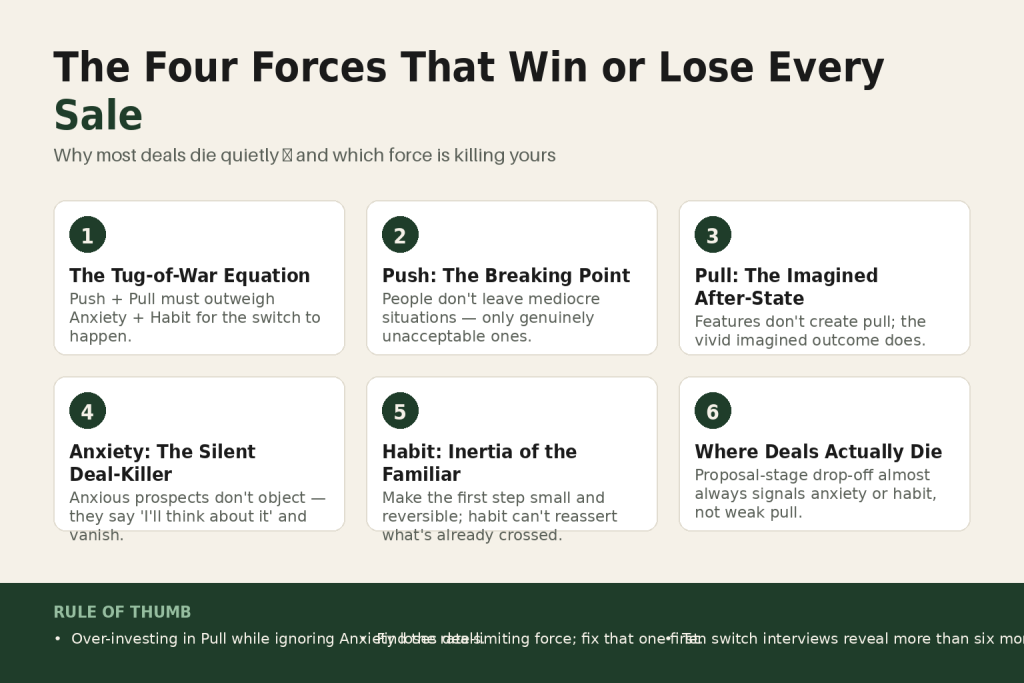
Switching forces jobs to be done is the cleanest decision model in marketing, and one of the most underused by small operators. Every time a customer decides whether to buy from you, four forces are pulling on them at once. Two push them toward change. Two pull them back toward staying put. Whoever wins that tug-of-war determines whether you get the sale or the competitor keeps the customer.
By the end of this page, you’ll be able to identify which of the four forces is doing the most damage to your conversion rate right now, and know exactly what to adjust in your messaging, offer, or onboarding to fix it.
The reason this model matters so much to a small-business operator is that it changes the question you ask. Instead of “how do I make my product more attractive?” you start asking “what is actually holding this person back from switching?” Those are very different questions, and they lead to very different marketing decisions. One leads you to add more features to your landing page. The other leads you to remove the risk from the decision. One of those moves works a lot better than the other.
The idea in 30 seconds
- Every buying decision is a tug-of-war between four forces: Push (pain with the current situation), Pull (appeal of the new solution), Anxiety (fear of switching), and Habit (inertia of the current way).
- A customer switches only when Push + Pull outweighs Anxiety + Habit, your marketing must work on all four levers, not just the first two.
- Most operators over-invest in Pull (features, benefits) and almost completely ignore Anxiety and Habit, which is where most deals quietly die.
- The framework is a decision tool, not a customer survey: you use it to diagnose why people aren’t buying, then fix the actual sticking point.
- By the end of this page, you’ll be able to map all four switching forces jobs to be done style for your own business and identify which one is costing you conversions right now.
Where the Model Came From
Bob Moesta was one of the original architects of Jobs-to-be-Done theory in the mid-1990s, working alongside Clayton Christensen. With Chris Spiek at The Re-Wired Group, he developed what they call the Progress Making Forces Diagram, the four-force model this page is about. Around 2012, they formalized the Forces of Progress as a named, teachable framework; a Switch Workshop at Basecamp’s Chicago headquarters is one of the earliest documented practitioner uses of it. The mattress interview from that workshop later appeared in Christensen’s 2016 book Competing Against Luckand Moesta codified the practitioner approach in his 2020 book Demand-Side Sales 101. What the two of them contributed wasn’t just naming four forces, it was showing that anxiety and habit (the “bottom half” of their diagram) are where the most interesting, least-explored marketing territory lives. That shift from a static pros-and-cons list to a dynamic tension between four specific forces is what makes this a decision tool rather than a framework you read once and file away.
The Four Switching Forces
A customer switches only when the forces pushing them forward outweigh the forces holding them back. The equation: Push + Pull > Anxiety + Habit = the switch happens. Flip that inequality and the customer stays put, no matter how good your product actually is.
Push is the friction or broken moment that makes someone start looking. Not just dissatisfaction, dissatisfaction that has crossed a threshold. People don’t leave situations that are merely mediocre; they leave when the situation becomes genuinely unacceptable. The accounting software that eats three hours every Monday. The agency that never returns calls. The packaging supplier that has missed the last two deadlines in a row. Without meaningful push, a prospect isn’t really in the market, they’re browsing. You can’t manufacture push from nothing; you can only identify people who already have it and make sure your language mirrors exactly what they’re frustrated about.
Pull is the magnetism of the new way, the better life the customer can picture if they switch. This is not your feature list. Features don’t create pull; the imagined outcome does. “Cut your reporting time in half” is pull. “Multi-format export options” is a feature that might feed pull, but it doesn’t do the work on its own. Pull can be social (“I want to be the kind of business that uses modern tools”), emotional (“I want to stop dreading Monday mornings”), or aspirational. The best marketing for pull paints a vivid picture of the after-state, the customer’s new situation, not the product’s attributes.
Anxiety is the most underestimated force in small-business marketing. It’s the internal voice asking: What if it doesn’t work? What if the migration is a disaster? What if I lose my data, my history, my relationship with the person I know? You can’t feature your way past it. A longer list of benefits doesn’t reduce the fear that the new thing might not deliver. What reduces anxiety is proof, risk removal, and lowered stakes, testimonials from people who look like the prospect, a free trial or pilot period, a clear unconditional guarantee, a migration checklist that makes the switch feel manageable. Anxiety is often invisible in marketing because anxious prospects don’t tell you they’re anxious. They just go quiet. They say “I’ll think about it” and never come back. When your conversion rate is mysteriously low relative to the interest you’re generating, anxiety is usually the culprit.
Habit is the inertia of the familiar. “It’s fine. I’m used to it. Switching is a hassle.” It’s why technically superior products lose to mediocre incumbents every single day. Habit isn’t just routine behavior, it’s the sunk cost of the learning curve, the relationships built into the current solution, the workflows that have grown up around it. What makes habit especially tricky is that it doesn’t feel like a barrier to the person experiencing it. It just feels like their life. Breaking it usually means making the switch feel small and reversible, a low-commitment first step, an easy migration path, a parallel-run period where they don’t have to fully commit before they feel confident.
Two forces push toward the switch; two push back against it. Your job is to figure out which one is the rate-limiting step for your specific buyer in your specific market, then fix that one first.
When Switching Forces Actually Tip
One of the most useful things about this model is that it’s dynamic, not static. The forces don’t all appear at once, they accumulate over time. A customer might carry moderate push for six months, adding a little pull each time they see a competitor’s ad or hear a peer mention a different tool, while anxiety and habit hold them in place. Then something shifts: a particularly bad week with the current solution, a glowing referral from a trusted contact, a risk-free trial offer at exactly the right moment. The forces tip, and the switch happens.
That timeline matters for operators because it means your marketing doesn’t just need to do one thing at one moment, it needs to be present at different stages. Content that amplifies push (“still using spreadsheets for inventory? here’s what that’s costing you”) works at one stage. Testimonials that reduce anxiety work at another. A trial offer that lowers the cost of habit-change works at another still.
It also means that the switch interview, the practice of interviewing recent buyers about the full arc of their decision, is one of the most valuable research methods a small operator has access to. Asking someone why they bought tells you the last domino. Asking them to walk you through the whole story from first frustration to final decision tells you where every force was operating and what finally tipped the balance. That’s the intelligence you need to reverse-engineer your marketing.
One more thing worth sitting with: the model accounts for non-consumption. Some of your most valuable potential customers aren’t currently using a competitor, they’re using nothing. They have push, they might even have pull, but anxiety and habit are keeping them in a workaround (a spreadsheet, a manual process, a person doing the job by hand). These customers aren’t in anyone’s funnel. They’re invisible to competitive analysis. The switching forces jobs to be done lens is one of the few tools that makes them visible.
Switching Forces Jobs to Be Done vs. What You’re Already Using
A few comparisons worth making clearly, because this model gets conflated with other things.
It’s not a buyer persona.
A persona tells you who your customer is, age, title, industry, maybe a few behavioral traits. The switching forces tell you what is happening inside a specific decision at a specific moment. Two people with identical personas can be in completely different places on the forces diagram. One is pushed hard and nearly ready to switch; the other is comfortable and going nowhere. Treating them with the same message is exactly why so much persona-based marketing underperforms.
It’s not a SWOT.
SWOT analyzes your business’s competitive position. The four forces analyze a single customer’s decision to switch in a specific moment. It’s a model of demand, not of competitive position. You can have every SWOT advantage and still lose to anxiety and habit.
It’s different from Market Awareness Levels.
Eugene Schwartz’s awareness levels tell you how much the customer already knows about their problem and your solution, which determines the sophistication of your messaging. The switching forces tell you what forces are operating on their decision right now. They’re complementary: awareness tells you the message; the forces tell you what job that message needs to do. A prospect at the “problem-aware” stage has push but probably no pull. A prospect who’s been following you for months has pull but might be paralyzed by anxiety. Different forces call for different moves.
It’s not just for acquisition.
Most operators read this model as a customer-acquisition tool. It’s also a retention and churn-prevention tool. Your existing customers are subject to the same forces, just in reverse. A competitor is applying push on your customer (by amplifying their frustrations), pull toward their offer, and trying to reduce the anxiety about switching away from you. Understanding the forces your customers feel toward leaving is exactly the same analytical exercise as understanding the forces new prospects feel toward joining.
Putting this to work? The ideas in the Canon are the foundation under the tactical playbook in Build a Complete Marketing Departmentgrab the free companion kit at mmsvegas.com/resources.
How the Switching Forces Jobs to Be Done Play Out in Practice
A few real situations where the model explains what’s actually happening.
The Mattress at Costco (Classic Anxiety Reduction in Action)
The mattress interview from Moesta and Spiek’s early Switch Workshops has become one of the most-cited examples of the forces in practice. A buyer who said he’d made an impulse mattress purchase at Costco turned out to have been thinking about replacing his mattress for over a year, sleeping badly, even researching mattresses at the kitchen table in the middle of the night. Push had been building for months. The pull of a better night’s sleep was real. What had been holding him back was anxiety and inertia: the risk that the new mattress wouldn’t actually be better. Costco dismantled that anxiety with a no-questions-asked return policy and foam samples he could touch in the aisle. That was it. The deal closed. Every move maps to a specific force.
Basecamp vs. Email + Spreadsheets
Moesta worked with Basecamp applying the JTBD framework directly. Upon running switch interviews, they found that customers rarely framed the purchase as “I need project management software.” The push was more visceral: projects slipping through the cracks, files scattered across inboxes, clients complaining. The pull wasn’t the feature set, it was the imagined state of being organized and in control. Anxiety was real: team adoption risk, the fear of adding another tool that nobody ends up using. Basecamp’s historically simple interface directly addressed learning-curve anxiety. And the habit force, email, was confronted rather than ignored: Basecamp was designed so people could participate without fully abandoning email on day one. The messaging eventually shifted from feature-based communication to the emotional job being done.
A Local Service Business: The Bookkeeper Example
You don’t need to be a tech company. Consider a bookkeeper trying to win clients away from DIY accounting. Push: the business owner is spending eight hours a month on books they hate, making errors, anxious every quarter. Pull: imagine handing that job to someone else and never thinking about it again. Anxiety: will they judge my messy records? what if they’re expensive? what if I lose control of my own numbers? Habit: the owner has been doing this themselves for three years and knows where everything is, even if the system is a mess. The right marketing response isn’t to list the features of the bookkeeping service, it’s to name the push precisely (“if you’re spending your Sunday nights on QuickBooks, we should talk”), paint the pull vividly (“get eight hours of your life back every month”), and then spend serious real estate on anxiety-reduction (“we handle messy books all the time, no judgment, we’ve seen far worse”) and habit-lowering (“we’ll do the first month’s cleanup for free so you can see it work before you commit”).
Casper and the Real Competitor
Casper’s early growth offers a sharp illustration of how forces analysis can surface competitors that traditional market research misses entirely. Rather than treating Sealy or Tempur-Pedic as the primary competition, a forces-aware reading of buyer behavior revealed that many sleep-anxious consumers were reaching for sleep aids, a sleep pill, not a new mattress, as their workaround. That’s a non-consumption play hiding in plain sight. Once Casper built its entire entry offer around eliminating the anxiety of a bad purchase, a 100-night trial, mattress in a box, free return, it dismantled the habit force that had kept buyers in showrooms and the anxiety force that made a high-stakes bedroom purchase feel too risky to attempt online. The offer architecture did the work the messaging alone couldn’t.
Where Switching Forces Work Best
The model is most powerful in situations with these characteristics:
- Considered purchases. When someone spends more than a few minutes thinking before they buy, all four forces are operating. A $30 impulse buy is mostly pull plus a little habit. A $3,000 service retainer involves significant anxiety and habit forces that have to be addressed explicitly.
- Competitive markets with an incumbent. If your prospect is already using something else, even a manual workaround, habit and anxiety are both present. This is where the model gives you a real advantage over operators who only optimize for pull.
- Service businesses and B2B. The switching costs in service relationships are high. Clients have existing contacts, learned processes, and real fear of disruption. Every element of that can be mapped and addressed.
- When your conversion rate doesn’t match your interest rate. If you’re generating traffic, attention, or inquiries but not converting them, the forces model is an excellent diagnostic. You probably have push and pull covered. Anxiety and habit are the likely culprits.
It also works particularly well as a framework for planning testimonials and case studies. Instead of asking customers to describe your product, you ask them to tell the story of their switch, from the frustrating moment that started the search, through the anxiety they felt about changing, to what finally pushed them over the line. That story, told in those terms, maps directly onto the forces diagram and addresses a prospective buyer’s forces in exactly the order they experience them.
Where the Model Has Limits
The switching forces model is a decision model. It describes a moment of choice. That means it’s less useful in a few specific situations.
Brand-new categories with no incumbent. If there’s genuinely no prior solution, no competitor, no workaround, no manual process, then habit and anxiety might be low, but so is push. Nobody is frustrated enough to switch from nothing. In that scenario you’re not managing a switch; you’re creating a market, which is a different problem entirely.
Very low-consideration purchases. The forces are all present at some level in every purchase, but for low-cost impulse buys, habit and anxiety are so weak that analyzing them carefully produces diminishing returns. Work on pull exclusively.
As a replacement for actual customer research. You can use the model to hypothesize what the forces are for your typical buyer. That’s a useful starting point. But if you haven’t done actual switch interviews, real conversations with people who recently bought from you or switched away from a competitor, you’re guessing at which forces are strongest. The model is the map; the interviews are the territory. Don’t confuse them.
There’s also a risk of using the model mechanically, running through all four forces in sequence like a checklist and calling it done. The real work is figuring out which force is the rate-limiting step for your specific buyer in your specific market. Sometimes that’s anxiety. Sometimes it’s genuinely weak pull. Sometimes you have a push problem, you’re attracting browsers, not buyers. The model tells you what to look for. Your judgment about which lever matters most is still required.
What People Get Wrong About Switching Forces
“If I just make a better product, the forces will sort themselves out.” Feature improvements increase pull a little. They do almost nothing for anxiety and habit. Lotus 1-2-3 was the dominant spreadsheet in the 1980s, and Excel was objectively superior, but users couldn’t switch because all their data was in Lotus files. Microsoft solved it not by adding more features, but by building Lotus file import into Excel, eliminating the habit force that was holding everyone in place. The forces don’t sort themselves out. You have to work each one deliberately.
“Anxiety is just price objections in disguise.” Price is one source of anxiety, but rarely the main one. A B2B software company that cuts its price 20% and still can’t close deals is almost certainly dealing with something else: fear that the migration will break current workflows, fear of looking foolish internally if the new tool flops, or fear of losing the relationship with the incumbent vendor. Lowering price addresses none of those. A documented migration plan, a named implementation contact, and a first-customer reference call address all of them.
“Habit means the prospect is too stuck to win.” Habit is a force, not a verdict. When Casper entered the mattress market, the incumbent habit was buying from a showroom. Casper didn’t try to argue people out of that habit, they replaced the anxiety-inducing commitment of a showroom purchase with a 100-night home trial, making the first step so low-cost that the habit force barely registered. That’s the move: not persuasion, but friction removal.
“Push is the customer’s problem; pull is my job.” Both forces are things you can shape through messaging and offer design. Push isn’t fixed, you can amplify it in copy by naming the problem with the precision your customer already recognizes. “Still running your inventory in spreadsheets? Here’s what that mistake is costing you this quarter.” That’s not creating frustration, it’s naming frustration clearly enough that the person who already has it stops scrolling. Pull isn’t automatic either, you build it with specific, vivid language about the after-state, not with generic claims about being “easy” or “powerful.”
“This model is just for SaaS or tech companies.” The examples that travel most widely happen to come from tech contexts, but the forces apply equally to a dental practice, a landscaping company, a staffing agency, or a commercial cleaning service. The Detroit condo market case, where Moesta found that buyers were hesitating to downsize not because of price but because they couldn’t imagine living without their large dining tables, is a pure anxiety force story in one of the most traditional industries there is. Wherever a prospect is choosing between staying put and making a change, all four forces are operating.
Common Mistakes
- Loading up on pull content while anxiety quietly kills the dealAudit your website, proposals, and sales emails for explicit anxiety-reduction content, guarantees, migration support, named fears addressed directly. If you find none, that’s your problem. A SaaS company that added a one-page ‘What happens to your data if you leave’ FAQ to its pricing page saw proposal-to-close rates improve within 60 days, without changing price or features.
- Hypothesizing which force is dominant instead of interviewing for itDo at least five switch interviews with recent buyers, not a survey, a real conversation that walks backward from ‘signed the contract’ to ‘first moment something felt broken.’ A staffing agency that did this discovered their main conversion problem wasn’t price anxiety (what they assumed) but fear of looking bad internally if the placed candidate didn’t work out. They added a 90-day replacement guarantee and closed the next three proposals in a row.
- Treating all four forces as equally important for every buyerFind the rate-limiting force for your specific market and fix that one first. A bookkeeper who spent months A/B testing landing page headlines (a pull problem) while her real issue was that prospects were terrified of handing over messy records to a stranger (an anxiety problem) wasted an entire quarter. One line, ‘We’ve cleaned up books in worse shape than yours, guaranteed’, started converting consultations within a week.
- Making the first commitment too large and letting habit reassert itselfRedesign your entry offer to be as small and reversible as possible. A commercial cleaning company that switched from quoting annual contracts to offering a free first clean plus one paid month-to-month trial saw its close rate on new accounts double. The annual contract was habit-force protection for the prospect; the monthly trial removed it.
- Applying the forces model only to acquisition and ignoring churn as the same problem in reverseRun a forces analysis on your departing customers: what’s pushing them out (service friction you’ve stopped noticing), what’s pulling them toward a competitor (their promise), and crucially, what anxiety about leaving you still holds them back? That last one is your retention lever. A managed IT firm that added a ‘what you’d lose if you switched’ summary to every quarterly business review, real data on resolved tickets, response times, prevented incidents, reduced annual churn by reinforcing the anxiety of switching away.
Operator’s Take
The single most actionable thing the switching forces jobs to be done framework gives you right now, in mid-2025, in a market where buyers are scrutinizing every spend and churning faster than two years ago, is a diagnostic for a very specific problem: high interest, low conversion. Traffic’s coming in. Calls are happening. Proposals go out. Then silence. The instinct is to sharpen the pitch or cut the price. The forces model says: stop and figure out which force is rate-limiting before you touch anything else.
Here’s a practical triage. Look at where in your funnel people disappear. Drop-off at the awareness or inquiry stage almost always points to weak push or pull, they’re not frustrated enough, or they can’t picture the better state clearly enough. Drop-off after the proposal or demo stage? That’s anxiety or habit, almost every time. They want to switch; they don’t feel safe doing it yet. These are different problems and they need different fixes. Cutting your price to solve an anxiety problem is like prescribing the wrong drug, you spend the money and the symptom doesn’t move.
Addressing anxiety means getting specific. “We’ve seen messier books than yours, much messier” lands differently than “we specialize in small businesses.” The former signals you’ve been in that exact situation; the latter is a claim anyone could make. Same with risk removal: a 30-day pilot lands differently than a 12-month contract, and a written one-page migration checklist lands differently than a general promise that the transition is easy. Anxious prospects aren’t reassured by your confidence. They’re reassured by evidence that you’ve thought through their exact fear and have a concrete answer for it.
This matters more now than it did in 2022. Buyer scrutiny has tightened across the board, B2B SaaS median churn ticked up roughly half a point from 2024 to 2026 as seat-expansion slowed and procurement got more conservative. Enterprise deals that used to close in 60 days are stretching to 90. That extra time isn’t buyers doing more diligence on your features, it’s anxiety accumulating. The operators who are closing in that environment are the ones who’ve reduced the cost of the first commitment: a scoped pilot, a single-use engagement, a 30-day out clause that removes the feeling of a long-term trap.
Habit deserves its own section because operators consistently underestimate the work. The person using a messy spreadsheet has years of mental models, workarounds, and institutional memory baked into it. You’re not asking them to switch tools. You’re asking them to abandon a system they built. The operators who win aren’t arguing the prospect out of their habits, they’re reducing the cost of the first step until it’s small enough that the prospect barely notices they’ve committed. Discovery call, not a contract. Free audit, not a retainer. One month, not one year. First step inside the experience; habit has no chance to reassert itself if they’ve already crossed the threshold.
A specific move most operators skip: design a force-mapped onboarding sequence after the sale closes. The switch isn’t finished at the signature, habit force immediately tries to reassert itself in the first two weeks. The new customer starts wondering if their old way was actually fine. A deliberate onboarding cadence that names the win they’ve already achieved (“you just saved three hours this week”), answers the fears that typically surface at day seven (“yes, your old data is still here, here’s how to access it”), and makes the next step obvious, that’s anxiety and habit management for the customer you already have. Churn is often a forces problem that operators fail to recognize because they think the sale is over.
On the research side: AI has genuinely changed what’s practical here. Running ten switch interviews used to mean two to three weeks of scheduling, conducting, and manual transcript analysis before you had usable patterns. Today, tools that auto-transcribe and tag qualitative data against a JTBD framework, Dovetail for retroactive coding, Perspective AI or Koji for structured interview templates, compress that to days. The forces map that used to take a full sprint of analyst time can now surface in an afternoon. That doesn’t mean you skip the interviews. It means the excuse of “we don’t have bandwidth for customer research” is thinner than it’s ever been. Ten conversations with recent buyers, run through an AI-assisted analysis workflow, will tell you more about which force is killing your conversions than six months of A/B testing headlines. Run the interviews. Use the tools to process them faster. Decide what to fix yourself, that judgment doesn’t get delegated.
Last: the forces shift as your category matures. A solution that was anxiety-heavy in year one, when nobody had heard of it, looks very different in year three, when the category is familiar and habit becomes the bigger wall. The barrier that cost you deals last year might not be the one costing you deals now. Check the forces periodically. Not obsessively, but don’t assume last year’s diagnosis still holds.
Used in
- ✓ Build a Complete Marketing Department
Used to audit why campaigns generate interest but not conversions, the four forces map directly onto the diagnosis of where in the funnel anxiety or habit is killing the sale. - ✓ The Missing Manual for FunnelKit
Used to design funnel stages and page content that address each force in sequence, push-amplifying hooks at the top, pull-building proof in the middle, anxiety-reducing guarantees and social proof before the close. - ✓ The Missing Manual for Make
Used to automate force-specific touchpoints, separate email sequences for anxiety reduction (onboarding, how-to content, check-ins) versus habit-lowering (low-friction first-step workflows and parallel-run automations).
FAQ
Do I need to understand Jobs to Be Done theory before I can use the switching forces model?
No. The four forces model stands on its own as a decision diagnostic. JTBD is useful context, but you can map push, pull, anxiety, and habit for your buyers without ever doing a formal JTBD analysis. Start with the forces, and read into JTBD further if you want to go deeper on the theory.
How do I find out which force is the biggest problem for my business?
Switch interviews with recent buyers are the most reliable method, ask them to walk you through the full story of their decision, from initial frustration to final purchase. Patterns in those conversations will reveal which force was dominant. A quicker proxy: look at where prospects drop out of your funnel. Drop-off at the inquiry stage suggests weak push or pull. Drop-off at the proposal or contract stage almost always points to anxiety or habit.
What’s the difference between anxiety and habit in practice?
Anxiety is fear-based: ‘What if the new thing doesn’t work?’ Habit is inertia-based: ‘I know how this works and changing is a hassle.’ Anxiety responds to proof, risk removal, and guarantees. Habit responds to making the first step smaller and more reversible. They often show up together, but they call for different tactical responses, don’t treat them as the same force just because both are holding the prospect back.
Can I use this model to reduce churn, not just acquire customers?
Yes, it works in both directions. A customer considering leaving you is experiencing the same four forces in reverse: being pushed away by some frustration with your service, pulled toward a competitor’s promise, possibly held back by anxiety about switching away from you, and held in place (for now) by the habit of your current relationship. Mapping those forces is exactly how you design retention and reactivation campaigns.
How many switch interviews do I actually need to run?
Ten well-conducted interviews with recent buyers is enough to reveal the dominant patterns, the information density of a good switch interview means most of the actionable themes surface well before you hit double digits. Most operators find the real language and the real fears surface within the first five conversations; the next five confirm what you heard. You don’t need a statistically significant sample.
Is this model only useful for B2B or high-ticket sales?
It’s most visibly impactful for considered purchases where all four forces operate at meaningful levels. But the structure applies to any purchase where habit and anxiety are present, which includes most recurring service relationships, professional services, and any B2B context. For pure impulse or commodity purchases, you get less return from detailed forces analysis.
Has AI changed how operators use the switching forces framework?
Mainly on the research side. Running switch interviews is the same as it always was, you’re still talking to real buyers about a real decision. What’s changed is the analysis. Tools that auto-transcribe and tag interview transcripts against a JTBD framework (Dovetail for retroactive coding, Perspective AI or Koji for structured JTBD templates) can compress what used to be weeks of manual synthesis into a day or two. The judgment call, which force is rate-limiting, what to fix first, still sits with the operator. AI handles the pattern detection; you handle the decision.
Further reading
- Demand-Side Sales 101 by Bob Moesta with Greg Engle (2020), the primary practitioner text; treats the switching forces as the foundation for a demand-side approach to sales, with real interview examples throughout.
- Competing Against Luck by Clayton Christensen (2016), brought the Forces of Progress to a wider business audience; useful for the broader Jobs-to-be-Done framing that surrounds the model.
- Job Moves by Ethan Bernstein, Michael B. Horn, and Bob Moesta (2024), applies the same push/pull/anxiety/habit logic to career switching decisions; useful for seeing how the forces operate in a non-commercial context and for operators thinking about talent retention.
- jobstobedone.orgthe Moesta/Spiek canonical resource; the Forces of Progress page and the switch interview guides are the most directly useful starting points for practitioners.
Sources: Bob Moesta and Chris Spiek, jobstobedone.org‘The Four Forces of Progress’ and ‘Unpacking the Progress Making Forces Diagram’; Bob Moesta and Greg Engle, Demand-Side Sales 101Lioncrest Publishing, 2020; Ethan Bernstein, Michael B. Horn, and Bob Moesta, Job Moves: 9 Steps for Making Progress in Your CareerHarperCollins, 2024; Clayton Christensen, Competing Against LuckHarperBusiness, 2016; Bob Moesta, Business of Software Europe 2024, live JTBD case studies session (businessofsoftware.org); Bob Moesta, Intercom podcast, ‘Unpacking customer motivations with Jobs-to-be-Done’ (intercom.com); GoPractice, ‘Jobs to Be Done Theory and Frameworks Explained’ (gopractice.io); Qualz.ai, ‘Jobs-to-Be-Done Interviews: The Research Method That Connects User Motivation to Product Strategy,’ April 2026 (qualz.ai); Perspective AI, ‘Jobs-to-Be-Done Interviews: The AI-Powered Guide for Product Teams,’ March 2026 (getperspective.ai); Koji.so, ‘Jobs-to-Be-Done Interview Guide 2026’ (koji.so); Recurly, 2025 Churn Reportcited in Vitally.io ‘B2B SaaS Churn Rate Benchmarks’ (vitally.io) and ChurnTools ‘State of SaaS Churn in 2026’ (churntools.com); Alan Klement, jtbd.info, ‘The Forces of Progress’ (Lotus 1-2-3 vs. Excel habit force example).
Brian Kasday spent forty years in direct-response marketing before rebuilding the whole operation as a one-person shop. He writes The Operator’s Library, including “Build a Complete Marketing Department”, for operators who’d rather build it themselves than wait on someone else.
Build the department these ideas describethe free companion kit: mmsvegas.com/resources.
More The Operator's Canon guides
Free · Operator Toolkit
Want the tools, not just the guide?
Get the free operator toolkit — templates and checklists for the systems you actually run, plus a note when this guide changes.
Get the free toolkit →How to cite: Switching Forces (Four Forces of Progress). Associated with Bob Moesta & Chris Spiek. The Operator’s Canon, MMS Vegas. https://mmsvegas.com/library/switching-forces-explained/