
Last updated: August 2026
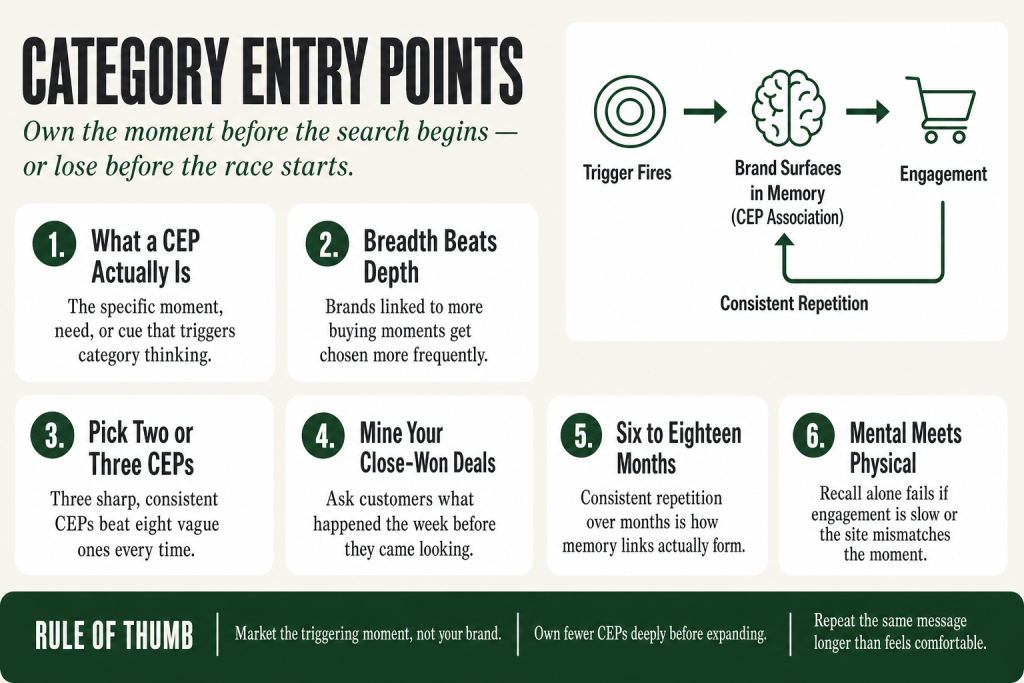
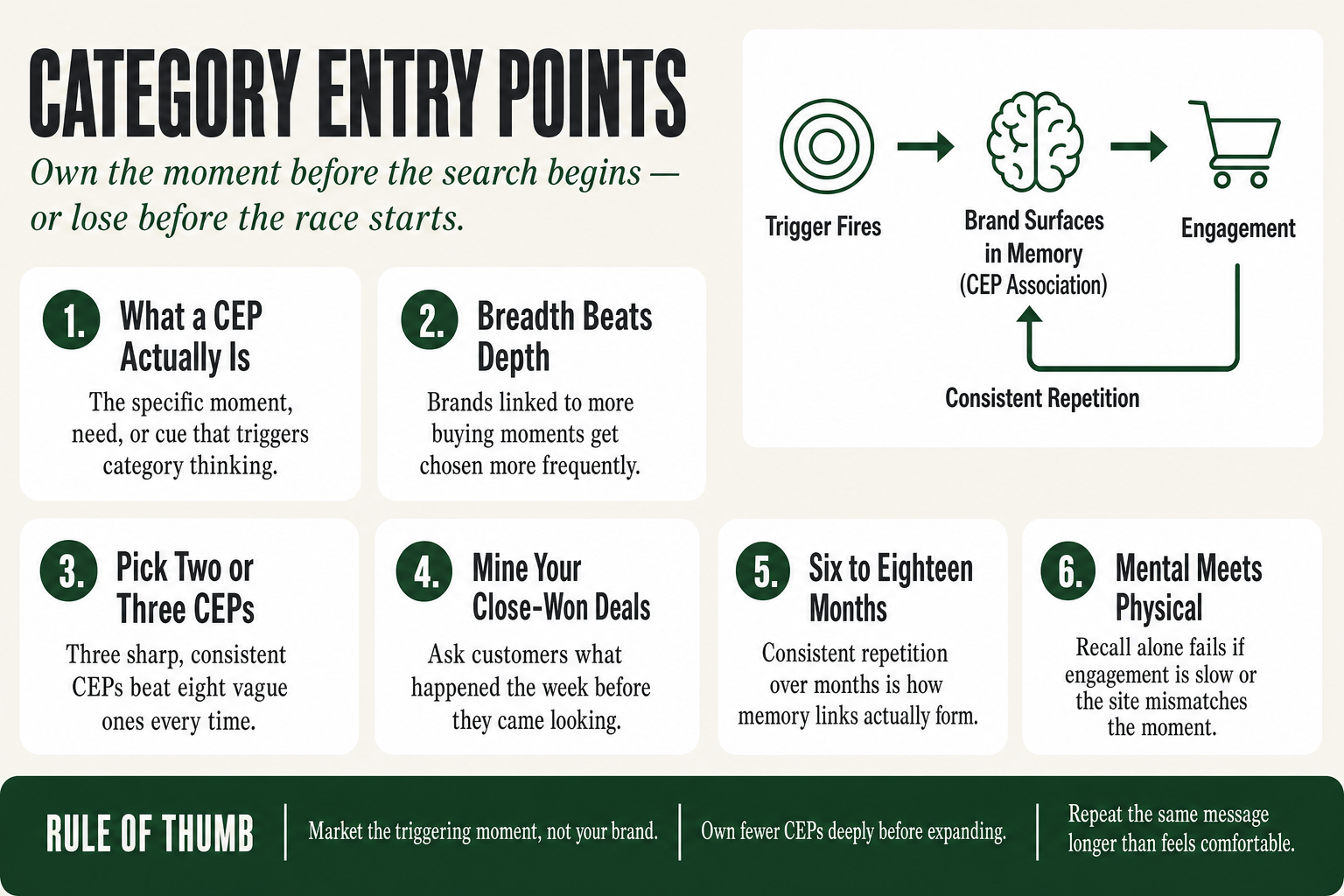
If you haven’t heard the term category entry points yet, here’s the short version: they’re the specific needs, occasions, contexts, and cues that cause someone to start thinking about a product category, and then decide which brand to consider. By the end of this page, you’ll know how to identify the two or three moments your business can credibly own, build those moments into your messaging and content, and stop wasting budget describing features that buyers don’t recall when it actually matters.
Here’s the uncomfortable truth about how buyers actually choose. They’re not sitting at their desk running a rational comparison of vendors. They’re in a moment, a contract just expired, a machine just broke down, a new employee just complained about the old system, a guest just left a bad review. The moment creates the need. The need triggers a category. And then, almost reflexively, one or two brand names float up from memory. If yours isn’t one of them, you’re not even in the race. You’re waiting to be found by whoever bothers to search.
Most small-business marketing is built entirely around what happens after someone already knows they want your category. You build a better website, run review campaigns, polish your Google Business profile. All worth doing. But the operator who understands category entry points is playing an earlier and more powerful game: shaping which brand surfaces in memory the moment a trigger fires, long before a Google search begins.
The idea in 30 seconds
- A category entry point (CEP) is the situation, moment, need, or cue that makes a buyer think about your category, and which brand comes to mind first.
- The operator who links their brand to more of these moments gets recalled more often, before a formal search, before a referral, before a competitor’s ad shows up.
- CEPs are not product features or brand promises; they are the buyer’s territory, moments in the buyer’s life, not statements about your offering.
- Identifying your top three to five CEPs and weaving them consistently into messaging, content, and outreach is the practical work of building mental availability.
- The trap most small operators fall into: describing their brand instead of owning the triggering moments, which means being invisible exactly when buyers are about to spend money.
- You don’t need a research budget. You need your best customers’ stories, and the discipline to repeat the right message in the right context, for longer than feels comfortable.
Where the Idea Came From
Byron Sharp and Jenni Romaniuk developed the CEP framework at the Ehrenberg-Bass Institute for Marketing Science, an academic research body at the University of South Australia that has spent decades studying actual purchase behavior across hundreds of categories. Sharp’s 2010 book How Brands Grow laid the foundation, arguing that brands grow because people remember them at the right moment, not primarily because of emotional attachment or differentiation. The term “category entry points” was formalized when Romaniuk and Sharp co-authored How Brands Grow Part 2published in 2016, where they detailed how to identify, measure, and build CEP associations.
The lineage matters for one reason: this framework is empirical, not theoretical. What the Institute found, repeatedly, was that brand choice is less deliberate than marketers assume. Buyers use mental shortcuts, they recall a brand associated with a relevant situation and go with it. The richer a brand’s network of associations to the situations that actually trigger buying, the more often it gets chosen. CEPs are those memory structures made concrete and actionable.
The Problem: Most Operators Market the Brand, Not the Moment
Ask most small-business operators to describe their marketing strategy and they’ll describe their brand, what they offer, who they serve, why they’re better. That’s positioning, and it matters. But it’s entirely brand-centric. The buyer isn’t thinking about your brand when a trigger fires. They’re thinking about their problem. If your brand hasn’t pre-loaded itself into the right memory slot, the one associated with that problem, you don’t surface.
This is the gap CEP thinking closes. Instead of asking “What do people think of when they think of us?”, a brand-centric question, you ask “When in our buyers’ lives does the need for what we do actually appear?” Those are two different questions, and they produce radically different marketing decisions.
Consider a commercial cleaning company. Brand-centric marketing says: “We’re reliable, affordable, and professional.” CEP-based marketing identifies the actual triggers: a tenant moving out with a hard deadline; a restaurant that just got a health inspection warning; an office manager onboarding forty new employees next Monday. Each of those is a category entry point, a specific, recognizable moment where someone shifts from “not thinking about cleaning” to “needing a cleaning company right now.” The brand that has spent six months publishing content around those moments, showing up in LinkedIn searches for those problems, and getting mentioned in those contexts by past clients, that’s the brand that gets the call.
The failure this prevents: being vaguely known instead of sharply associated. Vague awareness doesn’t help when a buyer is mid-crisis. Sharp, specific associations to real triggering moments, that’s what gets you thought of first.
The Core Principles Behind Category Entry Points
CEPs are the buyer’s territory, not the brand’s. This is the one thing that trips operators up most often. A category entry point is not a claim you make about yourself, it’s a moment in your buyer’s life. “When you need a reliable partner” is not a CEP; it’s a tagline. “When your accountant just told you your tax burden went up 30% and you don’t know why”, that’s a CEP. The difference is specificity, and specificity is what creates the memory link.
CEPs can be situational (a specific event or occasion), emotional (a feeling or anxiety state), contextual (a location, time of day, or surrounding activity), or social (who the buyer is with, or who is applying pressure). In B2B markets, they often involve organizational triggers: a compliance deadline, a new hire who hates the existing tool, a competitor threat that landed in the boardroom. In B2C, they skew toward occasions and feelings. The framework handles both.
Brands associated with more CEPs get chosen more frequently. This is the central empirical finding from Romaniuk and Sharp’s research. The more buying situations a brand has linked itself to, the greater the probability of being recalled when any one of those situations fires. It’s not about depth of attachment to one moment, it’s about breadth of presence across many relevant moments. That finding cuts against a lot of small-business instinct, which defaults to narrowing focus. Narrowing your target audience is smart. Narrowing the range of triggering moments you’re associated with is usually a mistake.
Mental availability and physical availability work together. CEPs build mental availability, the likelihood your brand surfaces in memory when a trigger fires. But recall alone doesn’t close the deal. If a buyer thinks of your brand and then hits a dead voicemail, a website that doesn’t match the moment they’re in, or a slow response, mental availability leaks out. Being thought of and being easy to engage: that combination is what converts recalled brands into actual revenue.
Consistency over time is what builds the link. Associating your brand with a CEP isn’t a campaign, it’s a sustained, repeated message across touchpoints, over months and years, until the link firms up. A few LinkedIn posts don’t do it. Neither does one webinar. KitKat’s near-monopoly on the “break” moment was built through decades of consistent pointing at one situation. Small operators can’t match that scale, but they can match that discipline within their own market.
How to Identify Your Category Entry Points (Without a Research Budget)
Large brands run formal CEP research, surveys that ask category buyers to describe the situations in which they last thought about the category, then map which brands came to mind. You probably can’t do that. Here’s what you can do instead, and it produces surprisingly usable results.
Start with the five Ws
Map your CEPs by asking: Who is under pressure to find a solution (and who is applying that pressure)? What specific problem or outcome are they trying to solve? When does the need typically arise, what event, deadline, or failure triggers it? Where are they when the thought occurs? While doing what, what adjacent activity or emotion is present when the category enters their mind? Run this exercise on your ten best customers, either by interviewing them or by replaying the sales conversations you remember. The recurring themes are your CEPs.
Mine your close-won deals
Ask every customer who converts one question: “What made you start looking for something like us right now, what happened in the week or two before you searched?” That answer, verbatim, is almost always a category entry point. Collect twenty of these and you’ll see three to five patterns. Those patterns are the situations you need to own.
Use your lost deals, too
Win-loss analysis is a natural partner to CEP identification. When you lose a deal, the buyer found another brand more mentally available for their specific triggering moment. Knowing which moment that was, and which competitor is now owning it, tells you where you have a gap and where you have an opening.
Prioritize with three filters
Once you have a list of candidate CEPs, run them through three questions: How often does this situation actually occur among buyers in your market? How credibly can your brand associate with it, do you have stories, evidence, and real presence in that context? And how much whitespace exists, is any competitor already dominating that mental slot? The best CEPs to pursue first are common, credible for you, and currently unowned.
Pick fewer than you want to
You’ll generate more CEP candidates than you can own. Chasing too many simultaneously is the fastest way to be present everywhere and remembered nowhere. Three sharp, consistently-reinforced CEPs beat eight vague ones every time. Start with two or three. Build the associations over a year. Then expand.
Putting this to work? The ideas in the Canon are the foundation under the tactical playbook in Build a Complete Marketing Department — grab the free companion kit at mmsvegas.com/resources.
Category Entry Points in Practice: What This Actually Looks Like
KitKat is the most instructive example in the literature because it’s so clean. One CEP, the moment of taking a break, owned so completely and for so long that the association is nearly automatic for millions of people. JWT London’s Donald Gilles wrote the line in May 1957; it first appeared in television ads a year later. The genius isn’t the slogan itself, it’s the discipline of pointing every piece of communication at that single, specific moment for nearly seven decades. KitKat didn’t describe its chocolate. It described a moment in which you might want chocolate. That’s a different thing entirely.
Häagen-Dazs made the same move with more selectivity. Rather than competing for all ice cream occasions, kids’ parties, casual summer snacking, post-sport treats, it deliberately focused on premium CEPs: personal indulgence, romantic evenings, sophisticated adult desserts. By refusing to show up in the wrong moments, it made its presence in the right ones feel more deliberate and more credible. Advertising placement, creative tone, pricing, all of it points at the same cluster of entry points. Nothing leaks.
Domino’s is worth looking at for operators who sell on a functional basis. The company didn’t win by arguing its pizza tastes better. It won by owning the CEP of delivery convenience, when you want food fast and don’t want to think about it. The 30-minute guarantee, introduced in 1979, shaped the brand’s early identity around that promise entirely. When the guarantee was dropped in 1993 following safety concerns and a $78 million verdict in a St. Louis lawsuit, Domino’s needed a new vehicle for the same CEP. The Pizza Tracker, launched in January 2008, carried that promise forward, a real-time order window that turned “I wonder where my pizza is” into a brand moment rather than an anxiety. Different tool, same triggering moment. That’s CEP thinking applied over decades.
In the B2B world, Colin Fleming, then EVP of Global Marketing at Salesforce, documented 33 CEPs within the company’s core business, a number he described publicly on The Marketing Architects podcast. That’s a large brand with the resources to maintain that many distinct associations. Your business shouldn’t try. But what you can take from Salesforce is the underlying move: instead of just saying “CRM software,” they mapped the exact moments in which a sales leader or VP of Growth starts thinking “we need a system for this.” Contract renewal season. Sales team scaling. A new executive who doesn’t trust gut-feel forecasting. Each is a CEP. Each gets a specific message, content piece, or sales motion pointed at it.
Small-business examples that work the same way
A bookkeeper who wants to grow doesn’t benefit much from saying “I do accurate, reliable bookkeeping.” She benefits from being sharply associated with the moments that actually send business owners looking: receiving a loan application requirement for three years of clean books; reaching the point where the founder is spending two Sundays a month on QuickBooks instead of running the business; getting the first IRS notice. Each of those is a CEP, and a content topic, a referral partner conversation, an email subject line, or a Google Business post.
A restaurant supply company renting commercial kitchen equipment doesn’t need to describe its inventory. It needs to be thought of when a caterer takes on a job bigger than their equipment handles; when a ghost kitchen concept is testing before committing to capital; when a restaurant owner’s walk-in fails on a Thursday. Those are the triggering moments. Marketing anchored to those moments converts. Marketing anchored to the catalog does not.
Where Category Entry Points Pay Off Most
CEPs are most valuable in categories where buying is infrequent but triggered by recognizable events. That covers a lot of small-business categories: legal services, accounting, HVAC, home renovation, commercial real estate, HR software, payroll, security systems, professional coaching. In these categories, the buyer isn’t in the market most of the time, but when a trigger fires, they move fast and they recall whichever brand surfaced most naturally. Being pre-loaded into memory before the trigger is enormously valuable. Being available only after the search begins is table stakes.
CEPs also pay off strongly in any category with a long consideration cycle. In B2B especially, the average decision takes months from trigger to contract. If your brand was already associated with the triggering moment before the formal RFP goes out, you enter that process with an advantage no ad campaign can replicate. You’re not a discovery, you’re a familiar name. Familiarity reduces perceived risk, which matters more in high-stakes B2B decisions than almost any other factor.
Local and regional businesses often underestimate their CEP advantage. You know your market. You know when the busy season ends and the cash-flow anxiety starts. You know which local events trigger category demand. You know the regulatory changes that send business owners scrambling. A national brand running generic category messaging can’t match the specificity you can bring to local CEPs, if you put in the work to identify them and show up consistently.
Where Category Entry Points Don’t Work (Or Work Differently)
CEPs are a long game. If you need revenue in the next thirty days, CEP-building is not the answer. The whole idea is about pre-loading memory before a trigger fires, which requires time for those associations to form. For immediate demand generation, direct response, retargeting, and referral activation are faster levers. CEPs complement them; they don’t replace them.
The framework also works differently in high-frequency, low-involvement categories, grocery staples, office supplies, commodity services where buying is habitual and CEPs are almost too numerous to isolate meaningfully. In those categories, physical availability (distribution, shelf presence, ease of finding you) often matters more than mental availability built through CEP association. For most small-business operators, this isn’t your category, but it’s worth knowing the model has limits.
CEPs are also harder to own when your category itself is poorly understood by buyers. If buyers don’t know your category exists, they can’t be triggered by the moments that would bring them to it. In that case, category education has to come before CEP positioning. You can’t point someone toward a door they don’t know is there.
One more honest caveat: the academic research behind CEPs was conducted primarily on large consumer brands with significant media budgets. The principle translates well to small businesses, but the measurement tools, Mental Penetration, Network Size, Share of Mind, don’t. Small operators should treat CEPs as a strategic lens for messaging and content decisions, not as a formal measurement system. Use it to guide what you say and where you say it. Don’t try to run a brand health tracker on a three-person business.
Common Misunderstandings About Category Entry Points
“CEPs are the same as buyer personas.” They’re not, and confusing them is genuinely costly. A persona describes who the buyer is, demographic, psychographic, job title. A CEP describes when they enter the category and why. You can have the same persona (mid-sized business CFO) who enters your category for completely different reasons at different times: a tax season pressure spike, a board-mandated cost audit, a new hire who flagged a risk. Each is a different CEP. Personas organize your audience. CEPs organize the moments that trigger action. You need both.
“A CEP is a use case or a job-to-be-done.” There’s overlap, but the distinction matters. Jobs-to-be-done focuses on the functional and emotional job a buyer is trying to accomplish, the outcome they want. A CEP is the specific triggering moment that sends them into the category to hire something for that job. JTBD is about what they want. CEPs are about when they start wanting it.
“Owning a CEP means running one ad campaign.” Association is built over time through consistent repetition, not a single exposure. A single campaign creates awareness; sustained repetition builds the automatic link. That’s a longer, more patient commitment than most operators are comfortable making, but it’s the only way it actually works.
“More CEPs is always better.” More CEPs means more mental availability, in theory. In practice, for a resource-constrained small business, spreading too thin means you’re not consistently reinforcing any one association. Three CEPs you actually show up for consistently outperform ten you mention occasionally. Scale up only when you’ve genuinely built a strong association to your priority moments.
“CEPs are only for consumer brands.” The Ehrenberg-Bass Institute has published specific research on B2B CEPs, and the mechanism works the same way. In B2B, triggering moments often have a more organizational flavor, a new executive mandate, a compliance deadline, a growth milestone that breaks the current tool, but they’re still specific moments that send someone into the category.
Common Mistakes
- Marketing the brand instead of the trigger — Rewrite your core messaging to describe the moment when the need arises, not what you do or how good you are at it. “We help growing businesses with their books” is about you. “When the founder is spending two Sundays a month on QuickBooks” is about the moment. Those two framings do completely different things in a buyer’s memory.
- Identifying too many CEPs and building associations to none — Commit to two or three entry points and point all content, referral conversations, and case studies at those specific moments for at least twelve months before expanding. Spreading thin across eight candidates means none of them stick. Pick fewer than feels right. Build depth first.
- Treating CEP-building as a one-time campaign — Run a campaign and you get a spike in awareness that decays. CEP associations form through sustained repetition over months and years, the message has to keep showing up in the right contexts. Set a quarterly content and outreach cadence anchored to each priority CEP, and hold it through the awkward stretch where it feels like nothing is happening.
- Chasing CEPs the operator wants to own rather than the ones buyers actually experience — Ground your CEP selection in customer interviews and close-won deal debrief data, specifically the answer to “what was happening the week before you came looking?” What buyers actually said beats what you wish they were thinking about, every time. Do ten interviews before you touch a whiteboard.
- Collecting generic social proof instead of situation-specific testimonials — “Great service, very professional” is invisible in a buyer’s memory when a trigger fires. You need reviews that open with the triggering moment: “Our lease was up in three weeks and the unit was a wreck”, that sentence lands in the next reader’s mind at exactly the right time. Coach every willing customer to describe what was happening before they called you, not just how things turned out.
- Ignoring physical availability as the follow-through — Mental availability gets you thought of. Physical availability is what happens next. If your site doesn’t match the moment a buyer just recalled you for, if your response time is measured in days, or if your referral partner can’t point someone to a clear next step, the recalled brand leaks. Every CEP you build toward needs a frictionless path to engagement behind it.
Operator’s Take
Here’s the thing nobody tells you when you first encounter CEP thinking: the framework sounds obvious once you hear it, and then you go back to your own marketing and realize almost none of it is actually doing the job. That gap is where the real work lives.
Right now, in mid-2026, there are two concrete shifts that make CEP thinking more urgent for small operators than it was three years ago. First, AI-assisted search is collapsing the discovery window. When a buyer asks an AI assistant to recommend a bookkeeper, a cleaning company, or an HR consultant, the model surfaces names it’s encountered repeatedly in situations that match what the buyer described. That’s essentially automated CEP recall, and if your content, reviews, and referral language haven’t been pointing at specific triggering moments, you’re not getting surfaced. Second, review platforms are rewarding situation-specific language. Google’s ranking signals increasingly favor reviews that describe the context of the purchase, not just sentiment. “Five stars, highly recommend” does nothing. “Called them Thursday afternoon when our walk-in failed before a Saturday event and they had us sorted by Friday morning”, that review fires in the right buyer’s memory and it signals context to an algorithm. Both of these shifts reward the same behavior: naming the triggering moment explicitly, consistently, in every customer-facing channel.
The most underused lever right now is your referral partners. Most operators who have referral relationships get vague, category-level introductions: “You should talk to Sarah, she does bookkeeping.” That’s better than nothing. But a referral partner who knows your CEPs introduces you differently: “You should call Sarah, she’s the person to talk to when your books are a wreck and you’ve got a lender asking for three years of clean financials in a hurry.” That introduction primes the buyer with the exact triggering context. They arrive already half-convinced you’re the right fit, because the situation described matches the one they’re in. Spend thirty minutes with your top three referral sources this month and give them that sentence. Not a pitch deck, one sentence that names the moment. That’s the highest-leverage CEP move most operators never make.
On AI tools: brief a model with your customer interview notes and ask it to cluster the triggering situations. It’s genuinely useful for drafting a first-pass CEP map in an hour instead of a day. The judgment calls, which CEPs you can credibly own given your current reputation, which ones a well-funded competitor already dominates, which moments you actually show up for right now, those stay with you. AI gets you to a starting list faster. It doesn’t tell you which moments are winnable.
The operators who stall on this work almost always stall for the same reason, they can’t commit to repeating the same message for twelve months. It feels like stagnation. It’s not. It’s how the memory link forms. If you find yourself wanting to change your messaging after three months because it’s gotten stale, it’s probably just starting to work. Hold the line a little longer than feels comfortable.
Used in
- ✓ Build a Complete Marketing Department
Used to structure the awareness and positioning layer of the marketing system, specifically, to define what moments the brand should be present in before a buyer starts an active search. - ✓ The Missing Manual for FunnelKit
Informs the top-of-funnel entry logic, which triggering moments each opt-in, lead magnet, or entry sequence is designed to intercept, so the offer matches the moment the buyer is actually in. - ✓ The Missing Manual for Make
Used to design automated outreach and nurture sequences that are timed and worded around specific CEP contexts, so messages arrive when the triggering moment is most likely to be active.
FAQ
How many category entry points should a small business try to own?
Start with two or three. Most small operators generate a longer list than they can act on, and spreading too thin means building no association strongly. Own a few CEPs well before expanding. A good rule: if you can’t point to at least three content pieces, three case study narratives, and three referral partner conversations that explicitly address each CEP, you don’t own it yet.
How do category entry points differ from positioning?
Positioning describes how you want to be perceived relative to competitors, your place in the market. CEPs describe the specific moments that send buyers into the category in the first place. Positioning is about the brand. CEPs are about the buyer’s life. Strong operators use positioning to decide what they stand for, then CEPs to decide which moments that standing should be linked to.
Do category entry points work for B2B businesses?
Yes, and the Ehrenberg-Bass Institute has published specific research confirming this. B2B CEPs tend to be organizational triggers, compliance deadlines, team scaling, new executive mandates, contract renewals, rather than emotional or occasion-based ones. Build a strong association between your brand and the moments that send buyers into the category, and you get recalled before the formal search starts.
How long does it take to build a strong CEP association?
Realistically, six to eighteen months of consistent, focused effort before you start seeing the brand-recall benefit in inbound inquiries and referral framing. This is a brand-building timeline, not a campaign timeline. Operators who expect ninety-day results from CEP work usually abandon it before the associations form.
Can I measure whether my CEP strategy is working without a formal brand tracker?
Informally, yes. Ask every new inbound inquiry what prompted them to reach out, if you hear the triggering moments you’ve been building associations to, the links are forming. Track how referral partners describe you when they make introductions; if they’re using the moment language you’ve been reinforcing, it’s working. Full mental availability metrics require research budgets most small businesses don’t have, but these proxies are meaningful.
What’s the relationship between category entry points and SEO content?
A strong CEP strategy naturally generates better SEO content because CEP-based writing describes real moments buyers experience, which is exactly what buyers type into search engines. Instead of writing about your services, you write about the moments that trigger the need for your services. That’s more specific, more searchable, and more likely to match buyer intent at the exact moment of the trigger.
Further reading
- How Brands Grow by Byron Sharp (2010), the foundational empirical case for mental availability and the conditions under which brands actually grow. Read the original argument before the framework layer.
- How Brands Grow Part 2 by Jenni Romaniuk and Byron Sharp (2016), where CEPs are formalized and made measurable; the more directly applicable of the two for anyone building a CEP strategy.
- Better Brand Health by Jenni Romaniuk (2023), the most recent Ehrenberg-Bass volume, focused on measuring mental availability and CEP performance over time.
- Category Entry Points in a B2B WorldJenni Romaniuk’s whitepaper published through the LinkedIn B2B Institute; freely available and the clearest short treatment of how CEPs translate to business-to-business marketing.
Sources: Byron Sharp and Jenni Romaniuk, Ehrenberg-Bass Institute for Marketing Science, How Brands Grow (2010) and How Brands Grow Part 2 (2016); LinkedIn B2B Institute / Jenni Romaniuk, ‘Category Entry Points in a B2B World’ whitepaper; Colin Fleming (then EVP Global Marketing, Salesforce), on Salesforce’s 33 CEPs via The Marketing Architects podcast and first-the-trousers.com; KitKat slogan history, Creative Review (‘Have a Break Have a Kit Kat,’ November 2018), Wikipedia/KitKat, The Ad Digest; Domino’s 30-minute guarantee history, The Hustle, Tasting Table, Snopes; Domino’s Pizza Tracker launch, Domino’s official press release (January 30, 2008), Domino’s Tracker Fact Sheet; Häagen-Dazs CEP analysis, categoryentrypoints.com (‘Category Entry Point Examples,’ January 2023); quantilope.com CEP research guide (December 2025); minimba.com CEP explainer (Mark Ritson MiniMBA, July 2025); basisglobal.co B2B CEP mapping guide (May 2026); footprints-ai.com CEP retail media analysis (May 2026); dovetail.com ‘How Brands Grow Changed Market Research’ (2024).
Brian Kasday spent forty years in direct-response marketing before rebuilding the whole operation as a one-person shop. He writes The Operator’s Library — including “Build a Complete Marketing Department” — for operators who’d rather build it themselves than wait on someone else.
Build the department these ideas describe — the free companion kit: mmsvegas.com/resources.
More The Operator's Canon guides
Free · Operator Toolkit
Want the tools, not just the guide?
Get the free operator toolkit — templates and checklists for the systems you actually run, plus a note when this guide changes.
Get the free toolkit →