
Last updated: July 2026
Channel market fit is the degree to which your acquisition channel, your offer, and your target market are structurally compatible with each other. By the end of this page, you’ll be able to run a real diagnostic on your own traffic, identify whether a channel mismatch is causing your numbers to stall, and make a defensible decision about where to put your next dollar, before you touch a single ad creative.
Here’s the situation most operators find themselves in: a campaign isn’t working, so they change the headline. That doesn’t work, so they try a new image. That doesn’t work, so they fire the agency. At no point does anyone ask whether the channel itself is structurally wrong for what they’re selling to whom they’re selling it. The creative gets blamed for a structural problem. That’s an expensive mistake, and it happens constantly.
Channel market fit sits one level above campaign execution. It’s the question of whether the channel can ever work for your offer, regardless of how good the messaging is. A $4,000 consulting engagement probably can’t be sold profitably through cold Instagram traffic, no matter how brilliant the copy. A $15 impulse-buy product probably can’t survive on outbound sales calls, no matter how polished the pitch. The math just doesn’t close. That’s a fit problem, not a creative problem.
Two distinct threads of growth thinking shaped this concept. Brian Balfour, founder of Reforge and former VP of Growth at HubSpot, argued on brianbalfour.com that market, product, channel, and business model form an interdependent system where each element constrains the others. The core insight: products are built to fit channels, channels don’t mold to products. Separately, Gabriel Weinberg (founder of DuckDuckGo) and Justin Mares published Traction in 2014, giving practitioners a structured method for testing channel candidates systematically rather than defaulting to whatever channel feels most familiar. Balfour explains why some channel-offer combinations are structurally wrong from the start. Weinberg and Mares give you the method for finding the right one. Neither work was aimed at small-business operators, both skew toward venture-backed startups, but the structural logic travels regardless of company size.
The idea in 30 seconds
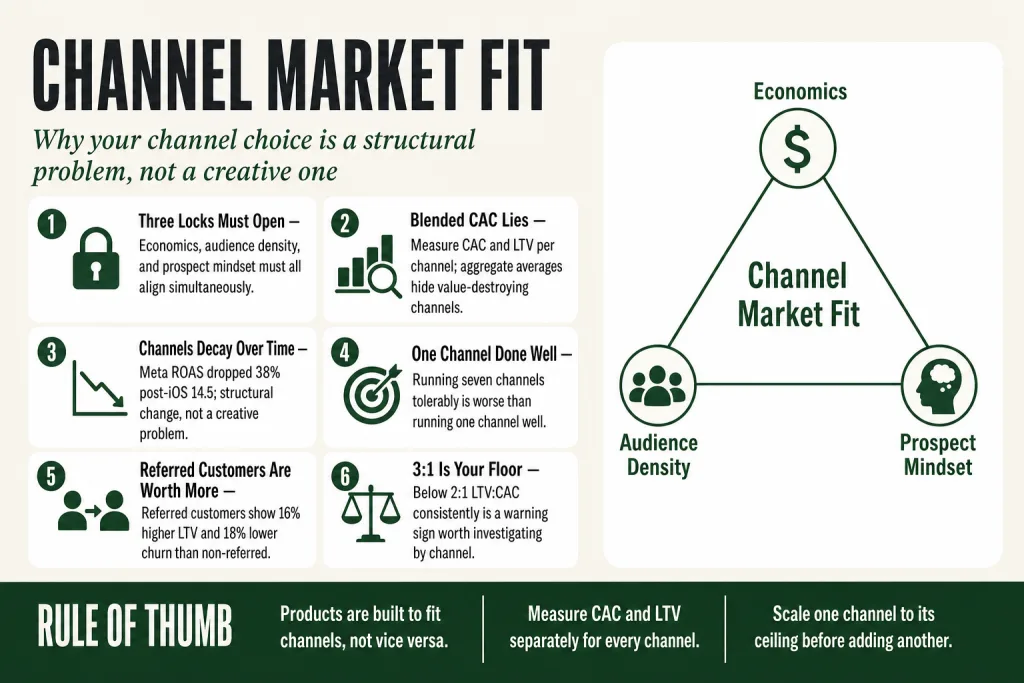
- Channel market fit is the structural match between your offer, your ideal customer, and the acquisition channel you use, all three have to align at once.
- Bad creative is rarely why a channel fails; a structural mismatch between channel and market almost always comes first.
- Every channel has implicit economics, CAC ceilings, buying temperature, audience mindset, and your offer must fit those constraints, not fight them.
- Channels have life cycles: they open, get crowded, and decay. What worked two years ago may be structurally broken today.
- The diagnostic move is to measure CAC and LTV by channel separatelynot as a blended average, the aggregate hides what’s actually killing you.
- You don’t need to win every channel. Finding one channel with genuine fit and scaling it reliably beats spreading thin across five mediocre ones.
Where the Idea Came From
Marc Andreessen’s 2007 essay “The Only Thing That Matters” made product-market fit the dominant lens for startup success, useful framing that also created a blind spot. Operators became so focused on whether their product fit the market that they never seriously asked whether the channel they chose could structurally support the offer.
Brian Balfour addressed this directly. His argument, laid out on brianbalfour.com: market, product, channel, and business model form an interdependent system, and treating channel selection as something you sort out after the product is ready is how you end up pushing a boulder uphill. Products are built to fit channels. The channel shapes requirements for the product, the pricing, the first offer, and the sales motion, not the other way around.
Gabriel Weinberg and Justin Mares contributed the complementary method in Traction (2014): brainstorm all possible channels, run cheap tests on the most promising candidates, then concentrate on the single channel most likely to drive the next growth stage. Where Balfour provided the structural logic, Weinberg and Mares provided the experimental discipline for finding fit through testing rather than theorizing about it.
What Channel Market Fit Actually Means
Think of channel market fit as a three-way lock. Your offer has to fit the channel’s economics. The channel has to reach the right audience. And the audience has to be in the right mindset to receive the offer when the channel delivers it. All three locks need to open simultaneously. Most failures come from one of them being stuck.
The economics lock. Every channel has an implicit cost structure, a floor below which you can’t acquire customers at scale, and a ceiling above which the math destroys your margin. A $49 software subscription can’t survive a channel where the average CAC runs $300, unless you have unusually high retention and expansion revenue. Conversely, a high-ticket B2B service can support outbound sales with a $1,500+ CAC if the average deal value is $40,000 and clients stay for years. The point isn’t that one CAC is good and another is bad in the abstract, it’s whether the channel’s natural economics fit your unit economics. Blended CAC figures lie. You need to know what it costs to acquire a customer through each channel separatelythen test whether that number fits the lifetime value of customers coming through that specific channel, not your overall average.
The audience lock. The question isn’t only whether your target customer exists on a given channel, it’s whether they’re there in sufficient density to build a viable acquisition engine. LinkedIn reaches B2B professionals, but LinkedIn’s ad auction is expensive precisely because everyone who wants B2B professionals knows this. If your ideal customer profile is a $200K/year CFO at a 50-person manufacturing firm, LinkedIn may be where they exist, but your total addressable audience on that platform may be 4,000 people. You can saturate that audience in a month and spend the next eleven months wondering why performance is declining. The audience has to be large enough for the channel to sustain your acquisition needs over time.
The mindset lock. Each channel puts the prospect in a different frame of mind when they encounter your offer. Someone searching Google for “emergency HVAC repair Las Vegas” is in active-need mode, high intent, willing to pay, impatient. Someone scrolling Instagram on a Sunday evening is in passive-entertainment mode, low intent, easily distracted, not shopping. These aren’t the same buyer, even if it’s the same person. Selling a high-consideration, high-trust service through a passive-entertainment channel is like walking into a comedy club and trying to deliver a PowerPoint presentation. You’re technically in front of people. But the context works against you from the start. Understanding where the prospect is in their decision journey when your channel reaches them is a prerequisite for knowing whether the channel can work at all.
The ARPU, CAC Spectrum: The Framework Operators Actually Need
Every acquisition channel sits somewhere on a spectrum defined by how much it costs to acquire a customer. Every offer sits on a parallel spectrum defined by average transaction value and lifetime value. Channel market fit, in economic terms, means your offer’s LTV is positioned far enough above your channel’s natural CAC that you have enough margin to operate and reinvest.
Here’s the rough shape of that spectrum in practice:
- Viral and product-led channels (referral programs, word-of-mouth, freemium conversion) have near-zero direct CAC but require a product that delivers value quickly and creates natural sharing behavior. They fit offers with moderate to high volume and low-to-mid ticket prices, consumer apps, low-cost SaaS, community-driven products.
- SEO and content have low marginal CAC once built but substantial upfront investment in time and production. They favor considered purchases, where prospects are actively researching, and products with enough margin to absorb a 6 to 18 month runway before organic traffic pays off. Structurally wrong for urgent, impulse, or rapidly commoditizing offers.
- Paid social (Meta, TikTok, Instagram) have moderate CAC for the right product categories, visually compelling, impulse-adjacent, sub-$200 price points where creative can do emotional work fast. Privacy changes have pushed CACs upward for lower-margin offers that needed targeting precision to survive economically.
- Paid search (Google, Bing) captures active demand, people who already know they have a problem and are looking for a solution. High intent means better conversion, but auction competition keeps CAC elevated. It fits offers with specific, searchable pain points and enough margin to compete in those auctions.
- Outbound sales and direct outreach have the highest CAC of any channel, sometimes four figures per acquired customer. They only work when deal size is large enough to absorb that cost and lifetime value is long. Enterprise software, high-ticket professional services, and complex B2B solutions belong here. Trying to move a $500 product through outbound sales is a structural mismatch, not a sales execution problem.
- Partnerships, affiliates, and co-marketing sit in a variable zone, CAC depends on commission structure and partner quality, and the channel inherits the trust and audience of the partner. Fit depends on whether your offer complements the partner’s audience without competing with it.
The question to ask before testing anything: given what this offer costs, what the customer is worth over time, and who the customer is, which channel’s native economics are even compatible? That question eliminates half the candidates before you spend a dollar.
Channel Market Fit Is Not Static, and That’s the Part Everyone Forgets
Channels have life cycles. A channel that delivers strong fit today can become structurally broken within 18 months, not because your offer changed, not because your audience changed, but because the channel itself changed around you.
The pattern is predictable. A channel opens with low competition and low CAC. Early movers find fit and get strong returns. Others notice. The auction gets crowded, CPCs rise, audience pools thin as everyone targets the same people, and returns compress toward the mean. Sometimes the channel itself degrades, algorithm shifts, privacy policy changes, regulatory pressure, or a demographic tide that pulls the relevant audience to a newer platform.
Facebook/Meta is the most cited example. Apple’s iOS 14.5 App Tracking Transparency rollout in April 2021 made cross-app tracking opt-in rather than automatic, and the published opt-in rates diverge so sharply by methodology that no single number is safe to quote: measuring the same first week after launch, Flurry put global opt-in at 11% and U.S. opt-in at 4% across 5.3 million users, while AppsFlyer put that same week at 37% globally and 29% in the U.S. The gap comes from different definitions of an eligible user, which is worth remembering any time a platform-impact number gets quoted at you. The conversion signal powering Meta’s ad algorithm shrank dramatically. Data from adnabu.com recorded Facebook ROAS dropping from approximately 3.13 (February, April 2021) to 1.93 (July, September 2021), a decline of roughly 38%. Advertisers who had built their entire acquisition engine on Meta’s targeting precision found their CACs climbing and their attribution deteriorating. That wasn’t a creative problem. It was a structural change to the channel that broke fit for offers that had depended on precision targeting to survive economically. Some rebuilt fit with server-side tracking, broader creative testing, and first-party data. Others discovered the channel was no longer viable for their unit economics and had to find different channels from scratch.
This is not an argument against any particular channel. It’s an argument for treating channel market fit as a continuous diagnostic, not a one-time decision. Rising CAC with flat conversion rates is often the first signal of audience saturation or competitive crowding, not a reason to refresh creative. Declining organic reach despite no change in content quality is often a platform shift, not a content quality problem. These signals deserve a structural reading before a tactical one.
Run a monthly check on each active channel: CAC trend, conversion rate trend, audience overlap. You catch structural decay before it becomes a budget crisis rather than after. A channel that had fit two years ago may need to be replaced, supplemented, or restructured. That’s maintenance, not failure.
Putting this to work? The ideas in the Canon are the foundation under the tactical playbook in Build a Complete Marketing Department — grab the free companion kit at mmsvegas.com/resources.
Diagnosing Channel Market Fit: The Operator’s Method
If you want to know whether you have channel market fit, or where the mismatch is, the sequence below does the work. It’s not a checklist. It’s a diagnostic process you run when traffic is underperforming and you need to know whether to fix the execution or fix the channel selection.
Step 1: Separate your CAC and LTV by channel, not in aggregate
Blended CAC is nearly useless for diagnosis. You need to know what it costs to acquire a customer through each specific channel, and, critically, what that channel’s customers are worth over time. These two numbers can diverge dramatically even when surface metrics look similar. A customer acquired through branded search may have an LTV of $1,800; the same product’s customer acquired through a discounted paid social campaign may have an LTV of $450. If your average CAC is $300, the organic channel is highly profitable at a 6:1 ratio, and the paid social channel is destroying value at a 0.9:1 ratio. That gap is invisible in aggregate numbers. A standard benchmark is an LTV:CAC ratio of at least 3:1 for healthy acquisition economics; below 2:1 consistently is a warning sign worth investigating by channel. Cohort analysis by acquisition channel is the cleanest way to surface this.
Step 2: Map the channel’s mindset against your offer’s required trust level
Ask: what is the prospect doing when the channel reaches them, and what level of trust is implied at that moment? Rank your offer on a trust-requirement scale, commodity purchases with no risk need almost no trust; complex, expensive, or irreversible purchases need substantial trust before the buyer commits. Then map the channel’s native trust level. Cold social traffic starts near zero. SEO organic searchers have already self-qualified with intent. Referrals from existing customers carry borrowed trust. Email subscribers who opted in have expressed some baseline interest. Wherever there’s a gap between the trust your offer needs and the trust the channel delivers, you need to bridge it, through nurture sequences, proof elements, free trials, guarantees, or repositioning the channel to a lower-stakes first offer. If the gap is too wide to bridge affordably, you have a channel fit problem.
Step 3: Test whether the buying temperature matches the ask
Buying temperature, how close a prospect is to a purchase decision when your channel reaches them, is the channel’s most important behavioral characteristic. High-temperature channels (branded search, direct referral, retargeting warm audiences) convert fast and need short, direct offers. Low-temperature channels (cold paid social, content-driven SEO, podcast sponsorships) reach people who are not shopping at all, they need time, education, and a softer first ask before a conversion attempt. A mismatch here looks like decent click-through rates but terrible conversion rates. The traffic arrives. It bounces. You add urgency. You discount. Nothing works. What’s actually happening is that the offer is asking for high-temperature behavior from a low-temperature audience. Either retool the offer to ask for something lower-stakes first, or accept that this channel will require a longer and more expensive funnel than your current economics support.
Step 4: Check audience density and saturation timeline
Even a perfectly fitted channel has a ceiling. If your total addressable audience in a given channel is 8,000 people, and you’re reaching 2,000 of them per month, you’ll saturate usable audience in about four months. After that, you’ll be paying to show the same message to the same fatigued audience at progressively worse returns. Audience density determines whether a channel can sustain your acquisition needs at the volume you require. A channel with fit but insufficient density is a short-term source, not a growth engine. You use it, extract what you can, and have your next channel already being tested before this one peaks.
Step 5: Use AI to accelerate the diagnosis, not to replace the judgment
A capable AI tool can compress the diagnostic timeline here. Feed it your channel-by-channel CAC and LTV data and ask it to identify which channels have below-threshold LTV:CAC ratios. Ask it to draft a channel comparison matrix with your offer’s key characteristics mapped against each channel’s structural constraints. It helps you build the initial hypothesis about where the mismatch is, what it can’t do is tell you whether your market has shifted, whether a channel’s trust dynamics have changed, or whether a specific audience is fatigued with your category. That judgment stays with you. AI cuts the time it takes to get to the data. The decision is still yours.
Where Channel Market Fit Thinking Works Best
This is most valuable when you’re making a significant channel commitment, meaning you’re about to put real time, money, or team capacity behind a channel for three months or more. That’s when the structural diagnostic earns its keep. Running a quick $500 experiment on a new channel is cheap; discovering six months into a $15,000/month paid social commitment that the economics can’t work is expensive. The fit question should come before the commitment, not after.
It’s also particularly relevant when you’re transitioning from early founder-led growth to a repeatable acquisition system. Founders often build initial traction through channels that don’t scale, personal relationships, conference conversations, warm intros, direct outreach to a network they spent a decade building. Those channels worked because of trust, not because of structural channel fit. When you try to systematize that into a paid channel or a content engine, the economics often look surprisingly bad. That’s the moment to do the structural work: which channels can actually carry the offer to the people who need it, at a cost the business can sustain?
Professional services, consulting, and B2B businesses with long sales cycles and high deal values tend to find that outbound, referral, and content channels fit better than paid social. The deal economics can support the longer acquisition timeline. The buying decision requires the kind of trust that’s hard to manufacture in 15 seconds of scroll. The offer is often too nuanced for a paid social format to explain effectively.
Consumer businesses with visually compelling, lower-ticket products in the $20, $150 range often find that paid social and SEO are structurally compatible, provided margins are healthy enough to absorb the channel’s CAC and the product creates natural repeat purchase behavior that improves LTV over time. The same consumer business with 30% gross margins on a single-purchase product is in a much harder position, because the LTV ceiling makes it nearly impossible to compete in auction-based channels at a sustainable CAC.
Local businesses, restaurants, service providers, clinics, retailers, often find that Google’s local search ecosystem (maps, organic local results, paid local search) has strong fit for high-intent, geographically bound searches. Someone searching for “HVAC repair near me” is already in purchase mode. The channel delivers warm buyers at the moment they’re ready to spend. The challenge is that local search volume is finite and the category can be competitive. Direct mail, community sponsorship, and local partnership channels supplement this well because they reach the same local audience through a different, often less saturated, path.
Where Channel Market Fit Thinking Doesn’t Apply (or Gets Misused)
The framework becomes counterproductive if you use it as a reason to never test anything uncomfortable. There’s a version of this analysis that leads operators to a narrow, paralyzed conclusion: “the economics don’t obviously work, so we won’t try it.” That’s not what this is for. The point is to test cheaply before committing, not to theorize your way out of experiments.
It also doesn’t tell you much about creative quality, message matchor offer construction within a channel that otherwise has structural fit. A channel can fit your market in terms of economics, audience density, and mindset, and you can still fail in it because your creative is weak, your landing page loses the thread from the ad, or your offer isn’t compelling enough. Channel fit is a necessary condition for success in a channel, not a sufficient one. An operator who diagnoses fit, concludes that a channel is structurally compatible, and then stops iterating on execution has confused “the channel can work” with “the channel will work.”
Channel market fit also originated in the startup and SaaS world. The timelines it implies, several months of channel testing before making a major commitment, assume you have enough capital to run parallel experiments. A one-person business or a cash-constrained operator often has to choose one channel and go deep before they have data. In that context, the framework still helps by shaping which single channel to bet on first, but the luxury of running multiple simultaneous tests against a structured prioritization matrix may not be available.
Finally: this concept says nothing about retention. A channel that delivers customers who immediately churn is either attracting the wrong audience or setting wrong expectations, and that’s a problem that lives after the acquisition, not during it. Good channel fit brings the right people in. What happens after they arrive is a different problem set.
Common Misunderstandings About Channel Market Fit
“Product-market fit is enough, channels will sort themselves out.” They don’t. Treating channel selection as something you defer until the product is right is a core failure mode. In practice, channels don’t mold to products. Products are built to fit channels. A product that’s only viable through a high-trust, long-nurture, enterprise sales channel needs to be priced and packaged accordingly from the start. One that has to work in a paid social channel needs creative hooks, a low-barrier first offer, and a fast path to value. The channel shapes the product requirements, not just the other way around.
“More channels means more safety.” Channel diversification is a risk-management strategy, not a growth strategy. Running seven channels tolerably is worse than running one channel well. The better approach is to find one channel with genuine fit, scale it to its ceiling, then develop a second channel while the first one is still performing, not as a hedge, but as a planned transition. At any given stage, one channel dominates. Finding that channel is the work.
“If CAC is lower on a channel, it’s better.” Lower CAC is only better if the LTV of customers acquired through that channel is at least proportionally as good. A channel with half the CAC that delivers customers with a third of the retention isn’t a better channel, it’s a worse one that looks better on a single metric. This is the aggregation trap: blending CAC across channels, celebrating the average, and missing that one channel is subsidizing another’s destruction of value. Measure LTV by acquisition channel, not just cost by channel.
“Channel fit is a one-time call.” Channels decay. Platform changes, privacy shifts, audience migration, and competitive saturation all erode fit over time. What worked two years ago may be structurally broken today, not because your offer or market changed, but because the channel did. Treating channel fit as a permanent finding is how operators get caught flat-footed when a channel they depend on quietly stops working.
Channel Market Fit in Practice: What Operators Are Navigating Now
The channel landscape in 2025 to 2026 has shifted in ways that make the structural fit question more consequential than it was five years ago.
Paid social signal degradation. Apple’s iOS 14.5 ATT rollout in April 2021 made cross-app tracking opt-in, and the published opt-in rates diverge so sharply by methodology that no single number is safe to quote: measuring the same first week after launch, Flurry put global opt-in at 11% and U.S. opt-in at 4% across 5.3 million users, while AppsFlyer put that same week at 37% globally and 29% in the U.S. The gap comes from different definitions of an eligible user, which is worth remembering any time a platform-impact number gets quoted at you. That gutted the conversion signal Meta’s algorithm depended on to find high-intent buyers. Data from adnabu.com recorded Facebook ROAS dropping from approximately 3.13 (February, April 2021) to 1.93 (July, September 2021), a decline of roughly 38%. For higher-margin offers that could absorb rising CAC, the channel remained viable with infrastructure adjustments. For lower-margin offers that needed precision targeting to survive economically, the channel broke. Operators who recognized this as a structural channel problem, rather than a creative or audience problem, moved budget to email, owned channels, and first-party data strategies faster and with less wasted spend.
SEO channel turbulence. Google’s AI Overview rollout has compressed organic click-through rates for informational queries. Seer Interactive’s September 2025 analysis, covering 3,119 informational queries across 42 organizations and 25.1 million organic impressions between June 2024 and September 2025, found that organic CTR fell from 1.76% to 0.61% for queries where an AI Overview appeared: a 61% decline. Queries without AI Overviews also fell 41% year-over-year over the same period. For operators whose acquisition economics depended on organic content traffic, this is a channel fit disruption, not a content quality problem. The fit question needs re-evaluation: does the channel still deliver sufficient volume at a CAC the business can sustain, given the changed click landscape?
Email as a first-party channel moat. Owned channels, email and SMS lists, are increasingly differentiated from rented channels precisely because they’re immune to platform algorithm changes and auction competition. An operator with a 30,000-person email list built through opt-in acquisition is running a channel where the CAC amortizes over every future send. The marginal cost of reaching that audience is near zero. The fit question for email isn’t acquisition cost, it’s list quality, relevance, and whether the offer has enough relationship depth to convert in an inbox environment versus a search or social environment.
Referral and community channels are underused by small operators. Research published in the Journal of Marketing, a 2011 Wharton study by Schmitt, Skiera, and Van den Bulte tracking roughly 10,000 bank accounts over six years, found referred customers carry at least a 16% higher lifetime value than non-referred customers with similar demographics, and churn at an 18% lower rate. For service businesses and professional services especially, referral is often the highest-fit channel available: it delivers warm prospects with high trust, pre-qualified by an existing customer. Most operators treat referral as something that either happens or doesn’t, rather than a channel to actively design and invest in. That’s a fit gap worth closing.
Local search remains structurally sound for local businesses. High-intent, geographically bounded search queries convert at rates most other channels can’t approach. The person searching for a dentist, a plumber, or a storage facility is not browsing, they have a problem and they want it solved. For local operators, Google Business Profile optimization, local service ads, and reviews are not optional tactics; they are the primary channel fit the market structure offers them. Neglecting this in favor of TikTok content or Instagram reels, because those feel more exciting, is a structural misallocation dressed up as a marketing strategy.
Common Mistakes
- Using blended CAC instead of channel-specific CAC — Calculate CAC and LTV separately for each channel. Aggregate averages hide the channels that are destroying value while a profitable one makes the blended number look acceptable.
- Treating channel fit as a one-time decision — Run a monthly channel health check, CAC trend, conversion rate trend, audience overlap, so you catch structural decay before it becomes a budget crisis rather than after.
- Spreading budget thin across five channels instead of scaling one — Commit to the single channel with the best structural fit for your offer and your buyer’s behavior, run it properly for 90 days, measure it, then decide, dilution across many mediocre channels kills signal and wastes capital.
- Ignoring channel-to-audience density limits — Estimate the total addressable audience in a channel before scaling into it. A channel with perfect fit but 4,000 reachable prospects will saturate in weeks, so plan your next channel test before the current one peaks.
- Assuming lower CAC always means a better channel — A channel with half the CAC that delivers customers with a third of the retention isn’t a better channel, it’s a worse one that looks better on a single metric. Always pair CAC with channel-specific LTV before drawing conclusions.
Operator’s Take
Pull your CAC by channel right now, pair it against the LTV of customers who came through that specific channel, and calculate the ratio for each. If you don’t have that data separated, that’s your first move, build a basic cohort view by acquisition source. A week of spreadsheet work. Once you have the ratios, the picture usually gets uncomfortable fast.
Any channel running below 3:1 LTV:CAC deserves scrutiny. Below 2:1 consistently is a real problem. Below 1:1 means you’re paying the platform to bring in customers who don’t pay you back. Before you change a single ad creative on that channel, answer two structural questions first: Is the audience in the right mindset for this offer when the channel reaches them? Is the buying temperature high enough for what I’m asking them to do?
If the answer to either question is no, stop iterating on messaging. Go experience the channel yourself as a prospect would. Open Instagram on a Saturday evening and scroll for five minutes. That mental state, passive, half-distracted, killing time, is what you’re selling into. Now ask whether requesting a $3,500 B2B service commitment from that mental state makes any sense. If it doesn’t, you have two options: reframe to a lower-stakes first ask that fits the channel’s native trust level (a free guide, a 15-minute call, a no-commitment audit), or move the budget to a channel where the audience is already thinking about the problem you solve. Choosing neither and hoping better copy fixes it is how operators burn two more quarters of budget on a structural mismatch.
Where I see small operators go wrong most often: spreading budget thin instead of going deep on one channel. I regularly see operators running $8,000 a month split across Meta, Google, a newsletter, LinkedIn, and TikTok, and not one of those channels is getting enough budget, enough creative iteration, or enough analytical attention to produce a real signal. That’s not diversification. That’s dilution. Pick the channel with the strongest structural case for your offer and your buyer’s natural behavior. Run it seriously for 90 days with weekly tracking on CAC and conversion rate. Then make a binary decision: scale it, fix a specific identified problem within it, or exit and shift budget to your next candidate. Don’t layer on a second channel until you’ve made that call on the first.
One specific misuse worth flagging: using fit analysis to justify not testing. “The economics don’t obviously pencil” is not a structural insight, it’s avoidance dressed in analytical language. A $500 test will tell you things that no amount of reasoning will. Use fit analysis to narrow your candidates and set realistic expectations for what success looks like. Don’t use it to eliminate experiments entirely.
On where AI helps here: a capable tool will accelerate building your channel comparison matrix, flag which channels have LTV:CAC ratios below threshold, and help you draft the hypothesis about where the structural mismatch is. What it won’t tell you is that your Facebook ads have been underperforming for six months because your market buys on referral and trust, and that no amount of channel optimization changes that underlying behavior. The judgment call on whether to stay, fix, or exit a channel is yours. AI cuts the time it takes to get to the data. The decision stays with the operator.
Used in
- ✓ Build a Complete Marketing Department
Used to make the strategic channel allocation decision, which acquisition channels are structurally compatible with the offer and ICP, before investing in campaign execution. - ✓ The Missing Manual for FunnelKit
Used to diagnose whether funnel drop-off is a channel fit problem (wrong audience mindset, wrong buying temperature) before optimizing page elements or sequences. - ✓ The Missing Manual for Make
Used to build automated channel health monitoring, CAC by channel, LTV by cohort, saturation signals, so the operator gets an early warning when channel fit is decaying.
FAQ
What is channel market fit in plain terms?
It’s the structural match between your offer, your target customer, and the acquisition channel you use to reach them. When all three align, the channel reaches the right audience, in the right mindset, at economics your offer can support, you have channel market fit. When one element is wrong, no amount of creative optimization fixes the problem.
How is channel market fit different from product-market fit?
Product-market fit asks whether your product solves a real problem people will pay for. Channel market fit asks whether the channel you’re using can deliver those people to you at a cost that makes sense given what they’re worth. You can have strong product-market fit and still fail because your channel selection is structurally wrong for your offer’s economics or your buyer’s behavior.
How do I know if I have a channel fit problem versus a creative problem?
Start with economics: calculate your CAC and LTV for that specific channel and check whether the ratio is viable. Then check mindset: is the audience you’re reaching in the right mental state to receive the offer? If the economics don’t close at any reasonable creative performance level, or if the audience is structurally in the wrong mode for what you’re asking them to do, you have a fit problem, not a creative problem.
Can channel market fit change over time?
Yes, and this is the part most operators miss. Channels have life cycles, they open with low competition and strong returns, then saturate as more advertisers enter, and eventually decay due to platform changes, privacy shifts, or audience migration. What had strong fit two years ago may be structurally broken today. Channel fit requires ongoing monitoring, not just an initial assessment.
How many channels should a small operator be running at once?
Usually one primary channel executed well, with one or two being tested at small scale. Spreading thin across five channels means none of them gets enough investment, creative iteration, or data to tell you whether fit actually exists. Find your one best channel, scale it to its ceiling, then develop your next one before the first peaks.
Is channel market fit only relevant for digital businesses?
No. A local service business has channel fit questions too, whether direct mail, local search, community sponsorship, or referral best matches their offer’s economics and their customer’s buying behavior. The structural logic applies regardless of whether the channel is digital. The channels are different; the diagnostic is the same.
Further reading
- Traction by Gabriel Weinberg and Justin Mares (2014), gives you a structured process for systematically identifying and testing channel candidates, including a taxonomy of 19 distinct acquisition channels.
- Brian Balfour’s growth essays (brianbalfour.com), the most rigorous public treatment of why channel, product, model, and market must be evaluated as a system; the structural foundation behind this concept.
- Hacking Growth by Sean Ellis and Morgan Brown, covers channel experimentation and growth team methodology with practical case studies from companies that had to find fit through structured testing.
Sources: Brian Balfour, Why Product Market Fit Isn’t Enough and related growth essays (brianbalfour.com); Gabriel Weinberg and Justin Mares, Traction: A Startup Guide to Getting Customers (S-curves Publishing, 2014); Marc Andreessen, The Only Thing That Matters (pmarchive.com, June 2007); Seer Interactive, AIO Impact on Google CTR: September 2025 Update3,119 informational queries across 42 organizations, 25.1M organic impressions, June 2024, September 2025 (seerinteractive.com); adnabu.com, iOS 14 Impact on Facebook Ads, ROAS data pre/post ATT rollout (Facebook ROAS 3.13 Feb, Apr 2021 vs. 1.93 Jul, Sep 2021, 38%); Flurry Analytics, first-week iOS 14.5 ATT opt-in measurement (11% global, 4% U.S., 5.3 million users, May 2021) and AppsFlyer’s measurement of the same week (37% global, 29% U.S.), reported by Fast Company; the two diverge because they define an eligible user differently, which is why no single opt-in rate is quoted here; Schmitt, Skiera, and Van den Bulte, Referral Programs and Customer ValueJournal of Marketing, Vol. 75 (January 2011), 16% higher LTV and 18% lower churn rate for referred customers vs. non-referred, based on ~10,000 bank accounts over six years; Deloitte, referred customer retention rate research, 37% higher retention for referred customers (as cited in multiple referral marketing studies).
Brian Kasday spent forty years in direct-response marketing before rebuilding the whole operation as a one-person shop. He writes The Operator’s Library — including “Build a Complete Marketing Department” — for operators who’d rather build it themselves than wait on someone else.
Build the department these ideas describe — the free companion kit: mmsvegas.com/resources.
More The Operator's Canon guides
Free · Operator Toolkit
Want the tools, not just the guide?
Get the free operator toolkit — templates and checklists for the systems you actually run, plus a note when this guide changes.
Get the free toolkit →How to cite: Channel Market Fit. Associated with Brian Balfour; Gabriel Weinberg & Justin Mares, 2014. The Operator’s Canon, MMS Vegas. https://mmsvegas.com/library/channel-market-fit-explained/