
Last updated: July 2026
Win loss analysis is the practice of going directly to buyers, the people who chose you, rejected you, or ghosted you entirely, and asking them to walk you through what actually happened. By the end of this page, you’ll be able to design a lightweight win-loss program that fits a small operation, conduct the interviews without a research firm, and translate what buyers tell you into decisions about messaging, offers, positioning, and your sales process.
Most operators think they already know why they win and lose. They have a CRM dropdown, a sales meeting where the team recaps the week, and a general feeling about what’s working. That’s not win-loss analysis. That’s folklore, a set of stories that get more confident and less accurate the longer they go unchallenged. The rep who lost the deal tells you it was price. The one who won says it was their relationship. Leadership writes both into the quarterly narrative and nothing changes. Meanwhile, the real reasons, the ones the buyer would tell you if you just asked, go unheard.
Win loss analysis breaks that loop. It’s one of the highest-leverage research practices available to a small business, requires no expensive consultant to start, and tends to produce its first actionable insight within the first three conversations.
The idea in 30 seconds
- Win loss analysis is a structured practice of interviewing real buyers, won and lost, to learn why they decided the way they did.
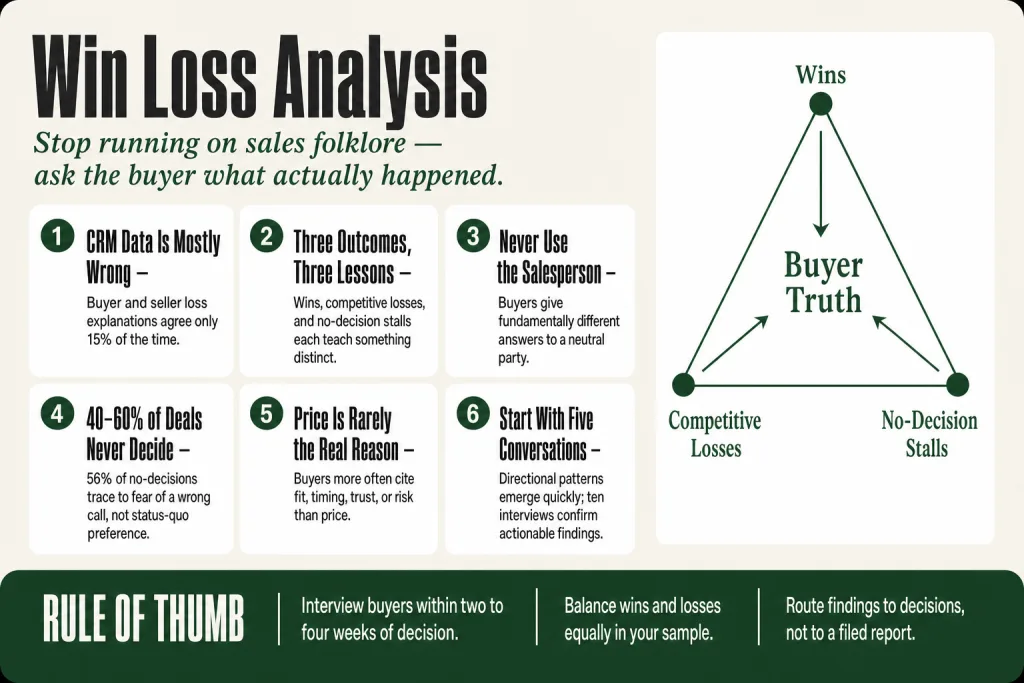
- Clozd’s buyer-interview data shows that buyer and seller explanations for the same lost deal agree only about 15% of the time, meaning the reason recorded in the CRM and the reason the buyer gives diverge on most deals.
- Sellers reflexively blame price; buyers are far more likely to cite trust, fit, timing, or risk, each requiring a completely different response.
- The practice covers three outcome types: wins, competitive losses, and “no decision” stalls, and all three teach you something different.
- A small operator can start with five buyer conversations per quarter; consistent patterns emerge quickly and feed directly into messaging, positioning, and offer design.
- AI tools can now assist with call analysis and pattern detection, but the judgment about what to change still belongs to the operator.
Where Win Loss Analysis Came From
Win-loss analysis doesn’t have a clean origin story. It emerged informally in enterprise selling, companies with complex, multi-stakeholder deals and enough at stake to care why they lost, and was gradually formalized by sales enablement practitioners, product marketing teams, and specialist consulting firms over the course of several decades. By the early 2000s, specialist firms had built repeatable methodologies around independent buyer interviews and standardized taxonomies, and the practice began to spread beyond the Fortune 500 set.
Richard M. Schroder founded Anova Consulting Group in 2004 and spent the following years running institutional win-loss programs for financial services and technology companies. In 2011 he published From a Good Sales Call to a Great Sales Call (McGraw-Hill), a practitioner book making the case for post-sale buyer debriefs as a direct lever on future sales performance. The book formalized a lot of thinking that had been accumulating in the field, not just at Anova, and helped establish win-loss analysis as a named discipline with a recognized methodology rather than just an ad hoc practice smart operators did when they remembered to.
The slow adoption at the small-business level has always been a resource-perception problem. Operators assume this requires a research firm, a sample of hundreds, and a quarterly slide deck. It doesn’t. The core practice is a structured conversation with a buyer, conducted soon after a decision, by someone who wasn’t the salesperson who worked the deal. Everything else is refinement.
The more recent shift has been technological. AI-assisted call analysis tools can now surface objections, competitor mentions, and hesitation signals from recorded sales conversations at volume, turning what was once a manual sampling exercise into something approaching a continuous data feed. That acceleration is real. But the underlying logic hasn’t changed: if you want to know why buyers decide, ask the buyers.
The Problem: Sales Folklore Is Running Your Decisions
Here’s what usually passes for win-loss insight at a small business. The sales rep loses a deal, clicks a dropdown in the CRM, selects “price,” and moves on. The owner reviews the pipeline report, sees “price” next to five losses in a row, and concludes the offer needs to be cheaper. A discount gets baked in. Win rate doesn’t move.
The problem isn’t that price never matters. It’s that “price” as a stated reason is almost always a placeholder. When a rep selects it, they’re making a single code do the work of at least four different buyer situations: the prospect truly couldn’t afford it; the prospect couldn’t perceive enough value to justify the spend; the competitor’s offer looked equivalent at lower cost; or the buyer used price as a polite exit because the rep’s process left them confused or unimpressed. Each of those scenarios requires a different response. Collapsing them all into one CRM field means your strategy is built on a fiction.
Clozd, a win-loss platform, reports from their buyer-interview data that buyer and seller explanations for the same lost deal align only about 15% of the time. Note what that figure does and does not establish. Disagreement is not proof the seller recorded the wrong reason, since both accounts can be partly right. What it does establish is that a CRM loss field cannot carry strategic weight on its own, because you have no way to tell which deals it got right. Separately, data collected across large samples of buyer interviews conducted by specialist firms consistently shows that sellers over-index on price as a loss driver, while buyers more often cite fit, timing, trust, or risk concerns, things that rarely appear in a CRM dropdown at all.
The misdiagnosis compounds. If the real reason a deal stalled is that the buyer couldn’t build an internal business case to bring to their CFO, but the rep logged it as “price,” then coaching investment goes into price negotiation instead of helping buyers champion the decision internally. Marketing adjusts messaging around cost rather than reducing perceived risk. The same pattern repeats across ten reps because nobody identified it as a pattern.
Win loss analysis fixes the data problem at the source: go talk to the buyer. Not through the rep. Directly.
What Win Loss Analysis Actually Covers, and the Three Outcomes That Matter
Most operators think of win-loss analysis as “figuring out why we lost.” That’s half the picture, and not even the most important half.
A proper win-loss program covers three categories of closed deals, and each teaches something distinct.
Competitive Losses
These are the obvious ones, the deals where a prospect evaluated you and chose someone else. They reveal your actual competitive positioning as opposed to your assumed one. Which objections is the competition using against you? What did the buyer’s real priority ranking look like? Where did your sales process create friction that the other side didn’t? The insight here often isn’t “our product is worse.” It’s frequently closer to “their pitch matched our buyer’s actual job; ours matched our own marketing copy.”
One data point worth sitting with: Clozd, a win-loss interview vendor, reports from its own client interviews that nearly 70% of buyers name a different primary competitor than the one their seller logged in the CRM. Clozd does not publish a sample for that figure, so treat it as directional. That means the competitive picture most sales teams are working from is wrong on the majority of deals, which makes competitive coaching, battlecards, and positioning adjustments based purely on CRM data a shaky proposition.
Wins
Wins are underused. Most operators interview losses and ignore wins entirely, which means they never understand why they’re succeeding, only that they are. Winning customers will tell you which specific parts of your pitch or process sealed the decision, what almost made them choose a competitor instead, and which of your features or claims actually moved them versus which ones they tuned out. That last piece is particularly valuable for messaging work: the thing you’re leading with in your deck might not be the thing that’s actually closing deals.
Interviewing wins also protects against a quiet bias. If you only study losses, you optimize entirely to reduce friction without knowing which parts of your process are structural to winning. You end up sanding down edges that you should have been protecting.
No-Decision Stalls
This is the category most operators completely ignore, and it may be the most instructive. Matthew Dixon and Ted McKenna, in their 2022 book The JOLT Effectanalyzed more than 2.5 million recorded sales conversations and found that 40% to 60% of B2B deals end without a decision. These aren’t losses to a competitor. The buyer evaluated options, showed real interest, and then went quiet.
Their research found that 56% of no-decision losses trace to buyer indecision, specifically, the fear of making a wrong call rather than a preference for the status quo. The remaining 44% reflect genuine status-quo preference. Those two situations require different responses. If you treat both the same way, lowering price or adding urgency, you’ll fix neither. Urgency tactics that work on status-quo inertia actually make indecision worse; the buyer freezes harder, not faster. Win-loss interviews on stalled deals help you figure out which one you’re actually dealing with on any given account.
The Core Principles of a Reliable Win Loss Analysis Program
The mechanics aren’t complicated. The discipline is. Here’s what separates programs that produce real insight from programs that produce comfortable reports.
The interviewer cannot be the salesperson who worked the deal
This is non-negotiable. Buyers give fundamentally different answers to a neutral party than they give to the person whose commission was on the line. The rep who lost the deal is the last person who should be making that follow-up call. Even if the buyer likes the rep, they’ll soften their feedback, skip the awkward parts, or give socially acceptable answers that confirm what the rep already believes. The point of the interview is to access the buyer’s real decision-making process, not to have them make the rep feel better.
For small operators without a dedicated research function, “neutral party” can mean the owner, a marketing manager, an operations person, or a fractional researcher. The key is that this person has no personal stake in the outcome of that specific deal.
Interview within two to four weeks of the decision
Memory of an evaluation process fades fast. The buyer’s recollection of which features mattered, what the competitive comparison felt like, and what made them hesitate is sharpest in the weeks immediately after the decision. Beyond a month, you’re mostly getting reconstructed narrative, the story they’ve told themselves about why they chose what they chose, not the actual moment-by-moment deliberation. Aim for within two weeks wherever possible.
Balance wins and losses in your sample
Interviewing only losses produces skewed results. If you only talk to the deals you didn’t win, you’ll calibrate every finding against a loss context and miss the signals that are driving the wins. Aim for an equal split. In practice, won clients are more willing to participate than prospects you lost, so you may need to work harder on the loss side, but the effort pays off in reliability.
Use consistent questions across every interview
Ad-hoc conversations are enjoyable but non-comparable. You want to detect patterns across deals, not just hear interesting stories. That requires asking the same core questions in roughly the same way every time. Standard interview guides typically cover: how the buyer first recognized a need; how they evaluated options; what criteria mattered most; what almost changed the outcome; how the sales process itself felt; and what they’d tell a peer in the same situation. The questions don’t need to be rigid, you’re having a conversation, not administering a survey, but the topics must be consistent.
Triangulate against other sources
A buyer interview is one data point. It’s richer than a CRM field, but it’s still a single perspective. For any significant deal, get at least three inputs: what the buyer said, what the rep reported, and what the deal behavior showed (timing, engagement levels, stage progression). When all three align, the finding is probably accurate. When they diverge, the buyer says “we loved the product” but the rep says “they were never really engaged”, the gap itself is the insight. That’s where the most useful learning usually lives.
Set a minimum viable sample before drawing conclusions
A small operator can start extracting directional value from five conversations. You cannot reliably distinguish a trend from a coincidence on fewer than ten. For any conclusion you’re going to act on, adjusting positioning, changing a sales script, adding or removing an offer element, you want at least that many data points, ideally split evenly between wins and losses. Treat the first round as calibration, not gospel.
Putting this to work? The ideas in the Canon are the foundation under the tactical playbook in Build a Complete Marketing Department — grab the free companion kit at mmsvegas.com/resources.
How to Run Win Loss Analysis as a Small-Business Operator
Large enterprises hire research firms, build formal programs with quarterly reporting cadences, and dedicate product marketing staff to administering them. You don’t have to do any of that to get most of the benefit. Here’s what a lean, owner-operated version looks like.
Step 1: Define your deal population
Decide which closed deals are in scope. For most small operators, that means any deal where a real evaluation happened, the prospect engaged meaningfully, got a proposal or quote, and then made a decision one way or the other. Exclude leads that never genuinely engaged. Separate competitive losses from stalls and no-decisions; they require different interview questions and produce different insights.
Step 2: Set up a simple outreach sequence
Reach out within one to two weeks of the decision. Email works; a personal note from the owner or a senior non-sales person tends to get the highest response. Be honest about why you’re asking: you’re trying to understand how buyers make decisions so you can serve future customers better. Most buyers, even ones who rejected you, will give you 15 to 20 minutes if you ask sincerely and make it genuinely easy. For small businesses, plan to invite roughly four times as many people as you actually need to interview; response rates vary but the invitation-to-interview ratio is typically around 4:1. A small gift card as a gesture of appreciation is appropriate for prospects who didn’t buy.
Step 3: Build a simple interview guide
Keep it to 20 minutes, eight to ten questions, and conversational. The best interview question in the practice is deceptively simple: “Walk me through how you made the final decision.” That single question, followed by attentive silence, will surface more useful information than most multi-page surveys. Follow-up probes to keep in rotation:
- “What surprised you about the evaluation process?”
- “At what point did you feel the clearest about which direction you were going?”
- “What would have changed the outcome?”
- “How did you perceive [your company] compared to the alternatives?”
- “What would you tell a colleague in the same situation?”
That last question is pure gold for messaging. It’s the buyer’s spontaneous description of your value proposition, or your failure, in language they’d actually use with a peer.
Step 4: Capture and code the outputs
After each interview, write a one-page summary and tag it against a standard set of categories: reason for win/loss, key decision criteria, competitive dynamics, sales process experience, perceived value vs. price, risk concerns. You don’t need specialized software to start. A shared document or a simple spreadsheet with consistent fields works fine at volumes under fifty deals per year. As your deal volume grows, your CRM’s custom fields become a more practical home for structured data.
Step 5: Look for patterns, not stories
After five interviews, you’ll have impressions. After ten, you’ll start seeing patterns. The useful question isn’t “what did this buyer say?” It’s “what do four out of the last seven buyers have in common?” Recurring themes across deal types, competitor comparisons, or sales stages are the findings worth acting on. One-off observations, even memorable, confident-sounding ones, should stay in the “watch” column until they repeat.
Step 6: Route findings to the right function
Win-loss findings should update three things: the positioning and messaging your marketing uses; the discovery questions and objection-handling your sales conversations use; and, if product feedback is consistent enough, the feature or service priorities you’re investing in. A report that gets filed is worth nothing. A 20-minute monthly conversation where findings become decisions is worth a great deal.
What Win Loss Analysis Actually Teaches You, and What to Do With It
The categories of insight that reliable win-loss programs consistently surface fall into four areas. Understanding which ones apply to your business is how you prioritize what to change first.
Positioning gaps
The most common finding is a mismatch between what the business thinks it’s selling and what the buyer thinks they’re buying. Your pitch leads with feature X; the buyer’s primary decision criterion was confidence in your implementation process. You emphasize your track record; the buyer was actually most concerned about ongoing support after the sale. These aren’t small calibration issues, they mean your messaging is optimized for an imaginary buyer.
This connects directly to Value Proposition Canvas work: the customer jobs, pains, and gains that buyers actually describe in interviews are frequently different from the ones you assumed when you built the initial proposition. Win-loss puts a real buyer in the room and lets you hear the gap directly, often for the first time.
Sales process friction
Corporate Visions has published findings from their analysis of more than 100,000 B2B purchase decisions across more than 500 companies in over 50 industries. Their data shows that 53% of buyers said a losing vendor could have won if the seller had done something different during the sales process. That’s a majority of losses that were preventable, not because the product was wrong, but because the sales experience was.
The missteps buyers cite are mundane: demos that felt generic and showed no understanding of the buyer’s context; proposals that arrived late or felt templated; failure to address the right stakeholders; momentum that stalled after a promising first meeting with no clear next step. None of these failures show up in a CRM dropdown. They show up in a buyer interview when you ask “What would have changed the outcome?”
Competitive intelligence
Buyers will often tell you, unprompted, what competitors said about you. They’ll describe how the competitor framed the comparison, which claims landed, and which of your positioning statements the competitor actively countered. This is information you cannot get anywhere else. It doesn’t just inform positioning, it feeds directly into sales battlecards, objection-handling preparation, and decisions about where your offer needs to sharpen.
Ideal customer profile calibration
Patterns in win-loss data are among the sharpest inputs you have for refining your Ideal Customer Profile. If you’re winning consistently in one segment and losing consistently in another, the interviews will tell you why, and usually with a clarity that no internal segmentation exercise produces. You’ll learn which buyer characteristics predict a smooth evaluation, which ones predict a painful no-decision, and which deals were a poor fit that you spent too long chasing. Knowing which deals to exit early saves more resource than winning a marginal deal at the edge of your ICP.
Where Win Loss Analysis Works Best
Win-loss analysis returns the most value in businesses where the sale involves real evaluation. The buyer compared options, weighed criteria, and made a considered choice. That’s the context that produces the richest interviews.
B2B service businessesagencies, consultants, managed services, professional practices, get disproportionate value because the sale is inherently interpersonal and the competitive differentiation is often perceived rather than purely functional. Buyers frequently can’t articulate the real reason they chose one firm over another without prompting. Win-loss interviews surface the actual trust and credibility signals that moved them.
Businesses with longer sales cycles gain more because each deal carries higher information value, and the cost of a preventable loss is higher. If you’re closing two to five significant deals per month, every loss you don’t learn from is expensive.
Businesses facing a market shiftnew competitors entering, buyer expectations changing, existing positioning feeling stale, can use win-loss interviews as real-time market intelligence. Patterns in buyer feedback will detect a competitive shift weeks before it shows up in revenue numbers.
Businesses preparing to change pricing or positioning should run a round of win-loss interviews before making the change. The interviews will tell you whether the proposed change addresses the actual decision drivers or just the assumed ones.
Where Win Loss Analysis Doesn’t Apply Well
Not every business model produces the conditions for useful win-loss work.
Very high-volume, low-consideration purchases don’t yield meaningful buyer interviews. If someone buys a $12 item from your e-commerce store or picks up a product off a retail shelf, there’s no deliberative process to debrief. Quantitative analysis of conversion data, cart abandonment, and A/B testing on messaging serves this context better than interviews.
Businesses with very few deals per year face a sample size problem. If you close ten deals a year, you don’t have enough volume to detect patterns, you’re collecting stories. That doesn’t mean the conversations are worthless; they’re still directionally useful. But treat them as hypothesis-generators, not validated findings, and be careful about making structural changes to your pricing, positioning, or process based on three buyer conversations.
Businesses where the operator already has direct, ongoing buyer relationships may find that win-loss insights are already flowing through normal conversation. A solo consultant who speaks to every client personally and loses business rarely is probably learning what they need to learn through the relationship itself. Formalizing the process adds structure but may not add much new information.
The honest caveat: if deal volume is low, the analysis is qualitative and directional. Use it to inform judgment, not to replace it.
Common Misunderstandings About Win Loss Analysis
Misunderstanding 1: “We already do this, we review losses in sales meetings.”
No. What most teams do is have the rep whose deal just died explain what happened. That’s self-reported, retrospective, and conducted by the person with the most incentive to protect their narrative. It might confirm what you already think; it almost certainly won’t challenge it. Win-loss analysis means going to the buyer, not the seller, for the explanation.
Misunderstanding 2: “Our CRM loss reasons are data.”
CRM dropdown fields are categorized opinions entered by a rep at the moment they are least motivated to be reflective. Clozd, a win-loss interview vendor, reports from its own client interviews that nearly 70% of buyers name a different primary competitor than the one recorded in their seller’s CRM, which means the competitive picture your team is working from is wrong on most deals. That’s not data. That’s structured guessing.
Misunderstanding 3: “We should focus on losses; wins don’t need analysis.”
Wins contain your most defensible intelligence. If you don’t know what’s actually closing deals, as opposed to what you think is closing deals, you can’t reliably replicate it, train for it, or use it to sharpen your positioning. Organizations that interview only losses end up optimizing to avoid failure instead of engineering success.
Misunderstanding 4: “One round of interviews will tell us what we need to know.”
Win-loss is a continuous practice, not a one-time project. Buyer decision criteria shift, competitors evolve, and markets move. A single round of ten interviews gives you a snapshot. Monthly or quarterly cadences give you a trend line. The value compounds with repetition.
Misunderstanding 5: “If we just lower the price, win rate will improve.”
Price is the most common stated reason for a loss and the least diagnostic. When buyers say “price,” they usually mean “I didn’t believe the value was worth what you were asking”, which is a messaging and positioning problem, not a pricing problem. Discounting treats the symptom and often trains buyers to wait for the deal rather than improving the underlying case for value.
Common Mistakes
- Using the salesperson as the interviewer — Assign the owner or a non-sales function, operations, marketing, or a fractional researcher, to conduct all buyer interviews. The practical implementation step: build the handoff into your deal-close workflow so the reassignment is automatic, not an afterthought. When the CRM stage moves to Closed Won or Closed Lost, a task fires to the designated interviewer within 48 hours. If you leave it to the rep to ‘pass the baton,’ it won’t happen consistently, and when it does, the buyer will sense the awkwardness.
- Interviewing only losses — Run equal interviews across wins and losses, and schedule win interviews first. Wins are easier to book (clients are happy to talk), which means you can have a solid baseline before you touch the harder loss conversations. That baseline isn’t just motivating; it gives you a comparison frame. When a loss interview reveals that buyers didn’t understand your implementation process, you’ll know from the win interviews whether that’s a messaging gap or an actual process problem, because won buyers will have described it differently.
- Treating CRM loss codes as win-loss data — Audit your last quarter of CRM loss reasons against a small sample of buyer interviews, five is enough, and count the mismatches. That gap is your proof of concept for why the interviews matter, and it’s the single most persuasive internal argument for building a real program. Once leadership sees that the CRM said ‘price’ on deals where the buyer cited ‘unclear ROI’ or ‘no internal champion,’ the conversation about investing in proper interviews gets much shorter.
- Running one round and declaring the work done — Treat the first round as calibration, not conclusion. After your first ten interviews, write down the top three findings, but label them as ‘hypotheses to confirm,’ not ‘decisions to act on.’ Run a second round the following quarter with the explicit goal of testing whether those patterns hold. If they do, act. If they shift, update. The discipline here is resisting the temptation to overhaul your messaging or offer after a single set of conversations, however compelling they sounded.
- Filing the report without routing findings to decisions — Replace the report with a standing 20-minute monthly meeting, owner, one marketing person, one sales person, where the only agenda item is: what did buyers tell us this month, and what are we changing? Cap it at three changes per cycle, no matter how many findings you have. Prioritize by deal impact: which finding, if addressed, would affect the most revenue at risk? Small operators who try to act on everything simultaneously end up acting on nothing. One real change per month compounds faster than a stack of insights nobody got to.
Operator’s Take
Pull up the last ten deals that went somewhere real, actual proposals, actual evaluations, and sort them into wins, losses, and stalls. Now ask yourself honestly: do you know, from the buyer’s mouth, why each one went the way it did? If the answer for more than two or three of them is “the rep told me” or “it’s in the CRM,” you don’t actually know. You have a story. Stories feel like strategy until you run them against someone who was actually in the room.
Here’s the move I’d make starting from zero: before you build any program or process, make three calls this week. Owner makes the call, or a non-sales person, someone with zero skin in that particular deal. The only guide you need: “Walk me through how you made the final call,” then stop talking. You will learn something in every single one of those conversations that isn’t in your CRM. At least one of those things will be something you can change immediately, a question you’re not asking in discovery, a concern you’re not surfacing early enough, a competitor claim you’ve never heard before and have no answer for. Three calls. This week. Not next quarter.
Second move: interview your wins first, losses second. Counterintuitive. But wins tell you what’s actually closing deals, not what you assume is closing deals. That baseline transforms every subsequent loss interview, instead of reading losses in a vacuum, you’re reading them against real evidence of what success looks like from the buyer’s side. Say your wins keep citing your onboarding process as the deciding factor, but your losses mention that same process barely at all. That’s not a coincidence; that’s a messaging gap. You’re not leading with the thing that’s closing deals.
A specific situation worth calling out: if you’re a service business, agency, consultancy, managed services, and you’ve been losing competitive evaluations at proposal stage, the win-loss interview will almost always surface one of two things. Either the proposal itself is generic and shows no understanding of what that specific buyer was actually trying to solve, or the buyer picked up a trust deficit somewhere in the process, a slow response, a rep who talked about features rather than the buyer’s situation, a reference check that went sideways. Both are fixable. Neither shows up in a CRM dropdown. The interview is the only way to know which one you’re dealing with.
On the no-decision stalls: this is where the overlooked revenue actually lives. Most operators obsess over competitive losses and barely touch the 40 to 60% of deals that just went quiet. Those buyers were interested enough to evaluate you seriously, they got a proposal, they had calls, they didn’t disappear after the first demo. Something stopped them. It’s almost always one of three things: they couldn’t build an internal business case to get approval; risk of a wrong decision paralyzed them; or something shifted in their business and the timing stopped being right. Win-loss interviews on stalls will often surface one specific, fixable friction point. Maybe they needed a clearer ROI framework to present to their CFO. Maybe one stakeholder had an unresolved concern nobody addressed. Fix that friction point across the next five similar deals and you’re pulling closed revenue from the same pipeline you already have, same targeting, same pricing, better process.
On the AI tools question, Gong, Chorus, and their equivalents are genuinely useful once you’re doing enough recorded calls to make pattern detection worthwhile. They’ll catch competitor mentions, objection clusters, and talk-time imbalances you’d miss in manual review. What they won’t do is tell you whether the pattern they’ve surfaced is a messaging problem, a process problem, or a targeting problem. A tool that flags “pricing objection in 60% of lost deals” has handed you a useful clue. Figuring out whether that means your offer is overpriced, your value case is thin, or your qualification is bringing in the wrong buyers, that’s still your call. The tool cuts your dependence on manual transcription. The judgment stays with you.
One failure mode worth naming: operators who route win-loss findings straight to the sales team as feedback on individual reps. The rep hears about interview results and gets defensive. Leadership uses the data to assign blame. Inside six months, reps stop referring prospects to interview, buyers sense the tension and go polite, and you’re back to folklore. The findings are intelligence about your market, your positioning, and your process, not a performance review. The moment it becomes punitive, the program is finished. Keep it in the “what are we learning about buyers” frame, and people will protect it. Move it into the “whose fault was this” frame, and they’ll quietly kill it.
Used in
- ✓ Build a Complete Marketing Department
Used to ground positioning decisions in buyer evidence, win-loss findings feed directly into the messaging hierarchy and ICP that the marketing system is built around. - ✓ The Missing Manual for FunnelKit
Informs funnel stage optimization by identifying where buyers hesitate or disengage, so landing pages, sequences, and offers can be calibrated to real objection patterns. - ✓ The Missing Manual for Make
Supports automation design by surfacing which buyer signals, timing, objection type, engagement behavior, should trigger different follow-up workflows.
FAQ
How many interviews do I need before the findings are useful?
Five conversations will surface directional impressions; ten is the practical minimum for identifying a pattern with enough confidence to act on it. For a small business doing ten to thirty deals a month, a quarterly sample of ten to fifteen interviews, balanced between wins and losses, is a realistic and sufficient cadence.
Can I conduct win-loss interviews myself, or do I need to hire someone?
You can absolutely conduct them yourself as the operator, provided you weren’t directly involved in selling the deal. The key is neutrality, the interviewer should have no personal stake in the outcome of that specific deal. Owners interviewing their own buyers often get excellent results because buyers sense genuine curiosity and respond to it.
What if the buyer who rejected us won’t agree to be interviewed?
Some won’t, and that’s fine. Keep the outreach low-pressure, be transparent about your purpose, and focus your initial program on the buyers who do respond. Over time, you’ll accumulate enough data from willing participants to identify patterns. Offering a small, genuine token of appreciation, like a gift card, can improve response rates without feeling transactional.
Should win-loss interviews be recorded?
Recording is useful for accuracy, but always ask permission first. Many buyers will agree to recording if you explain it’s for internal improvement purposes and won’t be shared. If they decline, take detailed notes during the call and complete a summary immediately after while the conversation is fresh.
How is win-loss analysis different from a customer satisfaction survey?
A customer satisfaction survey asks existing customers how you’re doing. Win-loss analysis interviews both buyers and non-buyers at the moment of decision, specifically about the factors that drove the choice. The timing, the audience, and the questions are all different. Satisfaction surveys measure experience after commitment; win-loss analysis examines the decision itself.
How do I handle the ‘no decision’ deals, the ones that just went quiet?
Treat them as a distinct category, not as losses. Reach out with a light-touch note acknowledging that the timing may not have been right and asking if a brief conversation would be welcome. Buyers who stalled are often willing to talk, and their reasons for not deciding (budget freeze, internal priority shift, risk concern, fear of implementation) are among the most useful inputs you can get for refining your qualification process and your case for change.
Further reading
- From a Good Sales Call to a Great Sales Call by Richard M. Schroder (McGraw-Hill, 2011), a practitioner book on structured buyer debriefs and win-loss methodology by the founder of Anova Consulting Group; useful for operators who want the systematic reasoning behind the practice, not just the mechanics.
- The JOLT Effect by Matthew Dixon and Ted McKenna (Portfolio/Penguin, 2022), research-grounded treatment of why buyers fail to decide, based on analysis of 2.5 million recorded sales conversations; the core finding that 40 to 60% of B2B deals end in no decision, and that 56% of those trace to fear of making a wrong call rather than preference for the status quo, reframes how most operators diagnose a stalled pipeline.
- Clozd Win-Loss Research (clozd.com), practitioner research on buyer-seller attribution gaps and win-loss program benchmarks, drawn from Clozd’s own buyer-interview platform data. Clozd is a commercial win-loss vendor; treat their published statistics as directionally useful industry data with that context in mind.
- Corporate Visions Win-Loss Research (corporatevisions.com), Corporate Visions publishes findings from their dataset of 100,000+ B2B purchase decisions across 500+ companies in 50+ industries via their TruVoice platform (formerly Primary Intelligence); their 53% ‘winnable losses’ figure and supporting data are published at corporatevisions.com/blog/win-loss-or-win-rates/ and corporatevisions.com/blog/the-business-case-for-win-loss-analysis/.
Sources: Anova Consulting Group, theanovagroup.com, founding year per Schroder’s own leadership profile. Richard M. Schroder, From a Good Sales Call to a Great Sales Call (McGraw-Hill, 2011). Clozd win-loss research, clozd.com, 15% buyer-seller alignment figure and ~70% competitive mis-tagging figure drawn from Clozd’s buyer-interview platform data; Clozd is a commercial win-loss vendor. Corporate Visions B2B buyer research, 53% winnable-losses figure from Corporate Visions’ TruVoice dataset of 100,000+ B2B purchase decisions across 500+ companies in 50+ industries; published at corporatevisions.com/blog/win-loss-or-win-rates/ and corporatevisions.com/blog/the-business-case-for-win-loss-analysis/. Note: Corporate Visions describes this dataset as ‘B2B purchase decisions’ and ‘B2B transactions,’ not solely as buyer interviews; TruVoice (formerly Primary Intelligence) is a commercial win-loss vendor. Matthew Dixon and Ted McKenna, The JOLT Effect (Portfolio/Penguin, 2022), 40 to 60% no-decision figure and 56%/44% indecision-vs-status-quo split from analysis of 2.5 million recorded sales conversations. Liminal win-loss analysis guide, June 2026, liminal.co. Elevated Signal win-loss methodology analysis, May 2026, elevatedsignal.com. Pragmatic Institute win-loss best practices, pragmaticinstitute.com. AskElephant win-loss analysis overview, askelephant.ai.
Brian Kasday spent forty years in direct-response marketing before rebuilding the whole operation as a one-person shop. He writes The Operator’s Library — including “Build a Complete Marketing Department” — for operators who’d rather build it themselves than wait on someone else.
Build the department these ideas describe — the free companion kit: mmsvegas.com/resources.
More The Operator's Canon guides
Free · Operator Toolkit
Want the tools, not just the guide?
Get the free operator toolkit — templates and checklists for the systems you actually run, plus a note when this guide changes.
Get the free toolkit →How to cite: Win Loss Analysis. Associated with Richard M. Schroder / Anova Consulting Group, 2004. The Operator’s Canon, MMS Vegas. https://mmsvegas.com/library/win-loss-analysis-explained/