
Last updated: August 2026
A B2B buying committee is the reason your best demos go quiet. You presented to the right person, they loved it, they said they’d get back to you, and then three weeks of silence followed by ‘we’ve decided to go a different direction.’ The product wasn’t the problem. The other six people in the room you never met were.
In B2B, most purchase decisions above a few thousand dollars aren’t made by a single person. They’re made by a group, sometimes a formal committee with a project charter and a steering board, sometimes an informal cluster of stakeholders who text each other after your demo. Either way, if you’re only talking to one of them, you’re not selling. You’re hoping.
This page maps the B2B buying committee from the ground up: how the concept evolved and why it keeps getting harder, who the real players are, what each one actually needs to hear, and how an operator with a small team can work a committee without a 20-person sales org. By the end, you’ll be able to identify every meaningful voice in your next complex deal, build content that reaches each of them, and stop watching good opportunities evaporate because one unmapped stakeholder raised a hand in a meeting you weren’t invited to.
The idea in 30 seconds
- A B2B buying committee is the full group of people inside a prospect’s organization who collectively research, evaluate, and approve a purchase, rarely just one person.
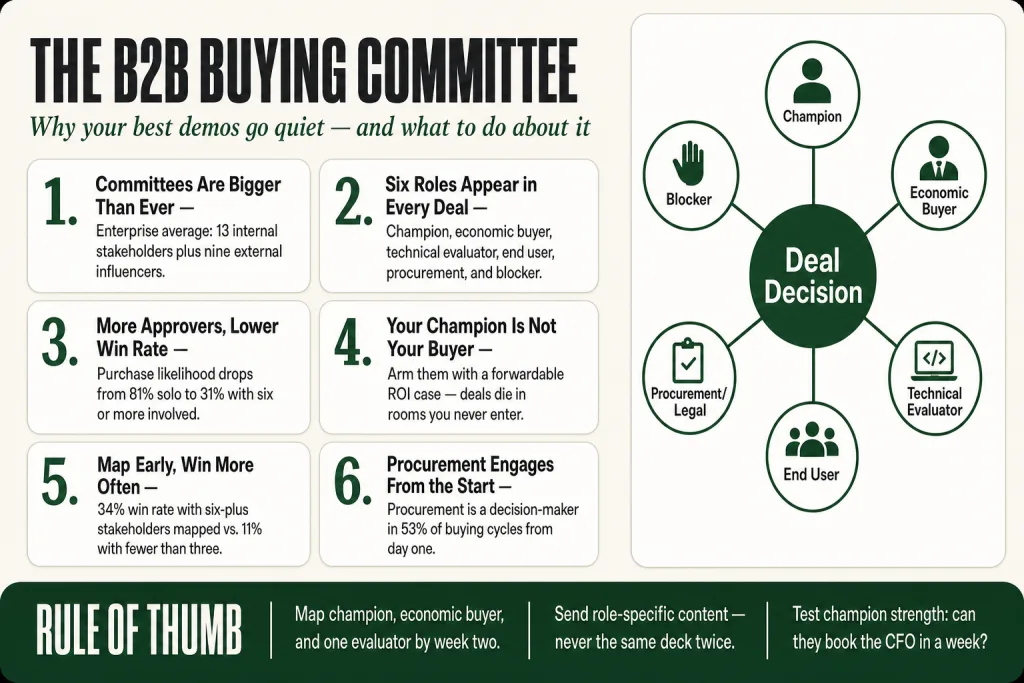
- Committees today typically span 6 to 13 internal stakeholders across multiple departments, each arriving with independent research and different definitions of ‘good.’ Forrester’s State of Business Buying (2024) puts the enterprise average at 13; Gartner’s research on complex purchases puts the typical range at 6 to 10. Forrester’s 2026 report confirms 13 internal stakeholders, plus nine external influencers, for a typical buying decision.
- Six roles appear in nearly every complex deal: champion, economic buyer, technical evaluator, end user, procurement/legal, and blocker, and any one of them can kill it.
- Your champion is not your buyer. They’re your internal sales rep. Arm them accordingly or the deal dies in a room you’re not in.
- Single-threading, building the entire relationship through one contact and calling it a pipeline, is how good deals evaporate quietly.
- By the end of this page, you’ll be able to map every role in your next complex deal, assign the right content to each one, and stop losing to ‘we need more time to align internally.’
How the B2B Buying Committee Has Changed, and Why It Keeps Getting Harder
The structural insight that drives everything here hasn’t changed since Robert Miller and Stephen Heiman put it in Strategic Selling in 1985: in complex B2B sales, there is no single decision-maker. There’s a committee of people with different priorities, different concerns, and different levels of influence. Miss any of them, and the deal dies from a direction you weren’t watching.
Miller and Heiman gave practitioners four functional roles to track: the Economic Buyer controls the budget and delivers the final yes or no; the User Buyer lives with the result day to day; the Technical Buyer screens against requirements and can only say no, never yes; and the Coach, their term for the internal person who wants you to win. The Blue Sheet planning tool that accompanied the book was the original deal-inspection artifact: a structured map forcing a rep to account for the whole buying group rather than just their favorite contact. (The ‘Blue Sheet’ got its name by accident, their printer ran out of white paper, so the worksheets came back on blue stock, and the name stuck.)
What has changed, dramatically, is the scope of what a purchase touches, and therefore who gets pulled into the decision. A software subscription in 2010 might have affected one department’s workflow. Today the same category of tool integrates with your CRM, triggers compliance questions, requires IT sign-off on data handling, and shows up as a line item the CFO notices in the monthly variance report. Buying decisions now routinely pull in IT, finance, operations, compliance, legal, procurement, and executive leadership, not because anyone mandated it, but because each of those functions has a legitimate stake. AI governance and ESG review have added two more seats to the table that barely existed five years ago.
In 2015, CEB published The Challenger Customer with a sharper, more uncomfortable finding: not all committee members are equally worth your time. Mobilizers, Go-Getters, Teachers, and Skeptics, are willing to push change through and build agreement around it. Talkers are happy to meet with you, give great feedback, and do absolutely nothing to move the deal. The uncomfortable implication: your most enthusiastic contact is probably a Talker. CEB surveyed over 3,000 individual B2B stakeholders and found that the average buying group at that time was 5.4 people. That number has nearly doubled in the decade since.
Forrester’s State of Business Buying (2024), drawing on responses from more than 16,000 global business buyers, put the enterprise average B2B buying committee at 13 internal stakeholders, with 89% of buying decisions crossing multiple departments. Forrester’s 2026 report, drawing on its 2025 Buyers’ Journey Survey of nearly 18,000 global buyers, confirms 13 internal stakeholders with the addition of nine external influencers for a typical purchase decision. The same report found that buying has become more collaborative, more risk-sensitive, and more dependent on validation from trusted sources, a direct consequence of committees that are larger, more skeptical, and leaning on generative AI to form early opinions before they ever talk to a vendor.
The practical consequence: most of the evaluation happens before you show up. Gartner’s 2024 B2B Buying Survey found that buyers spend only 17% of their total purchasing time meeting with potential vendors, split across all the vendors they’re considering. If they’re evaluating three solutions, your share of that window is roughly five or six percent of the calendar. Your pitch is one data point landing inside a group that has already been forming opinions, comparing notes, and reading G2 reviews for weeks before they took your meeting. That reality is what makes committee mapping a revenue decision, not a sales methodology.
Why the B2B Buying Committee Keeps Growing
Nobody created the buying committee on purpose. It grew because organizations learned, often painfully, what happens when one person makes a large purchase decision alone and gets it wrong. The fallout, wasted budget, failed implementations, vendor lock-in, a team that refuses to use the tool, is distributed across the whole company. So companies distribute the decision.
That logic hasn’t changed. What has changed is the scale of what those decisions now touch. The numbers reflect this clearly. Forrester’s State of Business Buying (2024) puts the average B2B buying committee at 13 internal stakeholders for enterprise deals. Forrester’s 2026 follow-up, based on its 2025 Buyers’ Journey Survey of nearly 18,000 global buyers, confirms that figure and adds nine external influencers to the typical buying decision, with the number rising further for complex or strategic purchases. Gartner’s research on complex B2B purchases puts the typical range at 6 to 10 decision-makers, each arriving with four or five pieces of independently gathered research. CEB originally measured 5.4 stakeholders per deal back in 2015; that figure has roughly doubled in a decade.
For most small-to-mid market operators, planning for 3 to 6 relevant stakeholders is the right starting assumption, though company culture moves the numbers more than deal size does. One 200-person startup might approve a six-figure contract with three people. A mid-size bank might put 14 names on the approval chain for a tool that costs less than one junior salary. Influ2’s 2026 survey of 50 enterprise and mid-market buyers found that 50% had buying groups of 2 to 4 people and 42% had 5 to 9. Every respondent with a group of 10 or more came from a company with over 1,000 employees. The Forrester enterprise average is real data, it’s just not your data unless you’re selling to enterprise.
There’s another dynamic that makes this harder: Forrester’s 2024 research found that 86% of B2B purchases stall during the buying process, and 81% of buyers express dissatisfaction with the provider they ultimately choose. That’s not a product quality problem. Forrester traces it directly to internal complexity, stakeholders who each conducted independent research, formed different conclusions, and couldn’t reconcile their pictures of the solution once they got in a room together. The committee isn’t the obstacle. Unmapped committees are.
The B2B Buying Committee’s Six Core Roles, and What Each One Actually Needs
The exact labels vary by framework. The functions are consistent. Six roles show up in nearly every complex deal: the champion, the economic buyer, the technical evaluator, the end user, procurement and legal, and the blocker. Titles shift from company to company; these functions don’t. Here’s what each one actually needs from you.
The Champion
The champion is your internal advocate, typically the person who believes strongly in your solution and helps move it through the organization. This is the person you usually build the relationship with first, and the person most operators over-rely on.
Champions shape conversations you’re not in, defend your proposal when objections arise, and can push the deal through internal roadblocks. A RevOps manager might pilot your product, document efficiency gains, and share those results with the VP of Sales to build confidence across leadership. They keep your story alive inside the org when you’re not in the room.
The job isn’t to sell the champion harder. It’s to arm them. Your champion may believe in your solution completely, but without the tools to sell it internally, they hit a wall, and the longer the silence, the colder the deal becomes. Give them a one-page business case they can forward. Give them an objection-handling reference for the questions they’ll face. Make it easy for them to represent you in rooms you’ll never enter.
One quick diagnostic for whether your champion is real: ask them to set up a 30-minute call with the economic buyer. A genuine champion gets it done within a week. Someone who doesn’t have the organizational standing to pull that off starts hedging, and now you know you need to build more relationships before you get to approval stage.
The Economic Buyer
Often a CFO or VP of Finance. They evaluate ROI and budget impact and care about one question: does this make or save us enough money to justify the spend and the risk? Not interested in features. They want a number, and they want to believe it.
G2 reports that during software selection the CFO always or frequently holds final decision-making power in 79% of purchases. G2 does not publish a sample for that figure, so treat it as directional rather than as a measured rate. If you’ve never built a basic ROI case, revenue upside, cost savings, time recovered, risk reduced, you’re leaving the economic buyer without anything to take to their own leadership. They won’t fill that gap themselves.
The Technical Evaluator
Typically in IT or operations. In Miller Heiman’s original framing, the Technical Buyer can only say no, they can’t say yes. That’s still roughly true. Their job is to find the reason your solution creates problems. Give them documentation before they go looking for holes on their own. A SOC 2 brief, an architecture overview, an honest answer to the data residency question, these aren’t obstacles. They’re table stakes for getting past this role.
The End User
They work with the solution every day after purchase. They make no formal buying decision, but their acceptance determines whether the deal delivers any value after it closes. During evaluation, they supply the real-world requirements and surface the friction points that only become visible when someone actually tries to use the thing. More important: they’re the ones who will loudly flag it if the workflow doesn’t fit, and that complaint reaches the economic buyer. Get them involved early with a trial or a demo built around their specific process, not a generic product walkthrough.
Forrester’s 2026 report found that more than 60% of business buyers now use some form of trial, from limited pilots to paid sandbox environments, to evaluate potential solutions. For purchases of $10 million or more, 78% of buyers engage in a trial first. That trend is moving downmarket. If you sell anything above a few thousand dollars and don’t offer a structured trial path, you’re leaving a decision-making tool on the table.
Procurement and Legal
These roles show up late and feel like a formality until they’re not. Procurement’s job is to extract concessions. Legal’s job is to find liability. Neither is inherently adversarial, both have legitimate functions, but the IT security team may need a SOC 2 brief and architecture diagram while procurement needs a redlined MSA template, sometimes at the same stage of evaluation. Forrester’s 2026 report found that procurement professionals are decision-makers in 53% of B2B buying cycles, engaging from the start of the process, not at the end. That figure should change when you surface them in your deal plan. Have clean versions of both documents ready before you’re asked. The vendor who makes procurement’s job easy wins on terms and timeline. The vendor who makes legal review a nightmare loses deals that were already verbally won.
The Blocker
Blockers can stall or kill your deal. They’re usually motivated by risk aversion, loyalty to an existing vendor, or concern that your solution adds complexity to their workflow. The instinct is to route around them. That’s usually wrong. The blocker is rarely malicious. Usually they carry a concern nobody has addressed, or they backed a different option and lost. Treat them as an unanswered question rather than an obstacle. Answer the question early, and most blockers go neutral.
The most dangerous blocker is one who was never mapped into the outreach at all, their objection arrives at the worst possible moment, in a meeting you’re not in, after the deal felt like it was two weeks from closing. The fix is mapping before the deal gets deep, not after it stalls.
The Consensus Problem: Why More People in a B2B Buying Committee Means More Friction
Here’s the uncomfortable math. CEB surveyed over 3,000 individual B2B stakeholders and found that purchase likelihood drops sharply as group size grows. With a single approver, purchase likelihood sits at 81%. Add a second person and it falls to 55%. When six or more are involved, it drops to 31%. You can have the right product, the right champion, the right price, and still lose to internal entropy.
Gartner’s 2024 survey of 632 B2B buyers found that 74% of buying teams experience unhealthy conflict during the decision process. But when committees do reach genuine agreement, they’re 2.5x more likely to call the outcome a high-quality decision. That second stat matters. Getting everyone aligned isn’t just a hurdle you clear to get the contract signed, it’s a signal about what happens after. Buyers who build real internal agreement before purchasing show lower churn and higher expansion. The fight to get everyone on the same page is actually working in your favor downstream.
The conflict itself is usually not about your product. Gartner’s research traces most of it to stakeholders who each believe they have an accurate picture of the solution, and can’t reconcile why their pictures don’t match each other’s. Every committee member researched independently. They each formed conclusions. Now they’re in a room together and their conclusions diverge. The CFO’s pricing assumptions, built from publicly available information, conflict with the technical lead’s understanding of the deployment model, built from a whitepaper that described an earlier version of the product. That’s not disagreement. That’s incompatible mental models, each held with confidence.
Your job, the part most operators miss, is to be the consistent thread running through all of that independent research. Forrester’s 2024 report found that internal complexity, not vendor performance, is the top reason deals stall. When each stakeholder Googles your product and lands on the same clear story about what it does and who it’s for, the committee conflict reduces. When each stakeholder gets a different message depending on which channel they found you through, the conflict amplifies. A CFO needs ROI math. IT needs a clean integration story. Procurement needs acceptable terms. The deal closes only when every one of those criteria is met, which means your marketing and sales content needs to do the alignment work before the room fills up.
Putting this to work? The ideas in the Canon are the foundation under the tactical playbook in Build a Complete Marketing Department — grab the free companion kit at mmsvegas.com/resources.
How an Operator Works a B2B Buying Committee Without a 20-Person Sales Org
Most of the writing on this topic is aimed at enterprise sales teams with dedicated account executives, sales engineers, and an SDR running parallel outreach to every stakeholder simultaneously. That’s not your situation. So let’s translate.
Map before you pitch
Before your second call with any prospect, ask one question: ‘Who else will need to weigh in before you move forward on something like this?’ Most buyers will tell you. Some will low-ball the number, they don’t want you talking to their CFO yet. But even a partial map is better than none. If you’re both the rep and the marketer, that mapping conversation is with yourself, but it still needs to happen early, and systematically, on every deal above your threshold.
Cross-reference what your champion tells you against their LinkedIn org chart. Look for functional leaders in IT, finance, and operations. Ask your champion directly who approved the last similar purchase. Leadership tends to shift by stage: the champion leads evaluation, technical evaluators lead the review phase, and the budget owner leads final approval. Knowing that in advance tells you who to reach next and when. The Starr Conspiracy’s 2024 GTM Audit found a win rate of 34% when six or more stakeholders were mapped in CRM, versus 11% when fewer than three were mapped. That gap is not subtle.
Build role-specific content, not a universal deck
The same deck to every stakeholder is how you lose all of them. Send the CFO an ROI model. Send the security lead your compliance docs. Send the end user a workflow-specific demo built around the tasks they actually run, not a generic product tour. This doesn’t mean building six entirely separate presentations, it means having modular assets you can mix and match. A two-page ROI summary. A short technical FAQ. A workflow-specific video. A case study written from the perspective of a customer in the same role, not just the same industry. None of these takes weeks to build. They take an afternoon, and they dramatically change what happens when your champion forwards something internally.
Arm your champion to sell without you
Your champion spends 95% of the cycle in rooms you’re not in. A forwardable asset, something they can paste into Slack or attach to an internal email, is worth more than another call where you repeat yourself to the one person who’s already convinced. Give them a one-page business case, an objection-handling reference, and ammunition against the specific competitor in the deal. Package it so forwarding everything internally takes one action, not an email thread.
Get to the economic buyer directly
This is the step operators skip most often. Your champion has access. Your champion is reluctant to use it because introducing you to their VP feels like it escalates the deal in ways they’re not ready for. That reluctance is information, it tells you the champion is either not confident in you yet, or not confident in their own standing with the VP.
Don’t demand the introduction. Earn it. A custom ROI analysis with their actual numbers. A reference customer willing to do a 15-minute call. A pilot result that lets the champion say ‘look what we found.’ The economic buyer rarely wants to talk features, they want to see a number and hear from someone who had the same problem and solved it.
Smoke out the blockers early
Work with your champion to understand specific objections before they surface in a late-stage meeting. Address them directly with targeted information, security documentation, a custom ROI analysis, a reference call. A single blocker has a hard time stopping a deal when the rest of the group, especially the economic buyer, is in strong agreement. The blocker you know about is manageable. The one you don’t know about is the one who derails a deal on a Tuesday afternoon when you thought you were two weeks from a signed contract.
Using AI without outsourcing your judgment
AI tools can accelerate several parts of committee-based selling: researching the org structure of a target account, drafting role-specific follow-up emails from a single set of notes, generating a first-pass ROI model based on publicly available benchmarks, or summarizing a long call transcript so you can identify which stakeholder voices were missing from the conversation. What AI can’t do is replace the judgment call of which roles actually matter in this specific deal, or read the political dynamics your champion is navigating. AI cuts your dependence on outside help for the mechanical work. The judgment and the final calls stay with you.
Where the B2B Buying Committee Framework Applies, and Where It Doesn’t
The committee framework earns its keep in deals with three conditions: meaningful dollar size (roughly $5K annually and up, though context matters more than a hard number), multi-department impact, and a sales cycle longer than a few weeks. Inside those conditions, ignoring the committee is a structural liability, you’re not just at risk of losing; you’re ceding ground to competitors who are actively mapping what you’re ignoring.
Outside those conditions, it’s overkill. If you’re selling a $500 tool that one person can buy on a credit card, mapping a six-person committee is theater. If you’re selling to founder-run companies under 20 people, the ‘committee’ is often the founder and their gut instinct, maybe a trusted advisor. In small companies, the economic buyer often doubles as the champion, which speeds everything up, and your whole framework collapses into one extra question on the discovery call.
The framework is also less useful, though never useless, for transactional B2B with repeat purchases and established vendor relationships. Once you’re the incumbent, the committee dynamics shift: the blocker becomes the person advocating to switch to a competitor, and your champion is now fighting to defend the status quo. The map looks different but the principle, know who has a voice, stays the same.
The place operators most over-apply it: SMB deals where they spend three weeks building stakeholder maps for a $2K sale that could have closed in two calls. Match the investment in committee management to the deal size. A $50K annual contract deserves a full stakeholder map and role-specific content. A $3K deal deserves one extra question, ‘who else signs off on this?’, and then trust the champion to handle it.
Common Misunderstandings About the B2B Buying Committee
‘My champion is the decision-maker.’ Almost certainly not. Your champion, the person who brought your solution into the conversation, often lacks the authority to push the deal across the finish line alone. They need ammunition to sell internally. Treating the champion as the decision-maker means you stop working the deal the moment they say ‘I love it.’ That’s exactly when the work starts.
‘The committee evaluates options rationally and picks the best one.’ If this were true, every well-built product would win every evaluation. The reality is that committee members each independently research the solution, form their own confident conclusions, and then arrive in a meeting where those conclusions don’t match anyone else’s. The B2B buying committee is a political system as much as an analytical one. Logic matters, but so does who trusts whom, who has the social capital to push an idea, and whose approval feels higher-risk to request.
‘More stakeholders means more opportunity to get a yes.’ No. More stakeholders means more veto points. CEB’s data from 3,000 surveyed B2B buyers is clear: purchase likelihood drops from 81% with a single approver to 31% when six or more are involved. Each additional stakeholder is an additional opportunity for the deal to die, not an additional advocate you can recruit.
‘I’ll deal with procurement at the end.’ This is how contracts get delayed by 90 days after a verbal yes. Forrester’s 2026 report found that procurement professionals are decision-makers in 53% of buying cycles and engage from the start of the process, not at the end. If you discover at signature that your standard contract terms are incompatible with their procurement process, you’ve just added a month of legal back-and-forth to what should have been a close.
‘One great relationship is enough.’ When your entire relationship lives through one contact, you’re building on sand. That contact goes on vacation, gets reassigned, or loses their standing with leadership, and your deal evaporates with it. Worse, you have zero visibility into the objections forming across other stakeholders.
What a B2B Buying Committee Looks Like in Practice Today
Consider a mid-market professional services firm evaluating a project management platform. The operations manager (champion) finds the tool, loves the UX, runs an internal trial, and introduces your team to the CTO (technical evaluator) who has integration and security questions. The CFO (economic buyer) wants a three-year ROI model before they’ll approve budget. Two project managers (end users) are quietly worried about workflow disruption during rollout. The head of procurement has a preferred vendor list and isn’t sure why they’re looking at something not on it. Legal wants to review data processing terms. That’s seven people for a deal that might be $25K annually, well within the range of a small-to-mid market SaaS sale.
The failure mode for this deal isn’t losing on features or price. It’s that the operator’s team treats the operations manager as the buyer, runs three demos with her, sends a proposal, and waits. The CTO’s security questions never get answered because nobody asked. The CFO never sees an ROI model because nobody built one. The blocker’s concern about the preferred vendor list never surfaces because nobody thought to ask the champion about procurement. Legal gets a contract at the end with terms that take six weeks to resolve.
The operator who maps the B2B buying committee in week one, even imperfectly, runs a different playbook. They ask the champion who approved the last similar decision. They send a technical one-pager to the CTO before the first formal call. They build a simple ROI template using the prospect’s publicly stated headcount and billing rates. They find out about the preferred vendor list in week two, not week eight. That’s not a sophisticated enterprise sales operation. That’s one thoughtful question per conversation, followed up with the right asset.
Forrester’s 2024 research identified internal complexity, not vendor performance, as the top reason deals stall. All three of the most common bottlenecks (budget approval, internal alignment, and security concerns) map directly to roles that most marketing programs systematically under-reach. And all three are predictable. Which means they’re preventable, if you’ve mapped the committee early enough to address each one before they collide in a room you’re not in.
Common Mistakes
- Single-threading: building the whole relationship through one contact — In your first two weeks on any deal above your threshold, map at least three roles: champion, economic buyer, and one functional evaluator. Don’t wait for your champion to introduce you, use LinkedIn to identify the functional leaders in IT, finance, and operations, then ask your champion explicitly who approved the last similar purchase. Get names before the deal is deep enough that asking feels presumptuous.
- Sending the same deck to every stakeholder — You don’t need six decks. You need three modular assets: a two-page ROI summary for finance (built with that prospect’s actual numbers, not industry benchmarks), a technical FAQ for IT that answers the five questions they always ask, and a workflow-specific demo clip or case study for end users built around the tasks they actually run day to day. Route the right asset to the right role through your champion. The champion’s job becomes one click, not an explanation.
- Waiting on procurement and legal until the contract stage — In week two of any meaningful deal, ask your champion: how were the last two purchases like this approved, and does your company use a preferred vendor list or a standard MSA? Get the answers before you’re on the hook. Forrester’s 2026 report found procurement is a decision-maker in 53% of buying cycles and typically engages from the start, not at signature. Have a clean, pre-redlined MSA template and a SOC 2 brief ready to share the moment either role surfaces. The vendor who makes procurement’s job easy wins on timeline. The one who makes legal review a surprise loses deals that were already closed in everyone’s mind.
- Ignoring the blocker until they kill the deal — Ask your champion a specific question early: ‘Who has pushed back on purchases like this before inside your company, and what was their concern?’ Most champions will tell you. Then build the response before the objection surfaces in a room you’re not in, a targeted one-pager, a reference call from a customer who had the same concern, a direct acknowledgment in your proposal. A blocker with an answered question usually goes neutral. A blocker with an unanswered one can derail a deal the week before signing.
- Treating champion enthusiasm as deal health — Test the champion’s actual standing with one request: ask them to set up a 30-minute call with the economic buyer within the next week. A champion with real organizational standing gets it done. One who hedges, ‘let me see if he has time,’ ‘I want to get a bit further along first’, is telling you their influence doesn’t reach the decision level yet. That’s not a crisis, but it changes where you put your energy. Stop selling to the champion and start building the assets that give them something concrete to bring to the people above them.
Operator’s Take
Here’s the question that unlocks the real committee map, not ‘who else is involved?’ which every buyer has a polished non-answer for, but: ‘Who has killed a deal like this before inside your company, and what was their reason?’ Ask that in week one. Most champions will tell you. Now you know who the blocker is before they become a problem, and you know what case you need to build before you’re deep enough that building it feels like damage control.
Before any deal crosses the $15K annual threshold, put three things together. First: an ROI summary built around that specific prospect’s situation, their headcount, their billing rates, their current tool cost, not your generic industry benchmark. A two-page document with real numbers from their world outperforms any polished deck. Second: a technical FAQ that answers the five questions IT actually asks, in plain language, with honest answers to the hard ones. Don’t sanitize it. The technical evaluator has seen sanitized answers before, and they know what they mean. Third: a case study rewritten from the perspective of someone in the same role as your champion, not your company’s standard narrative. Make all three forwardable in one click. A shared folder, a linked PDF, a short email template your champion can copy-paste. That’s the kit. That’s what lets a two-person team work a seven-person committee without losing three weeks to scheduling and follow-up.
Two things worth pushing back on that most advice gets wrong. Champion enthusiasm is not a deal health signal. It’s a champion signal. What tells you about deal health is whether that champion can arrange a 30-minute call with the economic buyer within a week of you asking. If they can, you have a real champion with organizational standing. If they hedge, ‘let me see if he has time,’ ‘I want to get a bit further along first’, you have a fan. Fans don’t close deals. Stop treating a warm email thread as pipeline and start building the assets that give them something concrete to bring upward.
Second: not every sale needs the full apparatus. A $3K software sale to a 12-person company needs one extra discovery question and a prompt follow-up, not a stakeholder map. Save the infrastructure for deals where the math justifies it. The Starr Conspiracy’s 2024 GTM Audit found a 34% win rate when six or more stakeholders were mapped in CRM, versus 11% when fewer than three were. That spread is the return on the investment in committee work. Below a certain deal size, you’d be spending more on the map than the deal is worth.
AI makes the mechanics faster, org chart research, first-draft ROI models, role-specific email variants from a single set of call notes. What it can’t do is read the political current your champion is swimming in, or tell you whether the CFO who went quiet did so because they’re busy or because they’ve already decided no. AI cuts your dependence on outside resources for the mechanical work. The read on the room stays with you.
Used in
- ✓ Build a Complete Marketing Department
Used to structure the content strategy across all six committee roles, ensuring the marketing program produces assets for champions, economic buyers, technical evaluators, and end users rather than defaulting to one persona and one message. - ✓ The Missing Manual for FunnelKit
Applied when building multi-path automation sequences that route different follow-up content to different stakeholder roles based on form field data, page behavior, or CRM tags that identify where a contact sits in the buying committee. - ✓ The Missing Manual for Make
Used to automate the delivery of role-specific enablement assets, triggering the right content bundle to the right committee role based on CRM stage changes, deal size thresholds, or champion-flagged contact records.
FAQ
How many people are typically in a B2B buying committee?
It depends heavily on deal size and company size. Forrester’s <em>State of Business Buying</em> (2024), based on responses from more than 16,000 global buyers, puts the enterprise average at 13 internal stakeholders. Forrester’s 2026 report confirms 13 internal stakeholders and adds nine external influencers for a typical complex purchase. Gartner’s research on complex B2B solutions puts the typical range at 6 to 10 decision-makers. CEB originally measured 5.4 stakeholders per deal in 2015; that figure has roughly doubled in the decade since. For most small-to-mid market operators, planning for 3 to 6 relevant stakeholders is the right starting point, though company culture and deal complexity matter more than any benchmark. Influ2’s 2026 survey found that 50% of mid-market buyers had groups of 2 to 4 people and 42% had 5 to 9.
What’s the difference between a champion and an economic buyer?
The champion is your internal advocate, the person who believes in your solution and helps move it through the organization. The economic buyer controls the budget and gives the final yes or no. They’re often different people, especially in organizations over 20 to 30 employees. Your champion can love your product and still be unable to approve the spend.
How do I find out who’s in the buying committee without seeming pushy?
Ask your champion directly: ‘Who else will need to weigh in before you can move forward on something like this?’ Most buyers will tell you. You can also ask how a similar purchase was approved in the past, or look at their LinkedIn org chart and ask whether specific functional leaders would have a stake. Curiosity reads better than interrogation, frame it as wanting to make sure you address the right concerns for the right people.
What should I do when I hit a blocker?
First, find out what the blocker’s specific concern is, through your champion if you can’t reach the blocker directly. Then address it with targeted information: a security brief, an ROI model, a reference customer in their role. Most blockers have a specific unanswered question. When you answer it, they turn neutral. When you route around them, they resurface at the worst possible moment.
Does the buying committee framework apply to smaller deals?
Yes, but proportionally. For a $1K deal, your ‘committee framework’ is one extra discovery question, ‘who else would weigh in on this?’ For a $50K deal, it justifies a full stakeholder map and role-specific content. Match the investment in committee management to the deal size and your margin for wasted effort.
How do I enable my champion to sell internally without me?
Build assets they can forward: a two-page ROI summary with their actual numbers, a technical FAQ that anticipates IT’s questions, and a short case study from a similar customer written from the perspective of someone in their role. Package these as a single shareable resource, a PDF, a linked page, or a shared folder, so forwarding everything internally takes one click rather than an email thread. The easier you make the champion’s job, the more likely they are to do it.
Further reading
- Strategic SellingRobert Miller & Stephen Heiman (1985). The original framework for mapping buying influences in complex deals. The four-role model (Economic Buyer, User Buyer, Technical Buyer, Coach) still holds up and is worth understanding before you adapt it.
- The Challenger CustomerBrent Adamson, Matt Dixon, Pat Spenner & Nick Toman (2015). The CEB sequel to The Challenger Sale, focused specifically on how buying group dynamics have changed and why finding the right internal Mobilizer matters more than charming the most accessible contact.
- Forrester, The State of Business Buying (2024)Primary research on current buying group composition, average stakeholder counts, and the percentage of decisions that cross multiple departments. Based on responses from more than 16,000 global business buyers. The 13-stakeholder average and 89% cross-department figure both originate here.
- Forrester, The State of Business Buying (2026)Confirms the 13 internal stakeholder average and adds nine external influencers. Covers procurement’s growing role (decision-maker in 53% of buying cycles), the rise of trials as a risk-reduction tool (60%+ of buyers now use them), and how generative AI is reshaping how buyers discover and validate vendors. Based on the 2025 Buyers’ Journey Survey of nearly 18,000 global buyers.
Sources: Forrester Research, The State of Business Buying (2024), source for the 13-stakeholder enterprise average, the 89% cross-department statistic, 86% purchase stall rate, and 81% buyer dissatisfaction rate; based on more than 16,000 global business buyer responses. Forrester Research, The State of Business Buying (2026), confirms 13 internal stakeholders, adds nine external influencers, procurement as decision-maker in 53% of cycles, 60%+ trial adoption, and the role of generative AI in reshaping buyer research; based on the 2025 Buyers’ Journey Survey of nearly 18,000 global buyers. Gartner B2B Buying Journey research (2024), 17% vendor time share, 74% unhealthy committee conflict, 2.5x consensus quality finding, 6 to 10 stakeholder range for complex purchases. G2 software buying research, CFO holds final decision-making power in 79% of software purchases; no sample published, so the figure is cited as directional only. CEB / Challenger Inc. The Challenger Customer (2015), 3,000-stakeholder survey; 5.4 average buying group; purchase likelihood curve from 81% (single approver) to 31% (six or more stakeholders). Miller Heiman Group, Strategic Selling (1985, updated 1998). Influ2 Enterprise Buying Survey (2026), 50% of mid-market buyers report groups of 2 to 4; 42% report 5 to 9; all groups of 10+ came from companies with 1,000+ employees. The Starr Conspiracy GTM Audit (2024), 34% win rate with six or more stakeholders mapped in CRM vs. 11% with fewer than three. The committee-mapping procedure, the stakeholder questions and the sequencing advice in this article are ours, not drawn from any source above.
Brian Kasday spent forty years in direct-response marketing before rebuilding the whole operation as a one-person shop. He writes The Operator’s Library — including “Build a Complete Marketing Department” — for operators who’d rather build it themselves than wait on someone else.
Build the department these ideas describe — the free companion kit: mmsvegas.com/resources.
More The Operator's Canon guides
Free · Operator Toolkit
Want the tools, not just the guide?
Get the free operator toolkit — templates and checklists for the systems you actually run, plus a note when this guide changes.
Get the free toolkit →How to cite: B2B Buying Committee. Associated with Miller & Heiman, 1985. The Operator’s Canon, MMS Vegas. https://mmsvegas.com/library/b2b-buying-committee-explained/