
Last updated: October 2026
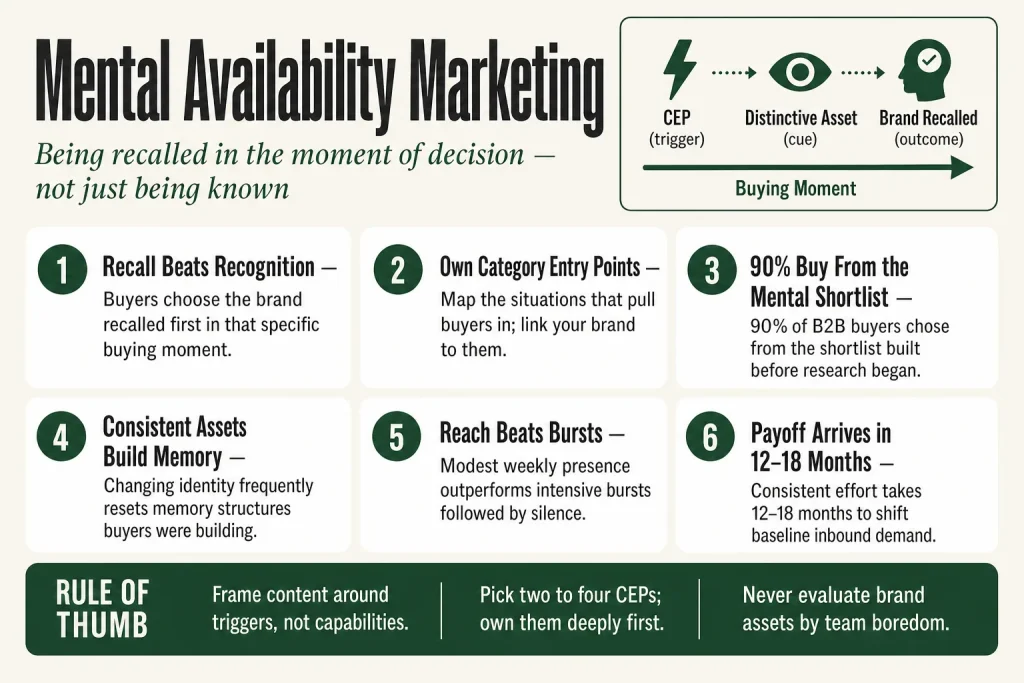
Mental availability marketing is the practice of making your brand the one that comes to mind when a buyer enters a buying situation. By the end of this page, you’ll be able to identify the specific moments your business should own, choose the assets that make you recognizable in those moments, and stop spending budget on awareness that never converts to recall when it counts.
Most operators think about brand-building the wrong way. They chase likes, impressions, and general awareness, the idea being that if enough people know the name, sales will follow. It’s intuitive. It’s also incomplete. A potential client can know exactly who you are and still not think of you when they’re standing at the moment of decision: the painful conversation with their accountant, the panicked search at 11pm, the hallway conversation where someone says ‘do you know a good…’ The gap between being known and being recalled in that specific moment is exactly what mental availability marketing is designed to close.
The concept comes out of the Ehrenberg-Bass Institute at the University of South Australia, built primarily by Professor Byron Sharp and Research Professor Jenni Romaniuk. Sharp’s How Brands Grow (Oxford University Press, 2010) brought their research to a mass marketing audience, but the foundation runs earlier. Romaniuk and Sharp published ‘Conceptualizing and Measuring Brand Salience’ in Marketing Theory4(4), 327 to 342, in December 2004. That paper formally broke salience away from simple top-of-mind awareness and redefined it as a contextual, situation-linked phenomenon, the propensity of a brand to be noticed or come to mind in buying situations. That distinction changes what you spend time building.
The idea in 30 seconds
- Mental availability marketing is about being remembered in the specific moments that trigger buying, not just being generally known.
- The idea comes from Byron Sharp and Jenni Romaniuk at the Ehrenberg-Bass Institute; Romaniuk and Sharp formally defined brand salience as a situational, context-linked phenomenon in Marketing Theory in 2004.
- The practical unit of work is the Category Entry Point (CEP): the situations, needs, and occasions that pull a buyer into your category.
- You build mental availability by linking your brand to more CEPs through consistent distinctive assets, not by chasing generic awareness or engagement metrics.
- For small operators, the priority is choosing a tight set of CEPs you can credibly own, then showing up for those moments repeatedly and consistently.
- Mental availability is a prerequisite for conversion, if buyers don’t think of you when the moment arrives, everything else in your funnel is moot.
Where the Idea Came From
For most of the twentieth century, top-of-mind awareness, the first brand someone mentions when you name a category, was treated as the gold standard of brand health. The assumption was that awareness drives preference drives purchase, a tidy funnel that felt logical and was easy to measure.
The Ehrenberg-Bass Institute spent decades collecting actual purchase-behavior data, and what came back was messier. Most category buyers are light or occasional buyers, people who buy infrequently and switch between several brands without much emotional investment. Given that, the more useful question became: what actually determines which brand a light buyer chooses in the moment? The research pointed to retrieval, which brand came to mind, quickly and easily, in that specific purchase situation. Not which brand they loved. Which brand surfaced first in that context.
Romaniuk and Sharp’s December 2004 paper in Marketing Theory‘Conceptualizing and Measuring Brand Salience’ (4(4), 327 to 342), formalized the shift. Brand salience, they argued, was not simply awareness, it was the brand’s propensity to be noticed or come to mind in buying situations, driven by the quality and quantity of memory structures buyers hold. A year earlier, in 2003, Romaniuk and Sharp had published ‘Brand Salience and Customer Defection in Subscription Markets’ in the Journal of Marketing Management19(1 to 2), 25 to 44, examining insurance and banking markets. Their finding: as salience increased, the proportion of customers likely to defect decreased, a pattern consistent across the three studies in that paper.
How Brands Grow (2010) made the framework accessible to practitioners by connecting it to empirical regularities, the Double Jeopardy Law, divided loyalty patterns, and the consistent finding that brands grow mainly by adding buyers rather than deepening loyalty. Romaniuk’s chapter ‘Building Mental Availability’ in How Brands Grow Part 2 (Oxford University Press, 2016) developed the CEP framework in detail. Her subsequent books, Building Distinctive Brand Assets (Oxford University Press, 2018) and Better Brand Health (Oxford University Press, 2023), formalized measurement metrics including mental penetration, network size, and mental market share.
What the body of work overturned was the received wisdom that marketing’s job is to build love, loyalty, and differentiation. The empirical case is that brands winning in most categories are not necessarily loved more, they are simply recalled more readily in more buying situations. Different job description, different decisions.
The Core Idea: Memory Structures and Category Entry Points
Mental availability, in plain terms, is the likelihood your brand comes to mind when someone enters a buying situation. Not when someone hears your name and recognizes it. When a specific situation arises, a problem, a need, a context, an occasion, does your brand surface? That’s the question mental availability marketing is built to answer with ‘yes.’
Every time your brand shows up in connection with a particular situation or need, it has the opportunity to strengthen a link in memory between that cue and your brand name. Over time and repetition, that link becomes easier to retrieve. When the link is weak or absent, the brand doesn’t come to mind at all, and someone else gets the business.
Category Entry Points
The practical unit here is what Romaniuk and Sharp call a Category Entry Point (CEP). A CEP is any internal or external cue that pulls a buyer into thinking about your category. Internal cues might be emotions or states: stressed about compliance, embarrassed by a slow website, anxious about an upcoming event, feeling a cash crunch. External cues might be situations or contexts: a conversation at a networking event, a colleague mentioning a recent hire, a line item on a budget review, a friend recommending someone. CEPs are the entry doors into your market. Your job, in mental availability terms, is to have your brand associated with as many relevant ones as possible, and to be the brand most strongly linked to the ones that matter most.
This is a fundamentally different exercise from positioning in the traditional USP sense. A USP asks: what is the one claim we own? Mental availability asks: in which situations do we want to be the first name retrieved? The two can coexist and often should, but they pull in different directions. A tightly-defined USP can actually limit your CEP coverage if it’s so specific that it only maps to one buying trigger. A broader set of CEP associations can make you easier to remember without sacrificing your core positioning, as long as the associations are honest and reinforced consistently.
Distinctive Assets
Memory structures don’t build themselves. They’re built by consistent exposure to distinctive brand signals, the colors, shapes, sounds, phrases, characters, and other identifiable elements that function as retrieval cues. When someone sees or hears those signals, the associated brand should come to mind almost automatically. Romaniuk’s Building Distinctive Brand Assets (Oxford University Press, 2018) is the detailed treatment. The operating principle for an operator is this: assets only work if they’re consistent and repeated over time. Changing your visual identity, your tagline, or your brand voice frequently is a way of spending your memory budget without building anything durable.
Think about how quickly you identify a FedEx truck, a Tiffany box, or the Intel four-note sound. Those aren’t accidents. They’re the result of years of deliberate, consistent application of the same distinctive elements across every touchpoint. You don’t need their budgets to apply the same logic. You do need the discipline to stop reinventing your look and feel every time a new trend appears.
Why Mental Availability Marketing Changes What Operators Should Actually Do
Here’s where this idea has real teeth for a small operator. The conventional growth playbook says: build a tight niche, develop a loyal fanbase, create differentiation so strong that people prefer you over competitors on the merits. There’s nothing wrong with those goals, but the mental availability framework adds something they miss: none of them help you if you’re not recalled at the moment of decision.
Consider a small accounting firm. Their clients know them. Their clients like them. Their clients may even tell other people to use them. But when a prospect’s business-owning friend asks at a dinner party ‘do you know a good accountant who handles small manufacturing companies?’, does this firm’s name surface? That moment is the CEP. That’s the retrieval test. And the firm’s name only comes up if the person at that dinner has a strong enough memory link between ‘finding a good accountant for manufacturing’ and this particular firm. Satisfaction won’t help if the link isn’t there.
This plays out constantly in B2B contexts. A Bain & Company and Google survey of 1,208 people at U.S. companies involved in buying software, cloud hosting, hardware, telecommunications, logistics, marketing services, and industrial equipment found that 90% of buyers ultimately chose from the vendor shortlist they had assembled before formal research began. Sherrard, Dave, and Parker MacGregor reported these findings in Harvard Business Review on September 20, 2022. That shortlist is built from memory, not from active search. If you’re not on the mental shortlist at the start of the buying process, you’re competing for scraps, the small share of buyers who look beyond their initial mental candidates.
For local and regional service businesses, the mechanics are the same but the geography is tighter. You’re not trying to be recalled everywhere; you’re trying to be the firm that comes to mind in your specific market when the right CEPs arise. That’s actually an advantage: you have a much more manageable universe of situations to own than a national brand does. A regional staffing agency doesn’t need to be in everyone’s head, it needs to be the first name retrieved when a hiring manager at a mid-size local company thinks ‘I need to fill a technical role fast.’ Own that CEP in that geography, and the business follows.
The other implication is about what you measure. Most small-business marketing is tracked by leads, clicks, and conversions, all demand-capture metrics that measure what’s happening right now with people who are actively in market. Those metrics miss the large share of your potential buyers who are not currently shopping, but who will be at some point. Mental availability is what you’re building for that future cohort. You won’t see it in this week’s lead volume. You’ll see it in the baseline of inbound demand over months and years, in the quality and source of your referrals, and in the fact that prospects arrive already knowing who you are and already somewhat sold.
Putting this to work? The ideas in the Canon are the foundation under the tactical playbook in Build a Complete Marketing Department. Grab the free companion kit at mmsvegas.com/resources.
Mental Availability Marketing in Practice: What Operators Should Build
The framework has a clear sequence for operators who want to apply it. None of it requires a research budget. Some of it requires discipline you might currently be skipping.
Step one: Map your Category Entry Points
Sit down and ask honestly: what are the situations, problems, emotions, or occasions that pull someone into needing what I sell? Be specific. ‘Needs a website’ is not a CEP. ‘Just got a sales job and realized their LinkedIn profile is embarrassing’ is a CEP. ‘Landed a new investor and needs to look credible fast’ is a CEP. ‘Heard a competitor’s name mentioned in a pitch meeting and felt behind’ is a CEP. The more specific the situation, the more useful it is as a targeting frame for your content, your advertising creative, and your sales conversations.
A practical exercise: talk to ten recent clients and ask them to describe the moment they decided to start looking for help. Not why they chose you, what triggered the search. The answers will give you your actual CEP list. It’s almost always richer and more varied than operators expect.
Step two: Prioritize the CEPs worth owning
You can’t credibly link your brand to every possible entry point. You don’t have the budget, and spreading thin dilutes the memory impact. The right frame for prioritization is a simple two-by-two: how frequently does this CEP occur in your market, and how strongly are competitors already linked to it? Frequent CEPs with weak competitor linkages are the obvious wins. Frequent CEPs that a dominant competitor already owns are expensive to challenge. Infrequent CEPs are rarely worth the investment regardless of competition.
For most small operators, two to four well-chosen CEPs is the right scope. Own those, deepen the links over time, and expand later.
Step three: Create consistent distinctive assets
What does your brand look, sound, and feel like? If your visual identity, your color palette, your writing voice, and your core visual elements are applied consistently across every touchpoint, your website, your emails, your social profiles, your physical space if you have one, your proposals, your follow-up, then every exposure strengthens the same memory structure. If they vary because your designer changed, you were going through a rebrand, or you just got bored, then each exposure is building a slightly different structure and none of them get strong enough to reliably trigger retrieval.
Pick your distinctive assets deliberately. Make sure they’re actually distinctive in your category, not just what every firm in your space uses. Then apply them relentlessly. The boredom you feel with your own brand identity after year two is not a signal that you should change it. It’s a signal that your internal team has seen it more than your market has.
Step four: Show up for CEPs explicitly in your content and advertising
This is where most operators miss the opportunity. They create content about their expertise, which is fine, but they frame it in terms of their capabilities, not in terms of the situations that trigger buying. Content that says ‘we are experts in employment law’ does not link your firm to the CEP of ‘received a formal complaint from an employee.’ Content that says ‘what to do in the first 48 hours after an employee files a formal complaint’ links you directly to that CEP. Same expertise. Very different memory impact.
Your advertising creative, your social media, your email subject lines, your event talk titles, all of these are opportunities to link your brand to specific situations. Use them that way. Name the trigger, then show up as the answer.
Step five: Maintain reach over concentration
One of the more counterintuitive findings from the Ehrenberg-Bass body of work is that continuous broad reach tends to outperform periodic intensive bursts. The brain forgets quickly. Memory structures decay if they aren’t refreshed. A modest presence every week beats a big presence for three weeks and then silence for three months. For small operators with limited budgets, this means choosing fewer channels and showing up in them consistently rather than spreading across many channels and going dark when cash gets tight.
Where Mental Availability Fits, and Where It Doesn’t Do Enough on Its Own
Mental availability is a powerful concept, but it’s not a complete marketing strategy. It’s one pillar of a two-pillar framework: mental availability tells people to think of you; physical availability makes it easy to buy when they do. If someone thinks of your plumbing company at 9pm on a Sunday but can’t reach you, can’t find your pricing online, and can’t book easily, the mental availability did its job and then got blocked at the door. For service businesses this means: is your website findable for the searches that match your CEPs? Is your phone answered or is there a clear alternative? Is your booking or intake process frictionless?
Mental availability also operates mostly on buyers who are not currently in market, it’s about building the memory that will influence the future purchase. If you have a short-term revenue crisis, mental availability work won’t help you this month. You need demand-capture tactics for that: paid search, direct outreach, referral activation. The two are not substitutes. They work together, addressing different time horizons. The mistake is treating mental availability work as optional because it doesn’t show immediate returns, that’s the same logic that leads operators to stop advertising during recessions and then wonder why their name recognition has eroded two years later.
There’s also an honest limit for very small operations: if your physical capacity to serve new clients is constrained, building broad mental availability is premature. Get your operations to a point where demand can scale before you invest heavily in building awareness across a large pool of potential buyers. Mental availability built before you can serve the resulting demand is mostly waste.
And one more caveat: the Ehrenberg-Bass research was developed primarily in consumer packaged goods categories, large markets, many buyers, frequent purchases, low switching costs. The principles translate to B2B and professional services, but the mechanics differ. In B2B, CEPs tend to be situation-specific business triggers rather than personal moments; the buying cycle is longer; and the ‘light buyer’ principle plays out differently when categories have small populations of buyers who buy infrequently. The framework is valid and useful in those contexts, but apply it with an awareness that you’re extrapolating from research conducted in different conditions. The directional logic holds; the specific claims about market penetration being the primary driver of growth are better treated as a useful corrective to excessive loyalty-focus than as a quantitative law.
How Real Brands Build Mental Availability, and What Small Operators Can Steal
Liquid Death is one of the more instructive recent examples of mental availability built from scratch. Canned water has almost no inherent reason to be memorable, it’s one of the most generic commodity categories imaginable. Liquid Death built memorability by committing completely to a polarizing aesthetic drawn from metal and punk culture that is so unusual in a beverage aisle it’s nearly impossible to forget once seen. Founded by Mike Cessario in 2019, the brand grew from roughly $3 million to $333 million in revenue by 2024, growth driven almost entirely by marketing, packaging, and positioning rather than product differentiation, since canned water is canned water. They won on distinctiveness and on consistent CEP linkage: ‘drinking at a party or event where you want to hold a can but not drink alcohol.’ That specific situational link, reinforced by consistent visual assets and a brand voice that hasn’t wavered, created rapid mental availability in a target market that didn’t know it needed them.
5-hour Energy’s campaign built around ‘That 2:30 Feeling’ is a textbook CEP execution. They didn’t advertise energy drinks, they advertised a specific, named moment that millions of office workers recognized from their own experience. The CEP was the creative idea. Every ad reinforced the same situational link: mid-afternoon fatigue triggered the brand. Repeatable. Durable.
HubSpot, from its founding in 2006, built mental availability in the ‘inbound marketing’ category partly by creating and naming that category, associating their brand so strongly with a set of CEPs (small business struggling with cold outreach, marketing team without a big advertising budget, company wanting to attract rather than interrupt) that ‘inbound marketing’ and ‘HubSpot’ became nearly synonymous in certain buyer segments. They did it through consistent content, a distinctive brand voice, and repeated presence at every relevant situation their buyers experienced.
For a local service business, the translation is modest in scale but identical in logic. A commercial cleaning company that consistently links its name to specific CEPs, ‘pre-inspection panic,’ ‘new office lease,’ ‘losing a client due to facility concerns’, in its content, its case studies, and its sales conversations will be retrieved in those moments far more reliably than a competitor whose marketing only ever says ‘professional cleaning services, call us today.’ The trigger-led approach costs nothing extra. It just requires thinking about your buyer’s situation first, before you think about your own capabilities.
On the B2B side, CEPs translate to specific business events and situations: a company receiving its first investor funding, a hiring freeze being lifted, a new regulatory requirement landing, a competitor acquisition creating uncertainty in the market. Each of these is a situational trigger. B2B brands that appear consistently in the context of those triggers, through trade press, LinkedIn content, webinars, event sponsorships, build the mental structures that put them on the shortlist when formal buying begins. The smaller the niche, the more achievable this is on a limited budget.
Common Mistakes
- Measuring engagement instead of memory. Track branded search volume over time using Google Search Console, and track the source and quality of inbound referrals, as proxies for mental availability. Engagement metrics tell you who clicked, not who remembered.
- Rebranding or refreshing brand voice too frequently. Lock in two or three distinctive assets, a color system, a visual style, a consistent phrase or character, and apply them everywhere for at least three years before evaluating whether to evolve them.
- Showing up in bursts and then going silent. Choose fewer channels and maintain a consistent low-level presence year-round. Memory structures decay during silence and cost more to rebuild than to maintain.
- Trying to own too many Category Entry Points at once. Prioritize two to four CEPs that are frequent in your market and weakly linked to competitors. Own those deeply before expanding your coverage.
- Framing content around capabilities instead of situations. Redesign your content and advertising around specific Category Entry Points, named situations your buyer is in, rather than general brand messages about what you do. ‘What to do in the first 48 hours after an employee files a formal complaint’ builds a situational link; ‘we are experts in employment law’ does not.
Operator’s Take
I’ve watched a lot of operators spend serious money on marketing without ever solving the actual problem, they’re not recalled when it matters. Their buyer arrives at the moment of decision, and someone else’s name surfaces. Not because that someone else is better. Because they showed up in the right context often enough that the link stuck.
Here are the things that come out of applying this framework in practice rather than just reading about it.
Run a CEP audit on your own content before you commission anything new. Pull your last twelve months of blog posts, LinkedIn content, or ad copy. For each piece, answer one question: does this name a specific situation my buyer is in, or does it describe what I do? Most operators find the ratio badly skewed toward capability descriptions. Flip it over twelve months, lead with the trigger situation, then the capability, and the inbound mix tends to shift. This audit takes a morning and costs nothing.
Map your CEPs against your competitors’ content, not just your own. Go to the websites and LinkedIn pages of your two or three closest competitors and run the same check. If they already dominate the CEP of ‘sudden regulatory deadline’ in your category, you have a choice: fight for that ground or go after adjacent CEPs they’re ignoring. For most small operators, the uncontested adjacent CEP is the smarter move. Less competition, faster memory-link formation, lower content investment to own it.
Think of CEP coverage as shelf space, not a campaign. You don’t build a shelf display, admire it for a quarter, and then tear it down. You maintain it, refill it, and expand it. If you wrote one post addressing a specific trigger situation, that’s a start, not a finish. The question is which adjacent CEPs you’re still missing and when you address them.
The enemy of distinctive assets is boredom, not time. More operators erode their own memory structures by refreshing their brand than by any external force, a new logo, a tone shift, a redesigned email template. Each feels like progress. Each resets some of the recognition your market had been building. A practical rule: don’t evaluate whether to change a distinctive asset based on how bored your team is. Evaluate it based on how many of your target buyers can identify it correctly without a prompt.
AI tools can speed up the CEP-mapping work you’d otherwise skip. You can use a language model to generate a draft list of the situations that pull buyers into your category, then check your existing content against that list to find the gaps. The judgment call on which CEPs to prioritize and how to address them stays with you, the model is producing a draft map, not deciding strategy. But for a solo operator or a small team, that coverage audit used to require a workshop and a consultant. Now it takes an afternoon.
The shortlist problem is more urgent than most operators think. A Bain & Company and Google survey of 1,208 U.S. B2B buyers, reported in Harvard Business Review on September 20, 2022 by Sherrard, Dave, and Parker MacGregor, found that 90% of buyers ultimately chose from the vendor shortlist assembled before formal research began. The implication: you need to be in someone’s memory before they enter an active buying cycle. Showing up during the process is too late for most of those buyers.
On sequencing when money is tight. Mental availability work runs on a 12-to-18-month lag before it visibly shifts baseline inbound demand. If you’re in a cash crunch right now, direct sales and referral activation are the right near-term moves. The right steady state is running both: demand capture for this month’s pipeline, memory-building for next year’s. Fix the revenue problem first. Then build the structures that make it less likely to return.
Used in
- ✓ Build a Complete Marketing Department
Used to frame the ‘demand creation’ half of the marketing calendar, ensuring the operator’s brand is being linked to relevant buying triggers consistently for buyers who are not yet in market. - ✓ The Missing Manual for FunnelKit
Informs the pre-funnel awareness and top-of-funnel content strategy, ensuring that funnels are pulling from a pool of buyers who already have memory structures linking the brand to their specific problem. - ✓ The Missing Manual for Make
Applied when designing automated nurture sequences that reinforce situational links over time, keeping the brand associated with specific CEPs between purchase cycles in subscription and repeat-purchase contexts.
FAQ
Is mental availability the same thing as top-of-mind awareness?
Not quite. Top-of-mind awareness measures which brand someone names first when asked to list brands in a category. Mental availability measures whether a brand is recalled in a specific buying situation, which is a higher bar and a more useful predictor of actual purchase. A brand can be highly recognizable but still fail to surface when the actual trigger fires.
How do I measure mental availability without a large research budget?
Track branded search volume over time using Google Search Console, consistent growth in people searching your name suggests strengthening memory structures. Also track the source and unprompted nature of your inbound referrals. A client saying ‘someone mentioned your name when I described my problem’ is a direct signal that a CEP-to-brand link fired in the wild.
Does mental availability apply to B2B, or is it mainly a consumer-brand idea?
It applies to B2B, with adjustments. B2B CEPs tend to be specific business events, a compliance deadline, a new hire, a funding round, a failed vendor relationship, rather than personal moments. The buying group is larger and the cycle is longer, but the basic dynamic holds: buyers assemble a mental shortlist before they begin formal research, and you need to be on it.
Can a very small business realistically build meaningful mental availability?
Yes, because the scope is smaller. A small operator isn’t competing for share of mind across an entire national market, they’re competing in a defined geography or niche. Owning two or three CEPs within that smaller universe is achievable with consistent content, local visibility, and a distinctive brand identity applied persistently over time.
How does mental availability relate to content marketing?
Content marketing is one of the most budget-accessible tools for building mental availability, but only if the content is structured around Category Entry Points rather than general expertise. Content that names and depicts the specific situations your buyers are in when they start looking creates situation-to-brand links in memory. Content that talks only about your capabilities builds awareness but not reliable situational recall.
How long does it take to see mental availability work pay off?
Realistically 12 to 18 months of consistent effort before you see a measurable shift in baseline inbound demand or unprompted referral quality. It’s a long game by design, you are building memory structures, not triggering immediate conversion. The operators who benefit most are the ones who treat it as infrastructure, not a campaign.
Further reading
- Byron Sharp, How Brands Grow: What Marketers Don’t Know (Oxford University Press, 2010). The foundational text that brought Ehrenberg-Bass empirical findings to a practitioner audience. Read it for the evidence base, then apply skepticism to the claims that don’t translate from FMCG to your category.
- Jenni Romaniuk and Byron Sharp, How Brands Grow Part 2 (Oxford University Press, 2016). The chapter ‘Building Mental Availability’ is where the CEP framework gets its fullest treatment. Worth reading alongside the first book rather than instead of it.
- Jenni Romaniuk, Building Distinctive Brand Assets (Oxford University Press, 2018). The practical companion on how to develop and manage the assets that carry your mental availability over time, useful for any operator who wants to be rigorous about what their brand actually is.
- Jenni Romaniuk, Better Brand Health: Measures and Metrics for a ‘How Brands Grow’ World (Oxford University Press, 2023). Formalizes the measurement framework, mental penetration, network size, and mental market share, for operators who want to track mental availability systematically rather than by feel.
- Romaniuk, J. and Sharp, B. (2004). ‘Conceptualizing and Measuring Brand Salience.’ Marketing Theory4(4), 327 to 342. The academic paper that broke salience away from simple top-of-mind awareness and gave the framework its rigorous foundation.
- Romaniuk, J. and Sharp, B. (2003). ‘Brand Salience and Customer Defection in Subscription Markets.’ Journal of Marketing Management19(1 to 2), 25 to 44. The earlier empirical work showing the relationship between salience and defection risk in insurance and banking markets, useful context for service businesses.
- Sherrard, S. Dave, R. and Parker MacGregor, M. (2022). ‘What B2Bs Need to Know About Their Buyers.’ Harvard Business ReviewSeptember 20, 2022. Reports findings from a Bain & Company and Google survey of 1,208 U.S. B2B buyers on shortlist formation and vendor selection behavior.
Sources:
Core academic grounding: Romaniuk, J. and Sharp, B. (2003), ‘Brand Salience and Customer Defection in Subscription Markets,’ Journal of Marketing Management19(1 to 2), 25 to 44, their analysis across three studies in insurance and banking found that as salience increased, the proportion of customers likely to defect decreased, a pattern consistent across the three studies; Romaniuk, J. and Sharp, B. (2004), ‘Conceptualizing and Measuring Brand Salience,’ Marketing Theory4(4), 327 to 342, defines brand salience as the brand’s propensity to be noticed or come to mind in buying situations, reflecting the quantity and quality of memory structures buyers hold. Broader framework: Sharp, B. (2010), How Brands GrowOxford University Press; Romaniuk, J. and Sharp, B. (2016), How Brands Grow Part 2Oxford University Press, chapter ‘Building Mental Availability’ is cited as the source for CEP framework details in this article; Romaniuk, J. (2018), Building Distinctive Brand AssetsOxford University Press; Romaniuk, J. (2023), Better Brand HealthOxford University Press. B2B shortlist data: Sherrard, S. Dave, R. and Parker MacGregor, M. (2022), ‘What B2Bs Need to Know About Their Buyers,’ Harvard Business ReviewSeptember 20, 2022, reporting findings from a Bain & Company and Google survey of 1,208 U.S. B2B buyers involved in buying software, cloud hosting, hardware, telecommunications, logistics, marketing services, and industrial equipment; the finding that 90% of buyers ultimately chose from the vendor shortlist assembled before formal research began is drawn directly from this published article. Liquid Death revenue and founding figures: founding year 2019 and revenue trajectory ($3M to $333M by 2024) drawn from multiple public sources including company-disclosed funding rounds and retail sales reports; the $333 million retail sales figure for 2024 appears in multiple published accounts citing Nielsen retail data. Metric definitions (mental penetration, network size, mental market share) from Romaniuk, J. (2023), Better Brand HealthOxford University Press, as described in the Ehrenberg-Bass Institute’s published methodology.
Brian Kasday spent forty years in direct-response marketing before rebuilding the whole operation as a one-person shop. He writes The Operator’s Library — including “Build a Complete Marketing Department” — for operators who’d rather build it themselves than wait on someone else.
Build the department these ideas describe. The free companion kit: mmsvegas.com/resources.
More The Operator's Canon guides
Free · Operator Toolkit
Want the tools, not just the guide?
Get the free operator toolkit — templates and checklists for the systems you actually run, plus a note when this guide changes.
Get the free toolkit →