
Last updated: October 2026
The pillar cluster model is a content architecture where one broad reference page, the pillar, sits at the center of a topic, and a set of tighter, focused pages, the clusters, surround it, all linked to each other in a deliberate hub-and-spoke structure. By the end of this page, you’ll be able to plan your first cluster, identify the one topic your business can credibly own at depth, and diagnose why your existing content may be cannibalizing itself instead of compounding.
Most small operators have a content problem they misidentify as a volume problem. They have 40 blog posts and wonder why nothing ranks. The real issue usually isn’t quantity, it’s isolation. Each post was written to target a keyword, published without connection to anything else on the site, and left to compete both with external sites and, quietly, with other posts from the same domain. Search engines can’t tell which page is supposed to be the authority. Neither can the reader.
The pillar cluster model solves that by giving every piece of content a job and a relationship. The pillar answers the broad question and signals to crawlers that this is where the subject lives. The cluster pages answer the specific questions the pillar is too wide to go deep on. The links between them are not decorative, they’re structural signals that tell search engines your site has organized, coherent coverage of the topic, not a pile of loosely related articles.
This matters more now than it did a decade ago. Search demand itself has shifted toward intent-driven, conversational queries, the kind that reward sites demonstrating subject coverage in depth over sites that simply hit the keyword once per paragraph. And with AI-powered search surfaces pulling cited answers from clustered content with higher frequency than standalone pages, the architecture question has real stakes for operators who depend on organic visibility.
The idea in 30 seconds
- The pillar cluster model organizes your site into one broad pillar page per topic, surrounded by 6 to 15 tighter cluster pages, all connected by deliberate internal links.
- Search engines read that connected structure as a signal that your site understands a subject at depth, not just one page on it, this is what topical authority means in practice.
- The mechanism works because the pillar accumulates intra-site authority from every cluster page linking to it, while the cluster pages earn traffic from specific long-tail queries.
- For a small operator, this means picking one or two topics you legitimately own, building a connected body of work around them, and stopping the habit of publishing isolated articles that compete with each other.
- The model took formal shape in a 2017 HubSpot Research report written by Mimi An. The experimental foundation came from Anum Hussain and Cambria Davies, whose 2015 “Topics Over Keywords” research showed that internal linking fueled SERP performance. Matthew Barby, then Director of Acquisition at HubSpot, introduced the team to the topic cluster concept and contributed the hub-and-spoke diagram that appeared in the report.
- By the end of this page, you’ll be able to map your first cluster, identify the pillar topic you can credibly own, and stop confusing activity (more posts) with architecture (a connected system).
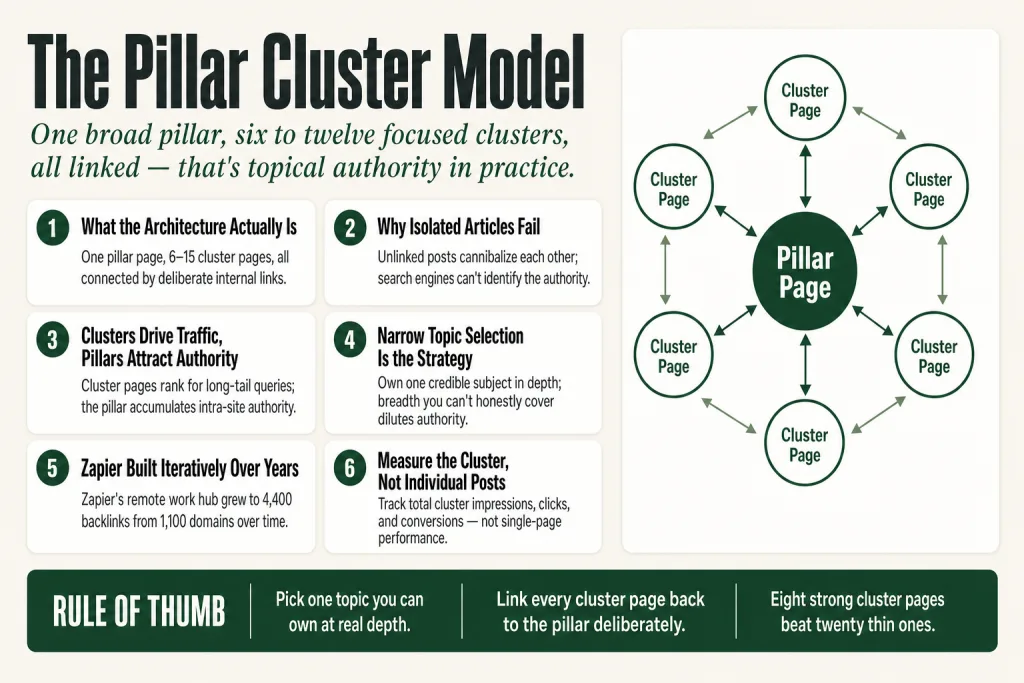
How the Pillar Cluster Model Actually Works
The architecture has three parts, each with a specific job.
The Pillar Page
The pillar page covers a broad topic at a high level, comprehensive enough to orient a reader who’s new to the subject, but not so specific that it tries to answer every narrow question under that topic. Think of it as the “complete guide to X” page, where X is a subject your business legitimately owns. It targets the head-term keyword for that subject and signals to search engines that this is the canonical reference your site offers on the topic. A well-built pillar tends to run long, not for padding, but because the topic genuinely has breadth.
The pillar page’s job is not to rank for every query on the topic. Its job is to organize the subject and link out to the cluster pages that go deeper. Trying to answer every specific question on the pillar defeats the purpose: you want the cluster pages to rank for those long-tail queries.
The Cluster Pages
Cluster pages address specific subtopics, long-tail questions, use cases, and comparisons that live within the pillar’s subject area but warrant their own focused treatment. A cluster page on “signs you need AC repair” goes places the pillar page on “HVAC services” can’t, specific checklists, cost ranges, failure mode explanations. Each cluster page owns a narrower intent. That specificity is what earns it traffic from people who have a specific question, not just a general curiosity.
Each cluster page links back to the pillar with descriptive anchor text, and the pillar links out to every cluster page. That bidirectional linking is load-bearing. It’s what creates the semantic neighborhood that crawlers can map.
Internal Links, the Structural Signal
When 10 or 12 cluster pages all link to one pillar, that pillar accumulates intra-site authority that no single page could earn on its own. Search engines read that link pattern as the site declaring which page is the canonical reference on the topic. It’s the same logic as external backlinks, concentrated inbound signals lift authority, except these signals are entirely within your control. You don’t have to wait for anyone else to link to you to start building the structure.
The links between cluster pages themselves also matter. If a reader is on your “HVAC maintenance schedule” cluster page and there’s a natural connection to your “signs your AC is failing” cluster page, linking between them extends the semantic neighborhood and keeps the reader inside your site’s knowledge base rather than sending them back to Google.
Topical Authority as the Output
Topical authority is what you accumulate when this architecture is in place and your content covers the subject well. It isn’t a score you can look up in any tool, Google has no public topical authority metric. What you can observe are the effects: pages ranking for queries they don’t explicitly target, the pillar gaining visibility for variations of its head term, and cluster pages pulling long-tail traffic that compounds over time. The structure is what makes those effects possible; the content quality is what makes them persist.
Why Publishing Isolated Articles Is a Losing Approach
The old content playbook, pick a keyword, write a post, repeat, made sense when search engines evaluated pages almost entirely in isolation. One page, one keyword, one ranking opportunity. That playbook is not dead, but it’s badly incomplete. Search engines now evaluate sites as topical systems, not collections of individual pages.
When you publish isolated articles with no structural relationship to each other, a few things go wrong simultaneously.
Keyword cannibalization. If you’ve published three posts that each touch on “pricing strategies for service businesses,” search engines don’t know which one to promote for that query. They may cycle between them unpredictably, or suppress all three in favor of a competitor with a single authoritative page. You’ve diluted your own authority.
No authority concentration. None of your pages accumulates the link signals that come from being the obvious hub for a subject. Every page starts from zero. A cluster architecture solves this by funneling intra-site authority toward the pillar, which then has a meaningful authority advantage before a single external link arrives.
Poor crawl efficiency. A site with dozens of loosely related posts in a flat architecture is harder and slower for crawlers to map. A hub-and-spoke structure tells the crawler exactly how the content relates and which page should be evaluated as the primary reference.
Reader confusion. When a person lands on a cluster page and wants more depth, where do they go? If your site has no pillar, they go back to Google. If it does, they move deeper into your content system, reading more, trusting more, and arriving at a conversion point having already built familiarity with your expertise. This is the demand capture payoff from demand that the cluster system helped create.
The math on this is not subtle. A well-linked cluster earns more traffic from the same number of pages than an equivalent set of isolated posts, not because the writing is better, but because the architecture directs authority toward the pages that deserve it and gives readers a reason to keep reading.
Applying the Pillar Cluster Model as a Small Operator
Here’s the honest translation for a business that doesn’t have a 20-person content team.
Start with topic selection, not keyword research
Most operators approach this backward, they open a keyword tool, find search volume numbers, and try to build content around whatever looks big. The right starting point is a different question: What subject do you legitimately know better than most sites in your space? Your pillar topic has to be something you can cover with real depth, not something you’re covering because a keyword tool said to.
For a local HVAC operator, a pillar on “home HVAC systems” is credible. A pillar on “home energy efficiency” might stretch into territory you can’t honestly own at depth. For a B2B accountant serving e-commerce brands, a pillar on “accounting for e-commerce businesses” is credible. A pillar on “e-commerce growth strategy” is not, that’s a different business’s subject.
Pick one or two topics maximum to start. One cluster done well beats three clusters done thinly. The value of the model compounds from depth, not sprawl.
Map the intent landscape before writing a word
Before anything gets written, map the questions your buyers actually ask about your pillar topic. These questions come from sales conversations, support tickets, reviews, and the autocomplete suggestions in your search bar of choice. Each distinct question that warrants a full answer is a candidate cluster page. Each question that the pillar can answer in a paragraph stays on the pillar.
The distinction is intent. “What is HVAC preventive maintenance?” is a pillar-level question, broad, definitional, sets up everything else. “How often should I service my HVAC system in a humid climate?” is a cluster-level question, specific, situated, deserves its own page with a real answer. Give every unique intent its own URL. Never collapse two distinct intents onto one page to save effort; you’ll end up with a page that ranks for nothing because it’s trying to serve two masters.
Build the links deliberately, not as an afterthought
Every cluster page needs a link back to the pillar with descriptive anchor text, not “click here,” not “learn more,” but the actual subject language a reader would recognize. “Complete guide to HVAC maintenance” is useful anchor text. “This page” is not. The pillar needs outbound links to every cluster page it refers to, using similarly descriptive anchors.
This is the step operators most often skip or do halfway. They write the content, publish it, and assume the internal linking will happen eventually. It won’t, or it won’t be systematic enough to matter. Build the linking structure before you publish. Add the cluster link to the pillar the day the cluster goes live. Don’t treat internal linking as a cleanup task.
Audit before you build
If you’ve been publishing content for more than a year, you probably have the raw material for at least one cluster already. Before writing anything new, audit what you have. Group existing posts by topic. Identify which ones are covering the same intent from different angles (candidates for consolidation) and which ones cover distinct subtopics under a shared parent (candidates for cluster membership).
Consolidating two weak, overlapping pages into one stronger page, then linking that page properly into a cluster structure, often delivers more ranking benefit than publishing five new pages. The cluster model is as much an editorial cleanup discipline as it is a content creation framework.
Repurpose the cluster content across channels
A cluster page that thoroughly answers one question is also a newsletter section, a social post, a short video script, and a talking point for a podcast appearance. The work you put into covering a subtopic in depth doesn’t have to live only on your website. Small teams should think of each cluster page as source material, a researched, authoritative take on one slice of your subject that can travel in multiple formats. This is how you extract maximum return from limited publishing bandwidth.
Measure the system, not individual posts
One of the cleaner indicators that the model is working is that pages you didn’t specifically optimize start ranking for queries they don’t explicitly target. That’s topical authority starting to accumulate. Watch for the pillar gaining impressions for related variations of its head term. Watch for cluster pages ranking for adjacent long-tail queries you didn’t plan for. These are the system-level signals worth tracking, not just whether the individual post hit page one for its target keyword.
Real Operators Who Built This Well
Three examples are worth naming because they show the model working at different scales and for different reasons.
HubSpot’s own blog reorganization
When HubSpot applied the pillar cluster model to their own site, which by that point had accumulated tens of thousands of blog posts, they reorganized the entire blog infrastructure around specific topic areas anchored by pillar pages. Per a HubSpot blog post on the restructuring, the project was spearheaded by Senior Content Strategist Leslie Ye, SEO and Acquisition Marketer Brittany Chin, and Search Marketing Manager Victor Pan. Matthew Barby, then Director of Acquisition at HubSpot, is credited in the same post with introducing the team to the topic cluster concept and its importance for search ranking. The process involved auditing existing content, grouping posts by topic focus, and manually auditing internal links across the site. What the model illustrates clearly is that the value flows heavily through the cluster pages, not the pillar alone, the pillar attracts authority and links, while the spokes pull long-tail traffic. Operators who expect the pillar itself to be the traffic engine are misreading how it works.
Zapier’s remote work hub
Zapier built a pillar page on remote work and populated the cluster with specific articles: why the company operates fully remotely, automated workflows for distributed teams, common remote work challenges, tooling comparisons, and more. What’s instructive about Zapier’s approach is the sequencing: they didn’t plan and publish all the articles at once. In 2017 the hub started as a set of 14 linked articles; Zapier kept publishing on remote work over the following years, expanding the cluster iteratively as the topic grew. According to Ahrefs’ case study of Zapier’s SEO strategy, the remote work hub had accumulated 4,400 backlinks from 1,100 domains by the time of writing, with 1,100 monthly organic visits to that single hub page alone, on top of traffic each linked subpage earns separately. The iterative approach, publish on a topic over time, then consolidate into a cluster as the body of work grows, is a realistic model for small teams who can’t plan 12 cluster pages in advance.
Hotjar’s full-funnel cluster model
Hotjar organized their content into full-funnel topic clusters, groups of articles covering a subject from multiple buyer-journey angles: problem-aware content at the top, solution-aware content in the middle, and product-specific content at the bottom. In a 2022 interview with Ben Goodey (“How the Fxck SEO” podcast), Sean Potter, then Senior SEO and Content Strategist at Hotjar, described results for one specific cluster: a 150% increase in monthly organic visitors over the prior year, leading to a 130% increase in free organic signups and a 70% increase in paying customers from that cluster. Potter was explicit that these were outcomes for a single cluster over a defined period, not company-wide totals. They are self-reported and attributed to the full-funnel content approach, not the cluster architecture alone, treat them as directional evidence from a practitioner, not a controlled study. What the Hotjar case does illustrate clearly is that clusters organized around buyer intent stages, rather than pure keyword volume, have a more direct path to commercial outcomes than clusters optimized purely for traffic.
None of these companies are small operators with limited budgets. But the structural lesson transfers directly. You don’t need Zapier’s content volume or HubSpot’s team. You need one credible pillar topic, six to ten cluster pages that each answer a distinct question well, and the discipline to link them properly. The mechanism works at any scale because it’s a structural argument to a search engine, not a volume argument.
Putting this to work? The ideas in the Canon are the foundation under the tactical playbook in Build a Complete Marketing Department. Grab the free companion kit at mmsvegas.com/resources.
Where the Pillar Cluster Model Works and Where It Doesn’t
The model is not universally applicable, and overselling it to every operator would be dishonest.
Where it works well
Local service businesses with high-intent search demand. An HVAC company, a dental practice, a law firm, a financial planner, these businesses serve buyers who research heavily before deciding. Cluster content on specific questions (“how much does roof replacement cost,” “signs of a cavity,” “when to refinance a mortgage”) captures buyers at exactly the moment they’re forming a consideration set. The pillar page establishes authority; the clusters intercept intent across the buyer journey.
B2B services with long consideration cycles. Accountants, IT consultants, marketing agencies, HR consultants, buyers research these categories for weeks or months. A cluster system built around the buyer’s actual questions means your site shows up repeatedly across that research journey, creating the kind of accumulated familiarity that drives eventual contact. This is the demand creation role of content: building preference before anyone has expressed intent.
SaaS with educational content strategies. Product-led businesses where buyers self-educate before trial benefit from clusters that answer category questions (“what is customer feedback software”), comparison questions (“best survey tools”), and use-case questions (“how to collect NPS feedback”). The cluster architecture ensures the right page appears for each stage.
Where it works less well
Businesses with genuinely thin topic depth. If you sell one commodity product and there are genuinely only six things worth saying about it, a cluster architecture won’t help you. Padding a cluster with low-value pages to hit some imaginary page count requirement makes the content worse, not better. The pillar cluster model rewards subject depth. If you don’t have depth to offer, the architecture won’t manufacture it.
Pure transactional e-commerce with commodity SKUs. A site selling generic office supplies through price competition doesn’t have a content story to tell. The cluster model excels where buyers are educating themselves before buying. When they already know what they want and are choosing on price alone, content architecture has limited leverage.
Very early-stage businesses with no content history and limited bandwidth. If you have one person who can spend two hours a week on content, a full cluster build is probably not the first priority. Getting one useful pillar page live, even without a complete cluster around it, is a better starting point than planning a 12-page cluster you won’t finish for two years.
Businesses in genuinely low-search-volume niches. If your buyers don’t use search to find what you sell, organic architecture doesn’t help. The pillar cluster model is an organic search play. If your buyers come through referrals, trade shows, or cold outreach, invest in those channels first.
Conceptual Misunderstandings About the Pillar Cluster Model
A few misreadings of the model circulate widely enough to be worth correcting before you start building. These are structural confusions about how the model works, distinct from execution mistakes, which are covered separately below.
Misunderstanding 1: The pillar page is supposed to drive the traffic. It isn’t, at least not primarily. The pillar attracts authority signals, both intra-site links from cluster pages and, over time, external backlinks from other sites linking to your reference resource. The cluster pages do the traffic lifting by ranking for specific long-tail queries. Expecting the pillar to pull large traffic volumes quickly misreads the model. Many operators write a 5,000-word pillar, publish it, check traffic after two weeks, and give up. The traffic comes from the cluster pages first.
Misunderstanding 2: More cluster pages always means more authority. Quantity without quality is just a larger liability. A cluster page that’s thin, duplicative, or fails to match its target intent doesn’t add topical authority, it dilutes it. Eight strong, focused cluster pages outperform twenty weak ones. The signal to search engines is depth and coherence, not volume.
Misunderstanding 3: Topical authority is a metric you can measure directly. Google has no public topical authority score. What you measure are the proxies: ranking positions for head and long-tail terms across the cluster, impressions for query variations you didn’t target, time-on-site for users entering through cluster pages. The authority is real, but it’s inferred from observable outputs, not read from a dashboard.
Misunderstanding 4: You need to build the whole cluster before publishing anything. You don’t. Publishing the pillar page first, with placeholder links to cluster pages you’ll add over time, is a legitimate approach. Publishing cluster pages first to build ranking momentum before the pillar goes live is also legitimate. The sequencing is flexible; the structural discipline is not.
Misunderstanding 5: The pillar cluster model replaces backlink building. It doesn’t. Internal link structure concentrates the authority you already have, and a well-designed pillar page is more likely to attract external links than isolated posts. But the model doesn’t generate external authority from nothing. If your domain has very few external backlinks, the cluster architecture gives you a better structure to apply any authority you earn, it doesn’t conjure authority from thin air.
Where the Pillar Cluster Model Came From
The named model took shape through three distinct contributions, and conflating them is a common error in how the history gets retold.
The experimental foundation came first. Anum Hussain’s “Topics Over Keywords” presentation, delivered in October 2015 and published on her own site, documented three months of experiments she and her team ran that summer. The findings were practical: relevant internal links fueled SERP traffic, and supporting a primary page with long-tail-focused posts helped dominate a full topic in search. Cambria Davies worked alongside Hussain on later experiments at HubSpot that the 2017 report describes as launching in 2016, both accounts are consistent, with 2015 referring to Hussain’s initial documented experiments and 2016 referring to the formal HubSpot topic cluster experiments described in the report.
Matthew Barby, then Director of Acquisition at HubSpot, introduced the topic cluster concept internally and contributed the hub-and-spoke diagram that became the model’s defining visual. His role was conceptual framing and internal advocacy, he surfaced the idea of organizing content into semantic neighborhoods and brought it to the team working on HubSpot’s own blog.
The 2017 HubSpot Research report, Topic Clusters: The Next Evolution of SEOwritten by Mimi An with contributions from Leslie Ye, Matthew Barby, Anum Hussain, and Cambria Davies, is the honest origin point for the named vocabulary: pillar page, cluster content, topic cluster as a formal architecture. It formalized, named, and published what the prior experimental work had found. That report is what put the model into wide circulation.
The timing wasn’t random. Google had launched Hummingbird in 2013, a significant rewrite of its core algorithm that shifted the engine from keyword matching toward semantic understanding, evaluating the meaning and intent behind a query rather than parsing it word by word. After Hummingbird, sites providing contextually relevant content covering an entire topic started outranking sites optimized purely for exact-match keywords. That created a real structural incentive to organize content around subjects rather than individual keyword targets, and the HubSpot experiments were a direct response to what the team was observing in their own search performance.
Since then, every major algorithm development has reinforced the model’s core premise. Google’s Helpful Content updates and its E-E-A-T signals (Experience, Expertise, Authoritativeness, Trustworthiness) reward demonstrated subject depth and coherent site structure over volume and keyword density. In May 2023, Google published a Search Central blog post titled “Understanding News Topic Authority” describing a system that evaluates the degree of expertise a publication demonstrates on specific subjects, worth noting the scope: Google described this system in the context of news content and specialized areas like health, politics, and finance, not as a blanket signal applied to all sites equally. The concept rhymes with the pillar cluster model’s core logic, but treating that post as a direct validation of the cluster model for every operator oversells what Google actually said.
The Pillar Cluster Model in the Age of AI Search
The architecture argument for clusters is, if anything, stronger in 2026 than it was in 2017. AI-powered search surfaces, the generative answers appearing above traditional results in Google, Bing, and others, draw heavily from sites that demonstrate organized, coherent coverage of a subject. A pillar page connected to a web of supporting cluster pages signals to the retrieval systems underlying these features exactly what they’re looking for: a site that can be cited as an authoritative reference on a topic.
Internal link concentration on the pillar helps crawlers and AI indexing systems understand which page represents your site’s primary resource on a subject. Coverage breadth, the fact that your cluster addresses the full landscape of questions within a topic, signals to these systems that your site’s coverage is complete enough to cite, not just relevant enough to list.
This doesn’t mean you should write cluster pages for AI citation. That’s a cargo cult version of the strategy. Write cluster pages because your buyers have those specific questions and deserve good answers. The structural benefit to AI visibility follows from thorough coverage; it doesn’t precede it.
One practical note for operators: AI answer engines tend to cite pages that are directly and specifically responsive to a query. A cluster page that answers one question thoroughly, with a clear structure, concrete specifics, and no filler, is a better candidate for citation than a broad pillar page. Another reason to keep your cluster pages focused and your pillar pages organizational rather than exhaustive.
Common Mistakes
- Treating a WordPress category archive page as the pillar. A category archive is auto-generated, lists recent posts, and has no substantive coverage of the topic. Search engines don’t read it as a reference resource. Write the pillar as a proper editorial page with real original prose, then link to it from category navigation if you want, but the pillar lives at its own URL, not as an index of post titles.
- Linking cluster pages only to the pillar, never to each other. Clusters that connect only upward to the pillar, and never sideways to related cluster pages, miss the cross-linking that extends the semantic neighborhood and passes authority across the full structure. When a cluster page on “HVAC maintenance costs” naturally relates to “signs your HVAC is failing,” link between them. Sibling links are structural signals, not navigation decoration. Check every cluster page at publication for at least one relevant link to a sibling page.
- Building two cluster pages that answer the same question from slightly different angles, splitting authority between them. Before publishing any cluster page, confirm it answers a meaningfully different question than every other page already in the cluster. If two drafts are both essentially answering “how much does HVAC service cost,” you have one page split in two. Consolidate them into one thorough page. Two pages chasing the same intent dilute authority for both; one strong page owns it. Run a quick intent check against your existing cluster pages before writing anything new.
- Publishing a pillar with no cluster pages yet pointing back to it, then leaving it to sit for months. A pillar with no cluster pages linking back to it has nothing concentrating authority toward it. You don’t need the full cluster live on launch day, but publish at least three or four cluster pages at the same time as the pillar, each linking back to it, so the structure starts working immediately. Schedule the remaining cluster pages on a weekly or biweekly cadence and treat the launch date as the start of a build, not a completion.
- Letting cluster pages go stale while continuing to publish new ones. A cluster page that answered “how much does commercial HVAC installation cost” accurately in 2022 is now actively misleading buyers if costs have shifted. Stale cluster pages create trust failures at the exact moment a buyer is evaluating whether to contact you. Set a six-month review cycle for every page in the cluster, the pages closest to commercial intent are the ones where outdated information does the most damage. Build the review dates into your calendar the day you publish each page.
Operator’s Take
Here’s the thing about cluster pages that almost nobody acts on: the ones that drive commercial return are rarely the most-searched ones.
High-volume informational queries pull traffic, fine. But the specific, situational queries, “what happens if I miss a quarterly estimated tax payment as an e-commerce seller”, pull buyers. Those long-tail cluster pages convert at a multiple of the broad ones because the person typing that exact question is usually close to a decision. If you’re building cluster pages only around queries with meaningful search volume, you’re missing the commercial end of your own funnel. Build for the buyer, not the traffic chart.
On topic selection: your credibility zone is smaller than you think, and that’s good news. A local accountant who builds a cluster on “accounting for e-commerce businesses” will outrank a generic personal finance site on every query in that cluster, not because of domain authority, but because the specificity and depth of the coverage signals something search engines can verify across the full cluster. That same accountant building a cluster on “how to grow your business” will rank for nothing, because dozens of better-resourced sites have deeper legitimate claims on that territory. Narrow is not a limitation. Narrow is the strategy.
Don’t start with the pillar. I know that sounds backwards, it feels like the foundation, so the instinct is to write the big guide first. In practice, the pillar you write before mapping your cluster is almost always too broad. You end up trying to cover everything in one place because you haven’t yet decided which questions belong on their own pages. Write the intent map first: every specific question your buyers actually ask, assigned to either the pillar or a cluster page. That forces the pillar to be organizational rather than encyclopedic. That’s the version that accumulates authority.
On AI-assisted production: AI can cut the real cost of creating cluster pages. Use it for research, outlines, and drafts, that’s a legitimate time savings. A cluster of 20 thin AI-generated pages is worse than a cluster of 8 strong ones. Topical authority is built on depth, not count of URLs. Use AI to make good writing faster, not to substitute for it.
Measurement deserves a different frame entirely. Stop checking individual page performance and start measuring cluster-level totals. A cluster page getting 80 monthly visits but sitting three clicks deep in a well-linked cluster is doing structural work that doesn’t show in its own Analytics row, it’s passing authority to the pillar and to sibling pages. Set up a simple tracking view: all pages in the cluster grouped together, total impressions, total clicks, total conversions monthly. That’s the number that tells you whether the architecture is doing anything. Individual post traffic is noise; cluster trajectory is the signal.
And on timelines: the compounding in this model isn’t evenly distributed. The first four months usually look like nothing happened. Then something shifts, often the pillar starts pulling impressions for variations you didn’t explicitly target, and the trajectory changes. Set a quarterly review cadence, look at direction rather than absolute numbers in the first half, and don’t mistake the flat stretch for evidence that the architecture isn’t working.
Used in
- ✓ Build a Complete Marketing Department
Used as the content architecture framework for building an owned-media system, the pillar cluster model is how the book structures long-term organic traffic as a marketing asset rather than a publishing activity. - ✓ The Missing Manual for FunnelKit
Applied to map content entry points into funnel sequences, cluster pages serve as top-of-funnel organic entry points that feed into FunnelKit automation and nurture flows. - ✓ The Missing Manual for Make
Referenced in the context of automating content operations, Make scenarios can handle internal link audits, cluster page status tracking, and publishing workflow triggers that keep a cluster system current without manual oversight.
FAQ
How many cluster pages does a pillar need?
There’s no magic number, but six to twelve focused cluster pages is a practical starting range for most small operators. The real answer is: as many distinct buyer questions as your topic genuinely warrants, each given its own page with a specific intent. Don’t pad to hit a count, and don’t stop short because the number feels large.
Can I build a pillar cluster model if my site is new?
Yes, and it’s arguably the best approach for a new site. Starting with a cluster architecture means you’re building authority from day one rather than accumulating isolated pages you’ll have to reorganize later. Expect a longer runway before rankings move, newer domains carry less baseline authority, but the structure gives you the fastest path to compounding once that authority starts to accumulate.
What’s the difference between topical authority and domain authority?
Domain authority is a third-party metric that estimates a site’s overall link equity, it’s influenced mainly by the quantity and quality of external backlinks. Topical authority is about how deeply and coherently your site covers a specific subject. A site with lower domain authority but strong topical coverage in a niche can consistently outrank larger sites on queries within that niche.
Does the pillar cluster model work for local SEO?
It does, with a local layer added. For a local service business, the pillar covers the broad service topic (‘HVAC services in [city]’) and cluster pages address specific questions buyers in that area search: cost questions, common problems, seasonal considerations, service area comparisons. Adding location signals to cluster pages strengthens local relevance alongside topical authority.
How is the pillar cluster model different from just having good navigation?
Navigation shows a reader where content lives. The pillar cluster model tells search engine crawlers how content relates semantically. Good navigation is visible to humans; the internal link structure of a cluster is a structural signal to crawlers. You need both, but they serve different purposes and shouldn’t be conflated.
Should I use AI to generate cluster pages at scale?
AI can help with research, outlines, and drafts, and that’s a real time savings worth taking. But cluster pages that survive algorithmically are the ones that answer a specific buyer question with real depth, specific detail, and original perspective. Generating dozens of thin AI pages and calling them a cluster is the fastest way to undermine the topical authority you’re trying to build. Use AI to reduce the cost of good writing, not as a substitute for it.
Further reading
- “Topic Clusters: The Next Evolution of SEO”Mimi An, with contributions from Leslie Ye, Matthew Barby, Anum Hussain, and Cambria Davies. HubSpot Research, originally published May 2017. The primary source for the model’s named vocabulary; worth reading directly rather than through summaries.
- “Topics Over Keywords: An SEO-Driven Approach to Content Marketing”Anum Hussain, October 2015 (anumhussain.com/presentations/topics-over-keywords). The presentation that documented the experimental work behind the cluster model, delivered before the 2017 report formalized it.
- “They Ask, You Answer” by Marcus Sheridan, Not about cluster architecture directly, but the most practical book written on the discipline of answering buyer questions in depth; the question-mapping exercise it teaches is the best preparation for identifying cluster page topics.
- Ahrefs’ case study of Zapier’s SEO strategy (ahrefs.com/blog/zapier-seo-case-study/), A detailed breakdown of how Zapier built and expanded its remote work hub over several years; useful as a realistic model for iterative cluster building.
- “Understanding News Topic Authority”Google Search Central Blog, May 23, 2023. The primary source for Google’s own description of its topic authority system; read it in full rather than through secondary summaries to understand the scope (news content) and not overextend its applicability.
Sources:
Primary source for the 2017 model vocabulary: Mimi An, Topic Clusters: The Next Evolution of SEOHubSpot Research, originally published May 11, 2017, with contributions from Leslie Ye, Matthew Barby, Anum Hussain, and Cambria Davies. Confirmed via the HubSpot Research Medium republication and the HubSpot blog (updated June 2026). The report names Mimi An as author. The hub-and-spoke diagram in the report is credited to Matthew Barby. The report is the named origin of the terms pillar page, cluster content, and topic cluster as a formal content architecture.
Experimental foundation: HubSpot’s blog (blog.hubspot.com, updated June 2026) credits Anum Hussain and Cambria Davies with “2015 Topics Over Keywords research” as the experimental foundation of the cluster model. Hussain’s October 2015 presentation “Topics Over Keywords: An SEO-Driven Approach to Content Marketing” (anumhussain.com/presentations/topics-over-keywords), delivered at SearchLove London, documents three months of experiments run in summer 2015 showing that relevant internal and external links fueled SERP traffic, and that supporting a primary page with long-tail-focused content helped establish topic authority. The 2017 HubSpot Research report describes Hussain and Davies as having launched topic cluster experiments in 2016; both accounts are consistent, 2015 refers to the initial experiments documented in Hussain’s presentation, 2016 refers to later formal cluster experiments at HubSpot described in the report itself.
Matthew Barby’s role: HubSpot’s blog post “How We Used the Pillar-Cluster Model to Transform Our Blog” (blog.hubspot.com/marketing/pillar-cluster-model-transform-blog) credits Barby, then Director of Acquisition at HubSpot, with introducing the team to topic clusters and explaining their importance for search ranking. The hub-and-spoke diagram in the 2017 report is attributed to Barby. His role was internal conceptual framing and advocacy, distinct from the experimental research conducted by Hussain and Davies and the formal authorship by Mimi An.
Google Hummingbird: Multiple algorithm history sources confirm the 2013 launch date and semantic search shift.
Zapier remote work hub data: Ahrefs, “6 Things I Love About Zapier’s SEO Strategy: A Case Study” (ahrefs.com/blog/zapier-seo-case-study/). The case study reports 4,400 backlinks from 1,100 domains and 1,100 monthly organic visits to the remote work hub page, per Ahrefs data at time of writing. It also notes the hub started as a set of 14 linked articles in 2017 and expanded iteratively. The Ahrefs case study is the direct source; no secondary aggregator is cited.
Hotjar cluster results: Sean Potter (then Senior SEO and Content Strategist at Hotjar), in a 2022 interview with Ben Goodey published on the “How the Fxck SEO” podcast and website (spicymargarita.co/archive/saas-seo-case-study-hotjar). Potter described outcomes for a specific cluster: 150% increase in monthly organic visitors over the prior year, leading to a 130% increase in free organic signups and a 70% increase in paying customers from that cluster. These are self-reported figures for one cluster over one period, attributed to the full-funnel content approach; treated as directional practitioner evidence, not controlled experiment results.
Google’s topic authority system: Google Search Central Blog, “Understanding News Topic Authority,” published May 23, 2023 (developers.google.com/search/blog/2023/05/understanding-news-topic-authority). Google described this system in the context of news queries in specialized topic areas (health, politics, finance, local news). The scope is news content; applicability to non-news operator sites is an inference, not a stated claim by Google.
Cluster page counts and pillar guidance: treated as practitioner conventions synthesized from the HubSpot blog and the primary 2017 report; not presented as empirical thresholds.
Brian Kasday spent forty years in direct-response marketing before rebuilding the whole operation as a one-person shop. He writes The Operator’s Library — including “Build a Complete Marketing Department” — for operators who’d rather build it themselves than wait on someone else.
Build the department these ideas describe. The free companion kit: mmsvegas.com/resources.
More The Operator's Canon guides
Free · Operator Toolkit
Want the tools, not just the guide?
Get the free operator toolkit — templates and checklists for the systems you actually run, plus a note when this guide changes.
Get the free toolkit →