
Last updated: October 2026
The sunk cost fallacy is probably the single most expensive cognitive bias a small-business operator will ever encounter, not because it’s exotic, but because it’s everywhere. By the end of this page, you’ll be able to identify when past spending is quietly driving a current decision, separate that from a genuinely legitimate reason to stay the course, and build the one habit that cuts the fallacy off before it runs for another quarter.
Here’s the pattern: you hired someone who isn’t working out, but you’ve already spent twelve weeks training them. You built a trade-show presence over three years and it stopped generating leads two years ago. You ran Facebook ads for eight months before the algorithm changed, and now you keep running them because abandoning the account would mean “all that work was wasted.” In every case, the logic sounds reasonable in the moment. That’s what makes the fallacy dangerous, it doesn’t feel like a bias. It feels like responsibility.
The problem is that the money is already gone. Whether you continue or stop, those twelve weeks of training, those three years of trade shows, those eight months of ad spend do not come back. The only economically rational question is: what does the next dollar or hour of effort return? Anything else is scar tissue making decisions for you.
The idea in 30 seconds
- The sunk cost fallacy is the habit of continuing to fund something, a channel, hire, product, or project, because of what you’ve already spent, not because of what it will return going forward.
- Past spending is gone regardless of what you do next. The only question that matters is whether the next dollar or hour you put in will generate a worthwhile return.
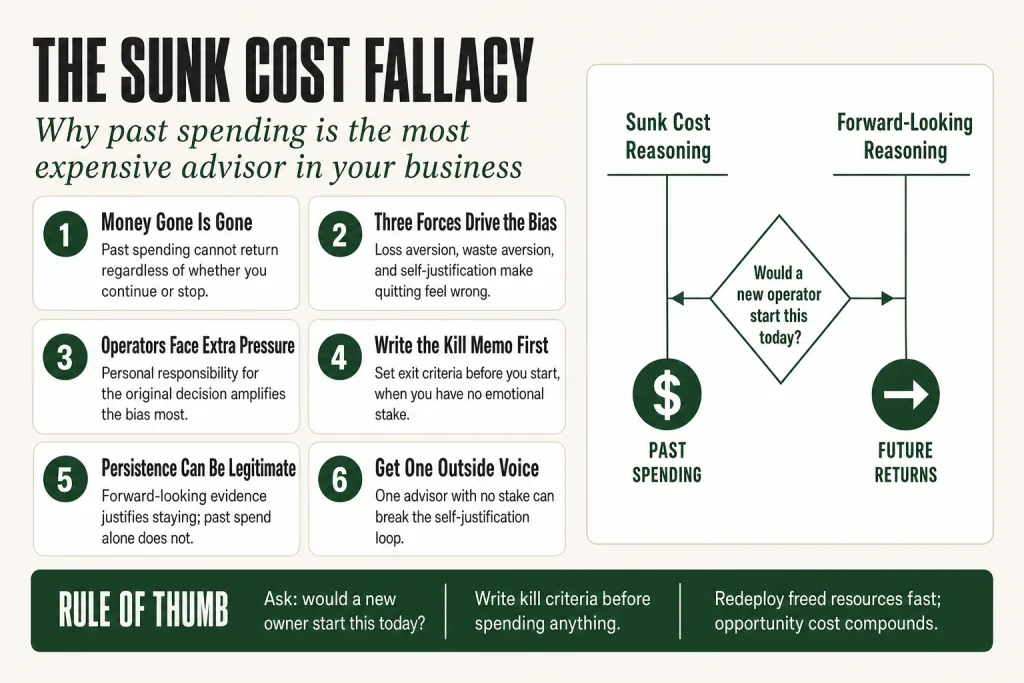
- The bias is driven by loss aversion, the desire not to look wasteful, and an emotional need to justify past decisions, none of which changes your future economics.
- The antidote isn’t cynicism about commitment; it’s predefined kill criteria set before you start, so the decision gets made on evidence rather than guilt.
- Operators are especially vulnerable when personal identity is attached to a project, when “we spent $40K building this” slides into “I am this product.”
- The goal is not to quit everything early. It’s to make continuation decisions on forward-looking data alone, then redeploy freed resources to what’s actually working.
Where the Sunk Cost Fallacy Comes From
Two research threads define the fallacy, and they explain different flavors of the bias you’ll recognize in your own operation.
The economics thread starts with Richard Thaler’s 1980 paper “Toward a Positive Theory of Consumer Choice,” published in the Journal of Economic Behavior and Organization. Thaler documented how people behave inconsistently with standard economic theory, including a refusal to ignore sunk costs. His basketball-ticket scenario makes it tangible: a family drives through a snowstorm to attend a game they paid for, even though a purely forward-looking actor would ask only whether the drive is worth the experience tonight. The ticket price is gone either way.
The organizational thread starts earlier. Barry Staw’s 1976 paper “Knee-Deep in the Big Muddy,” published in Organizational Behavior and Human Performancestudied what he called escalation of commitment: managers throwing more resources at a failing course of action because it was failing. In a simulation with 240 business school students, participants who felt personally responsible for an initial decision committed the greatest additional resources when outcomes turned negative. The engine was self-justification, continuing the bet became a way of proving the original bet wasn’t wrong.
The phrase “sunk cost fallacy” itself, along with the cleanest experimental demonstrations, came from Hal Arkes and Catherine Blumer’s 1985 paper, “The Psychology of Sunk Cost,” published in Organizational Behavior and Human Decision Processes. Their theater-ticket field study found that customers who paid more for a season subscription attended more plays over the following six months, even though the plays were identical. Only the price paid differed. A ski-trip scenario pushed it further: given a choice between a preferred, cheaper trip and a worse, more expensive one already booked, most participants chose the worse trip. Arkes and Blumer’s explanation was the desire not to appear wasteful, a rule so deeply internalized it overrides clear forward-looking analysis.
Arkes and Peter Ayton later reviewed the evidence in “The Sunk Cost and Concorde Effects: Are Humans Less Rational Than Lower Animals?,” published in Psychological Bulletin in 1999. Their striking finding: young children in sunk-cost situations behaved more rationally than adults. Their conclusion was that the fallacy is an overgeneralization of the “don’t waste” rule, useful in most of life, catastrophic when applied to irrecoverable resources.
The Concorde gave the phenomenon its second name. The British and French governments continued funding the joint supersonic project well after the economics had broken down. The British government privately regarded it as a commercial disaster, but political and legal constraints made exit nearly impossible. That made “Concorde fallacy” a boardroom shorthand that still comes up fifty years later.
Why the Brain Does This (And Why Operators Are Especially Vulnerable)
Three psychological forces work together to make the sunk cost fallacy feel like good sense rather than a bias.
Loss aversion. Kahneman and Tversky’s prospect theory, set out in “Prospect Theory: An Analysis of Decision under Risk” (Econometrica1979), established that losses feel roughly twice as painful as equivalent gains feel good. When you consider writing off a $30,000 custom software project that isn’t working, your brain processes that write-off as a loss, painful, present, immediate. The potential upside of redirecting that capacity to something better is more abstract and future-dated. The asymmetry in how those feel pushes you toward continuation, not exit.
Waste aversion. Arkes and Blumer identified a deeply internalized social norm: don’t be wasteful. This norm is useful in most of life. It’s what makes you finish the food on your plate, complete the project you started, and honor commitments. But when it gets applied to resources that are already spent and irrecoverable, it produces exactly the wrong outcome. Stopping isn’t wasteful, continuing after the signal has turned negative is.
Self-justification. Staw’s research showed that personal responsibility amplifies the bias. When you’re the one who decided to hire that person, launch that product, or commit to that channel, stopping is an implicit admission that the original decision was wrong. Continuation becomes identity protection. This is why sunk cost behavior is worst when someone has publicly championed a project. The investment isn’t just money anymore, it’s reputation.
Operators face an extra dose of all three. You made the call. You sold the team on it. You told the client it would work. Every exit from a failing bet requires you to walk back a decision you made out loud, often to people whose opinion of you matters. That’s a lot of social and emotional weight pressing against the economically correct choice.
There’s also a practical reality: small businesses don’t have the organizational redundancy that lets a large company quietly shelve a failing project and move on. When you kill a channel or let a hire go, everyone notices. The visibility raises the psychological cost of the exit, which makes the fallacy grip harder.
None of this means you’re doing something stupid. It means you’re human, operating in a context that amplifies a bias every human shares. Knowing that is the first practical step. The second step is building a system that takes the emotional weight off individual exit decisions, which we’ll get to.
What the Fallacy Actually Costs Operators
Abstract bias is easy to dismiss. Concrete dollar figures are harder. So before we get into the diagnostic tools and the kill-criteria system, it’s worth spending a moment on what this bias actually looks like in an operating context, not the mechanisms (covered above), but the specific financial drag each category creates.
Marketing Channels
This is the most common and most quietly expensive version. You run a channel for six months, paid search, trade shows, cold email, organic social, and it doesn’t perform. But you’ve built infrastructure around it: landing pages, ad creative, a relationship with a vendor, possibly a part-time person who manages it. The cost of stopping feels large. The cost of continuing feels incremental. So you keep going, usually framing the continuation as “giving it more time to mature” or “we need more data.”
Sometimes those justifications are true. More often, they’re the desire not to appear wasteful dressed up in business language. The test is simple: if you had zero history with this channel and were evaluating it fresh today, would you start it? If the answer is no, you have a sunk cost problem, not a patience problem.
The financial drag here compounds silently. A channel consuming $3,000 a month in direct spend plus eight hours of staff time runs up $36,000 in direct cost over a year, plus the opportunity cost of what that budget and attention could have done elsewhere. That second number never shows on a P&L, but it’s real.
Hires
You’ve spent time recruiting, onboarding, and training someone. You’ve covered their mistakes, invested in their development, given the feedback conversations. Letting them go means writing off all of that. So operators hold on, sometimes for years past the point where the evidence is clear.
The economic frame helps here. Whatever you’ve spent on training and onboarding is gone regardless. The question is whether continued employment generates enough value to justify the ongoing cost, and whether that seat, refilled with someone better suited, would generate materially more. When you ask it that way, the answer is almost always clear. The practical tool: calculate the ongoing monthly cost of the misfit, salary plus the less-visible costs of work not done and team friction, and compare it to a one-time exit and rehire cost. Most operators, when they do this math honestly, realize they’re paying for the privilege of avoiding an uncomfortable conversation.
Products and Service Lines
You built a product, service line, or feature set. It took months of your time and real money. The market hasn’t embraced it, but you’ve already announced it, maybe even priced it into your revenue projections. Pulling it is uncomfortable, it changes the story you’ve told customers, the team, and yourself. So you keep it on the menu, keep spending time supporting and selling it, and keep hoping the trajectory changes.
Nokia’s commitment to Symbian is the large-scale version of this pattern. After the iPhone launched in 2007, Nokia continued investing heavily in Symbian-based devices and, in December 2008, completed the acquisition of the remaining shares of Symbian Ltd. it did not already own, per Nokia’s own press release, even as the platform was losing competitive ground in the touch-screen, app-centric world the iPhone had initiated. According to Gartner data reported by Fierce Network in February 2009, Nokia’s smartphone market share fell to 43.7 percent for full-year 2008, down from 49.4 percent in 2007, with steeper declines ahead. The small-business version is quieter but proportionally just as damaging: a service that no longer fits your positioning staying on the menu because the time spent building it is hard to write off mentally.
Tools and Software
You bought an annual subscription to a CRM, a marketing automation platform, a project management tool. It doesn’t fit your workflow, but it cost $4,800 for the year and you’re four months in. So you keep paying the monthly equivalent in staff time trying to make it work, and you don’t evaluate the alternatives that would cost less and do more, because switching would mean admitting the $4,800 was a mistake. In a lot of small businesses, there are three or four tools in this category at any given time. None is catastrophic on its own. Together, they’re a slow bleed of time and money that compounds over years.
Putting this to work? The ideas in the Canon are the foundation under the tactical playbook in Build a Complete Marketing Department. Grab the free companion kit at mmsvegas.com/resources.
Sunk Cost vs. Legitimate Persistence: Where Operators Get Confused
The sunk cost fallacy is not an argument for quitting everything the moment it gets hard. That’s an overcorrection, and it would be its own operational problem. Some things legitimately require time to mature, and abandoning them too early is just as expensive as staying in them too long.
The difference comes down to one question: what is the continuation decision actually based on?
Legitimate persistence looks like this: the forward-looking evidence, new customer data, pipeline trends, a changed market condition, gives you reason to believe the next period will look different from the last. You have a specific, testable hypothesis about why things are going to change. You can name the indicator that would confirm or refute it, and you’ve set a date by which you’ll check.
Sunk cost continuation looks like this: you’re staying because leaving would mean the previous investment was wasted. You can’t articulate what specifically is going to change, or you keep moving the goalposts when your original milestones pass without improvement. The justification is backward-looking rather than forward-looking.
A channel that genuinely needs six months to build momentum is a real thing. Brand building, content marketing, and relationship-based acquisition all compound over time and their returns are not linear. A pillar content strategy that produces nothing visible in month two and generates significant organic traffic in month fourteen is not a sunk cost situation, it’s a channel with a long feedback loop. The distinction matters because applying a short-term kill-criteria framework to a genuinely long-horizon investment can be just as expensive as staying in a dead channel for too long.
The test is whether the mechanism is sound, not just whether results have appeared yet. If the logic of why the investment should work is still intact, if you’re building audience assets that compound, or deepening relationships that convert over 12 to 18 months, then “it hasn’t paid off yet” is not a sunk cost signal. It’s just an accurate observation about a long-cycle investment. The exit criteria for those channels should reflect longer feedback loops, not shorter ones.
One practical way to tell the difference: imagine you inherited this situation from someone else today. The channel, the hire, the product, you didn’t start it, it came to you as an existing commitment. What would you do? If your honest answer is “I’d shut this down,” then the only thing keeping it alive is the history of your own involvement. That’s the fallacy at work.
The Kill Criteria System: How to Defuse the Fallacy Before It Starts
The most reliable antidote to the sunk cost fallacy is also the least glamorous: set your exit criteria before you start, when you have no sunk costs yet and no emotional stake in the outcome. This is the only moment when you can make the decision purely on the forward-looking merits.
The kill criteria approach works like this. Before you launch a channel, hire someone, or build a product feature, write down three things: the specific outcome you expect, the timeframe in which you expect to see it, and the number or observation that would tell you it’s not working. Then treat those criteria as a contract with your future self.
For a marketing channel: “We will run this for 90 days. At that point, if we haven’t generated at least X qualified leads at a cost-per-lead below Y, we stop and reallocate the budget.” For a hire: “We will set a 60-day and 90-day performance benchmark. If those aren’t met, we have a conversation about fit, not another quarter of hoping.” For a product feature: “We’ll track usage for 60 days post-launch. If fewer than 15% of active customers use it at least once, we stop developing it further.”
The numbers in those examples are illustrative, yours will depend on your business, your margins, and your market. What matters is that you write them down, share them with someone who will hold you to them, and treat a breach as a genuine trigger for a decision rather than a starting point for renegotiation.
The reason this works is that it removes the emotional moment-of-exit from the decision itself. You’re not deciding in the heat of having already invested $40,000. You’re honoring a commitment you made at a moment of clarity. That’s a completely different psychological experience, and it makes the exit much easier to execute without guilt.
A version of this thinking appears in stage-gate product development, the idea of predefined checkpoints where a project either passes a criterion and continues, or doesn’t and gets paused or killed. The structure exists in large organizations precisely because the sunk cost fallacy is so predictable and so damaging at scale. Small operators can apply the same logic with a single document and a calendar reminder.
One more thing worth naming: the person setting the kill criteria and the person reviewing them should ideally not be the same person who championed the investment. Even a brief conversation with a co-founder, advisor, or trusted peer who has no stake in the outcome can break the self-justification loop that Staw identified as the core mechanism of escalation. You don’t need a formal board review. You need one honest conversation with someone who can say “the data says it’s not working” without flinching.
Common Misunderstandings About the Sunk Cost Fallacy
“Sunk cost thinking just means quitting too early.” No, it means making continuation decisions based on past investment rather than future return. A decision to stay in a failing channel because of what you’ve spent is sunk cost thinking. A decision to exit a working investment because it’s hard is a different mistake entirely. The fallacy is about the reason for the decision, not the direction of it.
“This only applies to money.” Time and effort produce the same bias, often more intensely. Arkes and Blumer’s research documented sunk cost effects for non-monetary investments, and the organizational behavior literature shows that effort investment, the hours a team has put into a project, can be an even stronger psychological anchor than the dollar cost. When a team has worked nights and weekends on a feature, killing it feels like a betrayal of that effort. Economically, it isn’t. Emotionally, it absolutely is, which is why it still drives bad decisions.
“Acknowledging sunk costs is just making excuses to give up.” This framing is usually deployed by people who’ve conflated persistence with wisdom. Sunk cost recognition isn’t defeatism, it’s the prerequisite for redeploying resources to where they’ll generate returns. Nokia didn’t fail because it was insufficiently committed. It failed because its commitment was anchored to the wrong platform for too long. Exit isn’t the absence of strategy; in many cases, it is the strategy.
“As the owner, I’m more rational than this.” Staw’s research showed that personal responsibility for the original decision amplifies the bias, not reduces it. Founders and owners are among the most susceptible to sunk cost thinking precisely because their identity is most tied to the bets they’ve made. Awareness of the bias helps, but it doesn’t eliminate it. You still need a system.
“The Concorde fallacy was a government problem. Private companies don’t do this.” Ford’s Edsel is a private-company version of exactly the same pattern, years of research and marketing investment in a car the market didn’t want, continued well past the point the evidence was clear. Blockbuster’s continued investment in its physical store infrastructure while the streaming model was already working for Netflix is another. Private ownership changes some incentives but doesn’t eliminate the psychological mechanism.
“Learning costs count as sunk costs too, so testing is pointless.” This one needs a correction. If you spent $15,000 testing a new acquisition channel and it didn’t work as a revenue channel but produced clear evidence about your ideal customer profile and where they don’t congregate, that $15,000 bought something. It’s only fully sunk if you didn’t capture the learning. This is part of why the MVP mentality from product development is worth borrowing even in marketing: run tests cheaply enough that a failed test’s learning value is worth its cost, and the exit doesn’t feel like pure waste.
Common Mistakes
- Moving the goalposts instead of making a decision. When a channel or hire misses its original benchmark, evaluate against that benchmark, don’t reset the clock. Moving criteria to avoid a hard call is the fallacy with extra steps, and it’s especially easy to rationalize when you set new targets that sound more “realistic.”
- Setting kill criteria after the investment starts. Write the kill memo before you begin, when you have no emotional stake in the outcome. Criteria set after the fact are almost always calibrated around what the data currently shows rather than what forward-looking success actually looks like.
- Keeping a misfit hire to avoid writing off training investment. Calculate the ongoing monthly cost of the misfit, salary, team drag, work not done well, opportunity cost of the unfilled role’s potential, and compare it to a one-time exit and replacement cost. The ongoing cost wins almost every time. The math is usually clearer than the emotional weight suggests.
- Applying kill criteria to every investment regardless of time horizon. Brand, content, and relationship channels have long feedback loops. Set criteria that reflect the actual compounding mechanism, not a short-cycle revenue test. Killing a legitimate long-horizon investment at month three because it “hasn’t produced” is a different mistake, not a cure for sunk cost thinking.
- Reviewing alone, no outside check. Bring in one advisor or peer with no stake in the outcome before any major continuation decision. Staw’s research on escalation of commitment shows that personal responsibility amplifies the bias. A single outside voice, someone who can say “the data says stop” without protecting their own reputation, is often all it takes to break the loop.
- Treating every failed test as pure waste. A test that doesn’t produce revenue but produces clear evidence about your customer, your channel fit, or your positioning bought something real. Capture the learning explicitly. A failed test with documented learning is not a sunk cost, it’s research.
Operator’s Take
Here’s what I see happen, over and over. An operator starts a channel. It underperforms for a quarter. They convince themselves it needs more time. It underperforms for another quarter. By month six, they’ve burned budget and attention on something the data had already answered at month two. When I ask what kept it going, the answer is almost never “we saw improvement in the metrics.” It’s “we’d spent too much to stop.” That sentence is the fallacy.
So here’s the specific practice I’d put in place starting with your next significant commitment, not your next quarterly review, your next commitment. Before you spend anything, write a kill memo. One paragraph, three sentences: what you expect to see, by when, and what below-threshold looks like in concrete terms. “If this paid channel hasn’t generated 15 qualified leads at under $200 CPL by day 90, we stop and reallocate.” File it where you’ll find it. Then share it with one person who had no role in the original decision, a business partner, an advisor, a peer in a non-competing business. Not for permission. For accountability.
When the review date arrives, pull the memo. Compare what you wrote when you had no stake in the outcome to what you’re seeing now. That gap is your decision. The sunken time, the vendor relationship, the creative costs, noise. Honor the memo, not the history. If you can’t do that, you haven’t built a kill criteria system. You’ve built a feelings-deferral system with extra steps.
On hires specifically: the sunk cost problem is worst when the person is likable. You don’t want to hurt someone who worked hard and clearly tried, that’s a decent instinct. But keeping a misfit hire longer than the evidence warrants isn’t kindness. It’s delayed inevitability with compounding cost. Every month you wait, the exit conversation gets harder, the performance gap widens, and the cost to both parties increases. A clear, early decision made honestly is, more often than you’d expect, better for the person too. A slow fade leaves them as stuck as you are.
One place I’d push back on applying kill criteria uniformly: content strategy at month three, referral-based relationship selling at month six, these look like failures by short-cycle standards and are often mid-run investments working exactly as designed. The question isn’t whether results are linear. It’s whether the mechanism is still sound. If you can name a specific leading indicator you’d expect to see by a specific date, inbound link velocity for content, first meetings booked for relationship selling, you have a reason to persist. If your best argument is “we’ve put too much into this to stop,” you don’t.
AI tools can help here in ways that are specific and bounded. The most useful application is running the “inherited situation” thought experiment at scale: paste your channel metrics or hire performance notes into a capable AI assistant and ask it to evaluate whether a new operator, seeing this for the first time, would continue the investment. You’re not outsourcing the judgment. You’re forcing yourself to confront data you’ve been rationalizing around, from a vantage point that doesn’t share your history. AI can also draft the kill memo structure before you start an engagement, prompting you to name the specific outcome, the deadline, and the threshold before you have skin in the game. And it can flag trends in your channel data that are harder to spot when you’ve been staring at the same dashboard for six weeks: a paid campaign where cost-per-lead has climbed for six consecutive weeks reads differently when an AI surfaces the trend than when you’ve normalized it day by day. What stays with you: the call on whether the mechanism is still sound, whether this is a long-horizon investment or a dead one, and the actual exit conversation. That’s where operator judgment earns its keep.
Redeploy fast. The real cost of the sunk cost fallacy isn’t only the money spent on the dead channel. It’s the months you didn’t spend that budget somewhere it could compound. That opportunity cost never shows on a P&L, but it shows up in where your business is twelve months from now. The faster you exit a dead bet and move that capital to something with real forward-looking return, the more of that gap you close. Scar tissue can’t make that call. You have to.
Used in
- ✓ Build a Complete Marketing Department
Used when auditing active channels and campaigns, the book’s framework for channel evaluation depends on operators being able to cut underperformers on forward-looking data rather than historical spend. - ✓ The Missing Manual for FunnelKit
Applies when operators decide whether to continue investing in a funnel configuration that isn’t converting, the kill criteria concept prevents over-engineering funnels that the market has already rejected. - ✓ The Missing Manual for Make
Relevant when evaluating whether to continue building or maintaining automations that were expensive to set up but no longer serve a live workflow, distinguishes genuine automation debt from sunk cost attachment.
FAQ
What exactly is a sunk cost?
A sunk cost is any expenditure, money, time, or effort, that has already been made and cannot be recovered regardless of what you do next. The key word is irrecoverable: once the cost is sunk, it has no bearing on what your next dollar or hour will return.
How do I know if I’m falling for the sunk cost fallacy versus making a legitimate judgment to persist?
Ask yourself: if you inherited this situation today with no prior history, would you start it? If yes, with a clear forward-looking reason, persistence is legitimate. If the honest answer is no, the only thing keeping it alive is the history of your own involvement, that’s the fallacy.
Does the sunk cost fallacy apply to time and effort, not just money?
Yes, and often more intensely. Arkes and Blumer’s research documented sunk cost effects for non-monetary investments. The months a team spends building a feature, the years you put into a vendor relationship, the personal energy invested in a hire, all of these create the same psychological pressure to continue that money does.
What’s the simplest practical system for avoiding this bias?
Write a kill memo before you start any significant investment: what you expect, by when, and what below-threshold looks like. Review it on schedule with someone who has no stake in the outcome. The structure converts an emotional exit into a procedural one.
Is the sunk cost fallacy always about staying in something too long?
No. The fallacy is about the reason for a decision, not its direction. Staying in a working investment because it’s hard is a different mistake, that’s impatience or poor tolerance for long feedback loops. The sunk cost fallacy specifically means continuing because of what you’ve already spent, not because of what the forward-looking evidence says.
Why are founders and small-business owners especially vulnerable to this?
Because personal responsibility for the original decision amplifies the bias. Barry Staw’s 1976 paper in <em>Organizational Behavior and Human Performance</em>a simulation with 240 business school students, established that when people are personally responsible for an initial decision, they commit the most additional resources when outcomes turn negative. When you’re the one who made the call, publicly and with conviction, exiting feels like self-indictment. That emotional cost is real, but it doesn’t change the economics.
Further reading
- Hal R. Arkes and Catherine Blumer, “The Psychology of Sunk Cost,” Organizational Behavior and Human Decision Processes35 (1985), 124 to 140. The foundational experimental paper, the theater ticket and ski trip studies that defined the concept and its mechanisms.
- Barry M. Staw, “Knee-Deep in the Big Muddy: A Study of Escalating Commitment to a Chosen Course of Action,” Organizational Behavior and Human Performance16 (1976), 27 to 44. The organizational behavior anchor, explains why personal responsibility amplifies the bias in management settings.
- Hal R. Arkes and Peter Ayton, “The Sunk Cost and Concorde Effects: Are Humans Less Rational Than Lower Animals?,” Psychological Bulletin125 (1999), 591 to 600. The review paper that found young children exhibit the fallacy less than adults, with the conclusion that it is an overgeneralization of the “don’t waste” rule.
- Richard H. Thaler, “Toward a Positive Theory of Consumer Choice,” Journal of Economic Behavior and Organization1 (1980), 39 to 60. The economics entry point, where sunk costs were first framed as a systematic deviation from rational choice theory, alongside the endowment effect and loss aversion.
- Daniel Kahneman and Amos Tversky, “Prospect Theory: An Analysis of Decision under Risk,” Econometrica47 (1979), 263 to 291. The psychological substrate that makes sunk cost reasoning feel rational when it isn’t, the formal treatment of loss aversion. Kahneman’s Thinking, Fast and Slow (Farrar, Straus and Giroux, 2011) covers the same material in accessible form.
Sources: Primary research grounding this page: Hal R. Arkes and Catherine Blumer, “The Psychology of Sunk Cost,” Organizational Behavior and Human Decision Processes, 35 (1985), 124 to 140 (confirmed via DOI 10.1016/0749-5978(85)90049-4); Barry M. Staw, “Knee-Deep in the Big Muddy,” Organizational Behavior and Human Performance, 16 (1976), 27 to 44 (confirmed via DOI 10.1016/0030-5073(76)90005-2); Hal R. Arkes and Peter Ayton, “The Sunk Cost and Concorde Effects: Are Humans Less Rational Than Lower Animals?,” Psychological Bulletin, 125 (1999), 591 to 600 (confirmed via DOI 10.1037/0033-2909.125.5.591); Richard H. Thaler, “Toward a Positive Theory of Consumer Choice,” Journal of Economic Behavior and Organization, 1 (1980), 39 to 60; Daniel Kahneman and Amos Tversky, “Prospect Theory: An Analysis of Decision under Risk,” Econometrica, 47 (1979), 263 to 291. Nokia/Symbian: the acquisition of Symbian Ltd. by Nokia (completed December 2, 2008) is confirmed by Nokia’s own press release at nokia.com/about-us/news/releases/2008/12/02/nokia-acquires-symbian-limited/ and Nokia SEC Form 20-F for FY2008. Nokia smartphone market share figures (49.4% for full-year 2007, 43.7% for full-year 2008) are sourced from Gartner data as reported by Fierce Network, February 2009 (fierce-network.com/wireless/report-nokia-s-smartphone-market-share-dropping); the Fierce Network article cites these as Gartner figures and they are consistent with the original Fierce Network report. The Concorde history is drawn from general historical record. All research findings are paraphrased; no extended quotations reproduced from primary sources. No vendor statistics are cited without named source and year.
Brian Kasday spent forty years in direct-response marketing before rebuilding the whole operation as a one-person shop. He writes The Operator’s Library — including “Build a Complete Marketing Department” — for operators who’d rather build it themselves than wait on someone else.
Build the department these ideas describe. The free companion kit: mmsvegas.com/resources.
More The Operator's Canon guides
Free · Operator Toolkit
Want the tools, not just the guide?
Get the free operator toolkit — templates and checklists for the systems you actually run, plus a note when this guide changes.
Get the free toolkit →