
Last updated: October 2026
Price discrimination is the practice of charging different customers different prices for the same product or service. That sentence sounds simple, maybe even a little sinister, but it describes almost every interesting pricing decision a business actually makes. Student discounts. Enterprise tiers. Early-bird rates. Annual vs. monthly billing. Geographic pricing on software. The person in seat 14A on your next flight who paid $189 while the person in 14B paid $440. All of it is price discrimination, and most of it is both legal and smart.
The reason operators need to understand this concept is not academic. It’s about money you’re currently leaving on the table. When you charge a single flat price, you serve two groups badly at once: buyers who would have paid more and didn’t have to, and buyers who would have bought at a lower price but walked. A well-designed pricing structure closes both gaps. By the end of this page, you’ll be able to see which form of price discrimination already exists in your business without your knowing it, choose which form to build deliberately, and recognize the handful of situations where it becomes legally or strategically dangerous.
One honest caveat up front: this is not a license to charge whoever seems rich whatever you feel like. Price discrimination works when it’s based on genuine differences in value, timing, volume, or segment, not on a guess about someone’s bank account. The distinction matters economically, legally, and reputationally.
The idea in 30 seconds
- Price discrimination means charging different customers different prices for the same thing, based on how much they’re willing to pay, not on what it costs you to serve them.
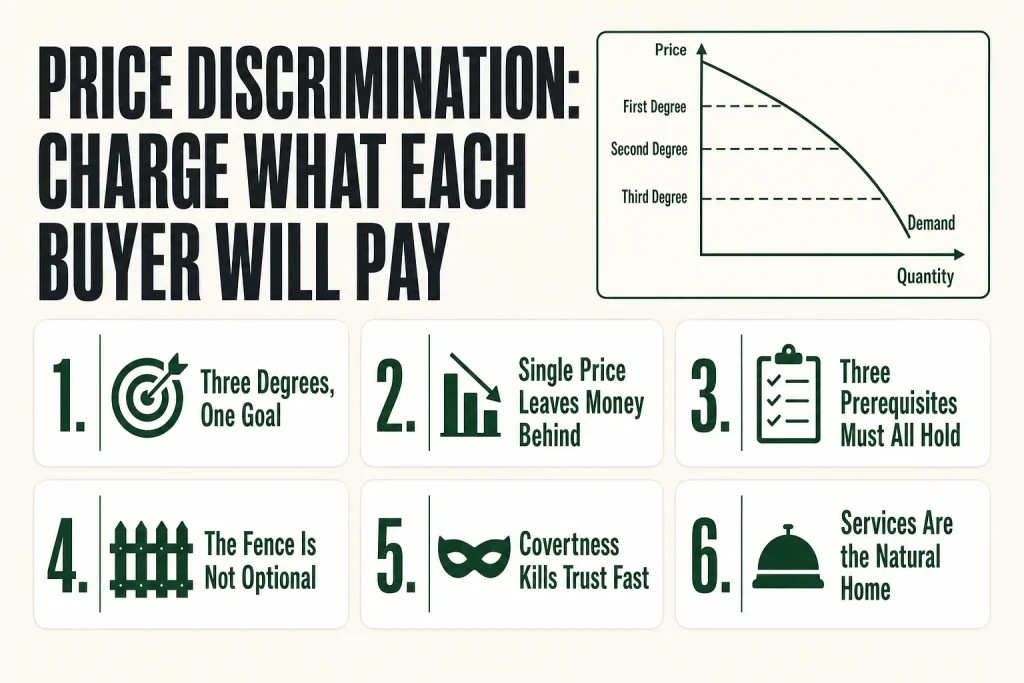
- There are three classic forms, named by A.C. Pigou in The Economics of Welfare (Macmillan, 1920): charging each buyer their personal maximum (first degree), offering tiered versions or quantities and letting buyers self-select (second degree), and charging different groups different flat prices (third degree).
- For most small-business operators, second- and third-degree discrimination are the practical tools. First degree is theoretically ideal but nearly impossible to execute cleanly and carries real fairness risk.
- The primary U.S. law is the Robinson-Patman Act, signed into law on June 19, 1936 (Pub. L. 74-692, 49 Stat. 1526). It applies to the sale of physical goods (commodities) to competing buyers. Services are explicitly outside its scope. For software and digital products, the picture is genuinely unsettled: Paul Stancil’s 2004 legal analysis “Still Crazy After All These Years,” published in Business Law Today (Sept./Oct. 2004), explains that courts apply a fact-specific “dominant nature” test to determine whether a transaction is more like a goods sale or a licensing arrangement, and that there is no clear judicial consensus on software.
- The biggest hidden cost isn’t legal exposure, it’s the customer trust you burn when the wrong person sees someone else’s price.
- By the end of this page you’ll be able to identify which form of price discrimination already exists in your business, decide which form to add next, and recognize the scenarios where any form becomes strategically or legally dangerous.
Where Price Discrimination Comes From
The formal taxonomy comes from A.C. Pigou’s The Economics of Welfare (Macmillan, 1920). Pigou held the chair of Political Economy at Cambridge, and in Part II of that book he organized the three-degree classification of discriminating monopoly that operators still use today. The behavior itself, haggling at a rug market, a barrister setting fees by client, a printer quoting a job, predated the vocabulary by centuries. What Pigou did was give economists a framework to analyze the welfare effects: who wins, who loses, and by how much. His three degrees map to decreasing seller knowledge about individual buyers. First degree requires knowing each buyer’s maximum willingness to pay. Third degree requires only the ability to identify which group a buyer belongs to. Second degree sits between: the seller needs no individual-level information because buyers sort themselves through their choices.
In 1933, Joan Robinson’s The Economics of Imperfect Competition (Macmillan, 1933) extended Pigou’s framework. As the arXiv paper “Third Degree Price Discrimination Under Costly Information Acquisition” (arXiv:2406.06026) states, Robinson was the first to analyze the welfare effects of third-degree price discrimination specifically, examining the conditions that make discrimination possible and producing a graphical analysis of discriminating monopolist decisions that became the standard textbook treatment.
Carl Shapiro and Hal Varian’s Information Rules: A Strategic Guide to the Network Economy (Harvard Business School Press, 1999) brought the concept squarely into the digital product world, reframing second-degree discrimination as “versioning” and arguing it was the central pricing strategy for information goods with near-zero marginal reproduction costs. Chapter 3 of that book is the most operator-useful treatment of the idea in print.
The legal history runs parallel. The Robinson-Patman Act was signed into law by President Franklin D. Roosevelt on June 19, 1936 (Pub. L. 74-692, 49 Stat. 1526). It amended Section 2 of the Clayton Act of 1914 and was adopted because Congress believed large retail chains were using their buying power to extract price concessions from suppliers that smaller competitors couldn’t match, the A&P grocery chain was among the specific concerns driving that legislation. The Act made it illegal to charge different prices to competing buyers of the same physical goods when the effect substantially lessens competition. Services are explicitly outside its scope.
The Three Degrees of Price Discrimination: What Each One Actually Means
Pigou’s three categories still organize the conversation, so it’s worth getting them clear before talking about application. They’re not a hierarchy of sophistication, each is a different mechanism with different requirements.
First Degree: Charge Every Buyer Their Personal Maximum
First-degree, or “perfect,” price discrimination means charging each customer exactly what they would be willing to pay. The seller captures all consumer surplus. In practice, it’s nearly impossible to execute cleanly, because sellers almost never know each buyer’s exact reservation price.
The cases that come closest are negotiated deals: enterprise software contracts, custom construction bids, B2B professional services engagements, car purchases at dealerships. Auctions approach it from the other side, buyers reveal their maximum through bidding. What we now call “personalized pricing” using browsing history, device type, and purchase behavior is an attempt to approximate first-degree discrimination at scale, with mixed results. In September 2000, Amazon ran a five-day pricing test on 68 DVD titles, offering random discounts of between 20 and 40 percent. When customers discovered that deleting cookies changed their quoted price, the backlash was severe enough that Bezos publicly apologized and Amazon refunded money to 6,896 customers. The lesson wasn’t that personalized pricing is always wrong. It was that covert price variation, where customers have no visibility into why they were quoted what they were quoted, destroys trust fast.
Second Degree: Offer a Menu, Let Buyers Sort Themselves
Second-degree price discrimination is the one most operators actually use, often without calling it that. The seller doesn’t need to know anything specific about individual buyers, because buyers reveal their type by choosing among options. Offer a small, a medium, and a large. Offer basic, pro, and enterprise tiers. Offer monthly and annual billing. Buyers with higher willingness to pay, more volume, or less price sensitivity choose the option that matches them.
Shapiro and Varian, in Information Rules (Harvard Business School Press, 1999), called this “versioning” and argued it was the correct default for digital products where the marginal cost of an additional copy is near zero. One price either leaves money on the table from high-value buyers or excludes low-value buyers who could have been served profitably. Versioning solves both. The tricky part, which Shapiro and Varian were direct about, is that making a degraded version good enough to sell but bad enough not to cannibalize the premium version often costs real engineering effort. The deliberate limitation has to be credible and acceptable, or it just looks like the product is broken.
Two-part tariffs (a fixed membership fee plus a per-use charge) are a variant. A gym membership with a monthly fee and guest fees. A professional service retainer with hourly overages. The customer who uses it heavily effectively pays a lower per-unit price than the light user, but the seller captures more total revenue across the full distribution of customers.
Third Degree: Segment by Group, Set a Price Per Group
Third-degree price discrimination is the most visible form in everyday life. Different prices for different identifiable groups: students, seniors, military, nonprofits, residents vs. tourists, early-bird purchasers vs. last-minute buyers, domestic vs. international markets. The seller doesn’t charge the individual their personal maximum, it charges the group a price calibrated to that group’s average price sensitivity.
Airlines are the textbook example for good reason. A leisure traveler who books six weeks out and has schedule flexibility is highly price-elastic. A business traveler who needs to be in Cleveland on Tuesday regardless is not. The fences, refundable vs. non-refundable tickets, advance purchase windows, sort the groups. Without a credible barrier to prevent one group from buying the other group’s price, arbitrage collapses the price difference.
Geographic pricing is third-degree discrimination across markets. A SaaS product priced at $99/month in the United States but $29/month in India captures more customers in a lower-willingness-to-pay market without eroding pricing in the primary market, because the arbitrage barrier, payment methods, local currencies, billing accounts, is real enough to hold.
The Three Things That Have to Be True for Price Discrimination to Work
Price discrimination is not available to every business at every moment. Scholars have generally converged on three prerequisites, and if any of them is missing, the pricing structure collapses.
You need some market power. If customers can buy the same thing from a competitor at a flat price tomorrow morning, your ability to charge different customers different amounts evaporates. Market power here doesn’t mean monopoly, it means a meaningful reason to prefer you: brand, relationship, service, location, features, switching costs. A commodity supplier with zero differentiation has no meaningful ability to price-discriminate.
You need to be able to segment buyers. For third-degree discrimination, you need observable, credible signals of group membership. A student ID is a credible signal. A user claiming to be a nonprofit with no verification is not. For second-degree discrimination, you need product or quantity options that genuinely map to different usage levels or values. For first-degree, you need either negotiation capacity or enough behavioral data to construct a reasonable estimate of each buyer’s reservation price.
You need to prevent or limit arbitrage. This is the one operators underestimate most. If a high-price buyer can purchase at the low price and resell, or if a low-price buyer can pass their discount to a full-price buyer, the price gap closes. Physical goods move, so arbitrage barriers need to be structural: regional licensing, seat limits, account-bound access, time restrictions. Digital products are better insulated because access is tied to an account. Services are better still, the service is delivered to a specific person and can’t be resold. If you’re running a B2B SaaS on geographic pricing, your terms of service and account verification need to hold. If they don’t, your pricing structure is a spreadsheet exercise, not a real policy.
Why Price Discrimination Captures More Value Than a Single Price
The argument for price discrimination is not complicated once you see it clearly. Every market has buyers with different willingness to pay. A single price forces you to pick one number that is either too high for some buyers (who leave) or too low for others (who would have paid more). Both gaps are uncaptured value.
Think of a simple example. You run a software tool. Three customers would each pay a different maximum: one would pay up to $200, one up to $100, one up to $40. Set a single price of $100, and you capture $100 from the middle buyer and $100 from the high buyer, but the low buyer walks. Revenue: $200. Set a single price of $40 and you capture $40 from each, but left $60 on the table from the middle buyer and $160 from the high buyer. Revenue: $120. Offer a basic tier at $40, a standard tier at $100, and a premium tier at $200, with features that genuinely support those tiers, and you might capture all three. Revenue: $340. That’s the rationale behind almost every SaaS pricing page built in the last fifteen years.
There’s also a customer-acquisition angle that gets less attention. Price discrimination can expand your total market. A segment you can’t profitably serve at your standard price can become profitable at a lower price, without giving that lower price to everyone. That’s what student discounts do for software companies, what geographic pricing does for global SaaS products, and what off-peak pricing does for restaurants and utilities. You grow the pie instead of just slicing it differently.
For service businesses the same logic applies with more flexibility. A consulting firm that quotes custom project fees is practicing something close to first-degree discrimination, assessing each client’s budget and urgency and setting a price accordingly. A firm that publishes package tiers is doing second-degree discrimination and letting clients sort themselves. Both are valid; the custom-quote approach requires more skilled salespeople, the tier approach scales better without as much human involvement.
Putting this to work? The ideas in the Canon are the foundation under the tactical playbook in Build a Complete Marketing Department. Grab the free companion kit at mmsvegas.com/resources.
How Businesses Use Price Discrimination Today
The clearest modern application is airline revenue management, which has refined third-degree discrimination into a sophisticated operational system. Business travelers who book last-minute and need flexibility pay prices that can be multiples of what leisure travelers pay for the same seat on the same flight. The fences that maintain the separation, advance purchase windows, refundability, are engineered specifically to be onerous for business travelers and acceptable for leisure travelers. The seat flies the same route regardless. The price difference is not a cost difference; it’s a demand difference, systematically captured.
SaaS companies have pushed second-degree discrimination further than almost any other sector. The basic-pro-enterprise structure that now appears on virtually every SaaS pricing page is versioning in Shapiro and Varian’s sense. The product ships from the same codebase; features are unlocked by tier. Self-serve buyers who need basic functionality pay the low price. Growing teams that need collaboration features pay the mid price. Enterprise buyers who need SSO, audit logs, compliance reporting, and dedicated support pay the high price. Each tier is calibrated to the value delivered and the buyer’s characteristic willingness to pay, not to the marginal cost of serving them.
Geographic pricing for software and subscription services is an increasingly common form of third-degree discrimination. A global SaaS operator charging the same dollar amount worldwide means either pricing out of developing markets entirely or leaving significant revenue in mature markets. The arbitrage barrier, account registration, local payment methods, regional billing, is usually sufficient to hold the gap.
Coupons and promotional codes operate as third-degree discrimination even though they don’t look like it. The customer who searches for a discount code before buying is demonstrating price sensitivity. The customer who pays list price without searching is demonstrating lower price sensitivity. By making discounts available but requiring effort to find them, the operator lets customers self-sort. Both transactions happen.
Professional service firms that quote custom project fees are practicing informal first-degree discrimination. A law firm billing a Fortune 500 company differently from a startup isn’t being arbitrary, it’s pricing to willingness to pay and to the different value the service delivers in each context.
Happy-hour pricing at bars and restaurants is time-based third-degree discrimination. Off-peak buyers, afternoon drinkers, early diners, are more price-elastic and have more schedule flexibility. The time window is the fence. It holds because you can’t stockpile a bar experience for later.
Where Price Discrimination Works Best for Small-Business Operators
There are conditions under which price discrimination pays off reliably, and some business types are better positioned than others.
Services businesses. Services are the most natural home for price discrimination because they’re non-transferable by definition. You cannot resell a haircut, a coaching call, or a plumbing service. The arbitrage problem essentially solves itself. Service businesses can price by client segment (nonprofit vs. commercial, small vs. enterprise), by timing (emergency vs. scheduled, off-peak vs. peak), or by the scope and complexity of the engagement.
Software and digital products. Near-zero marginal cost of reproduction makes versioning particularly powerful here. Once the product exists, the cost of serving an additional customer is essentially zero, so there’s a direct profit argument for serving more customers at lower price points rather than turning them away. The discipline required is that tiers must be genuinely different, by features, usage limits, or support levels, or customers will always buy the cheapest tier and feel cheated by the others.
Subscription businesses. Annual vs. monthly billing is an underused form of second-degree price discrimination. Annual buyers pay a lower effective monthly rate because they’re demonstrating higher commitment and lower churn risk, which is genuinely valuable to you. The discount is not charity, you’re trading a cash-flow advantage and lower churn for a lower effective price. Monthly buyers pay more per month because they keep the option to leave. Both prices can be right simultaneously.
B2B businesses with a genuine enterprise segment. If your customer base genuinely includes both self-serve SMB buyers and large organizations that want custom integration, dedicated support, compliance features, and executive relationships, tiered pricing can capture the value of both without a conflicted sales motion. The enterprise tier is not just the SMB tier with a bigger invoice, it’s a different product experience with a different buying process, and pricing it differently reflects that honestly.
Businesses with identifiable price-elastic segments. If you serve a market segment (students, nonprofits, military, senior citizens) that genuinely has lower willingness to pay, a formal discount program expands your customer base without undermining your standard price. The condition that makes this work is credibility: the segment has to be clearly defined and verifiable, or the discount program just becomes a coupon everyone uses.
Where Price Discrimination Fails, Backfires, or Becomes Dangerous
Price discrimination has real failure modes, and some of them are expensive.
When arbitrage is easier than you think. A B2B software company that offers sharply different pricing by region but does not lock accounts to regions can find customers in high-price markets simply registering under low-price addresses. A professional service firm that offers introductory rates for new clients will find longtime clients asking why they pay more. If the fence between segments is porous, the price difference evaporates or creates resentment. Before designing a pricing structure, be honest about how easy it is for buyers in one segment to access another segment’s price.
When the perceived unfairness outweighs the revenue gain. In September 2000, Amazon ran a five-day test on 68 DVD titles, offering random discounts of between 20 and 40 percent. When customers discovered that deleting cookies changed their quoted price, the reaction was swift: Amazon publicly apologized and refunded money to 6,896 customers. Amazon denied that the variable discounts were tied to customer demographics, calling the test random, but the perception of covert, individually targeted pricing was enough to cause significant backlash. The problem was not price variation in principle. It was that the variation was invisible, with no logic customers could evaluate for themselves. Segment prices (group-based third degree) feel more acceptable to most consumers than prices that appear to target them as individuals. That’s a design constraint, not just an ethical one.
When it runs into the Robinson-Patman Act. The Act, signed into law on June 19, 1936 (Pub. L. 74-692, 49 Stat. 1526), restricts discriminatory pricing on physical goods sold to competing buyers when the effect is to harm competition. As Paul Stancil’s 2004 analysis “Still Crazy After All These Years,” published in Business Law Today (Sept./Oct. 2004), explains, Robinson-Patman applies only to sales of commodities, not to sales of services. For software and digital products, courts apply a fact-specific “dominant nature” test, asking whether the transaction looks more like a goods sale or a licensing arrangement. A subscription delivered via login to a cloud-hosted product looks far more like a license than a physical disc sold at retail, but that determination is fact-specific and the case law is still developing. If you’re unsure, that’s a conversation for a lawyer.
When it commoditizes your product in the low-price segment. If your cheapest tier is generous enough that most customers genuinely don’t need to upgrade, your versioning structure is working against you. The low price becomes the default, the upper tiers feel like they’re overcharging for marginal additions, and average revenue per user trends down. The fix is not to make the cheap tier punitive, it’s to make the higher tiers genuinely more valuable, which requires product investment, not just pricing adjustment.
When your sales team quotes inconsistently. In B2B businesses that do custom quoting, the absence of a principled pricing structure means different salespeople charge different prices for similar deals based on individual judgment. Customers who compare notes feel cheated, and your win rate becomes impossible to analyze because no two deals were priced the same way. Some discipline around price floors, approval thresholds, and discount authorization makes custom quoting sustainable.
When it signals low confidence in your core offer. A business that reflexively discounts for every buyer who pushes back, with no principled rationale, is training its market to negotiate rather than buy. That’s not strategic price discrimination, it’s margin erosion by default. The difference is that principled price discrimination has defined criteria: this segment gets this price because of these objective factors. Unprincipled discounting has no criteria at all, which teaches customers that the right move is always to ask.
Common Misunderstandings About Price Discrimination
Misunderstanding 1: “Price discrimination is illegal.” It is not, as a general matter. The Robinson-Patman Act (Pub. L. 74-692, signed June 19, 1936) restricts certain forms of price discrimination in the sale of physical goods (commodities) when the effect is to harm competition between competing buyers. Services are explicitly outside the Act’s scope, Paul Stancil’s 2004 analysis in Business Law Today confirms that courts have consistently held it does not apply to intangible products and service transactions. The Act also has significant exceptions: meeting a competitor’s price in good faith, a genuine cost-justification defense, and functional discounts for buyers who perform actual distribution services. “Price discrimination is illegal” is not what the law says.
Misunderstanding 2: “You’re only allowed to charge more if it costs more to serve that customer.” This is the cost-plus intuition, and it’s not what price discrimination is. Price discrimination is the opposite: charging different prices when the cost to serve is the same (or substantially similar), based on differences in willingness to pay. The flight you book on Tuesday costs the airline roughly the same to operate regardless of when you booked. The price difference reflects demand differences, not cost differences. Charging above cost by an amount that varies by segment is not dishonest, provided you’re not hiding what you’re doing or discriminating on protected characteristics.
Misunderstanding 3: “First-degree price discrimination is the goal.” In economics textbooks, it’s the theoretical optimum for the seller, every dollar of consumer surplus captured. In practice, it’s usually both impossible (you rarely know each buyer’s true maximum) and risky (customers who discover they’ve been individually targeted tend to feel exploited). For most operators, second-degree discrimination through versioning or tiered products is the more attainable and more defensible goal. The customer knows the tiers exist and chooses their tier; that transparency makes the pricing feel fair even when different customers pay different amounts.
Misunderstanding 4: “Price discrimination and differential pricing are the same thing.” Economists use a technical definition: price discrimination is different price-to-cost ratios for different buyers, not just different prices. A product that costs significantly more to deliver in one region than another isn’t being price-discriminated in the economic sense when you charge more in that region, the markup is cost-justified. What makes something price discrimination is that the price difference is larger than the cost difference. This distinction matters less in practice for most operators than the concept’s basic mechanics, but it explains why some apparently different prices are not legally or economically classified as discrimination.
How to Build Price Discrimination Into Your Business Deliberately
The practical starting point is not the pricing page. It’s your customer data. Before you design price tiers or segment discounts, you need to know how much different segments actually value what you sell. Willingness-to-pay research doesn’t have to be expensive. You can use the Van Westendorp Price Sensitivity Meter, asking four questions about “too cheap,” “cheap but acceptable,” “expensive but acceptable,” and “too expensive”, with a sample of your existing customers segmented by type. The goal is not a precise number but a map of where the demand curve shifts across segments. If SMB buyers and enterprise buyers show dramatically different price ceilings, you have the evidence to build a tier structure. If they show roughly the same ceiling, you don’t have much to work with.
For most small-business operators, second-degree discrimination through product or service versioning is the right starting point. Define your offering at three levels. The lower tier should serve customers who are genuinely price-sensitive and would not otherwise buy at your standard price; the higher tiers should deliver real additional value that justifies the premium. The difference between tiers has to be meaningful enough that it doesn’t feel arbitrary, but not so extreme that the lower tier is actively punishing the buyer. Customers can tell when a cheap tier exists only to make them feel they’re missing out, rather than genuinely serving a different need.
Third-degree discrimination through identifiable segments comes next. The mechanics are simple: define the segment criteria clearly (student verification, nonprofit documentation, location confirmation), set the price for that segment, and build the fence. The fence is the system, verification, account type, purchase channel, that keeps the segment price from leaking to the full-price segment. If you can’t build a fence that holds, don’t launch the segment price. A discount with no enforcement is just a lower price for everyone.
For B2B businesses with a meaningful enterprise segment, the progression often runs: publish a standard price for self-serve buyers, create an enterprise tier that includes features, support, and customization that enterprise buyers genuinely need and SMB buyers don’t, and handle enterprise pricing through a sales conversation rather than a public page. This allows first-degree-adjacent pricing for enterprise deals (where the value of the contract varies substantially by customer) while maintaining transparent pricing for the self-serve segment.
Timing-based discrimination is worth considering for any business where demand is uneven. If you have clear peak and off-peak periods, price differentiation by time is a straightforward way to smooth demand and capture more from the peak while retaining off-peak customers who would otherwise not buy. Restaurants do it with happy hour. Consultants do it with next-day premium scheduling rates. Software businesses do it with annual vs. monthly billing.
On transparency: customers are more accepting of price differences they can see and understand than price differences they discover by accident. If your tiers are published, enterprise pricing involves a sales conversation customers know to expect, and your segment discounts require explicit qualification, you’ve done most of what you need to avoid the trust-eroding version of this practice. The Amazon problem was covertness, not price variation itself.
Common Mistakes
- Building tiers from price points down rather than from buyer differences up. Identify the specific features or service levels that genuinely separate your buyer segments before you assign prices. If you can’t name the problem each tier solves for a distinct buyer type, the tier isn’t ready to be priced.
- Launching segment pricing without a fence that holds. Build the verification process before you publish the discount rate. An education or nonprofit price without a credible gate (email domain check, EIN confirmation) becomes your lowest price for anyone willing to claim eligibility.
- Setting the annual discount spread too narrow to change behavior. A 10 to 15 percent annual discount rarely shifts a committed monthly buyer to annual billing. Calibrate the spread so that a buyer who plans to stay genuinely does the math and switches, then leave it alone long enough to see what it actually does.
- Running custom B2B quoting with no documented rate structure. A rate card with defined variables (scope, urgency, client size) gives custom quoting a principled floor and produces pricing data you can actually analyze. Without it, every deal is a one-off and your win/loss patterns are invisible.
- Penalizing loyal customers to attract new ones. Introductory rates for new customers are a legitimate acquisition tool. Charging existing customers more than new customers for the same offering, with no principled rationale, reliably triggers backlash when discovered, and customers do compare.
Operator’s Take
Most operators who try to build a tiered pricing structure get the sequence backwards. They pick three price points, label them Starter, Pro, and Enterprise, and then figure out what goes in each bucket. That’s working from price to product. It produces tiers that look coherent on a pricing page and fall apart in practice, because the middle tier has nothing that a Starter buyer actually needs, and the Enterprise tier is just the Pro tier with a higher invoice and a vague promise of “priority support.”
The sequence that works is the opposite. Start with buyers. Specifically, start with the question: who is buying from you right now, and what is the single thing that makes the difference between a deal that closes easily and a deal that stalls? Do that for each segment you can identify. If you find that your SMB customers mostly care about speed of setup and your mid-market customers mostly care about team permissions and audit trails, you’ve found your tier boundary. Price it there. That boundary is real. Tiers built around real boundaries hold. Tiers built around revenue targets don’t.
The specific judgment I’d offer on annual vs. monthly billing: the spread most operators use is too small to do anything. A 10 or 15 percent annual discount doesn’t change behavior, a buyer who was going to stay monthly stays monthly, a buyer who was going to commit annually commits annually, and you’ve just left money on the table from the second group. The spread needs to be large enough that a committed buyer genuinely does the math and switches. For most SaaS products in the $50 to $300/month range, that’s somewhere in the 20 to 30 percent effective monthly discount for annual payers. Below that, it’s noise. Above 40 percent, you’re training monthly buyers to wait for a discount offer before committing. Find the band where the annual option is clearly the right choice for someone who plans to stay, and hold it there.
On third-degree segment pricing: the fence is not optional, and the most common mistake is treating it as optional. Operators launch an education discount or a nonprofit rate, put it on a landing page, and skip the verification step because verification feels like friction. It is friction. That’s the point. The friction filters the people who qualify from the people who are just hunting for a lower price. Without it, your segment price becomes your real price for anyone willing to check a box. A simple .edu email domain check for education pricing, or a 501(c)(3) EIN for nonprofits, raises the effort cost enough to hold most of the segment separation you need. It doesn’t have to be airtight, it just has to make gaming the system not worth the bother for most buyers.
The one thing operators rarely ask about custom B2B quoting: can you actually analyze your own pricing data six months from now? If every deal is priced by instinct, the answer is no. You’ll have a pile of one-off invoices with no comparable baseline, no way to tell whether you’re winning on price or losing on price, and no way to spot the deals where you left the most on the table. A documented rate card with defined variables, a baseline rate, a scope multiplier, an urgency premium, a client-size adjustment, gives you something to learn from. You still close deals with judgment. The rate card just means the judgment has a paper trail.
One thing worth saying plainly: well-enforced tier pricing and segment pricing signal confidence. When a business has clear criteria, holds the fence, and doesn’t cave on every request for a better deal, it signals that the price reflects something real. When a business discounts for anyone who asks, it signals the opposite, that the list price is aspirational and the real price is whatever the customer negotiates. The first position is better for margins. It’s also just a better thing to sell from.
Used in
- ✓ Build a Complete Marketing Department
Used to structure the offer stack, defining what different customer segments receive at different price points, and why the tiers must reflect real value differences rather than arbitrary packaging. - ✓ The Missing Manual for FunnelKit
Applied when building order bumps, upsell sequences, and conditional pricing rules that deliver different offers to different buyer segments within the same funnel. - ✓ The Missing Manual for Make
Relevant when automating segment verification, conditional discount delivery, and pricing-tier assignment based on CRM fields or customer behavior signals.
FAQ
Is price discrimination legal?
In most business contexts, yes. The Robinson-Patman Act, signed into law on June 19, 1936 (Pub. L. 74-692, 49 Stat. 1526), restricts discriminatory pricing on the sale of physical goods (commodities) to competing commercial buyers when it substantially harms competition. Services are explicitly outside the Act’s scope, Paul Stancil’s 2004 analysis “Still Crazy After All These Years,” published in <em>Business Law Today</em> (Sept./Oct. 2004), confirms courts have consistently held it does not apply to intangible service transactions. For software and digital products, the picture is unsettled: courts apply a fact-specific “dominant nature” test, and there is no clear judicial consensus on whether software qualifies as a “commodity” under the Act. Student discounts, geographic pricing on software, and tiered subscription plans are all common and generally unproblematic in practice. If you sell physical goods to competing businesses at meaningfully different prices without a cost-justification rationale, that’s where you want a lawyer’s opinion.
What is the easiest form of price discrimination to implement for a small business?
Second-degree discrimination through versioning, publishing two or three tiers of your product or service with genuinely different feature sets or service levels. It requires no segment verification, no negotiation capacity, and no customer data beyond what you already know about how different buyers use your offering. The discipline is making the tiers real rather than cosmetic.
What is the difference between price discrimination and just offering a discount?
A discount reduces price for everyone in the same situation. Price discrimination sets systematically different prices for different segments or self-selection choices, with the gap reflecting differences in willingness to pay rather than cost. Coupons that require effort to find are price discrimination, price-sensitive buyers do the work to find them; less price-sensitive buyers don’t bother and pay full price.
Can price discrimination backfire?
Yes, particularly when it is covert, when it penalizes loyal customers to attract new ones, or when the logic is based on who someone is rather than what they are buying or when. The most reliable failure mode is a customer discovering they paid more than another customer for the same thing with no principled rationale, the trust damage from that discovery tends to outweigh the revenue gained.
Does price discrimination work for service businesses?
Services are the most natural environment for price discrimination because the service is non-transferable and the arbitrage problem largely solves itself. Custom quoting (informal first degree), package tiers (second degree), and segment pricing for nonprofits, students, or small vs. enterprise clients (third degree) are all commonly used and generally accepted in service contexts. Services are also explicitly outside the Robinson-Patman Act’s scope, so the legal picture is simpler.
How do I know which tier structure to use?
Start with willingness-to-pay research across your actual customer segments, even informal conversations or a simple Van Westendorp survey can reveal where price sensitivity differs meaningfully. If two segments show substantially different price ceilings, third-degree or second-degree discrimination through visible tiers is supported. If all segments have similar ceilings, tiering will have less impact.
Further reading
- A.C. Pigou, The Economics of Welfare (Macmillan, 1920)The source of the three-degree taxonomy. The relevant discussion of discriminating monopoly appears in Part II, Chapter VIII. Dense economic text, but that section covers the classification directly. Useful as the origin document, not as a practical manual.
- Joan Robinson, The Economics of Imperfect Competition (Macmillan, 1933)Robinson devoted chapters to third-degree price discrimination. As noted in the arXiv paper “Third Degree Price Discrimination Under Costly Information Acquisition” (arXiv:2406.06026), Robinson was the first to analyze the welfare effects of third-degree discrimination specifically. The graphical analysis of discriminating monopolist decisions in this book became the standard textbook treatment.
- Carl Shapiro and Hal Varian, Information Rules: A Strategic Guide to the Network Economy (Harvard Business School Press, 1999)The most useful operator-level treatment of versioning as second-degree price discrimination, specifically for digital and information products. Chapter 2 addresses personalized and group pricing; Chapter 3 addresses versioning.
- Paul Stancil, “Still Crazy After All These Years: Understanding the Robinson-Patman Act Today,” Business Law Today (Sept./Oct. 2004)A practitioner-level legal analysis of the Act’s current application, including its explicit conclusion that courts apply a “dominant nature” test to mixed transactions and that there is no clear judicial consensus on whether software constitutes a “commodity” under the Act.
- FTC, “The Robinson-Patman Act: General Principles, Commission Proceedings, and Selected Issues”The FTC’s own published overview of the Act’s scope, exceptions, and enforcement history. Directly useful for understanding what the Act does and doesn’t cover, including the services exclusion.
Sources: Pigou’s three-degree taxonomy is drawn from A.C. Pigou, The Economics of Welfare (Macmillan, London, 1920), confirmed via the Liberty Fund digitization (files.libertyfund.org/files/1410/Pigou_0316.pdf), which identifies the discriminating monopoly discussion in Part II, Chapter VIII. Robinson’s contribution attributed to Joan Robinson, The Economics of Imperfect Competition (Macmillan, 1933). The claim that Robinson (1933) was the first to analyze the welfare effects of third-degree price discrimination is drawn from the arXiv paper “Third Degree Price Discrimination Under Costly Information Acquisition” (arXiv:2406.06026, Section 1.1). Versioning as second-degree discrimination attributed to Carl Shapiro and Hal R. Varian, Information Rules: A Strategic Guide to the Network Economy (Harvard Business School Press, 1999); chapter structure confirmed via the knowen.org digitization of Chapter 1 (Chapter 2: “Pricing Information,” p. 19; Chapter 3: “Versioning Information,” p. 53). Robinson-Patman Act legislative details (signed June 19, 1936, Pub. L. 74-692, 49 Stat. 1526, signed by President Roosevelt; introduced as H.R. 8442 by Rep. Wright Patman) confirmed via Wikipedia’s Robinson-Patman Act article, the Living New Deal entry, and the GovInfo compilation (COMPS-12152). Attribution of “Still Crazy After All These Years” corrected: the article was written by Paul Stancil and published in Business Law TodayVol. 14, No. 1 (Sept./Oct. 2004), published by the ABA Section of Business Law (apps.americanbar.org/buslaw/blt/2004-09-10/stancil.shtml); also available at BYU Law Digital Commons (digitalcommons.law.byu.edu/faculty_scholarship/243). The article was not published by Godfrey & Kahn; prior versions of this page incorrectly attributed it to that firm. The “dominant nature” test and the unsettled state of software as a commodity under the Act are confirmed by the Stancil article. Amazon DVD pricing episode sourced from contemporaneous CNN/Reuters reporting (September 28, 2000: cnn.com/2000/TECH/computing/09/28/amazon.reut/) and eCommerceTimes (September 28, 2000). CNN/Reuters reporting confirms: five-day test on 68 DVD titles, random discounts of 20 to 40 percent, refunds to 6,896 customers, and Bezos’s public statement. FTC overview of Robinson-Patman Act cited at ftc.gov.
Brian Kasday spent forty years in direct-response marketing before rebuilding the whole operation as a one-person shop. He writes The Operator’s Library — including “Build a Complete Marketing Department” — for operators who’d rather build it themselves than wait on someone else.
Build the department these ideas describe. The free companion kit: mmsvegas.com/resources.
More The Operator's Canon guides
Free · Operator Toolkit
Want the tools, not just the guide?
Get the free operator toolkit — templates and checklists for the systems you actually run, plus a note when this guide changes.
Get the free toolkit →