
Last updated: July 2026
Good better best pricing is a tiered offer structure that replaces a single price point with three clearly differentiated packages. Not a trick, architecture.
Here’s the problem with a single price: it’s a binary. The customer either says yes or no, and the negotiation, if there is one, usually goes against you. Drop the price to close more deals, or hold it and lose the ones who flinch. Neither path is great. What you actually want is a structure where the customer’s natural instinct to compare works in your favor instead of against it.
That’s what good better best does. You stop competing on price because the comparison your buyer is making is no longer you versus a competitor. It’s your Good versus your Better versus your Best. You own the whole conversation.
Operators in every category, field service, SaaS, professional services, retail, insurance, have used this structure for decades. The psychology is more interesting than most people realize. And the implementation mistakes are surprisingly consistent.
The idea in 30 seconds
- Good better best pricing replaces a single price with three tiers, entry, mainstream, and premium, each offering more value at a higher price point.
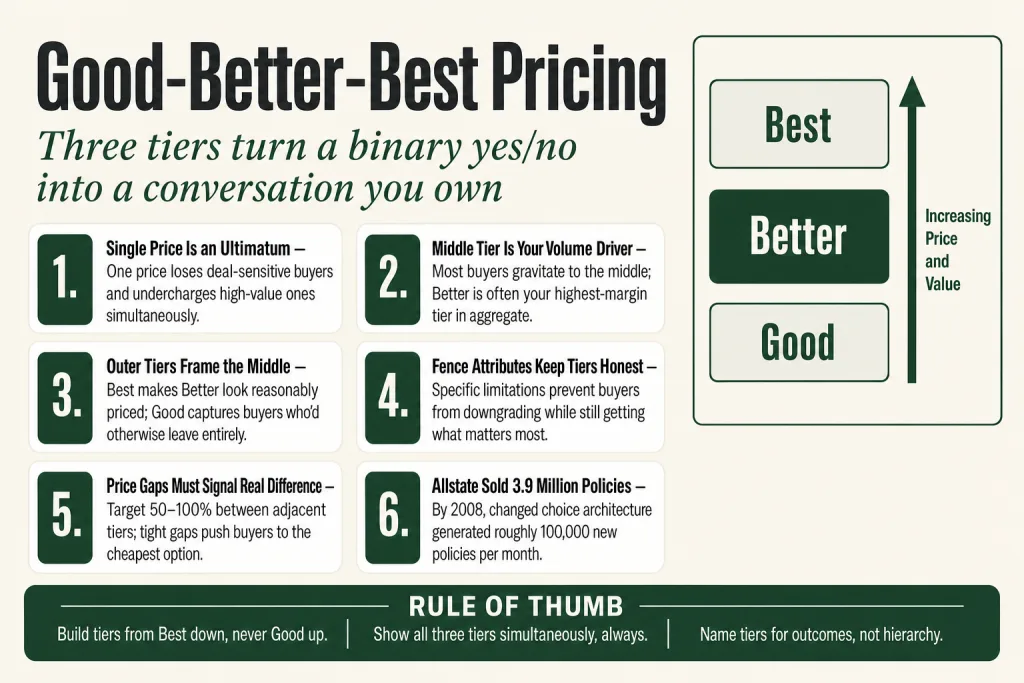
- A single price is an ultimatum. Three tiers are a conversation, and most buyers prefer the middle, a well-documented behavior called the compromise effect.
- The outer tiers (Good and Best) do as much work as signposts as they do as actual products, they frame the middle tier and make it look like the rational choice.
- The Best tier anchors perceived value upward; the Good tier captures buyers who would otherwise leave entirely rather than downgrade their expectations.
- Rafi Mohammed brought the framework to mainstream business practice, first in a February 2013 HBR article and more fully in his September/October 2018 HBR piece, but the underlying psychology traces to Itamar Simonson’s 1989 academic research on the compromise effect.
- The model fails when tiers aren’t genuinely differentiated, when Good is too generous, when the gap between Better and Best is unclear, or when tier design is driven by features you have rather than outcomes buyers want.
Where Good Better Best Pricing Came From
The research behind GBB didn’t start with a pricing consultant. Itamar Simonson, then an assistant professor at UC Berkeley, published the foundational work in the Journal of Consumer Research in September 1989. His core finding: add a third option and you change what people choose from the original two. Brands gain share when they become the compromise alternative, the option that sits between extremes. That’s the engine under every good-better-best structure.
Simonson and Amos Tversky extended the work in 1992 in the Journal of Marketing Researchnaming the phenomenon extremeness aversion: an option becomes more attractive when it sits in the middle of a choice set, and less attractive when it becomes an extreme. Buyers don’t just prefer the middle because it’s average, they prefer it because choosing an extreme forces them to give up more of something they value, and that loss feels larger than the corresponding gain.
The “Good, Better, Best” label is older merchandising shorthand, fuel grades, hotel room types, cable TV packages, but Rafi Mohammed brought the systematic practitioner framework to businesses of every size, first in a February 2013 HBR article and more fully in his September/October 2018 HBR piece, which detailed the Allstate case study and the role of fence attributes. The underlying psychology was already thirty years old by the time that article ran.
The Problem a Single Price Creates
Most small-business operators start with one price. It makes sense, you’ve built one thing, you sell it for what you think it’s worth, done. The trouble is that “what it’s worth” is not a fixed number. It varies enormously across your customer base, and a single price is a blunt instrument for capturing that variation.
A single price is an ultimatum. You’re telling every buyer, the one who wants the bare minimum and the one who’d happily pay twice as much for a better result, that they have exactly one option. The deal-sensitive buyer often says no and goes elsewhere. The high-value buyer says yes and pays less than they would have. You lose on both ends simultaneously.
There’s also a positioning problem: single prices force head-to-head competition on that one number. A competitor comes in 10% lower and suddenly you’re in a race you didn’t choose to enter. Three tiers changes the comparison. Your Good tier can compete with discounters while your Better and Best tiers don’t even play in that game.
For service businesses specifically, single-price quotes leave job scope entirely up to the buyer. A customer who asks for “a lawn cleanup” doesn’t know what’s possible. They take what you offer. Three tiers let you show them what their yard could look like, which, more often than not, gets them to spend more than they planned.
The Core Principles of Good Better Best Pricing
The structure isn’t complicated. The principles that make it work are where operators usually shortcut, and pay for it later.
The Three Tiers and Their Jobs
Each tier has a distinct job:
- Goodcaptures the price-sensitive buyer who would otherwise walk. Some customers who wouldn’t consider your brand at full price might engage with a leaner offer. Good is not your main event, it’s your door.
- Betteryour volume driver and likely your highest-margin tier in aggregate. When presented with three options, most people gravitate toward the middle. This “Goldilocks effect” means Better often becomes the tier where most of your revenue actually lands.
- Bestcaptures high-value buyers who want the full result and will pay for it. Best also does something else: it anchors perception upward, making Better look well-priced by comparison.
The Outer Tiers Frame the Middle
Good and Best don’t just exist to sell, their deeper function is to make Better look like the obvious choice. The cheapest tier sets a floor. The most expensive sets a ceiling. Together they create a reference frame inside which the middle tier appears optimally positioned.
Think about what Best does to perception: it makes Better look reasonably priced. Without that anchor, Better is just your regular price. With it, Better looks like the smart call. You haven’t changed the price, you’ve changed the context it lives in.
Loss Aversion Does the Heavy Lifting
Customers comparing Good versus Better focus on what they’d miss by choosing lower. Those comparing Better versus Best weigh whether the premium features justify the gap. The buyer’s mind is always running comparisons, GBB makes sure those comparisons happen between your tiers, not between you and a competitor.
Fence Attributes Keep Tiers Honest
A tier structure only works if customers can’t easily get around it. Fence attributes are specific features or limitations that prevent buyers from downgrading while still getting what matters most to them. For a hotel, that might be a non-refundable rate. For a service business, it might be response time, included revisions, or access to a senior team member. The Good tier delivers real value, it’s just fenced on the dimensions that matter to buyers who are willing to pay more.
Tier Mix Targets
A rough benchmark, and ours rather than anyone’s published research: expect around 10 to 20% of revenue from Good, 25 to 50% from Better, and 30 to 60% from Best. Your actual mix depends on how well the tiers are differentiated. If 70% or more land on Good, your Better tier isn’t compelling enough. If almost nobody buys Best, either the price gap is too wide or the value difference isn’t visible enough.
Building Your Good Better Best Tiers: The Operator Process
The order matters. Most operators start with their existing offer and try to add tiers around it. That works okay. The sharper approach is to start from your customer segments and build the tiers toward them.
Step 1: Identify the Real Segments
“Segment” doesn’t have to mean a complex persona document. It means: who are the buyers who only need the core outcome, who are the buyers who want the full service, and who are the buyers in the middle? If you’ve been operating for more than a year, you already have a rough sense of this from your sales conversations and support tickets.
Step 2: Assign Features to Tiers by Value, Not by Inventory
The mistake most operators make here is assigning features to tiers based on what they have available, not what the customer values. Start with Good, the minimum viable set to solve the core job credibly. Build Better around mainstream needs with clear incremental value. Reserve scarce, complex, or risk-reducing capabilities for Best, things like priority support, performance guarantees, extended warranties, or access to senior personnel.
The test for each tier: does someone in that segment have a clear reason to prefer it over the tier below? If the answer is “they get more features,” that’s not compelling enough. The reason needs to map to an outcome. “Faster response time” or “dedicated account contact” or “we handle the scheduling” beats a feature checklist every time.
Step 3: Set the Price Gaps Deliberately
Keep gaps between tiers in the 50 to 100% range. Smaller gaps signal that the products are basically the same thing. Jumps over 2× require substantial feature differences to carry the price. Start with a hypothesis, say, Better at +50% over Good and Best at +125% over Good, then model expected tier mix and margins. Adjust gaps to steer the mix toward your target, often 50 to 70% landing on Better and 10 to 30% on Best depending on the category.
If you’re starting from scratch with no data, the 50/125 structure is a reasonable first hypothesis. Run it for 60 to 90 days, look at where buyers land, and adjust from there.
Step 4: Name the Tiers for Outcomes, Not Hierarchy
“Basic, Standard, Premium” communicates hierarchy but tells the buyer nothing about what they’re actually buying. Names like “Essential, Growth, Complete”, or for a cleaning company, “Clean, Clean + Protect, Full Service”, let buyers self-identify with a tier before they’ve even read the feature list. That pre-frame matters more than most operators realize.
Step 5: Present the Tiers Side by Side
Don’t hide your tiers in separate proposals or separate pages. The comparison has to happen at a glance. Put them in a three-column table with the differentiating features highlighted, not buried in a long list of checkboxes where every tier gets a check. Show the buyer exactly what they’re trading off at each level.
Putting this to work? The ideas in the Canon are the foundation under the tactical playbook in Build a Complete Marketing Department — grab the free companion kit at mmsvegas.com/resources.
Good Better Best Pricing in Practice: Real Examples
The model shows up everywhere once you start looking for it, and the examples teach something beyond just confirmation that the strategy works.
Allstate “Your Choice Auto” (2005): Allstate launched three vehicle insurance tiers, a value option priced about 5% below its standard policy, a gold tier priced 5 to 7% above, and a platinum tier at roughly 15% above. By 2008 the program had sold 3.9 million policies and was generating around 100,000 new policies per month. What made it work wasn’t a new product, it was changed choice architecture around one that already existed. Drivers who previously had a single take-it-or-leave-it option suddenly had a frame for comparison.
Apple: Apple’s product lineup within each category, iPhone, MacBook, AirPods, Apple Watch, is a textbook case of visible tier differentiation. The iPhone lineup is worth studying specifically because the feature differentiation is genuine and legible: camera quality, storage, screen size. The naming (standard, Pro, Pro Max) signals tier identity without just labeling hierarchy. People buy the Pro Max partly because they want to be the kind of person who has the Pro Max, not only because they ran a feature comparison.
Netflix: Netflix has used GBB logic consistently, a base tier, a standard tier with higher definition, and a premium tier with 4K and broader simultaneous streaming. What makes the current execution notable is that the lower tier includes ads, making it functionally different from Better rather than just cheaper. It’s not the same product at a lower price; it’s a genuinely different experience. That’s fence design working as intended.
Fuel Grades: Regular, Plus, Premium. The underlying product is differentiated by octane rating, but the psychological effect is the same, three options makes the choice feel informed rather than binary. Most people pick midgrade not because they’ve read engine specifications but because it feels like the reasonable call. That instinct is the compromise effect doing exactly what Simonson documented in 1989.
Field Service and Home Services: A landscaping company offering “Mow & Edge,” “Mow, Edge & Fertilize,” and “Full Grounds Management” gives a homeowner a way to choose their level of involvement, and typically generates a substantially higher average ticket than quoting the mow-and-edge alone. The buyer who came in thinking they wanted the cheapest option often moves to the middle once they can see what they’d be missing.
Where Good Better Best Pricing Works Best
Not every business or transaction is a good fit. Understanding where GBB has the most leverage helps you decide how much to invest in building it out.
Services with bundleable components. If your service has a natural core plus optional additions, basic scope plus response time upgrade plus dedicated contact plus reporting, you can tier those components cleanly. Cleaning, HVAC, IT support, bookkeeping, marketing retainers, legal work, consulting: all of these have bundleable dimensions.
Subscription and recurring revenue models. Tiered pricing is one of the dominant structures in SaaS precisely because the recurring nature makes tier selection a longer-term commitment. That amplifies both the upsell opportunity and the stickiness of the right tier. A customer who self-selects into Best is telling you something about their long-term value, and likely their churn risk too.
Markets with varied willingness to pay. If your buyers come from meaningfully different segments, say, a home service that works for both rental property managers and owner-occupants, their willingness to pay and their feature priorities are genuinely different. GBB lets you serve both without discounting for the one who’d pay more.
Proposal-based sales. If you’re currently quoting customers a single number, you’re leaving the job scope entirely up to the buyer. Presenting three packaged options in a proposal gives the buyer a comparison frame and typically moves average job value up without any additional negotiation. One field service operator found that optional line items on a quote could turn a $500 request into a $2,000 conversation.
Categories where buyers need to justify decisions to others. The preference for the middle is especially strong when buyers feel accountable to a third party, a manager, a partner, a board. B2B purchases lean heavily on the middle tier because it’s the easiest choice to defend. “We went with the standard tier” is a much easier sentence than “we went with the cheapest” or “we went all-in on the premium.”
Where Good Better Best Pricing Doesn’t Work
The model has real limits. Using it in the wrong context doesn’t just fail to help, it can actively confuse buyers and cheapen the perception of your offer.
When your customer already knows exactly what they want. A buyer who calls you for a specific, defined scope, “replace the water heater, same model”, doesn’t need three tiers. Presenting them anyway reads as upselling, not choice architecture. GBB is most powerful when the buyer has genuine uncertainty about what level of service is right for them.
When the differences between tiers aren’t real. If you build three tiers but the Good tier is 90% of what Better delivers, you’ll see heavy cannibalization. A bottom tier that’s too generous steals conversions from the middle. And if the gap from Better to Best is mostly cosmetic, buyers will notice, and you’ll either discount the Best tier to close deals or watch it sit unsold.
When the Good tier becomes a trojan horse. Customers can turn resentful when the Good offering appears inexpensive but then reveals hidden fees and limitations. The Good tier should be a genuinely useful product at a lower price, not a stripped-down bait. Buyers forgive a lot of things; feeling tricked isn’t one of them.
When you have too many custom variables. If every deal requires significant scoping and customization, packaging into three fixed tiers may create friction rather than reduce it. Professional services with highly bespoke engagements, architecture, complex legal work, enterprise software implementations, often do better with a consultative approach and value-based pricing than with a menu.
When tiers don’t reflect how your segments actually break. Poorly designed tiers can force a customer who needs a $4,000 add-on into a jump to a $40,000 enterprise tier because the middle tier wasn’t built for them. That kind of misfit doesn’t just lose deals, it generates the kind of resentment that finds its way onto review sites.
What People Get Wrong About Good Better Best Pricing
Misunderstanding 1: The goal is to sell the Best tier. It isn’t. Or rather, it isn’t only that. The Best tier’s primary job is to make Better look reasonable. If 60% of your buyers end up on Better and that’s your highest-margin tier, the model is working exactly as designed. Measuring success by Best-tier conversion rate alone misses the point entirely.
Misunderstanding 2: You’re just adding a premium upsell. Adding a more expensive option on top of your existing price is not good better best pricing, it’s just a premium tier. GBB requires genuine differentiation at all three levels, including a Good tier that credibly serves buyers who don’t need everything. If you only have two real tiers and you’re calling it three, the buyer will feel it.
Misunderstanding 3: More tiers are better. Three tiers balances simplicity and choice. Four is workable if there’s a genuine fourth segment, but requires careful labeling to avoid confusion. Five or more almost always creates decision paralysis and dilutes the compromise effect. If you think you need more than three, you likely have distinct customer segments that deserve separate offer architectures entirely.
Misunderstanding 4: GBB is psychological manipulation. The compromise effect describes a cognitive tendency, not a sleight of hand. You’re not tricking buyers into choices they’ll regret; you’re making it easier for them to find the option that fits. If your Better tier delivers real value at its price, guiding buyers toward it is good service design.
Misunderstanding 5: The Good tier is a concession to price shoppers. Some operators resist building a Good tier because it feels like admitting the service can be done cheaper. The framing is backwards. The Good tier exists to capture buyers who would otherwise leave entirely. It doesn’t cannibalize Better unless you designed it to.
Common Mistakes
- Presenting tiers sequentially rather than side by side — The compromise effect only fires when all three options are visible at once. If you’re sending proposals with tiers on separate pages, or presenting options one at a time in a sales conversation, you’re removing the comparison frame entirely. Fix it mechanically: build a one-page or one-screen comparison table, put it in every proposal template, and make it the first thing a buyer sees, not a follow-up after they’ve already anchored on a single number.
- Launching without a defined review cycle — Your first tier structure is a hypothesis. Set a hard 60-day calendar reminder to pull tier mix data. Over 60% landing on Good means Better isn’t compelling enough, rewrite the Better tier headline to lead with a specific outcome rather than a feature list and recheck in 30 days. Near-zero on Best usually means the price gap is too wide or the visual presentation buries Best under Better’s ‘Most Popular’ badge. Fix the presentation before you cut the price.
- Using tier names that signal hierarchy instead of outcome — ‘Basic, Standard, Premium’ tells buyers which tier is inferior before they’ve read a word. Rename using the outcome each tier delivers for a specific buyer type. For a bookkeeping service: ‘Essentials’ (core compliance), ‘Growth’ (compliance plus monthly advisory call), ‘CFO-Ready’ (full reporting package, fractional CFO access). Test the names with five recent customers, ask which they’d pick before seeing prices. If they all say the first one, the name is suppressing upsell before you’ve even started.
- Compressing price gaps because the top tier feels expensive — Tight gaps, $99 / $129 / $159, signal identical products at different prices. Buyers default to cheapest. Aim for 50 to 100% between adjacent tiers. If the jump from Good to Better feels too large, the fix isn’t to shrink the gap, it’s to add visible value to Better that justifies the distance. Write out three specific outcomes a Better buyer gets that a Good buyer doesn’t, then check whether all three are visible in the tier description. If they aren’t, the tier looks overpriced even when it isn’t.
- Building the tiers in the wrong order — Start with Best, the full, no-compromise version of your service. Then strip it down to Better, then to Good. If you build Good first, it ends up too generous: you’ll include things that should be fences, and Better won’t have a clear enough edge to earn the price difference. A practical test: after designing all three tiers, ask whether a buyer in your Best segment would miss anything if they chose Better. If the answer is no, you haven’t built a real Best tier, you’ve built a Better tier with a higher price tag.
Operator’s Take
Pull your last 50 closed jobs before you design anything. You’re looking for three things: jobs you discounted to close (that’s a Good tier waiting to exist), jobs where the customer asked for add-ons after the fact (that’s your Better-to-Best gap, those add-ons belong in Best upfront), and jobs you lost without a clear reason (often a buyer who needed a lower entry point you didn’t offer). Your tier architecture is already sitting in that data.
Design tiers in reverse. Start with Best, the full, no-compromise version of your service. That’s your anchor. Strip out what only your most engaged customers actually use, and you have Better. Strip out what’s optional for someone who just needs the core outcome, and you have Good. If you design Good first, it ends up too generous, you’ll give away what makes Better worth buying before you’ve even priced it.
On price gaps: don’t compress them because you’re worried about sticker shock on the top tier. A $99 / $129 / $159 structure tells the buyer these are basically the same thing at slightly different prices. A $99 / $175 / $299 structure says: these are genuinely different things. The gap does the communicating. Tight gaps push buyers to the cheapest option, which is exactly the outcome you were trying to avoid.
Name the tiers for what the customer gets, not where the tier sits in your lineup. “Essential, Growth, Complete” tells a story. “Basic, Standard, Premium” tells the buyer which one is the inferior option. That framing shapes the choice before they’ve read a single feature.
Present all three tiers in one view, one table, visible at a glance, and put a “Most Popular” badge on Better. Not because it’s a trick, but because it’s almost certainly true, and it removes the decision anxiety that makes buyers default to the cheapest. If you bury the tiers in sequential pages or separate proposals, the compromise effect never fires. The psychology only works when the buyer can see all three at once.
Here’s where operators consistently leave money after launching GBB: they never look at the data. Set a hard 60-day calendar reminder to pull your tier mix. Better below 40% of closed deals means your price gap between Good and Better is too narrow, or Better is under-differentiated, rewrite the Better tier headline to lead with a specific outcome instead of a feature list and recheck in 30 days. Best below 10% is usually a visibility problem more than a price problem: check whether Best is presented at equal visual weight to Better, or whether Better’s “Most Popular” badge is accidentally suppressing it.
Tier names and descriptions aren’t set-and-forget. After 90 days, run the names by five recent buyers and ask which tier they’d gravitate toward before reading a single bullet. If they all point to Good, the naming is doing the wrong work. A name like “Essential” can read as “everything you need” to one buyer and “bare minimum” to another, those are different signals. Test the language with real customers, not your team.
One honest caveat: GBB amplifies a good offer. If your standard service isn’t compelling at its current price, three tiers just give the buyer three ways to say no. Fix the core offer first.
AI tools are useful for the analytical work here, scanning proposal history for upgrade patterns, drafting tier description variations to test, modeling price gap scenarios against your margins. What they won’t do is tell you whether the differentiation is real enough to hold up in a live sales conversation. That judgment stays with you.
Used in
- ✓ Build a Complete Marketing Department
Used to design offer packages that present comparative value rather than isolated prices, so that the marketing system drives buyers toward the highest-margin tier by default. - ✓ The Missing Manual for FunnelKit
Applied when building order bump and upsell sequences, the three-tier structure maps directly onto how FunnelKit presents offer variations on checkout and post-purchase pages. - ✓ The Missing Manual for Make
Referenced when automating tier-based onboarding flows, customers who self-select into different tiers can trigger distinct automation sequences matched to the features and expectations of their tier.
FAQ
Does good better best pricing work for service businesses that quote custom projects?
Yes, in fact proposal-based service businesses often see some of the biggest average-ticket lifts from GBB because most of them currently quote a single number. Presenting three packaged options in a proposal gives the buyer a comparison frame and typically moves average job value up by 20 to 40% without any additional negotiation.
How do I prevent buyers from always choosing the cheapest tier?
Two things: first, make sure the Good tier is genuinely fenced, it should solve the core job but be missing something buyers care about once they see Better. Second, check that the price gap between Good and Better is large enough to signal a real difference; if they’re close in price, buyers default to Good. Aim for at least a 50% gap.
Should I highlight one tier as recommended?
Yes, and it works well. A ‘Most Popular’ or ‘Best Value’ badge on Better is a widely used and effective technique, it gives buyers social proof and reduces decision anxiety. It also reinforces that the middle tier is the intended choice for most buyers, which is usually true.
What if I only have one product or service, can I still use this?
In most cases, yes. You can tier on dimensions like service level (response time, dedicated support, reporting), scope (what’s included versus optional), or guarantee depth. Even a single physical product can often be tiered with installation, warranty, and support bundles. The question is whether your buyers have different willingness to pay, if they do, there’s almost always a way to build differentiated tiers.
How many tiers is too many?
Three is the sweet spot for most businesses. Four is workable if there’s a genuine fourth segment, but requires careful labeling to avoid confusion. Five or more almost always creates decision paralysis and dilutes the compromise effect. If you think you need more than three, you likely have distinct customer segments that deserve separate offer architectures.
Is good better best pricing the same as the decoy effect?
Related but distinct. The decoy effect introduces an option that isn’t meant to be chosen, it exists purely to make another option look better by comparison. GBB uses three genuinely purchasable tiers, all of which deliver real value. The psychological mechanisms overlap (both shape how buyers evaluate options by changing the comparison set), but GBB is a pricing and packaging structure, while the decoy effect is a choice-architecture technique.
Further reading
- ‘The Good-Better-Best Approach to Pricing’Rafi Mohammed, Harvard Business Review, September/October 2018. The article that formalized the framework for business practitioners; worth reading for Mohammed’s discussion of fence attributes and the Allstate case study in detail.
- ‘Why Good-Better-Best Prices Are So Effective’Rafi Mohammed, Harvard Business Review, February 8, 2013. The earlier, shorter piece that introduced the core argument; useful as a quick orientation before the longer 2018 article.
- ‘The 1% Windfall’Rafi Mohammed (HarperBusiness, 2010). Mohammed’s broader pricing playbook; GBB is one strategy among many, but the surrounding chapters on customer price sensitivity and capture rates add useful context.
- ‘Priceless: The Myth of Fair Value’William Poundstone (Farrar, Straus and Giroux, 2010). An accessible treatment of the behavioral economics underlying pricing decisions, including anchoring and the compromise effect, grounded in real experiments.
Sources: Rafi Mohammed, ‘The Good-Better-Best Approach to Pricing,’ Harvard Business Review, September/October 2018; Rafi Mohammed, ‘Why Good-Better-Best Prices Are So Effective,’ Harvard Business Review, February 8, 2013; Itamar Simonson, ‘Choice Based on Reasons: The Case of Attraction and Compromise Effects,’ Journal of Consumer Research, Vol. 16, No. 2, September 1989, pp. 158 to 174; Itamar Simonson and Amos Tversky, ‘Choice in Context: Tradeoff Contrast and Extremeness Aversion,’ Journal of Marketing Research, Vol. 29, No. 3, August 1992, pp. 281 to 295; Leadership Review, ‘Why You Should Adopt Good-Better-Best Pricing,’ November 2018; Wikipedia, ‘Good, better, best,’ retrieved July 2025.
Brian Kasday spent forty years in direct-response marketing before rebuilding the whole operation as a one-person shop. He writes The Operator’s Library — including “Build a Complete Marketing Department” — for operators who’d rather build it themselves than wait on someone else.
Build the department these ideas describe — the free companion kit: mmsvegas.com/resources.
More The Operator's Canon guides
Free · Operator Toolkit
Want the tools, not just the guide?
Get the free operator toolkit — templates and checklists for the systems you actually run, plus a note when this guide changes.
Get the free toolkit →How to cite: Good-Better-Best Pricing. Associated with Itamar Simonson, 1989. The Operator’s Canon, MMS Vegas. https://mmsvegas.com/library/good-better-best-pricing-explained/