
Last updated: July 2026
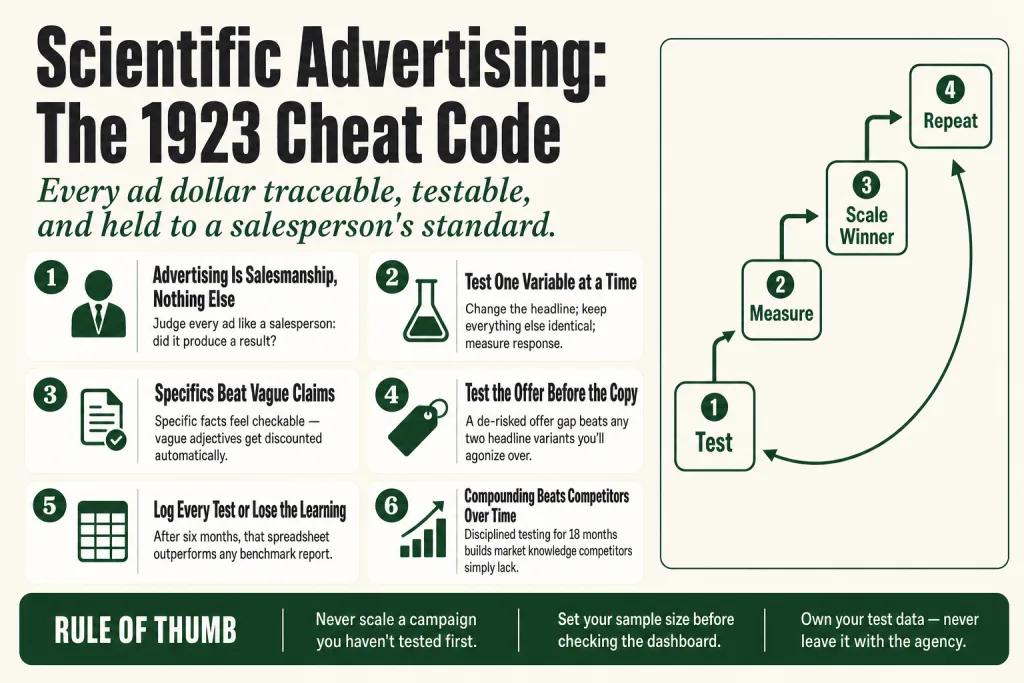
Scientific advertising is the idea that every dollar you spend on marketing should be traceable, testable, and held to the same standard as a salesperson knocking on doors. Not based on gut feel. Based on evidence.
Claude Hopkins laid out this framework in 1923, and the advertising industry has spent the last hundred years either following it or pretending it doesn’t apply to them. The ones who ignored it mostly ended up producing very expensive art that didn’t sell much of anything. The ones who followed it, David Ogilvy, Gary Halbert, Jay Abraham, and the entire performance-marketing world that runs on Facebook and Google today, built the most measurable commercial communication machine in history.
For a small-business operator, scientific advertising isn’t a historical curiosity. It’s the closest thing to a cheat code that advertising has ever produced. The cheat code isn’t a formula or a script. It’s a disciplinethe discipline of never spending money on an ad you can’t measure, never scaling a campaign you haven’t tested, and never trusting your instincts over the data your market is handing you for free.
The idea in 30 seconds
- Claude Hopkins published Scientific Advertising in 1923, it remains the foundational text for measurable, results-driven marketing.
- The core premise: advertising is salesmanship in print. Every ad should be judged the same way you’d judge a salesperson, did it produce a result?
- Hopkins pioneered split testing and coupon-based response tracking a century before Google Analytics existed.
- The testing discipline, one variable, measured response, winner scaled, is more executable today than it has ever been.
- Small operators who adopt a testing mindset stop guessing and start accumulating compound knowledge about what their market actually responds to.
- The media examples in the book are antiques. The measurement philosophy is timeless. Steal the philosophy, ignore the newspaper rates.
Where Scientific Advertising Came From
Claude Hopkins wasn’t an academic. He was a hired gun, Bissell Carpet Sweeper, Swift & Company, Quaker Oats, Goodyear Tires, Van Camp’s pork and beans. In 1907, when he was 41, Albert Lasker brought him into Lord & Thomas at $185,000 a year. The market had already validated his methods before he ever wrote them down.
His book, Scientific Advertisingcame out in 1923. Seventy-eight pages. You can read it in an afternoon. Two campaigns show what made his thinking different from everything else being done at the time.
For Schlitz beer, then sitting in fifth place in the American market, Hopkins toured the brewery and noticed the meticulous production process: filtered-air cooling rooms, steam-cleaned bottles, 4,000-foot artesian wells. The Schlitz team shrugged. Every major brewery did the same things. Hopkins understood that being first to tell a story the competition hadn’t bothered to tell was as good as being the only one who did it. He built the campaign around purity and process, and Schlitz moved from fifth place to neck-and-neck with first. Every competitor could have said the same thing. None of them did.
For Pepsodent, he built a consumer habit from scratch, found a cue (the film on your teeth), connected it to a craving for a clean smile, and offered the product as the reward. Within a decade, toothbrushing had gone from occasional to daily for a majority of the American population, according to polls cited by Charles Duhigg in The Power of Habit. Hopkins constructed that loop before anyone had named it that.
David Ogilvy said no one should be allowed to work in advertising without reading the book. The reason serious practitioners keep citing a century-old paperback isn’t nostalgia. Hopkins solved a fundamental problem, how do you know what works?, and that problem hasn’t changed.
The Core Principles of Scientific Advertising
Strip the book down and you get a handful of principles worth memorizing, because they govern how every high-performing ad campaign, in any medium, in any era, actually works.
“Almost any question can be answered, cheaply, quickly and finally, by a test campaign.”
Claude C. Hopkins, Scientific Advertising (1923)
Advertising Is Salesmanship, Nothing Else
Hopkins’ opening position was blunt: advertising is salesmanship multiplied. A good ad does what a good salesperson does, it finds the prospect’s problem, offers a credible solution, and asks for a specific response. The moment you start evaluating ads by how funny they are, how beautiful they look, or how much chatter they generate, you’ve stopped measuring the thing that matters.
His standard was simple: would you keep a salesperson on the payroll who generated this result? If the ad wouldn’t survive that question, it shouldn’t run. An ad that took three hours to design and performs at half the rate of a plainly written email isn’t a good ad. It’s an expensive hobby.
Mail-Order Thinking as a Standard
Hopkins held up mail-order advertising as the gold standard for the field, because mail-order was already accountable. Every mail-order ad had to pay for itself directly, there was no brand-building cover, no vague awareness play. You ran an ad, people sent in money or they didn’t, and you knew within days whether it worked. He argued that all advertising should be held to that standard. The discipline of asking “How will I know if this worked?” before spending a dollar changes what you build, and more importantly, changes what you don’t build.
Testing as the Only Reliable Answer
Hopkins argued that almost any question about advertising could be answered cheaply, quickly, and definitively by a test campaign. One variable. Controlled conditions. Measured response. This sounds obvious now, but it was genuinely radical in a world where advertising decisions were made by opinion, taste, and whoever had the biggest office.
The discipline he described was specific: you don’t test hunches, you test one variable at a time. Change the headline and keep everything else identical. Measure the response. The winner becomes the new control, and you test against that. Over time, you accumulate real knowledge, not theories, not best practices borrowed from someone else’s business, but data from your market, your offer, your customers.
Reason-Why Copy
Hopkins insisted that copywriters research their clients’ products thoroughly and produce specific, factual claims that gave a prospect an actual reason to act. Not “great quality” or “trusted for generations”, specifics. The steam-cleaned bottles. The film on your teeth. The way Quaker Oats are prepared. Specifics are credible in a way that vague adjectives never are, and they’re far harder for a competitor to copy directly, because the specifics belong to the story you tell first.
The Headline Does Most of the Work
Hopkins placed extraordinary weight on headlines, treating them as the most critical variable in any ad. A weak headline means the rest of the copy never gets read. This is why he tested headlines more aggressively than anything else, because the payoff from getting the headline right compounds across every impression the ad makes. Modern A/B testing of email subject lines is the direct descendant of this insight.
Sampling and Low-Risk Offers
He believed a good product was often its own best salesperson, which made him a passionate advocate for sampling and trial offers. Remove the risk for the prospect, get the product in their hands, and let the experience do the selling. This principle maps directly to modern free trials, lead magnets, demos, and money-back guarantees, anything that lowers the activation energy required to say yes the first time.
Why the Scientific Advertising Framework Actually Works
The framework works for a reason that has nothing to do with advertising theory and everything to do with human nature: most people, including smart, experienced marketers, are wrong about what their audience responds to. Not sometimes. Regularly. The gap between what you think will work and what actually works in your specific market, with your specific offer, to your specific list, is almost always significant. Testing closes that gap. Opinion doesn’t.
Hopkins understood that advertising losses from unsuccessful ads should be kept to a safe level, while gains from profitable ads should be multiplied. That’s the engine. You’re not trying to hit a home run on the first swing, you’re trying to identify, cheaply and quickly, which direction the market is pulling, and then follow it. The downside of a losing test is bounded. The upside of a winning one, scaled, is not.
The other reason it works is compounding. Every test gives you information. Every piece of information lets you write a better next ad, choose a better next offer, target a better next audience segment. An operator who runs disciplined tests for twelve months has a growing library of market intelligence that a competitor running on gut feel doesn’t have. That gap compounds. By month eighteen, you’re not just beating them on this campaign, you understand your market at a level they simply don’t.
There’s also something Hopkins intuited but never named explicitly: specificity creates credibility. When you make a vague claim, “the best service in town”, the reader’s brain pattern-matches it to every other vague claim they’ve ever heard and discounts it automatically. When you make a specific claim, “our technicians have completed over 1,200 installations in the Las Vegas Valley since 2019”, it feels checkable. It feels real. Reason-why copy works because specificity is a credibility signal, independent of whether the reader actually verifies the claim.
Putting this to work? The ideas in the Canon are the foundation under the tactical playbook in Build a Complete Marketing Departmentgrab the free companion kit at mmsvegas.com/resources.
Scientific Advertising Today: The Same Discipline, Better Tools
Here’s what Hopkins would find both delightful and maddening about the current landscape: the tools for scientific advertising are now absurdly good, and most small businesses still don’t use them properly.
The infrastructure Hopkins built with key-coded coupons and tracked phone calls now exists natively in every ad platform, email marketing tool, and CRM on the market. Google Ads shows you click-through rates by headline variant in real time. Facebook lets you run two versions of an ad to identical audiences simultaneously. Email platforms report open rates and click rates by subject line within hours. FunnelKit tracks conversion rates by page variant down to the decimal. The feedback loop that took Hopkins weeks through the mail now closes in days, sometimes hours.
And yet. Email-tool vendors publish figures suggesting a little over half of companies A/B test their email campaigns, which would leave a large minority essentially guessing. Those counts come from vendor round-ups with no stated sample, so treat the proportion as impressionistic. Most small-business operators still make their marketing decisions based on what they like, what their designer likes, or what some marketing influencer said worked for their completely different business. Hopkins would find this baffling. The whole apparatus for scientific advertising exists, and most people are still just guessing.
The modern operator’s advantage is that your competitors almost certainly aren’t testing systematically. They’re changing their ads based on vibes. You don’t have to be significantly smarter than them, you just have to be more disciplined. Run structured tests. Measure the right things. Scale what wins.
Where the Principles Map to Modern Channels
Every Hopkins principle has a direct modern equivalent. Key-coded coupons are UTM parameters and unique promo codes. Testing headlines is subject-line A/B testing in your email platform. Reason-why copy is what separates a landing page that converts from one that just generates traffic. Sampling is the free consultation, the lead magnet, the fourteen-day trial. Mail-order accountability is the conversion pixel, the attributed revenue report, the cost-per-lead dashboard.
The channel is irrelevant. The discipline transfers. Hopkins didn’t care whether you were running newspaper ads or direct mail, he cared whether you could measure the response and learn from it. Apply that standard to your Google Ads, your email campaigns, your landing pages, your direct outreach sequences, and you’re doing scientific advertising. Ignore it, and you’re doing something more expensive and less informative.
The Testing Ladder for Small Operators
For a small business that isn’t running large enough volumes to run statistically significant split tests across every variable simultaneously, the testing discipline still applies, you just sequence it more carefully. Start with the variable that has the highest leverage and the lowest cost to test: the headline or subject line. Once you have a control that performs reliably, move to the offer. Once the offer is dialed in, test the audience segment. Work from the top of the funnel down. Each test builds on the last. The operator who does this consistently for a year will have a marketing system that has been stress-tested by the actual market, not by anyone’s opinion.
Where Scientific Advertising Works Best for a Small Business
Scientific advertising is most powerful wherever you can close the feedback loop quickly and clearly. That narrows it down to:
- Email marketing. Subject lines, preview text, body copy, and calls-to-action are all testable with even a modest list. A 2,000-person list split two ways gives you enough signal on a subject line test within 24 hours. Email also generates among the highest tracked conversion rates of any channel, visitors who arrive via email convert meaningfully better than those from paid social or paid search.
- Paid search and paid social. These platforms were built for Hopkins-style testing. Multiple headline variants, multiple audience segments, multiple offers, all running simultaneously, all reporting back measurable data. The operator who treats their ad account as a testing environment rather than a broadcast channel accumulates knowledge their competitors don’t have.
- Landing pages. Every element of a landing page, headline, subhead, hero image, call-to-action, social proof, is testable. The payoff is significant: moving from 2% to 3% conversion on a page with meaningful traffic adds real revenue without adding a dollar of ad spend.
- Direct outreach. Sequences, subject lines, opening hooks, offers, all of it can be varied systematically and tracked by response rate. This is just Hopkins’ coupon-coded testing applied to a CRM.
- Offers themselves. Hopkins would have tested the offer before he tested the copy. What you’re asking someone to do, the price point, the structure, the risk reversal, the guarantee, is often more variable than the words around it. Many small operators have never systematically tested a different offer structure against their default.
Where Scientific Advertising Has Real Limits
Hopkins’ framework has genuine blind spots, and ignoring them leads to its own kind of trouble.
The biggest one: pure direct-response thinking can undervalue long-game brand positioning. Hopkins measured response. Some of the most durable competitive advantages in business, the associations people carry about a brand before they ever need the product, are genuinely hard to measure in the short run. Coca-Cola, Apple, Patagonia, their marketing investments don’t always close a traceable loop within the 90-day window that a Hopkins purist would demand. For a small operator in a local or niche market, this is usually a secondary concern. But if your business model involves a long consideration cycle or a high-trust purchase, know that measurable direct response only tells part of the story.
The second limit: small traffic volumes create noisy data. If your landing page gets 200 visits a month and your email list has 400 people, the statistical signal from any single test is weak. You can still test, you just have to run tests longer, change fewer variables at a time, and resist the urge to call winners too early. Patience is part of the discipline.
Third: some markets resist direct response framing. High-ticket B2B sales, complex professional services, luxury categories, these involve trust-building that happens over time and through multiple channels simultaneously. The tracking attribution gets messy. That doesn’t mean you abandon measurement; it means you track different things, qualified conversations, pipeline stage movement, referral source, rather than expecting a clean coupon-redemption-style loop.
And finally: A/B testing can optimize you into a local maximum. You test two versions of your current approach and pick the better one, but both versions might be inferior to an entirely different approach you haven’t tried. The testing discipline answers “which of these two is better?” It doesn’t always answer “are we testing the right things?” You still need someone with good strategic judgment to set the experiments worth running.
Common Misunderstandings About Scientific Advertising
“It’s about data, not creativity.” Hopkins never argued that creativity was worthless, he argued that creativity without measurement was worthless. The Pepsodent habit loop was a genuinely creative insight. The Schlitz preemptive claim was a creative insight. What Hopkins demanded was that you test those insights rather than assume they worked. Creativity tells you what experiments to run. Data tells you which ones won.
“The preemptive claim is a silver bullet.” The Schlitz story gets taught as pure triumph. It was, but the honest version is more interesting. Every major brewery used the same process Hopkins described. Schlitz wasn’t different; it was just first to say so. That gap between industry-standard practice and what you’ve actually told your market? It’s almost certainly sitting in your business right now. The move isn’t to invent a differentiator, it’s to find what you already do that you’ve never bothered to explain.
“Modern AI and targeting have made testing unnecessary.” Ad platforms that use machine learning to optimize delivery have become very good at finding the people most likely to click. They are not good at telling you whether your offer, your headline, or your core promise is the right one. The algorithm optimizes for the action you specify, it can’t tell you whether you’re specifying the right action, or whether your landing page deserves the click it’s getting. Human testing discipline and algorithmic optimization are complementary, not substitutes. One sets the experiments; the other distributes the results.
“Split testing is just about the headline.” Hopkins tested headlines aggressively because they have the highest leverage, they determine whether the rest of the ad gets read. But his full testing stack covered the offer, the proposition, the format, the placement. Modern operators who only A/B test subject lines and leave their offers, landing pages, and follow-up sequences untested are running maybe 20% of the discipline and wondering why the gains feel modest.
“This is what agencies do, not something I manage myself.” The entire premise of scientific advertising is that structured testing builds institutional knowledge about your market, and that knowledge belongs to whoever runs the tests. If an agency runs your tests and you never see the raw learnings, you don’t accumulate that knowledge. The contract ends, the data walks out the door with it. The operator who understands the testing framework can evaluate agency work, ask the right questions, and make sure the learnings compound inside the business, not disappear into someone else’s case study.
Common Mistakes
- Testing too many variables at onceBefore you launch any test, write the single element you’re changing at the top of your test log entry, headline, offer, or CTA, and lock everything else. If your instinct is to ‘clean up’ the page at the same time, don’t. Save those changes for the next test cycle. When results come in, you’ll know exactly what caused the shift.
- Calling winners too earlySet your minimum sample size before the test goes live, not after you check the dashboard and like what you see. For email, that’s at least 200 opens per variant. For landing pages, hold out for 300 to 500 sessions per variant. Put the end date in your calendar when you start the test. If the numbers aren’t there yet, the test isn’t done, period.
- Testing copy while leaving the offer untouchedRun your current offer against one with a stronger risk reversal, a money-back guarantee, an extended trial, a free first session, before you write a single new headline. Log both conversion rates for 30 days. You’ll likely find more room between ‘current offer’ and ‘de-risked offer’ than between any two headline variants you’ve been sweating over.
- Running tests but not logging the learningsOpen a shared spreadsheet today, one column each for: what was tested, control version, variant version, result, conclusion. Every test goes in before it launches (so you’re forced to write the hypothesis) and gets filled out when it closes. After six months, that document tells you more about your market than any benchmark report.
- Treating the agency as the keeper of test resultsAt the start of any agency engagement, specify in writing that all test data, variant performance, and learnings belong to your business and must be documented in a file you own, not their platform dashboard, not their monthly recap PDF. When the contract ends, audit that document before you offboard. If it doesn’t exist, ask for it before the relationship goes cold.
Operator’s Take
Let me tell you the single most expensive mistake I see operators make with Hopkins’ framework: they read the book, get fired up about testing, and immediately start A/B testing their headline colors. That’s not testing. That’s rearranging furniture while the foundation has cracks.
Test your offer first. Before you touch a headline, run your current offer against one with a real risk reversal, money-back guarantee, extended trial, first session free, whatever fits your model. Do it for 30 days. Log both conversion rates. In my experience watching operators do this, the gap between “current offer” and “de-risked offer” is almost always bigger than the gap between any two headline variants they’d spend weeks agonizing over. The copy around the offer barely matters if the offer itself is the thing losing you the sale.
Once you’ve got an offer that converts, then move to the headline. And here’s the move that pays for itself faster than almost anything else: run three subject-line variants on every email you send for the next 90 days. Not two, three. Log the winner each time, and log why you think it won. After 90 sends, patterns will emerge. Certain language angles pull. Certain curiosity hooks fall flat for your specific list. That log is genuinely worth more than any copywriting course you’d pay $997 for. It’s built from your audience, your offer, your market. Nobody else has it.
AI absolutely helps here, four minutes to draft three subject-line variants instead of twenty. Use it. What AI can’t tell you is which one your market will actually respond to. That’s what the test is for. The drafting gets faster; the judgment stays with you.
Now, sequencing. If your traffic volumes are low, under 300 sessions a month on a given page, or an email list under 1,000, the signal from any single test is noisy. I’ve watched operators call a winner after 40 responses and make sweeping changes, then wonder why their numbers went sideways a month later. Set your sample threshold before the test goes live, not after you glance at the dashboard and like what you see. For email, hold out for at least 200 opens per variant. For landing pages, 300 to 500 sessions per variant before you touch anything. Put the end date in your calendar when you start. If the numbers aren’t there yet, the test isn’t done.
Landing pages deserve a specific call-out because most operators treat them as finished products. They’re not, they’re permanent experiments. Pick the one page that drives the most meaningful traffic in your business right now. Write down its current conversion rate. Change one element only, the headline, the hero subhead, or the primary CTA, and run both versions for 30 days. Your competitors almost certainly haven’t touched their landing page headline since launch. That inertia is the gap you’re walking into.
Here’s the thing that actually separates operators who get compounding returns from ones who stay flat: the test log. A shared spreadsheet, what was tested, what the control was, what the variant was, what the result was, what you concluded. Every test goes in before it launches (forces you to write the hypothesis) and gets completed when it closes. After twelve months, that document is one of the most valuable things in your business. New hire? That’s the first thing they read. Agency relationship ending? That document stays with you, not in their dashboard, not in their monthly recap PDF.
Which brings me to agencies. If you’re working with one, require in writing that all test data, variant performance, and conclusions live in a file you own. Too many operators treat the agency as the keeper of institutional knowledge. When the relationship ends, that knowledge should stay in your business. If you don’t specify this upfront, you’ll spend the last 30 days of an engagement trying to extract learnings that were never properly documented in the first place.
One last thing, and I mean this: the reason this rates a 5 out of 5 on operator ROI has nothing to do with speed. This is slow. Disciplined testing, honest logging, resisting the urge to call winners early, it’s tedious in exactly the way compounding interest is tedious. Boring right up until it isn’t. The barrier isn’t money or technology. It’s consistency. Which is good news if you’re the one willing to show up for it.
Used in
- ✓ Build a Complete Marketing Department
Used to establish the measurement-first culture that governs how campaigns are evaluated, every channel, every ad, every sequence is assessed by traceable response, not by effort or aesthetics. - ✓ The Missing Manual for FunnelKit
Applied directly in the split-testing and conversion tracking sections, Hopkins’ one-variable testing discipline maps to FunnelKit’s A/B test configuration for landing pages and order forms. - ✓ The Missing Manual for Make
Used to automate the logging and reporting of test results, Make scenarios can capture conversion data across tools and surface it in a single test log, giving operators the feedback loop Hopkins built manually with coupons.
FAQ
Do I need a large audience or budget to practice scientific advertising?
No, but small audiences require longer test windows and more patience before declaring a winner. Start with email if your list is small; even a few hundred subscribers can give you directional signal on subject lines and offers over multiple sends. The discipline matters more than the scale.
Is scientific advertising only for direct-response businesses?
Hopkins developed it in direct response because that channel was the most measurable, not because the principles only apply there. Reason-why copy, tested claims, and tracked response work in B2B services, local businesses, professional practices, and e-commerce. Adjust what you measure based on your sales cycle, but don’t abandon measurement.
How is scientific advertising different from just ‘data-driven marketing’?
Data-driven marketing often means analyzing what already happened, looking at dashboards and drawing conclusions. Scientific advertising means designing experiments in advance, with a specific hypothesis and a controlled test, so you can attribute causation rather than just observe correlation. The former tells you what occurred; the latter tells you why.
Hopkins wrote in 1923, which parts of the book are still useful?
The philosophy and principles are almost entirely transferable: testing discipline, reason-why copy, headline priority, offer testing, salesmanship as the standard. The media-specific tactical advice, newspaper rates, mail-order formats, is a period piece. Read the principles, skip the channel-specific instructions.
Can AI tools replace the testing discipline Hopkins described?
AI and platform algorithms optimize ad delivery to the people most likely to take the action you specify, they’re very good at that. They don’t tell you whether your headline is strong, your offer is right, or your core promise is credible. AI cuts the research time before your first test and helps you generate variants faster; it doesn’t substitute for what the market’s response will teach you. The judgment calls stay with the operator.
How long before I see results from a testing-discipline approach?
Meaningful patterns typically emerge within 60 to 90 days if you’re running consistent volume. The compounding benefit, where accumulated test knowledge materially outperforms competitors, usually becomes obvious somewhere between 6 and 18 months of consistent practice. It’s not fast; it’s durable.
Further reading
- Scientific Advertising by Claude C. Hopkins (1923), the source document; it’s public domain and available free online. Read it once for the philosophy, not for the media tactics.
- My Life in Advertising by Claude C. Hopkins (1927), the autobiography that shows the principles in practice across Hopkins’ full career, including the Schlitz account in his own words; more readable than the main book for many operators.
- Ogilvy on Advertising by David Ogilvy, Ogilvy explicitly built on Hopkins and extended the framework into broadcast and international campaigns; read it as the next generation of the same discipline.
- The Power of Habit by Charles Duhigg, contains a detailed account of the Pepsodent campaign and explains the habit-loop mechanics Hopkins used intuitively decades before behavioral science named them.
Sources: Claude C. Hopkins, Scientific Advertising (1923, public domain); Claude C. Hopkins, My Life in Advertising (1927, public domain), primary source for the Schlitz account; Wikipedia, ‘Claude C. Hopkins’ entry (born April 24, 1866; hired by Lord & Thomas in 1907 at age 41, $185,000/year, per David Ogilvy, as cited); Charles Duhigg, The Power of Habit (2012), Pepsodent campaign account and toothbrushing adoption statistics; Freethink, ‘For entrepreneurs, product positioning can be even more important than the product itself’, Schlitz preemptive claim; Mailmend, ‘A/B Testing Email Statistics’ (2026), 59% of companies perform email A/B testing; Campaign Monitor / Charle Agency (2026), A/B tested emails achieve 49% higher open rates.
Brian Kasday spent forty years in direct-response marketing before rebuilding the whole operation as a one-person shop. He writes The Operator’s Library, including “Build a Complete Marketing Department”, for operators who’d rather build it themselves than wait on someone else.
Build the department these ideas describethe free companion kit: mmsvegas.com/resources.
More The Operator's Canon guides
Free · Operator Toolkit
Want the tools, not just the guide?
Get the free operator toolkit — templates and checklists for the systems you actually run, plus a note when this guide changes.
Get the free toolkit →How to cite: Scientific Advertising. Associated with Claude C. Hopkins, 1923. The Operator’s Canon, MMS Vegas. https://mmsvegas.com/library/scientific-advertising-explained/