
Last updated: October 2026
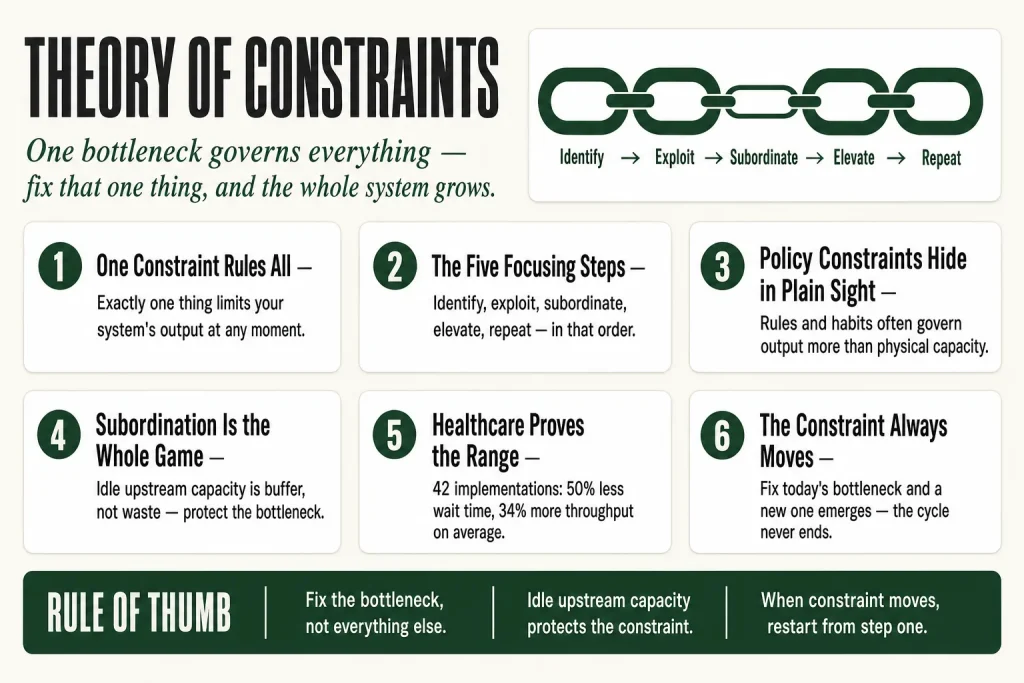
The theory of constraints is a management philosophy built on a single, uncomfortable observation: at any given moment, exactly one thing is limiting your entire system’s output. Not five things. One. Fix that one thing and the system grows. Fix anything else and you’ve busied yourself without moving the number that actually matters. By the end of this page you’ll be able to identify the one constraint currently governing your business, apply the five steps to break it, and stop spending budget on parts of your operation that aren’t the bottleneck.
That sounds obvious when you write it out. It turns out to be very hard to actually do. Most operators spread improvement efforts across every department simultaneously because every department has a manager with a problem list. The theory of constraints says that approach is not just inefficient, it’s actively misleading. You feel productive. You are not moving the system.
Eliyahu Goldratt introduced this idea in The Goal: A Process of Ongoing Improvement, co-authored with Jeff Cox and first published in 1984 by North River Press. The book has gone through multiple revised editions, most recently the 30th Anniversary Edition in 2014. North River Press’s own 30th Anniversary announcement reported more than six million copies sold in more than 27 languages as of 2014; later publisher and distributor listings report more than seven million copies, with translation counts ranging from 32 to 35 languages depending on edition and date. Time magazine named it one of the 25 Most Influential Business Management Books. The reason it has lasted is that the core idea is correct, uncomfortable, and applicable to any system with linked steps and a goal, whether that system is a factory floor, a marketing funnel, or a three-person professional services firm.
The idea in 30 seconds
- Every business system is governed by one primary constraint. Improving anything other than that constraint does not improve the system’s output.
- The five steps are: identify the constraint, exploit it to its current capacity, subordinate everything else to it, elevate it if needed, then repeat when the constraint moves.
- Constraints are not always physical. Policy constraints (rules and habits inside your business) are often the real bottleneck and the hardest to see.
- Optimizing non-constraints wastes money and time. A faster sales process does not help if fulfillment is what breaks under load.
- The constraint moves once you fix it. What chokes you today will not choke you in six months, so the loop never really ends.
- For most small operators, the constraint lives in one of three places: lead generation, conversion, or delivery capacity.
Where the Theory of Constraints Came From
Eliyahu M. Goldratt was an Israeli physicist who earned a doctorate from Bar-Ilan University before moving into industrial management. In the mid-1970s he began consulting for Israeli manufacturers, developing scheduling algorithms that became the basis for Optimized Production Technology (OPT). In 1979, a U.S. subsidiary, Creative Output Inc., was established to sell OPT software to American manufacturers. A 1986 Inc. magazine profile of Goldratt (“One of a Kind,” Inc., July 1, 1986) reported Creative Output revenues of around $10 million and OPT installations in more than 20 Fortune 500 companies as of 1983.
The software helped, but Goldratt kept hitting the same wall after every implementation: the habits and assumptions employees had built before the software arrived were still running the show after it was installed. His answer was to write a novel. The Goal, co-authored with Jeff Cox and published by North River Press in 1984, attacks cost accounting and the local-efficiency metric it produces. The plant where every machine is measured on its own utilization, so keeping everybody busy is rewarded even when the output is inventory nobody ordered. Jeff Cox’s contribution as a novelist is the reason that argument arrives as fiction rather than a textbook, and that turned out to matter: the story format lets the logic build in a way a bullet-point framework cannot.
Goldratt extended the framework to project management in Critical Chain, published by North River Press in 1997, which introduced Critical Chain Project Management (CCPM). From there the ideas spread into software development, healthcare, construction, and retail. The underlying diagnosis, that organizations optimize individual departments rather than the full workflow, applied everywhere.
The Problem: Everyone Optimizes the Wrong Thing
Before Goldratt named the bottleneck as the governing constraint, the dominant management instinct was to improve everything. Give every department a productivity target, run improvement projects in parallel, reward local efficiency. The theory of constraints said that instinct was precisely backwards.
The core claim is this: every process has a single constraint, and total throughput can only be improved by improving that constraint. Improving a non-constraint step, no matter how thoroughly, does not move the system’s output. You can run a faster sales process and generate more proposals than your closer can handle. You can run more ad spend and generate more leads than your onboarding can absorb. In both cases, the system is not growing. It is just piling up work in a different place.
The analogy Goldratt used, and it is the right one, is a chain. The strength of any chain is set by its weakest link. You can polish every other link until it gleams. The chain still breaks at the same place. Adding capacity before the bottleneck creates a pile of work that sits waiting. Adding capacity after it creates idle resources with nothing to process. Neither move helps.
For a small business operator, this lands hard. You have limited capital, limited staff, and limited hours. The temptation is to work on everything. The theory of constraints says that working on everything is the surest way to feel busy while standing still.
One category deserves special mention because it is almost invisible: the policy constraint. This is not a machine running at 95% utilization or a person with too many tasks. It’s a rule or habit embedded so deeply in how the business operates that nobody thinks to question it. “We require founder sign-off on all proposals.” “We batch invoices at month-end.” “We don’t do initial demos over video.” These are choices, not laws. And they can govern the whole system just as surely as any physical bottleneck. A mid-sized accountancy firm, for example, might find that only the senior partner can sign off on tax returns. Delegating preliminary reviews to managers could clear the backlog and allow the firm to bill significantly more clients each month, with the partner retaining final sign-off. The policy changes; the constraint moves. That kind of fix costs nothing and shows up nowhere in a capacity report.
How the Theory of Constraints Actually Works: The Five Focusing Steps
Goldratt gave the methodology a repeating five-step structure. The Five Focusing Steps are the practical, repeatable method to locate the constraint, get more from it, align everything else to it, expand it when needed, and then repeat as the constraint moves. Here is how each step works in practice, with the honest operator version of what each one requires.
Step 1: Identify the Constraint
The first step is to find the part of the system that is limiting total output. That sounds obvious, and it is less obvious than it sounds. Constraints are not always where the most complaints are. They are where work actually stalls or accumulates.
For most small businesses, the signal is simple: look for where work piles up. In a service business, it might be where clients wait the longest. In a funnel, it is the stage with the worst conversion rate relative to demand. In a knowledge business, “inventory” is unprocessed work: unreviewed drafts, unbooked leads sitting in a spreadsheet nobody touches.
In production settings, constraints are generally classified into four types: physical, policy, paradigm, and market. Physical is a tangible capacity limit: a machine, a person with a specific skill, floor space. Policy is a rule or procedure that slows flow, sometimes one that made sense when the business was smaller. Paradigm is a belief (“we have always done the proposal this way”) that prevents people from seeing the problem. Market is when your capacity genuinely exceeds what demand requires, meaning growth is limited by pipeline, not by delivery.
Most operators who believe they have a market constraint actually have a policy constraint that is capping pipeline. Spend an honest hour on this before concluding that the market is the problem.
Step 2: Exploit the Constraint
Once you’ve found the constraint, maximize what you already have before spending anything new. Exploit means getting every bit of productive output from the bottleneck at its current capacity.
If the constraint is your one closer on the sales team, exploit means protecting every minute of that person’s time for closing activity. No admin. No unanswered support tickets. No internal meetings scheduled at 2 p.m. on a Tuesday when demo calls should be running. If the constraint is your onboarding process, exploit means removing every manual step that a template or an automation could handle, so the human attention in that process is used only where a human is genuinely required.
Step 3: Subordinate Everything Else
This is the step most operators skip, and skipping it is why the improvement stalls. Subordinate means adjusting the rest of the system to support the constraint, even if that leaves other parts deliberately idle.
Idle capacity upstream of the constraint is not waste. It is buffer. It ensures the constraint never runs dry. If your constraint is delivery, then sales should not outrun what delivery can absorb. If your constraint is a single subject-matter expert who must review every proposal, then business development should pace itself to that person’s review queue, not race ahead and create a four-week backlog.
This step requires telling parts of the business to slow down, which is politically uncomfortable. Managers upstream of the constraint have their own utilization metrics. This is exactly the policy constraint Goldratt was diagnosing in The Goal: a policy of keeping every station busy, usually for what seem like perfectly good reasons, can itself become a major bottleneck by flooding work into a system that cannot absorb it.
Step 4: Elevate the Constraint
If the constraint is still limiting the system after exploitation and subordination, invest to increase its capacity. This is where you hire, buy equipment, add a system, or renegotiate a supplier arrangement. Elevation is the step that costs money, which is why you do it last. By the time you get here, you have already gotten more from what you have, and you know you are investing in the actual bottleneck rather than a department that lobbied well.
Step 5: Repeat
Once the constraint moves, go back to step one. The bottleneck will shift. When the delivery constraint is elevated, the bottleneck might become proposal quality. When proposal quality improves, it might become lead volume. The system grows unevenly, and the governing constraint is always somewhere specific. The job is to keep finding it. This is what Goldratt meant by “a process of ongoing improvement” in the subtitle: not a one-time project, but a management discipline.
The Three Constraints That Show Up Most for Small Operators
The four academic categories (physical, policy, paradigm, market) are useful for classification. In practice, most small business operators encounter three common flavors. Recognizing your flavor quickly is the whole game.
The Founder Bottleneck
This is the most common constraint in a professional services business, a boutique agency, a medical practice, or any expert-led firm. Every output of consequence requires the founder’s review, approval, or direct involvement. Revenue is capped not by demand but by the number of hours the founder can work. Adding staff does not help much because the staff feeds work into the founder’s queue rather than releasing throughput.
Exploiting this constraint means documentation, checklists, and defined quality standards that let other people self-review. Subordinating means the team does not create more work than the founder can process. Elevating means training a second person to take final accountability on a category of decisions, which feels risky until the alternative (staying capped indefinitely) is priced honestly.
The Conversion Constraint
The business has leads. The leads do not convert at a rate that justifies the acquisition spend. More advertising produces more unconverted leads and a worse cost-per-acquisition. Operators in this situation often respond by spending more on top-of-funnel activity, which is exactly the wrong move. The constraint is not lead volume; it is what happens to the leads after they arrive.
Exploiting this constraint starts by looking at the conversion step closely: where do leads drop? What objections recur? What does the follow-up sequence look like? Subordinating means slowing or pausing acquisition spend until the conversion process is repaired. Elevating might mean a dedicated salesperson, a better onboarding sequence, or a guarantee that removes the friction buyers are stalling on.
The Delivery Constraint
The business can sell. It cannot fulfill what it sells at the rate sales demands. This produces the worst operational failure mode: overselling into a delivery backlog, which produces unhappy customers, churn, and a reputation problem that persists long after the backlog is cleared.
An internal capacity constraint is when the current ability to deliver is less than market demand. In a service business, the signals are missed deadlines, scope creep complaints, and a support queue that never clears. Subordinating here means sales must be throttled to match delivery capacity, which is a difficult conversation to have with a salesperson on commission. But the alternative is a customer experience that undermines the very referrals and retention the business depends on.
Putting this to work? The ideas in the Canon are the foundation under the tactical playbook in Build a Complete Marketing Department. Grab the free companion kit at mmsvegas.com/resources.
Where It’s Actually Being Applied Right Now
The theory of constraints started on the factory floor and has moved well beyond it. A few concrete examples are worth knowing, not because they map perfectly to your business, but because they show the range, and because some of these are recent enough to put the “this is a 1984 manufacturing idea” objection to rest for good.
Healthcare: The Service-Delivery Proof Point
The most rigorous modern evidence base for TOC is in healthcare, which is ironic given that Goldratt wrote The Goal in a factory. Bacelar-Silva, Cox, and Rodrigues published a systematic review in Health Systems (Vol. 11, No. 1, 2022) covering 42 TOC implementations across healthcare settings. The two most commonly reported improvements were productivity (more patients treated, in 98% of the implementations reviewed) and timeliness of care (in 83% of those reviewed). Across those implementations, mean patient waiting time fell by 50% on average, and mean throughput rose by 34%.
The same researchers followed that review with an action-research case published in Health Systems (Vol. 13, No. 1, 2024) documenting how a single physician applied the five focusing steps to his ophthalmology imaging practice. The constraint was the imaging station itself. After identifying and exploiting it through scheduling changes and buffer management, patient throughput rose 64% in a matter of weeks, with no capital expenditure. The constraint that moved next was pharmacy waste from pre-prepared drugs, which is a clean illustration of why step five (repeat) is not optional.
That healthcare story is the best rebuttal to the claim that this is only a manufacturing idea. There is no factory floor in an ophthalmology practice. The logic translates because the logic is about systems, not about equipment.
SaaS: The Onboarding Bottleneck
For SaaS operators, the delivery constraint most likely to be invisible is time-to-value (TTV): the elapsed time between signup and the moment a user actually experiences what they paid for. Userpilot’s 2024 User Activation Rate Benchmark, based on 62 B2B SaaS companies, put the average activation rate at 37.5%. Roughly two in three signups never reach the core value the product was built to deliver. That gap is a delivery constraint, not an acquisition problem, and pouring ad budget into a leaking funnel will not close it.
The constraint framing makes the fix obvious: identify where in the onboarding sequence users stall, exploit the step by removing every manual or redundant action between signup and first value, subordinate everything else (including new feature development) to clearing that step, and elevate only if structural bottlenecks remain after the process is clean. The product does not need to be rebuilt; the flow into value needs to be unblocked.
A SaaS business spending heavily on paid acquisition while its onboarding takes eleven days to deliver a first outcome has a delivery constraint, not an acquisition problem. The same budget redirected toward shortening time-to-value would compound on itself, because every dollar of acquisition would suddenly work harder.
Manufacturing: Still Where the Evidence Is Densest
Pegels and Watrous published a case study in the Journal of Manufacturing Technology Management (Vol. 16, No. 3, 2005) of TOC applied to a heavy-duty truck-lighting plant where mold-changing operations were the identified bottleneck. Four separate solutions were combined to eliminate that constraint, producing measurably higher throughput and plant efficiency. The paper is a useful illustration of what “exploit then elevate” looks like when the constraint is physical and the resolution requires coordinated, not single-shot, intervention.
Project Management: CCPM and the Buffer Problem
Goldratt’s Critical Chain (North River Press, 1997) reframed the project bottleneck not as the longest sequence of tasks but as the critical chain of constrained resources. Traditional project scheduling protects each task with its own safety buffer; those buffers tend to evaporate through Parkinson’s Law (work expands to fill available time) and student syndrome (people start late because the buffer made it feel safe to). CCPM pools safety time into shared buffers at the end of chains, which makes the constraint visible and protects the delivery date without rewarding padding. For any operator running campaigns, product launches, or client engagements on a deadline, this is the most directly applicable extension of the framework.
Small Service Businesses: The Pattern That Repeats
For small businesses, the constraint is almost never a machine. The pattern that repeats across service industries is a person, a policy, or a handoff. A law firm where only the named partner can sign letters. A marketing agency where the creative director reviews every piece of copy before it ships. A software consultancy where the founder must approve every SOW. The physical capacity is fine; the policy constraint is the bottleneck. Recognizing which one it is, and subordinating everything else to it, is where the leverage lives, and where the money is not being spent.
Theory of Constraints as a Strategy and Resource-Allocation Tool
The five steps are often taught as an operations method. The more useful framing for an operator is to treat the theory of constraints as a resource-allocation rule: direct your next dollar and your next hour toward the one place where they will move the whole system, and withhold them from everywhere else.
This has direct implications for how you build a marketing budget, a team, and a technology stack. Most operators budget by department or by channel, allocating a percentage to each bucket and reviewing performance in isolation. The theory of constraints suggests a different question: which stage of the customer journey is currently governing my growth, and am I over-funding upstream stages at the expense of that one?
The same logic applies to hiring decisions. The first hire in a founder-constrained business should almost always be someone who absorbs work from the constraint, not someone who generates more of it. An additional account executive feeding more leads into a founder who is already the bottleneck on proposals is not growth; it is pressure on a pipe that is already clogged.
Rather than spreading improvements across every department, this framework focuses attention on identifying and exploiting the one constraint that is actually limiting output. As a strategy principle, that means your annual plan should have a primary theme: this is the year we fix delivery capacity, or this is the year we fix conversion, or this is the year we fix lead volume. Not all three simultaneously. When you try to fix all three simultaneously, you diffuse your attention, dilute your budget, and end up with modest improvement everywhere and transformation nowhere.
One practical diagnostic: take your marketing funnel and write down the conversion rate at each stage. The stage with the worst rate, adjusted for the volume that should be passing through it, is a strong candidate for your current constraint. That is not always the answer, but it is almost always a better starting point than a hunch or a department manager’s most recent complaint.
Where the Theory of Constraints Works Well
The theory of constraints is most valuable when the system has clear, sequential steps, where output at one stage feeds directly into the next. That describes most sales and marketing funnels, most service delivery processes, and most content production operations. Any place where you can draw an honest flowchart of how work or prospects move, the bottleneck concept is immediately applicable.
It works particularly well when you are growing and trying to decide where to invest. When resources are tight and you cannot improve everything, the constraint framework forces the conversation: if we had one thing to fix, what would have the highest leverage? That is a better question than the typical “what’s your top priority?” asked of every department head, which reliably produces a list of five equally urgent items with no way to compare them.
It also works well when you are stuck. Revenue has plateaued. You are doing more of what worked before and getting less result. The constraint has probably moved, and you have not noticed. Running the five-step diagnostic from scratch is usually more productive than brainstorming new tactics. Most plateaus are not caused by doing the wrong things; they are caused by continuing to optimize a non-constraint while the real bottleneck goes unaddressed.
In B2B businesses with longer sales cycles, the theory of constraints is useful for evaluating where sales velocity is actually lost. The constraint in a complex sale is often not pipeline volume; it is the handoff between stages, the step where deals sit longest. Identifying that step and subordinating everything else to accelerating it can compress cycle time significantly without adding headcount.
Where the Theory of Constraints Has Real Limits
The theory of constraints assumes the system has a clear goal and that throughput toward that goal can be measured. When either assumption breaks down, the framework becomes harder to apply cleanly.
Early-stage businesses, especially pre-product-market fit, often do not yet know what the system is trying to optimize. The goal is still being discovered. Treating discovery as an operations problem with a bottleneck to eliminate can make you efficient at running in the wrong direction. In that phase, the priority is learning, not throughput, and optimizing throughput too early can mask the signals you need to hear.
The theory also runs into trouble when the business has genuine complexity across multiple, relatively independent revenue streams that do not share a single constraint. A media company selling advertising, subscriptions, and events simultaneously may have different bottlenecks in each business line, and optimizing them together is genuinely difficult. The framework still applies within each line, but it does not give you a clean single answer for the whole business.
Finally, some genuine market constraints get misdiagnosed as operational bottlenecks, and operators spend years fixing internal processes for a demand level that simply does not exist at current positioning or price. The theory of constraints will not tell you whether you have the right offer for the right market. For that, you need positioning work first.
What People Get Wrong About the Theory of Constraints
Misunderstanding 1: The constraint is always operational. In most small businesses, the constraint is upstream of operations entirely. It is the market constraint (not enough of the right buyers), the messaging constraint (the right buyers exist but are not self-identifying as having the problem you solve), or the positioning constraint (the offer is not differentiated enough to win against an established alternative). These do not show up as production backlogs. They show up as flat or declining pipeline.
Misunderstanding 2: Fixing the bottleneck is the goal. Fixing the current bottleneck just moves it. The theory of constraints is not a one-time fix; it is an ongoing cycle that constantly seeks out and addresses the current constraint. Operators who treat it as a one-time diagnostic miss the point. “A process of ongoing improvement” is Goldratt’s own subtitle, and it is descriptive, not decorative.
Misunderstanding 3: Every inefficiency is a constraint. Most inefficiencies are not constraints; they are just inefficiencies. Improving a non-bottleneck step does not improve total output. The thing that irritates you most is not necessarily the thing limiting output. The constraint is whatever is actually limiting throughput, regardless of how annoying or how visible everything else is.
Misunderstanding 4: Idle resources before the constraint are a problem. Idle capacity upstream of the bottleneck is protective buffer, not waste. A machine or a person running at 70% capacity before the constraint is doing exactly what the system needs: ensuring the bottleneck never starves. Measuring upstream resources on utilization and rewarding them for running at 100% is the policy constraint Goldratt was diagnosing in The Goal. It produces overproduction and a pile of work-in-progress that masks the real bottleneck.
Misunderstanding 5: The theory only applies to manufacturing. Goldratt’s framework began on the factory floor but spread widely. It applies anywhere you have sequential steps with a shared goal: a marketing funnel, a content operation, a client onboarding sequence, a product development process, a hiring pipeline. The healthcare results above, a 50% average reduction in patient waiting time across 42 implementations reviewed by Bacelar-Silva, Cox, and Rodrigues in Health Systems (2022), are the clearest proof of that range.
Common Mistakes
- Diagnosing the constraint without data. Before naming your constraint, write the volume and conversion rate at every stage from first contact to retained revenue. The stage where the ratio breaks is your starting hypothesis. Test it by asking: if this stage converted 20% better, would total output meaningfully change? If not, keep looking.
- Skipping subordination and going straight to elevation. Before any elevation spend, hold a single meeting with the managers of every upstream stage and explicitly set a throughput ceiling tied to the bottleneck’s current capacity. Yes, that conversation is uncomfortable. It is also the only thing that makes the money you’re about to spend on elevation actually stick.
- Treating the identified constraint as permanent. Schedule a constraint audit every 90 days, or immediately after any major capacity change. Put it on the calendar the same day you close the current improvement cycle. The question is always the same: where does work actually stall right now?
- Applying the framework before establishing product-market fit. If your funnel is thin because demand is thin, stop. Do the positioning work first. The test is simple: if you doubled conversion rate at every stage, would you actually have a healthy business? If the answer is no, the constraint is the offer, not the process, and TOC cannot fix that.
- Conflating policy constraints with operational ones and missing both. Before looking for physical bottlenecks, ask your team one question: “Which internal rule most frequently delays a decision or a handoff?” Write down every answer. The most common answer is often the actual constraint, and a policy change costs less than anything else on this list.
Operator’s Take
Here’s the thing about the five-step structure: people hear “identify, exploit, subordinate, elevate, repeat” and walk away thinking that subordination is step three, something you get to after the exciting diagnostic work. In practice, subordination is the whole game. Identification tells you where to look. Exploitation squeezes what you have. But if you haven’t subordinated, you haven’t actually changed the system, you’ve just patched a leak while the upstream flood continues.
Every time I’ve watched a well-intentioned TOC improvement fall flat, it’s because subordination was treated as a memo rather than an organizational redesign. You have to tell people with their own utilization metrics and their own bonus structures to deliberately run slower. That’s a management problem, not a methodology problem. The five steps don’t solve it for you. They just show you where to aim.
Policy constraints deserve more attention than most TOC implementations give them. Physical constraints are satisfying to fix: buy the machine, hire the person, watch throughput rise. Policy constraints are harder because the policy is invisible. Nobody walks into a Monday meeting and says “our biggest bottleneck is the rule that only I can approve proposals.” They walk in and say “we’re overwhelmed” or “the team is struggling to keep up.” The words point at symptoms. The actual constraint is a decision that was made, possibly years ago, for a business that no longer exists at its current scale. Pull on those rules before you pull out a credit card. A well-placed policy change, something that costs nothing, can free more capacity than a new hire.
My actual take, which you won’t hear in most business school treatments: the theory of constraints is most powerful as a budget discipline, not as an operations methodology. When you have to allocate finite capital across a business with multiple competing needs, the constraint framework forces a question that budgeting by department never asks: which single investment would move total output the most? Department heads don’t answer that question honestly, because every department head believes their department is the constraint. The five-step process gives you a structured way to check that belief against data rather than seniority or persuasion. Run the diagnostic, find the stage where work actually stalls, and then cut the conversation short with a fact.
One thing the framework will not do, and this is worth being direct about: it will not tell you if your offer is wrong. If demand simply doesn’t exist at your current positioning and price, the “constraint” looks like a market constraint, you’ll shrug, and you’ll go optimize something internal. I’ve seen operators spend a year tightening their onboarding process for a product that didn’t have enough pull to generate a real bottleneck anywhere. The system was fine. The market was indifferent. TOC is a tool for growing a system that already works; it is not a substitute for figuring out whether the system is worth growing.
This framework pairs naturally with sensitivity analysis. Once you’ve identified what you believe is the constraint, run a quick check: if this step improved by 20%, what would happen to total output? If the answer is “not much,” it probably isn’t the constraint. If the answer is “our capacity would double,” you’ve found your leverage point. Ten minutes. Has saved me from more than one expensive wrong guess.
Most operators already know where their constraint is. They know which step is breaking, which meeting always runs long because the same person is always the blocker, which stage of the funnel they avoid putting on a slide. The value of the five-step framework isn’t revelation, it’s permission. It gives you the language to say “we are going to stop improving everything and fix this one thing,” and it gives the people around you a reason to believe that’s a strategy rather than an excuse to ignore their priorities.
Used in
- ✓ Build a Complete Marketing Department
Used to decide where marketing investment should concentrate at each stage of business growth, directing budget toward the one funnel stage limiting total revenue rather than spreading it across all channels equally. - ✓ The Missing Manual for FunnelKit
Applied to funnel diagnostics: identifying which step in the automation sequence has the worst conversion rate and subordinating all other optimizations to fixing that single stage first. - ✓ The Missing Manual for Make
Used when scoping automation builds, ensuring new workflows are directed at the process bottleneck rather than automating non-constraints that will not improve overall throughput.
FAQ
What is the theory of constraints in simple terms?
Your business system is only as strong as its weakest link. At any given moment, one step is limiting everything that follows it. Improve that one step and the whole system improves. Improve anything else and you’re just busy.
What are the five focusing steps?
Identify the constraint, exploit it to its current maximum capacity, subordinate everything else in the system to support it, elevate it if it’s still the bottleneck after exploitation, then repeat the process once the constraint shifts.
How do I find the constraint in my business?
Map every step from first customer contact to retained revenue and find where conversion is worst or where work accumulates. That is almost always the constraint. If nothing accumulates visibly, look for the policy or rule that most frequently delays decisions.
Can a small business apply the theory of constraints without a formal process?
Yes. The core question is simple: what single improvement would have the biggest effect on our total output right now? Ask that honestly, check it against your data, and focus your next 90 days there. The formal five steps are a useful structure but the underlying discipline is just focus.
What is a policy constraint?
A policy constraint is a rule, procedure, or habit inside the business that limits throughput, such as requiring founder approval on every proposal or batching invoices monthly. Policy constraints are more common than physical ones in small businesses and harder to see because the policy is treated as a given rather than a choice.
How is the theory of constraints different from general process improvement?
General process improvement tries to make every step better. The theory of constraints says improving non-bottleneck steps does not improve total output and is therefore a lower priority than fixing the one step that governs everything. It is a narrower, more aggressive resource-allocation rule.
Further reading
- The Goal: A Process of Ongoing Improvement by Eliyahu M. Goldratt and Jeff Cox (North River Press, 1984). The original source. Read it for the logic, not just the story; the Socratic method Goldratt uses is deliberate and the reasoning builds in a way a summary cannot replicate.
- Critical Chain by Eliyahu M. Goldratt (North River Press, 1997). Applies the constraint framework to project management via Critical Chain Project Management (CCPM), directly relevant to any operator running campaigns, product launches, or client engagements on a timeline.
- Bacelar-Silva, G.M., Cox, J.F., and Rodrigues, P.P. (2022). “Outcomes of managing healthcare services using the Theory of Constraints: A systematic review.” Health Systems, 11(1), 1-16. The most rigorous recent evidence base for TOC outside manufacturing. Useful if you want peer-reviewed documentation of what the framework actually produces in service settings.
Sources:
Publication history of The Goal (North River Press, 1984): Sales and translation figures are drawn from multiple sources that report different totals depending on edition and date. North River Press’s own 30th Anniversary Edition announcement (northriverpress.com/30th-anniversary-edition-of-the-goal-published/, accessed October 2026) reported more than six million copies sold in more than 27 languages as of 2014. Subsequent publisher and distributor listings, including the Routledge graphic-novel edition page and Amazon product descriptions for later printings, report more than seven million copies sold, with translation counts ranging from 32 to 35 languages depending on source. The Time magazine list citation is corroborated by the Goldratt Marketing Group’s own product page (toc-goldratt.com, accessed October 2026). All figures are presented with that sourcing variance stated in context; no single figure is represented as authoritative across all editions.
Goldratt’s biography: His physics doctorate from Bar-Ilan University, his development of OPT scheduling software in the mid-1970s, and the founding of Creative Output Inc. in 1979 are documented at the Theory of Constraints Institute (tocinstitute.org/eliyahu-goldratt.html, accessed October 2026) and corroborated by a 1986 Inc. magazine profile (“One of a Kind,” Inc., July 1, 1986), which reported Creative Output revenues of around $10 million and OPT installations in more than 20 Fortune 500 companies as of 1983. The Wikipedia entry for Eliyahu M. Goldratt (accessed October 2026) is used only for corroborating biographical details, not as a primary citation for any specific claim.
Critical Chain (North River Press, 1997) as the origin of Critical Chain Project Management (CCPM): Confirmed by the Wikipedia article on Critical Chain Project Management (accessed October 2026), which states CCPM was introduced in Goldratt’s 1997 book.
Healthcare systematic review: Bacelar-Silva, G.M., Cox, J.F., and Rodrigues, P.P. (2022). “Outcomes of managing healthcare services using the Theory of Constraints: A systematic review.” Health Systems, 11(1), 1-16. doi:10.1080/20476965.2020.1813056. The figures cited (98% of implementations reporting productivity improvement, 83% reporting timeliness improvement, 50% mean reduction in patient waiting time, 34% mean increase in throughput) are drawn directly from the abstract and results of this paper. The ophthalmology action research is: Bacelar-Silva, G.M., Cox, J.F., and Rodrigues, P.P. (2024). “Achieving rapid and significant results in healthcare services by using the theory of constraints.” Health Systems, 13(1), 48-61. doi:10.1080/20476965.2022.2115408. The 64% throughput increase figure is drawn from Table 1 of that paper (14 patients before TOC, 23 patients after TOC, a difference of 9, representing a 64% increase in total patients seen per session).
Manufacturing case study: Pegels, C.C. and Watrous, C. (2005). “Application of the theory of constraints to a bottleneck operation in a manufacturing plant.” Journal of Manufacturing Technology Management, Vol. 16, No. 3, pp. 302-311.
SaaS activation benchmark: Userpilot 2024 User Activation Rate Benchmark, based on 62 B2B SaaS companies, reported an average activation rate of 37.5% and a median of 37%. This figure is cited by multiple secondary sources (adoptionsignals.com, albato.com) consistently attributing it to this report and sample. The figure is used in this article as an illustration of the delivery-constraint pattern in SaaS, not as a universal market statistic.
The five focusing steps documentation and constraint typology (physical, policy, paradigm, market) are drawn from the Theory of Constraints Institute (tocinstitute.org, accessed October 2026). The accountancy firm policy-constraint illustration is a generalized constructed example consistent with the policy-constraint concept as documented in the TOC literature; it is not attributed to a named firm or study. All operator-facing applications, diagnostic procedures, and editorial judgments are original to The Operator’s Canon.
Brian Kasday spent forty years in direct-response marketing before rebuilding the whole operation as a one-person shop. He writes The Operator’s Library — including “Build a Complete Marketing Department” — for operators who’d rather build it themselves than wait on someone else.
Build the department these ideas describe. The free companion kit: mmsvegas.com/resources.
More The Operator's Canon guides
Free · Operator Toolkit
Want the tools, not just the guide?
Get the free operator toolkit — templates and checklists for the systems you actually run, plus a note when this guide changes.
Get the free toolkit →