
Last updated: July 2026
The rule of seven marketing principle says that a prospect needs to encounter your brand roughly seven times before they’ll take action. By the end of this page, you’ll be able to diagnose why your marketing isn’t converting, and design a frequency strategy that builds the familiarity needed to actually close.
Here’s what most operators get wrong: they launch a campaign, run it twice, see no immediate sales, and conclude the channel doesn’t work. Then they move on to the next tactic. The rule of seven is the oldest available rebuttal to that impulse. It says the problem almost certainly wasn’t the channel, it was that you quit before the prospect had seen you enough times to trust you.
Now, the number seven is not precise. It never was. The research behind it is loose, its origin story is part folklore, and the real threshold shifts depending on your category, your audience’s buying cycle, and how much noise they’re filtering out that day. What the rule does get exactly right is the direction: buyers need repeated exposure, and most small-business marketing isn’t planned with that in mind. If you take nothing else from this page, take that.
The idea in 30 seconds
- The rule of seven marketing principle holds that a prospect needs multiple exposures to your brand before they’ll take action, the original number was seven, but it was always a guideline, not a law.
- The psychology behind it is the mere exposure effect: familiarity builds preference, even below conscious awareness.
- In a world of thousands of daily ad impressions, seven is almost certainly too low, plan for more, and plan across multiple channels.
- The mistake operators make isn’t ignoring the rule; it’s running one-touch campaigns and wondering why nothing converts.
- Frequency without consistency is noise. Same message, multiple channels, over a meaningful time window, that’s the system.
- AI tools can help you build and schedule multi-touch sequences, but the message, the offer, and the judgment about when to ask for the sale stay with you.
Where the Rule of Seven Came From (and Why the Number Is Fuzzy)
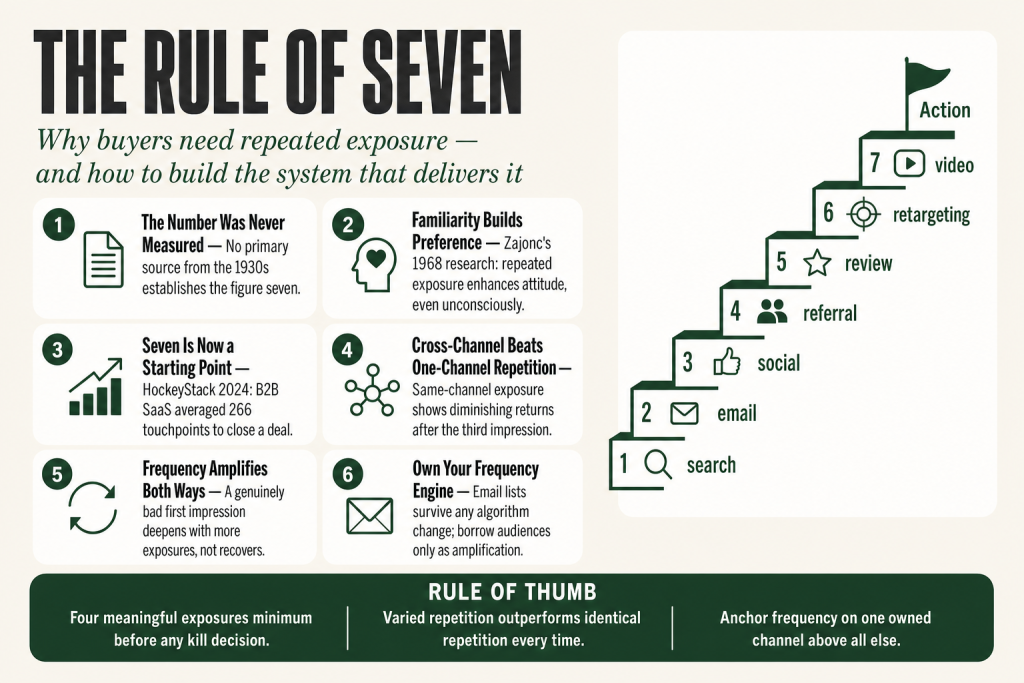
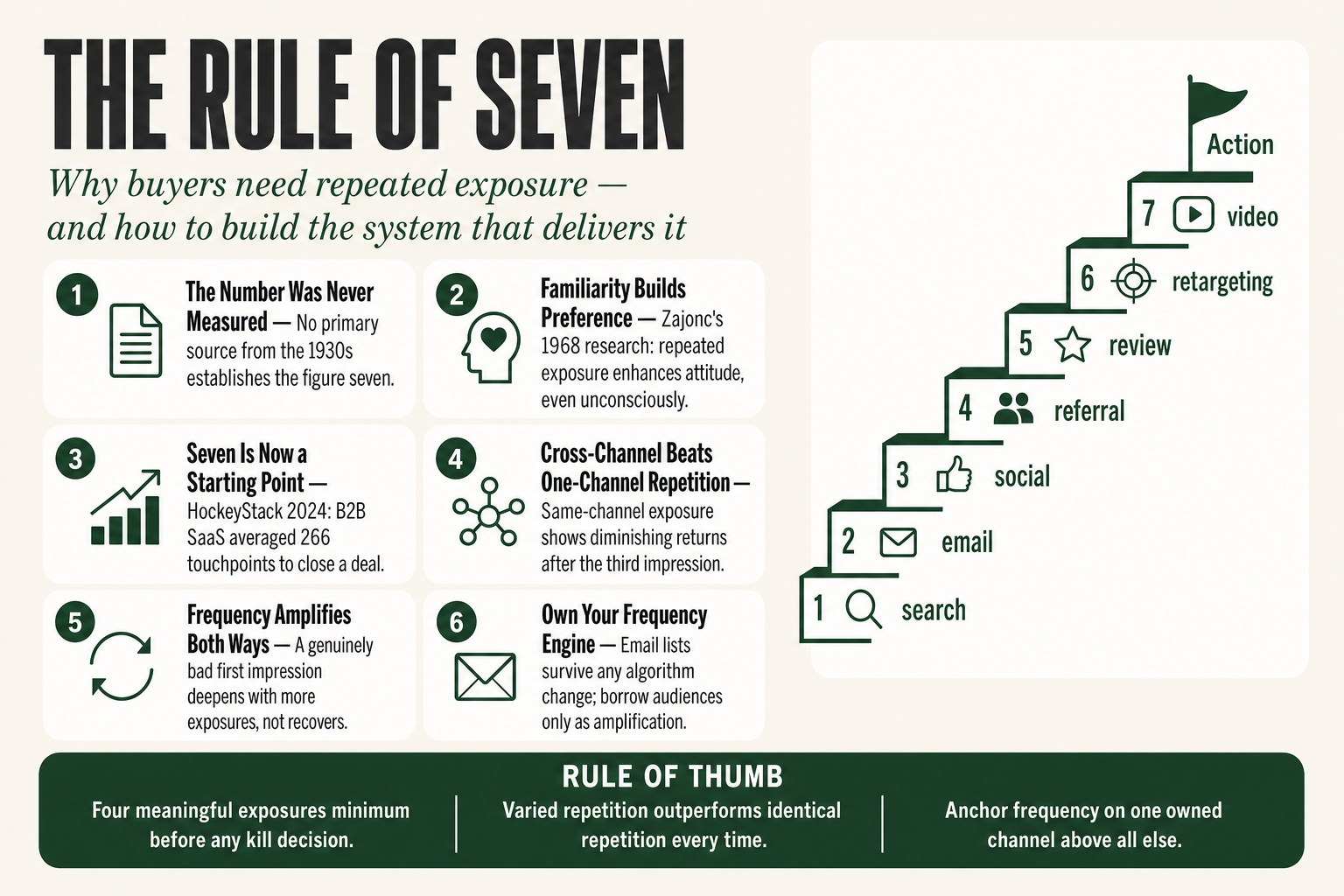
The origin story most often repeated is that Hollywood studios discovered audiences needed to see a film’s promotional material roughly seven times before buying a ticket. That story has traveled widely. The problem is there’s no primary source behind it, no studio memo, no agency research report, no trade journal from that era establishes the number. An Artful Science reviewed the historical record and put it plainly: the number was never measured. What circulated was assertion from people with advertising to sell or advice about it.
The practitioner most often credited with codifying the modern form is Jeffrey Lant, a marketing consultant who fixed it at seven exposures within an eighteen-month window for B2B contexts in his 1989 book Cash Copy. Thomas Smith’s Successful Advertising (1885) had argued audiences needed as many as twenty exposures before acting. Claude Hopkins made the case for repetition throughout Scientific Advertising (1923) but named no specific threshold. The number drifted, twenty, then seven, then three, and was never stable or empirical at any point.
What gave the rule staying power wasn’t the number, it was the media environment of the mid-twentieth century. Three TV networks. One daily newspaper. In that world, reaching a prospect seven times across those few channels was both hard to achieve and meaningful when you did. The repetition landed because there wasn’t much else competing for attention. The idea it points at, that buyers need repeated exposure before they act, is well-supported by psychology. The specific digit is not, and you shouldn’t lose sleep over it.
The Psychology Underneath: Why Repetition Actually Works
Strip the folklore away and there’s real psychology left. Two research threads matter here.
The first is the mere exposure effectidentified by social psychologist Robert Zajonc in 1968. His central finding: repeated, unreinforced exposure to a stimulus is sufficient to enhance your attitude toward it. You don’t have to consciously notice what you’re seeing. Familiarity itself generates preference, which is why people sometimes reach for a brand they can’t quite recall choosing. Zajonc found that the relationship between exposure and liking follows a positive, decelerating curve: the first few encounters do the heaviest lifting, and each additional exposure adds less than the last. By the time Robert Bornstein’s 1989 meta-analysis arrived, the mere exposure effect had been replicated across more than two hundred experiments.
The second thread is Herbert Krugman’s three-exposure theorydeveloped in the 1970s. Krugman argued that there are only three psychologically meaningful exposure stages: the first triggers a “What is it?” response (curiosity), the second a “What of it?” evaluation (relevance), and the third a reminder that completes the loop. Everything after is reinforcement, not new persuasion. This is why most campaign frequency caps land somewhere between three and seven impressions, practitioners borrowing from Krugman without always knowing it.
These two frameworks together explain what the rule of seven is pointing at. Familiarity builds preference (Zajonc). Enough exposures move a prospect through curiosity to recognition to decision (Krugman). Neither says the magic number is seven. Both confirm that one shot almost never does it.
One practical implication worth carrying: Zajonc’s research also found that mere exposure works best when the initial attitude isn’t strongly negative. If your first impression actively repels someone, more impressions just deepen the repulsion. Frequency amplifies in both directions. A weak first impression can still be recovered. A genuinely bad one probably can’t.
Rule of Seven Marketing in Practice: What ‘Multiple Touchpoints’ Actually Means
Most explanations of the rule stop at ‘reach your prospect seven times.’ That’s not a plan. For an operator, the real question is: seven times how, across what, and in what order?
Touchpoints Are Not Just Ads
A touchpoint is any moment your prospect encounters your brand in a way that registers. A Google search result where your blog post shows up. An email in their inbox. A retargeting ad following them around after they visited your pricing page. A referral from someone they trust. A review they read on Google. A LinkedIn post you published. A postcard that arrived in their mailbox last week. You’re not limited to paid impressions, organic, earned, and referral touches all count.
The practical implication: a small operator who can’t afford to run seven paid ad cycles can still engineer seven meaningful encounters. A prospect who reads your blog, sees your Facebook post, gets your email newsletter, hears about you from a client, googles you and finds your reviews, watches a short video you made, and then sees a retargeting ad, that’s seven. Budget matters less than system.
Cross-Channel Reinforcement Beats Repetition on One Channel
Running the same ad on Facebook seven times to the same person is not the same as showing up across seven different contexts. Research on effective frequency suggests diminishing psychological returns beyond the third same-channel exposure. Cross-channel reinforcement builds a more durable mental imprint because each context triggers a slightly different recognition cue, a paid ad that appears out of nowhere might be ignored, but the same brand appearing in a search result shortly after carries more weight because the prior exposure primed recognition.
The practical sequence for most small operators looks something like this: a prospect finds you through organic search or a referral, visits your site, and leaves without contacting you. A retargeting ad follows them. They open your email if you’ve captured their address. They see a social post. Eventually, they’re ready. That readiness was building through every prior touch, you just weren’t there to see it accumulating.
Timing and Context Matter as Much as Count
For a local service business, the window might be compressed, someone needs a plumber this week, not over six months. Even there, the operator who has shown up in local search, has reviews, and ran a neighborhood mailer is far more likely to get the call than the one who ran a single Facebook ad last Tuesday. The rule doesn’t change. The window does.
Consistency of Message Across Touchpoints
Repetition builds familiarity only if the signal is recognizable. If your email sounds like one brand, your social posts sound like another, and your ads look like a third company made them, each exposure has to do all the recognition work from scratch. Same tone, same visual identity, same core message across every channel, that’s what lets exposures compound instead of starting over.
Putting this to work? The ideas in the Canon are the foundation under the tactical playbook in Build a Complete Marketing Department — grab the free companion kit at mmsvegas.com/resources.
Where the Rule Still Applies, and Where It’s Stronger Than Ever
Some argue the rule of seven is dead in a world of thousands of daily ad impressions. That’s half right. The specific threshold of seven is probably too low for brand-new companies entering crowded categories. But the directive to plan for frequency instead of expecting one touch to convert is more applicable now than it was in 1950.
When there were three TV networks and one newspaper, seven exposures were hard to achieve. That was the standard to aim for. Today, seven exposures can happen in a week through automated sequences and retargeting, which means the bar has shifted. You’re not competing with three channels anymore; you’re competing with thousands of brands all trying to hit the same person at the same frequency. The operators who win are the ones who plan multi-channel exposure systematically, not the ones who hope a single touchpoint breaks through.
And the numbers in B2B have moved far past seven. Forrester’s 2021 B2B Buying Study found that the average number of buying interactions per purchase jumped from 17 in 2019 to 27, driven by more stakeholders and more digital self-research. HockeyStack’s analysis of 150 B2B SaaS companies found an average of 266 touchpoints to close a deal in 2024, up nearly 20% year over year, with deals over $100K averaging more than 400. McKinsey’s 2024 B2B Pulse Survey found that buyers now use an average of 10.2 interaction channels, up from five in 2016. The rule of seven was never a ceiling. In complex B2B, it’s barely a starting point.
The rule applies most directly in these scenarios:
- Long buying cycles. B2B, professional services, high-ticket home services, real estate, anything where a prospect researches for weeks or months. The window is long enough that a deliberate frequency strategy is the only sensible play.
- High-consideration consumer purchases. Vehicles, renovations, elective medical procedures, premium fitness memberships, categories where someone thinks before they act.
- Cold audiences. People who’ve never heard of you need more exposures before trust forms than warm referrals do. The rule applies differently depending on the audience’s starting familiarity.
- Relationship-dependent businesses. Consultants, accountants, attorneys, coaches, categories where the buyer is hiring a person as much as a service. Trust takes time and evidence, and that evidence accumulates through repeated exposure.
Where the Rule Breaks Down
The rule of seven is a useful planning scaffold, not a conversion guarantee. There are real conditions where it fails or misleads.
When the message is weak. Frequency amplifies your message, good or bad. If the core offer is unclear, the value proposition is generic, or the creative is forgettable, more impressions just mean more people have seen something they don’t care about. No quantity of exposures rescues a message that doesn’t connect.
When the prospect isn’t in-market. Krugman’s own framework implies this: unless a consumer is in market for what you’re selling, repetition produces minimal persuasive effect. Hitting someone with HVAC system ads in February when their furnace works fine isn’t building buying temperature, it’s just spending money. The rule of seven implicitly assumes a prospect who has at least latent interest in the category.
When frequency becomes fatigue. Zajonc’s research found that mere exposure typically reaches its maximum effect within ten to twenty presentations, and some studies show liking can actually decline after an extended series of exposures. There’s a ceiling. Running retargeting ads at high frequency past that ceiling doesn’t convert more people, it annoys them. Frequency caps exist for a reason.
When urgency is the actual driver. Someone whose pipe just burst isn’t running a seven-exposure decision process. They’re calling whoever shows up first in Google’s local results and has decent reviews. In high-urgency, low-consideration categories, top-of-mind presence matters more than sequential nurturing. The rule applies to deliberate purchase decisions, not emergency ones.
When the seven exposures are all the same. Identical repetition has diminishing returns faster than varied repetition. If your retargeting campaign serves the exact same static image to the same person for three weeks straight, the seventh exposure has far less value than it would if each touchpoint added something new, a different format, a customer story, a question, a demonstration.
Building a Frequency System That Actually Works for a Small Operator
The rule of seven marketing principle is not a campaign, it’s a design constraint. When you accept that buyers need multiple exposures before acting, it changes how you build your entire marketing stack.
Start by Mapping Your Buyer’s Consideration Window
How long does a typical buyer in your category take from first awareness to first purchase? A week? Three months? A year? That window defines how long your frequency system needs to run. A criminal defense attorney whose clients come in crisis mode has a very different window than a business consultant whose prospects evaluate for six months. Size your system to the window, not to your impatience.
Identify Your Owned Frequency Assets
These are the channels you control and that don’t cost you per-impression: your email list, your social profiles, your blog, your Google Business Profile, your text list if you have one. An email newsletter that goes out every two weeks is a frequency machine, every subscriber gets another exposure automatically. Treat your list as a frequency asset, not just a sales list.
Layer in Paid Amplification Strategically
Retargeting is the most direct paid application of the rule of seven. A prospect who has already visited your site has demonstrated interest, serving them additional exposures through paid retargeting is far more efficient than finding cold strangers. Set frequency caps so you’re not hammering anyone past the point of diminishing returns (three to five impressions per week is a reasonable starting ceiling for most small operators), and rotate creative so each exposure adds something rather than just repeating.
Use Sequence, Not Just Volume
A planned touchpoint sequence beats random frequency. Email marketing automation lets you build a deliberate journey: someone opts in, gets a welcome sequence, receives educational content over the following weeks, is invited to a conversation, and eventually gets an offer. Each step is an exposure with a purpose. Tools like ActiveCampaign, Kit (formerly ConvertKit), or FunnelKit’s automation builder let even a one-person shop run this without manual effort at every step.
AI can meaningfully help here. You can use AI tools to draft the content for each step in the sequence, to analyze which touchpoints in your existing system have the highest engagement, and to suggest timing adjustments. The judgment calls, what the message should actually say, what the offer should be, when to escalate to a direct conversation, stay with you.
Make Every Touch Add Something
Varied repetition outperforms identical repetition. Map out what each touchpoint in your sequence is designed to do. The first might introduce the problem you solve. The second might offer a concrete example of a result. The third might address the most common objection. The fourth might show social proof. By the time someone has seen those four things, they’ve accumulated a case for you, not just a vague recollection of your logo.
Measure Frequency the Right Way
Most small operators measure conversion at the last touch, the ad that ‘closed’ the sale. That’s last-click attribution, and it systematically undercounts the value of every earlier exposure in the sequence. If your email newsletter contributed to the awareness, your blog post answered the question that kept them researching, and the retargeting ad was what they finally clicked, giving all the credit to the ad is like crediting the closer on a relay team and ignoring the first three legs. Multi-touch attribution, even in a simple spreadsheet form, gives you a more honest picture of which channels are building frequency and which are just riding the last mile.
What It Looks Like When It’s Working
The rule plays out everywhere once you start looking for it, though most operators are on the receiving end rather than the building end.
Take a local accounting firm. Monthly email newsletter, consistent LinkedIn presence, the occasional quote in a regional business journal, a steady cadence of client review requests on Google, and a retargeting pixel on their tax planning page. None of that is glamorous. But the CFO who gets a referral call and immediately recognizes the firm’s name? That recognition was built one touchpoint at a time over the prior year. The referral closed because the frequency system had already done its job before anyone picked up the phone.
In B2B SaaS, the pattern scales but the logic is identical. A company running monthly webinars, publishing LinkedIn articles, running targeted display ads, sending a drip email sequence to trial users, and following up with a sales rep call isn’t doing five separate things, they’re running one frequency system across five channels. By the time a rep dials, the prospect already knows the company name, has read at least one piece of content, and has a general sense of the product. That call lands completely differently than a cold one would. The rep isn’t introducing the company, they’re closing a conversation that started weeks ago.
In local home services, the same logic compresses to a shorter window. An HVAC company with yard signs posted in the neighborhoods they serve, a Google Business Profile with fresh reviews, and a seasonal maintenance reminder email to past customers is doing multi-channel frequency on a shoestring. The homeowner whose system fails in August will call whoever comes to mind first. The company that has shown up across three or four channels over the prior year has a structural advantage the competitor who ran one radio ad in June simply doesn’t.
What these examples share: none of them are counting to seven and declaring victory. They’ve built systems that stay present. The frequency accumulates on its own because the system keeps running.
Common Mistakes
- Cutting spend right before frequency kicks in — Before killing a campaign, pull the reach and average frequency-per-person numbers. If the average prospect has seen your ad two or three times and your audience size is reasonable, you haven’t run a fair test. A home-services operator who pulled Facebook ads after three weeks and zero bookings is the textbook version of this, the channel wasn’t broken, the run was too short. Set a hard rule: four meaningful exposures per person minimum before any kill decision.
- Buying impressions instead of attention — A local retailer celebrating 50,000 Facebook impressions on a campaign that generated zero store visits probably ran a low-CPM placement that served their ad below the fold to fast-scrolling mobile users who never registered it. The fix isn’t more impressions, it’s better placements. Pull frequency-per-person alongside click and engagement rates. High impressions plus near-zero engagement means you’re buying rendered pixels, not actual contact moments. Shift budget toward placements where people can actually see and read what you put in front of them, even if the CPM is higher.
- Running the same creative across every touchpoint in the sequence — A B2B software company running the same ‘Book a demo’ banner across a six-week retargeting sequence typically sees click-through rates fall by more than half after the second week, not because the audience lost interest, but because the creative stopped adding anything. Give each touchpoint a specific job: introduce, educate, prove, address an objection, invite. Write a one-sentence purpose for each asset before you build it. If two assets have the same stated purpose, one of them is redundant and one of them is burning budget.
- Attributing every conversion to the last touch — When you give all the credit to the ad someone finally clicked, you’re ignoring every earlier channel that built the trust that made the click possible. Operators who do this routinely cut their email newsletter or their blog, both ‘invisible’ in last-click reports, and then wonder why their closing rate drops six months later. Even a simple spreadsheet tracking which channels and content pieces appear in the path to conversion gives you a more honest picture. The goal isn’t perfect attribution; it’s not systematically starving the channels doing the early work.
- Building your entire frequency system on borrowed channels — An operator who built their whole presence on an Instagram following of 8,000 found out what ‘borrowed’ means when a policy flag dropped their organic reach by 70% overnight, with no warning and no appeal. Borrowed audiences are fine as an amplification layer. They’re a liability as your primary frequency engine. Anchor everything on at least one owned channel, your email list above everything else. No algorithm change touches it, no platform policy affects it, and you take it with you if you ever move to different tools.
Operator’s Take
Most operators I talk to don’t have a frequency problem, they have a commitment problem. They start something, give it three weeks, see nothing, and move on. Email newsletter: four issues, then dark for two months. Retargeting: ten days, no bookings, campaign killed. Neither of those is a test of the principle. They’re warmup laps that got mistaken for the race.
So here’s the actual judgment call I’d push you toward: before you evaluate any channel, commit to a minimum frequency threshold first. Four meaningful exposures per person, minimum, before you make any kill decision. Pull the reach-and-frequency numbers from your ad platform, if the average prospect has seen your ad twice and you’re calling the campaign dead, you haven’t run a test. You’ve run a first impression.
The second thing: stop counting to seven. Forrester’s 2021 B2B Buying Study found the average B2B purchase involved 27 interactions per buyer, up from 17 just two years earlier. HockeyStack’s 2024 analysis of 150 B2B SaaS companies found 266 touchpoints from first impression to closed deal, with $100K-plus deals averaging over 400. Seven is a starting frame. In most categories, it’s not even a useful benchmark anymore, it’s just a number that feels achievable and stops you from building anything serious.
If I were starting from scratch with a limited budget, here’s the specific play: pick one owned channel and one paid channel, lock both in for ninety days, and don’t evaluate either one until that window closes. For most operators that means an email list plus retargeting. Email builds frequency with people who’ve already opted in, low cost, yours regardless of what any platform does to its algorithm. Retargeting catches site visitors who left, keeps your name in their field of view until they’re ready. Ninety days, coherent message across both, don’t touch it. You’ll have more real data from that window than from any number of two-week sprints across six different channels.
On the creative side, the operators who do this well treat their retargeting sequence the way a good salesperson treats a conversation: introduce, educate, prove, address an objection, invite. A prospect who sees a problem-framing ad in week one, a specific client result in week three, a common objection addressed in week six, and a direct offer in week eight has been walked through something. A prospect who saw the same ‘Call us today’ banner eight times has just been annoyed. That gap, between a sequence and a repetition, is where most operators leave real money.
AI fits into this specifically and usefully: drafting the email sequence, generating ad creative variations so the retargeting doesn’t go stale, building the follow-up cadence that’s been sitting half-done in your CRM for three months. It has mostly eliminated the production bottleneck that used to make multi-touch sequences feel impossible for a one-person shop. What it hasn’t touched: what to say, to whom, and when to make the ask. Those calls stay with you. Fix the message first. Then build the system around it.
Used in
- ✓ Build a Complete Marketing Department
Used to design the multi-channel touchpoint calendar, the book’s system for mapping owned, earned, and paid channels is a direct application of planning for frequency rather than expecting single-touch conversion. - ✓ The Missing Manual for FunnelKit
Used to structure email automation sequences inside FunnelKit, where the rule of seven informs the number and variety of automated follow-up steps built into each funnel’s post-opt-in journey. - ✓ The Missing Manual for Make
Used to build multi-step automation workflows in Make that trigger touchpoints across email, SMS, and ad audiences based on prospect behavior, systematizing frequency without manual effort.
FAQ
Is the rule of seven marketing backed by science?
The specific number seven is not backed by rigorous research, its origin is most likely unverified industry observation, and no primary source from the 1930s establishes the figure. What is well-supported by psychology is the direction: Robert Zajonc’s mere exposure effect shows that repeated encounters with a brand build familiarity and preference, and Herbert Krugman’s three-exposure theory maps the meaningful psychological stages a prospect moves through. Think of seven as a practical floor for planning, not a scientifically derived constant.
Does the rule of seven still apply today with so many ads competing for attention?
Yes, though the threshold is almost certainly higher than seven in most categories. The principle that buyers need repeated exposure before acting hasn’t changed; what’s changed is the competition for each exposure. Forrester’s 2021 B2B Buying Study found the average B2B purchase involved 27 interactions per buyer. HockeyStack’s 2024 analysis of 150 B2B SaaS companies found 266 touchpoints to close a deal. Operators who plan for frequency systematically across multiple channels outperform those running one-touch campaigns, regardless of the exact number.
Do the seven exposures need to be paid ads?
Not at all. Any meaningful brand encounter counts, a search result, an email, a referral, a review, a social post, a podcast mention. Small operators can engineer the necessary frequency primarily through owned and earned channels, using paid amplification strategically rather than as the sole frequency mechanism.
What’s the difference between the rule of seven and effective frequency?
Effective frequency is a media-planning concept most associated with Herbert Krugman’s 1972 paper, which suggests three psychological exposures, curiosity, recognition, and decision, are the meaningful stages before a purchase. The rule of seven is a broader marketing heuristic about the total number of brand encounters needed before a prospect acts. They point in the same direction but come from different traditions and use different frameworks.
How do I know if my frequency is too high?
Watch for rising unsubscribe rates in email, declining click-through rates in retargeting as frequency per person climbs, or direct negative feedback. Zajonc’s research found that liking can actually decrease after an extended series of exposures. Most practitioners use a cap of three to five paid impressions per person per week as a starting point, and rotate creative to keep each exposure feeling distinct.
Should every touchpoint in my sequence include a sales ask?
No, that’s one of the fastest ways to burn through goodwill and accelerate unsubscribes. Most touchpoints in a frequency sequence should add value: answer a question, show a result, address an objection, tell a story. The sales ask earns its place only after enough trust has accumulated. A rough ratio many practitioners use is four value-adding touches for every one direct offer.
Further reading
- Scientific Advertising by Claude Hopkins (1923), the earliest sustained argument for repetition and measurability in advertising; Hopkins’ case for consistent exposure foreshadows the rule of seven by decades.
- Permission Marketing by Seth Godin (1999), reframes repetition as something a prospect opts into, solving the annoyance problem that pure frequency-without-consent creates.
- ‘Why Three Exposures May Be Enough’ by Herbert Krugman, Journal of Advertising Research (1972), the landmark media-planning paper that provides the most rigorous theoretical framework for why repetition works and where it stops adding value.
Sources:
Robert Zajonc, ‘Attitudinal Effects of Mere Exposure,’ Journal of Personality and Social Psychology (1968). Herbert Krugman, ‘Why Three Exposures May Be Enough,’ Journal of Advertising Research (1972). Thomas Smith, Successful Advertising (1885). Claude Hopkins, Scientific Advertising (1923). Robert Bornstein, meta-analysis of mere-exposure experiments, Psychological Bulletin (1989). Jeffrey Lant, Cash Copy (JLA Publications, 1989), named modern claimant for the rule of seven in B2B contexts; establishes the seven-exposures-within-eighteen-months framework. Forrester, ‘Three Seismic Shifts in Buying Behavior’ (2021 B2B Buying Study), average of 27 interactions per buyer, up from 17 in 2019. HockeyStack Labs, B2B Customer Journey Touchpoints report (2024), analysis of 150 B2B SaaS companies; 266 average touchpoints to close, 417 for $100K-plus deals, up ~20% year over year. McKinsey 2024 B2B Pulse Survey, buyers now use an average of 10.2 interaction channels, up from 5 in 2016. An Artful Science, ‘The Marketing Rule of 7 & the 7-Touchpoint Myth’ (2025), historical critique establishing that the number was never measured; used to inform origin-story treatment throughout this article.
Brian Kasday spent forty years in direct-response marketing before rebuilding the whole operation as a one-person shop. He writes The Operator’s Library — including “Build a Complete Marketing Department” — for operators who’d rather build it themselves than wait on someone else.
Build the department these ideas describe — the free companion kit: mmsvegas.com/resources.
More The Operator's Canon guides
Free · Operator Toolkit
Want the tools, not just the guide?
Get the free operator toolkit — templates and checklists for the systems you actually run, plus a note when this guide changes.
Get the free toolkit →