
Last updated: July 2026
The AIDA modelAttention, Interest, Desire, Action, is the oldest named funnel in marketing, and by the end of this page you’ll know exactly where it earns its place in your toolkit, where it quietly misleads you, and what to reach for instead when it runs out of road.
Most operators encounter AIDA early, nod along, and then spend the next several years half-applying it without thinking too hard about what it actually claims. That’s a shame, because the model contains a real insight and a real blind spot. Both are worth understanding clearly.
The insight: buyers don’t go from zero to ‘give me your product’ in one leap. Something has to get their attention first. Then they need a reason to care. Then they need to want what you’re selling specifically, not just the category. Then they need a prompt to move. That four-part sequence is real. You’ll find it baked into every good piece of direct-response copy written in the last century, whether the writer knew the acronym or not.
The blind spot: AIDA assumes buyers start at the top and flow neatly downward, one stage at a time, with you in control of the order. That’s almost never how it actually works, and the gap between the model and reality gets bigger the more complex your sale is. A small-business owner who treats AIDA as a complete theory of buyer behavior is going to miss a lot of what’s actually happening.
Steal the insight. Correct for the blind spot.
The idea in 30 seconds
- AIDA stands for Attention, Interest, Desire, Action, a sequential model describing how a buyer moves from cold stranger to paying customer.
- It’s the backbone of direct-response copywriting: subject lines, landing pages, sales emails, ads, and cold outreach all lean on its logic.
- Its biggest flaw is that it’s linear. Modern buyers, especially B2B, loop, backtrack, skip stages, and often arrive at ‘Action’ already about 70% of the way through their own buying process before you ever speak to them.
- For a single piece of copy or a single ad, AIDA remains one of the most useful checklists you’ll find. For modeling an entire buyer journey, it’s too thin.
- The operator’s job is to know which stage any given buyer is in, and match the message to that stage, not assume they always start at Attention.
- Better companion models: Eugene Schwartz’s Market Awareness Levels for cold audiences; StoryBrand for brand messaging; Jobs to Be Done for understanding what’s actually driving the decision.
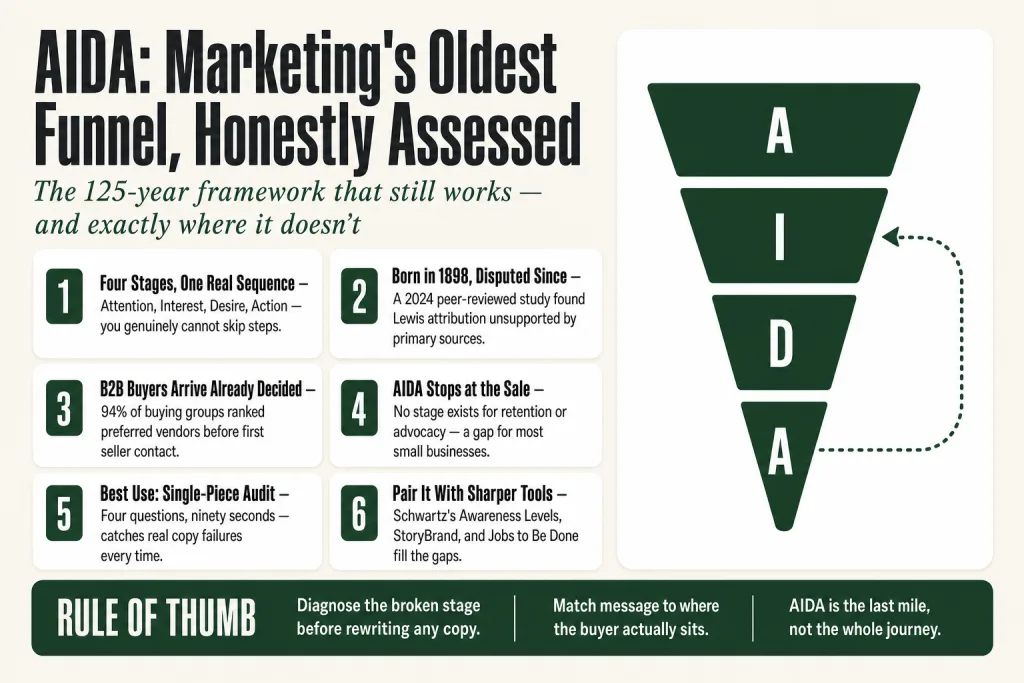
Where AIDA Came From (and Why the Backstory Is Murkier Than You Think)
The model is most commonly credited to Elias St. Elmo Lewis, an American advertising advocate who worked in the late nineteenth century. According to Edward K. Strong Jr.’s 1925 book The Psychology of Selling and AdvertisingLewis formulated the original slogan, attract attention, maintain interest, create desire, around 1898, with ‘get action’ added later. Lewis was posthumously inducted into the Advertising Hall of Fame in 1951.
One asterisk worth knowing: a 2024 peer-reviewed study by Akinori Iwamoto in the Japan Marketing History Review found that the attribution to Lewis is unsupported, or rests on weak evidence. Strong cited Lewis without a solid primary source, the acronym was almost certainly codified in the 1920s rather than the 1890s, and the same study makes a credible case that Arthur Frederick Sheldon recognized the necessity of the four-stage model before Lewis did, and names Sheldon together with Frank H. Dukesmith as the decisive contributors to its formulation. Philip Kotler then cited Strong, and the attribution snowballed from there.
Does any of this matter to an operator? Barely. Salespeople have worked some version of attention → interest → desire → action since long before anyone named it. What matters is that by the early twentieth century the framework was embedded in the DNA of American direct-response marketing, and that legacy is worth a paragraph, not a chapter.
The Four Stages: What They Actually Mean for Your Copy
Each stage has more operating room than the tidy acronym suggests.
Attention
Before anything else, someone has to stop scrolling, open your email, or read past the headline. This is the hardest job in marketing right now, and it was hard in 1898 too. Your only tool is relevance: say something the reader finds specific enough to pause for. A bold claim, a counterintuitive statement, a problem named precisely enough that the reader feels recognized.
What kills Attention: being generic. ‘Grow your business’ is not attention. ‘Plumbers in Las Vegas lose an average of $4,200 a month to no-show leads’ is attention, for a plumber. Specificity is the engine. The headline, the subject line, the first two seconds of a video: this is where Attention is won or lost, and no amount of good copy below the fold saves you if you lose it here.
Interest
Once you have attention, you have about three seconds of benefit of the doubt. Interest is where you make good on the implied promise of your Attention hook. You’re not selling yet. You’re explaining why this matters to the person specifically, connecting the thing you just said to something they recognize from their own life or problem.
The mistake most operators make at this stage: they slide into features. Features kill Interest because they require the reader to do the work of connecting a feature to a benefit themselves. That’s cognitive labor. Most readers won’t bother. Interest lives in their world, not yours.
Desire
Interest says ‘this is relevant to me.’ Desire says ‘I want the specific thing you’re selling.’ That’s a meaningfully different psychological state, and the gap between them is where most small-business marketing falls apart.
You can be interested in losing weight and not desire any particular program. The job at the Desire stage is to move the reader from ‘I have a problem’ to ‘this solution, from this provider, is the one I want.’ Testimonials earn their keep here. Specifics earn their keep here. Demonstrations, before-and-afters, social proof, all of it is Desire fuel. This is where your Unique Selling Proposition does its heaviest lifting.
Action
After Attention, Interest, and Desire, the reader needs a clear, frictionless next step. One. Not three options. Not a navigation menu. One thing to do next, stated plainly, with whatever reassurances they need to feel safe doing it, a money-back guarantee, no credit card required, a real phone number, whatever reduces the perceived risk.
Action is often where well-meaning operators over-engineer things. They bury the CTA. They soften it until it disappears. Or they add so many options that the reader, spoiled for choice, picks none. A clear, confident ask, ‘Call us at this number,’ ‘Click here to book,’ ‘Reply to this email’, beats a committee of options every time.
Why the AIDA Model Stuck for 125 Years
A framework that survives twelve decades isn’t surviving on inertia alone. AIDA stuck because it maps something genuinely true about persuasion: you cannot skip steps. You cannot create desire in someone who isn’t paying attention. You cannot get action from someone who hasn’t developed desire. The sequence has internal logic, and that logic holds across media, across eras, across categories.
It also gave practitioners a diagnostic tool. When a campaign wasn’t working, AIDA gave you a place to look. Ad not converting? Ask which stage is breaking. If the click-through rate is low, you have an Attention or Interest problem. If people click but don’t buy, you have a Desire or Action problem. That kind of structured debugging is more useful than most operators give it credit for.
The model also traveled well because it applied to individual units of communication, not just campaigns. A single email, a single ad, a single sales conversation, AIDA gives you a spine for all of them. That universality made it teachable and reusable in ways that more complex frameworks aren’t.
Run any mediocre piece of small-business marketing through four questions, Does this have a compelling Attention hook? Does it build real Interest before asking for anything? Does it create Desire for the specific offer, not just the category? Is the Action dead obvious?, and you’ll find the problem inside sixty seconds. That’s a legitimate quality filter, and it works every time.
Putting this to work? The ideas in the Canon are the foundation under the tactical playbook in Build a Complete Marketing Departmentgrab the free companion kit at mmsvegas.com/resources.
The AIDA Model in the Wild: Real Campaigns Worth Studying
The clearest examples of AIDA in practice come from campaigns with documented, measurable results and tight copy discipline. They’re worth naming specifically, not as inspiration porn, but because they show the model operating in full and give you something concrete to reverse-engineer.
Apple’s original iPhone keynote (January 9, 2007, Moscone West, San Francisco). Jobs opened the 90-minute presentation with a classic Attention move: announcing that Apple was introducing ‘three revolutionary products’, a widescreen iPod, a phone, and an internet communicator, then revealing they were all one device. That’s a counterintuitive pattern interrupt delivered to a room full of journalists. He built Interest by spending the first third of the demo diagnosing what was wrong with existing smartphones: physical keyboards that couldn’t change, styluses you had to carry. He named the pain before showing the solution. Desire came when he demonstrated the iPhone solving those specific problems, scrolling a Google Maps satellite view with one finger, pinching to zoom on a photo, features competitors couldn’t match at the time. Action was baked into the announcement itself: release date (June 29), starting price ($499 with contract), carrier (AT&T). Every stage landed in sequence. If you want to study AIDA at its most disciplined, watch the archived keynote.
Nike’s ‘Just Do It’ campaign (1988, Wieden+Kennedy, Portland). Dan Wieden coined the tagline the night before a client presentation, looking for a line that could unify TV spots ranging from elite marathoners to morning walkers. Nike was trailing Reebok badly at the time. The campaign launched in 1988, and from 1988 to 1998 Nike grew its North American sport-shoe market share from 18% to 43%, from $877 million to $9.2 billion in worldwide sales. What makes ‘Just Do It’ interesting through an AIDA lens is that it collapses Desire and Action into three words simultaneously. It’s aspirational enough to build desire for the brand while directional enough to push you toward a purchase decision. Very few three-word phrases pull that off across four decades of continuous use.
Coca-Cola’s ‘Share a Coke’ campaign (Australia, 2011, Ogilvy Sydney). Ogilvy replaced the Coca-Cola logo on bottles with 150 of the most common Australian first names, a radical act for a brand whose logo is one of the most recognized on earth. Attention came instantly: a bottle with your name on it is a pattern interrupt in a product category that had been functionally invisible on shelves for decades. Interest emerged from the social hunt, finding your name, or a friend’s. Desire became personal rather than categorical: you didn’t just want a Coke, you wanted that Coke. Action was frictionless because the product was already in your hand at a convenience store. The Australian launch produced a 7% increase in young adult Coke consumption and a 4% increase in category share, both of them Ogilvy’s own estimates for its own campaign; when the campaign rolled out in the U.S. in 2014, it reversed more than a decade of declining Coke consumption and drove a sales increase of more than 2%, per Wall Street Journal reporting at the time.
For small operators, the lesson from all three is the same: each stage does a distinct job, and shortcuts don’t work. Nike’s ‘Just Do It’ only functions as an Action trigger because thirty-plus years of Attention and Desire work preceded every new execution. The Action is only powerful because everything above it was built first.
In direct-response contexts, which is where most small businesses live, AIDA shows up most practically in email copy. Subject line = Attention. Opening paragraph = Interest. Middle = Desire. CTA = Action. That structure is not an accident; it’s the model applied to a single channel with real stakes at every stage.
Where the AIDA Model Breaks Down (and Why It Matters)
Here’s where an honest assessment diverges from the textbook cheerleading. AIDA is a useful model with real cracks in it, and pretending otherwise gets you into trouble.
It assumes a linear buyer journey that mostly doesn’t exist anymore. The 6sense 2025 Buyer Experience Report, based on more than 4,000 B2B buyer responses, found that buyers don’t engage with sellers until they are about two-thirds of the way through their purchasing process. The buying journey has shifted from a 70/30 to a 60/40 split between independent research and seller engagement, meaning buyers are reaching out earlier, but 94% of buying groups had already ranked their preferred vendors before first contact, and the preliminary favorite won the deal 77% of the time. If someone shows up that way, they didn’t move through your AIDA funnel. They moved through their own research process, largely invisible to you, and landed somewhere in the middle.
The modern B2B buying cycle doesn’t flow neatly downward either. Gartner describes buyers engaging in looping, revisiting distinct buying jobs multiple times, with new stakeholders entering mid-process who reset parts of the evaluation. A committee member who missed the first demo needs to be brought through Interest and Desire again while the champion is already at Action. A four-stage linear model can’t hold that complexity without significant modification.
It stops at the sale. AIDA ends with Action, meaning it ends at the transaction. There’s no stage for retention, no stage for advocacy. For any business where repeat customers or referrals matter, which is most small businesses, that’s a structural gap. A customer who bought once but never returns, never refers, and never upsells isn’t the outcome you built a business for.
It treats the buyer as passive. The original model assumes the marketer is doing things to the buyer: capturing attention, building interest, creating desire. Modern buyers research independently, compare options on third-party review sites, ask peers in industry communities, and run their own due diligence. The assumption that the marketer controls the information flow is increasingly obsolete.
It doesn’t account for awareness levels. AIDA treats all buyers as if they start at zero, needing your Attention before anything else. But many buyers enter your funnel already aware of their problem, already comparing solutions, already familiar with your category. Starting at Attention for those buyers is condescending at best, confusing at worst. Eugene Schwartz’s Market Awareness Levels framework is a far more precise tool for matching message to buyer state.
Where the AIDA Model Still Applies, Honestly
None of the above means you should throw AIDA out. It means you should know what it’s actually good for.
Single-piece copy quality control. A landing page, an email, an ad, a direct-mail piece, a sales script, run it through the four stages as a checklist and you’ll catch most structural failures quickly. Does it open with something that earns Attention? Does it build genuine Interest before asking for anything? Does it create Desire for the specific offer, not just the category? Is the Action unmistakably clear? That’s a four-question audit that takes ninety seconds and catches real problems. Use it every time.
Cold outreach. When you’re reaching someone with no prior relationship, cold email, cold call, a trade show conversation, they genuinely start at zero. AIDA’s linear logic holds here because you’re managing the entire interaction from the first word. You don’t have the luxury of them arriving warm.
Short-form advertising. A 30-second radio spot, a display ad, a social media post with a link: you need to get through some version of A → I → D → A in a compressed space. AIDA’s discipline forces you to prioritize ruthlessly, which is exactly the constraint those formats demand.
Training new team members. If you’re explaining persuasive communication to someone new, a salesperson, a marketing hire, a VA writing emails, AIDA is still one of the cleanest starting frameworks because it’s memorable, sequenced, and intuitive. It’s not the whole story, but it’s a good first chapter.
Direct-response campaigns where the funnel is intentional. If you’re running a campaign specifically designed to move someone from cold to purchase in a single sequence, a Facebook ad to a landing page to a sale, a direct mail piece with a reply card, AIDA describes what you’re building. You’re intentionally controlling the journey from Attention through Action, and the model is fit for that purpose.
Better Mental Models for When AIDA Runs Out of Road
AIDA is a starting point, not a complete theory. Here’s what to reach for when you need more precision.
Eugene Schwartz’s Market Awareness Levelsdetailed in Breakthrough Advertising and covered in the Canon, gives you five buyer states: Unaware, Problem Aware, Solution Aware, Product Aware, and Most Aware. Each state requires a different opening move, a different hook, a different message architecture entirely. AIDA assumes everyone starts at Unaware and needs you to generate their Attention from scratch. Schwartz’s model lets you skip straight to Solution Aware messaging for buyers who already know they have a problem and are actively comparing. For small businesses advertising to warm audiences, this precision is worth far more than AIDA’s general-purpose structure. Learn more about Market Awareness Levels →
StoryBrand’s SB7 Frameworkdeveloped by Donald Miller, reframes AIDA entirely by repositioning the customer as the hero and your business as the guide. Rather than capturing Attention and building Desire, you’re entering a story the customer is already telling themselves. The difference sounds subtle but it’s substantial in practice: SB7 starts with the customer’s problem, not your product’s features, which shifts the entire tone and structure of how you communicate. For operators who find their messaging feels ‘salesy’ even when they’re following AIDA faithfully, SB7 often solves the problem. Learn more about StoryBrand →
Jobs to Be Done gets underneath all of it by asking: what is the customer actually hiring this product or service to do? AIDA can be executed perfectly, great hook, solid body copy, clear CTA, and still fail if the desire it creates is for the wrong thing. JTBD forces you to understand the actual motivation before you build any communication architecture on top of it. Learn more about Jobs to Be Done →
The Value EquationAlex Hormozi’s framework around dream outcome, perceived likelihood, time delay, and effort/sacrifice, gives you a more precise lever set for the Desire stage specifically. If AIDA tells you to ‘create Desire,’ the Value Equation tells you exactly which dials to turn to make the offer more compelling without piling on more features or discounts. Learn more about the Value Equation →
None of these replace AIDA entirely. They complement it. Think of AIDA as the skeleton and these other frameworks as the diagnostic tools that help you figure out exactly what’s wrong when a skeleton isn’t walking right.
Common Mistakes
- Running the same cold-audience hook in a warm retargeting adVisitors who’ve already hit your estimate or pricing page aren’t at Attention, they’re mid-comparison. Skip straight to Desire-stage copy: a specific offer, named social proof, and one CTA. Restarting at Attention for a warm audience is the messaging equivalent of introducing yourself to someone you’ve already met.
- Burying the CTA behind reassurance copy the buyer didn’t ask forPut the primary CTA above the fold, then repeat it at the bottom. Keep guarantees, testimonials, and certifications adjacent to the CTA, not upstream of it, where they slow down readers who are already ready to act.
- Sending one AIDA nurture sequence to your entire list regardless of where contacts actually areExisting clients don’t need a ‘did you know you have this problem?’ email, they need a retention or upsell track. Warm referrals enter at Desire. Cold contacts start at Attention. Segment before you sequence, or you will keep sending the right message to the wrong people at every stage.
- Treating ‘licensed, bonded, and insured’ as a Desire-stage differentiatorPull up your top three competitors’ sites and list every claim they make. What’s left, what you can say that they genuinely can’t, is your actual USP. Generic credentialing shared by everyone in the category is table stakes, not differentiation. If your Desire copy sounds like theirs, it isn’t doing its job.
- Treating Action as the finish line and building no post-purchase sequenceAIDA ends at the transaction. Your business doesn’t. Map what happens after the Action before you launch the front-end campaign, a gym that nails its direct-mail campaign but sends nothing to new members for 30 days will watch its acquisition economics collapse in month two.
Operator’s Take
AIDA is right about the sequence and wrong about the journey. Those are two different claims, and conflating them is where operators quietly leave money on the table. So here are four places where I’d change how you’re actually using it, not summaries of what the framework says, but decisions you can make today.
Diagnose before you rewrite. When a campaign underperforms, the default reflex is to swap the headline or change the CTA button color. That’s almost always the wrong move. Work the four stages as a diagnostic first. Low open rate or click-through? Attention problem, your hook didn’t earn a second line. People clicked but bailed without reading? Interest problem, you slipped into talking about yourself instead of their situation. Read the whole thing but didn’t buy? Desire problem. Pull up your top three competitors’ sites right now and list every claim on their homepages. Whatever you can say that they genuinely can’t is your actual Desire-stage material. ‘Licensed, bonded, and insured’ is not a differentiator if every competitor makes the same claim. Did someone start checkout and not finish? That’s Action, friction, a trust gap, or one too many steps. Diagnose the stage, then rewrite only that stage.
Match the message to where the audience actually sits. If you’re running retargeting ads to people who’ve already visited your estimate or pricing page, and you’re still opening with a problem-awareness hook, ‘Did you know your roof could be failing?’, you’re talking to people who already know they have a problem and are currently comparing you to three other tabs. You never got to Desire because you kept restarting at Attention. The fix isn’t a sharper hook. It’s a Desire-stage ad: a specific offer, a real testimonial with a name attached, a concrete reason to choose you over the next tab. Before writing a word of copy for any paid campaign, map where your audience actually sits in the awareness spectrum. Eugene Schwartz’s Market Awareness Levels solves this more precisely than any generic checklist.
For B2B operators, AIDA describes maybe the last 30 to 40% of what determines whether you win. The 6sense 2025 Buyer Experience Report, based on 4,000+ buyer responses, found that the buying journey has shifted from a 70/30 to a 60/40 split between independent research and seller engagement, and that 94% of buying groups had already ranked their preferred vendors before first contact. The preliminary favorite won the deal 77% of the time. What that means in practice: the majority of the real decision happened in peer communities, LinkedIn, review sites, and organic search, before your AIDA-structured email ever landed. Your positioning, your content, your visible reputation during that invisible phase, that’s what determined whether your copy even gets a fair read. AIDA is the last mile. Don’t neglect the first sixty.
AIDA tells you the order to say things. It doesn’t tell you what to say. A perfectly structured four-stage piece built on a weak USP, a misunderstood customer, or a commodity offer is still going to fail, just in a tidy, organized way. Run a real Jobs to Be Done analysis and a competitive audit before you open a doc. The sequence is only as good as the substance underneath it.
Used in
- ✓ Build a Complete Marketing Department
Used as the structural template for evaluating every outbound communication, ads, emails, and landing pages are audited against the four AIDA stages to identify where conversion breaks down. - ✓ The Missing Manual for FunnelKit
AIDA maps directly to FunnelKit’s page-sequence logic, each funnel step is designed to carry a visitor from Attention (ad or opt-in hook) through Desire (offer page) to Action (checkout or CTA), making the model a literal build guide. - ✓ The Missing Manual for Make
Used to structure automated email sequences in Make, each node in a nurture automation is tagged to an AIDA stage so the flow matches buyer readiness rather than an arbitrary calendar cadence.
FAQ
Is the AIDA model still relevant in 2026?
As a copy-quality checklist for individual pieces of marketing, yes, absolutely. As a complete model of how modern buyers decide, no. Use it for what it’s good at: structuring a single email, ad, or landing page. Don’t use it to model your entire buyer journey, especially in B2B, where the actual decision process is far more complex and nonlinear.
Who actually invented the AIDA model?
The model is most commonly credited to Elias St. Elmo Lewis, an American advertising advocate, based on Edward K. Strong Jr.’s 1925 account attributing a three-part slogan to Lewis circa 1898. A 2024 peer-reviewed study found that attribution is not well-supported by primary sources, and another researcher has made a credible case that Arthur Frederick Sheldon recognized the necessity of the four-stage model earlier than Lewis. Strong likely popularized the four-stage version in the 1920s, and the acronym AIDA was cemented through his work and Philip Kotler’s subsequent citations.
What’s the biggest weakness of the AIDA model?
Its linearity. AIDA assumes buyers start at Attention and proceed neatly through each stage in order. Modern buyers, particularly in B2B, enter the journey at different points, loop back to earlier stages, research independently without your involvement, and often arrive already mostly decided. The model also stops at the transaction and says nothing about retention or advocacy.
How do I use AIDA for email marketing?
Apply it to every email as a four-part structure: subject line earns Attention, opening paragraph builds Interest by connecting to the reader’s situation, middle section creates Desire for your specific offer, and the CTA is one clear Action. Keep the stages distinct, don’t slide into selling during the Interest phase, and don’t bury the CTA in qualifying language.
What should I use instead of AIDA for B2B marketing?
AIDA is still useful as a copy checklist even in B2B, but pair it with Eugene Schwartz’s Market Awareness Levels to calibrate your message to where buyers actually are, and study Gartner’s six-stage B2B buying model, Problem Identification, Solution Exploration, Requirements Building, Supplier Selection, Validation, and Consensus Creation, to understand the full journey you’re marketing into.
Does AIDA work for social media marketing?
Yes, with one important modification: social media compresses the timeline dramatically. You often have a single post to carry someone from Attention through at least the beginning of Interest, which means your hook has to be sharper and your Interest-building has to happen faster. The structure holds; the execution has to be leaner.
Further reading
- Breakthrough Advertising by Eugene Schwartz, the most important refinement of AIDA-era thinking, replacing the single-entry-point assumption with a five-level awareness spectrum that changes everything about how you open a message.
- Scientific Advertising by Claude Hopkins, written in 1923, it predates the modern AIDA acronym but applies its logic more rigorously than most contemporary treatments; see also the Scientific Advertising Canon page.
- Building a StoryBrand by Donald Miller, the clearest counter-argument to AIDA’s product-first framing, and a practical alternative for operators whose messaging feels mechanical even when technically correct.
Sources: Akinori Iwamoto, “The origin of AIDA: Who invented and formulated the AIDA model?”, Japan Marketing History Review 3(2), 2024, pages 150 to 166, the peer-reviewed study behind the attribution section below; Edward K. Strong Jr., The Psychology of Selling and Advertising (1925), the origin of the Lewis attribution itself; the American Advertising Federation Advertising Hall of Fame for the 1951 induction; 6sense, “The Critical Period for B2B Buying” (October 2024), a survey of more than 3,500 B2B buyers across three regions, for the 70 percent figure; Gartner’s published six-stage B2B buying model; “Using the AIDA model to predict consumer behaviour: the moderating effect of brand evangelism”, SN Business & Economics (2025); Wikipedia and Wieden+Kennedy records for the 1988 “Just Do It” campaign, whose market-share figures are the widely cited case-study numbers for 1988 to 1998 rather than a Nike disclosure; Wikipedia, The Wall Street Journal (2014) and The Atlantic (2016) for the “Share a Coke” results. Where a campaign figure originates with the agency that ran the campaign, it is labelled as such in the text. The four-stage diagnostic sequence and the stage-by-stage fixes in this article are ours, not anyone’s primary research.
Brian Kasday spent forty years in direct-response marketing before rebuilding the whole operation as a one-person shop. He writes The Operator’s Library, including “Build a Complete Marketing Department”, for operators who’d rather build it themselves than wait on someone else.
Build the department these ideas describethe free companion kit: mmsvegas.com/resources.
More The Operator's Canon guides
Free · Operator Toolkit
Want the tools, not just the guide?
Get the free operator toolkit — templates and checklists for the systems you actually run, plus a note when this guide changes.
Get the free toolkit →How to cite: AIDA Model. The Operator’s Canon, MMS Vegas. https://mmsvegas.com/library/aida-model-explained/