
Last updated: July 2026
Direct response marketing is the discipline of creating advertising that asks for, and measures, a specific action from a specific person at a specific moment. Not awareness. Not impressions. A response. By the end of this page, you’ll know how to build a campaign where every dollar is accountable, recognize the elements that make direct response work, and decide when to use it and when it doesn’t apply.
Most small operators default to what they see the big brands doing: logo-forward ads, vague slogans, ‘awareness’ campaigns. That strategy works when you have Coca-Cola’s budget and thirty years of market saturation behind you. When you’re running a $30,000 ad budget, a campaign you can’t measure is a campaign you can’t improve, and you’ll quietly bleed money until you stop it. Direct response solves that. It’s the discipline built for people who need every dollar to pay its own way.
The tradition is older than most operators realize. Claude Hopkins was doing version-tested, coupon-tracked print ads starting in 1907. John Caples was split-testing headlines from 1925 onward, first at Ruthrauff & Ryan, then at BBDO. David Ogilvy, widely remembered as the brand-advertising archetype, called direct mail his first love and used it to build Ogilvy & Mather from nothing. Dan Kennedy took the same principles and translated them for the small-business owner who couldn’t afford to guess. A century later, the mechanics live in email sequences, Facebook ad sets, and landing pages. The idea hasn’t changed: put something out, measure the response, keep what works, kill what doesn’t.
The idea in 30 seconds
- Direct response marketing demands a measurable action from every ad, a click, a call, a booking, a purchase. If the ad doesn’t ask for something trackable, it isn’t direct response.
- Every element is tracked, so you know what each dollar produced. No guessing, no ‘brand awareness’ excuses, the numbers either work or they don’t.
- The tradition runs from Claude Hopkins (1907 at Lord & Thomas, keyed coupons, split-run tests) through John Caples, David Ogilvy, and Dan Kennedy, all making the same argument: make it measurable or stop spending.
- For a small operator, direct response is the default discipline, not brand advertising, because you can’t afford to run awareness campaigns you can’t prove.
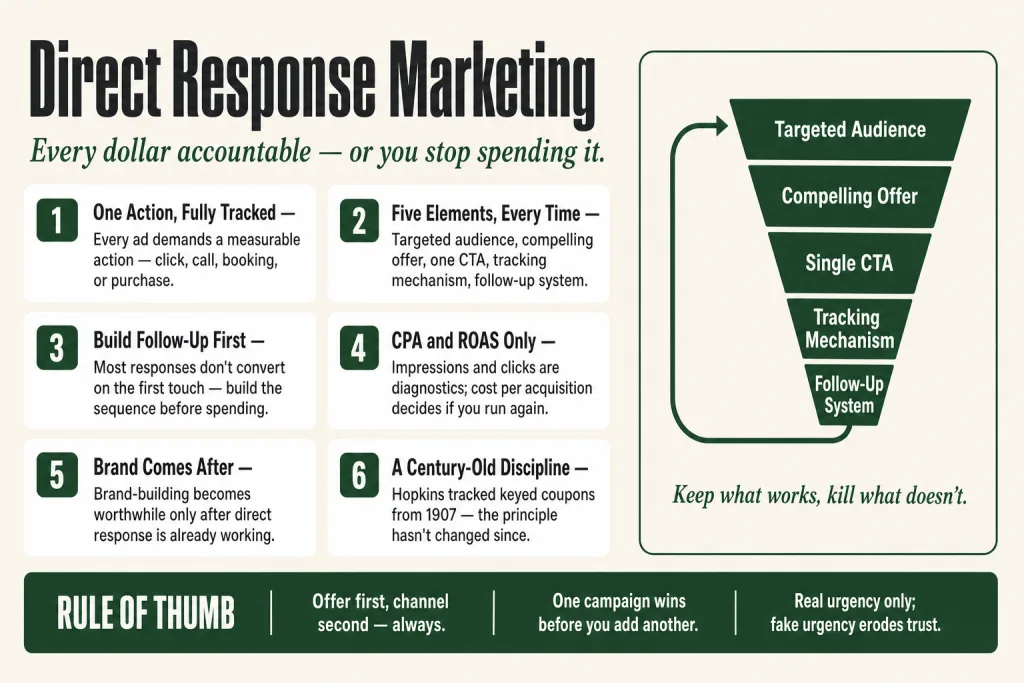
- Five things every direct response campaign needs: a targeted audience, a compelling offer, one call to action, a tracking mechanism, and a follow-up system.
- Direct response and brand-building aren’t enemies, but brand-building is something you earn after your direct response is working.
Where Direct Response Marketing Came From
The early 1900s advertising world ran mostly on faith. You placed an ad in a newspaper, assumed it was working because the product kept selling, and moved on. John Wanamaker’s famous frustration, that half his advertising was wasted but he didn’t know which half, was the universal condition of the era.
Claude Hopkins changed that. Hired by Albert Lasker at Lord & Thomas in 1907, Hopkins pioneered ‘keyed’ response mechanisms: unique coupon codes and dedicated reply addresses that let him trace exactly which headline and which offer generated a result. Run two versions to matched audience segments, count the responses, call the winner, not on opinion, but on data. His 1923 book Scientific Advertising made the case plainly: advertising is testable if you build the measurement in from the start.
John Caples extended the tradition at Ruthrauff & Ryan starting in 1925, writing the ‘They Laughed When I Sat Down at the Piano’ ad for the U.S. School of Music, then moving to BBDO in 1927. His 1932 book Tested Advertising Methods documented what he found over decades: specificity beats cleverness, benefits beat features, and the copy that makes an account director wince is often the copy that converts.
Ogilvy is usually remembered as the archetype of the polished brand advertiser, the man in the Hathaway eye patch, the Rolls-Royce on the quiet road. His private view was closer to Hopkins. He called direct mail his ‘first love and secret weapon,’ said he used personalized mailings to grow Ogilvy & Mather from scratch, and argued that no one should create general advertising until they’d served an apprenticeship in direct response, because direct response practitioners know what works to the dollar. Dan Kennedy arrived later as the translator for the small-business owner who couldn’t afford Madison Avenue rates. The channel has changed since Hopkins’ keyed coupons. The principle hasn’t.
The Five Elements Every Direct Response Marketing Campaign Needs
Strip every direct response campaign ever run down to its bones and you’ll find five things, every time. Get any one of these wrong and the campaign underperforms, often badly.
1. A Specific Audience
The tighter the audience, the more directly the message can speak to them. A postcard to ‘homeowners in a three-mile radius’ is already more targeted than a newspaper ad. A Facebook campaign to ‘homeowners aged 35 to 55 who searched for roof repair in the last 30 days’ is better still. The ad’s job is to be irrelevant to everyone who shouldn’t respond and magnetic to everyone who should.
2. A Compelling Offer
The offer is the heart of it. Not the product, the offer. The product is what you sell. The offer is the specific combination of what they get, what they pay, what guarantee backs it up, and what happens if they act now versus later. A weak offer with great copy still loses. ‘Come in for a free consultation’ is a weak offer, it’s vague, low-stakes, and it’s what everyone else says. ‘Bring this postcard in for a 45-minute roof assessment at no charge, we’ll show you exactly what we’d fix and why, with photos’ is an offer with shape and substance. Hopkins called this ‘reason-why’ copy: you’re not just telling them what to do, you’re telling them why the offer is worth taking and why acting now is the right move.
3. One Call to Action
One. Not three. Not ‘call us, visit our website, or stop by the showroom.’ One thing. The discipline of a single call to action forces you to decide what actually matters, what one step, if taken, advances the relationship. Every extra option you give a prospect is friction, and friction kills response rates. Pick the action, name it explicitly, and make it as easy as possible to complete.
4. A Tracking Mechanism
Hopkins used keyed coupons and unique reply addresses. Kennedy used dedicated phone numbers and offer codes. Today you use UTM parameters, conversion pixels, call-tracking numbers, and unique landing page URLs. The mechanism matters less than the principle: if you can’t trace a response back to the specific ad or campaign that produced it, you’re flying blind. Attribution doesn’t have to be perfect, especially in the age of multi-touch journeys, but it has to be good enough to tell you whether the campaign is working or failing.
5. A Follow-Up System
This is the element most small operators skip, and it’s probably the most expensive mistake in the list. The majority of responses to a direct response campaign don’t convert on the first touch. They’re interested. They need one more nudge, or three more nudges, or a different angle of the same offer at a different moment. A single email sequence, a retargeting ad, a second postcard, these are the instruments that turn a list of interested people into actual buyers. Without the follow-up system, you’re paying to generate interest you then abandon.
Why Direct Response Marketing Beats Brand Spend for the Small Operator
Brand advertising and direct response are not opposites, but they’re not equivalents either, especially at the scale most small operators are working at. Brand advertising builds recognition and preference over time through repeated exposure. It’s the reason you reach for Heinz ketchup instead of the store brand without thinking about it. It works, eventually, if you run it consistently for years, across enough touchpoints, with enough frequency to actually shift perception. That’s a project measured in years and millions.
For a small business with a real budget constraint, brand advertising has a structural problem: you can’t run it consistently enough to matter. A three-month billboard campaign followed by silence doesn’t build a brand, it just costs money. The few times a small business runs something brand-adjacent is nowhere near enough to compete with players who’ve been doing it for decades.
Direct response doesn’t ask you to win a war of attrition. It asks you to put out a measurable offer, count the responses, and decide whether to run it again. If a $500 Facebook campaign generates three booked consultations worth $1,200 in revenue, you know the math works and you run it again. If it generates nothing, you know within days, not after a twelve-month brand study, and you change something. That feedback speed is the whole advantage.
There’s also an equity argument that gets underrated. Every direct response campaign that works builds you a list: email subscribers, retargeting audiences, booked clients, repeat buyers. Brand awareness dissipates the moment you stop spending. The list doesn’t. A brand campaign builds vague recognition in the market. A direct response campaign builds a named list of people who raised their hand and said ‘I’m interested.’ That list is a real asset.
Smaller businesses should focus almost exclusively on direct response until they’re doing significant revenue, because it’s more accessible, it’s measurable, and it doesn’t require the kind of sustained massive exposure that brand campaigns demand to produce any effect. Brand-building becomes worthwhile when your direct response is already working and you’re looking to lower acquisition costs over the long term. That’s a later problem.
None of this means brand doesn’t matter. How you show up, your positioning, your visual identity, the experience you deliver, shapes whether your direct response ads convert at 2% or 8%. Brand is the water your direct response swims in. But you don’t get to spend your way to brand awareness on a small budget. You earn it by showing up consistently and delivering what your direct response ads promise.
What Direct Response Marketing Looks Like on Modern Channels
The channels have multiplied dramatically since Hopkins was counting coupon returns. The underlying structure, targeted audience, compelling offer, one CTA, tracking mechanism, follow-up, maps onto all of them. Here’s how direct response marketing actually runs today.
Email Sequences
Email is probably the purest direct response channel available to a small operator right now. You’re talking one-to-one, to a person who already opted in, with full tracking of opens, clicks, and conversions. A well-structured email sequence for a new lead, say, a five-email series over ten days that moves from problem identification to social proof to a specific offer, is direct response at its most efficient. You can see which email lost them, where click-through dropped, and which offer line generated bookings. An e-commerce cart abandonment sequence is a textbook example: you know exactly who left, what they left behind, and the sequence recovers revenue that would otherwise evaporate.
Paid Social Ads
Facebook and Instagram’s targeting infrastructure is what Hopkins would have considered a miracle: you can reach people by age, geography, interests, purchase intent, and behavioral signals with an offer that addresses exactly their context. The ‘Shop Now’ button on a Facebook ad, the ‘Book a Call’ link in an Instagram Story, these are direct response mechanisms. The ad has one job: get the click. The landing page has one job: get the conversion. You track both, you test both, and you cut what underperforms. The creative and copy principles from Caples still apply, a benefit-forward headline, a stated offer, a clear CTA, the platform just changed.
Search Ads
Google Ads are direct response with intent data layered on top. A prospect searching ’emergency plumber Las Vegas’ is not browsing, they have a problem right now and they’re looking for a solution. Your ad appears at that moment of need, makes a specific offer (free estimate, 24/7 availability, same-day service), and links to a landing page that converts. The tracking is granular: cost per click, cost per lead, cost per booked job. For local service businesses especially, search ads run with direct response discipline, tight keyword intent, one CTA per page, dedicated landing pages, are often the highest-ROI channel available.
Direct Mail (Still)
This one surprises operators who’ve written it off. U.S. marketers spent roughly $37.3 billion on direct mail advertising in 2024, according to Winterberry Group research, reversing a significant prior-year decline. That’s not nostalgia spending; that’s marketers voting with budgets because physical mail stands out in an era of inbox overload. QR codes now bridge the gap between the physical piece and a digital tracking system, so you can tie a postcard to a specific landing page with a dedicated phone number and know exactly how many bookings that mailer generated. Not every business needs it, but it’s not obsolete by a long shot.
SMS Campaigns
Short, immediate, and measurable, SMS carries open rates far above email and click-through rates that outperform most other channels for the right kind of offer. A restaurant running a Tuesday slow-period special, a med spa promoting a limited-time introductory offer, a service company following up on an unbooked estimate, these are direct response moments that SMS handles with minimal friction. The constraint is respect for the channel: this is close contact and the offer has to be genuinely relevant or you lose the subscriber fast.
Landing Pages and Funnels
Every direct response ad needs a destination that continues the conversation, not your homepage. The landing page is where the tracking mechanism lives, where the offer is expanded, where the call to action converts. It removes distractions, maintains the continuity of the message that got the click, and gives you testable variables: headline, offer framing, social proof placement, CTA button copy. Running A/B tests on landing pages is exactly what Hopkins was doing with split-mailed letters in 1920, just faster and with better data.
Putting this to work? The ideas in the Canon are the foundation under the tactical playbook in Build a Complete Marketing Departmentgrab the free companion kit at mmsvegas.com/resources.
Where Direct Response Marketing Works Best
Direct response marketing is the right default when at least one of these conditions is true:
- You need near-term revenue. Not six-month awareness campaigns. Actual booked appointments, purchases, or inquiries, this month. Direct response is built for that.
- Your budget is constrained and you need it to pay its own way. Every dollar has to be accountable. You can’t sustain spend on campaigns you can’t prove. Direct response gives you the data to make that call.
- You’re testing a new offer, a new channel, or a new audience. It’s the only discipline where you get real market feedback quickly. Brand campaigns don’t tell you whether the offer is right, direct response does.
- You’re selling something with a clear, describable value and a defined buyer. A specific service to a specific kind of person in a specific situation. The more clearly you can define the problem and the buyer, the more directly you can write the offer.
- You’re in a category where people are actively searching for a solution. Emergency services, professional services, home improvement, health, anyone searching ‘HVAC repair near me’ is a warm audience for a direct response ad. Meet them at the moment of need with the right offer.
Local service businesses, plumbers, dentists, accountants, real estate agents, med spas, attorneys, run almost entirely on direct response logic. The sale is relatively defined, the buyer has a concrete problem, and the conversion event (an appointment, a consultation, a quote request) is trackable. This is the sweet spot direct response was built for.
Where Direct Response Marketing Doesn’t Work (and Gets Misapplied)
Direct response isn’t a universal answer. Here’s where it breaks down, and where operators get into trouble trying to apply it anyway.
When the sale cycle is very long and complex
Enterprise B2B deals that take nine months and involve twelve stakeholders don’t respond to a ‘Book a Demo Now’ CTA the same way a consumer purchase does. Direct response principles still apply, you want measurable actions, you want follow-up sequences, but the ‘immediate response’ expectation has to be recalibrated. The action you’re measuring might be a content download, a webinar registration, or a qualification call, not a closed sale. The discipline is there; the timeline and the definition of ‘response’ are different.
When trust has to come before the first transaction
Some categories, wealth management, legal services, high-ticket consulting, require a prospect to trust you before they respond to any direct offer. A direct response ad asking a cold prospect to book a $10,000 engagement doesn’t convert the way a lead magnet, a nurture sequence, and a discovery call might. This isn’t a failure of direct response; it’s a failure to match the offer to the stage of the buyer relationship. The fix is usually a lead-capture mechanism, a guide, a free assessment, a webinar, that starts the relationship before the hard ask.
When the category is low-consideration and habitual
Commodity categories where purchase is driven by habit, availability, and price, household staples, fuel, generic software subscriptions, have limited upside from direct response for cold audiences. The switching cost is low and the decision is fast, but it’s not made in response to a thoughtful direct response ad. These categories lean on availability, convenience, and brand cues more than persuasive response mechanisms.
When the execution crosses into manipulation
There’s a version of direct response that crosses into manipulation, fake countdown timers, false scarcity, manufactured urgency. This isn’t a principle of direct response; it’s a corruption of it. Hopkins, Caples, Ogilvy, and Kennedy all argued that copy must be honest. An offer that’s real and clearly explained converts better over time than one that tricks people into a click. The short-term response rate on a fake-urgency ad is always worse than operators think, and the brand damage is real. When operators conflate ‘direct’ with ‘pushy,’ they produce campaigns that perform poorly and erode the trust that makes future campaigns work.
Common Mistakes Operators Make with Direct Response Marketing
These aren’t misunderstandings about what direct response is, they’re execution failures that happen even when the operator fully understands the concept. The distinction matters: you can know the theory cold and still make every one of these mistakes.
Running ads without a dedicated landing page. The homepage is not a landing page. It has navigation, multiple messages, and no connection to the specific offer that got the click. The conversation breaks the moment someone lands there. Build a single-focus page that matches the ad’s promise and removes every exit that isn’t the CTA.
Launching the front-end campaign before the follow-up system exists. This one is expensive and almost universal among operators new to direct response. You run the ad, leads come in, and then… nothing happens to them. No sequence. No retargeting. No callback process. The leads go cold while you scramble to respond. Build the follow-up first, even a three-email sequence and a retargeting audience, before you spend the first dollar on acquisition.
Measuring impressions and clicks instead of CPA and ROAS. Clicks feel like progress. They’re not a business result. Cost per acquisition and return on ad spend are the metrics that tell you whether a campaign is worth running again. Everything else is a diagnostic, useful when something’s broken, not useful as a scorecard.
Running multiple campaigns simultaneously before finding a winner. The instinct to diversify is understandable but it kills your signal. If you’re running three campaigns at once with a $1,500 budget, none of them generates enough data to tell you anything. One audience, one offer, one channel, get a profitable result first, then scale it, then add another campaign on top of a working foundation.
Letting urgency become dishonest. There’s a meaningful difference between a real deadline, a price that expires Friday, an available slot that fills up, and a fake countdown timer that resets every time someone visits the page. Operators reach for manufactured urgency because it can lift short-term click rates. It also burns the trust that makes follow-up sequences, repeat purchases, and referrals possible. Build urgency into the offer itself. If there’s no real urgency, don’t manufacture it.
How to Apply Direct Response Marketing as a Small Operator Today
Most small operators are already running some version of direct response, they’re just not running it with enough discipline to get the compounding benefit. They’re boosting posts without a tracking pixel. They’re running ads without dedicated landing pages. They’re generating leads without a follow-up sequence. The individual elements exist; the system doesn’t. Direct response marketing is about turning those scattered tactics into a measurable system that tells you something useful every time you run it.
Start with the offer, not the channel
The most common error is picking the channel first, ‘we should run Facebook ads’, before deciding what you’re offering and to whom. The offer comes first. What specific action do you want someone to take? What do they get if they take it? Why should they do it now rather than later? Until you’ve answered those questions with specifics, no channel is going to save you. A weak offer on a perfectly targeted channel still loses.
Build one campaign with full tracking before you scale
Pick one audience, one offer, one channel, one tracking mechanism, and one landing page or destination. Run it. Measure it. A campaign that produces a cost-per-acquisition you can profit on gets more budget. One that doesn’t gets changed. Don’t run three campaigns simultaneously before you have a winner, you’ll dilute your data and your budget. The testing discipline from Hopkins and Caples is still the right approach: one variable at a time, let the responses decide.
Build the follow-up before you launch the front end
If you run an ad that generates 30 leads but you have no email sequence, no retargeting campaign, and no call-back process, you’ve paid to generate interest you’re going to abandon. The follow-up infrastructure, even a simple five-email sequence and one retargeting ad, should exist before you spend the first dollar acquiring leads. Most operators build front-end campaigns before back-end systems. That’s backwards.
Use AI to speed up the execution, not replace the judgment
AI tools can accelerate direct response work significantly, drafting copy variations for split-testing, building email sequence frameworks, generating headline options to test, structuring landing page outlines. Real time-savers. What AI can’t do is decide which offer is the right one, read whether the copy sounds right to your specific customer, or call a test conclusive. Those calls stay with you. AI cuts the time between strategy and execution; it doesn’t replace the strategic thinking that makes the campaign worth running.
Track the metrics that actually matter
Cost per acquisition (CPA) and return on ad spend (ROAS) are the numbers that tell you whether the campaign is working. Impressions, reach, and click-through rates are useful as diagnostics, they help you understand where in the funnel something is breaking, but they’re not business results. If you spent $500 on ads and made $2,000 in revenue, ROAS is 4:1 and you keep running it. If you spent $500 and made $300, something in the offer, the audience, or the landing page is broken and you fix it before you run it again. Every direct response campaign gets evaluated by the revenue it produced, not the eyeballs it collected.
Common Mistakes
- Running ads without a dedicated landing pageEvery direct response ad needs its own destination that continues the conversation, not your homepage. Build a single-focus page that matches the offer and the audience exactly.
- Launching the front-end campaign before the follow-up system existsBuild at least a basic email sequence and a retargeting audience before spending the first dollar on lead acquisition, the follow-up is where the majority of revenue is captured.
- Measuring impressions and clicks instead of CPA and ROASTrack cost per acquisition and return on ad spend as your primary metrics; everything else is a diagnostic tool, not a measure of whether the campaign is actually working.
- Testing multiple campaigns simultaneously before finding a winnerRun one audience, one offer, one channel at a time until you have a profitable campaign, then scale it before adding complexity.
- Using fake urgency or manufactured scarcityBuild urgency into the offer itself, a real deadline, a genuine limited quantity, an expiring price, because artificial pressure erodes trust and degrades long-term conversion rates.
Operator’s Take
Most operators treat direct response marketing as a set of tactics. Stop. It’s a decision-making system, and the place where that distinction costs you real money is in the decisions you never make, the kill numbers you don’t set, the follow-up gaps you don’t audit, the warm traffic you don’t test first.
Set your kill number before you hit publish. Decide right now: if this campaign spends $X without producing a conversion, I stop it and change one thing. Not five things, one. That’s how you learn which variable was broken. Most operators either let campaigns run on hope or panic-kill them before there’s enough data to learn anything. Write the number down. $200 without a lead. $500 without a booking. Whatever fits your unit economics. The discipline isn’t knowing when to stop, it’s committing to the number before you’re emotionally invested in the result.
Audit your follow-up gap before you touch anything else. Pull your last three campaigns. For each one, ask: what happened to someone who clicked but didn’t convert? If the answer is ‘nothing’ or ‘they went to the homepage,’ you’ve found where the money went. Fix it before you run another dollar of traffic. A three-email sequence triggered by a form fill, problem acknowledgment, social proof, direct ask, can recover a meaningful slice of leads that went cold on first contact. That’s not a creative problem. It’s a systems gap.
Test your offer with warm traffic before you go cold. If you have 200 past clients or opted-in contacts in a spreadsheet, you have a direct response audience right now, for free. Email them the new offer. See what converts. Then take what worked with warm traffic and run it cold with paid spend. Operators who test cold-traffic offers against cold-traffic audiences first are paying for information they could have gotten for nothing.
Run a message match check on every landing page. Take the headline from your ad and the headline from the landing page it points to, do they match? Same tone, same promise, same offer? If someone clicks ‘Get your free roof assessment’ and lands on ‘Welcome to Smith Roofing, Serving the Tri-State Area Since 1987,’ you’ve broken the conversation mid-sentence. Message match is one of the highest-leverage fixes in direct response and one of the most consistently skipped. Twenty minutes. Affects every campaign you run.
Own one channel before you spread across three. A $2,000/month budget on one channel, understood, tracked, and optimized, beats $500 across four channels every time. Pick the channel that reaches your buyer where they’re most reachable: Google Search for intent-driven categories, Facebook for demographic targeting, email for existing lists. Make it actually work. Then add another.
Used in
- ✓ Build a Complete Marketing Department
Used as the foundational discipline for structuring every campaign around a measurable action, a defined audience, and a trackable offer, rather than activity or awareness. - ✓ The Missing Manual for FunnelKit
Direct response principles govern every funnel stage: the offer on the opt-in page, the single CTA per step, and the follow-up automation sequences that convert leads into buyers. - ✓ The Missing Manual for Make
Used to build automated direct response systems, lead tracking, follow-up sequence triggers, and campaign attribution workflows, that run the feedback loop without manual effort.
FAQ
What’s the simplest definition of direct response marketing?
It’s advertising that asks a specific person to take a specific action, and measures whether they did. The response is the point. If there’s no trackable response, it isn’t direct response marketing.
How is direct response different from content marketing?
Content marketing builds audience and trust over time through useful or interesting material, with conversion as a downstream outcome. Direct response asks for the conversion action now, or at a defined next step, and tracks whether it happened. The two can coexist, a lead magnet is content that initiates a direct response sequence, but their primary goals are different.
Can a small local business with a tiny budget run direct response marketing?
Yes, and it’s probably the best-suited marketing approach for exactly that situation. Direct response doesn’t require scale to work, a postcard to 200 households, an email to 50 past clients, or a targeted ad to a defined local audience are all valid direct response campaigns. The discipline is about the measurement and the offer, not the size of the list.
Do I need to use long-form copy to do direct response properly?
No. The right copy length depends on the buyer’s stage and the medium. Cold-traffic ads on social media usually need short, punchy hooks. Warm-audience emails or sales pages can go longer because the reader is already interested. The principle is: as long as the sale requires, and no longer.
Is direct response marketing still relevant in the age of social media and AI?
More relevant, not less. The targeting precision available through digital platforms, behavioral data, intent signals, retargeting audiences, gives direct response practitioners far better tools than Hopkins had with coupons and mail segments. The principles haven’t changed; the feedback loop has gotten faster and cheaper.
What’s the biggest mistake operators make with direct response marketing?
Running the front-end campaign, the ad, the offer, the lead capture, without building the follow-up system first. Most responses don’t convert on the first touch. Without a follow-up sequence, you pay to generate interest and then abandon it.
Further reading
- Scientific Advertising by Claude Hopkins (1923), the foundational text; short, dense, and more applicable today than most books written last year. Public domain, so you can find it free.
- Tested Advertising Methods by John Caples (1932), the most rigorous study of what actually makes headlines and copy produce responses. Get the fifth edition if you can find it; it’s been updated for modern contexts.
- Ogilvy on Advertising by David Ogilvy, read the chapter titled ‘Direct mail, my first love and secret weapon’ specifically; it reveals more about Ogilvy’s real convictions than anything else he wrote.
- No B.S. Direct Marketing by Dan Kennedy, the translation of the whole tradition for the small-business owner; blunt, practical, and useful for the argument it makes about why small businesses should stop copying what large corporations do with their ad budgets.
Sources: Claude C. Hopkins, Scientific Advertising (1923); Wikipedia, ‘Claude C. Hopkins’ (confirmed: hired by Albert Lasker at Lord & Thomas, 1907; Scientific Advertising published 1923 following retirement as president and chairman); Wikipedia, ‘John Caples’ (confirmed: began at Ruthrauff & Ryan 1925; piano ad created 1925 to 1926; joined BBDO April 1927; Tested Advertising Methods published 1932); Smithsonian Institution Archives, John Caples Papers (NMAH.AC.0393), confirms Ruthrauff & Ryan start date 1925, BBDO move 1927; Creative Hall of Fame, John Caples inductee entry; David Ogilvy, ‘We Sell or Else’ video transcript, via Skyworks Marketing and DirectResponseContentMarketing.com, confirms ‘first love and secret weapon’ quote and personalized mailing growth strategy; Ogilvy on Advertising chapter 12: ‘Direct mail, my first love and secret weapon’; Dan Kennedy, No B.S. Direct Marketing; Winterberry Group, ‘Delivering Performance 2024: Direct, Digital and the Dynamics Shaping the Future of Omnichannel Marketing’ (December 2024), source for U.S. direct mail spend figure of $37.3B in 2024; PassiveSecrets, ‘Direct Mail Statistics 2026’; Research and Markets, ‘Direct Mail Advertising Market Size & Forecast to 2030’; CrazyEgg, ‘Direct Response Marketing vs Branding: When to Use Each’; Vizion Interactive, ‘Direct Response Marketing: The Power of Persuasive Advertising’; Young Urban Project, ‘Direct Response Marketing (2026): Strategies That Drive Sales’; The Wojo Media, ’10 Direct Response Marketing Examples to Drive Conversions in 2025.’
Brian Kasday spent forty years in direct-response marketing before rebuilding the whole operation as a one-person shop. He writes The Operator’s Library, including “Build a Complete Marketing Department”, for operators who’d rather build it themselves than wait on someone else.
Build the department these ideas describethe free companion kit: mmsvegas.com/resources.
More The Operator's Canon guides
Free · Operator Toolkit
Want the tools, not just the guide?
Get the free operator toolkit — templates and checklists for the systems you actually run, plus a note when this guide changes.
Get the free toolkit →How to cite: Direct Response Marketing. Associated with Claude C. Hopkins, 1923. The Operator’s Canon, MMS Vegas. https://mmsvegas.com/library/direct-response-marketing-explained/