
Last updated: July 2026
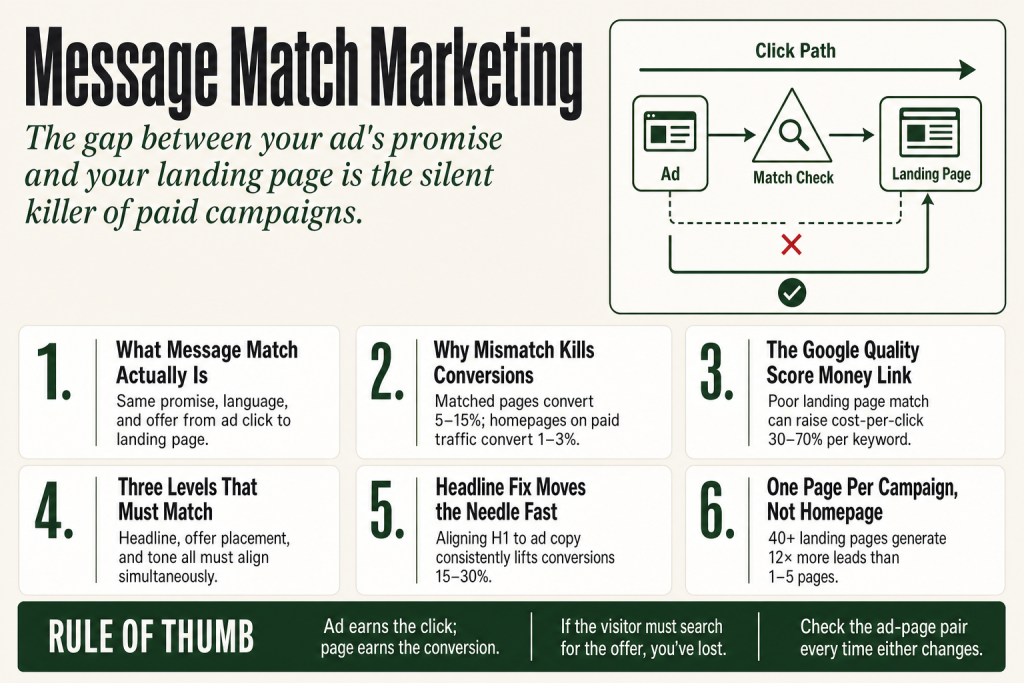
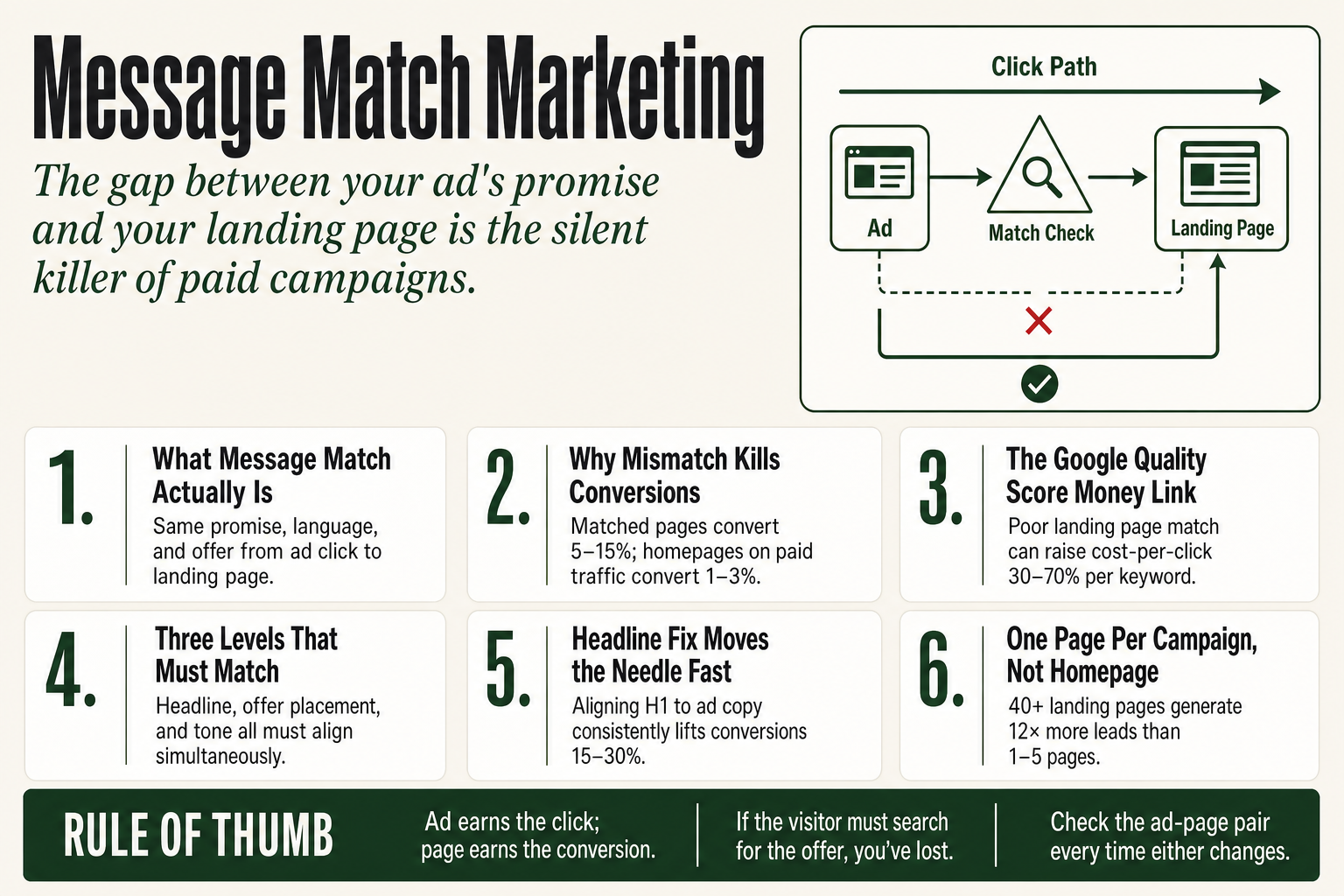
Message match marketing is the practice of keeping the exact same promise, same language, same offer, same intent, from the ad or link a visitor clicked all the way through to the page where they’re asked to act. By the end of this page, you’ll be able to audit any campaign in your business, spot a mismatch in under five minutes, and know exactly what to fix first.
The problem it solves: you pay to get someone’s attention, you earn the click, and then the landing page talks about something slightly different. Not wildly different, just different enough. The headline uses different words than the ad. The offer has shifted. The tone changed. The visitor spends two seconds looking for confirmation they’re in the right place, doesn’t find it fast enough, and leaves. You paid for that click. You got nothing back.
That gap between the promise and the delivery is the single most common silent killer of paid campaigns. Not the bid strategy. Not the creative. Not the offer itself. The gap. And the maddening part is that it’s almost always fixable in an afternoon, if you know what to look for.
The idea in 30 seconds
- Message match marketing means the headline, offer, and language on your landing page directly mirror what the ad or link that sent someone there promised.
- A mismatch, even a small one, creates enough friction to kill conversions that your ad budget already earned you.
- It applies to every traffic source: paid search, paid social, email, organic links, and retargeting.
- Google’s Quality Score literally grades you on it; poor match raises your cost-per-click while lowering conversions simultaneously.
- The fix is almost always cheaper than the problem: a dedicated landing page per campaign beats a shared homepage every time.
- AI tools can help you draft matched pages faster, but the judgment about what promise to make, and whether the page actually keeps it, stays with you.
Where Message Match Came From
The vocabulary traces back to conversion optimization work in the mid-2000s. Bryan Eisenberg was writing about “scent trails” by around 2005, the metaphor being that an ad leaves a scent the landing page must carry forward, or the visitor loses the trail and turns back. The underlying research drew on information-foraging theory from the web navigation work at Xerox PARC: people scan pages for cues that the next step is worth following, much the way animals evaluate whether a trail leads toward food.
Direct mail copywriters had always known this instinctively. The envelope teaser had to match the letter inside, or response rates cratered. What changed in the 2000s was measurability, every click left a data trail, and the trail either held or it didn’t.
Oli Gardner at Unbounce formalized the term “message match” in the early 2010s, defining it as a measure of how well landing page copy matches the phrasing of the ad or link that brought the visitor there. Google then built the concept into its Quality Score framework, landing page experience became one of three scored components, which effectively institutionalized what conversion practitioners had been arguing for years.
What Message Match Marketing Actually Means
The simplest version: your landing page should always deliver what your ad promises. That’s it. But the execution has more surface area than people expect.
Message match operates on at least three levels simultaneously:
1. The headline level
The most obvious and the most commonly broken. If your Google ad says “Roof Inspections for Storm Damage, Same-Day Appointments,” your landing page headline should not say “Protecting Homes Across the Valley Since 2003.” Those are different messages. The first is urgent, specific, action-oriented. The second is brand-building copy. They don’t belong in the same click path.
2. The offer level
The promise in your ad must clearly match what people see after they click. If the ad promotes a free inspection, the landing page needs to lead with the free inspection, not the company’s full list of services. The moment a visitor has to search your page to find the thing the ad mentioned, you’ve broken match. A click is proof that a specific promise created enough curiosity to earn a visit. Break that promise on the landing page and you’ve paid for confusion.
3. The language and tone level
This one’s subtler. Vocabulary matters. If your ad uses casual, direct language aimed at small business owners, your landing page shouldn’t suddenly sound like enterprise software documentation. The visitor made a subconscious judgment about who they were clicking toward. The page needs to confirm that judgment instantly.
When the copy, visuals, and tone match, the reader doesn’t have to interpret anything. That absence of interpretation is the goal. Zero cognitive work required to confirm “yes, I’m in the right place.”
Think of it this way: the ad has already done the creative work of identifying the right message. The landing page’s job is to continue that message without interruption. Not a separate creative problem. A continuation problem.
The Psychology Behind Why Mismatch Kills Conversions
People don’t read landing pages the way they read articles. They scan, make instant pattern-matching judgments, and they’re doing it while short-term memory is still holding the reason they clicked. That reason, the promise in the ad, is the lens through which they evaluate everything on the page in the first three seconds.
Two behavioral mechanisms explain most of what happens. First: cognitive fluency. A matched page is easy to process, the visitor doesn’t have to reconcile what the ad said with what the page says. When there’s a gap, the brain registers a mismatch, flags it as a potential error, and defaults to caution. Caution, in a conversion context, means leaving.
Second: micro-commitment. The visitor already clicked. They’ve invested a small act of interest. A page that immediately confirms the promise leverages that tiny commitment, a page that breaks it wastes it. The sunk cost works in your favor when match is strong.
The trust dimension is underrated in most write-ups about this. Re-orienting a visitor, making them think “wait, is this the right page?”, costs you trust before they’ve read a single word. It doesn’t need to be dramatic to hurt. A single moment of confusion at landing is enough.
The data bears this out. Dedicated, matched landing pages convert at 5 to 15% on paid traffic; homepages on that same traffic convert at 1 to 3%, a 2 to 4x improvement at zero additional ad spend, according to contractor performance marketing analysis. In controlled headline tests, matching ad copy to landing page H1 consistently lifts conversion rates 15 to 30%. These aren’t marginal gains. That’s the difference between a campaign that works and one that quietly bleeds budget.
Message Match Marketing and Google Quality Score: The Money Connection
If you run Google Ads and you’re ignoring message match, you’re almost certainly paying more per click than you need to. This isn’t a soft claim, it’s built into Google’s auction mechanics.
Quality Score is calculated from three components: expected click-through rate, ad relevance, and landing page experience. That third component is essentially a scored measure of message match. Google rates it Above Average, Average, or Below Average per keyword, and a Below Average rating means you’re paying a premium on every click just to hold your position against competitors whose pages better reflect their ads.
Research by Adalysis estimates that landing page experience accounts for approximately 39% of Quality Score weight, making it the single highest-leverage component for most underperforming accounts. The CPC impact is steep: a poor landing page experience rating can trigger a 30 to 70% higher cost-per-click compared to competitors rated Above Average. Analysis of non-branded keywords shows that ads rated “Above average” for landing page experience had CPCs 36% below the account average. Google’s own data shows that a Quality Score difference of 6 vs. 4 on the same keyword can mean a CPC difference of 16 to 25%, at $40,000 a month in spend, that’s $6,400, $10,000 in unnecessary cost, every month.
The economic consequence is direct. A business spending $3,000 a month on Google Ads and carrying Below Average landing page experience ratings on its core keywords could be overpaying by hundreds of dollars a month on clicks alone. Fix the page, and that money either comes back as margin or buys more traffic.
The practical audit is simple: place your ad text next to your landing page headline and first paragraph. If a visitor cannot immediately confirm they are in the right place, you have a message match problem. The Google Ads Quality Score column shows landing page experience ratings per keyword, any keyword flagged “Below Average” is a direct cost signal, not just a performance note.
Putting this to work? The ideas in the Canon are the foundation under the tactical playbook in Build a Complete Marketing Department — grab the free companion kit at mmsvegas.com/resources.
Message Match Beyond Paid Ads: Email, Social, and Organic
Most of the conversation about message match happens in PPC, that’s where the financial feedback loop is tightest. But the principle applies everywhere a link exists between a promise and a destination.
Email campaigns. An email subject line is a promise. The body is another promise. The landing page is where both get kept or broken. If your subject line says “Your Q3 pricing options are ready” and the page opens with a generic product overview, you’ve broken match twice before the visitor reads a word. The landing page headline should read like the logical next sentence after the email’s CTA, same promise, same language, same key phrases.
Social media ads. On Meta or Instagram, the visual carries as much of the promise as the copy. If your ad creative shows a before-and-after bathroom renovation, your landing page better open with that same bathroom, not your company’s full portfolio. Running multiple ads with different messages to a single generic page means you’re running multiple mismatches simultaneously.
Organic search and content. A blog post ranking for “how to fix a leaky faucet” that sends readers to a homepage leading with “Full-Service Plumbing for Greater Phoenix” has broken match. The reader arrived with a specific problem. The page pivoted to something broader. Connection snaps.
Retargeting. A retargeting ad should reflect what the visitor already saw, or a logical next step from it. If they looked at your pricing page, your retargeting ad and destination should speak to evaluation-stage concerns, not awareness-stage introductions. Sending a retargeted visitor back to the same homepage they already left is not a strategy.
Every click is a conversation. Someone sees your ad, understands it, and responds. That response is a small act of trust. The page’s job is to honor that trust immediately, and the traffic source doesn’t change the rule.
How to Implement Message Match Marketing in Your Business
The concept is simple. The implementation is a discipline, not a one-time fix. Here’s how an operator actually builds this into their campaigns.
Start with the audit
Pull your top five active ad campaigns or email sequences. For each one, open the ad and the destination page side by side. Ask three questions:
- Does the landing page headline use the same words, or at least the same core promise, as the ad?
- Is the offer in the ad the first thing a visitor sees on the page, above the fold?
- Does the tone and vocabulary match, or does the page feel like it was written for a different audience?
If you can’t answer yes to all three, you have a mismatch. Start with the highest-spend, highest-traffic pairs.
Build campaign-specific landing pages
Using a single generic landing page for multiple campaigns with different audiences, messaging, and offers almost always produces lower conversion rates than campaign-specific pages. This is the most common structural mistake in small-business paid advertising. The homepage is designed for everyone, which means it’s optimized for no one in particular.
HubSpot’s research across 4,000 businesses found that companies with more than 40 landing pages generate 12 times more leads than those with 1 to 5. The marginal cost of additional landing pages, particularly with modern builders, is low relative to the conversion lift. Tools like Unbounce and FunnelKit make this faster than it used to be. AI can draft your page copy once you define the promise, though you still need to read it against the ad and confirm the match is real, not just approximate.
Mirror the headline specifically
The single highest-leverage action in most message match fixes is making the landing page H1 reflect the ad headline in the same register and with the same core claim. This doesn’t mean copying it word for word. If the ad says “Accounting for Freelancers Who Hate Spreadsheets,” the page headline shouldn’t say “Simplified Financial Solutions for Independents.” Same idea, very different feeling. Tight headline-to-ad match consistently lifts conversion rates 15 to 30% in controlled tests.
Match the visual language too
If your Facebook ad uses a specific image, a product, a person, a setting, and the landing page opens with something visually unrelated, you’ve created a disconnect before the visitor reads a word. The visual continuity is part of the scent trail. Repeating images and color schemes from ad to page extends the experience physically, so the visitor doesn’t have to mentally bridge a gap between where they were and where they are.
Dynamic text replacement for search campaigns
For operators running Google Ads with multiple tightly themed ad groups, dynamic text replacement is worth knowing about. Tools like Unbounce let you automatically update headings on your page based on the ad copy each individual visitor clicked. One page serves multiple ad variations while still delivering match for each one. It’s not a substitute for well-written, specific pages, but for high-volume campaigns with many keyword variations, it’s a practical tool.
Tighten your ad group structure first
A structural point that’s often missed: if your ad groups are too broad, you cannot create specific enough landing pages for each one. An ad group mixing “emergency plumber,” “plumbing installation,” and “drain cleaning” cannot have a single landing page that matches all three with any precision. Tightly themed ad groups, each with a narrow set of keywords sharing the same intent, are the prerequisite for meaningful message match at scale.
Where Message Match Gets Complicated
Message match is close to universally applicable wherever there’s a link between a promise and a destination. But a few places deserve more nuance than a simple “match the headline” instruction.
Cold outbound email. The match dynamic is different here because the prospect didn’t search for you, you interrupted them. The page needs to match not just the email’s language but its temperature. A cold prospect who clicked a curiosity-based subject line and arrives at a page that assumes high familiarity is a context mismatch, not just a copy mismatch. Short, low-commitment offers, a 15-minute diagnostic, a single specific benchmark, a concrete insight, tend to convert better from cold traffic than anything that assumes they already know why they need you.
Brand awareness campaigns. If you’re running top-of-funnel content promotion where the goal is reach and engagement rather than immediate conversion, the match calculus shifts. There’s no specific offer to keep. The principle still applies, the page should continue the conversation the ad started, but “match” here means continuity, not offer mirroring.
Long nurture sequences. A visitor who has received eight emails and clicked a link in the eighth one is not the same as a cold click from a display ad. They’ve absorbed context. The match they need is between where they are in their thinking and what the page offers them next. Harder to engineer, same principle.
Organic traffic from content. This is where message match is least discussed and most underused. A blog post that ranks for a specific problem is a promise. If your highest-traffic post is about a problem your product solves and the CTA sends readers to a generic product page, you’re breaking match at the moment of highest intent.
Common Misunderstandings About Message Match Marketing
“It just means repeating the headline.” The most frequent conceptual error, and it leads to pages that look matched but aren’t. Message match is a system-level property, not a single copywriting move. You can copy an ad headline verbatim onto your landing page and still have a mismatch if the offer below it is different, if the tone shifts, or if the visual story contradicts the text. The headline is the first handshake. What follows is the rest of the conversation. Both have to hold.
“It’s primarily a paid search concept.” Google Ads is where the financial feedback, Quality Score, CPC impact, makes mismatch instantly legible in your account. So that’s where most practitioners first encounter it. But message match is really a property of any link between a promise and a destination. The financial pain in paid search is the loudest signal, not the only context where it applies.
“The landing page is the problem.” Not always. Sometimes the ad is the problem, it promises something the product can’t deliver, or sets expectations the page has no hope of meeting. When you audit for match, you’re looking at the relationship between two things. If the relationship is broken, either end could be causing it.
“Match means sameness.” The goal isn’t for your landing page to look like a photocopy of your ad. The ad had to fit a constrained format, a few words, maybe an image. The landing page expands that promise with evidence, context, and a specific ask. Match means the promise established in the ad is the organizing idea the page builds from. Continuity, not repetition.
“Better creative will fix it.” Creative matters, but it’s downstream of this question: does this page answer what the visitor arrived asking? A beautifully designed page answering the wrong question still loses. Get the match right, then make it look good.
Common Mistakes
- Sending all paid traffic to the homepage — Create a campaign-specific landing page for every distinct offer or audience; the homepage is for exploration, not conversion from a specific promise.
- Fixing the headline but leaving the offer mismatched — Run the full three-point audit, headline, offer, and tone, not just the headline; match can break at any layer.
- Running five ad variations to one landing page — Either build dedicated pages per ad group or use dynamic text replacement so each visitor’s page reflects the specific ad they clicked.
- Treating match as a one-time setup — Audit campaigns whenever ad copy changes; a page that matched perfectly last quarter may be mismatched the moment you update the ad creative.
- Ignoring tone and temperature mismatch — Match the assumed familiarity level too, a cold display ad visitor and a warm retargeting visitor need different pages even for the same offer.
Operator’s Take
Here’s the honest take: message match is not where operators usually look when a campaign underperforms. They look at the ad creative. They check the bid strategy. They run A/B tests on button colors. All of that is real work, it’s just not the first thing to fix when the page isn’t connected to the ad.
The most common version of this I see: a business running Google Ads to their homepage because building a dedicated landing page “takes time.” That homepage isn’t wrong, exactly. It’s just designed for exploration, seven navigation links, five different service categories, a general brand statement. A visitor who clicked an ad for “emergency HVAC repair in Phoenix” and arrives at “Full-Service Comfort Solutions for Arizona Homeowners” has to do real mental work to confirm they’re in the right place. Most won’t bother. You paid $12 to 40 per click for that moment. It lasted three seconds.
Two things operators get wrong that rarely get talked about:
First, they over-invest in the ad and under-invest in the destination. The ad gets written and rewritten. The landing page gets whatever was already there. But the ad’s only job is to earn the click. The page’s job is to convert it. If you’re spending 80% of your optimization time on the thing that earns clicks and 20% on the thing that converts them, your priorities are backwards.
Second, they treat page creation as a one-time event. A page that matched perfectly when the campaign launched may be mismatched the moment you update the ad creative. This happens constantly in accounts that run seasonal promotions, limited-time offers, or any campaign where the ad copy evolves over time while the landing page stays static. Build the habit of checking the pair, ad and destination, every time either one changes.
A few specific moves worth making, in order of impact:
- Check your Quality Score column for landing page experience ratings before you touch your bids. Filter for “Below Average” ratings. Those keywords are billing you a CPC surcharge, sometimes 30 to 70% above what a matched competitor pays, on every single click. Fix the page-to-ad alignment on those keywords first. You’re addressing the cause, not the symptom. Bid adjustments on a mismatched page just pay more for the same problem.
- Fix the worst mismatch first, and fix only the headline and offer placement. Don’t redesign. Don’t rewrite the page. Change the H1 to reflect the ad’s core claim. Move the offer above the fold if it isn’t there. Ship it. Check conversion rate in 48 to 72 hours. This is one of the fastest signals you’ll ever get from a page change, and the pattern is consistent: headline-to-ad alignment routinely moves conversion rates 15 to 30%.
- Commit to one dedicated landing page for your highest-spend campaign. Not a homepage variant. A page written for one audience, one offer, no navigation, one CTA. That page becomes your structural template for every other campaign. The hard part isn’t building it, it’s deciding that every campaign deserves its own destination. Once you’ve made that decision once, you just repeat it.
- Audit your last email sequence the same way. Pull the most recent email with a destination link. Read the subject line, read the CTA copy, then open the destination page cold, as if you’ve never seen it. Does the first thing on that page feel like the natural next sentence after the email? If it doesn’t, fix the destination before you write the next email.
On AI: drafting matched landing page copy is one of the genuinely useful things AI writing tools do well. Once you know exactly what promise the ad is making, which is your call, not the model’s, you can generate a full matched page draft in minutes. The constraint isn’t time anymore. The constraint is deciding what the promise should be, and whether the page you ship actually keeps it. That judgment doesn’t outsource.
Used in
- ✓ Build a Complete Marketing Department
Used to define the messaging discipline that governs campaign structure, ensuring every ad-to-page path is built as a kept promise rather than a collection of disconnected assets. - ✓ The Missing Manual for FunnelKit
Applied directly when configuring funnel steps: each step’s headline, offer copy, and CTA must mirror the link or ad that drove the visitor into the funnel. - ✓ The Missing Manual for Make
Relevant when automating campaign delivery, automated triggers and sequences must carry consistent messaging forward so that the page a contact reaches reflects the specific email or workflow that sent them there.
FAQ
What is message match marketing in plain terms?
It means that whatever you promised in the ad, email, or link that brought someone to your page, the headline, the offer, the tone, is immediately visible and confirmed on the landing page they arrive at. No re-orienting required.
How much does message mismatch actually hurt conversion rates?
Dedicated, matched landing pages convert at 5 to 15% on paid traffic while homepages on that same traffic typically convert at 1 to 3%, a 2 to 4x improvement at no additional ad spend. In controlled headline tests, aligning ad copy to landing page H1 consistently produces 15 to 30% conversion lifts. On Google Ads, poor message match also drives up cost-per-click by lowering your Quality Score, sometimes by 30 to 70% per click.
Does message match apply to email campaigns, not just paid ads?
Yes. Every link in an email is a promise, the subject line, the body copy, and the CTA all set an expectation. The landing page has to continue that specific conversation, not redirect the reader to something broader.
Do I need a separate landing page for every ad?
Not necessarily for every individual ad, but you should have distinct pages for distinct audiences, offers, or levels of buyer awareness. Dynamic text replacement tools can help you serve near-matched copy from a single page template for high-volume search campaigns.
How does message match affect Google Ads Quality Score?
Google grades your landing page experience as one of three Quality Score components, research estimates it carries about 39% of the total weight. A page that reflects your ad’s language and offer earns a higher rating, which lowers your cost per click and improves ad rank. A ‘Below Average’ landing page experience rating is one of the most common and most fixable causes of elevated CPC.
Can AI tools help with message match?
Yes, AI writing tools can draft matched landing page copy quickly once you define what promise the ad is making. The judgment about whether the promise is credible, and whether the page genuinely keeps it, still requires a human read.
Further reading
- Always Be Testing by Bryan Eisenberg, the source of the ‘scent trail’ framework that underlies message match; most relevant for understanding the persuasion architecture behind why continuity matters.
- Call to Action by Bryan and Jeffrey Eisenberg, extends persuasion architecture concepts into the full click path from ad to conversion.
- Unbounce Conversion Benchmark Report (annual), real conversion rate data across tens of thousands of landing pages; useful for calibrating what ‘good’ looks like in your industry and understanding the role of message alignment in top-performing pages.
Sources: Disruptive Advertising (message match CRO analysis); CXL / Peep Laja (ad scent and Bryan Eisenberg attribution); Unbounce Marketing Glossary (Oli Gardner’s message match definition); Google Ads Help Center (Quality Score components, expected CTR, ad relevance, landing page experience); Adalysis (Quality Score component weighting research, approximately 39% landing page experience weight); Growleads / Lionelz (Quality Score CPC impact analysis, 2026); GenPage.ai (Below Average landing page experience financial impact, QS 6 vs. 4 CPC differential); Apexure / Search Performance Marketing (headline-to-ad match conversion lift data, 15 to 30%); Webtonic / PipelineOn (dedicated landing page vs. homepage conversion rate data, 5 to 15% vs. 1 to 3%); HubSpot ‘Lead Generation Lessons From 4,000 Businesses’ (40+ landing pages, 12x lead generation); Leadpages Blog (message match across traffic sources); SalesHive (email-to-landing-page match for B2B); Landingi (visual continuity).
Brian Kasday spent forty years in direct-response marketing before rebuilding the whole operation as a one-person shop. He writes The Operator’s Library — including “Build a Complete Marketing Department” — for operators who’d rather build it themselves than wait on someone else.
Build the department these ideas describe — the free companion kit: mmsvegas.com/resources.
More The Operator's Canon guides
Free · Operator Toolkit
Want the tools, not just the guide?
Get the free operator toolkit — templates and checklists for the systems you actually run, plus a note when this guide changes.
Get the free toolkit →