
Last updated: July 2026
The framing effect is the finding that people’s decisions change depending on how you present the same information, not because the facts changed, but because the context around them did. By the end of this page, you’ll be able to audit any piece of marketing copy or pricing display you own, identify which frame you’re currently using, and make a deliberate choice about whether that frame is working for you or against you.
Here’s how it shows up in practice. A gym membership costs $30 a month. That’s the fact. You can present it as “$30/month,” or you can present it as “less than $1 a day.” Same math. Different feeling. One sounds like a recurring bill; the other sounds smaller than your morning coffee. That gap, between the objective fact and the subjective response it produces, is exactly what the framing effect describes, and it shows up in every pricing table, every email subject line, every proposal you’ve ever sent.
Most operators stumble into their frames by accident. They write what sounds natural, post it, and move on. This page is about making that choice deliberately, knowing which frame you’re using, why, and what it’s actually doing to the person on the other end.
The idea in 30 seconds
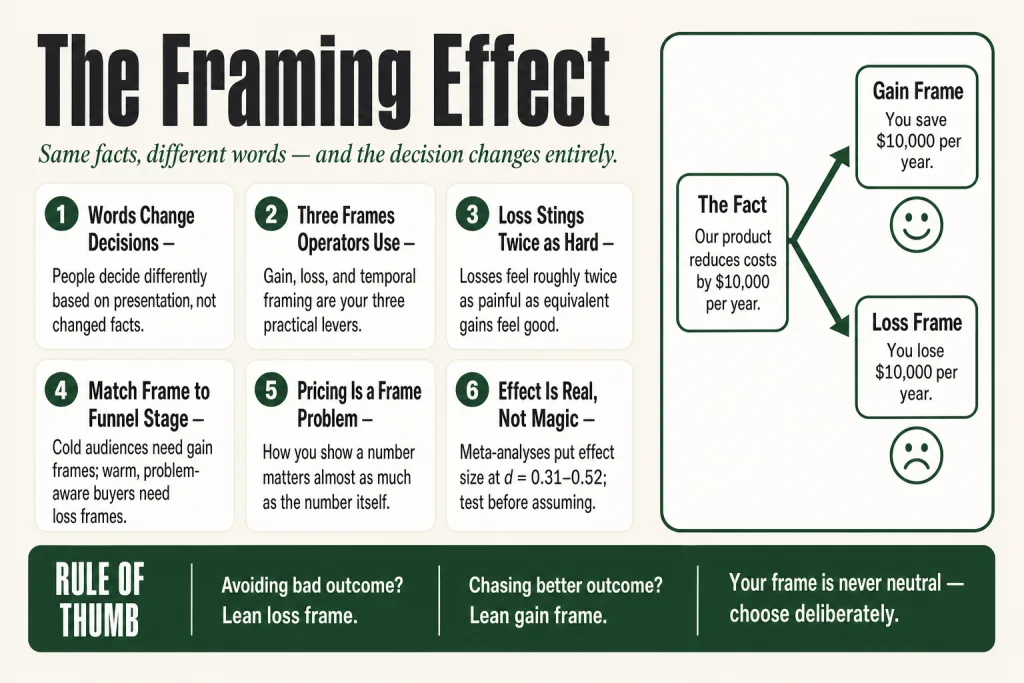
- The framing effect means people respond differently to the same information depending on how it’s presented, gain vs. loss, big number vs. small, certain vs. risky.
- Tversky and Kahneman named it formally in 1981, building on Prospect Theory: losses feel roughly twice as painful as equivalent gains feel good.
- Three frames an operator needs to know: gain framing, loss framing, and temporal (pennies-a-day) framing.
- Your frame is never neutral. If you haven’t chosen one deliberately, you’ve chosen one accidentally, and it’s probably the wrong one.
- Effect sizes in the research range from small-to-moderate (d ≈ 0.31 in Kühberger’s 1998 meta-analysis) to moderate (d ≈ 0.52 after publication-bias correction). The pop-psychology version overstates it. High-stakes, numerate buyers are less susceptible. Test before assuming.
- AI tools can generate and help you test multiple frame variants quickly, but the judgment call on which frame fits your audience stays with you.
Where the Framing Effect Came From
The formal story starts in 1981. Amos Tversky and Daniel Kahneman published “The Framing of Decisions and the Psychology of Choice” in Sciencebuilding on their 1979 Prospect Theory work. Loss aversion was the engine. The framing paper was the demonstration of what that engine could do to real decisions.
Their most famous experiment: participants chose between two disease-response programs. When options were framed as lives saved, “200 people will be saved”, most chose the certain outcome. When the identical options were framed as deaths, “400 people will die”, preferences flipped toward the risky choice. Same math. Reversed preference. The only thing that changed was the frame.
The finding implies something uncomfortable: preferences aren’t stable objects people quietly reveal through their choices. They’re constructed on the spot, shaped by the language you hand them. Kahneman won the Nobel Prize in Economics in 2002 (Tversky had died in 1996; the prize isn’t awarded posthumously).
One calibration worth making before you rewrite every page on your site: Kühberger’s 1998 meta-analysis of 136 studies put the average effect at d = 0.31, small to moderate. A p-curve reanalysis corrected that upward to d = 0.52 after accounting for publication bias, close to the Many Labs Replication Project’s own estimate of d = 0.60. The effect is real and replicable. It’s just not magic. You’re not going to reword a headline and watch revenue double overnight.
The Three Frames Every Operator Actually Uses
Most treatments of the framing effect collapse it into one idea, “gain vs. loss”, and leave it there. That’s useful but incomplete. Three distinct types of framing matter in practice: risky-choice framing, attribute framing, and goal framing. For a small-business operator, these map to three practical levers you pull constantly, whether you realize it or not.
1. Gain Frame vs. Loss Frame
This is the one everyone knows, and it’s the most powerful. A gain frame highlights what the customer gets. A loss frame highlights what they risk missing or losing if they don’t act. The directional rule from Prospect Theory is that losses sting roughly twice as much as gains feel good, which is why loss framing tends to create urgency.
The part that gets glossed over: the frame that outperforms depends heavily on what the customer is buying. Negative framing is more effective for prevention-focused products, insurance, security, compliance software, and for creating urgency around time-limited offers. Gain framing tends to win for aspiration-focused purchases, the things people buy to become something rather than to protect what they already have.
A good working rule: if your customer is buying to avoid a bad outcome, lean loss. If they’re buying to achieve a better outcome, lean gain. When the product sits in the middle, and many do, the structure that tends to work is leading with a negative frame to surface the problem, then transitioning to a positive frame to present the solution. That’s the architecture behind Problem-Agitate-Solution copy.
2. Attribute Framing
This is the “95% fat-free vs. 5% fat” type. Attribute framing involves highlighting either the positive or negative aspect of the same factual characteristic. In marketing, this shows up everywhere: a contractor who says their materials are “97% defect-free” is using a gain frame on a quality claim. The competitor who quotes a “3% defect rate” is saying the identical thing with a loss frame, and will lose the comparison even if both numbers are equally true.
Attribute framing is especially powerful in services where customers struggle to evaluate quality directly. When you control which attributes get highlighted and how they’re labeled, you shape the customer’s entire mental model of your offer. This connects directly to positioning: what you call your product’s attributes, not just what those attributes are, determines how you’re perceived.
3. Temporal Framing (the Pennies-a-Day Effect)
Underused and underrated. Gourville’s 1998 research in the Journal of Consumer Research identified the “pennies-a-day” strategy, reframing a large aggregate expense as a small daily one, as a reliable way to reduce the perceived cost of a transaction. A $30/month gym membership becomes “less than a dollar a day.” A $999/year software platform becomes “$2.74/day.” Framed well, that’s less than a cup of coffee.
The effect runs in both directions, though. The pennies-a-day strategy works when the resulting daily figure is genuinely small, but effectiveness can reverse at high dollar magnitudes, where a large annual fee can actually feel more legitimate and manageable than a daily breakdown that reads as alarming. For small-ticket recurring purchases, break it down. For large annual contracts with buyers who think in budget cycles, the annual number can feel more grounded. Know your buyer’s mental accounting unit before you pick the time frame.
Amazon frames Prime as “less than $12 per month” rather than leading with the full annual fee, a textbook application of temporal framing that makes a larger commitment feel like a smaller one. Any operator with a recurring offer can do the same.
The Framing Effect in Pricing, Where Small Operators Leave Money on the Table
Pricing is where the framing effect has the most direct, measurable impact for a small operator, and where most operators are leaving money on the table without realizing it.
Discounts. “50% off” and “Save $200 on a $400 service” are mathematically equivalent for the same product. They don’t land the same way. Use the Rule of 100: for products under $100, percentage discounts feel larger. For products over $100, absolute dollar discounts feel larger. A 20% discount on a $60 product should read “20% off.” A $300 discount on a $1,500 service package should read “save $300.” Same economics, better psychological impact.
Price presentation on proposals and quotes. Most small operators put the total annual number front and center, because that’s how they think about the project. The client, thinking in monthly budget terms, immediately compares that lump sum to their monthly cash flow and panics. Showing monthly equivalents first, even when billing annually, often reduces sticker shock substantially, without changing the price at all. How you say the number matters almost as much as the number itself.
Price increases. “We’re increasing your monthly rate from $800 to $832” is a loss frame, pure and simple. “We’re making a 4% annual adjustment, in line with our cost index, to continue delivering the same level of service” is a context frame that normalizes the change. The customer gets the same information either way, but one version triggers loss aversion and the other positions the increase as routine. This isn’t manipulation, it’s recognition that your customer’s response to pricing news is shaped by the language around it.
Anchoring as a framing device. Showing a higher “original” price next to your current price is a gain frame, the customer feels like they’re getting something, not spending something. A retailer who shows a $400 item marked down to $249 is using the original price as a reference point to frame the current price as a win. This is why the anchoring effect and the framing effect are so frequently used together in pricing displays, they reinforce each other.
Subscription and service tier labels. Naming your tiers “Basic / Pro / Enterprise” is a loss-aversion frame disguised as a lineup: nobody wants to be on “Basic.” Naming them “Starter / Growth / Scale” is a gain frame, everyone’s on a journey, just at different points. Same tiers, different emotional register. The name you give your options shapes how customers feel about choosing any of them.
Putting this to work? The ideas in the Canon are the foundation under the tactical playbook in Build a Complete Marketing Department — grab the free companion kit at mmsvegas.com/resources.
Framing in Copy: The One Sentence That Changes Everything
Every headline you write makes a framing choice. Most operators don’t think of it that way, but that’s exactly what’s happening. You’re deciding whether to orient the reader toward what they gain, what they avoid losing, what kind of person they become, or what outcome they’re heading toward. The framing effect is the underlying mechanism that determines which of those orientations produces more action from your specific audience.
Take a simple service claim. A pest control company can write:
- “Keep your family safe from pests”, gain frame, safety achieved
- “Don’t let pests threaten your family’s health”, loss frame, risk avoided
- “97% of our customers see zero pest activity within 30 days”, attribute frame, positive stat front and center
- “Join 3,000 Las Vegas homeowners who’ve already eliminated the problem”, social proof frame
None of these are wrong. All of them are factually equivalent if the facts check out. But they will not perform equally with every audience. The loss frame tends to outperform with homeowners who’ve had an infestation, they know the downside is real. The gain and social frames may outperform with first-time buyers who haven’t experienced the problem yet and are shopping preventively.
This is the insight most framing-effect explainers skip: the right frame depends on where your customer is in their awareness of the problem. A customer who already knows they have a problem responds better to loss-avoidance language. A customer who doesn’t fully feel the problem yet responds better to aspiration and outcome framing. Mixing this up, running loss-frame copy at unaware audiences, can feel alarmist. Running gain-frame copy at people who are already anxious about a real problem can feel dismissive. This is why Voice of Customer research is so useful here: the language your existing customers use to describe their problem tells you which frame they were already in when they decided to buy.
The GEICO tagline is worth a moment of study. “15 minutes could save you 15% or more on car insurance”, held for over two decades, is a gain frame anchored to a specific, believable claim. It doesn’t say “don’t overpay for insurance” even though that’s the identical proposition stated as a loss. The gain frame was chosen deliberately, and it built one of the most recognized brand promises in American advertising. The lesson isn’t to copy GEICO, it’s that deliberate frame selection, tested and committed to, beats accidentally landing on something vague.
The Rule of One in copywriting says every piece of copy should make one promise to one reader about one desired outcome. The framing effect is about how that one promise is oriented. You can nail the specificity of the message and still undercut it by choosing the wrong frame for your audience’s current state of mind.
Where the Framing Effect Works Hardest for a Small Operator
The framing effect doesn’t hit equally in all situations. Here’s where it tends to pay off most reliably for a small business:
Proposals and quotes. This is probably the highest-leverage application most operators never think about. How you structure the numbers, which figure you lead with, whether you show the daily/monthly/annual equivalent, what you call each line item, all of it is framing. A $6,000 annual retainer framed as “$500/month for a fully staffed marketing function” will get a different reaction than a lump-sum invoice with no context. The math is identical. The psychological experience of reading it is not.
Pricing page layout. Operators with online pricing pages almost always have at least two tiers. The order, the labels, the visual emphasis, the default selection, all framing decisions. Highlighting your middle tier as “Most Popular” is a social-proof frame that reduces the perceived risk of that choice, and it uses the Decoy Effect to make the lower tier feel insufficient. These aren’t tricks, they’re structural realities of how humans process a set of options. You’re not neutral if you don’t choose. You’re just choosing randomly.
Risk-heavy service categories. Legal, financial, insurance, medical, security, and compliance categories all involve a buyer who’s acutely aware of what goes wrong if they choose wrong. Loss framing tends to outperform in these categories because the buyer is already running loss-avoidance calculations. Meeting them in that frame, rather than dragging them toward aspirational language they didn’t ask for, is respectful and effective.
Onboarding and retention communication. The emails you send after someone buys are framing opportunities most operators waste. “Here’s what you haven’t set up yet” (mild loss frame) is a different experience than “You’re one step away from [desired outcome]” (gain frame). For subscription products where churn is the enemy, gain-framed progress messages, showing customers what they’ve already achieved, build the kind of attachment that makes cancellation feel like giving something up.
Objection handling in sales conversations. When a prospect says “that’s expensive,” the instinctive response is to justify the number. The framing-aware response is to reframe the reference point. If the alternative is hiring an employee, or living with the problem, or continuing to lose X per month to inefficiency, those are the real reference points, and framing your price against any of them changes the perceived cost-benefit entirely. The anchoring effect and framing working together, in real time.
Where the Framing Effect Won’t Save You
The framing effect is useful, but it’s not a magic wand. Here’s where operators get into trouble by expecting it to do more than it can.
When the underlying offer is bad. Framing changes how people perceive information, it can’t manufacture value that isn’t there. If your price is genuinely above market without a defensible reason, temporal framing buys you a click; it doesn’t buy you a sale. The frame gets you to the conversation. The substance has to close it.
With highly numerate, high-stakes buyers. Meta-analyses find wide variation in the framing effect by domain, numeracy, and whether the decision is truly high-stakes. A CFO evaluating a six-figure software contract is going to run the actual numbers. A procurement officer comparing vendor bids is going to strip the framing and look at comparable line items. Framing still matters in enterprise B2B, but it operates more subtly, through category positioning, than through pennies-a-day math.
When the frame contradicts the customer’s direct experience. If a customer has already decided your service is expensive, showing them a per-day breakdown isn’t a revelation, it’s an evasion. They’ll see through it and trust you less. Framing shapes context before a judgment forms; it doesn’t override a judgment that’s already hardened. The window is earlier in the relationship.
When you’re using the wrong frame for the audience’s awareness level. Loss-framing an unaware audience often reads as alarmist. They haven’t felt the sting of the problem, so the threat doesn’t register as real, it registers as pressure. Gain frames and aspirational language work better at the top of the funnel; loss frames and urgency work better mid-to-bottom with warm audiences who already feel the problem.
When the frame feels dishonest. “Less than a cup of coffee a day” is a legitimate temporal frame, truthful and contextual. But if the comparison feels stretched, the customer’s skepticism activates and the frame backfires. There’s a credibility ceiling. Every frame needs to pass the “would I say this to a smart friend?” test. If it makes you wince, it’ll make them suspicious.
Common Mistakes
- Sending a lump-sum proposal with no comparison point, then wondering why prospects go dark — A $6,000 annual retainer with no context is an inkblot test, prospects fill in their own reference price, usually the cheapest competitor they Googled. Before your next proposal goes out, add one sentence naming the real alternative: the cost of a junior hire, the monthly burn from the existing problem, or the monthly equivalent of the annual fee. You don’t need a paragraph. One sentence with a specific number does the reframing. Without it, you’ve outsourced the anchor-setting to Google.
- Running loss-frame ad copy at a cold audience that has never felt the problem — A home security company ran Facebook retargeting copy, ‘Don’t let your family become a statistic’, as their cold prospecting creative too. Cold audiences who haven’t experienced a break-in or near-miss don’t feel that threat as real; they read it as a scare tactic and scroll past. The fix is to segment creatively, not just demographically: cold traffic gets aspiration and outcome framing (‘See clearly, day or night’), warm retargeting gets loss urgency. Same product, two different frames, matched to where the audience actually is.
- Breaking down a high-dollar contract to a daily figure that’s still alarming — A $14,400/year managed IT contract broken down to ‘$39.45/day’ doesn’t read as small, it reads as a daily drain. Buyers without a mental benchmark for daily IT spend don’t have a petty-cash comparison to reach for, so the daily figure sits there feeling exposed. For contracts in this range, test monthly framing (‘$1,200/month, about what most businesses spend on a single unplanned IT emergency’) rather than daily. The monthly figure connects to how buyers actually budget.
- Using ‘Basic’ as a tier name and then being surprised that nobody picks it — A SaaS operator had three tiers: Basic, Pro, Business. ‘Basic’ had the lowest conversion rate by a wide margin, not because of price, but because nobody wants to identify as a ‘Basic’ customer. Renaming it ‘Starter’ took about 20 minutes. In their next quarterly review, the lowest tier’s share of new signups rose measurably, with no change to features or price. The tier name is a frame. It runs before any feature comparison happens.
- Keeping the same gain-frame onboarding and retention emails for customers who are actually churning — An operator running a monthly subscription service used identical ‘here’s what’s new’ emails for active and at-risk accounts. For customers who hadn’t logged in for 45 days, aspirational update emails were invisible, the customer had already mentally moved on. A separate track for at-risk users, built around mild loss framing (‘Your [specific feature] setup is sitting unused, here’s what you’re leaving on the table’), reactivated a meaningful share before they formally canceled. Segment your list by engagement, then match the frame to the behavioral signal.
Operator’s Take
Here’s the thing most operators miss about framing: it’s not primarily an advertising problem. It’s a proposal problem. A pricing-page problem. A how-you-answer-objections-on-the-phone problem. The copy nerds obsess over ad headlines while leaving the real money sitting in a poorly structured PDF they email to every prospect who asks for a quote.
So let’s be concrete. Five things you can actually do with this, starting this week.
1. Add one comparison sentence to every proposal over $2,000. Right now, your proposal probably leads with a total or a scope, and your prospect’s brain immediately reaches for a reference point you didn’t give them. They’ll compare your $6,000 retainer to the cheapest agency they found on Google. You want them comparing it to a junior marketing hire at $55,000/year who still needs managing. One sentence does this: “This is roughly equivalent to one day per week of a dedicated in-house marketer, without the overhead, benefits, or onboarding time.” You haven’t changed the price. You’ve changed the math they’re doing in their head.
2. Check which number appears first on your pricing page. If it’s the annual total, you’re handing a loaded gun to sticker shock. Monthly-first presentation, even for annual billing, almost always reduces friction. Amazon does this with Prime. HubSpot does it with every plan tier. You can do it with a three-tier service lineup and a line of text that reads “billed annually.” Five minutes of work, potentially meaningful lift in your close rate. Test it.
3. Match your frame to funnel position, not to your personal comfort. Most operators have a frame they like, usually gain, because writing “here’s what you get” feels friendlier than writing “here’s what you risk losing.” That’s a stylistic preference, not a strategic one. Go read your last five Google reviews. If your customers keep saying things like “I was losing sleep over the compliance exposure” or “leads were slipping through the cracks,” that’s a loss frame in the wild, and your cold-traffic copy should meet them there. Once they’re a paying customer, shift to progress and outcomes. Different job, different frame.
4. Use AI to generate frame variants in 90 seconds, then make the judgment call yourself. Take any claim in your current copy. Feed it to an AI tool with this prompt: “Give me three versions of this claim, one gain-framed, one loss-framed, one built around a specific number or outcome.” You’ll have raw material to compare in under two minutes. The generation is fast. The judgment about which variant fits your audience’s current awareness level, and whether the tone matches your brand, stays with you. The tool doesn’t know whether your list is warm or cold, whether your buyers are anxious or aspirational. You do.
5. Audit your retention emails separately from your acquisition copy. The urgency and mild loss framing that closes a new customer can feel like manipulation once they’re already paying you monthly. Retention emails should lean gain: what they’ve achieved, what’s available next, what they’d be walking away from if they canceled. Churn decisions are loss-framed by nature, you want the customer feeling the loss of leaving, not continued pressure about the problem that originally brought them in. Two very different emotional jobs.
One honest note before you go reframe everything: the research puts the average effect size in the small-to-moderate range (d = 0.31 to 0.52 depending on the analysis). Framing won’t save a weak offer, and it won’t double your revenue from a single headline tweak. What it does do, reliably, is stop you from accidentally talking your prospects out of a good decision, which is the more common failure. Most operators don’t undersell because they lack psychology knowledge. They undersell because they default to whatever frame was easiest to write. Fix that first, then test the rest.
Used in
- ✓ Build a Complete Marketing Department
Used to teach operators how to write gain- and loss-framed messaging for each stage of the marketing hourglass, matching frame to buyer awareness level. - ✓ The Missing Manual for FunnelKit
Applied when structuring pricing tables, order bumps, and upsell copy, choosing temporal framing, tier labels, and default selections that reduce friction and lift average order value. - ✓ The Missing Manual for Make
Referenced when building automated email sequences that shift frame from aspiration (top-of-funnel nurture) to loss-avoidance urgency (cart abandon and expiry reminders).
FAQ
Is using the framing effect in marketing unethical?
Not inherently. Every presentation of information involves framing, there’s no neutral option. The ethical line is honesty: frames that present true information in a helpful context are legitimate; frames that obscure material facts or manufacture false urgency are not. The test is whether a customer, fully informed, would feel they made a good decision.
Should I always use loss framing because losses feel stronger than gains?
No. Loss framing outperforms for prevention-focused purchases where the buyer is already worried about a bad outcome. For aspiration-focused products, growth tools, fitness, improvement, gain framing typically performs better. The right frame depends on your buyer’s current mindset, not a universal rule.
How do I know which frame is working for my business?
Test it. Email subject lines and ad headlines are the fastest surfaces, split a list and measure open or click rates within 48-72 hours. Pricing pages and proposal language take longer to accumulate data but have higher dollar stakes. Don’t rely on intuition when you can get actual data.
What’s the difference between the framing effect and the anchoring effect?
Anchoring is specifically about numerical reference points, a high price shown first makes a lower price feel like a bargain. Framing is the broader concept: gain vs. loss orientation, temporal reframing, attribute selection, and goal framing all qualify. Anchoring is one tool that framing can use.
Does temporal framing (pennies-a-day) work for every price point?
No, it works best when the resulting daily or monthly figure is genuinely small and relatable. The effect can reverse at high dollar magnitudes: a large annual fee may be better presented as an annual figure than broken down to a daily number that reads as alarming. Match the denomination to where the number feels most comfortable.
Can I use AI to help with framing decisions?
AI is useful for generating multiple frame variants quickly, give it a fact about your offer and ask for gain-framed, loss-framed, and temporal-framed versions. That gives you raw material to test. The judgment about which variant fits your audience’s awareness level and your brand’s voice stays with you.
Further reading
- Thinking, Fast and Slow by Daniel Kahneman, the primary source for Prospect Theory and the framing effect, written for general readers. The chapters on loss aversion and frames are the relevant ones.
- Predictably Irrational by Dan Ariely, applies behavioral economics findings, including framing, to real consumer decisions with accessible examples.
- Influence: The Psychology of Persuasion by Robert Cialdini, covers the influence principles that interact with framing, particularly scarcity and social proof as contextual frames.
Sources: Tversky, A. & Kahneman, D. (1981). “The Framing of Decisions and the Psychology of Choice,” Science211, 453 to 458. | Kahneman, D. & Tversky, A. (1979). “Prospect Theory: An Analysis of Decision Under Risk,” Econometrica47, 263 to 291. | Levin, I.P. Schneider, S.L. & Gaeth, G.J. (1998). “All Frames Are Not Created Equal,” Organizational Behavior and Human Decision Processes76, 149 to 188. | Kühberger, A. (1998). “The Influence of Framing on Risky Decisions: A Meta-Analysis,” Organizational Behavior and Human Decision Processes75, 23 to 55. | Steiger & Kühberger (2018). “A Meta-Analytic Re-Appraisal of the Framing Effect,” Zeitschrift für Psychologie. | Gourville, J.T. (1998). “Pennies-a-Day: The Effect of Temporal Reframing on Transaction Evaluation,” Journal of Consumer Research24(4), 395 to 408. | Goffman, E. (1974). Frame Analysis: An Essay on the Organization of Experience. | BehavioralEconomics.com Framing Effect entry. | Umbrex Behavioral Pricing Frameworks. | Advergize Framing Effect Marketing overview.
Brian Kasday spent forty years in direct-response marketing before rebuilding the whole operation as a one-person shop. He writes The Operator’s Library — including “Build a Complete Marketing Department” — for operators who’d rather build it themselves than wait on someone else.
Build the department these ideas describe — the free companion kit: mmsvegas.com/resources.
More The Operator's Canon guides
Free · Operator Toolkit
Want the tools, not just the guide?
Get the free operator toolkit — templates and checklists for the systems you actually run, plus a note when this guide changes.
Get the free toolkit →How to cite: The Framing Effect. Associated with Amos Tversky & Daniel Kahneman, 1981. The Operator’s Canon, MMS Vegas. https://mmsvegas.com/library/framing-effect-explained/