
Last updated: July 2026
The playing to win strategy framework is the clearest answer anyone has given to a question most operators never actually answer: what, specifically, are we choosing not to do? By the end of this page, you’ll be able to run your own five-question cascade, identify the one or two choices that are genuinely undecided in your business right now, and understand why getting those wrong makes every downstream decision harder than it needs to be.
Most small businesses don’t lack goals. They lack choices. There’s a meaningful difference. Goals tell you where you want to end up. Choices tell you what you’ll do, and what you’ll refuse to do, to get there. The playing to win framework, developed by A.G. Lafley (the CEO who turned around Procter & Gamble) and strategy advisor Roger Martin, is built entirely around that distinction. It’s not a planning template. It’s a forcing function: five interconnected questions that, when answered together, produce a coherent strategy rather than a list of aspirations dressed up in a slide deck.
The reason it matters for operators specifically is that small businesses are uniquely vulnerable to the “play everywhere” trap. You can serve any customer, in any geography, solving any problem. Nobody stops you. The cascade stops you, or at least forces you to have an honest conversation with yourself about what you’re actually committing to.
The idea in 30 seconds
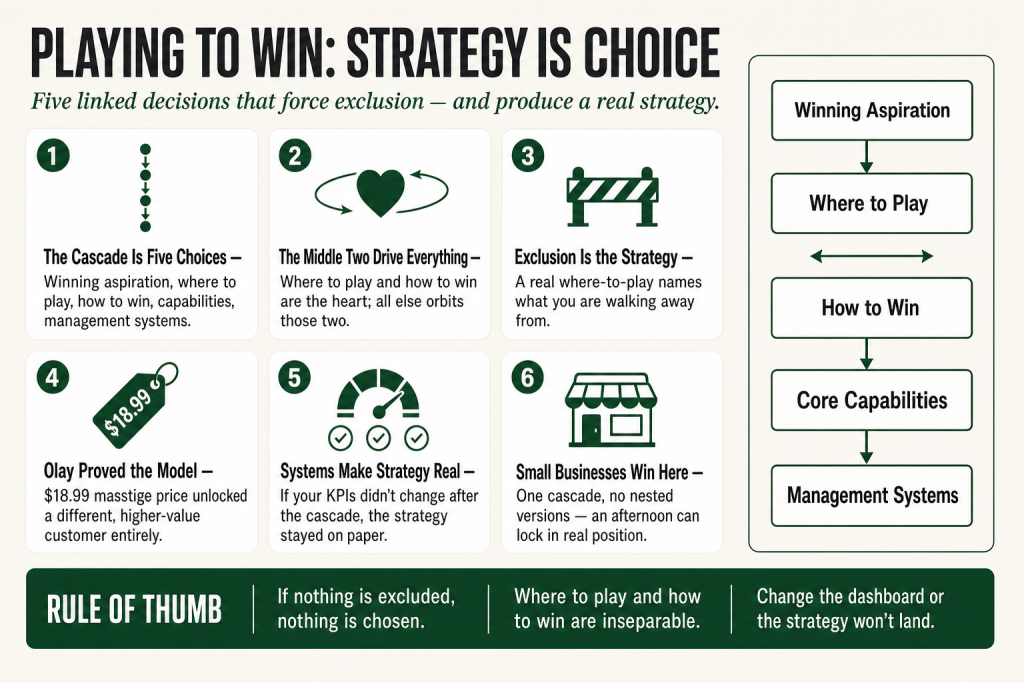
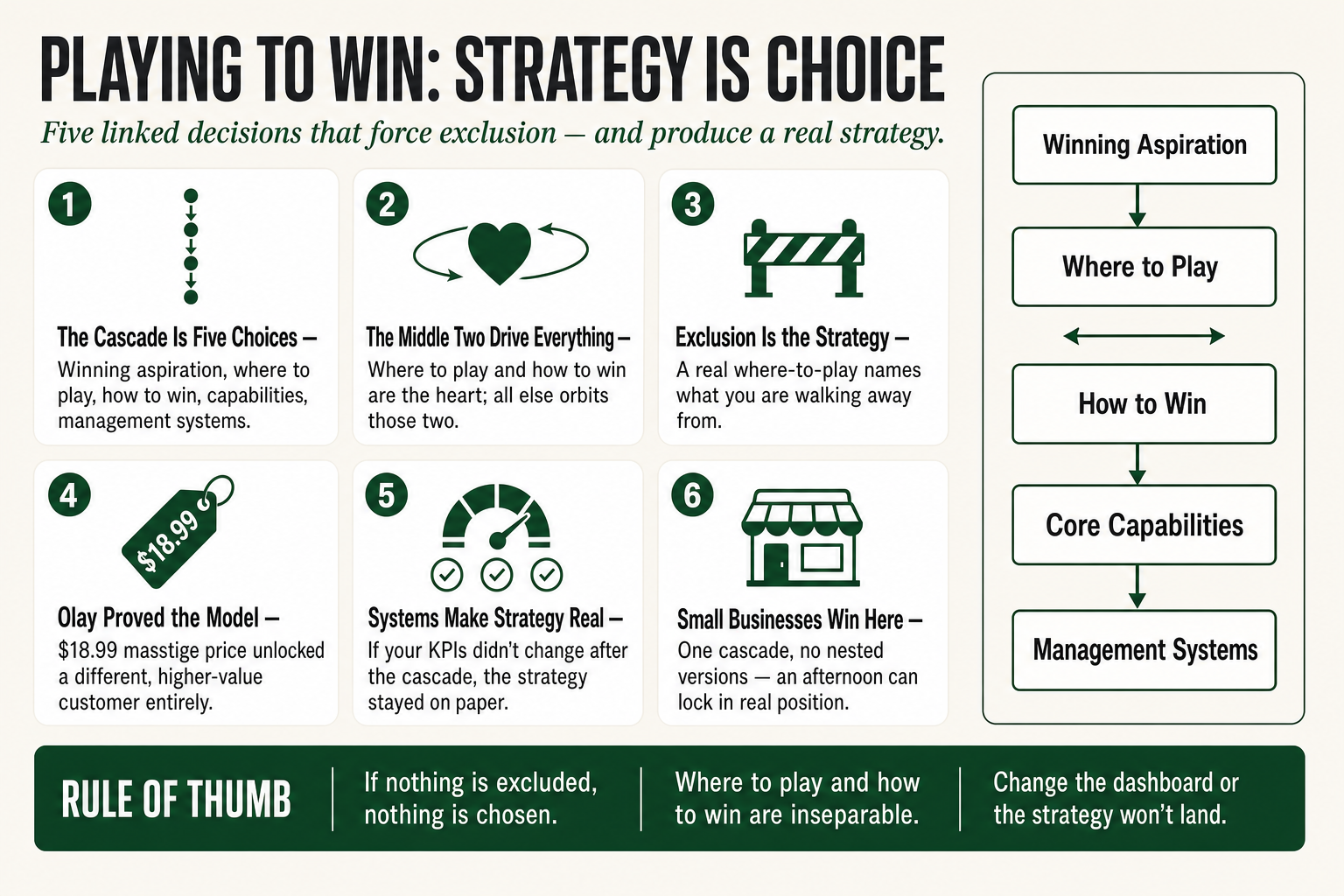
- The playing to win strategy framework is five linked choices: winning aspiration, where to play, how to win, core capabilities, and management systems.
- The choices form a cascadeeach one constrains and reinforces the others. Change one and the rest shift too.
- The heart of the whole thing is the middle pair: where to play and how to win there. Everything else orbits those two.
- A strategy that doesn’t rule anything out isn’t a strategy, it’s a wish list. The cascade forces exclusion.
- For a small operator, the full cascade fits on one page. You don’t need a P&G-sized planning process to use it.
- It complements, but does not replace, Rumelt’s Strategy Kernel. Rumelt asks “what’s the problem?”; Lafley and Martin ask “what do we want to win?” Use both.
Where the Playing to Win Framework Came From
The cascade’s origins trace to 1987, when Roger Martin led a Monitor Company strategy assignment for the medium-duty truck-axle business of Eaton Corporation in Battle Creek, Michigan. It was his first attempt at building a coherent strategy methodology, he drew what he later called the first rudimentary strategy process, a rough sketch of how strategic analyses needed to be sequenced. Between 1987 and 1989, Martin and colleagues created and taught a program called Applied Strategic Management for P&G’s newly formed Category Management Teams, the engagement where he first met A.G. Lafley. The five-question structure we know today wasn’t formalized until the mid-1990s, during separate client work that incorporated Martin’s latest thinking on strategic choice structuring.
The framework’s real proving ground came when Lafley became CEO of P&G in 2000 and made the cascade central to how the company set strategy at every level. According to the book’s own publisher page and multiple corroborating sources, under Lafley’s leadership P&G’s sales doubled, its profits quadrupled, its market value increased by more than $100 billion, and its portfolio of billion-dollar brands grew from 10 to 24. The book was published by Harvard Business Review Press in 2013 and won the Thinkers50 Best Book Award for 2012 to 2013.
Worth noting about the origin story: this wasn’t built in a classroom. Truck axles at Eaton, then Pampers and Olay at P&G. That’s part of why it translates to smaller operations better than most enterprise frameworks. The questions are scale-agnostic even if the examples aren’t.
The Problem: Strategy as Vague Ambition
Ask most business owners what their strategy is and you’ll get something like: “We want to be the best in our market, grow revenue, and deliver an exceptional customer experience.” That’s not a strategy. That’s a mission statement nobody will argue with, which is exactly why it’s useless. If everyone agrees, nothing was chosen.
Martin is direct about this: strategy is choice. Not a planning document, not a vision statement, a set of interrelated decisions that position you to win somewhere specific. That sounds obvious said plainly. It’s apparently not obvious in practice, because most businesses carry around implicit strategies that commit to nothing. They serve any customer who shows up. They compete on price when needed and on quality when they can. Every move is reactive, and there’s no coherent thread connecting any of it.
There’s a sharper way to put it: there’s a difference between playing to win and playing not to lose. Playing not to lose means staying alive without making hard trade-offs, spreading resources across many opportunities without the focus needed to excel at any of them. It feels prudent. It’s actually a slow drain. Playing to win means making choices that could be wrong, committing resources on the basis of a hypothesis about where and how you can build real advantage.
The cascade is the structure that turns that belief, strategy is choice, into a usable process. Nothing more, nothing less.
The Playing to Win Strategy Framework: All Five Choices
The strategic choice cascade is five choices that must work together: a winning aspiration, where to play, how to win, core capabilities, and management systems. Here’s what each one actually means for an operator, not the corporate version, but the practical one.
1. Winning Aspiration
This is not your mission statement. Lafley and Martin are explicit that growth targets aren’t a strategy: a strategy is a coordinated and integrated set of where-to-play, how-to-win, core capability, and management system choices, not a revenue number.
For an operator, this means getting specific enough that you can actually tell whether you’re winning or losing. “Be the best HVAC company in Phoenix” is closer than “deliver exceptional service.” “Become the go-to bookkeeper for food-and-beverage businesses in our metro” is better still, it specifies the customer and the market. The aspiration sets the direction for everything below it, so vagueness here poisons every downstream choice.
2. Where to Play
This covers geography, customer segment, product or service category, price tier, and channel. The choices are interdependent, your chosen customer segment implies a channel; your chosen price tier implies a customer type. Choosing the wrong playing field means you can’t win, regardless of how strong your capabilities are.
The critical word is not. A real where-to-play choice names what you’re walking away from. A regional residential roofing company that stays out of commercial work has made one. A law firm focused strictly on estate planning for clients with between $500K and $5M in assets has made one. Those exclusions are what make the strategy real.
3. How to Win
This is where competitive advantage lives. The answer to: why would a customer in your chosen arena pick you over anyone else? For small operators, the how-to-win is usually either cost leadership (you’re structurally cheaper), differentiation (you deliver something meaningfully different), or, the rarest but most defensible, a specific combination of both in a narrow arena nobody else has defined. That last one is the Olay play, which we’ll get to in a moment.
The how-to-win only makes sense relative to the where-to-play. If you change the arena, you often have to change the how-to-win too. That’s why the two are inseparable, and why the cascade asks you to develop them together.
4. Core Capabilities
Build only the capabilities that directly support your where-to-play and how-to-win decisions. This is the reality check built into the cascade. You might decide to win among enterprise customers on a differentiation basis, but if you don’t have a sales team that can manage six-month procurement cycles, the capabilities aren’t there yet. The capability question forces honest gap analysis: what do you have now, what do you need to build, and is building it realistic given your resources?
For most small operators, three to five capabilities are in play. A boutique fitness studio competing on coached, results-driven training needs: programming expertise, coaching talent, retention systems, and enough physical capacity to deliver consistently. Weak in one, the whole thing leaks.
5. Management Systems
The final choice covers the systems that support and measure the strategy. For operators, this translates directly to: what do you measure, how do you hire, what does your weekly check-in cover, and what KPIs sit on your dashboard? If your systems are generic, just tracking revenue and hours, they won’t reinforce a differentiated strategy.
A pest control company that has decided to win among high-income residential customers on a relationship-and-communication differentiation shouldn’t be measuring technician throughput as the primary KPI. It should be measuring customer retention, net promoter scores by technician, and response time on service calls. The measurement shapes behavior, so if the numbers don’t align with the strategy, the strategy stays on paper.
The Cascade Logic
The choices at the top set context for the choices below, and choices at the bottom refine the choices above. Plan to loop. In practice, you start somewhere, probably at the aspiration, work down, and then work back up. The bottom choices inform the top, the top constrains the bottom, and eventually the whole thing locks into coherence. That’s a cascade, not a checklist.
The Olay Case: What a Real Cascade Looks Like
The clearest illustration of all five choices working together is the Olay turnaround, the central case in the book, and the one Martin has continued to reference because it shows the mechanism cleanly.
By the late 1990s, Oil of Olay was a slowly growing brand sitting below $800 million in sales, selling pink cream at $3.99, mainly through drugstores, and informally known as “Oil of Old Lady.” The P&G beauty team considered three paths: compete harder in the bargain segment, move into prestige at $30-plus in department stores, or carve out a third position nobody owned. They chose the third, what became known as the masstige play: staying in mass channels like Walmart, CVS, and Kroger, while creating a prestige-like shopping experience. They also focused on the 25 to 49 demographic rather than the 50-plus crowd most skincare companies chased.
The price point was the tell. Testing showed that at $12.99, the response was positive but the buyers were mostly existing mass-channel shoppers, trading up within the channel. At $15.99, purchase intent dropped off a cliff. At $18.99 it surged back, and this time the team was pulling consumers who also shopped department stores. That specific number wasn’t arbitrary; it was the threshold where a different customer became reachable. Olay Total Effects launched at $18.99, as confirmed by Roger Martin’s own July 2025 Medium essay on the strategy.
One competitor risk they thought through explicitly: Estée Lauder could have matched the masstige strategy by adding mass-channel distribution to Clinique and probably crushed the attempt. P&G concluded Estée Lauder wouldn’t move because its prestige channel partners would revolt. They were right. Olay grew across the 2000s into a multi-billion-dollar brand and the leader in mass skincare.
What makes this useful for smaller operators isn’t the scale, it’s the structure. The where-to-play choice was specific and exclusive: P&G chose not to compete in prestige skincare, not to hold the $3.99 product as the brand’s center, not to chase department-store distribution. Those exclusions are the strategy. A local accounting firm that decides its where-to-play is small manufacturers in one metro, and its how-to-win is cost-accounting expertise the big regional firms don’t specialize in, has made the same kind of move at a different scale. Every downstream choice follows from the two in the middle.
Putting this to work? The ideas in the Canon are the foundation under the tactical playbook in Build a Complete Marketing Department — grab the free companion kit at mmsvegas.com/resources.
Playing to Win vs. the Strategy Kernel: Two Frameworks, One Job
These two frameworks get conflated constantly, and clearing that up is practical, not academic, because they do different things and a smart operator benefits from both.
The sharpest way to put the difference: Rumelt’s kernel starts with a diagnosis, what’s actually going on, what’s the central challenge, what makes this situation hard. Only after naming the obstacle do you build a guiding policy and coherent actions. The cascade starts the other way: it begins with aspiration, what does winning look like, and structures the integrated set of choices that would produce it. One starts from the problem; the other starts from the prize.
In practice, that distinction matters when you’re deciding which to use. If your business is under real competitive pressure, a new entrant is eating your margins, a channel shift has disrupted distribution, a customer segment has changed behavior, Rumelt’s diagnosis-first approach is right. You need to name the crux honestly before you start designing your way out of it. Jumping straight to aspiration and choices when the situation hasn’t been clearly diagnosed is how operators build beautiful cascades that miss the actual problem entirely.
The cascade is better when the business is stable enough to think offensively, when you’re not in crisis mode but want to build deliberate position over the next few years. The questions assume you have enough environmental stability to commit. When you don’t, commit-first thinking is dangerous.
Used together, the sequencing is clean: run Rumelt’s diagnosis first to get honest about your competitive situation. Then use the cascade to design the integrated set of choices that responds to that diagnosis. Rumelt tells you what you’re dealing with; the cascade helps you build your way through it.
One more practical note: Rumelt’s guiding policy does some of the same work as the cascade’s where-to-play and how-to-win pair, both are meant to channel and constrain choices. But Rumelt stops there. He doesn’t force you to specify capabilities and management systems. That’s where the cascade adds weight: it pushes the strategy all the way down to operations, not just direction-setting. The Strategy Kernel is covered separately in the Canon; if you haven’t read it, that’s the right companion to this page.
Where the Playing to Win Framework Applies for Small Operators
The cascade was built at a company with billions in revenue and global distribution. It works better at small scale, not worse, because small businesses have less organizational inertia. There may be only one cascade to run. You can answer the five questions in an afternoon and make decisions that would take P&G a quarter.
Four operator situations where it earns its keep:
- You’re growing but scattered. Revenue is up, but you’re serving wildly different customer types with a team that’s stretched thin. The cascade forces one question: which customers are we actually playing to win with, and which are we just accepting because they showed up? That’s not a rhetorical question, the answer should change who you pursue next quarter.
- A competitor is making you look expensive. The temptation is to match price or pile on features. Wrong move, usually. The cascade asks something harder: should you redefine where you play rather than fight harder in an arena that’s been commoditized? Sometimes the right answer to a price war is to stop fighting it in that segment entirely.
- You’re designing something new. A second location, a new service line, a channel you haven’t tried. Run the cascade as a design tool before you build anything. What’s the aspiration? What’s the specific arena? How exactly will you win there? Do the capabilities exist? A single afternoon with these five questions will surface more real problems than six months of execution on a plan that never asked them.
- Your team has diverged. When your staff has four different ideas about who the customer is and what makes you different, the cascade is a conversation-forcing document. Work through it together and you’ve aligned around something real, not a values statement, but actual choices with actual exclusions.
One note on management systems for small operators: this is the choice most often skipped. Not because people don’t understand it, because it feels administrative. But your weekly standup agenda, your hiring criteria, the first question your onboarding asks, those are your management systems. If they don’t reflect the choices you made in steps one through four, the strategy exists only in the document. Audit three things when you’re done: what you measure, how you hire, and what your customer review process rewards. If none of those changed, the strategy didn’t land.
Where the Framework Struggles
The cascade is not a discovery tool. If you genuinely don’t know your market well enough to form a hypothesis about where to play and how to win, running the five questions will produce vague answers and false confidence. The framework formats whatever you put into it, good judgment produces a clear strategy, but poor market knowledge produces a neatly packaged mistake.
It’s also less useful when your environment is so volatile that the choices can’t hold for more than a few months. A business pivoting rapidly in response to a crisis, a pandemic-era hospitality company, a retailer dealing with a supply chain collapse, needs Rumelt’s diagnostic approach first: what is the situation, what’s actually changeable, what must be preserved? The cascade assumes you have enough stability to commit. When you don’t, commit-first thinking is dangerous.
There’s also a tendency, especially for first-time users, to answer the questions at the wrong level of specificity. “Win in the B2B services market” is not a where-to-play. “Win with professional services firms with 10 to 50 employees in the Southwest who’ve outgrown their current software but can’t afford enterprise solutions” is a where-to-play. The cascade only works if the choices are specific enough to exclude something. Vague answers produce the illusion of strategy without the discipline.
Finally: the cascade handles horizontal competitors well but is less explicit about disruptive substitutes. If your real threat isn’t a rival in your category but a technology or business model that makes your category obsolete, the five questions need supplementing with harder disruption thinking. The framework was built for competitive positioning within a defined market, it’s less suited to the question of whether the market itself is going away.
Common Misunderstandings About the Playing to Win Strategy Framework
“This is just goal-setting with extra steps.” Goals describe a future state. The cascade describes how you’ll create it and what you won’t do to get there. The exclusions are the strategy. If your cascade doesn’t make choices that could be wrong, choices that rule out real alternatives, it’s goals dressed in five boxes.
“The cascade lives at the company level.” It can live at any level, business unit, service line, campaign. At P&G, there were brand-level cascades, category cascades, sector cascades, and a company-level cascade. A small operator can apply this at whatever altitude is useful. The scale changes; the logic doesn’t.
“‘Winning aspiration’ means growth targets.” Revenue targets describe where you want to end up financially; the aspiration is the market position you’re trying to build. “Be the dominant choice for commercial landscaping contracts under $100K in our city” is a winning aspiration. “Grow revenue 30% year over year” is a financial goal. The cascade needs the former to function.
“The framework is only for big businesses.” The examples are large, P&G, Pampers, Joy dish detergent in Japan. The questions aren’t. A plumbing company, a staffing agency, a boutique winery, any business that faces real choices about who to serve, how to compete, and where to build can use the cascade. The P&G examples just happen to have the most documented detail.
Common Mistakes
- Writing a where-to-play that doesn’t exclude anyone — After drafting your where-to-play, add one sentence that starts: ‘We are explicitly not serving…’ If you can’t complete it honestly, the choice isn’t real yet. Keep narrowing until at least one plausible customer type or segment falls outside the line.
- Running the cascade before doing any market research — Treat the cascade as a design tool, not a discovery tool. If you don’t yet have a grounded hypothesis about where real demand and real advantage exist, run Customer Discovery first, talk to at least five to ten potential customers before filling out the five boxes. Otherwise you’re formatting a guess.
- Treating the capability question as a wish list or vision exercise — Write two columns: what your team can actually deliver right now at production quality, and what your how-to-win requires. The gap between those two lists is a strategy risk you need to plan around, assign a build timeline to each item, or rethink the how-to-win before you commit resources.
- Finishing the cascade and changing nothing about how the business actually runs — Before the planning session ends, name one metric to add or swap on your dashboard, one hiring criterion to make explicit in your next job post, and one question to add to your weekly team check-in. If none of those change, the strategy won’t either, it’ll sit in a document while the business runs on old signals.
- Treating the cascade as a one-time exercise rather than a live set of commitments — Put a quarterly review of the middle two choices, where to play and how to win, on your calendar now. When a significant competitor move, a technology shift, or a change in customer behavior happens, revisit those two before reacting tactically. Reactive pivots that skip the cascade tend to undo the coherence the whole exercise built.
Operator’s Take
The cascade doesn’t fail because operators don’t understand it. It fails because they won’t commit to answers that could be wrong. Every question has a version that sounds like a real answer and isn’t, and most operators land on that version and move on.
Test your where-to-play answer by trying to prove it wrong. If you described your target customer and someone across the table couldn’t argue against it, if they couldn’t say “but that also includes X, which we definitely don’t want”, you haven’t made a choice yet. The answer has to be specific enough to exclude something real. “Small B2B companies in our metro” doesn’t cut it. “Owner-operated distributors with $2M, $8M in revenue who are running QuickBooks but starting to need job-cost tracking” does. One of those can be wrong. The other can’t.
Don’t run the full five-question ritual on day one. Get where-to-play and how-to-win sharp enough that you could write a one-paragraph pitch to a single named customer type, one that would clearly land for them and clearly not fit someone else. Once those two are locked, the capability question becomes a gap analysis, not a brainstorm. You’re comparing what you actually have against what your how-to-win requires.
On capabilities: operators consistently overestimate what they have. The real test is whether your team could execute the how-to-win you just described, right now, at the volume and quality your chosen customer expects. Not “could we build toward it”, now. If there’s a gap, name it, assign a timeline to closing it, and decide whether the gap is big enough to change your where-to-play entirely. Better to discover that in a planning session than six months into a new service line that’s bleeding margin.
Management systems is where strategies quietly die. Finish the cascade, feel good about it, and Monday morning the team is still running on the old KPIs, because nobody changed the dashboard, nobody updated the hiring criteria, nobody told the ops manager that retention now matters more than throughput. Before you ship the strategy, pick three things: one metric to add or swap, one hiring criterion to make explicit, one question to add to your weekly check-in that directly tests whether the strategy is working. Three changes. That’s enough to create real pull-through in most small operations.
One genuine push-back on the framework: it works best when you have at least a working hypothesis about your market. If you’re in real discovery mode, new customer type, brand-new market, major pivot, run Customer Discovery first. Talk to real customers, test the assumptions that would have to be true for your where-to-play to hold. The cascade is a design tool, not a research tool. You can design yourself confidently into a market nobody wants if you skip that step.
The cascade is also revisable, that’s not a caveat, that’s the point. Martin himself encourages toggling between the choices as the competitive environment shifts. When a competitor makes a big move, when a customer segment changes behavior, when a new channel opens, those are the moments to re-examine which choices still hold. Review it at minimum once a year. Strategy isn’t a document you finalize; it’s a set of active commitments you tend.
For operators using AI in this process: the cascade is an excellent prompt structure. Run each of the five choices as its own research brief, use AI to pressure-test your answers against observable market data, and have it challenge the coherence between your where-to-play and your capability inventory. AI won’t make the choices for you, what you’re willing to commit to and walk away from stays with you, but it can compress the analytical work and surface contradictions in your thinking faster than any solo review will.
Used in
- ✓ Build a Complete Marketing Department
Used to define the strategic positioning layer before any messaging, channel, or offer decisions are made, the cascade answers who we serve and why we win before the marketing system is built around those choices. - ✓ The Missing Manual for FunnelKit
Used to ensure funnel architecture, offer sequence, segmentation, and conversion logic, reflects deliberate where-to-play and how-to-win choices rather than generic funnel templates. - ✓ The Missing Manual for Make
Used to design automations and management-system triggers that reinforce strategic choices, so operational workflows measure and reward behaviors aligned with the operator’s competitive positioning.
FAQ
What are the five choices in the playing to win strategy framework?
Winning aspiration (what does winning look like in market terms), where to play (which customers, geographies, and channels you’ll compete in), how to win (your source of competitive advantage in that arena), core capabilities (the skills and systems required to execute), and management systems (the metrics, hiring, and processes that reinforce the other four choices).
Can a small business use the Playing to Win cascade, or is it only for large corporations?
It works at any size. A small business actually has the advantage of running a single cascade rather than nested ones, no brand-level, category-level, and sector-level versions to reconcile. The P&G examples are large-scale, but the five questions are scale-agnostic. A two-person firm that answers them with real specificity will get more from the exercise than a large company that answers them vaguely.
How is Playing to Win different from Rumelt’s Strategy Kernel?
Rumelt starts with diagnosis, what is the actual challenge or obstacle, and builds a guiding policy and coherent actions from there. Lafley and Martin start with aspiration, what does winning look like, and cascade down through five linked choices. In practice: use the Strategy Kernel when something is clearly wrong and needs naming first; use the cascade when you’re stable enough to build forward position deliberately. Rumelt’s guiding policy channels action but stops short of specifying capabilities and management systems, that’s the gap the cascade fills.
How often should an operator revisit the cascade?
At minimum annually, and whenever a significant market shift occurs, a major competitor move, a technology disruption, or a material change in customer behavior. The cascade is not a five-year commitment; it’s a set of active choices that should be stress-tested when circumstances change.
What’s the most common mistake operators make with the cascade?
Answering the questions at too high an altitude, answers that are technically true but don’t exclude anything. A real where-to-play choice names what you’re walking away from. If every plausible customer could still fit your answer, you haven’t made a choice. The fix is simple: after writing your where-to-play, add a line that begins ‘We are explicitly not serving…’ and see if you can complete it honestly.
Do you have to answer all five questions to use the framework?
Technically no, but skipping any of the five creates coherence gaps downstream. Most operators start with where to play and how to win, the two central choices, and then work backward to sharpen the aspiration and forward to identify capability gaps and system requirements. The full set is more powerful than any individual part.
Further reading
- Playing to Win: How Strategy Really WorksA.G. Lafley and Roger L. Martin (Harvard Business Review Press, 2013). The source. Covers the full cascade in detail with P&G case studies; the Olay and Pampers examples are the most instructive for operators building position in a defined market.
- Good Strategy/Bad StrategyRichard Rumelt (Crown Business, 2011). The diagnostic complement to the cascade. Read it before you fill out the five boxes if your business is dealing with a real competitive challenge that hasn’t been clearly named yet.
- Roger Martin’s Playing to Win/Practitioner Insights seriesAvailable on Medium and Substack. Martin has published hundreds of practitioner-facing essays extending the framework since the book’s 2013 publication; the pieces on winning aspiration, the cascade as a whole, and the relationship between strategy and planning are the most useful for operators.
Sources: A.G. Lafley and Roger L. Martin, Playing to Win: How Strategy Really Works (Harvard Business Review Press, 2013); Roger Martin, ‘The Origins of Playing to Win,’ Medium, February 2023; Roger Martin, ‘Strategy & Non-Financial KPIs,’ Medium/Substack, July 2025; HBR Press publisher page for Playing to Win (hbr.org/books/playing-to-win); Forbes, ‘A.G. Lafley: Develop a Strategy to Win at Business,’ February 2013; Thinkers50, ‘Thinkers50 2013 Best Book Award Announced’ (thinkers50.com); Roger Martin, ‘Compelling Communication for Your Strategy,’ Medium, August 2021; Thinkers50 press release PDF, November 2013.
Brian Kasday spent forty years in direct-response marketing before rebuilding the whole operation as a one-person shop. He writes The Operator’s Library — including “Build a Complete Marketing Department” — for operators who’d rather build it themselves than wait on someone else.
Build the department these ideas describe — the free companion kit: mmsvegas.com/resources.
More The Operator's Canon guides
Free · Operator Toolkit
Want the tools, not just the guide?
Get the free operator toolkit — templates and checklists for the systems you actually run, plus a note when this guide changes.
Get the free toolkit →