
Last updated: July 2026
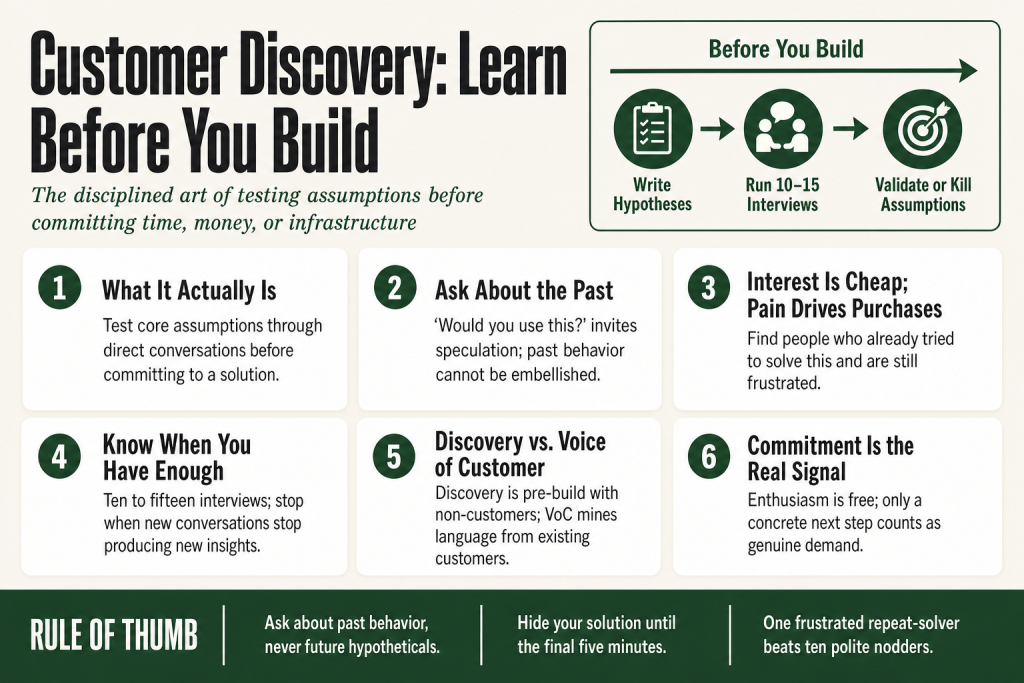
Customer discovery is the disciplined process of testing your core assumptions about a customer problem through direct conversations, before you commit time, money, or infrastructure to a solution. By the end of this page, you’ll know how to structure those conversations so they produce real signal instead of polite encouragement, and you’ll understand the specific operator mistakes that turn this powerful idea into wasted afternoons.
Most small-business owners skip this step, or they do a version of it that feels like discovery but isn’t. They pitch the idea to a few friends, get nodding heads, interpret the nods as market research, and build. Then they launch into silence. The product was fine. The problem wasn’t as widespread, as urgent, or as painful as assumed. What was missing wasn’t effort or skill, it was evidence gathered before the commitment was made.
That’s the specific failure customer discovery exists to prevent. Not all failure, not all uncertainty, just the particular disaster of building something nobody needed badly enough to pay for.
The idea in 30 seconds
- Customer discovery is the practice of testing your assumptions about a customer problem through structured interviews, before you build the offer, hire the staff, or spend on ads.
- It was formalized by Steve Blank in The Four Steps to the Epiphany (2003) and became the first step of the Lean Startup movement.
- The single biggest failure mode: asking people if they like your idea instead of asking about their actual behavior and past frustrations.
- The goal isn’t validation. It’s to find out what’s actually true, including the parts that would kill your plan.
- Ten to fifteen interviews with the right people, asked the right way, will tell you more than six months of guessing.
- Customer discovery is a pre-build tool; once you have an existing customer base, you shift to Voice of Customer work, a different job with different methods.
Where Customer Discovery Came From
Steve Blank wasn’t an academic. He’d lived through eight startups and noticed a pattern: companies were failing not because they lacked a product, but because they’d built something nobody wanted badly enough to buy. He formalized a counter-approach in 2003 with The Four Steps to the Epiphanyframing your initial product idea as a hypothesis to be tested rather than a plan to be executed. Customer discovery, structured conversations with potential customers before you build, was step one.
Eric Ries, who had studied under Blank, combined that framework with agile software development and popularized the term ‘Lean Startup.’ Rob Fitzpatrick later contributed The Mom Testnamed for the observation that even your mom will protect your feelings, so your interview questions have to be designed to make flattery structurally impossible. Blank supplied the framework. Fitzpatrick supplied the conversational mechanics.
What operators tend to miss: this wasn’t invented for Silicon Valley. Blank was solving a failure mode that exists in every industry, building first and asking questions later, at the most expensive possible moment. That hasn’t changed.
The Problem Customer Discovery Actually Solves
The standard small-business move goes like this: you notice a problem, sketch a solution, get excited, build it, go to market, and then find out somewhere in that last step whether anyone actually wanted it. The learning happens at the worst possible moment. You’ve already hired, built the website, printed the brochures, signed the lease.
This isn’t a startup cliché. It’s a description of how nearly every small-business expansion decision gets made. The restaurant adds a catering menu because the owner thinks it would work. The consultant launches a course because people asked for one, which isn’t the same as people who will pay for one. The HVAC company adds a maintenance plan without first checking whether customers see their current situation as a problem worth solving.
Bad discovery conversations aren’t just useless, they’re actively misleading. People who are politely asked if they like something will say they like it. Social pressure rewards agreement. So those early nods give you false confidence, which causes you to over-invest cash, time, and team in something that doesn’t have the traction you believed it did.
Customer discovery changes the sequence: learn first, build second. The operative word is learnnot confirm. If you go into interviews hoping to have your idea validated, you will find a way to hear validation whether it’s there or not. The discipline is in designing conversations that make it genuinely hard to lie to you.
The Core Principles of Customer Discovery
Start with written hypotheses, not hunches
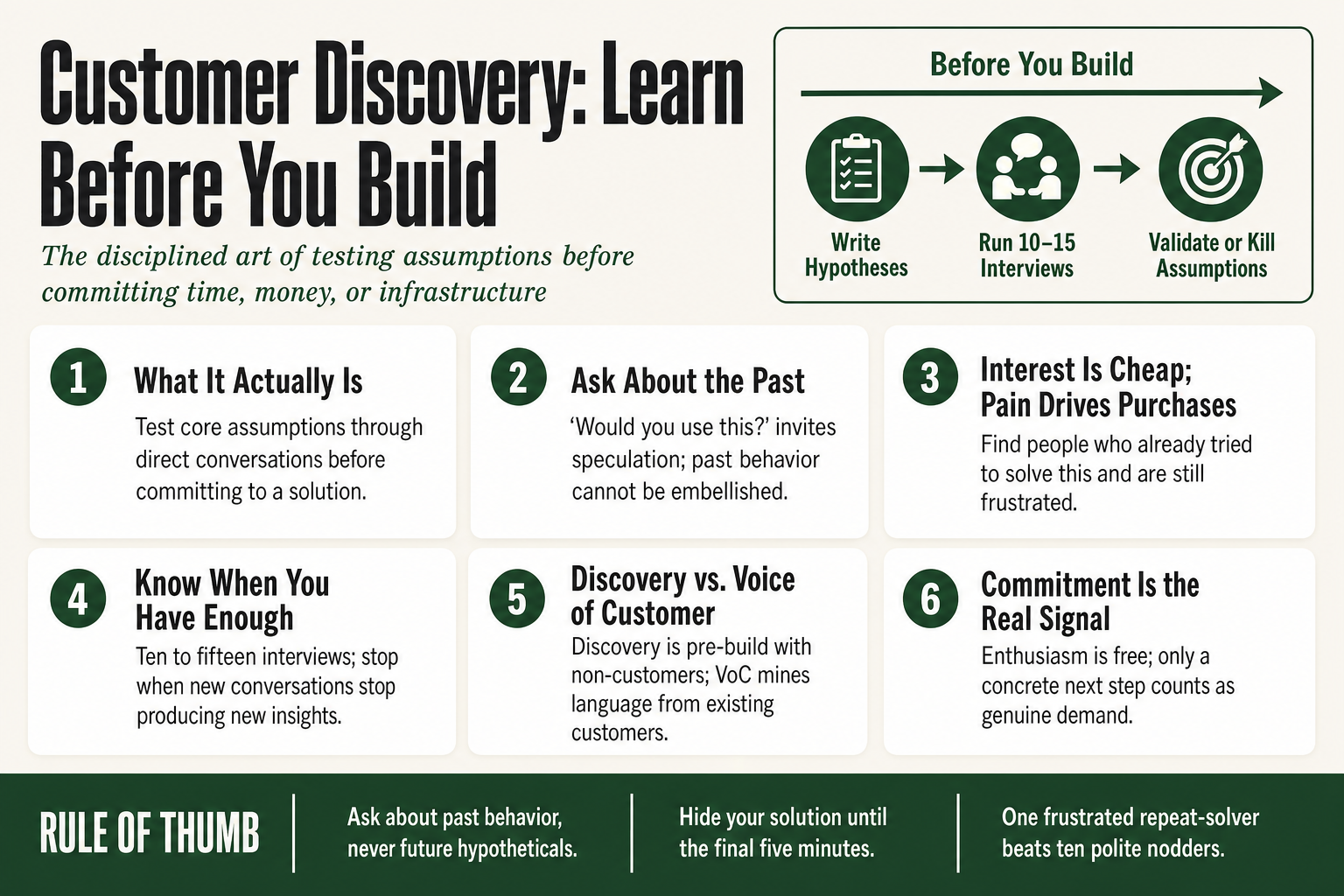
Before you talk to anyone, write down what you believe. Who has this problem, how often does it affect them, how are they solving it today, what would a better solution need to do, and what would they pay. These aren’t answers, they’re the assumptions you’re testing. Writing them down forces you to notice what you actually believe versus what you’ve conveniently left vague. Every assumption is either confirmable or killable.
Ask about the past, not the future
This is the piece most people get wrong. Ask about specific past experiences rather than hypothetical futures. ‘Would you use this?’ invites speculation and politeness in equal measure. Instead: ‘Walk me through the last time you dealt with this. What did you do? How long did it take? What did that cost you?’ Past behavior has already happened, it can’t be embellished to make you feel good.
Don’t reveal your solution early
Keep your specific product idea off the table for as long as possible. Once you’ve described it, the conversation shifts from ‘is this problem real?’ to ‘is your idea good?’, and now you’re getting feedback shaped by the interviewer’s desire not to crush you. Keep the conversation on their world, their current behavior, their frustrations, until the very end.
Chase specifics, not generalities
Ask for stories, not opinions. Ask about what they’ve actually done, not what they’d hypothetically do. Ask where they already spend time and money, because that’s where the real pain lives. The signal you’re looking for isn’t ‘that sounds interesting.’ It’s ‘I spend three hours a week on exactly that, I’ve tried two tools, and I’m still not happy.’ That’s a person with a real problem. The first kind of response is just friendliness.
Look for pain, not interest
Interest is cheap. Pain is what drives purchases. There’s a useful question sequence here: Does the problem exist at all? Is it frequent enough to matter? Is it painful enough to pay to solve? Are they already spending money on a workaround, and is that workaround failing them? You want the person who has already tried to solve this and failed, not the person who finds the concept appealing.
Know when you have enough
Stop when new interviews stop producing new insights. In most discovery contexts, that happens within ten to fifteen conversations for a well-defined segment. When the last three or four interviews mostly confirm what you already heard, you have enough to proceed. This isn’t a survey, you don’t need statistical significance. You need pattern clarity.
Running a Customer Discovery Interview That Actually Works
Most discovery interviews fail not because of the questions but because of the posture. The interviewer is secretly pitching. They nod too eagerly at favorable answers. They change the subject when the answer is inconvenient. They end with ‘so you’d buy this, right?’ and count the answer as data.
Here’s a structure that holds up:
Before the conversation: Write out your top five assumptions, the ones that, if false, would kill the idea. Design questions aimed at those five. Set a rule: you are not allowed to mention your solution until the last five minutes, and only if they ask.
Opening the conversation: Frame it as research, not a pitch. You’re trying to understand how people in their situation currently handle a general problem area. Ask about their past and present behavior, not future hypotheticals.
During the conversation: Ask open-ended questions and go one level deeper whenever you get a surface answer: ‘Why does that happen?’ ‘What did you do next?’ ‘How often does that come up?’ The goal is to understand their world, not confirm yours. Instead of ‘Would you buy this?’, try ‘How are you solving this today?’ or ‘When was the last time you faced this problem?’, those get honest answers rather than polite speculation.
The commitment signal: The most honest data in any discovery conversation isn’t what they say about your idea, it’s what they’re willing to do. You can’t fully trust what customers say they’ll do in the future; you can only trust how they currently behave. Translate that into your close: instead of asking ‘would you buy this,’ ask for a concrete next step. Would they join a beta? Can you follow up in two weeks with a prototype? Willingness to take a real step separates genuine interest from social politeness.
After the conversation: Write up notes immediately, not what you hoped they said, but what they actually said. Keep a running document tracking which assumptions are being confirmed, which are being challenged, and what unexpected patterns are emerging. Discovery interviews consistently surface needs the operator hadn’t anticipated.
On recruiting interviewees: Don’t survey your existing customers, that’s Voice of Customer work, which is different. For discovery, you want people in the segment you’re targeting who don’t already know you. Warm introductions work well. A strong way to end any interview is to ask whether they can introduce you to someone else in their field. A referral from inside the network beats cold outreach every time.
Putting this to work? The ideas in the Canon are the foundation under the tactical playbook in Build a Complete Marketing Department — grab the free companion kit at mmsvegas.com/resources.
Customer Discovery vs. Voice of Customer: Two Different Jobs
These two ideas are close neighbors and it pays to be precise about the boundary, conflating them leads to doing the wrong thing at the wrong time.
Customer discovery is a pre-build activity. You’re talking to people who are not yet your customers, or to early customers about a problem you haven’t yet solved. The output is a set of validated or invalidated hypotheses. You’re still searching.
Voice of Customer is a mining activity. It works on language and sentiment from your existing customer base, reviews, support tickets, sales call transcripts, exit surveys. The goal is to extract the exact words customers use to describe their problems so you can reflect them back in your messaging. That’s useful, but it’s a different job: you already have customers, you already have an offer, you’re optimizing the language that sells it. (See the Voice of Customer page for that toolkit.)
Where operators go wrong: they have an established business, they want to launch a new service line, and they survey their existing customers. That’s not discovery, it’s surveying a biased sample (people who already like you and your current offer) about a hypothetical future thing. The results will be misleading in exactly the ways you’d least expect. Discovery means getting out of your existing customer base and talking to people who haven’t decided to trust you yet.
The practical dividing line: if you’re trying to understand whether to build something, or who to build it for, that’s discovery. If you’re trying to understand how to talk about something that already exists, that’s Voice of Customer.
What Customer Discovery Looks Like in Practice
The famous examples are all from tech, which can make this feel irrelevant to a plumbing company or a law firm. Let’s fix that, but start with the tech cases because the mechanics translate directly.
Airbnb is the textbook case. In October 2007, Brian Chesky and Joe Gebbia were behind on rent in their San Francisco apartment. A major design conference was coming to town and every hotel in the city was sold out. Rather than build a platform, they set up three air mattresses in their loft, created a simple website offering accommodation and breakfast, and charged $80 a night. Three guests showed up. No survey, no slide deck, just the smallest possible real-world test of the one assumption that would kill the idea if it were wrong: that strangers will pay to sleep in someone else’s home. It worked. Nathan Blecharczyk later joined as the third co-founder to build out the technical infrastructure.
Drew Houston’s Dropbox test is equally instructive, though it’s worth telling accurately, because the story often gets compressed in retelling. In April 2007, Houston posted a short video demonstrating what a finished Dropbox would do and submitted it to Hacker News as part of his Y Combinator application. His prototype wasn’t public-launch-ready, but the video proved the problem, syncing files across devices, was real and resonant enough to get him into YC. A year later, during private beta, a second video posted on Digg caused the beta waitlist to jump from 5,000 to 75,000 overnight. Two different tests, two different moments. The through-line: proof of demand before full product commitment.
Joel Gascoigne did something similar with Buffer in 2010. He built a two-page landing page: step one described the idea and measured interest via email sign-up; step two showed a pricing page before sign-up, which led to a ‘not ready yet’ message. That two-step test confirmed both that people wanted the tool and that they were willing to pay for it, before he’d written much of the actual product.
Now leave the tech world entirely.
Warby Parker is a cleaner non-tech example, and the details matter. In 2008, co-founder Dave Gilboa lost a $700 pair of glasses on a backpacking trip just before starting his MBA at Wharton. The replacement cost was steep enough that he went through his entire first semester without them. That lived experience became the hypothesis: people need affordable prescription glasses, and a market dominated by a single company is badly failing them. Gilboa and his three co-founders, Neil Blumenthal, Andy Hunt, and Jeff Raider, spent time talking to fellow students, surveying classmates to test price tolerance, and researching the market before committing to a model. When they did launch online in February 2010, they ran out of home try-on inventory within days. Customers who couldn’t wait started emailing to ask if they could come see the glasses in person. There was no office, they were still working out of Blumenthal’s apartment on Walnut Street in Philadelphia, so that’s exactly where they invited people. Frames laid out on the dining room table, founders on the couch answering emails. Blumenthal later described it as customers seeing the people behind the brand, which was rare and drove word-of-mouth they couldn’t have bought. That’s discovery culture: staying close to the customer even when it’s messy and inconvenient.
Now translate all three into something closer to your own situation. Say you run a regional accounting firm and you’re thinking about adding a flat-fee CFO advisory service for small manufacturers. Write the hypothesis: ‘Small manufacturers in our region with $2 to 8M in revenue lack reliable cash-flow forecasting, don’t currently have a fractional CFO, and would pay $X/month for one.’ Spend three weeks talking to ten owners in that revenue band. Ask how they currently think about cash flow. Ask what happens when a big order comes in, how do they fund it? Ask what financial decisions keep them up at night and how they currently get help with those. Don’t mention your service. See whether the pain shows up, how vivid it is, and whether they’ve already tried to solve it with something that disappointed them.
If five of those ten people describe cash-flow timing as the single most stressful thing in their business, and two of them ask ‘does something like that exist at a price I could afford?’, you have a signal. If most of them shrug and say ‘our bookkeeper handles it,’ the problem isn’t urgent enough. Neither answer is wrong. Both are infinitely more valuable than six months of building before finding out.
The same logic applies to a physical therapy clinic thinking about corporate wellness contracts, a commercial cleaning company considering a specialized medical-facility offering, or a boutique fitness studio considering nutrition coaching. The industry doesn’t change the method. You’re always testing the same thing: does the problem exist, is it frequent enough to matter, and is the pain sharp enough that someone will actually pay?
Where Customer Discovery Applies for an Operator
Any of these situations call for discovery work before you commit:
- New offer or service line. You’re thinking about adding something new. You have an intuition about who would buy it and why. Before you set prices, build packages, or hire for it, spend two weeks confirming the intuition is actually true.
- New market segment. Your current offer works well for one type of customer. You want to expand to a different segment. That segment has different problems, different language, different priorities. You don’t actually know their world yet. Customer discovery is how you learn it before you mismarket to them for a year.
- Pivoting after a launch that didn’t work. You built the thing, it didn’t sell as expected. Before you assume it’s a pricing problem or a marketing problem, go talk to eight people who saw the offer and didn’t buy. The answer is almost always in those conversations.
- Entering a market you don’t have personal experience in. The best-positioned person to skip discovery is someone who has personally lived the problem. If that’s not you, if you’re building an offer for a customer whose daily life you don’t share, discovery isn’t optional. Your assumptions will be wrong in ways you can’t detect from the inside.
One thing worth naming: discovery is also useful for refining an offer that’s already selling but not performing as well as it should. If your close rate is lower than expected, if customers drop off at a predictable point, if the same objections keep coming up, structured conversations with people in that segment will surface what the numbers can’t tell you.
Where Customer Discovery Has Less to Offer
Customer discovery is most powerful at the front end of a decision. It has real limits, and pretending otherwise makes you waste time you don’t have.
When the problem and solution are already proven in your market. If you’re opening a second location of something that’s clearly working, and you’re not changing the model, the discovery has already been done. Go execute. Spending six weeks interviewing people about whether they want pizza when you’re opening a pizza restaurant in a neighborhood full of pizza buyers is not discovery; it’s procrastination.
When your existing customer base is large and the question is optimization, not creation. If you have hundreds of existing customers and you want to improve conversion on an existing funnel, that’s a job for analytics and Voice of Customer work, not cold discovery interviews with strangers.
When speed genuinely matters more than certainty. There are situations where the cost of being slow outweighs the cost of being wrong. If a market window is closing, if a competitor is moving fast, if a client is about to go elsewhere, sometimes you take the hypothesis and ship. Customer discovery has a time cost, and you have to weigh it honestly.
When operators use it as a way to avoid deciding. This is the subtler trap. Discovery can become a comfort blanket, always one more interview before committing. At some point the data is as good as it’s going to get and you have to make a call. Theme saturation is your signal: when the last three or four conversations are mostly confirming what you already heard, you have enough. Schedule the decision, not another interview.
What People Get Wrong About Customer Discovery
‘I already know my customers, this doesn’t apply to me’
Knowing your current customers is not the same as knowing the customer you haven’t yet acquired. Customer discovery is specifically useful when you’re entering new territory: a new offer, a new segment, a new geography. Familiarity with your existing base can actually make you overconfident when you move into adjacent markets, because you carry assumptions that were true in one context and may not be true in another.
‘I did a survey, that’s discovery’
Surveys measure what people are willing to say in response to your questions. Discovery interviews are designed to surface what people actually do and actually care about, including the things they wouldn’t think to mention in a survey. The format matters: a survey’s power is in scale and comparison; an interview’s power is in depth and surprise. A 200-response survey where every question confirms your idea is worth less than six conversations where three people describe a problem you’d never thought to ask about.
‘Positive feedback means the idea is validated’
Enthusiasm in a conversation is almost free to give. Watch for three flavors of bad data, compliments (‘this sounds great!’), hypothetical commitments (‘I’d totally use that’), and wishlists (‘could you also add…’), because all three can lead you to over-invest in something without real demand underneath it. The question isn’t whether they liked the conversation; it’s whether they took a concrete next step, offered a real commitment, or described a real version of the pain you’re trying to solve.
‘Discovery is a startup thing, established businesses don’t need it’
Customer discovery is a pre-build activity, and established businesses make pre-build decisions all the time. Every time you develop a new service, a new pricing model, a new campaign, or a new target segment, you’re making assumptions. The difference between a startup and a small business isn’t the presence of assumptions; it’s the volume of cash at risk when those assumptions turn out to be wrong. Established operators have more cash to lose, which makes the case for discovery stronger, not weaker.
‘I should only talk to people who are enthusiastic about the idea’
The most useful discovery conversations are often the ones where the person pushes back, doesn’t have the problem, or describes a completely different solution they’re already happy with. Disconfirming evidence is the point. Everyone likes approval, especially an operator who may have already started falling in love with a new idea. Pursue the truth even when it’s inconvenient. You want a representative sample of the segment, not a hand-picked audience of supporters.
Common Mistakes
- Pitching inside the interview — Don’t reveal your solution concept until the final few minutes, if at all, keep the conversation on their life, their current behavior, and their actual frustrations.
- Interviewing existing customers for a new offer — Your existing customers are a biased sample; recruit people from the target segment who don’t already have a relationship with you.
- Treating enthusiasm as validation — End every conversation with a concrete ask, a commitment to a next step, a beta slot, or a follow-up, and count only that as real signal.
- Running discovery after the build is already underway — Customer discovery has to happen before significant investment, not as a post-hoc justification; if you’re already building, what you need is customer feedback, not discovery.
- Stopping when they confirm the hypothesis — Actively probe for disconfirming evidence, ask what they would miss if your proposed solution didn’t exist, what alternatives they’ve tried, and where those alternatives fell short.
Operator’s Take
Customer discovery is not a research project. It’s a decision-support tool. So here’s how I’d actually use it, not as a startup founder with a runway clock, but as an operator with real overhead and real downside if a new offer flops.
For anything genuinely new, a service category you haven’t sold before, a segment you haven’t served, run two to three weeks of structured interviews before spending real money. Go in with one specific objective: find the person who has already tried to solve this problem and is still frustrated. That person is worth ten ‘sounds interesting’ responses. They have urgency. The others are being polite.
There’s one question I’d include before closing every interview: what are you currently spending, not hypothetically, but actually spending right now, on the closest existing solution? That number does more work than any competitive analysis. It tells you whether the pain generates invoices, and it gives you a real anchor for your pricing conversation. If they can’t answer because they’re spending nothing, the pain probably isn’t sharp enough to monetize.
For a pivot or a positioning adjustment on something that already exists, skip the full discovery cycle. You already know the problem exists. The question is narrower: why do people in this segment handle it the way they currently do, and what would have to change for them to switch? Five to eight focused conversations on that switching logic will tell you more than any amount of copy A/B testing, because they get underneath the behavior instead of just measuring it from the outside.
What I’d skip entirely: running discovery on something you’ve already sold successfully to the same buyer type in the same segment. The validation lives in your sales history. Go execute.
One thing that doesn’t get said clearly enough, the person who describes a problem in vivid, specific detail, who’s already tried three workarounds and is still frustrated, isn’t just a data point. They’re a future early adopter. Handle the conversation accordingly. Always ask at the end whether they’d be willing to try an early version of what you’re building, and whether they can introduce you to someone else in their situation. Discovery is research. It’s also the start of a pipeline.
On AI: useful here, and worth using. AI can help you draft your hypothesis sheet before you start, structure your interview guide, transcribe conversation notes, and surface patterns across ten conversations faster than you’d catch them manually. What it can’t do is sit across from a prospective customer and notice the pause before they answer, or register that they lit up when describing the workaround they hate. That read stays with you. AI compresses the prep and the synthesis; the judgment and the final calls don’t move.
Used in
- ✓ Build a Complete Marketing Department
Used in the offer development and market selection stages, customer discovery interviews inform which segment to target, which problem to anchor the offer to, and which positioning claims the market will actually find credible. - ✓ The Missing Manual for FunnelKit
Informs funnel strategy at the top-of-funnel awareness and hook stages, knowing the real language customers use to describe their problem (surfaced through discovery) drives the copy and offer structure that opens the funnel. - ✓ The Missing Manual for Make
Discovery findings inform which data to collect and which automation triggers matter, when you know the precise moments of friction in a customer’s journey, you can build automations that address real pain points instead of assumed ones.
FAQ
How many customer discovery interviews do I actually need?
For a well-defined segment, ten to fifteen is typically enough to reach theme saturation, the point where new conversations stop producing new insights. When the last three or four interviews mostly confirm what you already heard, you have enough to make a decision. More than twenty is usually procrastination.
Can I do customer discovery with my existing customers?
Only if you’re exploring a problem your existing customers also have and haven’t yet solved. If you’re targeting a new segment, your existing customers are the wrong sample, they already chose you, which introduces selection bias. For new-segment discovery, recruit people who don’t know your business.
What’s the difference between customer discovery and a focus group?
Focus groups aggregate opinion in a social setting, which means group dynamics and social pressure distort every answer. Customer discovery interviews are one-on-one, focused on past behavior rather than future opinions, and deliberately structured to prevent the interviewer from contaminating answers by revealing their idea early.
What if everyone I interview says they love the idea?
Treat it as a warning sign, not a green light. Enthusiasm is easy to give in conversation. The real test is whether they take a concrete next step, agree to a beta, provide a referral, or put money down. If none of them will commit to anything real, the enthusiasm in the room isn’t predictive of purchases.
Is customer discovery just for new businesses, or can an established business use it?
Established businesses make new-offer decisions constantly, and customer discovery applies to every one of them. Any time you’re considering a new service, a new segment, or a new pricing model, you’re making assumptions. Discovery is how you test those assumptions before you invest in them.
How does customer discovery relate to market research?
Traditional market research tends to be survey-based, quantitative, and focused on confirming known questions. Customer discovery is qualitative, conversational, and specifically designed to surface things you didn’t know to ask about. They’re complementary, research tells you scale; discovery tells you depth and nuance.
Further reading
- The Four Steps to the Epiphany by Steve Blank (2003), the book that formalized Customer Development and established customer discovery as the essential first step before any build or scale activity.
- The Mom Test by Rob Fitzpatrick (2013), the practical companion for actually running discovery conversations without being misled; covers question structure, commitment signals, and how to avoid collecting false positives.
- Running Lean by Ash Maurya (2012), applies Lean Startup principles in a structured canvas format, with customer discovery embedded in the problem-solution fit stage.
Sources: Steve Blank, The Four Steps to the Epiphany (2003); Rob Fitzpatrick, The Mom Test (2013); Joel Gascoigne, ‘Idea to Paying Customers in 7 Weeks: How We Did It,’ Buffer Resources blog (primary source); AgilePainRelief.com, ‘Fake Door MVP,’ citing Gascoigne/Buffer (January 2025); Leigh Gallagher, The Airbnb Story (2017), as excerpted in Knowledge@Wharton; Hostaway.com, ‘Airbnb Founders: Brian Chesky, Nathan Blecharczyk, and Joe Gebbia’ (December 2025); Shortform Books, ‘The Original Dropbox MVP Explainer Video’; YourStory, ‘Dropbox’s fake demo video that got 75K signups overnight’ (February 2026); DoganTech, ‘From 3-Minute Video to Tech Giant, Dropbox MVP Flashback’; CNBC, ‘How Warby Parker grew from eyeglasses upstart to sustainable business’ (September 2024); Fast Company, ‘How Warby Parker Narrowly Avoided Becoming a Victim of Its Own Early Success’ (February 2020); Knowledge@Wharton, ‘What Eyewear Startup Warby Parker Sees That Others Don’t’; Daily Pennsylvanian, ‘Warby Parker Comes Home to Philadelphia’ (January 2017); UXtweak, ’40+ Best Customer Discovery Questions’ (August 2025).
Brian Kasday spent forty years in direct-response marketing before rebuilding the whole operation as a one-person shop. He writes The Operator’s Library — including “Build a Complete Marketing Department” — for operators who’d rather build it themselves than wait on someone else.
Build the department these ideas describe — the free companion kit: mmsvegas.com/resources.
More The Operator's Canon guides
Free · Operator Toolkit
Want the tools, not just the guide?
Get the free operator toolkit — templates and checklists for the systems you actually run, plus a note when this guide changes.
Get the free toolkit →