
Last updated: July 2026
If you’ve ever Googled ‘blue ocean strategy explained’ looking for a clean answer and landed on a page full of Cirque du Soleil hagiography, you know the problem. The concept is genuinely useful. The way it gets taught is almost always too clean. So here’s the honest version: blue ocean strategy is a framework for stopping the fight over existing market share and instead creating space where the old competitive rules don’t yet apply. By the end of this page you’ll be able to run the ERRC Grid on your own business, sketch a rough strategy canvas, and, just as importantly, honestly decide whether a full blue ocean move is feasible for you or whether a sharper repositioning is the smarter play.
Most small operators are stuck in what Kim and Mauborgne called a red ocean: a defined market with established rules, known competitors, relentless pressure to cut prices or pile on features. Every marketing dollar goes toward winning a bigger slice of a fixed pie. Exhausting, and over time, usually a race to the bottom.
The blue ocean idea is seductive because it promises an exit from that treadmill, build something different enough and the comparison shopping stops, or at least slows down. The appeal is real. The trap is also real: this is one of the most cited and least honestly applied frameworks in business. Operators read the Cirque story, feel inspired, and then add a few features and raise their prices, calling it value innovation. It isn’t. This page is about what the framework actually requires, where it genuinely works for small operators, and where it becomes expensive wishful thinking.
The idea in 30 seconds
- The core idea: instead of competing harder in saturated markets (“red oceans”), create uncontested space where the old competitive rules don’t apply.
- Value innovation is the engine, simultaneously raising buyer value while cutting costs, not trading one off for the other.
- The ERRC Grid (Eliminate, Reduce, Raise, Create) is the practical tool that forces you to question every assumption your industry makes.
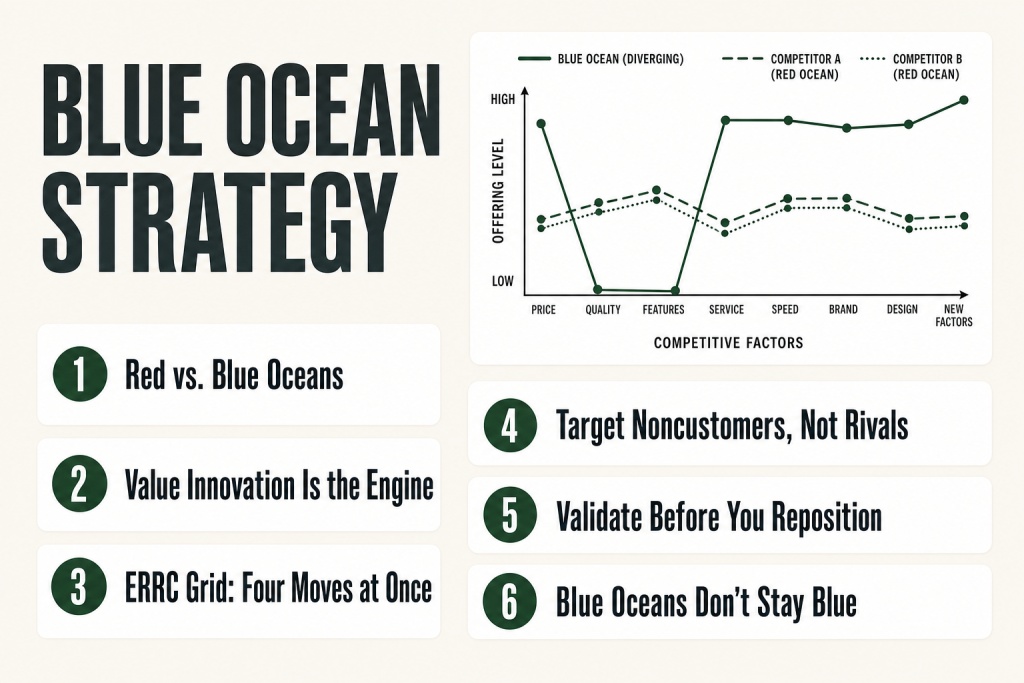
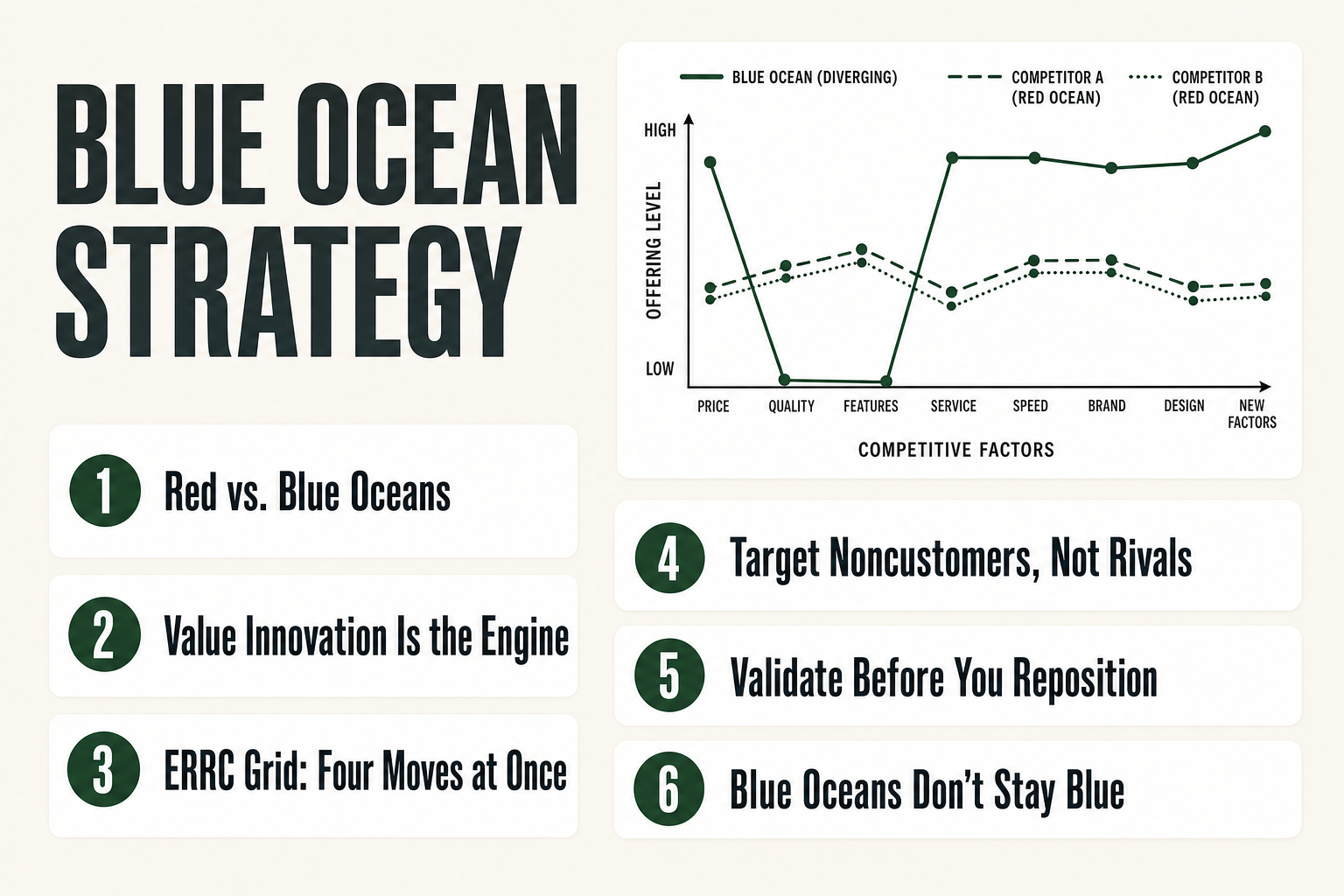
- The strategy canvas maps where your industry clusters, the crowded middle, and shows you the open lanes.
- For small operators, true blue oceans are rare; the more useful move is a partial repositioning that carves out a defensible niche inside a red market.
- The framework fails when operators use it to justify wishes rather than test them, customer discovery first, canvas second.
Where the Idea Came From
W. Chan Kim and Renée Mauborgne are professors at INSEAD in Fontainebleau, France. Their core argument, that high-growth companies followed a logic fundamentally different from conventional competitive strategy, first appeared in a 1997 Harvard Business Review article titled ‘Value Innovation: The Strategic Logic of High Growth.’ The 2005 book Blue Ocean Strategy (Harvard Business Review Press) pulled those ideas into a single framework; an expanded edition followed in 2015.
The intellectual target was Michael Porter. Porter’s competitive advantage framework told companies to pick a lane, cost leadership or differentiation, because trying to do both left you stuck in the muddy middle. Kim and Mauborgne pushed back directly: value innovation is the simultaneous pursuit of differentiation and lower cost, and they argued it defined every major market-creating success they’d studied.
One fair criticism upfront: the research examined only moves that succeeded. Academic reviewers have pointed to a selection bias, the framework is used as a lens through which earlier success stories are interpreted, with little large-scale quantitative evidence to test it against failures. Kim and Mauborgne have acknowledged they don’t have data on the hit rate of red versus blue ocean initiatives. Keep that in mind throughout. A useful tool, honestly applied, doesn’t need to be treated as a guaranteed recipe.
The Core Ideas: Red Oceans, Blue Oceans, and Value Innovation
Red oceans are existing markets where industry boundaries are defined and companies fight for shares of known demand. Competition is fierce, products converge, margins compress. The ocean is red because competitors wound each other fighting over the same ground.
Blue oceans are market spaces where competition either doesn’t yet exist or is irrelevantbecause nobody’s written the rules yet. Demand isn’t captured from rivals; it’s created. That distinction matters. Growth in a red ocean is zero-sum. Growth in a blue ocean expands the total.
The engine behind all of this is value innovationand be precise about what the term means, because it’s widely misused. Value innovation is not adding more features. It’s not being better than your competition. It’s the simultaneous pursuit of higher buyer value and lower cost, both at once, not one after the other. The value-cost trade-off that most business thinking treats as a given is exactly what a blue ocean move tries to break.
Why does that trade-off exist in most industries? Because companies watch each other. Every participant benchmarks against the same competitors and competes on the same dimensions. Costs inflate because everyone’s trying to outdo everyone else on the same attributes. A blue ocean move asks a prior question: which of these attributes do buyers actually care about, and which are just industry habits nobody has questioned in years?
Putting this to work? The ideas in the Canon are the foundation under the tactical playbook in Build a Complete Marketing Department — grab the free companion kit at mmsvegas.com/resources.
The Four Tools: Canvas, ERRC, Buyer Utility Map, and Noncustomers
The Strategy Canvas
The strategy canvas is the framework’s most practical starting point. It’s a line chart: competing factors run along the horizontal axis, price, service speed, product range, location convenience, and so on, and how highly each player in your market rates on each factor runs up the vertical axis. Plot yourself and your key competitors and you get a visual of where everyone clusters. Industries in deep red ocean territory show nearly identical value curves, everyone competing on the same things, just executing them better or worse.
The canvas reveals the open lanes. Look for a factor your competitors all score high on but that might not actually matter to buyers, that’s a candidate for elimination or reduction. Look for dimensions that nobody in your industry competes on but that an adjacent industry delivers well, that’s a candidate for creation.
The ERRC Grid
The Eliminate, Reduce, Raise, Create Grid is the operational heart of a blue ocean move. It pushes teams not just to ask four strategic questions but to act on all four simultaneously, which is what actually creates a new value curve.
- Eliminate: Which factors the industry takes for granted should be removed entirely? Not dialed down, gone.
- Reduce: Which factors should be dropped well below the industry standard to cut costs?
- Raise: Which factors should be lifted well above the industry standard to deliver a genuine leap in buyer value?
- Create: Which factors the industry has never offered should be introduced?
The grid is deliberately balanced. Eliminate and Reduce drive cost down. Raise and Create drive value up. Most teams, when they first fill this out, load up Raise and Create and leave Eliminate nearly empty. That’s the problem, costs go up, you’re over-engineering, and the value-cost trade-off is still intact. A real blue ocean move requires courage in the Eliminate column.
Cirque du Soleil didn’t just add theatrical elements to the circus, it eliminated star performers and animal acts, both expensive and, for the adult audience it was targeting, largely irrelevant. Lower cost and higher value, simultaneously. The Eliminate column did as much work as the Create column. Most operators never let it.
The Buyer Utility Map
Before you touch the ERRC Grid, there’s a prior question: where does your industry block value delivery? The buyer utility map is a matrix structured around the stages of the buyer experience cycle, purchase, delivery, use, supplements, maintenance, and disposal, plotted against utility levers like simplicity, convenience, and risk reduction.
Working through it forces you to think about the full journey a buyer has with your category, not just the product itself. Most industries obsess over one or two stages, usually the use stage, and ignore the rest. Empty cells in the map signal blocked utility, and blocked utility is where opportunity hides. A local law firm might be excellent at the work but painful to hire, impossible to bill, and confusing to navigate after engagement ends. Those ignored stages are the open lanes.
Three Tiers of Noncustomers
One of the most useful, and most overlooked, parts of the framework. Growth, the logic goes, comes from noncustomers, not from fighting for share among existing buyers. Three tiers:
- Tier 1 (Soon-to-be): People at the edge of your market who buy minimally or reluctantly, they’ll leave the moment something better appears.
- Tier 2 (Refusing): People who consciously choose not to use your category at all, even though the underlying need exists.
- Tier 3 (Unexplored): People who have never been considered as potential customers by anyone in your industry.
Dollar Shave Club, founded in 2012, is a useful example, with a caveat. The razor market was as red as oceans get: Gillette and Schick had spent decades racing each other on blade count. Dollar Shave Club ignored that race and targeted men who hated the retail razor-buying experience, the expense, the locked display cases, the friction. Eliminate in-store retail complexity, reduce blade-technology theater, raise price simplicity and convenience, create subscription delivery. The model worked well enough that Unilever acquired it in 2016 for a reported $1 billion.
Here’s the honest footnote. Unilever CEO Hein Schumacher later described Dollar Shave Club as an example of “unsuccessful attempts to move away from our core.” A prior CEO had noted in a 2021 earnings call that “Dollar Shave Club did not deliver as expected, and the economics of the DTC model changed.” The blue ocean move opened a real window, it didn’t stay open. P&G launched its own subscription service; Amazon made direct subscription delivery a commodity. That’s not a reason to dismiss the framework. It’s a better illustration of how this actually plays out than the sanitized version of the story.
What Blue Ocean Strategy Actually Looks Like in Practice
The canonical example is Cirque du Soleil, and it earns that status. When Cirque launched in 1984, the traditional circus was a declining, cost-heavy industry. Every smaller circus was essentially a cheaper copy of the Ringling Bros. template, competing on the same dimensions, executing them less well, charging less.
Cirque didn’t compete. It eliminated star performers and animal acts, expensive and unappealing to adults. It raised production values to Broadway standards and created a theatrical narrative the circus format had never attempted. The result was a show that appealed to adults and corporate clients willing to pay several times a traditional circus ticket, a buyer group the industry had never targeted.
Southwest Airlines is a second example closer to ground level. The airline industry competed on hub connectivity, seating classes, lounges, meals, and legacy carrier prestige. Southwest eliminated most of that, no seat classes, no hub routing, no meals, while raising on-time performance and creating frequent point-to-point departures on short-haul routes. The target wasn’t people already flying, it was Tier 2 noncustomers who had written off air travel as too expensive and complicated for short trips.
Yellow Tail wine shows the same logic at smaller scale. The wine industry competed on vineyard prestige, complexity, aging potential, and connoisseur jargon, attributes that served experts but intimidated casual drinkers. Casella Wines eliminated aging quality claims and above-the-line marketing, reduced complexity and wine range, and raised ease of selection. The brand functioned more like a casual beer in a social setting than a traditional wine, pulling in people who’d opted out of wine entirely. Nintendo’s Wii did something similar in gaming, sidestepped the industry’s processing-power arms race, raised accessibility, and created motion-sensing gameplay aimed at families and casual players who’d never owned a console.
Notice the pattern: none of these required inventing new technology. Cirque had acrobats. Southwest had airplanes. Yellow Tail had grapes and bottles. The blue ocean came from reconfiguring what already existed to serve a different buyer in a different way. That’s encouraging news for a small operator with limited capital.
Applying Blue Ocean Strategy as a Small Operator
True blue ocean moves, the ones that create genuinely new categories, are rare even for large companies. For a small operator, the full idealized version of the framework (create an entirely new market, attract noncustomers who’ve never bought in the category, eliminate competition entirely) is mostly aspirational. But the underlying logic and the specific tools are genuinely useful at a smaller scale. What you’re really after is a partial blue ocean move: a repositioning sharp enough that you stop being compared to everyone else, even if you haven’t redefined the whole industry.
That’s a realistic and worthwhile goal. Here’s how to actually do it.
Step One: Draw Your Strategy Canvas Honestly
List every dimension your industry competes on. Price, response time, specialization, credentials, location, technology, hours, service breadth, relationship quality, whatever the real factors are in your market. Then plot yourself and your two or three most direct competitors on each one. Be honest. The temptation is to rate yourself generously; resist it.
When you’re done, look for two things. First, where are the curves nearly identical? That’s the industry’s conventional wisdom, the assumptions everyone has been competing on without questioning. Second, are there factors you currently score low on that you could realistically raise dramatically, or create from scratch, where your competitors aren’t watching?
A plumbing company in a mid-size market might find that every competitor competes on price, speed of dispatch, and warranty. Almost no one competes on the visit experience itself, how clean the truck is, how the technician communicates, what happens after the job. Those ignored dimensions are the open lanes.
Step Two: Run the ERRC Grid on Your Industry’s Assumptions
This is where most operators get it wrong. They skip straight to Raise and Create, adding things, and never seriously confront Eliminate and Reduce. But the cost side of value innovation is just as important as the value side. What does your industry do as standard practice that buyers either don’t care about or actively dislike?
A local accounting firm might find that clients don’t particularly value the elaborate reception area, the lengthy engagement letter, or the formal quarterly review meeting. Those cost real time and money. Meanwhile, clients desperately want fast email responses and plain-English explanations of what the numbers mean. Eliminate the ceremony, reduce the formality, raise responsiveness, create a monthly one-page financial narrative. That’s an ERRC in practice, not a grand category-creation, but a real and defensible repositioning.
Step Three: Work the Buyer Utility Map Before You Redesign Anything
Most operators think about their product or service. The buyer utility map forces them to think about the experience of buying and using it, from the moment someone decides to look for a solution through to long after the transaction closes.
Most small businesses have enormous opportunity in the delivery, supplement, and maintenance stages, the ‘after the yes’ experience. A yoga studio that competes on class quality and instructor reputation might ignore that its booking system is clunky, its pricing is confusing, and nobody explains to a new student what to bring. A competitor who eliminates that friction has a real advantage even if the yoga instruction is identical.
Step Four: Know Which Tier of Noncustomer You’re Targeting
This is the most strategic question and the one operators skip most often. If your repositioning only appeals to people who are already buying from competitors, you’re still in the red ocean, just with a different message. Find the people who have opted out of your category entirely and ask why. What’s keeping them away? Price, complexity, perceived risk, lack of awareness the category even exists for them?
A personal financial planner targeting Tier 1 noncustomers, people using a bank’s generic investment products because they can’t access a traditional advisor, might build a flat-fee subscription service that eliminates the asset-minimum requirement and the intimidating first consultation. Same expertise, radically different entry experience. Not Cirque du Soleil scale. Real differentiation in a market that otherwise looks identical from the outside.
Where AI Fits
AI tools are useful in the research and mapping phases, running competitor analysis to populate your strategy canvas, scanning customer reviews across your industry to surface recurring pain points in the buyer utility map, generating ERRC hypotheses worth stress-testing. The judgment calls stay with you: which factors to actually eliminate, which noncustomer tier to pursue, whether the proposed repositioning is credible and executable given your actual operations. AI cuts the legwork significantly. It can’t tell you whether you can deliver on the new promise.
Common Mistakes
- Loading the ERRC Grid with Raise and Create, then stalling on Eliminate — Before your next ERRC session, add a standing rule: nobody gets to write anything in Raise or Create until the team has named at least one full elimination and two reductions. If the team can’t agree on what to cut, that paralysis is the data. It usually means the group is protecting something for identity reasons rather than strategic ones, a billing format they’re comfortable with, a service tier that sounds impressive, a process nobody has questioned in five years. Force the decision. The cost savings from a single real elimination often fund the entire Raise investment.
- Declaring a niche repositioning a ‘blue ocean move’ — After you sketch your repositioning, ask one concrete question: am I targeting people who currently buy from a competitor, or people who don’t buy in this category at all? If your honest answer is the former, stop calling it a blue ocean move. That’s fine, a better-differentiated position in a red ocean is still worth having, but it means you need a competitive strategy, not a category-creation strategy. The tactics are different and conflating the two wastes time.
- Interviewing current customers instead of noncustomers — Current customers will tell you how to improve what you already do. That’s useful but it’s not blue ocean research. Schedule 10 conversations specifically with people who looked at your category and walked away, or who have never considered it at all. Ask them what would have had to be different for them to say yes. Their answers should be what drives your ERRC hypotheses. If you skip this step, you’re filling out the grid based on your own assumptions, and the most expensive repositioning mistakes come from assumptions that felt obvious inside the building.
- Repositioning the promise while the delivery experience stays the same — Run the buyer utility map, all six stages, not just the use stage, before you announce any change externally. Map exactly where friction exists across purchase, delivery, use, maintenance, and follow-up. Then identify which friction points are specifically blocking the noncustomers you want to reach. A repositioned promise delivered through the same clunky intake process, confusing billing, and silent post-purchase experience will fail regardless of how clean the strategy looks on paper. The map tells you where to fix first.
- Treating the blue ocean move as the endgame — Build a 12-month ‘competition arrives’ assumption into your plan from day one. When you finalize your repositioning, write down specifically what switching costs, brand relationships, or operational capabilities you will build during the window it opens. If you can’t name at least two concrete things, the repositioning is a campaign, not a strategy. Competitors will notice anything that works. The window has a clock on it.
- Running the ERRC Grid without verifying buyer demand first — The grid is a hypothesis-generation tool, not a validation tool. Before you commit budget or operational changes to any Create or Raise item, test the specific assumption with real buyers, or better, real noncustomers. A cheap way to do this: describe the repositioned offer to five people who currently opt out of your category and ask them what they’d pay and what would still give them pause. Their objections tell you more than any internal strategy session.
Operator’s Take
Here’s what I actually think, after watching operators try to apply this: the tools are genuinely useful. The framework’s brand promise, that you can engineer a durable escape from competition, is a different matter.
Start with the strategy canvas, and do it before your next planning cycle, not as a grand exercise but as basic strategic hygiene. Sit down and honestly map what your industry competes on. You’ll find assumptions your competitors are all honoring that buyers don’t actually care about. You’ll also find dimensions where you could pull away from the pack at a fraction of the cost you’re burning trying to be marginally better than the person down the street.
The buyer utility map is underused and underrated. Most small operators obsess over the quality of what they deliver and completely ignore the experience of buying, starting, and staying as a customer. Here’s a heuristic worth writing down: making it dramatically easier to find, hire, onboard, and stay with you often costs less than the marketing budget you’re burning to replace the customers you’re losing to friction. Fix the back half of the experience first. Then worry about differentiation at the product level.
The noncustomer tiers, this is the one most operators get completely backward. Don’t brainstorm this with your team in a conference room. Go have actual conversations with people outside your category, specifically people who decided the whole thing wasn’t for them. Not people who chose a competitor, people who opted out entirely. Sometimes that reveals a population nobody in your market is speaking to. Sometimes it reveals that reaching them would require rebuilding your pricing model from scratch. Either answer is useful. Neither is available from a whiteboard session.
Two things I’d add that the framework doesn’t make loud enough.
First: run the ERRC Grid with a hard constraint, you must name at least one thing to eliminate before you’re allowed to add anything. Most teams will fight this. Make them do it anyway. The thing they resist eliminating is almost always the most revealing item on the list: either it’s genuinely load-bearing and they’re right to protect it, or it’s an industry habit they’ve been paying for without questioning. Dollar Shave Club’s founding insight was almost entirely about what to eliminate, the in-store retail layer, the blade-count arms race, not about inventing anything new. An Eliminate-and-Reduce play with a subscription model attached. The whole thing.
Second, and this matters more for operators than the framework acknowledges: blue oceans may not remain uncontested indefinitely, success eventually attracts new entrants, turning them red over time. Cirque du Soleil spent decades defending its position, costs rose, debt accumulated to fund global expansion, and in June 2020 it filed for bankruptcy protection. Dollar Shave Club opened a real window in 2012 and P&G was running its own subscription response within a few years. The repositioning buys you time, maybe 18 months in a crowded local service market, potentially longer if you’ve built genuine switching costs. The question isn’t just ‘what’s the blue ocean move?’ It’s ‘what will I build during the window it opens?’ Brand equity, deeper relationships, operational advantages your competitors can’t copy cheaply. Those are the actual moat. The repositioning just opens the door.
And the single most important practical step: validate before you reposition. Mauborgne has noted that managers’ existing mental models, assumptions about what works in competing in existing industry space, often get applied to efforts to create new markets, and that’s what creates the failure. Before you eliminate a dimension your competitors all provide, go talk to the noncustomers you’re hoping to attract. Customer discovery first, canvas second, every time, no exceptions. The operators who skip that step are the ones who discover, six months and a rebrand later, that the thing they eliminated was the only reason anyone would have considered switching.
One last thing. A real risk of blue ocean strategy is that it leads companies to oceans that are blue for a very good reason, dead, empty, and impossible for most species to survive in. Markets can be uncontested precisely because there is no market. The strategy canvas and ERRC Grid tell you what your industry does. They cannot tell you whether the buyers you’re targeting actually want what you’d create by changing it. That question only gets answered outside the building.
Used in
- ✓ Build a Complete Marketing Department
Used to define the positioning layer of a marketing department, specifically, how to choose which competitive dimensions to abandon and which to own before building any campaign or channel strategy. - ✓ The Missing Manual for FunnelKit
Informs funnel architecture by clarifying which buyer utility stages are most friction-heavy in your market, so funnel stages can be designed to resolve those specific blockers rather than replicating industry defaults. - ✓ The Missing Manual for Make
Supports automation design by identifying which post-purchase experience stages, delivery, supplements, maintenance, have been neglected by the industry and can be systematically improved through automated touchpoints.
FAQ
Can a small local business actually create a blue ocean?
A full category-creation is rare at any scale, but a partial blue ocean move, a repositioning sharp enough to stop direct comparison shopping, is genuinely achievable. Focus on the ERRC Grid and the buyer utility map rather than trying to reinvent your whole industry.
What’s the difference between blue ocean strategy and regular differentiation?
Regular differentiation still operates within the existing competitive frame, you’re being better or different on dimensions everyone already competes on. Blue ocean strategy attempts to change the frame itself: different dimensions, different buyer, different value curve. The distinction matters because differentiation still invites direct comparison; a genuine blue ocean move reduces or eliminates it.
How long does it take to see results from a blue ocean repositioning?
Realistic horizon is 6 to 18 months for a small operator to see measurable results. You need time to build awareness of the new positioning, attract noncustomers who weren’t considering you before, and let word-of-mouth establish the new frame. Operators who quit in month three almost always do so before the repositioning has had time to work.
Is blue ocean strategy compatible with competing on price?
The framework doesn’t prohibit low pricing, but it’s explicitly not a cost-cutting strategy. The goal is to break the value-cost trade-off entirely. If the only dimension you’re changing is price, that’s just a red ocean strategy with lower margins. Southwest reduced costs on many dimensions, but the blue ocean move was the combination of those reductions with genuinely new dimensions of value.
What’s the biggest risk of pursuing a blue ocean strategy?
Choosing a direction that has no real buyer demand. An uncontested market with no one in it may be empty because no one wants to be there. Validate with noncustomer interviews before committing to any significant repositioning investment.
How is the strategy canvas different from a competitive analysis?
A competitive analysis describes what competitors do. The strategy canvas is a tool for questioning the dimensions everyone competes on and imagining a different set of dimensions entirely. Drawing the canvas is the beginning of strategic thinking, not the end of research.
Further reading
- Blue Ocean Strategy by W. Chan Kim & Renée Mauborgne (Harvard Business Review Press, 2005; expanded edition 2015), the source document; most useful for the ERRC Grid, strategy canvas, and buyer utility map tools, which are more actionable than the higher-level case studies.
- Blue Ocean Shift by W. Chan Kim & Renée Mauborgne (2017), a more operationally focused follow-up that addresses the implementation gap critics identified in the original; particularly useful for the process of moving a team through the change.
- ‘Value Innovation: The Strategic Logic of High Growth’the 1997 Harvard Business Review article where the core idea first appeared; shorter and in some ways more direct than the book.
- blueoceanstrategy.comthe official tools site maintained by Kim & Mauborgne; the ERRC Grid, strategy canvas, and buyer utility map pages are the most useful starting points for practitioners.
Sources: W. Chan Kim and Renée Mauborgne, Blue Ocean Strategy (Harvard Business Review Press, 2005; expanded edition 2015); Kim & Mauborgne, ‘Value Innovation: The Strategic Logic of High Growth,’ Harvard Business Review1997; Kim & Mauborgne, Blue Ocean Shift (Hachette, 2017); blueoceanstrategy.com, official tools documentation for ERRC Grid, Buyer Utility Map, and Strategy Canvas; IMD.org Blue Ocean Strategy overview (February 2026); StrategyU Blue Ocean Strategy analysis (March 2026); Madsen, D.Ø. & Slåtten, K. ‘Examining the Emergence and Evolution of Blue Ocean Strategy through the Lens of Management Fashion Theory,’ Social Sciences8(1), 2019, academic review noting selection bias in BOS case examples and limited large-scale quantitative evidence; Kim & Mauborgne, ‘Blue Ocean Strategy: From Theory to Practice,’ California Management Review47(3), 2005; ClearPoint Strategy, ‘Blue Ocean Strategy: Examples & How to Apply It’ (June 2026); mooncamp.com Blue Ocean Strategy glossary entry (May 2026); Digital Commerce 360, ‘Unilever is selling Dollar Shave Club after seven years’ (October 2023); Retail Brew, ‘Unilever sells Dollar Shave Club amid strategy shift’ (October 2023); Forbes, ‘Looking For A Blue Ocean Strategy? Consider These Three Risks,’ Jeroen Kraaijenbrink (September 2019); FW Consulting, ‘Blue Ocean Strategy Had a Flaw No-One Talks About’ (April 2026).
Brian Kasday spent forty years in direct-response marketing before rebuilding the whole operation as a one-person shop. He writes The Operator’s Library — including “Build a Complete Marketing Department” — for operators who’d rather build it themselves than wait on someone else.
Build the department these ideas describe — the free companion kit: mmsvegas.com/resources.
More The Operator's Canon guides
Free · Operator Toolkit
Want the tools, not just the guide?
Get the free operator toolkit — templates and checklists for the systems you actually run, plus a note when this guide changes.
Get the free toolkit →