
Last updated: July 2026
Growth loops are closed, self-reinforcing systems where the output of serving one customer creates the input that acquires the next, no fresh budget required. By the end of this page, you’ll be able to identify at least one growth loop that already exists inside your business (even if you haven’t named it), design it deliberately, and stop confusing it with the linear funnel thinking that makes most small-business marketing feel like a treadmill.
Here’s the problem every operator recognizes: you run a campaign, customers arrive, the campaign ends, the customers stop. Run another campaign. Repeat forever. That’s a funnel, it has a top, a middle, and a bottom, and the moment you stop feeding the top, the whole thing goes quiet. Your effort yesterday doesn’t lower the cost of acquiring someone tomorrow. There’s no memory in it.
A growth loop changes that logic. When a customer uses your product, refers a friend, or creates content on your platform, that activity becomes the mechanism that brings in the next customer. You’re not pushing people through a pipe, you’re spinning a wheel that gets a little easier to turn with every rotation. Each cycle produces a small increment of new input. That increment accumulates, and after two or three years it creates something a paid channel can’t match: a structural advantage competitors have to build, not just buy.
This isn’t a Silicon Valley concept that only works at scale. A local accountant who turns every satisfied client into a structured referral has a growth loop. A trades company whose before-and-after photos rank in Google Maps searches has one too. The framework just makes the machinery explicit so you can actually improve it.
The idea in 30 seconds
- A growth loop is a closed system where the output of one cycle, a new customer, a piece of content, a referral, becomes the input that drives the next cycle of growth.
- The core difference from a funnel: funnels require you to buy or generate every new input at the top; growth loops reinvest what you already produced.
- The four main loop types are viral/referralcontent/SEOpaid acquisitionand product-ledeach suits different business models and economics.
- Each cycle produces a small amount of incremental new input, unimpressive in month three, structurally significant by year two.
- Small businesses benefit most from growth loops because they reduce dependence on paid acquisition, which is the most expensive and fragile growth engine available.
- Build one loop before you stack a second, an unproven second loop dilutes focus without accelerating growth.
Where the Growth Loop Idea Came From
On July 31, 2018, Brian Balfour, Casey Winters, Kevin Kwok, and Andrew Chen published “Growth Loops Are the New Funnels” on the Reforge blog, the third post in a four-part series. Balfour, who had founded Reforge in 2016 after serving as VP of Growth at HubSpot’s Sales Product Division, was the primary voice on the piece.
The central argument: the funnel is the wrong unit of analysis. Dave McClure’s AARRR model had helped a generation of operators think in measurable stages, but it created functional silos, marketing owns acquisition, product owns retention, and neither team was accountable for how one stage affected the other. Marketing got rewarded for lead volume, so it brought in low-quality users whose poor retention quietly poisoned downstream numbers. Growth loops made the whole system visible at once.
The loop framing wasn’t entirely new. Amazon’s flywheel predates the Reforge vocabulary by more than a decade. Viral coefficient math had circulated in growth circles since the early Facebook and PayPal days. What Balfour and his co-authors contributed was precise enough codification to actually work with: named the types, mapped inputs and outputs, gave operators a shared language for strategy meetings. Non-tech businesses had been running loops without naming them far longer, Costco’s membership dynamic, TripAdvisor’s review-and-rank cycle. The framework just made the structure legible.
What a Growth Loop Actually Is
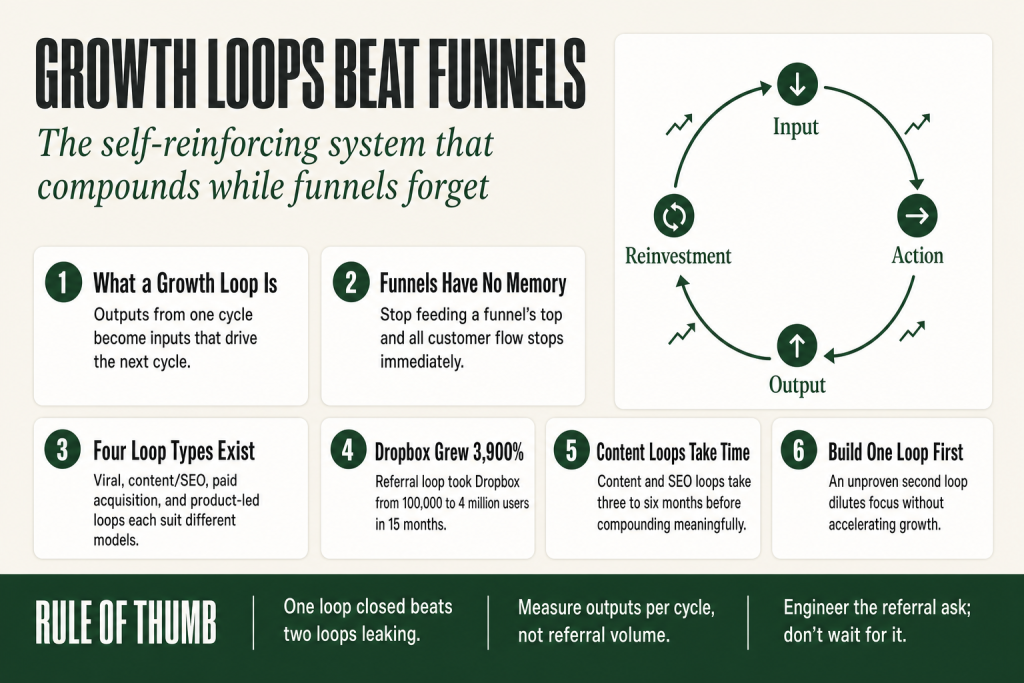
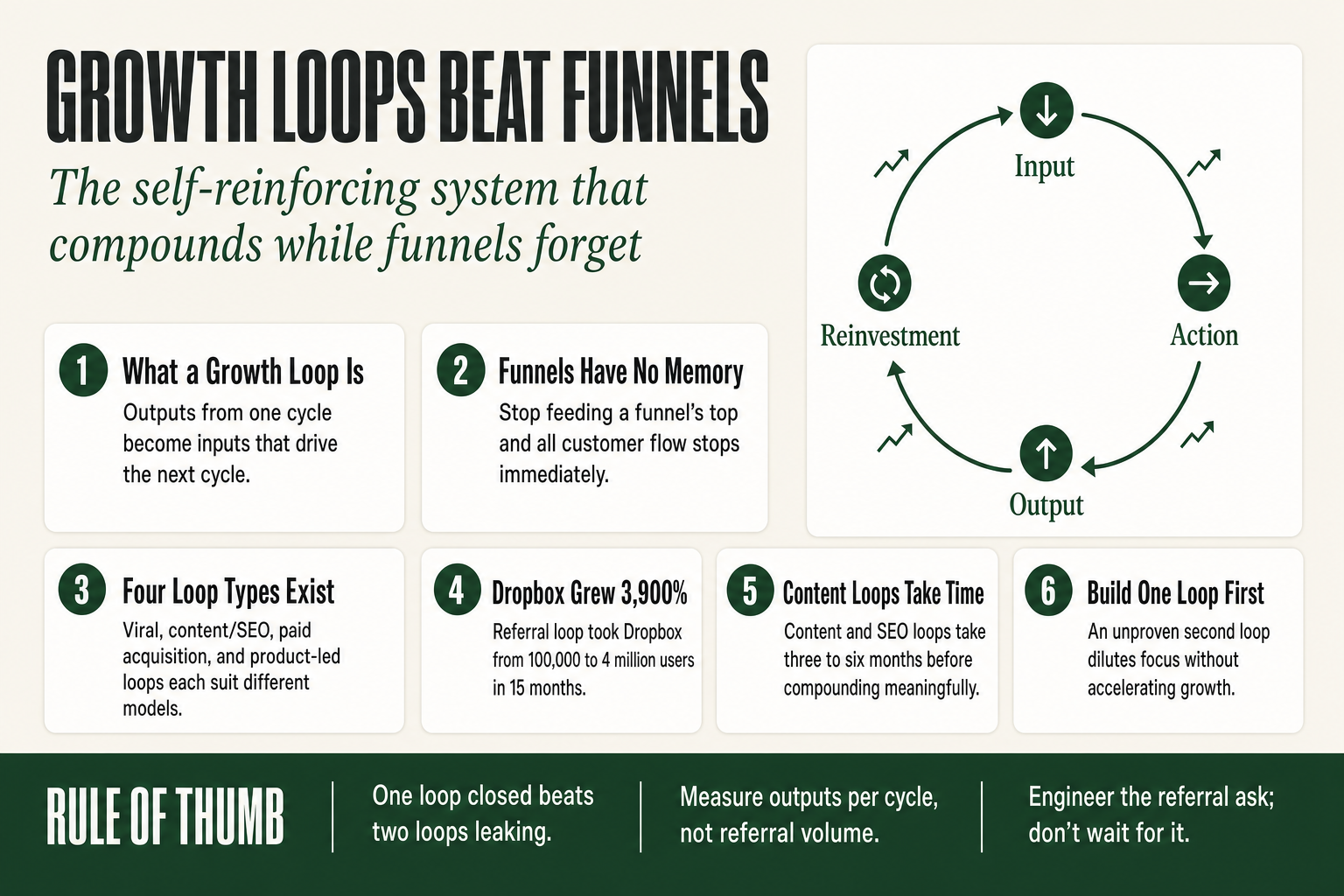
A growth loop is a closed system in which inputs, through some process, generate outputs that can be reinvested as the next cycle’s inputs. That’s the whole definition. It sounds abstract until you see the structure:
- Input: A new user or customer enters the system, through an ad, a referral, a search result, a word-of-mouth conversation.
- Action: That user does something meaningful, they use the product, share it, create content, refer a friend, generate revenue.
- Output: That action produces a tangible asset, a new lead, a piece of indexed content, margin that funds more ads, a referral.
- Reinvestment: That output feeds back in as the next cycle’s input, without requiring you to start from zero.
What distinguishes this from a funnel isn’t semantics, it’s physics. A funnel is open at the bottom. Every customer who comes in eventually exits. The energy that got them there doesn’t accumulate; it dissipates. A growth loop is closed. The customer’s activity generates fuel for the next rotation.
Even a modest loop adds up in a way a funnel can’t match over time. The math resembles compound interest: unimpressive early, then very difficult to replicate from a standing start. Dropbox’s viral coefficient was reportedly around 0.35, meaning every ten users brought in roughly three and a half more through referrals. Well below self-sustaining virality, and yet, combined with other channels, it contributed to 3,900% user growth in 15 months, from 100,000 users to 4 million.
There’s one more structural advantage worth naming: growth loops embedded in your product or customer experience are harder to copy than channels. A competitor can copy your ad creative overnight. Replicating a referral mechanic that has been running for three years and now generates 30% of your new customers takes years, and usually requires building the same underlying trust with customers that yours already has.
The Four Types of Growth Loops (and Which One Fits Your Business)
Most loops that actually work fall into one of four categories. They’re not mutually exclusive, the strongest businesses eventually run several in parallel, but starting with the right one for your model matters enormously.
1. The Viral / Referral Loop
A user derives value from your product or service, refers someone else, and that new user enters the same cycle. The output is a new qualified lead who arrived pre-sold by someone they trust.
Dropbox is the canonical example. The company grew from 100,000 users to 4 million in 15 months, starting in September 2008. The mechanic: both the referrer and the new user received 500 MB of extra storage. The incentive worked precisely because it rewarded people with more of the thing they already valued, the product itself. At peak, 35% of all daily signups came through the referral program, and Drew Houston reported at the 2010 Startup Lessons Learned conference that the program permanently increased signups by 60%.
The structure works just as well without software. A boutique fitness studio whose members regularly bring a friend to a trial class is running a referral loop, especially when the studio makes that moment deliberate: a structured invite, a tracked first visit, a follow-up that turns the friend into a member. Making it deliberate is what separates 10% referral-sourced membership from 40%.
2. The Content / SEO Loop
You create or attract content. That content ranks in search engines and generates organic traffic. Some of those visitors convert to customers or subscribers. Their activity generates more content, through reviews, case studies, user-generated material, or your own production capacity funded by that revenue. The loop repeats.
This is the most accessible growth loop for small businesses and the one with the longest time constant. Content and SEO loops typically take three to six months before they compound meaningfully. But once running, they’re hard to interrupt, unlike a paid channel that goes silent the moment the credit card stops. (For operators building this loop, the permission marketing page covers how an email list becomes the asset that routes content outputs back to acquisition.)
The key variable is whether your content generates something that re-enters the system. An article that attracts visitors but never converts them breaks the loop at the output stage. The content loop only closes when visitors become customers, customers generate reviews or testimonials, and those assets attract more visitors.
3. The Paid Acquisition Loop
You spend money on ads, acquire customers, generate revenue, and reinvest a portion of that margin into more ads. At low scale this looks like a funnel. It becomes a growth loop when the economics improve with each cycle, as your creative sharpens, your targeting tightens, and your CAC drops while LTV holds or grows.
The paid loop is the fastest to spin up and the most fragile. It depends entirely on the margin between what a customer costs to acquire and what they return over their lifetime. When ad costs rise, as they have consistently on every major platform, the loop degrades. A pure paid loop with no other self-reinforcing mechanism is a treadmill with an incline that keeps increasing.
The strongest version pairs with another loop type, paid acquisition feeds users into a product that generates referrals, or into a content system that eventually reduces paid dependence. Understanding the CAC to LTV ratio is prerequisite reading before deciding whether a paid loop is viable for your margins.
4. The Product-Led Loop
The product’s own use generates new users. Slack is the cleanest example: when a company adopts it, team members invite other team members. Every workplace that signs up expands the number of people who’ve used the product, some of whom bring it to their next company. The product is literally the distribution channel.
This loop is the hardest to design from scratch and the most durable when it works. For most small businesses, a partial version is achievable: a proposal template so clearly branded it gets forwarded, a client-facing deliverable that carries your contact information in a way that generates inquiries, a service process visible to others (a branded vehicle, a job-site sign, a public installation). The product-led growth loop for a service business is often built into what customers see and share about the work itself.
Why Growth Loops Beat Funnels for Operators
The funnel isn’t wrong. It’s just incomplete, and the incompleteness compounds over time into a real strategic disadvantage.
The specific problem Balfour and his co-authors identified holds for operators of any size: when you organize your growth around a funnel, you implicitly assign different teams, or different vendors, or different mental buckets, to different stages. Marketing brings leads in. Sales converts them. Someone else retains them. Each group optimizes for its own metric. Marketing is rewarded for lead volume, so it brings in anyone who clicks, including people who’ll never buy and whose churn later damages your retention numbers. The funnel creates incentives that work against the system as a whole.
A growth loop forces you to see the whole system. If a new customer eventually refers others, then the quality of that referral depends on how well you served them. Acquisition and delivery end up inside the same feedback loop, which is how they should have been connected all along.
The second problem with pure funnel thinking is that it produces linear growth, not growth that accelerates with scale. Every new customer acquired via a funnel requires the same input at the top. A loop, by contrast, produces a small amount of incremental input from each cycle, and that increment grows with scale. After two or three years, the operator who built a functioning referral loop and the operator who kept buying the same ads are in structurally different positions. The first has a customer acquisition cost that’s been quietly declining. The second is watching theirs go up.
Ad costs on Google, Meta, and every major platform have risen consistently. Operators who built growth loops during periods of cheaper acquisition used that traffic to fund self-reinforcing systems. The ones who just ran ads are now paying more for the same result with nothing to fall back on. For a deeper look at how funnel metrics and loop architecture can coexist, see the Pirate Metrics (AARRR) page.
Putting this to work? The ideas in the Canon are the foundation under the tactical playbook in Build a Complete Marketing Department — grab the free companion kit at mmsvegas.com/resources.
Growth Loops in Practice: Named Examples Worth Studying
Looking at loops that have actually run, not to copy the mechanics, but to understand the structure well enough to find analogues in your own business.
Dropbox: The Referral Loop That Built a Company
Dropbox went from 100,000 users to 4 million in 15 months, starting in September 2008. Both the referrer and the new user received 500 MB of additional storage. The referral prompt appeared when a user was running low on space, the offer arrived at the moment of highest motivation. At peak, 35% of all daily signups came from referrals. Drew Houston reported at the 2010 Startup Lessons Learned conference that the program permanently increased signups by 60%. The reward was more of the product, not cash, which filtered for users who actually valued the service and would therefore stay and refer again. The loop fed itself.
Morning Brew: The Content-Referral Hybrid
Morning Brew launched its referral program in 2017, when the newsletter had around 100,000 subscribers. The program, “Share the Brew”, offered tiered branded merchandise at subscriber milestones. According to Tyler Denk, who built the referral program as an early employee, referrals drove 80% of Morning Brew’s growth in its early phase and have consistently accounted for around 30% of total new subscribers since. The newsletter grew to more than 4 million subscribers, with the referral program as its largest single acquisition driver. Two loops ran in parallel, content driving discovery, referrals accelerating it, each reader who shared the newsletter bringing in the next reader who would share it again.
TripAdvisor: The Review-and-Rank Loop
TripAdvisor’s entire model is a content growth loop. Travelers search for hotel and restaurant reviews, find TripAdvisor pages in search results, complete their trip, and add their own reviews. That new content improves TripAdvisor’s search rankings, attracting the next round of travelers. The loop has been compounding for over twenty years, which is why no well-funded competitor has managed to displace it. The advantage isn’t the brand; it’s the review corpus that grows more accurate and more comprehensive with every new user.
A Local Contractor (The Structural Version)
A residential contractor who photographs every finished project, posts them to Google Business Profile and Houzz with the neighborhood named in the caption, and asks each satisfied client for a Google review is running two growth loops simultaneously: a content/SEO loop (photos and reviews surface in local searches, generating new inquiries) and a referral loop (satisfied clients who leave reviews also tell neighbors). Neither requires ongoing budget once the habit is built. Both accumulate over time. The contractor who’s been doing this for four years has a review count and a local search presence that a new competitor simply can’t buy overnight. The North Star Metric concept is useful here, picking one number at the output stage of your loop (reviews published, referrals sent) keeps the whole operation aligned around the same compounding signal.
How to Design a Growth Loop for Your Business
Designing a growth loop is really an exercise in tracing what already happens in your business and then making it deliberate. Most small businesses have the skeleton of at least one loop without having named it or optimized it. Here’s how to find it and build it out.
Step 1: Map the output of a satisfied customer
When a customer has a genuinely good experience with you, what happens next? Do they tell someone? Leave a review? Hire you again? Become a case study? Every one of those outcomes is a potential loop output. Most operators never connect that output back to the input of the next acquisition cycle. The loop already exists, it just isn’t closed.
Step 2: Identify the friction that breaks the loop
A loop breaks somewhere. Usually it’s at the output-to-reinvestment stage: the customer had a great experience but was never asked to refer anyone, never prompted to leave a review, never handed anything they could share. The referral moment passed because no one engineered it. Find where your loop leaks and patch it before you try to accelerate anything.
Step 3: Pick one loop and build it deliberately
The single most common mistake is trying to run multiple loops simultaneously before any single one is self-sustaining. Pick the loop that fits your business model and economics. For service businesses and professional services, that’s usually a referral loop. For content businesses and local businesses with searchable work, it’s a content/SEO loop. For e-commerce with healthy margins, a paid loop is often the right starting point, but only if you’re building retention that eventually funds a second loop. Cohort retention data tells you whether loop participants stay long enough to generate meaningful outputs; see the Cohort Analysis page for how to run that analysis.
Step 4: Shorten the cycle time
A loop with a weak coefficient but a fast cycle time can outperform a loop with a strong coefficient and a slow one. If your referral cycle takes 18 months because that’s how long it takes a client to have a referral conversation, the loop is technically running but practically invisible. How do you compress the time between a customer experiencing value and them creating the next input? For a referral loop, that might mean asking for referrals at 30 days instead of 12 months. For a content loop, it means publishing on a regular cadence instead of sporadically.
Step 5: Measure the loop, not just the stages
The metric that tells you whether a growth loop is working is the ratio of outputs to inputs per cycle. For a referral loop, that’s roughly how many new customers each existing customer generates, the viral coefficient. For a content loop, it’s how much organic traffic your existing content body generates this month versus last month, independent of new content published. If both numbers are growing, the loop is working. If one is flat, you have a leak to find.
Where AI fits in
AI tools can reduce bottlenecks that previously broke loops. Content loops often stall because production capacity runs dry, the operator can’t write fast enough to keep the SEO loop spinning. AI-assisted drafting doesn’t replace editorial judgment; it lowers the floor on production cost so the loop can sustain its own pace. Similarly, AI can help identify which customers to approach for referrals, when, and with what framing, without requiring a dedicated growth hire. The judgment about which growth loop to build and what the output should look like stays with the operator. AI handles throughput inside a loop you’ve already designed.
Where Growth Loops Work Best
Growth loops work best when two conditions are present: your product or service has genuine repeat value or social visibility, and the output of customer activity is something transferable, a referral, a piece of content, a review, a recommendation.
Service businesses with strong word-of-mouth cultures, home renovation, legal services, financial planning, accountancy, are natural referral loop candidates. The trust dynamic in those categories means a referral carries enormous weight, and the economics often allow for a structured incentive to make the loop deliberate rather than accidental.
Content businesses, media, education, consulting, anything where intellectual output is part of the product, have a natural content loop available. Every article that ranks, every case study that gets shared, every client deliverable that reflects well on you publicly is a loop input. The challenge is connecting the content to a conversion mechanism that re-enters the system.
E-commerce businesses with strong margins can often run a paid loop efficiently, the revenue from one cohort funds the ads that acquire the next, but they’re most stable when combined with a retention loop (email, loyalty) that raises LTV without raising CAC.
B2B businesses with longer sales cycles often build their most durable loops through thought leadership and community. A podcast that attracts ideal prospects, who become clients, who then appear as guests and bring their own audiences, that’s a growth loop. It’s slow. It works.
Where Growth Loops Don’t Work (or Work Slowly)
Not every business can build a fast loop, and it’s worth being honest about this rather than pretending the framework is universally applicable at the same speed.
Businesses with low visibility, B2B services sold under NDA, highly confidential professional categories, anything where clients actively prefer not to be identified publicly, have limited referral and content surface area. The loop exists but the output is muted. You can build a referral loop in a confidential consulting practice, but you’re fighting the norms of the category to do it.
One-time purchase businesses with no natural reason for repeat contact struggle more than subscription or repeat-service businesses. The loop output (a satisfied customer) exists but there’s no obvious mechanism to route it back to acquisition without deliberate intervention, a referral program, a review-request sequence, a case study process. Those interventions work, but they require more infrastructure than a loop that’s native to the product experience.
Low-margin businesses, commoditized retail, thin-margin services, often can’t sustain a paid loop because there simply isn’t enough margin to reinvest. For these operators, the content and referral loops become the only viable options, which means a longer time horizon before the loop accumulates meaningfully.
And for any business: the loop takes time to prove. Viral and referral loops can show early signs in weeks. Content and SEO loops typically take three to six months before you see the effect in the data. Operators who expect growth loops to outperform paid channels in the first 90 days will usually abandon them before the math turns in their favor.
Common Misunderstandings About Growth Loops
“Growth loops are only for software companies.” The concept was articulated in a product context, but the underlying logic, outputs reinvested as inputs, is universal. A dentist who asks every new patient for a review and whose search ranking improves as a result, generating more new patients, is running a loop. The software framing is incidental.
“A referral program is a growth loop.” A referral program is a mechanism that can produce a loop, but it only becomes one if it actually closes, if referred customers generate further referrals at a rate that accumulates over time. A referral program that brings in occasional one-off recommendations isn’t a loop; it’s a tactic. The loop is the system, and the referral program is one component of it.
“You need virality for a loop to work.” Viral loops, where a single user generates more than one additional user, viral coefficient above 1.0, are the most dramatic but not the only viable type. A loop with a coefficient of 0.3, where every ten customers produce three new ones, still accumulates significantly over time when combined with other acquisition channels. Dropbox’s viral coefficient was reportedly around 0.35, well below self-sustaining virality, yet it contributed to 3,900% growth over 15 months when combined with other inputs.
“Building a loop means abandoning the funnel.” The best-performing teams use both: the funnel to diagnose where customers drop off at individual stages, and loops to describe the system-level growth architecture. They’re different analytical tools for different questions. The funnel answers “where is the conversion problem?” The growth loop answers “how does growth self-sustain?”
“More loops are better than one.” Adding a second loop before the first is proven and producing consistent outputs dilutes focus without accelerating growth. Get one loop to a place where outputs are reliably re-entering the system, then add a second that reinforces it.
Common Mistakes
- Skipping the trigger entirely and waiting for referrals to happen organically — This is the failure mode that looks like a working loop but produces nothing measurable. A satisfied customer who was never asked won’t refer on their own at the rate one who was asked will, the gap is typically 3x or more. The fix is mechanical: build a 30-day post-project email into your delivery process, with a single direct ask, “Is there anyone you know dealing with the same problem you came to us with?”, and a referral link. Test it on your next 10 completed projects before declaring it a system. If the ask is absent, the loop exists only in your imagination.
- Tracking referral volume instead of referral coefficient — “We got 12 referrals last quarter” tells you nothing about whether a loop is working. The question is: how many new customers did each cohort of existing customers produce per cycle? A referral rate of 12% that’s been flat for three quarters is a stable tactic, not a compounding loop. Calculate the ratio monthly, new referral-sourced customers divided by total active customers, and plot it over time. If it’s growing, the loop is working. If it’s flat, find the stage where the chain breaks: the ask, the incentive, the cycle time, or second-generation referrals (customer B referring customer C) that never materialize because you never prompted them.
- Launching a content/SEO loop and evaluating it at 60 days — Content loops have a three-to-six month indexing and ranking lag before they show up in traffic data. Operators who benchmark against their paid channel at week eight, where the paid channel is winning, almost always kill the content initiative before the compounding starts. The fix is a pre-committed evaluation window: set a 180-day review date before publishing the first piece. During those 180 days, track leading indicators (indexed pages, average position in Search Console, pages with at least one click) rather than revenue. Pulling the plug at day 60 because “it’s not working” is a category error, you’re comparing a channel that pays per click today to one that compounds for years.
- Building a second loop before the first one closes reliably — The pattern: referral loop stalls at 12% referral rate in Q1, so the operator launches a content strategy in Q3, hoping parallel efforts will compound each other. Instead, neither gets enough attention to reach escape velocity. Before adding a second loop, run the referral coefficient report for the last 90 days. If the number is flat or inconsistent, the first loop has a leak, a missing trigger, a weak incentive, a cycle time that’s too long. Patch the leak. One loop closing reliably at 20% referral rate is worth more than two loops running at 10% each, and it’s far easier to manage.
- Designing the paid loop without a retention layer, then wondering why CAC keeps rising — A paid acquisition loop that doesn’t build anything self-reinforcing is just a funnel. The math works only if each cohort’s revenue funds the next cycle at equal or better unit economics, but on every major platform, ad costs have risen consistently over the last five years, which means the economics degrade unless you improve LTV on the other side. The fix: attach a deliberate retention mechanism to paid acquisition from day one, an onboarding email sequence, a loyalty program, a referral ask at day 30, so that paid-acquired customers become inputs for a second loop over time. Pull LTV:CAC by cohort quarterly. If CAC is rising and LTV is flat, you’re not running a loop. You’re renting customers.
Operator’s Take
Here’s my honest read on growth loops after watching operators try to implement them: the framework is right, and most execution is lazy. Not because people don’t understand the concept, they do, after reading one good article, but because they treat “build a referral program” as synonymous with “build a growth loop,” set it up once, and wonder why it plateaus at 8% referral-sourced revenue and stays there forever.
The uncomfortable truth about most referral loops in small service businesses: they’re running accidentally at 15 to 20% of their potential. The customers are willing. The moment of highest motivation, right after a great project, when they’re still telling people about it, passes unused because no one engineered the ask. I’ve seen operators with NPS scores in the high 70s generating fewer referrals than operators with NPS scores in the 50s, purely because the second group asks systematically and the first group asks when they remember to. If your referral rate has been flat for six months, the loop isn’t broken, the trigger is missing.
On the content/SEO loop: I think it’s the most underbuilt asset in small business marketing, and I also think the timeline kills more operators than the work does. Three to six months before you see compounding effect in the data is genuinely hard to sit with when a paid campaign can show results in two weeks. The operators who win here aren’t the ones who produce better content, they’re the ones who don’t quit at month four. If you’re using the flat numbers in month three as evidence that the loop “doesn’t work for your industry,” you’re pulling the cake out before it’s done. Set a 180-day review date before you start, write it in the calendar, and don’t evaluate before then.
The paid loop deserves more skepticism than it gets. Everyone understands the paid loop intuitively, spend money, get customers, spend more, so it feels like the safest starting point. But a paid loop with no retention layer is just a funnel with a fancier name. The loop only actually closes when the revenue from a cohort funds the next cycle at equal or better unit economics. Pull your LTV:CAC trend by acquisition cohort for the last 12 months. If CAC is rising and LTV is flat, you’re not running a loop, you’re on the treadmill, and it’s getting steeper. The fix isn’t more ad spend. It’s attaching something to the paid channel, a referral mechanic, a retention sequence, a community, so acquired customers eventually produce inputs for the next cycle. Otherwise you’re just renting growth.
One more thing the standard growth loops literature tends to underplay: loops have diminishing coefficient returns at scale in ways funnels don’t. Your referral coefficient at 200 customers and your referral coefficient at 2,000 customers are not the same number. The early adopters who love you refer at a higher rate than the mainstream customers who came later. Plan for this. The answer isn’t to abandon the loop, it’s to keep improving the trigger and the incentive as the customer mix changes. AI can help here more than most operators realize: not by replacing the judgment about what to ask or when, but by making it possible to personalize referral asks at scale without a dedicated growth hire.
Use your AARRR funnel metrics to find where customers drop off at each stage, that diagnostic work is irreplaceable. Use loop thinking to design the system that converts those customers into the next cycle’s inputs. They’re not competing frameworks. One tells you where you’re leaking. The other tells you what you’re trying to fill.
Used in
- ✓ Build a Complete Marketing Department
Used to design the acquisition architecture so that each marketing channel feeds a self-reinforcing system rather than requiring perpetual reinvestment at the top of a funnel. - ✓ The Missing Manual for FunnelKit
Used to structure automation sequences that trigger referral asks, review requests, and re-engagement at the output stages of each customer cycle, closing the loop inside the funnel platform. - ✓ The Missing Manual for Make
Used to automate the reinvestment steps between loop stages, routing customer activity data into referral requests, content workflows, and CRM triggers without manual intervention.
FAQ
What’s the simplest growth loop a small service business can build today?
A structured referral loop: at 30 days after a project completes, send a personal note asking the client if they know anyone who might benefit from the same service. Track who sends whom. Offer a clear incentive, a discount on future work, a gift card, or simply public acknowledgment. That’s a loop. It takes an afternoon to design and a consistent habit to maintain.
Do growth loops work for B2B businesses with long sales cycles?
Yes, but the cycle time is longer, which means the accumulation is slower. The most durable B2B loops tend to be content or thought-leadership loops, a podcast, a newsletter, or case studies that surface in searches, combined with a referral mechanic triggered after a successful engagement. Patience is the key variable.
What’s the difference between a viral loop and a growth loop?
A viral loop is a specific type of growth loop where users generate more than one new user each, producing exponential growth. A growth loop is the broader category, it includes viral loops, content loops, paid loops, and product-led loops, most of which accumulate without achieving true virality.
How do I know if my loop is actually working?
Measure the ratio of new inputs generated per cycle, roughly, how many new customers does each cohort of existing customers produce? If that ratio is stable or growing, the loop is working. If it’s flat or declining, find where the output isn’t re-entering the system and fix that stage.
Is a paid advertising campaign a growth loop?
It can be, if the revenue generated is systematically reinvested to acquire more customers and the unit economics (LTV:CAC) improve over time. Most paid campaigns are not loops, they’re linear spend for linear return. The loop only closes when you track the economics tightly enough to reinvest with confidence that each cycle is more efficient than the last.
Can I run more than one growth loop at the same time?
Eventually, yes, and the strongest businesses run several that reinforce each other. But build one loop to a measurable, repeating output before stacking a second. Running two unproven loops in parallel usually means running neither well.
Further reading
- “Growth Loops Are the New Funnels”, Reforge Blog (Balfour, Winters, Kwok, Chen, July 31, 2018): The original post that codified the framework; worth reading for the precise vocabulary and the critique of funnel-based thinking. This is the third post in a four-part series.
- Hacking Growth by Sean Ellis and Morgan Brown: The practical playbook for running growth experiments across acquisition, retention, and monetization, useful for anyone who has identified a loop and wants to optimize each stage systematically.
- The Cold Start Problem by Andrew Chen: Focuses on network effects, which are the most powerful form of product-led growth loop; worth reading if your business has marketplace or network characteristics.
Sources: Reforge Blog, “Growth Loops Are the New Funnels” (Brian Balfour, Casey Winters, Kevin Kwok, Andrew Chen, published July 31, 2018; confirmed third post in a four-part series; confirmed via Balfour’s Twitter thread timestamped July 31, 2018 and the Reforge blog post itself); Reforge, Brian Balfour listed as Founder/CEO Reforge, former VP of Growth at HubSpot’s Sales Product Division; Dropbox referral program statistics, 100k to 4M users in 15 months, 3,900% growth, 35% of daily signups at peak, and permanent 60% signup increase sourced from Drew Houston’s presentation at the 2010 Startup Lessons Learned conference, as cited by Omegapoint Systems, Viral-Loops, GrowSurf, and ReferralCandy; Dropbox viral coefficient of ~0.35 sourced from Waitlister and StartupShortcut growth analyses and noted as reported rather than primary-source; Morning Brew referral program, launched 2017, drove 80% of early-phase growth, settled to ~30% of ongoing new subscribers, grew to 4+ million subscribers, sourced from Tyler Denk (Morning Brew early employee and product lead) Medium post (2019), Firewards, ReferralRock, and GrowSurf Morning Brew breakdowns; TripAdvisor review-and-rank loop, user-generated content driving SEO dominance, compounding for over twenty years, sourced from BusinessModelHub, Inc. Magazine (Jeff Bussgang), and GrackerAI case study; Dave McClure AARRR framework introduced 2007, confirmed via Ortto and Reforge thread.
Brian Kasday spent forty years in direct-response marketing before rebuilding the whole operation as a one-person shop. He writes The Operator’s Library — including “Build a Complete Marketing Department” — for operators who’d rather build it themselves than wait on someone else.
Build the department these ideas describe — the free companion kit: mmsvegas.com/resources.
More The Operator's Canon guides
Free · Operator Toolkit
Want the tools, not just the guide?
Get the free operator toolkit — templates and checklists for the systems you actually run, plus a note when this guide changes.
Get the free toolkit →