
Last updated: July 2026
Flywheel model marketing is the idea that your business growth should be a self-reinforcing loop, not a straight line that ends when someone buys. By the end of this page, you’ll be able to draw your own flywheel, name the friction points that are costing you momentum right now, and redesign your acquisition, experience, retention, and referral stages so each one actively feeds the next.
Here’s what most operators actually experience: they run an ad, land a lead, close a sale, deliver the work, and then start the whole expensive process over again. Acquire, close, deliver, repeat. Every month feels like pushing a boulder uphill from scratch. That’s the funnel model in practice, and it describes the daily reality of a lot of small businesses, even ones that are doing fine.
The flywheel model says: what if the customers you already have were doing a meaningful share of the work of finding you the next ones? What if your business operated more like a wheel gathering speed than a boulder you drag up a hill every morning?
That’s not a soft aspiration. It’s an engineerable system. And getting it right is one of the highest-leverage things an operator can do.
The idea in 30 seconds
- The flywheel model treats your existing customers as the engine of new growth, not as the end of a funnel.
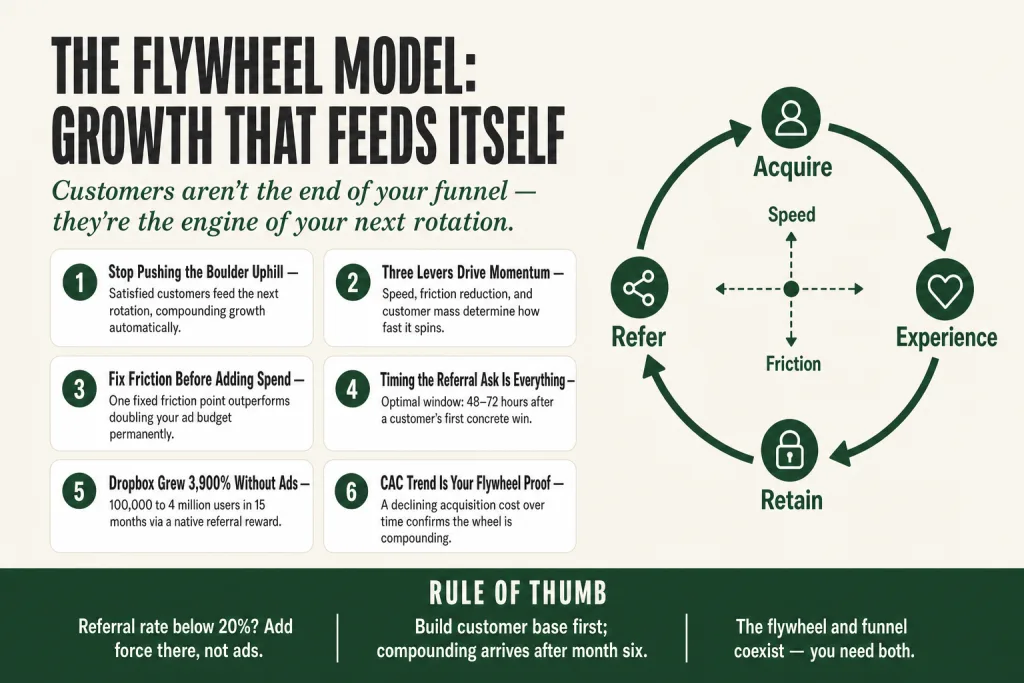
- Every stage, acquisition, experience, retention, referral, feeds energy back into the next rotation.
- Speed and friction are the two levers: more delight spins it faster; more friction (clunky processes, poor handoffs) slows it down.
- It contrasts sharply with the AIDA funnel, which disposes of customers at the bottom and forces you to start over every time.
- The flywheel compounds: each rotation is cheaper and faster than the last because your installed base is doing more of the lifting.
- For a small operator, the practical work is identifying your one biggest friction point and your one most replicable referral trigger, then systematically fixing and amplifying them.
Where the Flywheel Came From
Jim Collins introduced the flywheel effect in Good to Great (2001), not as a marketing concept, but as a description of how organizational transformations actually happen. His research found that companies making the leap from good to great had no single defining moment, no dramatic pivot. They just kept pushing in the same direction, turn after turn, until momentum became nearly self-sustaining. The original insight was about strategy and discipline across the whole enterprise, the kind of compounding that comes from sustained, directional effort rather than dramatic reinvention. Marketing had nothing to do with it.
Bezos picked it up almost immediately. During the dot-com bust, Collins met with the Amazon leadership team and shared the flywheel concept. Bezos and his lieutenants adapted it into a specific growth loop for their business, sketched, famously, on a napkin: lower prices drive more customer visits, more visits attract third-party sellers, broader selection lowers costs, lower costs enable lower prices. Customers aren’t the end of that chain. They’re the middle, generating the force that starts the next rotation.
The marketing world caught up in 2018. HubSpot co-founder and CEO Brian Halligan took the stage at INBOUND 2018 and made the case, crediting Bezos’s Amazon loop as his inspiration, that the traditional funnel had become the wrong model for an era when buyers arrive already informed. Halligan’s contribution was translating a business-strategy metaphor into the customer-journey language that marketers and operators actually work in: attract, engage, delight. Collins later published Turning the Flywheel (2019) as a tighter companion piece for operators who wanted a practical guide to building their own loop.
So the attribution is worth getting right. Collins gave us the physics metaphor and the organizational insight. Bezos turned it into a specific customer-centric growth loop. Halligan brought it into marketing, and that’s the version most operators are working from today.
Why the Funnel Eventually Fails You
The sales funnel isn’t wrong, it’s incomplete. It was a useful map for an era when the seller held more information than the buyer, and when marketing’s job was to manufacture awareness and push prospects toward a close. As Halligan put it at INBOUND 2018, the funnel worked well when sales reps had a lot more information than their customers. That information gap has inverted. Your customers now know more before they ever talk to you.
Here’s the structural flaw: funnels lose all the energy put into them once you reach the bottom. The momentum is gone, and to drive more business you start over from scratch. Customers are the output. You spend money creating them, deliver on your promise, and then they fall off the end. Any goodwill, any trust, any enthusiasm they have, that’s idle value sitting in a leaking bucket.
Think about what that means at the unit economics level. If every customer costs $200 to acquire and generates $400 in gross profit on a first transaction, you’re doing fine. But if you spend another $200 to bring them back for a second transaction, instead of having an automatic process do it, you’ve treated your best asset like a stranger.
There’s a harder version of this problem too. Before flywheel thinking became mainstream marketing language, the online marketing industry was already reckoning with sharply rising customer acquisition costs on Google and Facebook. When it becomes expensive to keep buying customers through paid channels, the math shifts: you either earn more from the customers you already have, or you get them to act as ambassadors. The flywheel is the architecture for doing both.
The flywheel closes the loop. Customers aren’t the end state, they’re fuel. When you design your business so that a delighted customer naturally feeds back energy into the attract stage through referrals, reviews, word of mouth, and social proof, you’ve changed the fundamental economics of growth. Each turn of the wheel is cheaper and faster than the one before.
Flywheel Model Marketing: The Core Principles
Three variables determine how much momentum your flywheel generates, and they come directly from the physics of the thing.
Speed
Speed is how fast the wheel turns. In marketing terms: how quickly a new customer becomes a satisfied customer, and how quickly that satisfied customer refers or re-engages. Speed increases when your onboarding is clean, your core delivery is excellent, and there’s no unnecessary gap between “they paid” and “they got real value.” An HVAC company that sends a follow-up text the morning after a service call turns a transaction into a relationship 24 hours faster than one that doesn’t. That’s speed, and it compounds.
Friction
Halligan said it plainly at INBOUND 2018: we filled the funnel with friction. To build great experiences, you need a flywheel free of it. Friction is anything that slows the rotation: a clunky checkout, a handoff where nobody follows up, a referral program nobody knows exists, a billing process that irritates people right after they’ve bought. Every friction point is a place where energy leaks out.
This is the underrated half of flywheel management. Most operators think about adding force, more ads, more content, more outreach. They underinvest in removing friction. One fixed friction point can have more impact than doubling your ad spend, because it permanently improves every future rotation. You fix it once. It pays off forever.
Size (Mass)
More delighted customers means a heavier wheel, one that produces more energy when spun. Your flywheel produces more growth as your customer count increases. And if you can add density to those customers, getting them to adopt more of your services or become stickier, you get even more momentum out of the same rotation.
For a small operator, mass is the slow-building advantage. You might feel like nothing is happening in months two through six. You’re not wrong, it genuinely takes time to build the installed base that makes the referral loop self-sustaining. The flywheel is not a short-term play. But once it’s moving, it’s an asset that most paid-acquisition competitors can’t buy their way to match.
The Four Operator Stages
Most operators will find it practical to organize their flywheel around four stages rather than HubSpot’s three, because it makes the referral trigger explicit:
- Acquire: How someone first discovers and decides to try you. Paid, organic, referral, content, the input channel. The goal here is qualified relevance, not raw volume.
- Experience: The delivery of your core promise, plus everything that surrounds it. Onboarding, communication, the moment of truth when the service is rendered. This is where most small businesses’ flywheels break down, not in acquisition, but in the gap between “they paid” and “they’re genuinely happy.”
- Retain: Whether a customer comes back, expands, or stays engaged over time. This includes follow-up communication, loyalty mechanics, upsells, and simply not disappearing after the first purchase.
- Refer: The stage most operators accidentally ignore. A satisfied, retained customer who has no clear channel to tell others about you is wasted energy. This stage requires deliberate design, a prompt, an incentive, a mechanism, or at minimum a moment that makes sharing easy.
The loop closes when referred customers re-enter at Acquire. Each happy customer creates energy that makes acquiring the next one easier.
Flywheel vs. Funnel: An Honest Comparison
The AIDA funnel, Awareness, Interest, Desire, Action, is a perfectly good model for what it does. It describes the psychological sequence a buyer moves through before making a decision. That’s real and still relevant. If you’re writing a landing page, AIDA tells you the right order to make your case. The AIDA model was never designed to be a complete growth system, which is exactly where funnel thinking breaks down when applied to the full business.
The funnel is linear. Most companies think about growth as a sequence: generate leads, convert customers, repeat. But that model treats growth as a series of disconnected steps. There’s no mechanism for customers to re-enter the system or become assets that reduce your future acquisition cost.
The flywheel is circular. Customers aren’t discarded at the bottom, they become the most important input into the next rotation. In a flywheel, your current customers are the primary engine that helps you find the next ones.
But here’s the honest take: these two models aren’t enemies. The funnel is still useful inside your flywheel. Your Acquire stage still has a funnel shape, awareness leads to consideration leads to conversion. The flywheel is the macro architecture; the funnel describes the micro mechanics of a single conversion event. You need both. The mistake is treating the funnel as if it ends at purchase and calling it done.
The more damaging comparison isn’t model vs. model, it’s the mentality that comes with each. Funnel thinking optimizes for conversion. Flywheel thinking optimizes for the full customer relationship, because that relationship is the growth engine. If your whole marketing operation is oriented around “how do we get more people into the top,” you’ll systematically underinvest in experience, retention, and referral. The flywheel is largely a forcing function to take the post-purchase half of your business seriously.
Putting this to work? The ideas in the Canon are the foundation under the tactical playbook in Build a Complete Marketing Department — grab the free companion kit at mmsvegas.com/resources.
What Real Flywheels Look Like
The canonical example is Amazon, and it’s worth understanding because the structure translates well past e-commerce. The loop relies on lower prices and vast selection to drive customer visits. More traffic attracts more third-party sellers, which increases selection and further lowers costs, continuing the cycle. Every component feeds the next. There’s no stage that’s a dead end.
Amazon Prime is the same loop made more personal: faster shipping and exclusive benefits attract new customers, a clean shopping experience keeps them engaged, and exceptional service turns them into repeat buyers whose word-of-mouth fuels the next rotation.
Dropbox built one of the clearest referral flywheels in tech history, and did it without a meaningful advertising budget. The company grew from 100,000 to 4 million users in just 15 months, a 3,900% increase, driven almost entirely by a double-sided referral program where both referrers and invitees received 500MB of free storage. The insight wasn’t “let’s build a referral program.” It was: our product’s core value is storage space, so the referral reward should be storage space. The incentive was native to the experience, not bolted on. Critically, the program was embedded directly in onboarding and activated at moments of peak engagementlike when users were running out of storage, not in a generic follow-up email. That’s deliberate referral trigger design.
HubSpot’s own flywheel is worth examining because it’s a B2B service business, closer to what most operators run than Amazon is. HubSpot gives away real value through free CRM and marketing tools that customers use and talk about. The delight happens before the purchase, not just after it. Free tools attract users who share those resources, driving further inbound traffic and sign-ups. The flywheel feeds itself.
For a local service business, the same logic applies at a different scale. A residential HVAC company whose technicians do a five-minute walk-through summary at the end of every service visit, telling the homeowner what they fixed, what they noticed, and what to watch, creates a consistent delight moment. That moment is the most natural trigger for a referral in the next 72 hours, when the homeowner’s neighbor texts asking “do you know anyone good for AC?” The referral doesn’t happen automatically. The delight makes it possible; the prompt makes it happen.
Designing Your Flywheel: Where Operators Actually Start
The first thing most operators get wrong is trying to design the whole flywheel at once. Don’t. Start by mapping the one you already have, which is messier and less intentional than you’d like, but it exists.
A practical way to do this: take last year’s best customers and trace backward how they found you, what their first experience was like, why they came back, and whether they ever referred anyone. That path reveals your flywheel’s actual shape. You’ll almost certainly find that most of your best customers either came from referrals or became referrers themselves. That’s your flywheel in embryonic form. The question is: why is it only happening with some customers, and what would it take to make it happen consistently?
Audit for Friction First
Before you add anything, list every handoff in your customer journey. The moment a lead moves from marketing to sales. The moment a prospect becomes a paying customer. The first week of delivery. The point at which an invoice arrives. Any of these can be friction points where energy leaks. Fix the worst one. You don’t need to eliminate all friction, you need to identify the one that’s killing referrals most reliably.
Common friction sources for small operators: a slow or unclear onboarding process, inconsistent follow-up after purchase, no mechanism to collect reviews or referrals, surprise fees or billing confusion, and handoff failures when work passes between staff members or departments.
Add Force at the Right Stage
Force is energy you add to spin the wheel faster, content that attracts, advertising that acquires, onboarding that activates, follow-up that retains, incentives that trigger referrals. The question is where to add force for maximum effect.
Most small-business operators over-invest in the Acquire stage and under-invest in Experience and Refer. If your referral rate is below 20% of new customers, that’s where you need to add force, not more ad spend. A referred customer has higher engagement rates and refers others at roughly twice the rate of non-referred users. They cost less to acquire, stay longer, and generate more referrals themselves. The math on investing in your Refer stage is often dramatically better than the math on scaling paid acquisition.
Define Your Referral Trigger
The specific moment a customer is most likely to refer you is not random. It’s the moment they most acutely felt the value of what you do, often right after a successful outcome, right when they’re telling someone about it organically, or right when someone asks them for a recommendation. Your job is to identify that moment in your specific business and install a prompt there. Something as simple as a post-service text: “We’d love to help someone you know, here’s a link you can share.” The trigger matters far more than the incentive. Most referral programs fail because the mechanism fires at the wrong moment, not because the reward was too small.
Connect Retention to Re-Acquisition
The most direct way to close the loop in a local or service business is to make re-engagement automatic. RFM segmentationrecency, frequency, monetary value, gives you the map. Your high-recency, high-frequency customers are your flywheel’s engine. Your lapsed high-value customers are your highest-ROI reactivation target. When you systematically pursue reactivation, you’re not just recovering revenue, you’re adding mass to the wheel, which makes every future rotation more powerful.
Track these numbers at minimum: customer retention rate, referral rate (what percentage of new customers name an existing customer as the source), and average purchases per year per customer. If retention is going up while acquisition cost is staying flat or falling, your flywheel is working.
Where the Flywheel Model Really Works
The flywheel is at its best in businesses where customer satisfaction is genuinely demonstrable and where the buying decision is relationship-influenced. That describes most service businesses, most B2B businesses, and most subscription or repeat-purchase models.
It’s particularly powerful in three specific situations:
- High-trust categories. Anything where the buyer is taking real risk, healthcare, legal, financial services, home improvement, professional services. In these categories, data consistently shows that consumers trust recommendations from other customers far more than any promotional channel. Referral-driven acquisition is structurally better than paid acquisition here, full stop. The flywheel is how you harvest that advantage systematically rather than accidentally.
- Businesses with natural re-purchase cycles. HVAC, pest control, accounting, SaaS, landscaping, gym memberships, anywhere a customer can and should come back. Retention stages of the flywheel become acquisition multipliers because each re-purchase deepens the relationship that eventually drives referrals.
- Businesses where the product or service improves with customer engagement. The classic example is software that gets better as you use it more, or a coaching relationship that deepens over time. Growth loops that build on each interaction strengthen the next one most when the value genuinely compounds with use.
Where It Doesn’t Work (or Works Slowly)
The flywheel model is not a universal solution. Be honest with yourself about the following.
One-time, low-repeat categories. If you sell wedding photography, funeral services, or something else most people buy once in a lifetime, the retention loop is weak or nonexistent. You can still build a referral loop, a great wedding photographer absolutely gets referrals, but you’re running a three-stage flywheel at best. That’s fine; just don’t design a retention stage that doesn’t fit your actual purchase cycle.
Businesses where the experience is undifferentiated. The flywheel assumes you’re delivering something worth talking about. If your service is equivalent to three competitors and customers perceive it that way, no flywheel mechanics will rescue you. Referral incentives and follow-up systems won’t compensate for a mediocre core experience, they’ll just make the cycle spin faster toward the same outcome.
Early-stage businesses without a base. The flywheel compounds, which means it needs mass to generate meaningful momentum. In the first six to twelve months, you probably don’t have enough customers to make the referral loop materially self-sustaining. That doesn’t mean you ignore the model, but expect to invest heavily in Force (advertising, outreach, content) early while you build the base. The efficiency advantage arrives later.
Businesses with thin margins and no reinvestment capacity. Compound growth requires reinvestment. If your margins don’t allow you to invest in customer experience improvements, referral programs, or retention communications, the flywheel stays theoretical. Fix unit economics first, then build the loop.
What People Get Wrong About the Flywheel
“The flywheel replaces the funnel.” HubSpot declared this loudly at INBOUND 2018, and the marketing world took it more literally than it should have. The flywheel is a good addition to, not a replacement of, the traditional funnel. You still need to convert strangers into customers, and that conversion process has a funnel shape. The flywheel is the architecture for the full relationship; the funnel describes a conversion moment within it. These coexist.
“More referral incentives = faster flywheel.” Referral programs fail far more often because of poor trigger design than inadequate incentives. If you ask for a referral at the wrong moment, say, in a post-purchase email two hours after someone bought, before they’ve even used the thing, no discount will fix that timing. The Dropbox referral program worked partly because it activated at the moment of highest perceived value (running out of storage), not as a default onboarding step.
“The flywheel is just a metaphor for word-of-mouth.” Word-of-mouth is what happens when you have a flywheel, it’s not the flywheel itself. The model is about designing connected, self-reinforcing stages across acquisition, experience, retention, and referral. Word-of-mouth is one output of a working Refer stage. Conflating the two leads operators to think they’re running a flywheel when they’re actually just hoping satisfied customers will say something.
“It only works for big businesses.” The examples that travel, Amazon, HubSpot, Dropbox, are large companies, but the flywheel works for all kinds of businesses. The mechanism (satisfied customers lowering your future acquisition cost) is actually more valuable at small scale, where every dollar of CAC reduction has outsized impact. A plumbing company with a 40% referral rate is outperforming most Fortune 500 marketing departments on the metric that matters most.
“A flywheel means you can stop marketing.” The wheel doesn’t maintain momentum without continued input, especially while it’s still building mass. You still need to work the Acquire stage, producing content, running ads, doing outreach. Over time, the referral loop should carry an increasing share of that load. “The flywheel runs itself” is the aspirational end state of a mature, well-designed loop. It’s not where you start.
Common Mistakes
- Asking for the referral before the customer has felt the win — A landscaping company added a referral card to every post-install walkthrough, before the client had seen the garden through a full season. Response rate was near zero. They moved the ask to the 90-day follow-up call, when clients could actually speak to the results, and referral conversions tripled. The fix: map your specific moment of clearest value delivery and put the referral prompt there, typically 48 to 72 hours after the customer first experiences a concrete outcome, not at the point of purchase.
- Building a referral portal instead of a referral prompt — A regional accounting firm spent four months building a branded referral portal with a points system, a leaderboard, and a custom URL. Participation was negligible, their clients, mostly small-business owners, weren’t going to log into a portal to refer someone. A direct text from the account manager asking “is there anyone you know who might benefit from what we do?” outperformed the entire portal in its first week. Complexity is friction. The referral mechanism needs to be simpler than the referral itself, ideally a single step.
- Treating the follow-up email sequence as the retention stage — A SaaS company running a four-email post-purchase nurture sequence assumed they’d covered retention. Churn analysis showed 60% of cancellations happened in week three, after the sequence ended and before the customer had achieved a first real outcome. Every email was content; none of them checked whether the customer had completed onboarding. Adding a single “have you done X yet?” checkpoint at day 14, with a human reply if the answer was no, cut week-three churn by a third. Retention isn’t content delivery. It’s outcome confirmation.
- Adding spend before finding the leak — An e-commerce operator doubled their Facebook ad spend to compensate for slowing growth, which raised CAC by 40% over six months. A customer journey audit showed that 35% of first-time buyers never received their onboarding email sequence due to a tag misconfiguration, meaning a third of new customers were getting no follow-up at all. The ad spend was adding water to a bucket with a hole. Run a full journey audit before scaling acquisition. Confirm the loop from purchase to retention is working before you pay to fill it faster.
- Expecting momentum before building mass — An eight-person B2B agency switched entirely to flywheel thinking in month one, cut their paid acquisition budget, and waited for referrals to carry growth. Six months in, new business had stalled, because they had fewer than 30 active clients, not enough mass for referrals to compound. The fix: treat the first 6 to 12 months as a Force-heavy phase. Run the ads, do the outreach, produce the content. Build the installed base first. The compounding efficiency of the referral loop arrives once you have enough satisfied customers to spin the wheel, not before.
Operator’s Take
Most operators who come to the flywheel model are already closer to it than they think. They’ve got a handful of customers who showed up because someone else sent them. They’ve got one or two delivery moments that consistently generate a “you were great, I’ll definitely refer you” comment. And they’ve got a referral rate somewhere between 10% and 20%, good enough to validate the loop, not good enough to rely on it.
The question isn’t whether the flywheel exists in your business. It’s whether it’s designed or accidental. Those are very different things, and the gap between them is where money leaks.
Your referral ask is almost certainly in the wrong place. This is the single most common and most fixable problem I see. Not after they sign up, that’s before trust exists. Not in a drip email three weeks later, that’s after the emotional window has closed. The research on this is consistent: the optimal window is in the 48 to 72 hours after a customer experiences their first clear, concrete win. The morning after a great service call. The session where a client finally solved the problem they hired you for. That’s when the story is forming in their head, and a simple, direct prompt at that moment converts at a rate no elaborate referral portal will match. A text, not a form. A personal ask, not an automated sequence. Test this before you build anything else, because it costs you nothing and the upside is immediate.
CAC trend is the metric your flywheel either proves or disproves. Most operators track CAC as a number, $180, $240, whatever. That’s not the signal. The signal is whether it’s moving. A flywheel that’s actually compounding shows up as a declining customer acquisition cost over time, even as you’re adding customers. If your CAC has been flat for two years, the loop isn’t compounding, you’re just running a well-oiled funnel. Set a simple discipline: CAC by source, quarterly, rolling 12 months. Paid acquisition cost going up while referral-sourced acquisition holds flat or falls is the clearest early indicator that the wheel is doing real work. If you can’t see that split in your data right now, fixing that visibility is the first move.
Talk to ten customers before you redesign anything. I’m skeptical of the survey-and-dashboard version of this for most small operators. Response rates are low, scores are easy to game, and the language gets sanitized. Call ten customers who’ve been with you at least six months. Tell them you’re working on how you serve people and you want their honest read. Ask two questions only: what’s the one thing you’d tell a friend about working with us, and what’s the one thing that almost made you leave or nearly caused a problem? Those answers will locate your flywheel’s real friction points faster than any audit will, and you’ll hear them in the customer’s actual words, which tells you how to prompt the referral too.
Fix the handoff your team dreads most. In any business with more than one or two people, the biggest flywheel friction point is almost always a handoff, the moment a sale moves from the person who sold it to whoever delivers it, or when a completed job moves to billing. Context drops, surprises appear, enthusiasm leaks right when it should be building toward a referral. Ask your team plainly: where do things most often go sideways? It’s usually a checklist gap or a communication failure, not a technology problem. Fixing it costs an afternoon, not a platform budget, and it affects every future customer permanently.
Design the referral trigger first, automate it second. AI-assisted follow-up and triggered review requests can make your flywheel faster, the judgment stays yours, the delivery is what the tool handles. But a bad referral ask automated at scale is worse than no ask at all. It trains customers to ignore your communications. Get the trigger right manually on ten customers. Watch what happens. When you know it works, hand the delivery to a tool. The sequence matters.
Where does AI actually help here? Drafting and testing referral message variations without waiting for a copywriter. Segmenting your customer list by recency and purchase frequency so you’re targeting reactivation at the right people. Summarizing call notes to identify recurring friction patterns across customers. Scheduling and personalizing follow-up so the right message reaches the right customer at the right stage, not as a generic blast. These are real time savings that let you run a more systematic flywheel without hiring a marketing coordinator. What AI won’t do is tell you which moment in your specific business is the right referral trigger, or whether your core delivery is actually worth talking about. Those calls stay with you.
On the ROI rating: this is a 4 out of 5, not a 5, because the compounding takes longer than most operators expect or have patience for. A business in month three won’t feel it. A business in month eighteen will wonder why they didn’t start sooner. If you’re running a business you intend to still be operating in three years, the flywheel is worth designing for. If you need customers next Tuesday, run an ad, and while you’re at it, make sure the customer you close this week has a clear path to referring someone next month.
One pairing worth making: the flywheel model works well alongside the Marketing Hourglass from John Jantsch, which maps a nearly identical journey, Know, Like, Trust, Try, Buy, Repeat, Refer, in stage-by-stage detail. Use the Hourglass to audit what you’re doing at each stage; use the flywheel model to understand what compounding momentum should feel like and what’s preventing it. Together they give you both the map and the physics.
Used in
- ✓ Build a Complete Marketing Department
Used to structure the full customer lifecycle across acquisition, experience, retention, and referral so that each department’s work feeds momentum into the next stage rather than operating as isolated campaigns. - ✓ The Missing Manual for FunnelKit
Applied to design post-purchase automation sequences, follow-up, reactivation, and referral flows, that close the loop between delivery and re-acquisition, turning the funnel tool into a circular growth engine. - ✓ The Missing Manual for Make
Used to automate the inter-stage handoffs (purchase to onboarding, delivery to review request, review to referral prompt) that reduce flywheel friction without adding manual operator workload.
FAQ
What is flywheel model marketing in simple terms?
It’s a growth system where your satisfied customers do meaningful work pulling in the next ones. Instead of starting over from scratch after every sale, you design your acquisition, experience, retention, and referral stages so each one feeds energy back into the next rotation.
How is the flywheel model different from a sales funnel?
A funnel is linear, customers enter at the top and exit at the bottom as a transaction. The flywheel is circular, satisfied customers loop back as referrers and repeat buyers, reducing your future acquisition cost with every rotation. The funnel ends at purchase; the flywheel uses the post-purchase relationship as the growth engine.
Does the flywheel model work for small local businesses?
Yes, and often more powerfully than for large ones, because every dollar of reduced acquisition cost matters more at small scale. A local HVAC company, law firm, or restaurant with a deliberate referral trigger and strong follow-up system is running the same loop as Amazon, just at a different size.
How long does it take for a flywheel to generate real momentum?
Realistically, 6 to 18 months before referral-driven growth becomes a meaningful share of new customer acquisition. The first several months require heavy Force investment (ads, outreach) to build the customer base that eventually makes the loop self-sustaining. Expect to invest before you see compound returns.
What’s the most common reason a flywheel doesn’t spin?
Friction at the handoff between stages, particularly between delivery and referral. Most operators deliver solid work but have no mechanism that prompts a satisfied customer to tell someone else. The loop breaks there, not because the experience was bad, but because there’s no designed trigger to convert satisfaction into a referral.
How do I measure whether my flywheel is actually working?
Track three numbers: customer retention rate, referral rate (what percentage of new customers name an existing customer as the source), and repeat purchases per customer per year. If retention is rising and referral rate is above 20%, the flywheel is gaining mass. If CAC is falling over time while those numbers rise, it’s compounding.
Further reading
- Good to Great by Jim Collins, the source of the Flywheel Effect concept; most relevant for understanding why momentum builds from consistent directional effort rather than dramatic pivots.
- Turning the Flywheel by Jim Collins (2019 monograph), a tighter, more applied companion piece specifically on diagnosing and accelerating a business flywheel.
- Duct Tape Marketing by John Jantsch, where the Marketing Hourglass lives; the most practical stage-by-stage execution guide for operators building the kind of referral-generating experience the flywheel depends on.
Sources: Jim Collins, Good to Great (2001) and Turning the Flywheel (2019); HubSpot INBOUND 2018 keynote by Brian Halligan (co-founder and CEO); Brad Stone, The Everything Store; Brian Dumaine, Bezonomics; Dropbox’s referral figures are sourced to Drew Houston’s own presentation at the 2010 Startup Lessons Learned conference, the same primary we cite elsewhere in the Canon, rather than to the growth blogs that restate it. Analyses of the Amazon flywheel’s origin and of referral timing were read for framing only, not for any figure above. The referral-rate thresholds and the audit sequence in this article are ours.
Brian Kasday spent forty years in direct-response marketing before rebuilding the whole operation as a one-person shop. He writes The Operator’s Library — including “Build a Complete Marketing Department” — for operators who’d rather build it themselves than wait on someone else.
Build the department these ideas describe — the free companion kit: mmsvegas.com/resources.
More The Operator's Canon guides
Free · Operator Toolkit
Want the tools, not just the guide?
Get the free operator toolkit — templates and checklists for the systems you actually run, plus a note when this guide changes.
Get the free toolkit →How to cite: Flywheel Model Marketing. Associated with Jim Collins / Jeff Bezos / Brian Halligan (HubSpot), 2001. The Operator’s Canon, MMS Vegas. https://mmsvegas.com/library/flywheel-model-explained/