
Last updated: July 2026
Porter’s generic strategies are a framework for deciding how your business competes, not what you sell, but why anyone picks you over the alternative. By the end of this page, you’ll be able to identify which of the three positions your business actually holds, stress-test whether you’re genuinely committed to it, and spot the warning signs that you’ve drifted into the most dangerous position of all: no position at all.
Most small-business operators think about strategy the way they think about their kids’ sports teams, everyone should play, everyone should win, and nobody wants to pick favorites. The result is a business that’s reasonably priced but not the cheapest, pretty good but not remarkable, available to most people but not the obvious choice for anyone. That’s not a strategy. That’s a slow bleed.
Porter’s insight was blunt and a little uncomfortable: competitive advantage comes from making a real choice about how you’ll be better than everyone else, then building your entire operation around that choice. The businesses that do this, and resist the urge to be all things, consistently outperform the ones that don’t.
The idea in 30 seconds
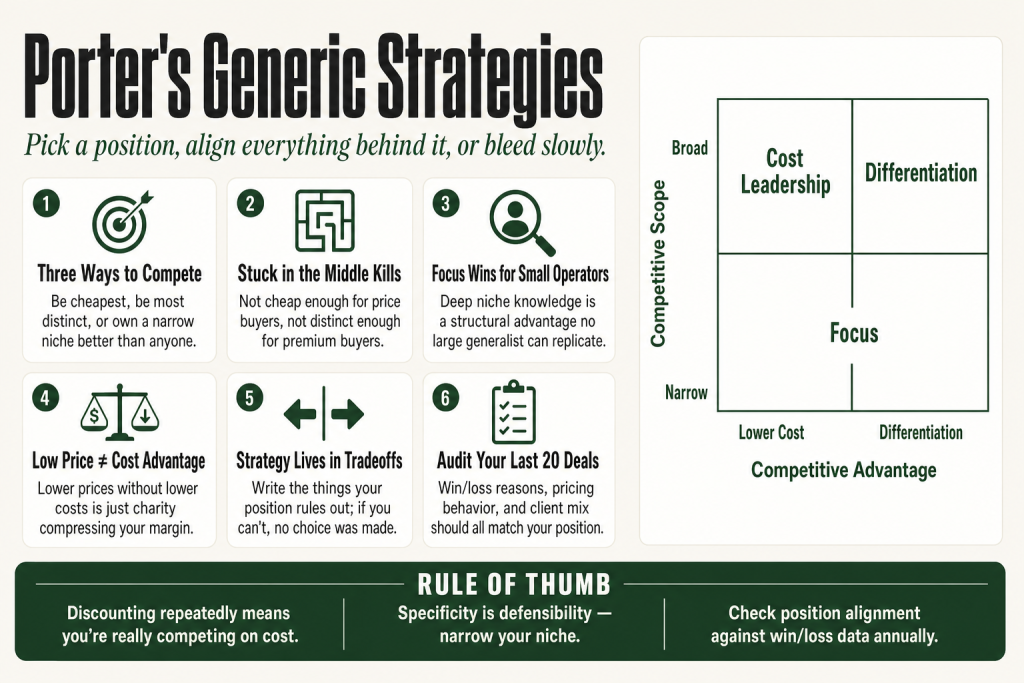
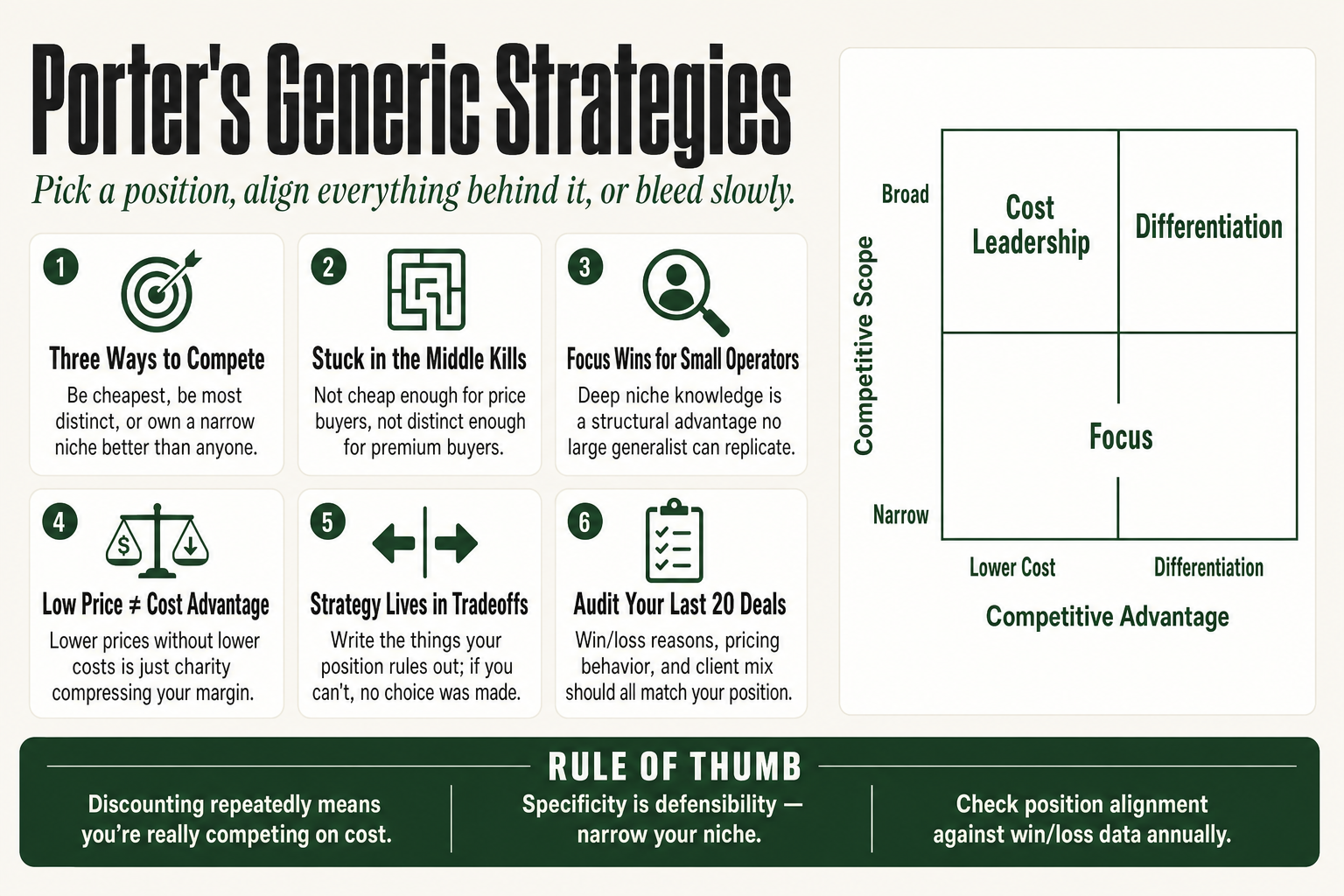
- Michael Porter identified three ways any business can compete: be the cheapest, be the most distinct, or own a narrow niche better than anyone else.
- Trying to do all three at once leaves you “stuck in the middle”, not cheap enough for price buyers, not differentiated enough for premium buyers, losing to specialists on every front.
- For most small operators, the answer is some version of Focus, differentiation focus specifically, because you can’t out-scale Walmart, but you can out-care, out-specialize, and out-serve within a defined segment.
- Picking a strategy isn’t a one-time PowerPoint exercise; it governs your pricing, your hiring, your marketing, and what you say no to.
- The framework’s real value isn’t the label you choose, it’s the discipline of making a choice at all and then aligning every decision behind it.
Where Porter’s Generic Strategies Came From
Michael E. Porter of Harvard Business School introduced the framework in Competitive Strategy (Free Press, 1980) and extended it in Competitive Advantage (Free Press, 1985). The driving question sounds obvious in hindsight: why do some firms consistently outperform others in the same industry, not for a year or two, but structurally, over time?
The dominant view at the time credited market forces and scale. Porter disagreed. His argument: where you sit within an industry matters as much as which industry you’re in. The Generic Strategies sit at the center of a broader system, Five Forces maps the pressures in your market; the Generic Strategies tell you how to position against them; the Value Chain shows which internal activities have to reinforce that position. The logic clicks fully only when you see all three together.
The framework’s core warning, that firms failing to commit to one position risk being stuck in the middlebecame one of the most cited phrases in business strategy. Forty-five years on, it still describes the default condition of most small businesses that haven’t made a real strategic choice.
The Three Porter’s Generic Strategies, Explained Without the Jargon
Porter drew from two variables: competitive advantage type (lower cost vs. differentiation) and competitive scope (broad market vs. narrow segment). Cross those two axes and you get three named strategies, cost leadership, differentiation, and focus, with focus splitting into two variants: cost focus and differentiation focus. Call it three or four depending on how you count; the practical difference between those focus variants matters a lot for operators, even if Porter simplified the naming.
Cost Leadership
Cost leadership means becoming the lowest-cost producer in your market at an acceptable level of quality. Not just pricing low, actually costing less to operate. This is the hardest position for a small operator to hold at any meaningful scale. Walmart and Ryanair built that position over decades through supply-chain leverage and infrastructure that a ten-person shop can’t replicate by shaving margins.
Where cost leadership does make sense for small operators is the focused version: a narrow or local market where larger competitors have left pricing slack. A local print shop undercutting a national chain on turnaround time. A regional distributor with genuinely lower overhead than a national player. The edge isn’t “we charge less”, it’s “our structure costs less to operate, and we pass some of that on.”
Differentiation
Differentiation means offering something the market perceives as uniquely valuable, and paying a premium for. Not because you’re cheapest, but because you’re the one they want.
This is where most small operators have a real shot. You can out-care, out-communicate, and out-specialize a national competitor in ways you can never out-scale them. The risk is that differentiation becomes a story you tell yourself rather than a real perception your customers hold. “We have great service” is not differentiation, everyone says that. The test: do your customers actually pay more, stay longer, or refer others specifically because of something you do that competitors don’t?
Focus
A focus strategy means concentrating on a narrow target, a specific customer type, geography, use case, or industry vertical, and serving that segment better than any generalist competitor can.
Focus is where most small businesses actually win, whether they name it that or not. The regional HR consultant who only works with healthcare companies. The HVAC contractor who only services commercial kitchens. The marketing agency that only works with credit unions. That specificity is a strategy, not a limitation, it lets you price higher, build deeper expertise, and generate referrals within a community that already trusts you.
Stuck in the Middle: The Most Dangerous Place a Small Business Can Be
The concept that has outlasted everything else in Porter’s framework is the warning about being stuck in the middle, the default condition of a business that hasn’t made a real strategic choice.
A firm stuck in the middle doesn’t offer features unique enough to justify a premium, but its prices are also too high to compete on cost. You lose to both sides simultaneously. For a small service business, this looks like: pricing too high to win on cost, not distinctive enough to justify a premium, chasing every job, discounting when you shouldn’t, saying yes to clients outside your sweet spot because the pipeline looks thin. Each individual decision seems fine. The cumulative effect is a business with no identity and no pricing power.
JCPenney is the retail textbook version. The chain lacked the service depth of Nordstrom and the low cost structure of Walmart, caught exactly between the two. When Ron Johnson took over as CEO in 2011 and attempted a rapid pivot toward differentiation, same-store sales tanked 31.7% in Q4 2012 and Johnson was ousted 17 months into the job. The problem wasn’t that he tried to move, it’s that JCPenney had no coherent position to pivot from.
McDonald’s Arch Deluxe is a sharper lesson because the mistake was made at the top of the market. In 1996, McDonald’s spent an estimated $150 to 200 million, the most expensive promotional campaign in fast-food history at the time, per reporting cited by The New York Times via Business Insider, to launch a “burger for adults.” The problem wasn’t the burger. It was that McDonald’s customers came for convenience and value, not for a premium experience. The Arch Deluxe was discontinued by the late 1990s. McDonald’s had tried to migrate from cost leadership to differentiation without changing the underlying experience to match.
Arby’s is the recovery story. After years of bouncing between slogans, logos, and strategies, Arby’s stores were losing $150,000 per restaurant in sales over a four-year period. The 2014 “We Have the Meats” campaign, developed with the Fallon agency, was a deliberate choice to own a specific differentiation position: meat-forward, unapologetically. That campaign produced a 9.6% increase in same-store sales. You can get out of the middle, but it takes a deliberate choice and the discipline to stop hedging.
Porter was clear: a firm practising more than one strategy loses its organizational focus and clear direction of future trajectory. This is the growth trap for focused operators specifically, you win with a tight position, then get greedy, expand your scope, and spend the next three years wondering why growth stalled.
Putting this to work? The ideas in the Canon are the foundation under the tactical playbook in Build a Complete Marketing Department — grab the free companion kit at mmsvegas.com/resources.
What Porter’s Generic Strategies Look Like in the Real World Today
The examples that show up in business school decks, Walmart for cost leadership, Apple for differentiation, are fine as illustrations but don’t help an operator running a $2M service business make a real decision. Here are sharper examples.
Cost Leadership: Ryanair
Ryanair stripped the flying product to its absolute minimum and rebuilt margins through ancillary fees, bag charges, seat selection, priority boarding. The result is a cost structure genuinely lower than any full-service airline operating the same routes, which lets them price below the market and still make money. The lesson for operators isn’t “be cheap.” It’s: if you’re going to compete on cost, build actual structural cost advantages, not just lower prices. Lower prices without lower costs is just charity.
Differentiation: Trader Joe’s
Trader Joe’s doesn’t try to be the biggest or the cheapest. Around 80% of its products carry its own private-label brands, items you can’t buy anywhere else, which creates destination shopping behavior. Estimated sales run somewhere between $1,750 and $2,100 per square foot depending on the source and year, roughly double what Whole Foods generates, which places it among the highest revenue-per-square-foot operations in U.S. grocery.
That result didn’t come from competing with Whole Foods on premium organics or with Aldi on rock-bottom prices. It came from owning a specific combination a particular customer values: affordable, interesting, and genuinely fun to shop. The product lineup requires constant curation and the discipline to refuse expansion strategies that would dilute the in-store experience, which is itself a strategic choice, made over and over. That’s the real lesson. It’s not about charging more for the same thing, it’s about being the only place someone can get a specific combination of things they value.
Differentiation Focus: Tesla (Early)
Early Tesla was a differentiation focus play, targeting a narrow segment of early-adopter, premium buyers who wanted an electric vehicle that didn’t look or feel like a compromise. That focus let them price at $80,000+, build the brand, and only later expand scope. The sequence matters: focus first, broaden later, once you have the margin and the reputation to do it credibly. Skipping the focus phase and going broad too early is exactly how you end up stuck in the middle.
Cost Focus: Local and Regional Operators
This is the one that shows up least in textbooks but most in real small-business life. A local insurance agency that only serves contractors. A bookkeeping firm that only works with restaurants. A staffing agency that only places warehouse workers. Each wins on cost within their niche because they’ve eliminated the overhead and inefficiency that generalists carry. They know exactly what their clients need, they’ve systemized delivery, and they can price below a generalist’s rate while still making better margins. The niche is the cost advantage.
Applying Porter’s Generic Strategies Today: The Operator’s Decision
The goal isn’t to classify your business, it’s to make a decision that governs everything downstream.
Audit Where You Actually Compete
Before you pick a position, look at your last 20 clients or transactions. Who were they? Why did they choose you? What did they pay? How often did you discount? What objections did you lose on? The data will usually tell you more than your gut will. Most operators think they compete on differentiation but act on cost, they say they’re better but discount when pressed, which is cost-leadership behavior without the cost-leadership economics.
Match Position to Your Actual Advantages
Your strategy should be built around what you can actually sustain, not what sounds good in a mission statement. If you have lower overhead than competitors, through location, systems, or structure, cost leadership or cost focus might be defensible. If you have deep expertise, strong referral networks, or a signature method that clients value, differentiation is available to you. If you serve a specific niche better than anyone else, you have the raw material for focus.
In plain language: decide whether you’ll be the lowest-cost producer at acceptable quality, deliver something customers value uniquely and will pay for, or specialize deeply in a narrow segment. Then design your activities, investments, and incentives to make that choice real. Porter’s connecting thread across all three is that your activity system, the specific internal choices you make, has to reinforce whichever position you’ve picked.
Align Every Decision Behind the Choice
This is where most operators drop the ball. They pick a position, “we compete on service quality”, and then hire the cheapest technician, use the lowest-cost tools, and quote the same rates as their cheapest competitor. Strategy isn’t a sentence in your About page. It’s a set of tradeoffs that show up in your pricing model, your hiring criteria, your ideal customer profile, your marketing message, and what you say no to.
If you’ve chosen differentiation focus: your ICP should be narrow and specific. Your pricing should reflect a premium the segment can bear. Your marketing should speak directly to that segment’s pain, not generically to everyone. Your onboarding should create familiarity and switching costs. Your referral strategy should stay within the niche. Every one of those decisions flows from the same root choice.
Where AI Tools Fit In
AI-assisted tools can help you operationalize whichever position you’ve chosen, but they don’t make the choice for you. For a differentiation position, AI can help you produce messaging that articulates your unique value consistently across every touchpoint, generate research on your target segment’s specific language and concerns, and help you build content that reinforces your authority in the niche. For a cost focus position, AI can accelerate operations, faster proposals, automated follow-ups, systemized delivery, and help you find where the process waste is. The judgment about which position to hold, and whether you’re actually executing it, stays with the operator.
Where Porter’s Generic Strategies Still Apply, and Where They Don’t
Porter’s framework is 45 years old. It has survived recessions, the internet, and the platform economy. That should tell you something. But it has also been challenged, updated, and misapplied in ways worth knowing about.
Why It Still Works for Small Businesses
Any market with real cost differences, real switching behavior, and real competitive intensity, which describes most small-business markets, responds to this framework. When you can name the two or three competitors your clients also considered, and explain why they chose you or didn’t, Porter’s logic is operating. The choice your clients made was a choice between positions.
The reason it remains useful isn’t that it’s sophisticated, it’s that it forces a question most operators avoid: what is the actual reason someone picks you? Not the reason you’d like, but the reason they actually cite. If the honest answer is “we were the cheapest option they found,” you’re running a cost strategy whether you’ve named it or not. If the answer is “they came through a referral from another client in the same industry,” you’re already building toward focus. The framework just makes you say it out loud.
It’s also the right starting question before any significant marketing investment, because your message has to reflect your position, and if you don’t know your position, your message will be incoherent. A differentiation focus business running generic “professional, experienced, results-driven” copy is wasting its budget.
Where the Framework Gets Complicated
Contrary to Porter’s original position, subsequent academic research has found evidence of firms successfully practising a hybrid strategy, combining cost efficiency and differentiation. Research by Davis (1984, cited in Prajogo 2007) found that firms employing a hybrid approach outperformed those adopting a single generic strategy, and Hill (1988) challenged Porter’s premise that the two are mutually exclusive. The research is genuinely divided: other empirical work has found that firms applying hybrid strategies underperform rivals that commit to a single position. For a small operator running one business, the practical implication holds: you almost certainly don’t have the organizational complexity to run two positions cleanly.
Toyota is the standard large-company example: cost efficiency for its mass-market vehicles, while the Lexus brand targets the premium segment through differentiation. Porter himself argued that firms able to succeed at multiple strategies often do so by creating separate business units for each, separating the strategies into different units with different policies and even different cultures. Pick one, unless you’ve explicitly built the structure to run two.
The other place where the framework gets complicated is in platform businesses and network-effect models, where being the cheapest and the best can both be true at scale because marginal cost approaches zero. That dynamic matters for understanding where industries are headed, but it’s not the decision facing most service business owners today.
Common Mistakes
- Discounting on price while claiming to compete on differentiation — Track your last 20 closed deals. If you cut price more than once or twice, your actual competitive behavior is cost-based regardless of what your positioning says. Either raise your prices and hold them, or reclassify your position and build the cost structure to support it. Those are two different problems with two different fixes.
- Confusing ‘we have low prices’ with ‘we have a cost structure advantage’ — Ask yourself: can I explain in one sentence why my costs are genuinely lower than a competitor’s? If not, you’re discounting, which is more fragile than a real cost position and usually just compresses margin without winning market share.
- Expanding into adjacent services or customer types without testing position fit — Before adding a service line or customer type, check: does this require the same capabilities, the same sales motion, and the same delivery standards as your current work? If the answer is no on more than one of those, you’re diluting your position. Expansion that fits your position builds compounding advantage. Expansion that doesn’t, doesn’t.
- Writing a positioning statement and calling it a strategy — Write the short list of things your position rules out. If you can’t fill it in, you haven’t made a choice yet. The ruled-out list is the evidence that the choice is real.
- Assuming thin margins mean you should compete harder on cost — In most small service businesses, the fix is to raise prices for the clients who already value you, tighten your ICP to exclude the ones who don’t, and stop quoting work outside your core position. Doubling down on cost when margins are thin often just accelerates the squeeze.
- Treating the strategy as permanent once it’s chosen — Check your position alignment at least once a year against three things: your win/loss reasons, your actual pricing behavior, and your client mix. All three should reflect the same position. If they don’t, you’ve drifted, and drift compounds faster than operators expect.
Operator’s Take
Here’s where I actually land on this, not a summary of the framework, but what I’d tell you over a beer.
Skip broad cost leadership. You cannot build the supply chain, purchasing volume, or operational infrastructure to beat Walmart, Aldi, or Ryanair in your category. If price is your only pitch, you’re one well-funded competitor away from losing everything. The only version of cost leadership that works for small operators is cost focus in a niche where you have a genuine structural edge, lower overhead, a proprietary system, a local advantage that bigger players can’t replicate cheaply.
Here’s the test: can you explain in one sentence why your costs are structurally lower than a competitor’s? Not “we’re lean” or “we don’t have a big office.” Something specific, “we only service one equipment type so our techs don’t carry dead inventory” or “we run all project coordination through a single software stack that took us two years to build.” If you can say that, you have a cost position. If you can’t, you’re discounting. Different problem, different fix.
Most small operators have a differentiation position they can’t yet prove. The test I’d apply: name three specific things you do that your two closest competitors don’t, things your best clients actually mention when they refer you. Not “we really care” or “we go the extra mile.” Specific things. If you can’t name them, go check your last five referral conversations and write down the exact words clients used. That language is your real position, or the raw material for one. Your website’s “About” page is probably not.
Differentiation focus is where most small operators win. Pick a segment narrow enough that you can know it better than anyone, serve it better than anyone, and become the obvious referral within it. Price accordingly. Market specifically. Hire people who fit the niche.
When growth slows, and it will, resist the instinct to broaden scope. That instinct is understandable. It’s usually wrong. Slow growth in a focused position is more often a signal to deepen the wedge: add a complementary service the niche specifically needs, build a referral network within it, publish content that makes you the obvious authority. Not: start chasing adjacent segments to hit a revenue number.
Two things the framework doesn’t spell out but that matter in practice:
First, pick your position based on what you can defendnot what sounds best. A differentiation story built on “we’re relationship-focused” collapses the moment a better-resourced competitor decides to be relationship-focused too. A differentiation story built on “we’re the only bookkeeper in this region who’s worked inside a restaurant group” is harder to steal. Specificity is defensibility. Before committing to a position, ask: what would it take for a competitor to replicate this in twelve months? If the answer is “not much,” keep narrowing.
Second, AI tools help you execute your position more efficiently, they don’t replace the decision. If you’re competing on differentiation focus, AI can produce niche-specific content faster, research your segment’s language more precisely, and systematize client delivery without losing the personal quality that defines the position. If you’re competing on cost focus, AI can cut overhead from proposals, follow-ups, and routine operations. What AI can’t do is tell you which position to hold, or whether you’re actually holding it. That’s still yours.
Used in
- ✓ Build a Complete Marketing Department
Used to establish which competitive position governs the entire marketing strategy, cost, differentiation, or focus, before any channel, message, or budget decision is made. - ✓ The Missing Manual for FunnelKit
Informs how funnel structure and offer framing are built differently depending on whether the operator is competing on price, perceived uniqueness, or niche authority. - ✓ The Missing Manual for Make
Used to prioritize which operational workflows to automate first, based on whether the operator’s position is built on cost efficiency or on delivering a premium, differentiated experience.
FAQ
Can a small business really use Porter’s Generic Strategies, or is this just for big corporations?
The framework applies to any business with competitors and customers making a choice. Small operators often find it more actionable than large ones because the decision is clearer, you have fewer resources, so you need to concentrate them on one position rather than spread thin across all three.
What does ‘stuck in the middle’ actually look like for a small service business?
It looks like a business that prices too high to win purely on cost, but hasn’t built a reputation or specialization that justifies a premium. Prospects compare you to cheaper options and more specialized ones, and you lose to both. Margins are thin, referrals are scattered, and growth is inconsistent.
Is differentiation focus the right default for most small operators?
For most, yes, because it’s the one position where you can build a structural advantage without scale. Deep niche knowledge, referral density, and genuine specialization are all things a small operator can develop and a large generalist can’t easily replicate. The risk is that the niche turns out to be too small or too easily entered by competitors.
How does Porter’s Generic Strategies framework relate to positioning and messaging?
Your generic strategy is the upstream decision that should govern your positioning statement, your messaging hierarchy, and your offer design. If you’re pursuing differentiation focus, your message should speak specifically to the niche and articulate the unique value you deliver to it. If you haven’t chosen a position, your message will be generic, and generic messages don’t convert.
Can I combine cost leadership and differentiation?
Academic research is divided on this. Some studies find that firms combining cost and differentiation outperform pure-strategy firms; others find the opposite. Large companies like Toyota manage it by running separate business units, mass-market vehicles under cost efficiency, Lexus under differentiation. For a small operator running one business, the more reliable path is committing to one position clearly rather than hedging toward both.
How often should I revisit my generic strategy choice?
At least once a year, and informally whenever you notice that your win rate is dropping, your margins are compressing, or your pipeline is filling with the wrong client type. Any of those signals suggests drift between your stated position and your actual behavior.
Further reading
- Competitive Strategy: Techniques for Analyzing Industries and Competitors by Michael E. Porter (Free Press, 1980), The original source. Chapter 2 lays out the generic strategies directly. Skip to it if you want the primary text rather than a summary.
- Competitive Advantage: Creating and Sustaining Superior Performance by Michael E. Porter (Free Press, 1985), Extends the generic strategies into the Value Chain framework, showing how internal activities must reinforce your chosen position. Chapter 1, pp. 11 to 15 is the densest section on the strategies themselves.
- Playing to Win by A.G. Lafley and Roger Martin (Harvard Business Review Press, 2013), The most operator-usable extension of Porter’s logic; translates the same ideas into a five-question cascade that works inside a real organization.
- Blue Ocean Strategy by W. Chan Kim and Renée Mauborgne (Harvard Business Review Press, 2005), A direct challenge to Porter, arguing that the best move is to render the competition irrelevant by creating new market space rather than choosing a position within an existing one.
Sources: Michael E. Porter, Competitive Strategy: Techniques for Analyzing Industries and Competitors (Free Press, 1980); Michael E. Porter, Competitive Advantage: Creating and Sustaining Superior Performance (Free Press, 1985); Wikipedia, ‘Porter’s Generic Strategies’; University of Cambridge Institute for Manufacturing, ‘Porter’s Generic Competitive Strategies’; EBSCO Research Starters, ‘Porter’s Generic Strategies’; InsideRadio, ‘Arby’s Beefs Up Sales With Campaign’ (2015); AOL/Tasting Table, ‘The Story Behind the Iconic Arby’s Slogan, We Have The Meats’; Trader Joe’s sales-per-square-foot estimated at $1,750, $2,100 (multiple sources including ContactPigeon 2026 and Vetted Biz 2024); SEC filing (Wells Fargo Commercial Mortgage Trust 2021-C61), Trader Joe’s private-label share approximately 80%; New York Times reporting on McDonald’s Arch Deluxe campaign spend ($150, $200 million), cited in Business Insider (2018) and Yahoo Finance/Adweek (2026); Darden School of Business case, ‘McDonald’s: The Arch Deluxe Launch’ (2000); Retail Dive and Fortune, JCPenney Ron Johnson case (2013); Davis (1984, cited in Prajogo 2007) on hybrid strategy, via Wikipedia; Emerald Publishing, ‘Can hybrid strategy improve SME performance?’ (2024).
Brian Kasday spent forty years in direct-response marketing before rebuilding the whole operation as a one-person shop. He writes The Operator’s Library — including “Build a Complete Marketing Department” — for operators who’d rather build it themselves than wait on someone else.
Build the department these ideas describe — the free companion kit: mmsvegas.com/resources.
More The Operator's Canon guides
Free · Operator Toolkit
Want the tools, not just the guide?
Get the free operator toolkit — templates and checklists for the systems you actually run, plus a note when this guide changes.
Get the free toolkit →