
Last updated: July 2026
The 4 Ps of marketing explained is the closest thing marketing has to a universal diagnostic, and that’s exactly the problem with how most operators use it.
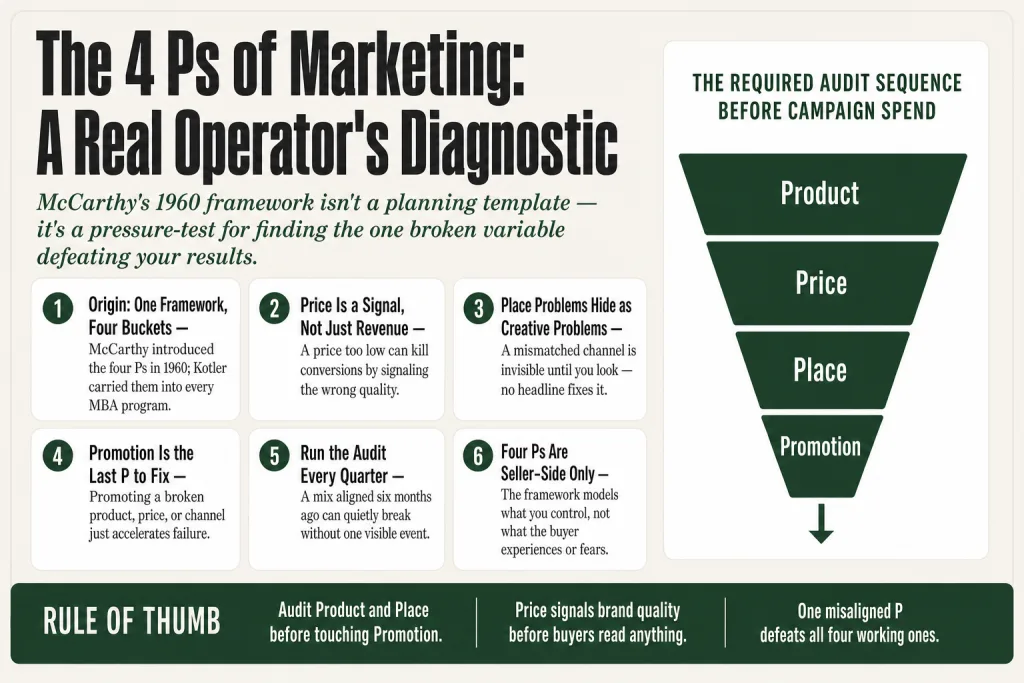
When most small-business owners hear “marketing,” they hear “promotion.” The Facebook ad. The email blast. The Google campaign. The four Ps, Product, Price, Place, Promotion, get treated as a college vocabulary quiz rather than the pressure-test they actually are. That misreading costs real money. A weak product positioned in the wrong channel at a price that signals the wrong thing to the wrong buyer will not be rescued by better copywriting. The four Ps exist precisely to stop you from skipping straight to the megaphone.
The framework is almost absurdly simple. Its power is entirely in how disciplined you are about applying all four questions, in order, before you run anything. By the end of this page you’ll be able to run the four-P audit on your own business, identify the one misaligned variable that’s quietly defeating your results, and stop pouring ad spend into a mix that was never going to work.
The idea in 30 seconds
- E. Jerome McCarthy introduced the four Ps, Product, Price, Place, Promotion, in 1960 as a framework for organizing every decision a marketer controls.
- Most operators unconsciously treat Promotion as the whole game. The framework’s real value is forcing you to audit the other three first.
- A misaligned P anywhere in the mix will defeat good advertising, you can’t spend your way past a broken product or a wrong channel.
- Used honestly, the four Ps work as a pre-campaign diagnostic: find the weakest variable, fix it, then promote.
- The framework has real limitations for pure service businesses and digital-native models, but those are edge cases to understand, not reasons to dismiss it.
- By the end of this page, you’ll know how to run the four-P audit on your own business and identify the one variable that’s quietly costing you conversions.
Where the Four Ps Came From, and What McCarthy Actually Built
The story starts a decade before McCarthy. In 1948, Harvard’s James Culliton described the marketing executive as a “mixer of ingredients”, someone blending available resources to match market conditions. Neil Borden picked up that metaphor and ran it into a sprawling list of twelve variables, no organizing structure. Useful concept. Not teachable.
McCarthy’s answer was the bucket system. He proposed the four-P concept in his 1960 book Basic Marketing: A Managerial Approachwhich has been one of the top textbooks in university marketing courses since its publication. He didn’t invent pricing strategy or distribution thinking. He invented the four categories, same first letter, easy to hold in your head under pressure, that made the whole thing manageable. These mnemonically easy-to-remember labels rapidly became the organizing structure for virtually all introductory marketing textbooks.
McCarthy’s conceptualization was later popularized by Philip Kotler, who is often referred to as the “father of modern marketing.” Kotler wove the framework through his textbooks and into MBA programs. By the early 1980s, the four Ps had too much installed base to be meaningfully displaced.
The service-marketing community pushed back, with good reason. Bernard H. Booms and Mary J. Bitner added People, Process, and Physical Evidence in 1981 for service industries. Those additions matter if you run a service business. They don’t invalidate the original four; they layer on top.
What the Four Ps Actually Mean (Not the Textbook Version)
The textbook definitions tend to flatten these into checklists. Here’s what each one actually asks of an operator.
Product
Product is not just what you sell. It’s the entire experience of what you deliver, features, quality, packaging, warranty, service after the sale, and how it sits against alternatives. For a service business it’s your scope of work, your deliverables, your guarantees, and what the experience of working with you actually feels like.
The operator question here is blunt: does this product actually solve the problem it claims to solve, for the buyer who is seeing your ads? That sounds obvious. It isn’t. A significant fraction of failed campaigns fail because the product-market fit was off, not because the ads were bad. If you haven’t done real customer discovery on what your buyers actually hire you for, you’re writing copy for assumptions, not reality.
Price
Price is what customers pay, and it shapes how they see your brand before they read a word of copy. Most operators miss this: price is not just a revenue decision. It’s a signal. A $49 offer and a $4,900 offer for nominally similar services are not the same product in the buyer’s mind, even if the underlying work is identical. A price that’s too low for your category can be as damaging as one that’s too high.
There’s a whole discipline here, price elasticityanchor pricing, decoy structures, but the four-P framework asks just the baseline question: is your price aligned with your product quality signal, your competitive set, and your buyer’s expectations given how they found you? Those three things can be independently miscalibrated, which is why checking them matters.
Place
Place is distribution. Every answer to the question: where and how does your buyer actually access what you sell? In 1960, Place meant physical channels, retail shelves, sales reps, distributors. For most operators today it means which digital and physical channels carry your offer, how frictionless the buying process is, and whether you’re showing up where your buyer is actually looking.
An enormous number of operators are selling through channels their buyers don’t use, then blaming the creative when nothing converts. You can change your ad copy this afternoon. Changing your distribution channel, switching from retail to direct-to-consumer, moving from cold outbound to inbound content, building a partner network, takes months. This is why operators underinvest in thinking about Place. It feels fixed. It rarely is, but the returns are slow.
The practical question: is there friction between where your buyer looks for this solution and where you’re putting the offer? If your ideal customer finds you through Google and you’re spending your whole acquisition budget on Instagram, that’s a Place problem. No amount of improved ad copy fixes a channel mismatch.
Promotion
Promotion covers the full range of how you communicate the offer’s existence and value to prospective buyers, advertising, content, email, PR, sales, word-of-mouth programs, events. It’s the P that consumes most of the budget and most of the attention in most small businesses.
It’s also the last one that should get your attention if the other three are broken. Getting Promotion right when Product, Price, or Place is wrong is like tightening your tie before a job interview you’re not qualified for. Focus, consistency, and a clear understanding of your customers, not a bigger budget, is what makes Promotion work.
The 4 Ps of Marketing Explained as an Operator’s Audit
The framework is most useful not as a planning template, fill in the four boxes before you launch, but as a diagnostic after something isn’t working. Leads are coming in but not converting. Conversions are happening but churn is ugly. Traffic is fine but click-through is dead. The four-P audit forces you to ask which variable is the actual culprit before you reflexively throw money at Promotion.
Step One: Start with Product
Before anything else, ask whether the product, in the hands of a real buyer, does what the promotion says it does. Talk to the last five customers who didn’t re-purchase. Not the happy ones. Read every negative or mediocre review. Ask: if the product were better, would the marketing problem go away? If the honest answer is yes, fix the product first. Improving your ad targeting on a product with a real satisfaction gap just accelerates churn. You fill the bucket faster while the hole gets bigger.
Use the Voice of Customer to capture exactly how buyers describe the problem the product solves, and compare that language to what your promotion is actually saying. The gap between those two things is often the entire conversion problem.
Step Two: Check Price Against Signal
Pull your pricing and ask three separate questions. First: does this price reflect the actual value delivered? Second: does it fit the pricing norms in this category, or does it trigger suspicion in one direction (too cheap, must be low quality) or resistance in the other (too expensive relative to perceived risk)? Third: is the price aligned with the channel through which the buyer found you? A premium offer sold through a discount-discovery channel, a Groupon, a “cheap X near me” search term, has a built-in positioning conflict that no headline can solve.
The Decoy Effect is one of the better tools for structuring price tiers once you’ve confirmed the anchor price is right, but sequence matters. Anchor first, tier second.
Step Three: Audit Place Ruthlessly
Map every step between “potential buyer becomes aware” and “payment clears.” Count the clicks, the calls, the form fields, the delays. Each one is a place where a buyer who was ready to purchase decided it wasn’t worth the friction.
Then ask: are you in the channels where this buyer is actually searching for this solution? The Bullseye Framework is the right companion tool here, it gives you a structured method for finding the one acquisition channel that’s actually working and doubling down on it rather than spreading thin across five mediocre ones.
Place also includes the post-purchase question: are you making it easy for an existing customer to buy again, upgrade, or refer? A lot of operators optimize Place for acquisition and ignore it entirely for retention. That’s a Value Ladder problem in Place clothing.
Step Four: Only Then, Examine Promotion
If Product, Price, and Place all check out, the problem is Promotion. Now you’re looking at: which channels carry the message, what the message actually says, and whether the creative connects with how the buyer describes their own problem. This is where Market Awareness Levels become the operating manual, a buyer who doesn’t know the category exists needs a different message from a buyer actively comparing vendors.
One consistent failure at the Promotion stage: operators confuse activity with strategy. Running three channels, posting daily on social, and sending a weekly email are not a promotion strategy. A promotion strategy has a clear claim (see the USP), a defined audience, a matched channel, and a measurable goal. Everything else is noise.
Putting this to work? The ideas in the Canon are the foundation under the tactical playbook in Build a Complete Marketing Department — grab the free companion kit at mmsvegas.com/resources.
Where the Four-P Framework Still Earns Its Place
Despite sixty-five years of academic challenges and the arrival of digital channels McCarthy never imagined, the four Ps hold up reliably in a few specific operator contexts.
Product launches and offer redesigns. Any time you’re bringing something new to market, or relaunching something that hasn’t been working, the four-P framework is the right forcing function. It makes you answer the questions you most want to skip. What exactly is the offer? What does the price signal about it? Where will the buyer encounter it? How will they find out it exists? Skipping any of these means guessing, and guessing is expensive.
Diagnosing stalled growth. When a business that was growing has plateaued, the four-P audit is a faster first-pass diagnostic than most attribution models. Growth plateaus are almost always a single-variable problem: the product hasn’t kept pace with buyer expectations, the price has drifted out of alignment with the market, the channel mix is stale, or the message is hitting the wrong audience. Isolating which P is the culprit before spending on a fix is the value the framework delivers.
B2B and professional services. For a small B2B operator, the framework still works, you just have to translate each P into service terms. Product becomes scope of work and deliverables. Price becomes your rate structure and what it signals about positioning. Place becomes your outreach channels, your referral networks, and how easy it is for a prospect to say yes. Promotion becomes everything you do to stay visible and credible to the people who might hire you. The words change; the logic doesn’t.
Pre-campaign go/no-go decisions. Before spending a dollar on paid acquisition, running the four-P audit gives you a defensible answer to the question: “Is this offer ready to be marketed?” If any P is broken, the answer is no, and you’ve just saved yourself a failed campaign’s worth of budget and time.
Where the Framework Runs Out of Road
The four Ps have real limits. Pretending otherwise wastes your time.
It’s a seller’s checklist, not a buyer’s map. The framework is organized around what a marketer controls, product, price, channel, message. It is not organized around what the buyer experiences, believes, fears, or resists. A buyer doesn’t think “I need a product at this price in this place promoted this way.” They think “I have this problem, I’ve tried these things, I’m skeptical of X, and I trust Y.” Jobs to Be Done does a much better job of modeling that inner logic. The four Ps should be the output, how you design and position the offer, not the input. The input is understanding the buyer.
It doesn’t tell you what to say. The Promotion P covers everything from a billboard to a cold email sequence to a content strategy. But it doesn’t tell you what the message should be, who it should be written for, or how the narrative should be structured. For that you need something like Rule of One or Problem-Agitate-Solution. The four Ps confirm that Promotion is a variable you should think about; they don’t help you think about it well.
It treats the four variables as independent. They aren’t. Price affects how the product is perceived. Channel affects which price is defensible. Promotion affects how much Place friction buyers will tolerate. In practice you’re managing a system, not four separate levers. The framework doesn’t model those interdependencies well, which is part of why operators can check four boxes and still have a broken mix.
It underweights existing customers. The four Ps were designed to describe how you bring something to market, acquisition-side thinking. There’s no native slot for retention, referral, or customer lifetime value. A small operator whose best growth lever is repeat purchase and referral, which describes most service businesses, can use the framework but shouldn’t rely on it exclusively for the post-sale half of the business. The Marketing Hourglass fills that gap.
How Real Operators and Brands Use the Mix Today
The textbook examples tend to be Apple and McDonald’s. They’re instructive but not particularly useful if you’re running a thirty-person services firm or a local retail shop. Here’s a more grounded read of how the framework maps to real decisions.
McDonald’s is actually a useful study precisely because each P is a distinct, deliberate decision. The menu maintains consistency and speed while offering options across price tiers; their locations sit in high-traffic areas, highways, malls, city centers, engineered for convenience; and their promotional calendar runs nearly independent of any single product. What’s instructive is that each of those decisions is independently defensible and internally consistent. The price matches the product tier. The locations match the buyer behavior. The product portfolio matches the price range. When all four Ps are coherent, marketing becomes easier because the product does a lot of the work. McDonald’s doesn’t need to explain itself in an ad. The location, the price, and the product do that before anyone sees creative.
For a local professional services firmsay, a bookkeeping firm targeting small construction contractors, a four-P audit might reveal: the Product (monthly bookkeeping) is table-stakes and undifferentiated; the Price ($350/month) is slightly below what a premium positioning would support; the Place (cold outreach to a list) is mismatched to where contractors actually find vendors (trade associations, subcontractor referrals, the crews they see at supply houses); and the Promotion (LinkedIn posts) reaches no construction contractor who ever lived. Fix Place first. Join the NARI chapter. Be in the room where contractors already gather. Then revisit Promotion with that context. The product and price might be fine, but it didn’t matter while the channel was wrong.
E-commerce operators who’ve scaled paid acquisition often discover that their four-P problem is pure Place, specifically, checkout friction. A seven-step checkout process is a Place failure. So is only accepting one payment method, or not offering buy-now-pay-later when your price point sits at the threshold where buyers hesitate. The ads are fine. The channel is fine. The last fifty feet of the distribution channel are broken.
Common Misunderstandings About the Four Ps
“The four Ps are a planning template.” The most common misread. McCarthy designed the framework as a set of decision categories, variables a marketing manager controls and must coordinate. It was never meant to be a fill-in-the-blanks planning document. Used as a checklist to complete before launch, it produces surface-level answers. Used as an ongoing diagnostic to find misalignment, it’s genuinely powerful. The difference is whether you’re checking boxes or asking hard questions.
“Promotion is the most important P.” It gets the most budget and attention, which operators tend to mistake for evidence of importance. It isn’t. Promotion only works when the other three Ps are doing their jobs. A well-promoted, poorly positioned product with a confusing price sold through the wrong channel is just an efficiently delivered bad offer.
“The four Ps are outdated.” This is an academic critique that’s been circulating since Lauterborn’s 1990 piece in Advertising Age. The complaint is that the framework is seller-centric rather than buyer-centric, and that’s a fair conceptual point. But for an operator using the framework as a diagnostic rather than a worldview, it holds up. McCarthy’s core concept has proven durable, marketing educators need only expand the definitions of Product, Price, Promotion, and Place for them to continue to serve as the operative organizing structure of marketing education and practice.
“More Ps make it better.” The 5 Ps, 7 Ps, 8 Ps, every decade adds another P. Some are genuinely useful for specific contexts (Booms and Bitner added People, Process, and Physical Evidence in 1981 for service industriesand those additions matter if you run a service business). But they dilute the framework’s main virtue: simplicity. A framework you can run mentally on a walk is more useful than an exhaustive one that requires a spreadsheet.
“It’s only for big companies.” The framework was built by a professor teaching future corporate marketing managers, and Kotler’s popularization happened through MBA programs. That provenance makes operators dismiss it as enterprise thinking. It isn’t. The scale of the decisions changes. The logic doesn’t, and the audit works just as well for a ten-person firm as for a Fortune 500 division.
Common Mistakes
- Blaming creative when the channel is wrong — Before rewriting copy or redesigning ads, audit Place first. A mismatched channel, LinkedIn for a trade contractor, cold email when every real client came through referral, is invisible until you look for it, and no headline fixes it.
- Setting price once and never revisiting the signal it sends — Run a price-signal audit quarterly: ask what a first-time buyer infers from your price before they read anything else. Then test a 20 to 30% price increase on a new cohort and track close rate alongside revenue, the result often surprises operators who’ve anchored too low.
- Using the framework as a launch checklist rather than an ongoing diagnostic — The four Ps drift. A channel that worked at $200/month may be wrong at $2,000/month. A product that was competitive two years ago may have been overtaken. Schedule a four-P review quarterly, triggered also by any campaign that underperforms by more than 20% of target.
- Treating the four variables as independent — They aren’t. A Place change, moving from retail to direct, changes which price is defensible. A Promotion change, moving to content inbound, changes how much Place friction buyers tolerate. When one P shifts, re-audit the others before assuming the rest of the mix still holds.
- Skipping the post-purchase half of Place entirely — Most operators optimize Place for acquisition and ignore it for retention. Make it as easy for an existing customer to buy again or refer as it was for them to buy the first time, that’s a Place decision, not just a relationship one.
Operator’s Take
I’ve run this audit on my own business more than once, and here’s what I’d tell you that the framework itself won’t.
The Place diagnosis is almost always the one nobody wants to hear. When a campaign underperforms, the first instinct is to blame the creative, wrong headline, wrong hook, wrong offer. Sometimes that’s right. But in practice, a disproportionate share of what looks like a marketing problem is a distribution problem wearing marketing’s clothes. I’ve seen it in a B2B consulting practice where cold email was burning money for eight months, while every real client had walked in through a single referral from one trade event the owner attended. The channel was wrong before a single email was written. No headline change was going to fix it. The question that actually mattered, where do our real clients actually come from? was the one nobody was asking.
Price is probably the most underused diagnostic in the mix. Operators set prices once, watch the math work (or not), and leave them alone for years. What they rarely do is ask what the price is communicating, not to their spreadsheet, but to a stranger seeing the offer cold. A $297/month retainer for a service that eliminates a $50,000-a-year problem tells that buyer one of two things: either you don’t know what you’re worth, or there’s a catch. Both kill the conversion before the sales call starts. I’ve watched a client raise prices 40% on a new cohort, close at a higher rate, and attract clients who were easier to work with. The cheaper price was actively signaling the wrong thing. They thought they were competing on value. They were competing on suspicion.
The audit works best when you treat it as adversarial. If you run through all four Ps and everything checks out cleanly, you’re either running an excellent business or you’re grading your own test. Most operators who’ve hit a plateau have one badly broken P and three they’ve rationalized into “good enough.” The discipline is trying to find the hole, not confirm there isn’t one. Ask the question like a competitor would ask it: where is this offer actually weak? That’s the version of the audit that earns its keep.
On the “outdated” debate: stop worrying about it. The four Ps aren’t a theory about consumer psychology. They’re a list of things you control. That list hasn’t changed in sixty-five years, what you sell, what you charge, where people can get it, and how you tell them it exists. The tactics inside each P have changed beyond recognition. The categories haven’t. Use the framework for what it’s good at, forcing sequential, honest questions, and reach for Jobs to Be Done or Market Awareness Levels when you need to model the buyer’s side of the equation. Those aren’t competing tools. They’re sequential ones.
One note on AI. AI handles the evidence-gathering portion of a four-P audit well, pulling competitor pricing, summarizing review patterns from Google and G2, mapping checkout friction across a category. That work used to take a day; a well-prompted model can do it in an hour. What it can’t do is make the call. When the audit surfaces that your price is 40% below category norms, a model flags the gap. Whether that gap is an opportunity to raise prices or proof you’ve correctly targeted a price-sensitive segment is a judgment that belongs with the operator. Keep it there.
Used in
- ✓ Build a Complete Marketing Department
Used as the foundational diagnostic audit that precedes any channel or campaign decision, the book treats the four Ps as the pre-flight checklist before committing budget. - ✓ The Missing Manual for FunnelKit
The Place and Promotion Ps map directly to funnel architecture decisions, which pages carry the offer, how the price is presented, and where in the customer journey each promotion appears. - ✓ The Missing Manual for Make
Used to structure automated marketing workflows by P, automations for product delivery, price-tier segmentation, channel routing, and promotion sequencing each correspond to a distinct P.
FAQ
What are the 4 Ps of marketing?
The 4 Ps are Product, Price, Place, and Promotion, the four variables an operator controls when bringing an offer to market. E. Jerome McCarthy introduced the classification in 1960 in his textbook Basic Marketing: A Managerial Approach.
Which of the 4 Ps is most important?
It depends on which one is misaligned. Product and Place failures are the most expensive because operators most often try to fix them with Promotion spend, which doesn’t work. Run the audit in order, Product, Price, Place, before investing in Promotion.
Are the 4 Ps outdated?
As a conceptual model for describing how buyers experience markets, yes, it’s seller-centric and shows its age. As a diagnostic tool for identifying which variable in your own marketing is broken, it’s still one of the sharpest instruments available.
How do the 4 Ps apply to a service business?
Each P translates directly: Product becomes your scope, deliverables, and service experience; Price becomes your rate structure and what it signals about positioning; Place becomes your acquisition channels and how easy you make it to hire you; Promotion becomes your visibility and credibility efforts. For service-heavy businesses, the 7 Ps add People, Process, and Physical Evidence on top of the original four.
What’s the difference between the 4 Ps and the 4 Cs?
Bob Lauterborn proposed the 4 Cs in 1990 as a buyer-centric reframe of the same decisions: Consumer needs (vs. Product), Cost to satisfy (vs. Price), Convenience (vs. Place), and Communication (vs. Promotion). The 4 Ps describe what you control; the 4 Cs describe what the buyer experiences. Both perspectives are useful, the 4 Ps for operational decisions, the 4 Cs for testing whether your decisions actually serve the buyer.
How often should I run a four-P audit on my business?
Quarterly is a reasonable cadence for most small operators, plus any time a campaign underperforms, growth stalls, or you’re planning a new offer. Market conditions, competitor moves, and your own product quality all drift, the mix that was aligned six months ago can quietly break without a single visible event.
Further reading
- Basic Marketing: A Managerial Approach by E. Jerome McCarthy (1960), the original source; less useful as a practitioner guide than as context for understanding what McCarthy actually built and how far the textbook version drifted from his intent.
- Marketing Management by Philip Kotler, the book that carried the four Ps into every MBA program; useful for its rigor and breadth, though oriented toward enterprise contexts rather than small-operator decisions.
- Bullseye Framework in The Operator’s Library, the right companion for the Place audit, giving a structured method for finding the one acquisition channel that actually works.
- Voice of Customer in The Operator’s Library, the input that makes the Product P honest; how to gather and use real buyer language before you write a word of Promotion.
Sources: E. Jerome McCarthy, Basic Marketing: A Managerial Approach (1960); Philip Kotler, Marketing Management (1967, multiple editions); Bob Lauterborn, “New Marketing Litany: Four Ps Passé: C-Words Take Over,” Advertising Age (1990); Bernard H. Booms and Mary J. Bitner, “Marketing Strategies and Organizational Structures for Service Firms” (1981); Julian Yudelson, “Adapting McCarthy’s Four P’s for the Twenty-First Century,” Journal of Marketing Education (1999); Goi, “A Review of Marketing Mix: 4Ps or More?,” International Journal of Marketing Studies (2009).
Brian Kasday spent forty years in direct-response marketing before rebuilding the whole operation as a one-person shop. He writes The Operator’s Library — including “Build a Complete Marketing Department” — for operators who’d rather build it themselves than wait on someone else.
Build the department these ideas describe — the free companion kit: mmsvegas.com/resources.
More The Operator's Canon guides
Free · Operator Toolkit
Want the tools, not just the guide?
Get the free operator toolkit — templates and checklists for the systems you actually run, plus a note when this guide changes.
Get the free toolkit →How to cite: 4 Ps of Marketing (Marketing Mix). Associated with E. Jerome McCarthy, 1960. The Operator’s Canon, MMS Vegas. https://mmsvegas.com/library/4-ps-of-marketing-explained/